




Abstract
In this article, Mn doping on Ce-based γ-Al2O3 (i.e., Mn-Ce-γ-Al2O3) was synthesized and then employed as catalysts to study the removal of phenol from aqueous solutions through catalytic ozonation process. The results showed that the phenol removal was remarkably increased to 97.50% if Mn-Ce-γ-Al2O3 was adopted as the catalyst. In addition, the kinetic rate of the reaction was increased, approximately, about 1.49 times when using Ce-γ-Al2O3 catalyst with Mn doping. Moreover, X-ray diffraction, transmission electron microscopy, Brunner-Emmet-Teller measurements, and X-ray photoelectron spectroscopy techniques were used to comprehensively characterize the physicochemical properties of the synthesized Mn-Ce-γ-Al2O3 catalyst, including the phases, morphologies, textural properties, and dispersity of the surface active species. More uniform channel mesoporous structures were obtained after Mn doping on Ce-γ-Al2O3, which could enhance the gas-liquid mass transfer rate, surface hydroxyl groups, Ce3+/Ce4+ ratio, and the formation of Mn-Ce solid solution. In this study, the effects of Mn doping on Ce-based γ-Al2O3 on phenol degradation were investigated and the removal mechanisms were suggested for a better understanding of the improved removal efficiency.
Introduction
The ozone oxidation process is considered a promising technology for the removal of refractory and toxic compounds in wastewater due to its high oxidation ability and environment-friendly characteristics (Mousavi et al., 2017; Gonçalves and Gagnon 2018; Hien et al., 2020). However, intermediates are inevitably generated in the ozone oxidation process and some of them are difficult to be further degraded by ozonation due to the selective oxidation between ozone (O3) and pollutants (Benton et al., 2019; Wang and Chen, 2020).
For a long time, many studies have been conducted to improve the oxidizing capacity of ozone and thus enhance the mineralization rate of these refractory intermediates. Heterogeneous catalytic ozonation was demonstrated to be an effective method in the treatment of organic pollutants in wastewater due to the powerful and unselective oxidizing radicals that could be generated, promoting the ozonation rate (Shahidi et al., 2015; Zhang et al., 2020). Recently, several studies have been used to develop various types of heterogeneous ozonation catalysts by doping with metal ions and metal oxides, which can generate reactive oxygen species (ROS) and deeply degrade refractory organic pollutants (Zhu et al., 2017; Tian et al., 2021).
Ce-based metal oxidation catalysts have perfect redox properties and high oxygen storage capacity to increase ROS, which has drawn much attention from researchers in recent years (Xu et al., 2016; Wen et al., 2019). Cerium oxides not only have higher activities but also ultra-low metal leaching, and thus have a promising commercial application for wastewater treatment (Qin et al., 2014; Li et al., 2020). Meanwhile, Mn-based metal oxidation has also been used as promising catalysts for catalytic ozonation (Sun et al., 2014; Li et al., 2015; Wang et al., 2016a). MnOx has been extensively developed to form active radicals in AOP applications because it has the unique Mn2+/Mn3+ redox cycle and diversified crystallographic structure (Wang et al., 2016b).
In addition, MnOx-CeO2 catalysts exhibited superior catalytic activity compared to single CeO2 or MnOx catalysts (Jiang and Xu, 2011; Lin et al., 2018). Rui and Quinta-Ferreira also observed the synergetic effect between Mn and Ce because the composite Mn-Ce-O catalyst presented higher activity than the simple oxides (i.e., MnOx or CeOx) in the ozonation process (Rui and Quinta-Ferreira, 2015). Although the performance improvement of heterogeneous Mn-Ce catalyst application in ozonation was investigated, the reason for the improved phenol removal efficiency after Mn doping on Ce-based γ-Al2O3 was not clear.
In this study, phenol is selected as the target pollutant because it is one of the most ubiquitous industrial wastewater contaminants and may cause severe ecological and environmental problems. Mn-Ce-γ-Al2O3 was first synthesized under the optimal preparation conditions obtained by the response surface method (Zhao et al., 2009; Zhou et al., 2020). After that, four characterization techniques (i.e., X-ray diffraction [XRD], transmission electron microscopy [TEM], Brunner-Emmet-Teller measurements [BET], and X-ray photoelectron spectroscopy [XPS]) were performed to analyze the physicochemical properties of the synthesized Mn-Ce-γ-Al2O3, including the phases, morphologies, textural properties, and dispersity of the surface active species. Finally, the effects of Mn-Ce-γ-Al2O3 on phenol degradation were determined and the removal mechanisms were proposed.
Materials and Methods
Materials and reagents
The reagents and chemicals were of analytical grade and purchased from National Drug Chemical Reagents Co. Ltd. (China). High purity oxygen (99.99%) was purchased from Xuzhou Lu You Gas Co. Ltd. (China). Alumina (particle size is 2–3 mm) was obtained from Aladdin Industrial Corporation (China).
Catalyst preparation
In this study, γ-Al2O3 was selected as the carrier because of its porosity, high dispersion, and strong adsorption and stability (Ziylan-Yavaş and Ince, 2018); also, it was widely used in the study of water treatment processes.
The catalyst was prepared by the impregnation-calcination method (Xu et al., 2018). The alumina was washed with deionized water to remove the impurities and powders that may exist on the surface of the carrier and the pores. Afterward, alumina was dried at 110°C for 3 h and then calcined in a muffle furnace at 350°C for 3 h, which was denoted γ-Al2O3. In impregnation process, Mn(NO3)2 and Ce(NO3)3·6H2O (the molar ratio was 0.7) were dissolved in distilled water. The γ-Al2O3 was then impregnated by the above-mentioned mixed solution at 45°C for 24 h, followed by precipitation with NaOH for 24 h and removal of the residual metal salts by repeated cleaning. After precipitation, the samples were dried at 90°C for 12 h and calcined at 382°C for 4 h in the air to obtain Mn-Ce-γ-Al2O3.
The optimized preparation conditions of the catalyst described above were determined according to the best phenol removal activity. The optimal manganese doping process and preparation conditions are described in the Supplementary Data (Supplementary Tables S1–S3).
Experimental procedures
The catalytic ozonation reaction was performed to remove the phenol in a self-regulating quartz reaction (Supplementary Fig. S1). The ozone concentration was adjusted by changing the current and flow rate of the ozone generator (Anseros Environmental Protection Co., Ltd., COM-AD-01, Germany) and measured by an ozone detector (Anseros Environmental Protection Co., Ltd., GM-6000-OEM, Germany). Once the O3 concentration was stable, it was introduced into the integrated adsorption-catalytic ozonation reactor to start the reaction. The gas distribution plate was used to ensure full contact of the ozone with the water and catalyst. The tail gas produced in the experiment was absorbed by a potassium iodide solution.
The pHzpc of the prepared catalysts (γ-Al2O3, Ce-γ-Al2O3, and Mn-Ce-γ-Al2O3) in this study was 7.49, 7.90, and 8.90, respectively. The pH value of the solution was set at 9.0 to achieve the zero potential of the catalyst surface, which enhanced the catalytic ability (Martins and Quinta-Ferreira, 2009). Therefore, in the typical catalytic ozonation procedure, 2 g of catalyst was mixed with 1 L of phenol solution (200 mg/L, pH = 9.0, 20°C) in the reaction system. The flow rate of O3 during the ozonation process was maintained at 3.0 L/min and its concentration was 3.0 mg/L, which meant a dosage of 9 mg/min. During the reaction process, samples were taken at certain intervals for analysis. Then, 0.1 M Na2S2O3 was immediately added to quench the remaining aqueous ozone in the reaction solution. Liquid-phase phenol concentrations were measured at a wavelength of 269 nm with ultraviolet and visible spectrophotometry (model: 722) (Koh and Dixon, 2001).
Catalyst characterization
The catalyst was purged for 5 h at 120°C under the protection of a nitrogen atmosphere. After the sample was cooled, the BET surface area and pore size distribution were determined by an ASAP2020 micrometer analyzer. The morphology and dispersion of the samples were observed by TEM (JEM-2100, JEOL) at an acceleration voltage of 200 kV. The atomic arrangement and phase composition of the crystal were revealed by X-ray diffraction (model: D8 ADVANCE, Bruker, Germany). The XRD had monochromatic Cu-Kα radiation (λ = 1.5406Å) as the X-ray source and operated at 40 kV, 30 mA in the angular range of 2θ = 5°–85°. XPS was performed with ESCALAB250 system equipped with an Al-Kα excitation source and operated at 15 kW and 1486.6 eV. The spectra were fitted with Casa XPS software. Charging effects were corrected by adjusting the binding energy of C 1s to 285 eV. Fourier transformed infrared (FT-IR) analyses were carried out using a NicoletiS10 FT-IR plus spectrophotometer in a wavelength range of 4000–400 cm−1.
Results and Discussion
Catalytic performance of Mn-doping Ce-γ-Al2O3
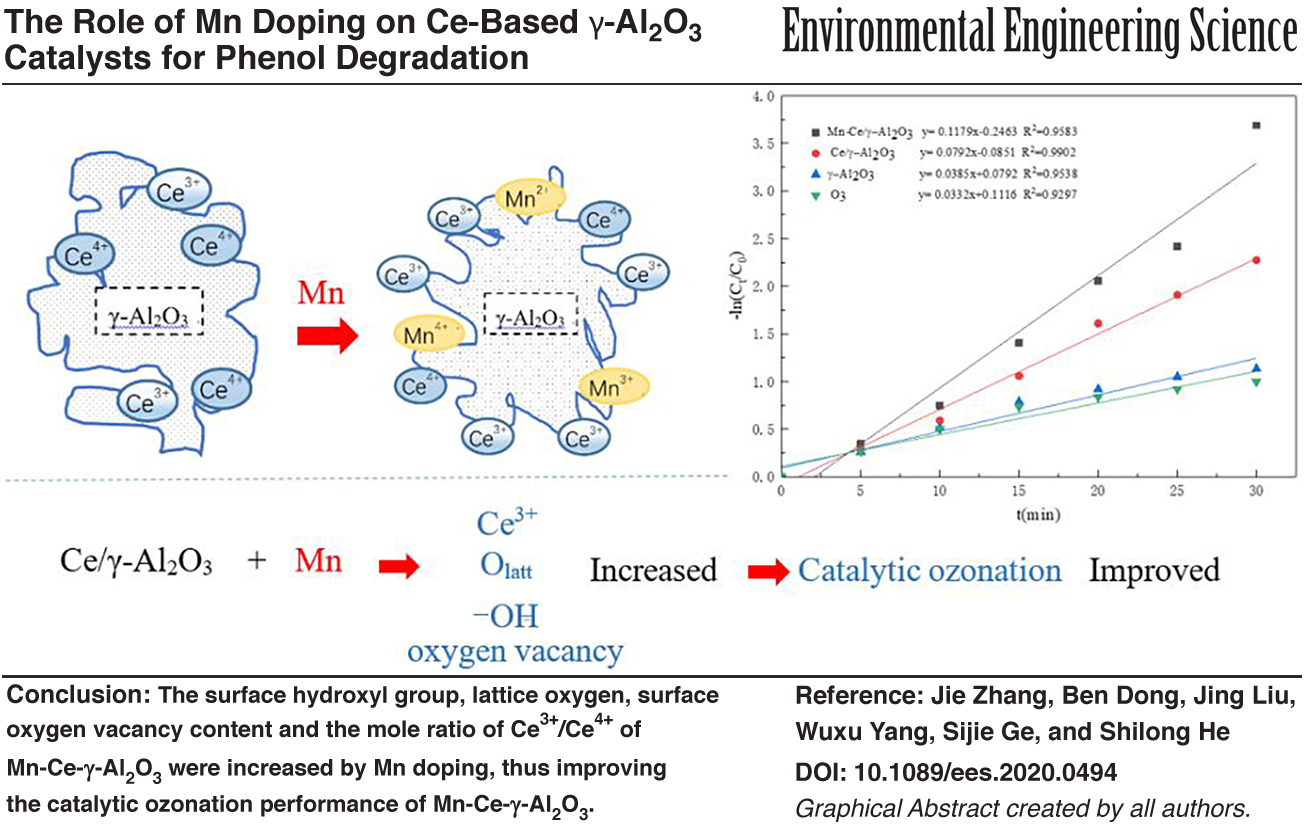
The removal performance of phenol by catalytic ozonation process with different catalysts (i.e., γ-Al2O3, Ce-γ-Al2O3, and Mn-Ce-γ-Al2O3) was investigated. The degradation of phenol with Mn-Ce-γ-Al2O3 catalyst had the highest removal efficiency (97.50%) after 30 min of reaction, indicating that Mn loading on Ce-γ-Al2O3 enhanced the catalytic ozonation activity. The reaction kinetics of Mn-Ce-γ-Al2O3 catalytic ozonation was consistent with the pseudo-first-order kinetic model, which was explained as below:
where kobs is the pseudo-first-order rate constant (min−1); t represents the reaction time; and C0 and Ct stand for the phenol concentration at 0 min and t min, respectively.
Linear relationships were met with high regression coefficients through kinetic modeling analysis (Fig. 1). The rate constants (kobs) of O3, O3/γ-Al2O3, O3/Ce-γ-Al2O3, and O3/Mn-Ce-γ-Al2O3 were calculated to be 0.03315, 0.03845, 0.07924, and 0.11795 min−1, respectively. The phenol removal with Mn-Ce-γ-Al2O3 catalytic ozonation was 3.56 times that of simple ozonation without catalysts. It was also worth noting that the oxidation rates of Ce-γ-Al2O3 were increased by 50% by doping Mn element.

The fitting curves of phenol degradation under O3 alone, γ-Al2O3+O3, Ce/γ-Al2O3+O3, and Mn-Ce/γ-Al2O3+O3 systems.
The identification of catalytic oxidation byproducts and intermediates is of great importance (Lin et al., 2020, 2021). Therefore, the byproducts and intermediates of the catalytic oxidation of phenol were analyzed and identified as P-benzoquinone, hydroquinone, catechol, maleic acid, malonic acid, and acetic acid (Othman et al., 2020; Zhou et al., 2020). The doping of Mn promoted further degradation of these byproducts and intermediates. Therefore, it can be assumed that the doping of Mn played an important role in improving phenol degradation by catalytic ozonation on Mn-Ce-γ-Al2O3 catalyst. Furthermore, the effect of operational factors (e.g., pH, catalyst amounts, and ozone dosing) was investigated and the corresponding results are presented in Supplementary Data.
Supplementary Figure S2 shows that the removal of phenol gradually increased with increasing pH. At alkaline conditions, OH− were initiators of chain reactions involving the decomposition of ozone and leading to the formation of highly reactive hydroxyl radicals, which increased the reaction rate (Chiou et al., 2013). As the catalyst dose increased, the removal of phenol gradually increased (Supplementary Fig. S3). The increase of the catalyst dose would promote the degradation of ozone to generate active free radicals, thus promoting the reactions between ozone and organic substances, which can improve the degradation efficiency (Bhatnagar et al., 2013). However, the overdose of catalyst could affect the uniformity and mass transfer efficiency of gas-liquid-solid mixing, which might cause the decrease of phenol removal. The removal of phenol gradually increased with the increasing dosage of ozone (Supplementary Fig. S4).
This finding can be explained by the fact that (1) a higher ozone dosage would increase the oxidation capacity and (2) increasing the ozone flow rate to increase the ozone dosage could promote three solid-liquid-gas full contacts, which in turn could increase the volume mass transfer coefficient and increase the mass transfer rate (Moslemi et al., 2010).
Morphology
The scanning electron microscope and energy dispersive X-ray spectroscopy (EDS) mappings of Ce-γ-Al2O3 and Mn-Ce-γ-Al2O3 are presented in Fig. 2 to investigate the dispersion of metal oxides. The introduction of Mn oxides did not significantly alter the surface morphology of Ce-based catalyst. Compared to Ce-γ-Al2O3 image, the particle agglomeration of Mn-Ce-γ-Al2O3 could be alleviated and the load particles were more uniform (Fig. 2a, b). Element mapping identified four elements of Al, O, Mn, and Ce uniformly existing in Ce-γ-Al2O3 [Fig. 2(a1), (a2), and (a3)] and Mn-Ce-γ-Al2O3 [Fig. 2(b1), (b2), (b3), and (b4)] catalysts. A microanalysis performed by EDS indicated that Mn oxides were successfully loaded on the carrier. The high relative intensity of Ce for Mn-Ce-γ-Al2O3 from EDS spectrum showed more Ce distribution compared to that for Ce-γ-Al2O3. It can be concluded that, Mn doping did not interfere with Ce loading; on the contrary, improved Ce loading and uniformity. These findings may explain why the addition of Mn improved the efficiency of catalytic ozonation.

SEM and EDS mappings of
Specific surface and pore size distribution
The BET physical properties of γ-Al2O3, Ce-γ-Al2O3, and Mn-Ce-γ-Al2O3 are listed in Table 1. Compared to γ-Al2O3 carrier, it could be observed that the specific surface area and pore volume of Ce-γ-Al2O3 and Mn-Ce-γ-Al2O3 were decreased to some extent. Remarkably, the specific surface area of Mn-Ce-γ-Al2O3 (91.6115 m2/g) obviously decreased compared to the specific surface area of Ce-γ-Al2O3 (165.3435 m2/g), which might be due to the formation of Mn oxides inside the pore structure of Ce-γ-Al2O3. The results of N2 adsorption-desorption isotherm analysis for Ce/γ-Al2O3 and Mn-Ce-γ-Al2O3 showed that these two kinds of catalysts belong typically to IV type, which indicated that they were mesoporous materials (Zhai and Hao, 2017), favored in gas-liquid mass transfer of ozone, and promoted the catalytic ozonation (as shown in Fig. 3) (Ghuge and Saroha, 2018).

Nitrogen sorption isotherms and pore size distribution for
Chemical Composition and Surface Area of Catalysts
Moreover, the hysteresis loop of Mn-Ce-γ-Al2O3 and Ce-γ-Al2O3 was of typical H2 and H3 type, respectively, indicating that Ce-γ-Al2O3 was a loose polymer with interstitial pores formed by lamellar particles, while Mn-Ce-γ-Al2O3 was a uniform channel mesoporous material that was more conducive to gas-liquid mass transfer (Zou et al., 2012). The results indicated that the higher catalytic activity of Mn-Ce-γ-Al2O3 compared with Ce-γ-Al2O3 might be due to the enhanced mass transfer rate rather than the catalytic adsorption capacity of ozone or organic compounds.
Crystal phase
The XRD patterns of Mn-Ce-γ-Al2O3 and Ce-γ-Al2O3 are presented in Fig. 4. Ce-γ-Al2O3 showed strong characteristic peaks at 28.5°, 33.1°, 46.6°, and 56.4°, which were assigned to CeO2 plane facet (JCPDS 81-0792) (Podor et al., 2012). Compared to Ce-γ-Al2O3, the complex oxides of Mn-Ce-γ-Al2O3 exhibited a broad diffraction peak and low intensity of CeO2, which implied lattice distortion of CeO2 caused by Mn doping. Figure 4 shows that there were no apparent characteristic diffraction peaks of crystalline phase of Mn oxides.

XRD patterns of two catalysts. XRD, X-ray diffraction.
However, Mn was successfully doped on Ce-γ-Al2O3 based on EDS and the following XPS analysis. This phenomenon might be attributed to the solid solution of Mn-Ce generated by introducing Mn into the crystal structure of CeO2 (Miller and Chuang, 2009). The Mn-Ce solid solution changed the physical and chemical properties of the original catalyst, as well as the acidic site distribution and electron distribution on the catalyst surface, which promoted the production of lattice oxygen (Olatt). Moreover, Olatt and Lewis acid on the surface of metal ions combined with water to produce surface hydroxyl group (-OH), which was the activation center of ozonolysis and produced ROS to enhance the efficiency of catalytic ozonation (Maehida et al., 2000; Lu et al., 2016). The presence of the surface hydroxyl group was well confirmed by the following FT-IR analysis results:
Surface functional groups properties
FT-IR analysis was carried out to characterize the catalysts to expose the influence of Mn doping on the surface functional groups of Ce-γ-Al2O3 and the results are presented in Fig. 5. In contrast to the absorption bands, bands near 3436, 2100, 1635, 1543, and 1398 cm−1 were found in all catalysts. For Mn-Ce-γ-Al2O3, the intensity of the bands near 3436 and 2100 cm−1 increased slightly compared to that of the bands of Ce-γ-Al2O3. According to previous studies, the absorption bands at 3436 cm−1 were assigned to O-H stretching vibrations, which might be due to hydroxyl (-OH) (Kwong et al., 2015).

Infrared spectra of two catalysts.
The hydroxyl on the catalyst surface (-OH) was the main active site of ozonation, and it was shown in the form of acidic or alkaline groups through proton exchange with the aqueous solution, which promoted electron transfer and produced ROS contributing to higher catalytic ozonation efficiency (Zhang et al., 2009). Bands at 2100 cm−1 were attributed to C ≡ C stretching vibrations. These unsaturated bonds could promote the decomposition of ozone by the catalyst. The intensities of bands near 1635, 1543, and 1398 cm−1 compared to those of Ce-γ-Al2O3 were decreased, indicating a reduction in crystallinity (Sun et al., 2014). These results were highly consistent with the XRD characterization, implying the formation of the Mn-Ce solid solution.
Surface chemical compositions
XPS analysis of Ce 3d and Mn 2p of Ce-γ-Al2O3 and Mn-Ce-γ-Al2O3 was conducted to further investigate the elemental valence at the surface of the catalyst. The introduced element Mn existed in a variable valence state on the surface of Mn-Ce-γ-Al2O3 (shown in Fig. 6a). Two main Mn 2p peaks were observed at binding energies of 657.5 ± 7.5 and 642.5 ± 2.5 eV, which could be assigned to Mn 2p3/2 and Mn 2p1/2. Besides, three characteristic fitting peaks were observed in Mn 2p3/2 spectra which were located at the binding energies of 642.645, 641.273, and 644.550 eV, corresponding to Mn2+, Mn3+, and Mn4+, respectively. The relative contents of Mn2+, Mn3+, and Mn4+ contributed about 39.91%, 33.59%, and 26.50%, individually (Table 2).

XPS spectra over catalysts
Relative Percent Content of Catalytic Atom and Element Valence Distribution Percentage
According to previous studies, Mn oxides increased the ozonation rate mainly by its own redox reaction (Wang et al., 2016b). Moreover, the spectra of Ce 3d are presented in Fig. 6b and mainly contained the Ce 3d3/2 and Ce 3d5/2 spectra labeled as u and v, respectively. There were 10 characteristic peaks, μ, μ0, ν’, and ν0 corresponded to Ce3+ and the other peaks corresponded to Ce4+. The coexistence of Ce3+ and Ce4+ species was proved to create charge imbalance, oxygen vacancies, and unsaturated chemical bonds on the surface of the catalysts, which was beneficial to form chemisorbed oxygen on the surface of the catalysts, to promote the migration and transformation of ozone (Chen et al., 2017). The molar ratio of Ce3+/Ce4+ increased from 47.64% to 52.50% after Mn doping as shown in Table 2.
It has been reported that a higher ratio of Ce3+/Ce4+ on the catalyst surface witnesses a higher electron transfer rate in catalytic ozonation. Also, the higher electron transfer between Ce3+ and Ce4+ could result in the formation of more oxygen vacancies (Gao et al., 2017). Oxygen vacancies would provide higher catalytic ozonation efficiency since they tailored the electronic structure and significantly promoted the ability of oxygen mobility (Wang et al., 2019).
Catalytic mechanism
It could be concluded from the XRD and XPS characterization analysis that Mn doping could increase the content of hydroxyl groups on the surface of Ce-γ-Al2O3. The surface hydroxyl group may be the main active site for the catalyst to absorb and further decompose ozone to produce

Effect of tert-Butanol on the degradation of phenol.
The phenol removal rate decreased by 9.41%, 16.93%, 49.05%, and 61.40%, respectively, after the addition of tert-butanol as a masking agent in these four systems. The addition of tert-butanol significantly inhibited the removal rate of phenol, which indicated that in the process of phenol decomposition in Mn-Ce-γ-Al2O3+O3 and Ce-γ-Al2O3+O3 systems, the competitive consumption of
Conclusions
The doping of Mn promoted the efficiency of phenol removal by catalytic ozonation from 89.71% to 97.50% compared to Ce-γ-Al2O3, which was 1.44 times the sole ozonation. The phenol removal rate in catalytic ozonation increased with the addition of Mn by a rate of 0.11795 min−1, which was 1.49 times and 3.56 times those of Ce-γ-Al2O3 catalytic ozonation and pure ozonation system, respectively.
The high catalytic activity of Mn-Ce-γ-Al2O3 catalyst could be attributed to a series of better properties compared to Ce-γ-Al2O3 catalyst. A more uniform channel mesoporous structure could provide a good channel promoting the migration and transport of a gas-liquid mass more favorable to ozone. The formation of Mn-Ce solid solution promoted the production of lattice oxygen, and then surface hydroxyl groups on Mn-Ce-γ-Al2O3 catalyst were produced, which was the activation center of ozonolysis, and produced ROS enhancing the efficiency of catalytic ozonation. Furthermore, the higher Ce3+/Ce4+ ratios indicated the formation of oxygen vacancies that would significantly contribute to promoting the oxygen mobility ability from the bulk to the surface.
In addition, the masking test results showed that the catalytic ozonation system with Mn-Ce-γ-Al2O3 catalyst produced more •OH to degrade phenol than the catalytic ozonation system with Ce-γ-Al2O3 catalyst. All of these factors well illustrated the role of Mn in improving phenol degradation by catalytic ozonation on Mn-Ce-γ-Al2O3 catalyst.
Footnotes
Acknowledgments
All authors of this article have read the “Information For Authors” carefully and agree to the content contained therein. All the signed authors confirm that the article has not been submitted more than once and infringes others' copyright. After publication, the copyright of the article belongs to the author, and the right of publication belongs to the journal of Environmental Engineering Science.
Authors' Contributions
B.D., J.L., and W.Y. (M.D. student) conducted all the experiments and wrote the article. J.Z. (Associate Professor) and S.H. (Professor) wrote and revised the article. S.G. (Assistant Professor) revised the article.
Author Disclosure Statement
No competing financial interests exist.
Funding Information
This study was supported by the Fundamental Research Funds for the Central Universities (2019XKQYMS78).

References
Supplementary Material
Please find the following supplemental material available below.
For Open Access articles published under a Creative Commons License, all supplemental material carries the same license as the article it is associated with.
For non-Open Access articles published, all supplemental material carries a non-exclusive license, and permission requests for re-use of supplemental material or any part of supplemental material shall be sent directly to the copyright owner as specified in the copyright notice associated with the article.
