




Abstract
A high percentage of available Cadmium (Cd) in acid rice fields in south China promoted Cd accumulation in rice plant and caused a grain Cd content above the national standard GB 2762-2012 guideline of 0.20 mg/kg. In this study, an in-situ field-scale demonstration was conducted under continuous flooding and conventional and wetting irrigation to establish the optimal remediation mode for reducing the Cd concentration in rice plant grown in polluted soils. The Cd assimilation by plant, pH, and Cd chemical fraction in soils, and the physiological response of plant were observed to illuminate the influences of palygorskite on Cd immobilization and the antioxidant capacity of plant. The results showed that continuous flooding promoted Cd conversion from exchangeable to Fe/Mn oxide bound and residual. The pH in clay-treated soils increased by 0.58–1.34 U under continuous flooding, 0.52–1.39 U under conventional irrigation, and 0.44–1.37 U under wetting irrigation (p < 0.05). The palygorskite application decreased the exchangeable Cd by 8.1–16.2%, 4.7–14.0%, and 1.8–9.1%, respectively (p < 0.05). The concentrations of Cd in brown rice in clay-treated soils were reduced by 28.6–61.9%, 24.2–51.5%, and 25.0–54.5% (p < 0.05). Under continuous flooding, the Cd concentration of brown rice was lower than national standard GB 2762-2012 guideline of 0.20 mg/kg only after 0.5% clay addition. The antioxidant activities in leaves were enhanced after clay addition. Palygorskite application combined with continuous flooding was proposed as a strategy for the remediation of metal-polluted rice fields to realize the safe production of rice.
Introduction
Industrialization and urbanization have brought about environmental pollution and ecological destruction over the last decades in China. Heavy metal accumulation in soil–crop systems has been a pressing issue for society and the public due to nondegradation and toxicity to plant and microbial processes (Rattan et al., 2005; Sun et al., 2013). Rice plants are the chief crop in southern provinces in China, and rice is a staple food for 60% of the Chinese population. A high percentage of available Cadmium (Cd) in acid rice fields in south China promoted Cd accumulation in rice plant and caused a grain Cd content above the national standard GB 2762-2012 guideline of 0.20 mg/kg (Liang et al., 2014; Li and Xu, 2018).
The traditional solutions to metal-polluted soils include excavation and dumping, phytoextraction, and chemical washing, which come with damaging and expensive defects (Lasat, 2002; Khan et al., 2004; Jiang et al., 2009). In-situ immobilization is a low-cost and highly efficient approach to remediate metal-contaminated fields, aimed at changing the species distribution of trace elements and decreasing metal availability in soils. Lime, clay minerals, organic matter, phosphate, and composite materials have been developed and have demonstrated to decrease the phytoavailability of heavy metals in polluted farmland. Among the mentioned deactivators, clay minerals are particularly abundant and inexpensive, and their application facilitates crop establishment in contaminated soils due to the reduction of extractable Cd and improvements in the enzymatic activity and available content of nutrient elements in soils (McGrath et al., 2000; Malandrino et al., 2011; Liang et al., 2014; Li and Xu, 2018).
Water management, especially in the field of acid rice, is an environmental-friendly approach for reducing the pollution risk of Cd in brown rice. It has been reported that water management has a distinct effect on Cd uptake by rice plants (Hu et al., 2010; Xu et al., 2017). However, the combined use of clay addition and water management to immobilize heavy metals in rice fields has rarely been reported. In the present study, an in-situ field experiment was conducted to build the optimal remediation mode for reducing the concentration of Cd in brown rice. We aimed to evaluate the effects of palygorskite on pH and Cd chemical fractions in soils, rice yield, and concentrations of Cd in rice plants under different water managements. Furthermore, we aimed to observe the physiological responses of the rice plants and the antioxidant enzymatic activity and malondialdehyde (MDA) content in the rice leaves.
Materials and Methods
Institutional Review Board approval is not applicable for this study.
Material properties
The investigated site was located in Hunan province, China. The rice field was derived from red soil and was polluted by industrial mining and smelting. The paddy soil was found to be heavily contaminated with Cd. The sample of composite topsoil at a depth of 0–50 cm was collected using a five-point sampling method. The test of total Cd in soils was performed after passing through a 100-mesh sieve. The soil material was air dried and passed through a 20-mesh sieve for chemical analysis. The total concentration of Cd in soils was 1.03 mg/kg, which was higher than the Environmental Standard Grade III (GB 15618-1995) of 0.60 mg/kg in acidic soils. The values for the main physicochemical characteristics of soil investigated were a pH of 5.01, a total N content of 0.93 g/kg, a total P content of 0.47 g/kg, and a cation exchange capacity (CEC) of 17.3 cmol/kg (Lu, 2000).
Palygorskite, a naturally occurring clay mineral, was used as a Cd immobilization agent. The CEC was 45.1 cmol/kg, reflecting the high adsorption capacity of the metal ion. Palygorskite showed an orthorhombic crystalline system with a Pn space group and a characteristic diffraction peak at ∼2θ = 8.3°. Its composition, which was determined by X-ray fluorescence and investigated by our research team, was 1.2% CaO, 64.4% SiO2, 20.5% MgO, 10.4% Al2O3, and 1.5% Na2O (Liang et al., 2014).
The ordinary rice cultivar TY-272 of hybrid Oryza sativa L. subsp. Hsien Ting was cultivated, and its average growth period was 130 days.
Field trials design
The different applied doses of palygorskite (0, 0.25, 0.50, and 0.75 kg/m2, namely 0%, 0.5%, 1.0%, and 1.5%) were mixed into the topsoil at a depth of 0–50 cm using a plow. After a 4-week interaction of clay and soil with a 70% field water-holding capacity, rice seedlings were cultivated and transplanted into plots (each measuring 5 m × 6 m) in May 2018. The guard row was set in the rice field, and the ridge of the plot was covered by plastic film. Water management contained continuous flooding (5–7 cm surface water during the whole growth period), conventional irrigation (moist soil surface during the late tillering state and grain filling stage, and 5–7 cm surface water during the other growth stages), and wetting irrigation (moist soil surface during the entire growth period, 75% of the field water-holding capacity). All treatments were arranged in a randomized block, and there were 12 treatments (4 × 3) and 36 plots. After 110 days of growth, rice plants were harvested by plum blossom-type sampling. The plant was separated into rice straw (stalk and leaf) and brown rice and dried to a constant weight at 65°C. The plant sample was ground with a stainless mill and passed through a 60-mesh sieve before physicochemical analysis.
Analytic methods
The in-situ pH measure of topsoil in the plot was measured using a pH analyzer (FJA-6, Tp, China). The zeta potential of the NaNO3 solution at different pH values was tested using a zeta potential analyzer (JS94J2M; Powereach, China).
The Cd fraction in soils was determined by sequential extraction procedure, which partitioned Cd into five forms: exchangeable (SE; 1 M MgCl2, agitation for 1 h at 25°C), carbonate bound (WSA; 1 M CH3COONa, plus CH3COOH of pH 5, agitation for 5 h at 25°C), Fe/Mn oxide bound (OX; 0.04 M NH2OH·HCl in 25% CH3COOH, agitation for 6 h at 96 ± 3°C), organic matter bound (OM; 0.02 M HNO3 and 30% H2O2, agitation for 5 h at 85 ± 2°C), and residual (RES; Tessier et al., 1979). The crop sample was decomposed by HNO3, and the resulting solution was diluted to 100 mL with distilled water. The Cd in the solution was determined using an atomic absorption spectrometer (AA-6880; Shimadzu, Japan).
Fresh leaves were sampled during the anthesis. The leaf material (0.5 g) was ground in a mortar using 5 mL of phosphate buffer of pH 7.8. The supernatant was collected after centrifugation at 104 rpm at 4°C, and then utilized to determine the antioxidant enzymatic activity. The superoxide dismutase (SOD) activity was determined as recommended by Giannopolitis and Ries (1977). The peroxidase (POD) activity was assayed as described by Wu and Tiedemann (2002). The catalase (CAT) activity was measured using the method provided by Havir and Mchale (1987). The MDA content was analyzed using the thiobarbituric acid method (Sun et al., 2009).
Data analysis
All treatments were replicated three times. The mean and standard deviations were calculated using Microsoft Office Excel 2007. One- or two-way analysis of variance was carried out using SAS 9.1. Multiple comparisons were made using the least significant difference test when significant differences were observed among treatments (p < 0.05).
Results
The growth response of plant
Metal pollutants in soils can disturb plant metabolism and growth (Shah et al., 2001; Sun et al., 2009). The rice yield is shown in Fig. 1. In the treatment without palygorskite, compared with conventional irrigation, rice production in the treatment with continuous flooding decreased by 11.4%, and wetting irrigation caused a reduction of 25.9% (p < 0.05). The rice yields in clay-treated soils increased by 2.1–7.1% under continuous flooding, 2.7–7.5% under conventional irrigation, and 3.6–9.2% under wetting irrigation (p < 0.05). After applying palygorskite to soils, the increase in rice weight may be attributed to lower Cd stress in both soil and crop systems. In a previous study, the higher concentration of available phosphorus in soils amended with clay was another factor influencing the increase in grain production (Li and Xu, 2018).

The rice yields in different treatments. Continuous flooding, conventional irrigation and wetting irrigation represented different water managements. Vertical bars represent mean ± standard deviations. Same letters above bars were not significantly different by LSD test under different water management, and different letters below X axis show significant differences at different clay applied doses (p < 0.05; n = 3). LSD, least significant difference.
The pH and zeta potential in soils
The pH is a vital factor that controls the mobility and availability of metals in soils (Singh and Myhr, 1998; Liang et al., 2014). The effects of palygorskite on pH under different water managements are reported in Fig. 2. In soils untreated with clay, in contrast to conventional irrigation, the pH in the continuous flooding treatment increased by 0.14 U and that in wetting irrigation was reduced by 0.21 U (p < 0.05). The higher pH in continuous flooding was due to hydrogen depletion and dissolution of Fe oxides in soils. Because of the presence of metallic oxides in clay, the pH in soils added with clay increased by 0.58–1.34 U under continuous flooding, 0.52–1.39 U under conventional irrigation, and 0.44–1.37 U under wetting irrigation (p < 0.05).
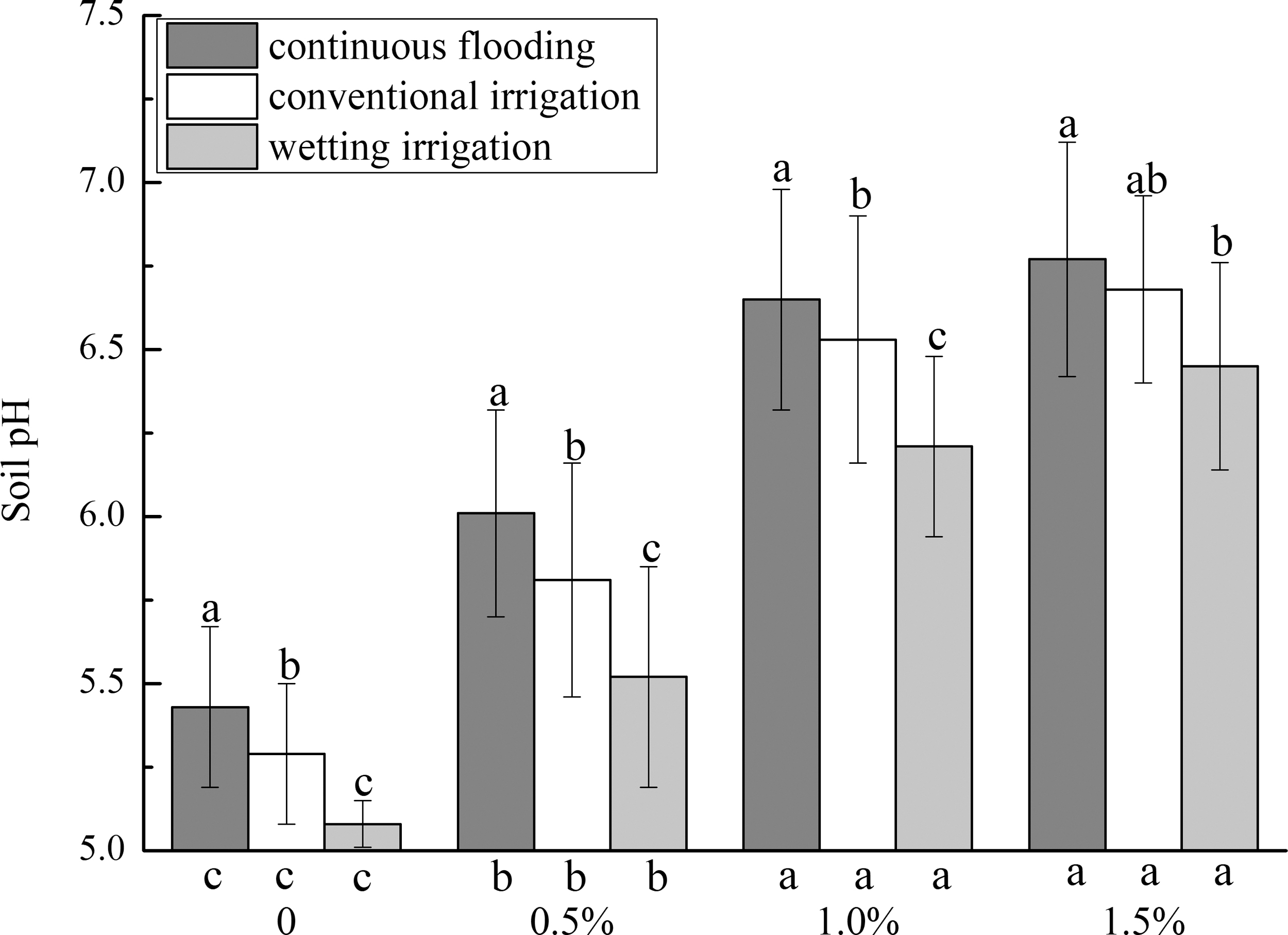
The pH in soils. Continuous flooding, conventional irrigation and wetting irrigation represented different water managements. Vertical bars represent mean ± standard deviations. Same letters above bars were not significantly different by LSD test under different water management, and different letters below X axis show significant differences at different clay applied doses (p < 0.05; n = 3).
The zeta potential was a crucial index reflecting the surface potential of the soil colloid. As shown in Fig. 3, within a certain pH range, the zeta potential in soils amended with palygorskite showed a gradual decreasing trend with increasing pH, which revealed that the quantity of negative charge on the surface of the colloid increased. The higher pH in clay-treated soils promoted the ionization of the hydroxyl of the colloid and increased the negative charge.

The chemical fraction of Cd in soils
To evaluate the effect of palygorskite addition on Cd availability, the chemical fractions of Cd in acid soils are reported in Fig. 4. In general, Cd was extracted at a high percentage in the first four fractions, showing that it was not strongly bound to the soil matrix. Indeed, Cd is considered to be an exogenous pollutant rather than a constituent of soil. In the treatment without clay, the percentage of exchangeable Cd in the total was 37% under continuous flooding, 43% under conventional irrigation, and 55% under wetting irrigation (p < 0.05). The concentrations of the Fe/Mn oxide-bound and residual Cd increased gradually during the process of flooding, resulting in an 11.1% increase for the Fe/Mn oxide-bound Cd and 20.2% increase for the residual Cd compared with conventional irrigation (p < 0.05). The exchangeable Cd in soils amended with clay declined remarkably. At applied doses of 0.5–1.5%, exchangeable Cd was inhibited by 8.1–16.2% under continuous flooding, 4.7–14.0% under conventional irrigation, and 1.8–9.1% under wetting irrigation (p < 0.05). The low total Cd concentration or low fraction of labile Cd in soils was deduced to be more easily transformed to less available forms by palygorskite. Thus, continuous flooding promoted soil Cd immobilization by clay. The increased negative charges on the surface of the colloid promoted Cd adsorption on soil and reduced Cd availability. Additionally, palygorskite of high CEC accounted for Cd immobilization in polluted soils.
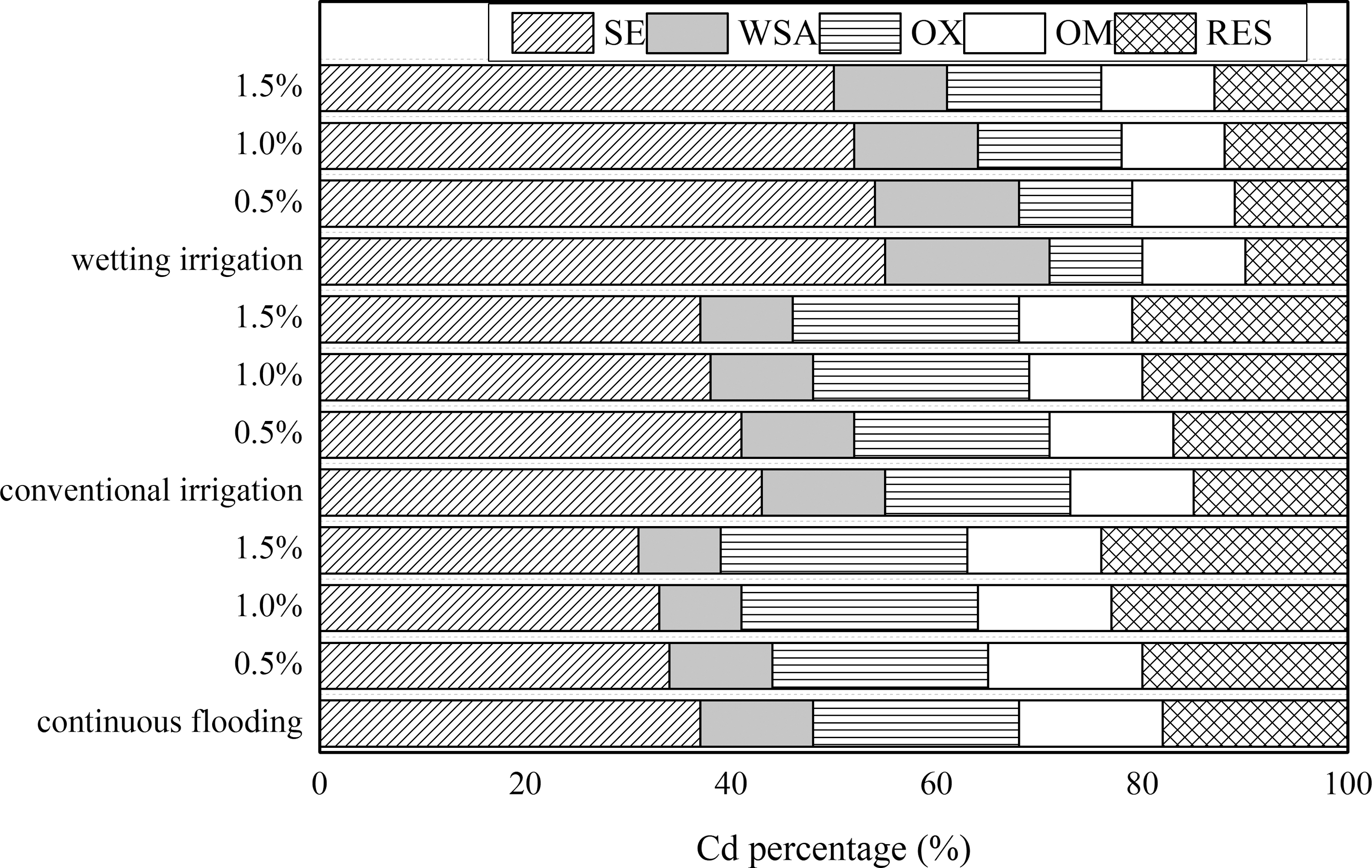
The distribution of species of Cd in soils. The SE, WSA, OX, OM, and RES refer to Cd chemical forms of exchangeable, carbonates-bound, Fe/Mn oxides-bound, organic matters-bound, and residual.
The Cd assimilation by plant
The concentrations of Cd in brown rice are reported in Fig. 5. In soils untreated by clay, a lower concentration of Cd in brown rice was observed under continuous flooding. The Cd in brown rice in long-term flooding was 63.6% of that in conventional irrigation and 48.9% of that in wetting irrigation (p < 0.05). The Cd concentrations of brown rice in control soils exceeded the national standard GB2762-2012 of 0.20 mg/kg. The addition of palygorskite led to a reduction of Cd in brown rice by 28.6–61.9% under continuous flooding, 24.2–51.5% under conventional irrigation, and 25.0–54.5% under wetting irrigation (p < 0.05).
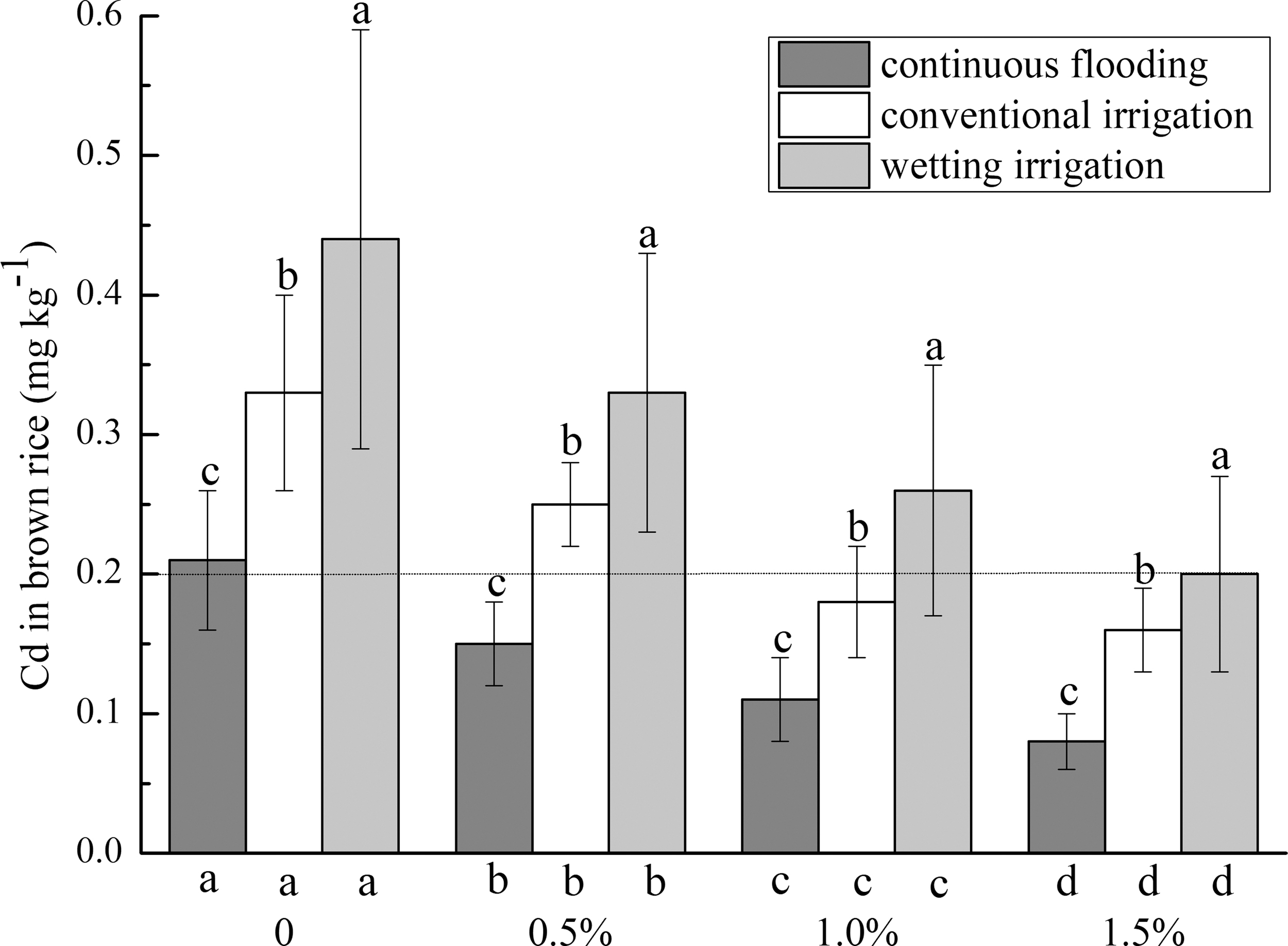
The concentrations of Cd in brown rice in different treatments. Continuous flooding, conventional irrigation and wetting irrigation represented different water managements. Vertical bars represent mean ± standard deviations. Same letters above bars were not significantly different by LSD test under different water management, and different letters below X axis show significant differences at different clay applied doses (p < 0.05; n = 3).
As reported in Table 1, the above-ground straw, in the direction of stalk to leaf, was divided into four parts, namely, stalk -1, -2, -3, and leaf. As a whole, Cd in straw along the stalk declined in the order of stalk-1 > stalk-2 > stalk-3 > leaf, and a significant difference was observed between stalk-1 and -3 (p < 0.05). In soils untreated with clay, the Cd concentration of stalk-1 in continuous flooding was reduced by 39.3% and that in wetting irrigation increased by 37.5% in contrast to conventional irrigation (p < 0.05). The Cd in leaves decreased by 40.8% and increased by 36.9%, respectively (p < 0.05). After clay addition, the Cd content in stalk-1 reduced by 16.7–52.9% and Cd in leaves decreased by 24.6–62.3% under continuous flooding, 16.1–50.0% and 24.3–58.3% under conventional irrigation, and 11.7–60.2% and 18.4–66.0% under wetting irrigation (p < 0.05). The lower concentrations of Cd in the straw indicated that palygorskite addition greatly decreased the translocation of Cd to plant due to the reduction of available Cd in soils, as shown in Fig. 4.
The Cd Concentrations of Different Parts of Rice Straw
Means followed by different letters differ at p < 0.05. Letters beside mean refer to the difference in the same part of straw, and letters enclosed in parentheses refer to difference in different parts of straw.
The physiological responses of plant
The physiological indices as biomarkers, activity of antioxidant enzymes, and content of MDA in leaves are presented in Table 2. In soils unamended with clay, the activities of SOD, POD, and CAT declined in the order of continuous flooding > conventional irrigation > wetting irrigation (p < 0.05). The application of palygorskite increased the antioxidant enzymatic activity. The SOD activity in leaves increased by 11.0–41.1% under continuous flooding, 12.7–47.6% under conventional irrigation, and 14.1–49.8% under wetting irrigation, compared with controls (p < 0.05). The increases in POD activity were 13.0–51.9%, 13.2–57.3%, and 16.9–59.5%, respectively (p < 0.05). The CAT activity also increased (p < 0.05). In the treatment without clay, compared with conventional irrigation, MDA content in continuous flooding was reduced by 26.6%, and wetting irrigation caused a 26.2% increase (p < 0.05). The MDA content of leaves in the clay treatment was inhibited by 11.7–31.0%, 16.7–30.0%, and 29.3–44.9% (p < 0.05). The reduction of MDA in leaves after clay addition reflected that oxygen injury of Cd to the cell membrane during the reaction of lipid peroxidation declined to relieve Cd toxicity. In summary, the increase in activities of antioxidant enzymes and reduction of MDA content were caused by lower Cd accumulation in leaves, as shown in Table 1.
The Physiological Indexes in the Leaves of Rice Plants
Different letters in the column are significantly different according to LSD test (p < 0.05; n = 3).
MDA, malondialdehyde; SOD, superoxide dismutase; POD, peroxidase; CAT, catalase; LSD, least significant difference.
Discussion
The distribution of Cd chemical species in contaminated soils could determine its bioavailability, and exchangeable Cd was present in a form that could be easily absorbed by plant. The pH, redox potential, temperature, humidity, and organic matter govern the solubility of trace elements in soils. Continuous flooding promoted Cd transformation from exchangeable to Fe/Mn oxide-bound and residual fractions, in accordance with the existing research that a lower bioavailable Cd was observed in reduced soils (Xu et al., 2017; Li and Xu, 2018). Under different water managements, the concentration of exchangeable Cd was much higher in the unamended soils than in the soils with clay, as reflected in Fig. 4. Our results agree with those of other researchers who found a reduction in the Cd percentage extracted from the first two fractions of the Tessier protocol after applying vermiculite to polluted soils (Malandrino et al., 2011).
The pH increase in acid soils led to the formation of negatively charged adsorption sites on surfaces of colloid and organic matter (Bolan et al., 2003), which was in agreement with our present research findings showing a gradual decrease in the zeta potential of colloid, an index for the rise in the negative charge of the surface on the colloid, with increasing pH in soils, as shown in Fig. 3. Consequently, the combined effect of pH regulation and high CEC of palygorskite caused the reduction of Cd availability in rice fields. Similarly, under traditional irrigation, the diethylenetriamine pentaacetate- and HCl-extractable Cd in sepiolite-treated soils declined, with reductions of 19.5–32.9% and 87.0–95.1%, respectively (Yin et al., 2017). The remarkable declines in extractable Cd in rice fields, Toxicity Characteristic Leaching Procedure, NH4OAc, CaCl2, and HCl extraction were observed after clay application of 0.75–2.25 kg/m2 (Liang et al., 2014).
In addition, Si in palygorskite played an important role in Cd immobilization. The study reported that the addition of 400 mg/kg of Si decreased the Cd accumulation in shoots and roots of plants, which was caused by Cd distribution mainly in the form of specific adsorbed or Fe/Mn oxide-bound Cd in Si-amended soils (Liang et al., 2005). As shown in Fig. 5, Cd accumulation in brown rice depended on water management and clay application. Under wetting irrigation, Cd in brown rice in 1.5% palygorskite treatment could meet the national standard GB 2762-2012 guideline of 0.20 mg/kg in China. However, the Cd in brown rice under the continuous flooding treatment was lower than the guideline of 0.20 mg/kg only after 0.5% clay application. Hence, it was concluded that the selection of water management was vital for the achievement of remediation required for safety rice production using chemical immobilization of clay. Thus, palygorskite addition combined with continuous flooding is a recommended project for Cd-polluted rice field remediation.
The toxic responses of plants to Cd stress involve a series of physiological disorders such as photosynthesis limitation, respiration, oxidative stress, growth inhibition, and yield decline (Chien and Kao, 2000; Liu et al., 2007). The SOD could remove oxygen-free radicals (O2−) through the disproportionation reaction of O2− to H2O2, and POD and CAT could catalyze H2O2 hydrolysis to form H2O. Antioxidant enzymes protect plant tissues against injury. MDA, an index of oxygen injury, is produced by the lipid peroxidation of the cell membrane. In this study, continuous flooding promoted an increase in antioxidant enzyme activity. The SOD and POD activities in plants were elevated by the Cd reduction, and POD activity was inhibited when the Cd concentration in the plants rose (Chien and Kao, 2000; Shah et al., 2001). The antioxidant enzymes after palygorskite application increased, revealing an increase in the antioxidant capacity of rice. Similar results were reported in a study by Sun et al. (2016), wherein sepiolite addition increased the SOD and POD activities in rice plants to relieve Cd stress. The in-situ stabilization of heavy metals in soils may benefit soil functionality and plant physiology by decreasing the liable element pool of metal pollutants. Therefore, the activity of antioxidant enzymes in plants could be utilized to evaluate the effect of soil remediation. The higher antioxidant enzymatic activities after clay addition indicated that they were useful in predicting the recovery of soil ecosystems after Cd immobilization. In addition, the sulfhydryl compounds in plants rose remarkably when the Cd content in plants declined, which may promote an increase in the activity of antioxidant enzymes in leaves and the enhancement of Cd tolerance after palygorskite application (Han et al., 2018).
Conclusions
The effect of the pH rise and high CEC of palygorskite reduced the available Cd content in the rice fields. Continuous flooding promoted Cd immobilization by clay. The concentrations of Cd in the above-ground straw along the stalk showed a gradual decline. Under continuous flooding, the Cd concentration in brown rice followed the national standard GB 2762-2012 guideline of 0.20 mg/kg only after 0.5% clay addition. Furthermore, palygorskite application increased the antioxidant capacity of rice plant in relieving Cd stress. These results have shown that clay addition combined with continuous flooding could be adopted to remediate Cd-polluted rice fields.
Footnotes
Acknowledgments
The authors acknowledge the funding supported by the National Natural Science Foundation of China and Scientific and Technological Innovation Programs of Higher Education Institutions in Shanxi.
Author Disclosure Statement
No competing financial interests exist.
Funding Information
The study was supported by funding from the National Natural Science Foundation of China (grant number 21177068) and Scientific and Technological Innovation Programs of Higher Education Institutions in Shanxi (grant number 2020L0641).