




Abstract
Phosphorus recovery from sludge incinerated bottom ash (SIBA) is one of the effective methods to realize phosphorus reuse. Extracting phosphorus efficiently from SIBA is the first step. In this study, hydrochloric acid (HCl) was used to extract phosphorus from SIBA at low liquid-solid ratios (≦5 mL/g). The phosphorus extraction conditions were studied. The results revealed that the maximum extraction occurred in 10 min when the HCl concentration was 2.0 mol/L at a temperature of 25°C. The best stirring rate was 200 rpm, and the liquid-solid ratio was 3 mL/g. Under the best conditions, the phosphorus extraction efficiency was 92.9%, and the concentration of phosphorus in the extraction solution was 23.2 g/L. The adsorption and release processes of phosphorus and metals under different HCl concentrations were also studied. It was observed that under low HCl concentration (0.5 mol/L), phosphorus and metals were initially released into the extraction solution and subsequently adsorbed by the sludge incinerated bottom ash residues. The adsorption kinetics followed the pseudo-first-order model. At high HCl concentration (2.0 mol/L), phosphorus and metals exhibited a sustained release, which could be described by the Drozdov equation. The mechanism of migration of the metals was also investigated. Most metals remained in SIBA at low and high HCl concentrations. This study reveals that it is feasible to extract phosphorus with HCl at a low liquid-solid ratio.
Introduction
Phosphorus is ubiquitously present in DNA, proteins, and enzymes (Vogel and Adam, 2011; Shiba and Ntuli, 2017). It is one of the three major nutrients present in plants (Zhao and Zhao, 2009; Schütte et al., 2015). It has a huge significance in modern agricultural systems and food security (Petzet et al., 2011; Gorazda et al., 2017). In addition, phosphorus is widely used in the field of human medicine and industrial production in the world. At present, the main way to obtain phosphorus is to mine natural phosphate ores. However, it is a nonrenewable source of phosphorus. On the one hand, it is predicted that phosphate deposits will be exhausted in 30–300 years (Ye et al., 2017). On the other hand, with the use of phosphorus products, a lot of phosphorus-containing sewage sludge has been discharged into the environment. It is reported that sewage sludge contains about 90% phosphorus (Tarayre et al., 2016). Besides, The current wastewater treatment plants primarily use biological and chemical methods to remove phosphorus. Most phosphorus in sewage migrates into sludge. According to a rough estimate, 6.5 tons of sludge (80% water content) had been produced from 10,000 tons of wastewater. China's total sludge production reached ∼45 million tons by 2017 (Ministry of Housing and Urban Rural Development of the People's Republic of China, 2016). Zhai et al. (2014) reported that the phosphorus content in the sludge of China was about 125,000 tons in 2012, indicating that sludge can be regarded as a secondary phosphorus source. In the next few decades, with the consumption of phosphate ores and its nonrenewable nature, recovery of phosphorus from sludge will become increasingly important
The current phosphorus recovery technologies mainly include thermochemical, electrodialysis, biological, and wet chemical methods. However, the thermochemical method (Herzel et al., 2016) requires better equipment and higher energy consumption. In addition, the electrodialysis (Villen-Guzman et al., 2018) and biological methods (Mehta et al., 2014) involve long extraction time and exhibit low phosphorus extraction efficiency. Compared with the above methods, the wet chemical method is widely used because of its cost-efficiency, relatively simple operation process, and high efficiency of phosphorus extraction (Ottosen et al., 2013). The wet chemical method uses different extractants to extract phosphorus from SIBA. Following this, the phosphorus-rich extracts are treated to produce phosphorus products. Therefore, the choice of extractant is very important for the wet chemical extraction of phosphorus. The commonly used extractants include inorganic acids (sulfuric acid [H2SO4,], hydrochloric acid [HCl], and nitric acid [HNO3]) (Gorazda et al., 2012, 2016; Fang et al., 2018), organic acids (oxalic acid [H2C2O4] and citric acid [H8C6O7]) (Herzel et al., 2016; Cieślik and Konieczka, 2017), alkali (NaOH), chelating agents (EDTA and EDTMPA) (Li et al., 2017), and so on. The inorganic acids (H2SO4, HCl, and HNO3) have the best effect on phosphorus extraction. H2SO4 is the most widely used extractant due to its low price, easy storage ability, and high phosphorus recovery ability. However, when H2SO4 is used as an extractant, it easily reacts with Ca in SIBA to form gypsum (CaSO4). It covers the SIBA surface and prevents the continuous reaction between H2SO4 and SIBA during the phosphorus extraction process. Eventually, phosphorus extraction efficiency is reduced (Cohen, 2009; Kleemann et al., 2017). The use of HCl does not lead to this problem, and it also exhibits a high phosphorus recovery efficiency. The liquid-solid ratio also affects the extraction process. It has been reported that most of the liquid-solid ratio is controlled at a high range (20–150 mL/g) (Atienza Martínez et al., 2014; Fang et al., 2018; Meng et al., 2019). A high liquid-solid ratio leads to high phosphorus extraction efficiency. However, the disadvantages include a low phosphorus content in unit volume extracts, large amounts of waste chemicals, and high operation cost. Therefore, a high phosphorus extraction efficiency at a low liquid-solid ratio will help avoid secondary pollution and reduce operating costs. Metal leaching is inevitable with the release of phosphorus. Excessive metal leaching can potentially affect the preparation of phosphorus-containing products. So, research mainly focuses on the removal of metals from the extracts (Wang et al., 2018; Liang et al., 2019; Meng et al., 2019). But it is worth noting that the distribution of metals in the extracts and SIBA residues is not clear. It is also unclear how metals are leached from SIBA. Hence, it is essential to answer these questions to achieve selective treatment of phosphorus and metals.
Based on the above, this study used HCl to extract phosphorus from SIBA at a low liquid-solid ratio (≦5 mL/g) by the wet chemical method. The effects of extraction time, HCl concentration, extraction temperature, stirring rate, and liquid-solid ratio on phosphorus extraction were also investigated. Following this, the migration of metals in SIBA under different HCl concentrations and extraction time were studied. Also, the dynamic distribution of metals between the extracts and SIBA was analyzed. Finally, the kinetics of phosphorus extraction using different concentrations of HCl was investigated. The microscopic models of phosphorus and metals migration were also established.
Materials and Methods
Experimental materials and reagents
SIBA used in the experiments was collected from an excess sludge incineration plant in Chengdu, China. Before testing, the collected samples of SIBA were dried at 105°C for 2 h and then transferred to a drying dish for cooling and storage.
The reagents used in the experiments were HCl, H2SO4, HNO3, hydrofluoric acid (HF), ammonium molybdate [(NH4)6MoO24·4H2O], potassium antimony tartrate [K(SbO)C4H4O6·1/2H2O], potassium dihydrogen phosphate (KH2PO4), and ascorbic acid (C6H8O6). Analytical grade reagents were used, and the chemicals were purchased from KeLong Chemical Co., Ltd. (Chengdu, China). In addition, perchloric acid (HClO4, 70–72%) was purchased from DongWan Chemical Co., Ltd. (Tianjin, China). Pure water (UPK-I-5; YouPu Instrument Equipment Co., Ltd., Chengdu, China) was used throughout the experiments.
Experimental methods
HCl was used as an extractant to extract phosphorus and other metals from SIBA. SIBA (10 g) and a certain amount of HCl were added to a 250 mL conical flask. The mixture of SIBA and HCl was stirred using a six-unit water bath electric stirring pot (JJ-6S; GuoYu Equipment Co., Ltd., Changzhou, China). The unit was operated at a constant speed. Then, the mixture was filtered using a circulating water vacuum pump [SHZ-D(III); YuHua Instrument Co., Ltd., Gongyi, China]. The filter cakes were the sludge incinerated bottom ash residues, and the filtrates were phosphorus-rich extracts. The filtrates were filtered through a 0.45 μm filter and diluted for analysis.
To determine the best phosphorus extraction conditions, the effect of extraction time (1, 3, 5, 10, 20, 30, and 60 min), HCl concentrations (0.5, 1.0, 1.5, 2.0, 2.5, and 3.0 mol/L), extraction temperatures (25°C, 35°C, and 45°C), stirring rates (50, 100, 200, 300, 400 rpm), and liquid-solid ratios (2, 3, 4, and 5 mL/g) on phosphorus extraction were investigated. Furthermore, the migration of metals in SIBA under different HCl concentrations (0.5, 2.0 mol/L) and extraction time (1, 10, and 60 min) were studied. Each experiment was repeated thrice.
Analytical methods
Scanning electron microscope (SEM) and energy dispersive spectrometer (LEO 1530; Leo Electron Microscope Co., Ltd.) were used to analyze the morphology and the type of elements on the surface of SIBA. The instrument test and analysis conditions were acceleration voltage 0.1–30 kV, detection current 4 pA to 10 nA, the high vacuum mode resolution of 1.0 nm, low vacuum mode resolution of 5.0 nm, and magnification at 20–900,000 × . Then, X-ray diffraction (XRD) (EMPYREAN; Panaco) was used to analyze the constituents of SIBA. The test conditions were 60 mA of current, 60 kV of voltage, continuous scanning of 10–80°, and a step length of 0.0001°. Further, X-ray fluorescence (XRF) (ZSX Primus II; Rigaku) was used to analyze the elemental composition of SIBA. An Rh target was used for the test under the conditions of 60 kV voltage and 150 mA current to get the oxide composition in SIBA. Simultaneously, to explore the elemental composition of the original SIBA, SIBA was treated with the tetra-acid digestion method (HCl-HNO3-HF-HClO4). Then the digestion solution was diluted for analysis. The element types and contents in the digestion solution were analyzed by the inductively coupled plasma optical emission spectrometer (ICP-OES) technique (NexlON2000; PerkinElmer Instruments Co., Ltd.). Phosphorus in the extracts was determined by the molybdenum–antimony antispectrophotometric method (American Public Health Association et al., 1998) using an ultraviolet-visible (UV-vis) spectrophotometer (L5S; Shanghai Instrument and Electric Holding Company). An ICP-OES technique (NexlON2000; PerkinElmer Instruments Co., Ltd.) was used to determine the metal contents in the extracts. Finally, the extraction efficiencies for phosphorus and metals were calculated.
Calculation methods
Extraction efficiency of phosphorus or metals
During the experiments, certain volumes of HCl with different concentrations were used to extract phosphorus and metals from SIBA of varying quality. The extraction efficiencies for phosphorus or metals in SIBA is shown in Equation (1):
where X (%) is the extraction efficiency of phosphorus or metals; C (mg/L) is the concentration of phosphorus or metals in the extraction solution; V (L) is the volume of the extraction solution; M (mg) is the mass of SIBA; W is the mass fraction of phosphorus or metals in SIBA.
Adsorption capacity
When different concentrations of HCl were used for the extraction process, phosphorus adsorption was achieved in some cases. At this time, the adsorption capacity (of SIBA) was calculated as Equation (2):
where qt (mg/g) is the adsorption capacity of SIBA at t (min); C0 (mg/L) is the phosphorus concentration in the extraction solution at 1 min; Ct (mg/L) is the phosphorus concentration in the extraction solution at t (min).
With increasing adsorption time, the equilibrium is gradually reached. At this point, the adsorption equilibrium capacity is calculated from Equation (3) as follows:
where qe (mg/g) is the adsorption capacity of SIBA at equilibrium condition; Ce (mg/L) is the phosphorus concentration in extraction solution at adsorption equilibrium (120 min); V and M denote the same variables as in Equation (1).
Kinetics of phosphorus extraction process with HCl
To explore the kinetics of phosphorus extraction from SIBA at different HCl concentrations, four kinetic processes were selected: the pseudo-first-order model (Rodrigues and Silva, 2016), pseudo-second-order model (Zhang et al., 2019), Morris-Weber (M-W) internal diffusion model (Yous et al., 2019), and Drozdov equation (He et al., 2016). The calculation formulas are as follows, Equations (4)–(7):
where t (min) is the adsorption or extraction time; K1 and K2 are the rate constants of the pseudo-first-order reaction and pseudo-second-order reaction, respectively; qe (mg/g) is the adsorption capacity at equilibrium condition; qt (mg/g) is the adsorption capacity at t (min); Kint is the diffusion rate constant of the particles; X (%) is the extraction efficiency of phosphorus from SIBA; B is the retardation coefficient; K is the rate constant of the reaction.
Results and Discussion
Characterization of SIBA
SEM and XRD images of SIBA are shown in Supplementary Fig. S1, and the element types and contents are shown in Supplementary Table S1. Furthermore, the XRF results of SIBA are shown in Supplementary Table S2. It can be seen that SIBA has a porous structure with varying sizes, which is beneficial for liquid entering the SIBA particles for various chemical reactions and material exchange. At the same time, the rich void structure also imparts the adsorbent property to SIBA. Supplementary Figure S1b shows that the main crystal phases in the SIBA particles are SiO2 and Ca19Fe2(PO4)14. These two compounds were formed during incineration. The phosphorus content in SIBA was found to be 70,200 mg/kg (Supplementary Table S1) (calculated as P2O5 [17%]). It is similar to the phosphorus content of commercially developed phosphate minerals (P2O5: 5–40%) (Cordell et al., 2009). Therefore, phosphorus can be potentially recovered from SIBA. At the same time, it can be seen from Supplementary Table S2 that the SIBA also contains many metal elements, and most of them exist in the form of oxides (such as Al2O3, Fe2O3, CaO, K2O, MgO, etc.), which also makes it difficult to extract phosphorus.
Factors influencing the extraction efficiency of phosphorus
Effect of extraction time
The phosphorus extraction efficiency at different time is shown in Fig. 1. The trend of the change in the phosphorus extraction efficiency with time was the same at different temperatures. When the concentration of HCl was 0.5 mol/L, the extraction efficiency of phosphorus decreased gradually with the increase of time. The extraction efficiency did not change significantly when the HCl concentration was 1 mol/L under prolonged extraction time. When the concentration of HCl was more than 1.5 mol/L, the extraction efficiency increased with time. Under this condition, a higher phosphorus extraction efficiency could be obtained after 1 min, and it increased significantly during the first 10 min. After this, the increase in extraction efficiency decreased gradually until the extraction time reached 60 min. Therefore, the best time for phosphorus extraction was 10 min.
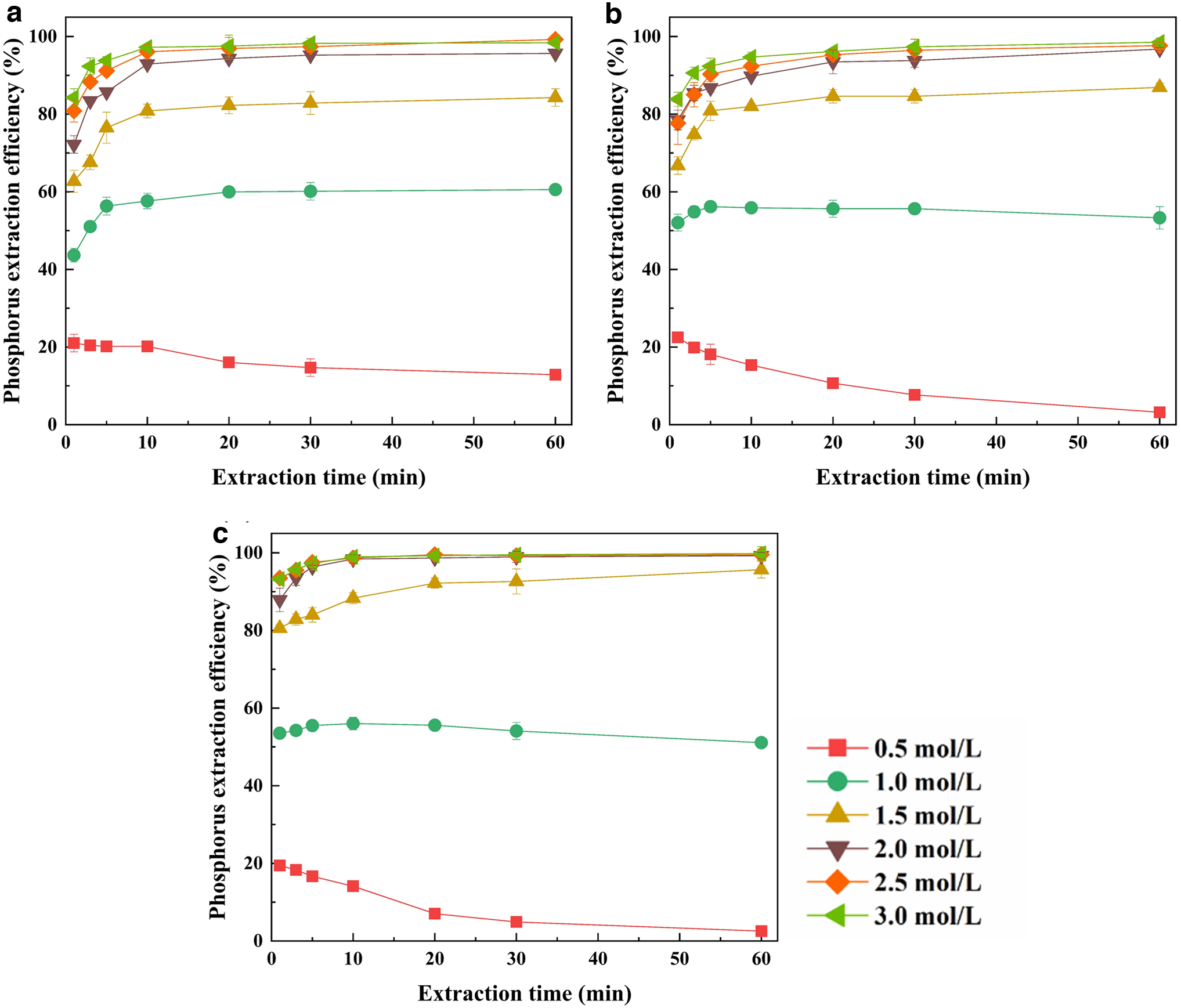
Effect of extraction time, HCl concentration and extraction temperature [
Effect of HCl concentration
The concentration of HCl is an important parameter that affects phosphorus extraction. It is used to determine whether there is sufficient substrate in the unit volume of the solution. With the increase in HCl concentration, the phosphorus extraction efficiency increased at different temperatures. As shown in Fig. 1, when the HCl concentration was lower than 2.0 mol/L, the extraction efficiency increased significantly with the increase of HCl concentration. However, when the concentration was higher than 2.0 mol/L, a significant increase in the extraction efficiency was not observed. At 25°C, the extraction efficiency of phosphorus was 92.9% (2.0 mol/L), while at others it was 96.1% (2.5 mol/L) and 97.2% (3.0 mol/L). The increase was only 3.2% and 4.3%, respectively. The same was true at 35°C and 45°C. It indicates that when the HCl concentration is 2.0 mol/L, not only higher phosphorus extraction efficiency can be obtained, but also the dosage of HCl and the operation cost can be reduced. So, 2.0 mol/L is the best HCl concentration for extracting phosphorus.
Effect of extraction temperature
Extraction temperature can affect the rate of phosphorus extraction. The reaction between HCl and SIBA is exothermic. The increasing temperature would inhibit the forward reaction. Furthermore, the need for additional heating equipment to increase the temperature to 45°C increases the operational cost. At the extraction time of 10 min, HCl concentration of 2.0 mol/L, stirring rate of 200 rpm, and liquid-solid ratio of 3 mL/g, the extraction efficiency of phosphorus was 92.9% and 98.4% at 25°C and 45°C (Fig. 1), respectively, with an increase of only 5.5%. Therefore, 25°C is taken as the best temperature for phosphorus extraction.
Effect of stirring rate
An appropriate stirring rate helps SIBA attain better contact with hydrochloric acid, which leads to an efficient reaction between the two. When the stirring rate increased from 50 to 200 rpm, the phosphorus extraction efficiency increased rapidly, from 52.4% to 92.9% (with an increase of 40.5%). When the stirring rate was increased to 400 rpm, the phosphorus extraction efficiency decreased to 91.8% (Fig. 2a). It can be seen that an appropriate increase in the stirring rate helps the SIBA particles to fully interact with the hydrochloric acid solution. This improves phosphorus extraction efficiency. When the stirring rate is higher than 200 rpm, a small amount of SIBA particles splashed to the wall and spilled outside the container, reducing the phosphorus extraction efficiency. Further, increasing the stirring rate resulted in an increase in energy consumption, but the phosphorus extraction efficiency did not change significantly. So, the best rotation speed was 200 rpm leading to a higher phosphorus extraction efficiency and reduced energy consumption.
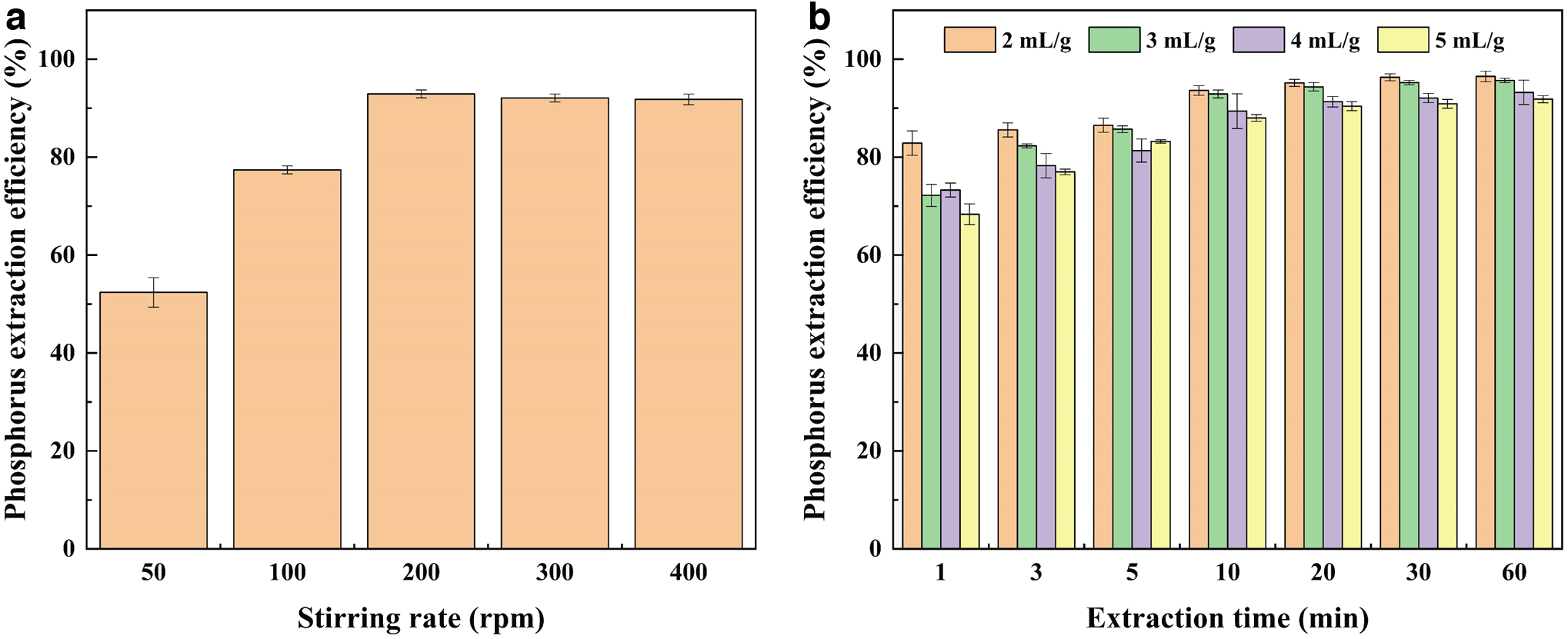
Effect of
Effect of liquid-solid ratio
The liquid-solid ratio not only affects the rate of phosphorus extraction but also affects the subsequent preparation of phosphorus products. As shown in Fig. 2b, when the reaction was carried out for 10 min, the phosphorus extraction efficiencies were 93.6%, 92.9%, 89.4%, and 88.0% at the liquid-solid ratio of 2, 3, 4, and 5 mL/g, respectively. This revealed that reducing the liquid-solid ratio can indeed increase phosphorus extraction efficiency. However, when the liquid-solid ratio was too low (2 mL/g), the obtained phosphorus extract was too thick to filter. So, 3 mL/g was the best liquid-solid ratio.
In summary, the best phosphorus extraction conditions were extraction time: 10 min; hydrochloric acid concentration: 2.0 mol/L; extraction temperature: 25°C; stirring rate: 200 rpm, and liquid-solid ratio: 3 mL/g. The phosphorus extraction efficiency obtained under this condition was 92.9%, and the phosphorus concentration in the extract was 23.2 g/L.
Metals migration during the extraction of phosphorus with HCl
The use of HCl during phosphorus extraction leads to the leaching of metals. It can be seen from Supplementary Tables S1 and S2 that SIBA contains more metal oxides and the composition is more complex. Therefore, excessive HCl not only extracts the phosphorus from it, but also leaches a large amount of Al, Fe, and other metals. In addition, due to the high content of metals, it also consumes a large amount of H+, which affects the extraction efficiency of phosphorus. Meanwhile, this can potentially affect the purification of the subsequent phosphorus extracts. Therefore, it is necessary to explore the migration of metals between the solid and liquid phases. The migration of metals was investigated at different HCl concentrations (0.5 and 2.0 mol/L).
Metals migration at 0.5 mol/L HCl concentration
Figure 3a shows the distribution of metals between the solid and liquid phases when the HCl concentration was 0.5 mol/L. It can be seen that the migration ability of the metals exhibited a downward trend with the increase of time. Most of the metals remained in the SIBA. Nonetheless, the extraction efficiency for some metals exhibited an upward trend (such as Mn and Zn). In the whole process, the order of metals extraction efficiency with greater environmental impact was As > Cd > Cu > Zn > Pb > Cr. It indicates that the migration ability of As was the largest.
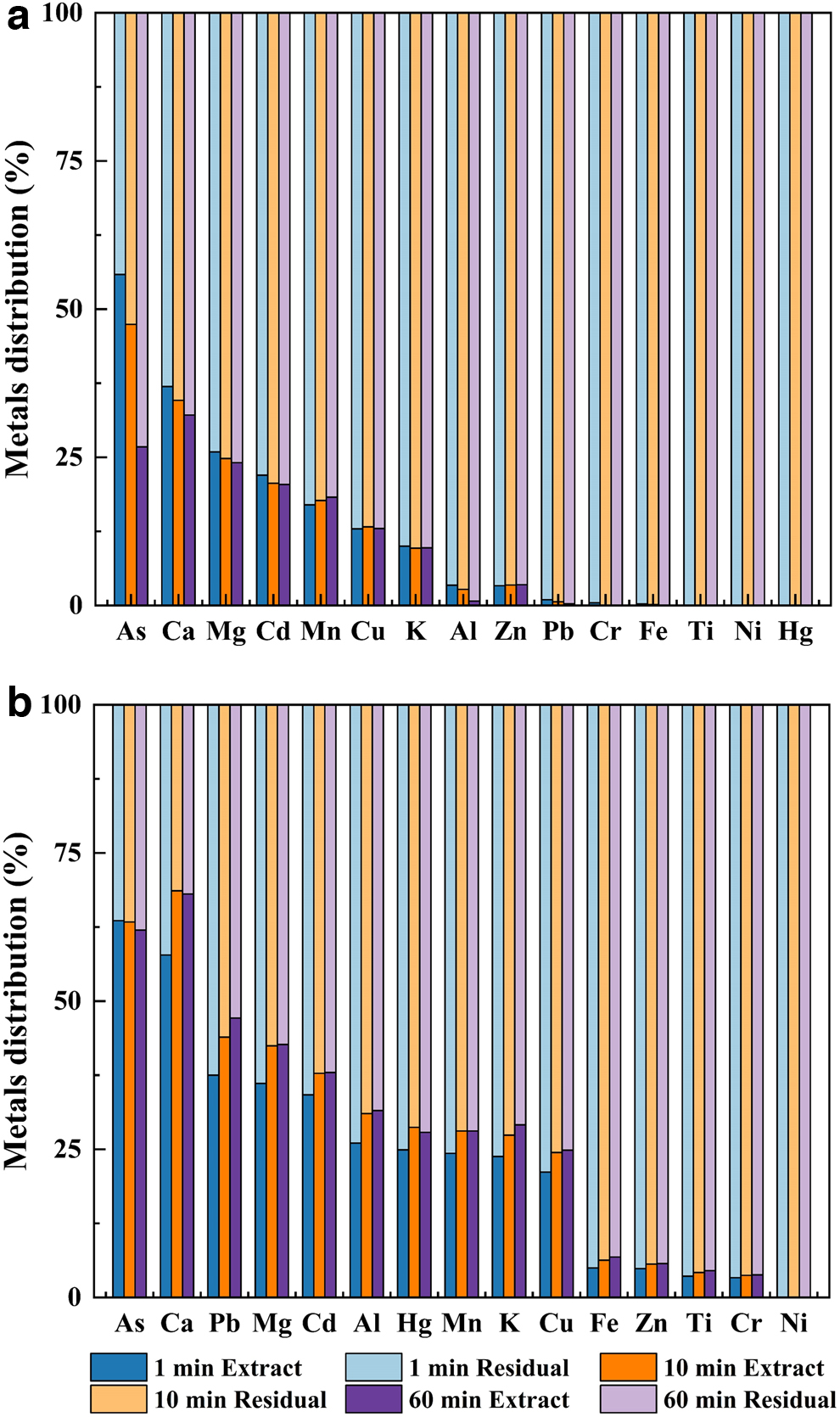
Distribution of metals between extracts and residues [
It had been observed that at low HCl concentrations, the migration of metals followed a process involving release and adsorption. When the HCl concentration of 0.5 mol/L was used to extract phosphorus from SIBA, H+ could quickly react with a part of SIBA within 1 min. A small amount of metals could be extracted with the leaching of phosphorus (Ca, Mg, Al, Fe, As, Cd, Cr, etc.). With the passage of time, the leached phosphorus and metals might be re-adsorbed on the SIBA residues (Luo et al., 2019; Wang et al., 2019a, 2019b). The occurrence of this phenomenon has also been confirmed in other literature (Ottosen et al., 2013). This is mainly due to the complexity of the phosphorus extract system and the slower reaction kinetics, so that phosphorus is adsorbed on SIBA residues over time. At the same time, since SIBA has a large specific surface area and rich pore structure, it has received extensive attention as an adsorbent. Further, the main mechanisms of metals removal are ion exchange, precipitation and complexation (Wang et al., 2019a). Because of this, the amounts of the metals in the extract were reduced.
Metals migration at 2.0 mol/L HCl concentration
As can be seen from Fig. 3b, most metals could be extracted with HCl at a concentration of 2.0 mol/L. In addition, the amount of metals extracted increased with the entire reaction process. Compared with the HCl concentration of 0.5 mol/L, the content of metals in the extraction solution significantly increased, including some undetected metals (such as Ti and Hg) at low HCl concentrations. This showed that sufficient amounts of H+ were present to react quickly with SIBA during the extraction of most metals. However, the majority of the metals remained in the SIBA residues. It indicated that metal leaching had little influence on the extraction process of phosphorus and the purification of the extraction solution.
Mechanisms of phosphorus and metals migration
Kinetics of phosphorus migration
According to Metals Migration During the Extraction of Phosphorus with HCl section, phosphorus migration at low (0.5 mol/L) and high (2.0 mol/L) HCl concentrations exhibited different trends. Under low HCl concentrations, SIBA showed the properties and functions of an adsorbent as the extraction time increased. At high HCl concentrations, phosphorus is always released. Therefore, the kinetics of the entire phosphorus extraction process was studied.
Kinetics of phosphorus adsorption under low HCl concentrations
The extraction time was extended until the concentration of phosphorus in the extraction solution did not decrease further. The phosphorus concentration obtained at the extraction time of 1 min was taken as the initial phosphorus concentration of the extract, which is the adsorbate. SIBA residue was used as the adsorbent to obtain the phosphorus adsorption capacity at different time. The phosphorus extraction efficiency and adsorption capacity at different temperatures are shown in Fig. 4a. The phosphorus extraction efficiency continued to decrease till 60 min and remained almost unchanged thereafter. Meanwhile, the adsorption capacity of phosphorus in the SIBA continued to increase till 60 min and reached an adsorption equilibrium after 60 min. To describe the adsorption process more accurately, the pseudo-first-order and pseudo-second-order models, and the M-W internal diffusion model, were used. The results are shown in Supplementary Table S3 and Fig. 4b–d. At different temperatures, R2 of the pseudo-first-order model was larger than 0.99, and that of the pseudo-second-order model was in the range of 0.60–0.90. The results revealed that the adsorption process conformed to the pseudo-first-order model. The adsorption process was primarily controlled by a single factor, namely the number of active points. In addition, when the M-W internal diffusion model was used for fitting the data, it was found that R2 was more than 0.90, and the fitting curve did not pass through the original point. It was revealed that during the process of phosphorus adsorption, there was surface adsorption and diffusion adsorption (i.e., occupied point adsorption).
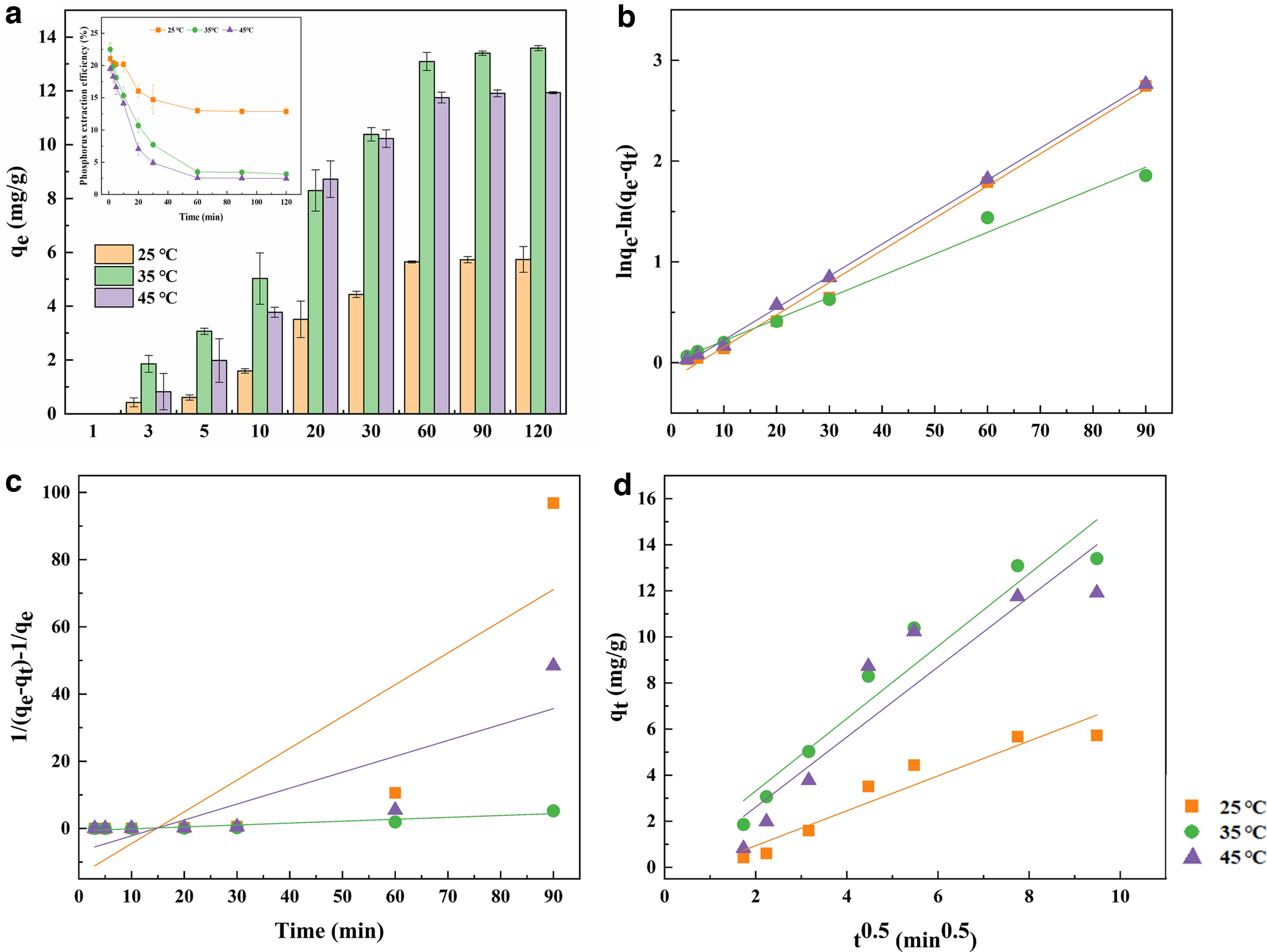
Kinetics of phosphorus release under high HCl concentrations
At high HCl concentrations, the whole reaction process had been shown to release phosphorus. It can be seen that the phosphorus extraction efficiency rises rapidly in a short time, and then it increases slowly and tends to be flat. This shows that some factors in the process hinder the progress of the reaction process, showing a more obvious self-impeding phenomenon. The Drozdov equation is a dynamic model with self-impeding coefficient (He et al., 2016). Therefore, it is suitable to analyze the phosphorus release kinetics. The slope of the fitting curve is the retardation coefficient (B), and the intercept is the reaction rate constant (K). The fitting results are shown in Supplementary Table S4 and Fig. 5. R2 was >0.99, and K was positive, indicating that the Drozdov equation could better describe the release process. Moreover, as the HCl concentration increased, both the values K and B became larger. This is because a higher HCl concentration indicates an increased amount of H+. The rate of diffusion on the SIBA surface can potentially increase, thereby accelerating the reaction process, which is manifested as an increase of K. On the other hand, more H+ can cause an increase in the viscosity of the extraction solution increasing the obstacles faced during the phosphorus extraction process. Thus, B increases. Furthermore, at different temperatures, the values of K and B differed significantly. K and B increased with temperature, exhibiting a positive correlation. The increase in B was higher than that of K, indicating that the reaction would be strongly inhibited by increasing temperature.
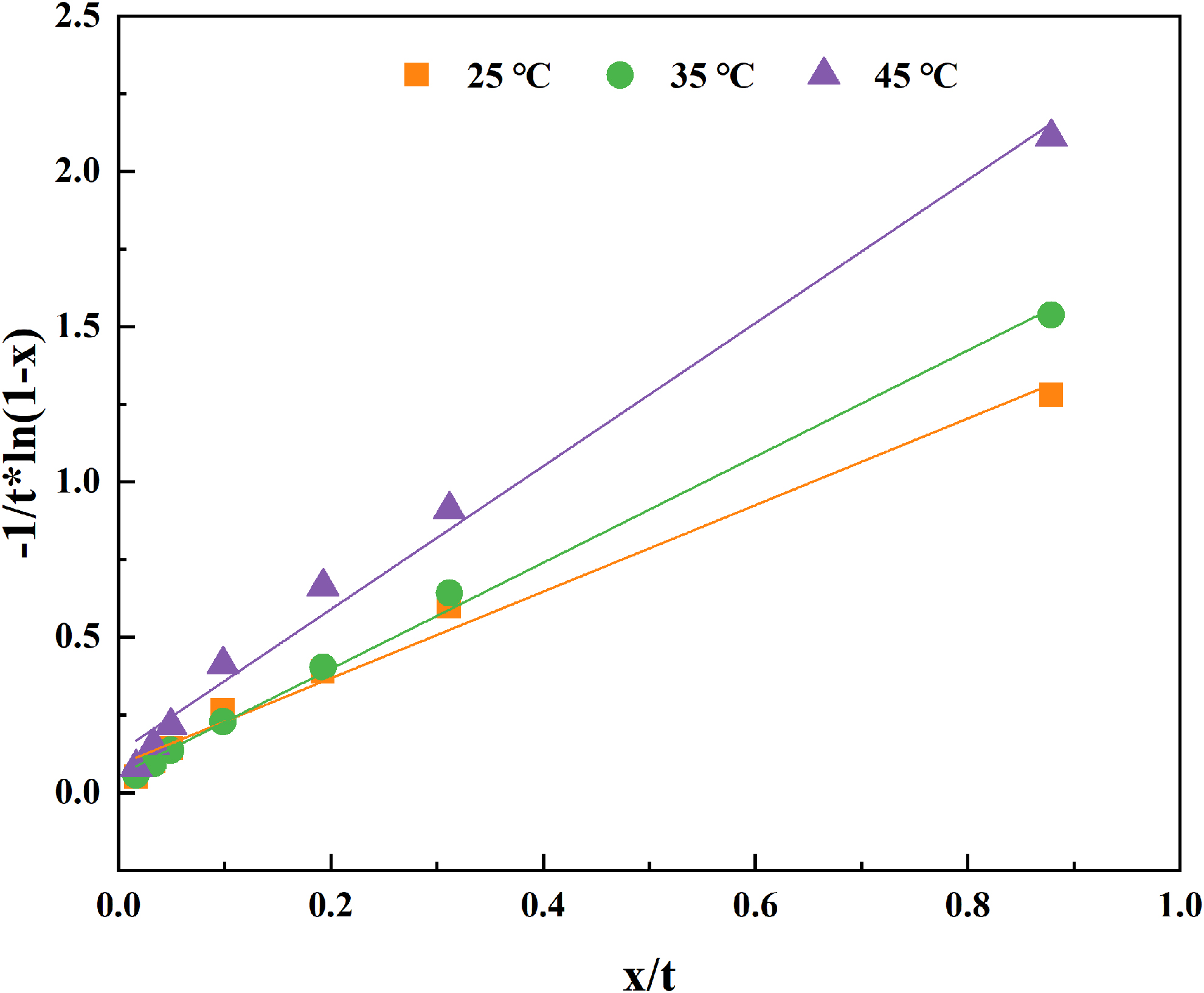
Kinetic fitting curve for phosphorus release. Experimental conditions: CHCl = 2.0 mol/L, stirring rate = 200 rpm, and liquid-solid ratio = 3 mL/g.
Microscopic models of phosphorus and metals migration
Microscopic model of phosphorus and metals adsorption
At low HCl concentrations, phosphorus and metals present in SIBA were released into the extraction solution quickly. Subsequently, they were adsorbed on the SIBA particles again. A pseudo-first-order model can describe the adsorption process. This means that the adsorption process is only affected by the number of adsorption sites on SIBA. It is assumed that the SIBA particles are approximately spherical, and a liquid film is formed around the particles in solution. The characteristics of the migration of phosphorus and metals are as follows: (1) in a very short time, H+ diffuses from the solution through the liquid film to the sludge incinerated bottom ash particles; (2) H+ reacts with compounds on the sludge incinerated bottom ash particles to release phosphorus (PO43−, HPO42+, H2PO4+, and H3PO4) and various metals (Ca2+, Mg2+, Al3+, etc.); (3) phosphorus and metals diffuse into the solution through the liquid film; (4) phosphorus and metals from the solution pass through the liquid film to the surface of sludge incinerated bottom ash particles; (5) phosphorus and metals are adsorbed at different sites on the surface of the particles. The microscopic model is shown in Fig. 6 [A refers to H+; B refers to the substances present on the SIBA particles, such as Ca19Fe2(PO4)14; C refers to the reaction products].
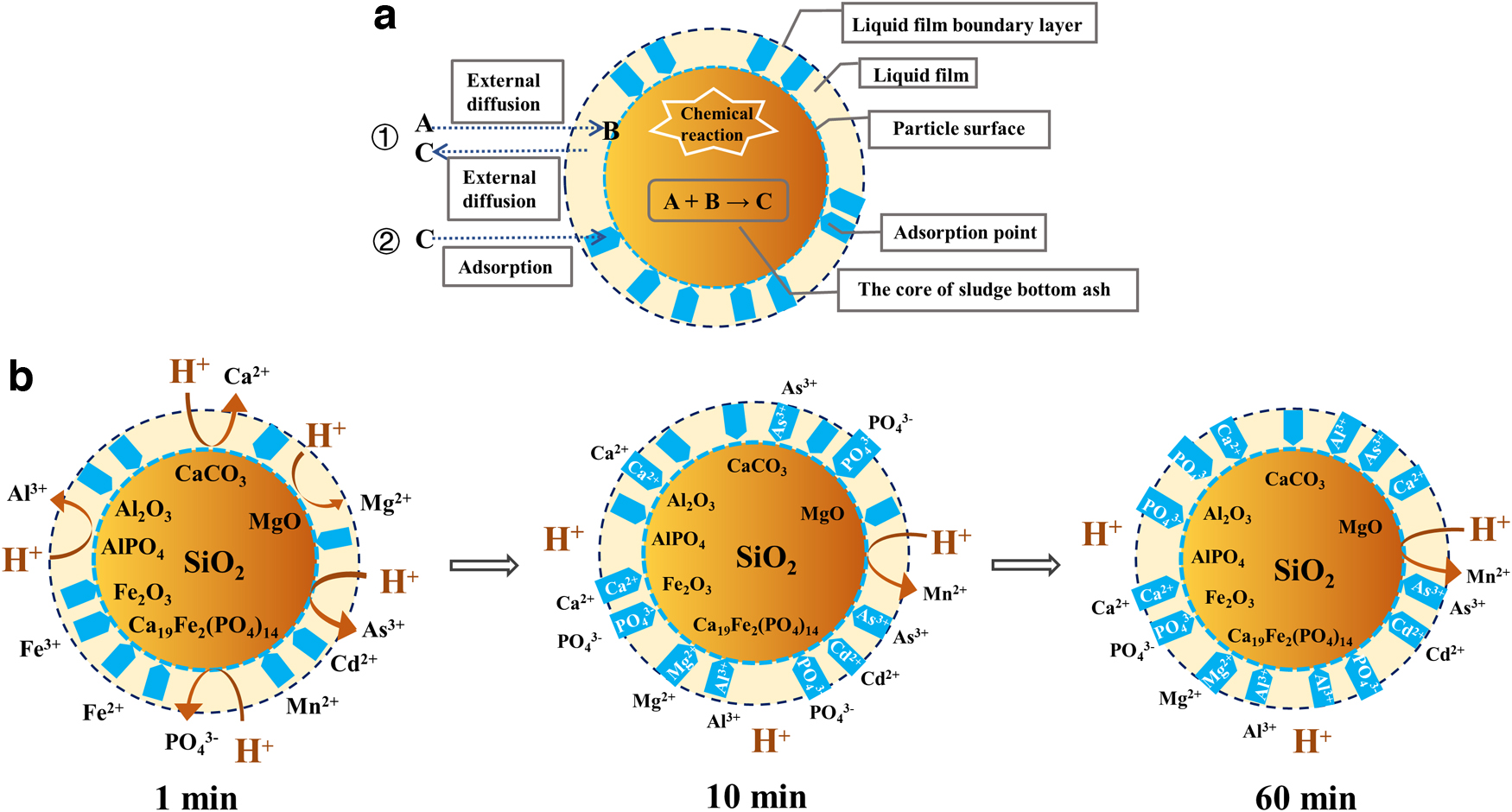
Microscopic model of phosphorus and metals release
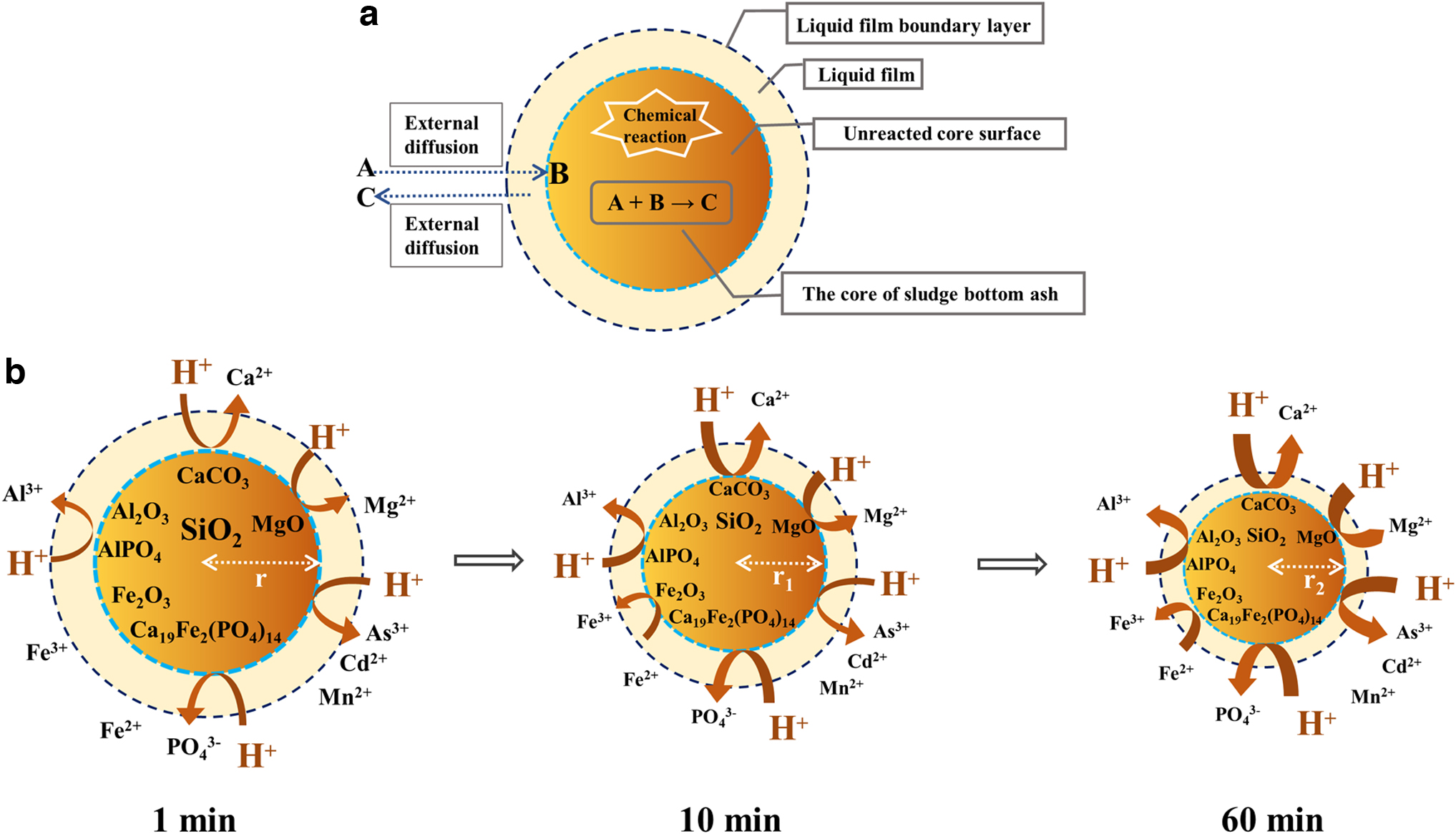
The extraction of phosphorus from SIBA using a high HCl concentration is a typical fluid–solid noncatalytic reaction. When HCl solution and SIBA are in contact, H+ reacts with the substances present in SIBA. After this, the reaction products were released into the solution. Meanwhile, the sizes of the SIBA particles decrease gradually. This conforms to the shrinking core model (He et al., 2016). It is assumed that the SIBA particles are approximately spherical. A liquid film is formed around SIBA in solution. There is a boundary layer between the liquid film and the solution. The reaction proceeds as follows: (1) H+ diffuses from the solution to the sludge incinerated bottom ash particles surface through the liquid film boundary; (2) H+ reacts with the substances present in the sludge incinerated bottom ash particles to release PO43−, HPO42+, H2PO4+, H3PO4, Ca2+, Fe2+, and so forth; (3) PO43–, Ca2+, Fe2+, and other ions diffuse from the particles surface to the liquid film, and then into the solution. The microscopic model is shown in Fig. 7 [A refers to H+; B refers to the substances present on the SIBA particles, such as Ca19Fe2(PO4)14; C refers to the reaction products].
Conclusion
In this study, HCl was used to extract phosphorus from SIBA with a low liquid-solid ratio. The best conditions of phosphorus extraction were determined (extraction time: 10 min, HCl concentration: 2.0 mol/L, extraction temperature: 25°C, stirring rate: 200 rpm, and liquid-solid ratio: 3 mL/g). The phosphorus extraction efficiency was 92.9%, and the phosphorus concentration in the extraction solution was 23.2 g/L under this condition. It is noteworthy that a high phosphorus extraction efficiency was achieved at a low liquid-solid ratio (3 mL/g). This is an interesting result, and it can effectively reduce the production of waste chemicals. Another exciting observation was that the migration of phosphorus and metals during the extraction process could be easily elucidated. At low concentrations of HCl, phosphorus and metals migrated to the extraction solution within a very short time. With the progress of time, they were adsorbed on the SIBA particles. This process conformed to the pseudo-first-order model and was mainly controlled by the number of adsorption sites. At high HCl concentrations, phosphorus and metals were continuously released into the solution. This phenomenon could be described by the Drozdov equation. The higher the HCl concentration and extraction temperature, the larger were the K and B values. Most metals remained in the SIBA residues irrespective of the concentration of HCl used. The metals exhibited weak migration ability. This work reports a feasible method for recovering phosphorus and reveals the migration of phosphorus and metals in SIBA during this process. The results are beneficial for future research in this field.
Footnotes
Authors' Contributions
H.H.: experiment; data curation. Y.C.: conceptualization; supervision; writing—review and editing; methodology. M.L.: project administration; conceptualization; funding acquisition; writing—review and editing. L.X.: experiment.
Author Disclosure Statement
No competing financial interests exist.
Funding Information
This work was supported by the Science and Technology Major Projects of Sichuan Province “Technology Integration and Demonstration of Stability and Standard Achievement in Urban Sewage Treatment Plant” (No. 2019YFS0501) and the Opening Project of National Engineering Laboratory for “Advanced Municipal Wastewater Treatment and Reuse Technology” (No. 201803).

References
Supplementary Material
Please find the following supplemental material available below.
For Open Access articles published under a Creative Commons License, all supplemental material carries the same license as the article it is associated with.
For non-Open Access articles published, all supplemental material carries a non-exclusive license, and permission requests for re-use of supplemental material or any part of supplemental material shall be sent directly to the copyright owner as specified in the copyright notice associated with the article.
