




Abstract
Addressing society's water and energy challenges requires sustainable use of Earth's critical zones and subsurface environment, as well as appropriate design and application of porous materials for resilient infrastructure and membranes for water treatment/recovery. Reactive transport models (RTMs) provide a powerful tool for environmental engineering and science professionals to investigate the complex interplay between biogeochemical reactions, flow, transport, and heat exchange, which control the dynamic behaviors of these systems. RTMs are, thus, able to inform engineering design and policy making for sustainable use of Earth's critical zones and subsurface environment. This special issue on “Addressing Society's Water and Energy Challenges with Reactive Transport Modeling” provides a few examples that illustrate the diverse application of RTMs in informing practices, including resource recovery, subsurface energy extraction, and carbon mitigation. In this article, we present a brief overview of the development of the research field of reactive transport modeling and its growing applications in environmental engineering and science in the past three decades. We also provide perspective on the frontiers of reactive transport modeling research and emergent application areas that are critical for addressing water and energy challenges our society faces. Example application areas include groundwater quality management, mine waste pollution management, safe nuclear waste disposal, reliable geological carbon storage, climate–water interactions, materials for resilient infrastructure, recovery and valorization of critical materials, groundwater resource management for drought mitigation, negative carbon emissions, and subsurface renewable energy.
Perspectives
Sustainable supply of water and energy is one of the grand challenges and opportunities facing the environmental engineering community for the 21st century. Designing and implementing impactful solutions require creative and sustainable use of the subsurface and other Earth's natural environments, as well as technological innovations in treatment and other engineered systems (Fig. 1). Fundamental and applied research that support the development of such solutions need to capture complex system dynamics, which makes reactive transport modeling that is capable of simulating multiphysics, for example, coupled biological–chemical–physical processes, across scales extremely valuable.
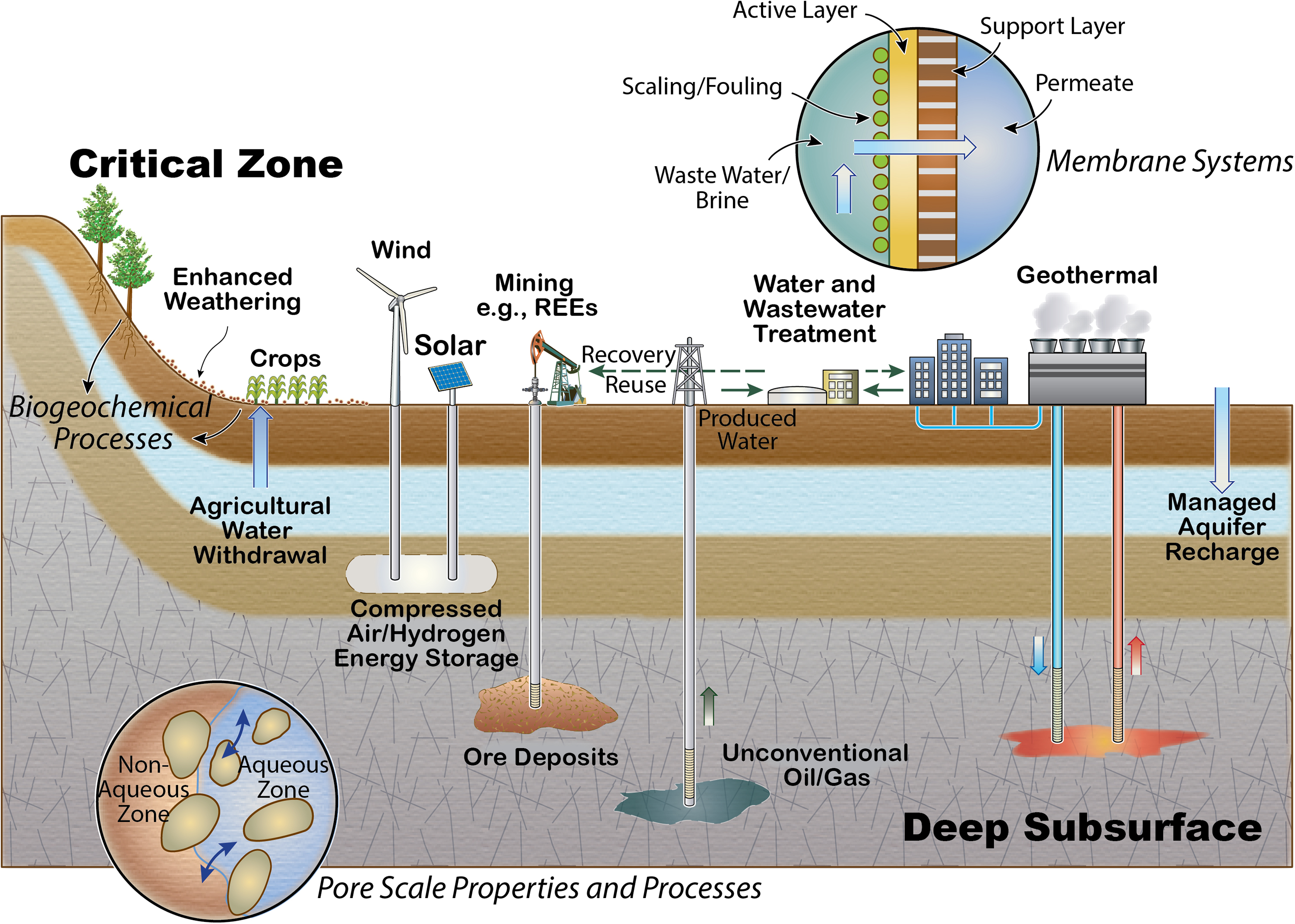
Conceptual illustration of Earth's critical zones and subsurface and engineered systems for addressing our society's water and energy challenges. Reactive transport modeling is playing a critical role in related emerging research areas, including recovery and valorization of critical resources and materials, groundwater resource management for drought mitigation, negative carbon emissions, and subsurface renewable energy. The inset figures highlight a multiphase environment at pore scale that can be encountered in many natural systems and a membrane system as an example of the engineered systems.
Reactive transport models (RTMs) started with a handshake between traditional groundwater modeling and geochemical modeling, and embody the coupling of groundwater flow and solute transport equations with the laws of mass action and kinetic rate equations to predict the production, fate, and transport of reactive species. The origins of groundwater modeling focused on water resources, and was extended to include transport of simple solutes (Kitanidis and Bras, 1980; Celia et al., 1989). Geochemical models were developed to apply the principles of chemical thermodynamics and kinetics to calculate speciation at equilibrium or track the temporal reaction path in complex chemical systems (Helgeson, 1968). Initially limited to batch systems, geochemical models were used to investigate reaction networks and chemical evolution in Earth and environmental systems such as groundwater aquifers (Plummer et al., 1990; Postma et al., 1991; Zhu, 2012).
Eventually science drove the need to track the fate and transport of complex emergent contaminants that could not be represented by simple reactions such as linear partitioning and exponential decay. Furthermore, the need emerged to account for contaminants that exist in different oxidation states, different aqueous species, and multiple phases (e.g., non-aqueous phase liquids, water), depending on variations in environmental conditions. This scientific need for models that couple flow and transport with biogeochemical speciation and reactions co-occurred with advancements in computational power, data storage, and unprecedented accessibility to numerical simulation tools. This prompted a surge in the development of RTMs in the 1990s (Yeh and Tripathi, 1991; Lichtner, 1996; Steefel and MacQuarrie, 1996; Clement et al., 1998; Yabusaki et al., 1998; Sun and Clement, 1999; Xu et al., 1999).
In the early 2000s, reactive transport modeling grew into a mature and well-established research field, and has become an important tool for investigating both the subsurface and Earth's critical zones (Steefel et al., 2005; Li et al., 2017) (Fig. 1). Modern RTMs commonly implement a full (bio)geochemical framework that considers chemical heterogeneity, multiple organic and inorganic chemicals, and complex parallel and consecutive reaction pathways. Rich data sets of thermodynamic properties, kinetic mechanisms and rate constants, and distributions of mineralogy and surface area at small scales, among others, generated through advances in molecular level modeling and probing techniques (e.g., microscopy and spectroscopy) are now also incorporated into RTMs (Tokunaga et al., 1998; Goldberg et al., 2007; Scheibe et al., 2009; Y. Wu et al., 2011; Viswanathan et al., 2012; Deng et al., 2016, 2020; Beckingham et al., 2017).
RTM has a long history of application in environmental engineering and science, which is steadily increasing (Fig. 2). Over the 30 years between 1990 and 2019, 33% of publications from a Web of Science search of the keyword “reactive transport model*” are tagged with Environmental Sciences, and 14% categorized as Environmental Engineering, ranking #1 and #5 among all disciplines. Water Resources has consistently been the primary application area for RTM, and in the past decade, energy emerged as one of the primary application areas.
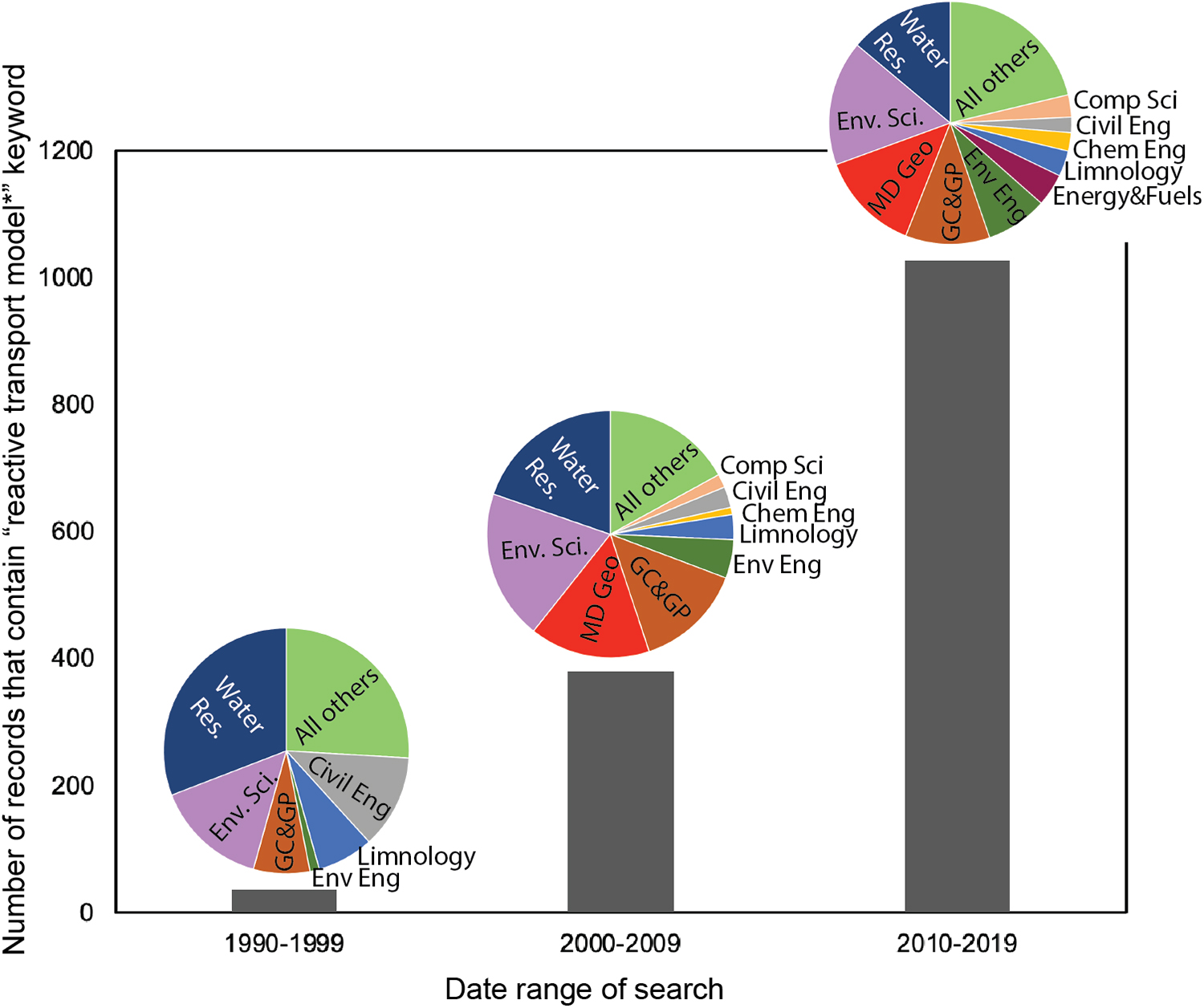
Number of records from “reactive transport model*” keyword search in the Web of Science (© 2020 Clarivate Analytics) for the periods of 1990–1999, 2000–2009, and 2010–2019. The pie charts highlight the relative percentages of records associated with specific subject areas. The top 10 subject areas in the period of 1990–2019 are shown in discrete colors, including Environmental Sciences (Env. Sci.), Water Resources (Water Res.), Multidisciplinary Geosciences (MD Geo.), Geochemistry Geophysics (GC&GP), Environmental Engineering (Env. Eng.), Limnology, Energy & Fuels, Computer Science Interdisciplinary Applications (Comp. Sci.), Chemical Engineering (Chem. Eng.), Civil Engineering (Civil Eng.). All other subject areas are combined in “All others.” Note that a record might be associated with more than one subject area, and some of these subject areas emerged after 2000 or 2010.
Overall, the top three application areas of reactive transport modeling that are of particular interest to the environmental engineering and science community in the past three decades are groundwater contamination and remediation (Walter et al., 1994; Mayer et al., 2001; Zhu et al., 2001; Gibson et al., 2011; Wallis et al., 2011; Yabusaki et al., 2011; Prommer et al., 2019), mine waste pollution management (Wunderly et al., 1996; Runkel and Kimball, 2002; Amos et al., 2004; Jurjovec et al., 2004; Mayer et al., 2015), and subsurface systems such as nuclear waste disposal and geological carbon storage (Spycher et al., 2003; Goldberg et al., 2007; Xu et al., 2010; Aradottir et al., 2012; Viswanathan et al., 2012; Navarre-Sitchler et al., 2013). Patil and McPherson (2021) in this special issue presents a review of reactive transport modeling in fault zones, which is an important feature that controls solute transport and fluid migration in the underground. It includes a thorough discussion of different conceptual models and numerical approaches, with a focus on self-sealing and self-enhancing of the fault zones as a result of water–rock interactions.
Natural and engineered systems are rarely static, and are subject to alteration due to processes such as mineral dissolution and precipitation and biofilm growth. Current RTMs can account for dynamic changes in physical properties of the systems investigated by tracking porosity and surface area evolution in continuum-scale models (Xie et al., 2015) and mineral–fluid interface geometry in pore-scale models (Molins et al., 2020). These expanded capabilities make long-term predictions about system evolution that draw inferences from much shorter-term laboratory experiments possible with RTMs. This development of dynamic modeling capability has benefited enormously from the development of nonintrusive imaging techniques and 4D scanning (Deng et al., 2015, 2020; Voltolini and Ajo-Franklin, 2020). For instance, the RTM developed by Ling et al. (2021) in this special issue is based on x-ray micro-computed tomography imaging, synchrotron micro x-ray fluoresence, and micro x-ray diffraction data from experimental studies.
As the field of RTM moves forward, the multitude of advances provide the backbone for further development of multiphysics codes. Existing RTMs can be readily expanded to couple additional physical processes (Beisman et al., 2015; Tournassat and Steefel, 2019), which will broaden the role of RTMs in environmental studies. For instance, recent developments include models that solve energy balance across the land–atmosphere interface and surface flow equations to expand application of RTM to coupled surface water–groundwater systems and consider climate forcings (Beisman et al., 2015; Li et al., 2017). Advances in subsurface RTM include the coupling between reactive transport and mechanical processes (Spokas et al., 2019). As shown in Gonzalez-Estrella et al. (2021) in this special issue, geochemical reactions between brine and cement and the confining stress acted together in controlling the hydraulic and mechanical properties of fractured cement. Both mineral precipitation and deformation of fracture asperities contributed to a decrease in fracture hydraulic conductivity. Further development of RTMs to account for such interactions is required for more accurate assessments of wellbore integrity, cement-based or other materials used for resilient infrastructures (e.g., permeable pavement systems and low-carbon cements).
RTMs can also be readily coupled with statistical methods or machine learning algorithms for sensitivity analyses and to quantify uncertainties associated with thermodynamic and kinetic data and other model inputs. It cannot be overemphasized that this type of coupling can only be meaningful when the RTMs are tested and validated against experimental measurements and/or field observations. Li et al. (2021) in this special issue reports a global sensitivity analysis of the controlling parameters for scale development in shale-hydraulic fracturing fluids systems. A validated RTM was used to generate data under a multitude of conditions to systematically evaluate the key controls and to inform operations that minimize the environmental impact and water consumption. These advancements will bring an expansion of the use of RTM to inform policy making. RTM results with quantifiable uncertainty can be incorporated in risk analysis (Siirila et al., 2012) and RTMs can be directly included as a module in integrated assessments. Deng et al. (2017) is among the first to present a framework that couples process-based physical modeling and integrated assessment models to investigate leakage risks associated with geological carbon storage and the impacts on global energy systems and carbon mitigation efforts. This kind of framework can be leveraged to expand the role of RTMs in policy making.
Emerging RTM Applications
After continuous advancements, RTMs are expected to play an increasing role in emerging areas that are of interest to environmental engineering and science communities and that are critical for addressing water-energy challenges our society faces (Clarens and Peters, 2016; National Academy of Engineering and National Academies of Sciences, Engineering, and Medicine, 2019). In this study, we highlight a few example application areas (as also illustrated in Fig. 1), which have demonstrated great potential for leveraging/developing RTM capabilities to examine system-specific processes and parameters to inform reverse engineering and operation optimization.
Sustainable recovery of rare earth elements (REEs). REEs are critical for making materials necessary for renewable energy production and storage (e.g., battery), and their mining is typically associated with extensive environmental damage. Recovering REEs from waste streams and natural deposits in an efficient and environmentally friendly manner benefits from the application of reactive transport modeling. Chang et al. (2021) in this special issue provides an example of optimizing extraction of high-value lanthanides using a new approach to separate specific REEs by leveraging Escherichia coli cells engineered with lanthanide binding tags.
Membranes for resource recovery and valorization. Advanced membrane technologies enable recovery of fresh water, nutrients, and trace elements from unconventional water resources, which include a multitude of sources such as industrial wastewater and brines as opposed to the conventional sources of rainfall, snowfall, and river runoff. One important challenge many membrane systems face is scaling and fouling. RTMs, especially pore-scale RTMs, provide a valuable tool for investigating precipitation or deposition at membrane surfaces, dependence of these processes on fluid chemistry and flow rate, as well as the resulting impacts on membrane permeate flux. Findings from the modeling studies can complement experimental observations to improve membrane designs and optimize operational parameters.
Groundwater banking for water management and drought mitigation. In contrast with natural infiltration, groundwater banking introduces large amounts of fluids at disequilibrium with the aquifers, which can trigger chemical reactions that affect the aquifer properties and water quality (Wu et al., 2019). RTMs can be used for predictive understanding of these processes and thus for better engineering design. In this special issue, Özgen-Xian et al. (2021) present an RTM for efficient simulation of groundwater. The study implemented a new relaxation approach in solving the diffusion equation, which allowed consideration of more complex systems with larger time stepping. The modeling capability is also illustrated in a real-world case study, in which intra-meander groundwater flow and reactive transport were simulated.
Negative emission technologies for climate change mitigation. It has been shown that to achieve our goals for climate change mitigation, negative emission technologies must play an increasingly important role (Fuhrman et al., 2019). Enhanced weathering involves accelerated weathering of geomaterials, and is one technological option that holds great potential but requires more investigations on its environmental impacts and economic costs (National Academies of Sciences, Engineering, and Medicine, 2019). RTMs have been widely used to study geological carbon storage and carbon dioxide (CO2) mineralization. For example, Ling et al. (2021) investigated mineral precipitation resulting from interactions between CO2 and calcium silicates, and their impacts on the flow and transport properties of porous media in the context of geological carbon storage. These capabilities can be transferred and adapted to investigate technological options such as enhanced weathering, to optimize engineering practices regarding grain size and application frequency of the rock materials and to minimize its environmental impacts.
Engineering the subsurface for renewable energy. Geothermal energy extraction is one example of using the subsurface for renewable energy production. Using it for electricity generation and urban heating and cooling involves flowing fluids across large temperature gradients that can result in mineral reactions and corrosion or clogging of the flow paths. Engineering designs can be improved by using RTMs to evaluate pumping scenarios. Another example is subsurface energy storage, which involves temporary storage of compressed air or hydrogen gas in subsurface formations, and can be used to address the intermittency issues associated with renewables. Its security and efficiency depends on the interactions of the stored gas, displaced fluids, and the reservoir. Iloejesi and Beckingham (2021) in this special issue explores the possibility of utilizing CO2 as a cushion gas for compressed energy storage. Using RTMs, this study evaluated the potential alteration of the formations due to the presence of CO2. They demonstrated that the changes in porosity overall are limited with cyclic injection–extraction operation compared with the injection only scenario.
Footnotes
Author Disclosure Statement
No competing financial interests exist.
Funding Information
The authors would like to thank the support from Laboratory Directed Research and Development (LDRD) funding from Berkeley Lab, provided by the Director, Office of Science of the U.S. Department of Energy (DOE) under contract no. DE-AC02-05CH11231, and from the National Science Foundation through award number 1935321 (NSF-EAR).