




Abstract
For the first time, an industrial solid waste (CAS) was used for the rapid oxidation and neutralization of acidic sulfate soil. The waste mainly contained Fe-doped CaCO3 and CaAl-layered double hydroxide (LDH). After treatment, CAS neutralized the acidic soil with the aid of hydrogen peroxide. Compared with other oxidation-accelerating materials, including activated carbon, biochar, and Fe-doped biochar, CAS showed the best oxidation rate acceleration. When the ratio of CAS and sulfur in acidic soil was 1.5:1, the pH of the soil changed to 6.32 and the oxidation rate increased by 50%. The characterization results showed that the main products of CAS were CaMg oxides and Ca-Al LDH. The oxidation product (SO42−) was intercalated into the LDH interlayers. The accelerated oxidation mechanism of CAS was divided into the following stages: accelerated Fenton oxidation; LDH adsorption of oxidized SO42−; and neutralization of sulfuric acid by calcium carbonate. The main results of this work provide a high-value-added utilization method of solid waste for acidic soil remediation.
Introduction
Acid sulfate soil (ASS) is a poor soil type that is widely distributed in tropical and subtropical coastal delta plains and depressions (Zhang et al., 2020). For many harbor reclamation projects, there are potential problems associated with ASS. When a hydraulic reclamation project was carried out, it produced acidic soil containing reducing sulfur that required to be exposed to air (Neumann-Mahlkau, 1993), controlling and completely neutralizing its acidity. Generally, one of the necessary conditions for such a project is the treatment of acid sulfate dredger fill to meet a particular standard. Otherwise, ASS may result in various damages. A large amount of acidic earthwork is produced by hydraulic reclamation projects in harbor areas, which typically have short time limits; therefore, a rapid oxidation method is necessary for treating ASS.
ASS is typically remediated by functional materials, industrial by-products, and other conditioners to inhibit the release of acids. The effect of dolomite and biochar on maize and legume yields, as well as soil properties, was compared in the acidic soil of the Madagascar highlands (Raboin et al., 2016). Biochar and dolomite significantly increased the yield of corn and beans, increased the soil pH, and reduced immutable aluminum (Raboin et al., 2016). In a strong acid environment, the increase of aluminum (pH-dependent element) in acid soil will produce toxic effects on plants, rivers, and aquatic organisms. Low lime fly ash-treated, lime-stabilized soil is highly stable and durable, which can limit expansion (uplift) caused by sulfate in acidic soil and improve the ground (Mccarthy et al., 2014). Calcite and magnesite were used to remediate acidified forest soil (Iljkic et al., 2019), and after 7 years of application, the pH of soil moisture was increased, and the Al concentration was decreased (Iljkic et al., 2019). Advanced oxidation processes have been widely used in soil remediation, such as ozone (Testolin et al., 2021), photocatalysis (Mambwe et al., 2021), electrochemical oxidation (Brillas, 2021), and chemical methods (using hydrogen peroxide, permanganate, and persulfate) (Neyens and Baeyens, 2003; Ushani et al., 2020). Highly active free hydroxyl radicals are produced during Fenton oxidation, which can oxidize S2− in ASS.
Fenton oxidation is one of the most popular advanced oxidation processes due to its strong oxidation potential, which provides efficient remediation against a wide range of environmental pollutants (Usman and Ho, 2020). During the Fenton reaction, many intermediate active species, such as hydroxyl radicals (•OH) with a high redox potential (2.20 V), oxidize and decompose organic and inorganic substances that are difficult to be decomposed by general chemical oxidation methods (Li et al., 2009). The oxidation efficiency of the Fenton system is affected by many factors, including temperature, reactants, dissolved oxygen concentration, properties of organic matter, and the type and content of additives. Recently, many Fe-containing solid wastes such as sludge (Bolobajev et al., 2014; Zhang et al., 2018; Liu et al., 2019) and clay (Garrido-Ramírez et al., 2010) have been used to form Fenton systems with H2O2. According to these reports, if an additive contains Fe, it can potentially form an effective Fenton system with H2O2 for the remediation of ASS.
Ca-Al-containing slag is a by-product of the cement industry that contains both alkaline substances and Fe. Therefore, this work investigates whether it is possible to form an effective Fenton system and neutralization system from Ca-Al-containing slag and H2O2, and then use them to remediate ASS. To highlight the advantages of the slag, it was compared with other typical soil remediation additives, including activated carbon, biochar, and Fe-doped biochar. After characterizing the Ca-Al-containing slag, a mechanism was proposed to explain why the slag was effective at remediating ASS. The main results of this work favored the use of high-value-added solid waste for the low-cost remediation of ASS.
Materials and Methods
Materials
ASS samples were collected from a mangrove area in Sanya City, Hainan Province, China. Supplementary Figure S1 in the supporting information shows the procedures used to obtain these soil samples. Table 1 lists the basic properties of ASS, which contained 70.0 ppm of Fe (mass concentration). According to field observations and measurements, the sulfur bearing layer in soil (surfur soil) is usually light yellow with jarosite mineral nodules and pH <4.0; the soil layer containing sulfide parent material (sulfide soil) was golden with a pH of 6.0–7.0, the color was unstable and turned to black after aeration (Karimian et al., 2018). The reducing sulfide (e.g., Fe2S) in an undisturbed ASS sample was partially converted to sulfuric acid by chemical oxidation, and the soil pH decreased from 6.81 to 2.5, which was consistent with the oxidation characteristics of the soil layer containing sulfide parent material. After ASS was transferred to the laboratory, it was stored in a freezer. The pH of sulfide-containing soil was 6.33, which decreased to 3.22 after hydrogen peroxide oxidation [15H2O2 + 2FeS2 → 14H2O + Fe2(SO4)3 + H2SO4]. These values were similar to soil oxidation measurements at the sampling site. In addition, a pyrite sample (PS) was supplied by a polymetallic sulfide mine in Xiangshan District, Guilin City, Guangxi Province.
Basic Properties of Acid Sulfate Soil
EC, soluble salt concentration.
CaAl-containing slag was supplied by a cement plant and was milled to 0.15 mm before being used and denoted as CAS. After X-ray fluorescence analysis, CAS contained 64.3% CaO, 16.4% Al2O3, 12.6% Cl, 4.1% SiO2, and 1.3% Fe2O3 (oxide-based).
Oxidation activity and neutralization ability
To investigate the effect of CAS on the oxidation rate, the oxidation abilities of CAS and three controls were compared. As conventional soil amendments, biochar and activated carbon have highly porous structures, large specific surface areas, and abundant surface functional groups that provide free radicals for acidic soil to accelerate oxidation. The controls included a coconut shell-derived activated carbon (AC, 100 mesh), corncob-derived biochar (BC, 100 mesh), and Fe2+-doped BC (FC, 100 mesh). AC was commercially available. BC was obtained by pyrolyzing corncob at 600°C for 2 h. The carbonized product was processed with 200 mL 1 M HCl for 12 h. Then, ash was removed, the sample was filtered, washed to neutrality with distilled water, and dried at 70–80°C in an oven. The main elements were C, H, and O. FC was prepared by an immersing method and contained 3% Fe. Fe(NO3)3 (0.0025 mol) was dissolved in 100 mL ethanol. After Fe(NO3)3 was completely dissolved, 20 g FC (0.150 mm) was added, stirred for 1 h, put into an oven at 105°C, dried for 12 h, and then put into a muffle furnace at 400°C for 3 h (Peng et al., 2021).
When the controls were dispersed in water, the pH of the resulting dispersion was 7.00. In comparison, when 2 g CAS was dispersed in 20 mL water, the pH >7.00; thus, dilute acid was used to neutralize the dispersion (pH = 7.00). Then, 5 g of ASS and 10 mL of H2O2 (pH = 7.00) were added to the obtained slurry. In this case, the weight ratio of H2O2 and S was 200:1. During this process, the mixture was continuously stirred by a magnetic mixer. The pH was measured every 5 min for 45 min. Control materials with the same dosage were used to substitute for CAS in the above processes. In addition, a blank (BK) was analyzed in which no solid was added to the above samples.
To investigate the influence of the CAS dosage on pH, experiments were designed as follows: X grams of CAS was mixed with 5 g of ASS and 10 mL of H2O2 (pH = 7). The weight ratio of CAS and S in ASS was X:1 (X = 1, 1.25, 1.5, 1.75, and 2), and the weight ratio of H2O2 and S was 200:1. The reaction time was 45 min. Each experiment was denoted as PX.
PS (3 g) and CAS (3 g) were mixed in 20 mL of deionized water and stirred for 30 min. Then, H2O2 (pH = 7) was added to the mixture, which was then stirred for another 30 min. Afterward, the mixture was centrifuged at 3,000 rpm for 15 min, dried at 105°C, and milled to 100 mesh. The sample was denoted as CASA. The oxidation test of PS and CAS can be used to simulate the oxidation process of ASS and CAS, and the reaction products can be clearly observed by characterization.
Characterization
The metal content in samples was detected by inductively coupled plasma-atomic emission spectrometry (Prodigy Leeman) after a standard digestion procedure. X-ray diffraction (XRD) patterns were recorded on a D/max-2500V+/PC diffractometer (Rigaku Industrial Co., Ltd.), which was equipped with monochromated Cu-Kα radiation. The scanning speed was 8°/min. X-ray photoelectron spectroscopy (XPS) was performed using a monochromatic Al-Kα source and a large neutralizer (Escalab; ThermoFisher Scientific). The micromorphology of samples was characterized by scanning electron microscopy (JEOL JEM2010). The oxidation products of ASS were determined by high-performance liquid chromatography (HPLC, Lc-20ad; Shimadzu, Japan) equipped with a chromatographic column (Eclipse XDB-C18 4.6x250; 5u Analytical).
Results and Discussion
CAS characterization
Figure 1A shows the XRD pattern of CAS. CAS contained Ca-Al-layered double hydroxide (LDH), which produced diffraction peaks at 11.3°, 22.7°, and 36.0° (Zhang et al., 2012; de Sá et al., 2013). In addition, diffraction peaks of CaCO3 (PDF#05-0586) were observed at 29.4°, 39.4°, and 43.1° (Arandigoyen and Alvarez, 2006). In comparison, when CAS was mixed with pyrite and H2O2, the obtained solid CASA still showed diffraction peaks of Ca-Al-LDH and CaCO3, as well as new peaks at 33.0° and 56.3°, which corresponded to FeS2 (PDF#99-0087) derived from pyrite (Zhu et al., 2015). Figure 1B compares the patterns from 9° to 14°. This diffraction peak belonged to the (002) plane of Ca-Al-LDH (Zhang et al., 2012; Radha et al., 2014). Ca-Al-LDH has a layered structure, and the (002) diffraction peak represents the interlayer. Elemental analysis of CAS showed that Cl was intercalated in the Ca-Al-LDH interlayer. After Ca-Al-LDH reacted with pyrite, the shoulder peak at 10.9° grew in intensity, with relative proportions of 0.16 (CAS) and 0.76 (CASA). According to previous reports, when the anion in the LDH interlayer is exchanged by larger anions, the interlayer spacing increases, and the diffraction peak shifts to a lower 2θ value (Zhang et al., 2019; Li et al., 2020). In this work, the larger anion was potentially SO42−.

XRD patterns of CAS and CASA
The micromorphology of CAS particle was rose petal with a layered structure (Fig. 2), which is a typical morphology of LDH. These particles were uniformly distributed with similar sizes from a zoomed-out view. The CaCO3 particles appeared to be well-mixed with LDH. Figure 3 shows the Fe 2p XPS spectra of Fe in CAS, which was deconvoluted into two peaks at 711 and 714 eV, which were attributed to Fe(II) and Fe(III) (Curtius et al., 2013; Nie et al., 2015). Based on the peak fitting, the peak area ratio of Fe(II) and Fe(III) was 1:1, which indicated that bivalent Fe occupied 50% of the total iron content in CAS.

SEM images of CAS. SEM, scanning electron microscopy.
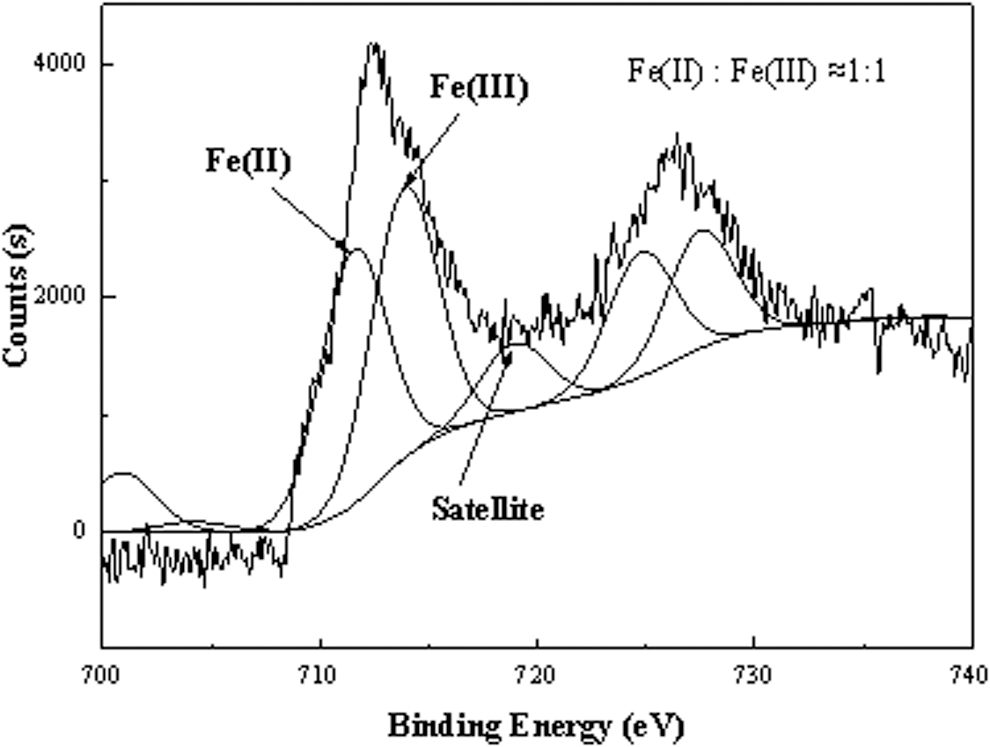
Fe 2p XPS spectra of CAS. XPS, X-ray photoelectron spectroscopy.
According to the above characterization results and discussion, CAS contained 1.3% Fe2O3. Half of the total Fe content was Fe2+, which combined with hydrogen peroxide to form a Fenton system. CAS also contained alkaline CaCO3, which neutralized acidic pollutants (e.g., Fe2S, FeS1.1, tannins). These two features made it possible for CAS to remediate ASS.
Oxidation optimization capability
Figure 4 shows the change of the pH value of ASS with time under four different controls. The curve of time and pH showed a trend of first decreasing and then flattening, an inflection point appeared in 15–30 min, which indicated that ASS has been completely oxidized. Thus, 5 g of ASS was completely oxidized by CAS with 10 mL of H2O2 after the neutralization ability of CAS was eliminated, and the pH finally stabilized at 3.2. The pH curve of acidic soil without CAS reached the lowest point at 30 min and a pH of 3.21. Previous reports have shown (Feizbakhshan et al., 2021; Liang et al., 2021) that activated carbon and biochar have abundant oxygen-containing active groups, high aromaticity, rich pore structure, and large specific surface area. They were used to improve the stability of the soil structure, promote the formation of aggregates, and provide oxygen-containing active groups for the oxidation of ASS. In this work, AC, BC, and FC were investigated under the same conditions. The results showed that the oxidation rate increased by 50%, and the oxidation time was reduced by 50% after adding CAS. After 20 min, the pH of FC decreased to 3.46; however, the oxidation rate of FC was still lower than that of CAS. The oxidation rate acceleration followed the order of CAS>FC>AC≥BC>BK. In other words, CAS showed the best performance.

Changes in pH using different controls.
Neutralization performance
Figure 5 shows changes in the pH over time when the ratio of CAS was increased from 1:1 to 2:1. From 0 to 5 min, the pH decreased significantly, which indicated that pyrite in acidic soil was oxidized to sulfuric acid. Since CAS contained 1.3% Fe2O3, a Fenton system was formed when mixed with H2O2. The iron in CAS appeared to accelerate the oxidation of ASS, and H+ simultaneously reacted with CaCO3 in CAS. As a result, the pH decreased from 7.0 to 6.0. Then, the curve showed a slow increase, indicating that LDH and CaCO3 in CAS continued to neutralize the acid and fix the sulfate. Finally, the pH stabilized around 6.2, which indicated that the acid was completely neutralized.
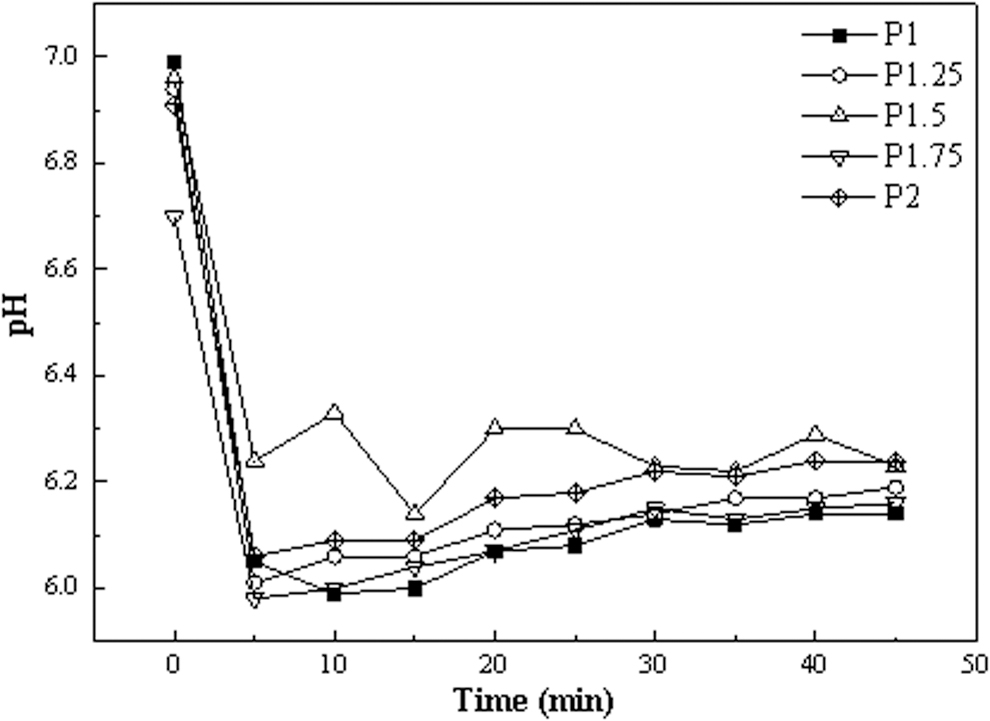
Effect of CAS dosage on the oxidation of ASS. ASS, acid sulfate soil.
Figure 5 shows that the order of the neutralizing effect of each proportion followed the order of P1 < P1.75 < P1.25 < P2 < P1.5. In other words, when the ratio of CAS and S in acid soil was 1.5: 1, the pH of ASS increased to 6.32, indicating the optimal dosage of CAS. However, even when the ratio of CAS and S was 1:1, the resulting pH was still 6.14.
Mechanism discussion
After the reaction in Fig. 5, the supernatant of the oxidized soil suspension was extracted and determined by HPLC (Fig. 6). Several S-containing anionic species were detected, including S2O32−, S4O62−, S5O62−, and S6O62−. Some literatures have shown that SnO62− is probably formed from S2O32− (Tu et al., 2017). According to the pyrite oxidation mechanism (Schippers et al., 1996; Druschel et al., 2003), the reaction of ASS is as follows: S22− is first transformed into S2O32−. Then, a small amount of S2O32− is disproportionated and decomposed into S0 and HSO3−. Most S2O32− is oxidized to S4O62− under pyrite catalysis. S4O62− can react with S2O32− to form S5O62− and SO32− under acidic conditions. In addition, since S4O62− is bimolecular, it can rearrange to form S5O62− and S3O62−. Many SnO62− species were hydrolyzed to S0, S2O32−, and SO42−. Finally, pyrite in ASS was oxidized, and these S-containing anionic species entered the Ca-Al-LDH interlayer, which explains why the interlayer spacing of Ca-Al-LDH was enlarged as shown in Fig. 1B.

Sulfur-containing anionic species determined by HPLC. HPLC, high-performance liquid chromatography.
Table 2 lists the effects of inorganic components on the reaction efficiency of the Fenton system. Generally, inorganic ions showed an inhibitory effect on the oxidation efficiency of the Fenton system, which increased as the complexing ability of the inorganic ion with an iron ion increased. In other words, the effect of inorganic ion was mainly due to Fe3+ not effectively catalyzing the decomposition of H2O2 after complexation with inorganic ions; thus, it inhibited the reaction of hydroxyl radicals to a certain extent. In addition, SO42− captured the produced hydroxyl radicals, which further decreased the degradation rate of a target compound in the solution. According to the above discussion, a mechanism was proposed to explain why CAS was effective at ASS remediation.
Effect of Inorganic Ions on the Fenton Reaction System
Figure 7 shows the oxidation and neutralization mechanism of CAS for ASS, which was divided into three main parts. The first step was the oxidation acceleration process. Since CAS and FeS2 in ASS contain Fe2+, a Fenton reaction occurred after Fe2+ was mixed with hydrogen peroxide. In the presence of Fe2+, H2O2 generated strongly oxidizing hydroxyl radicals (•OH), which triggered the formation of other active oxygen species. This accelerated the oxidation of pyrite in ASS, which was a chain reaction, as shown in Equations (1) and (2). At this time, the FeS2 in ASS was rapidly oxidized to sulfuric acid and iron hydroxide, and the tannic acid in soil was degraded into carbon dioxide and water.
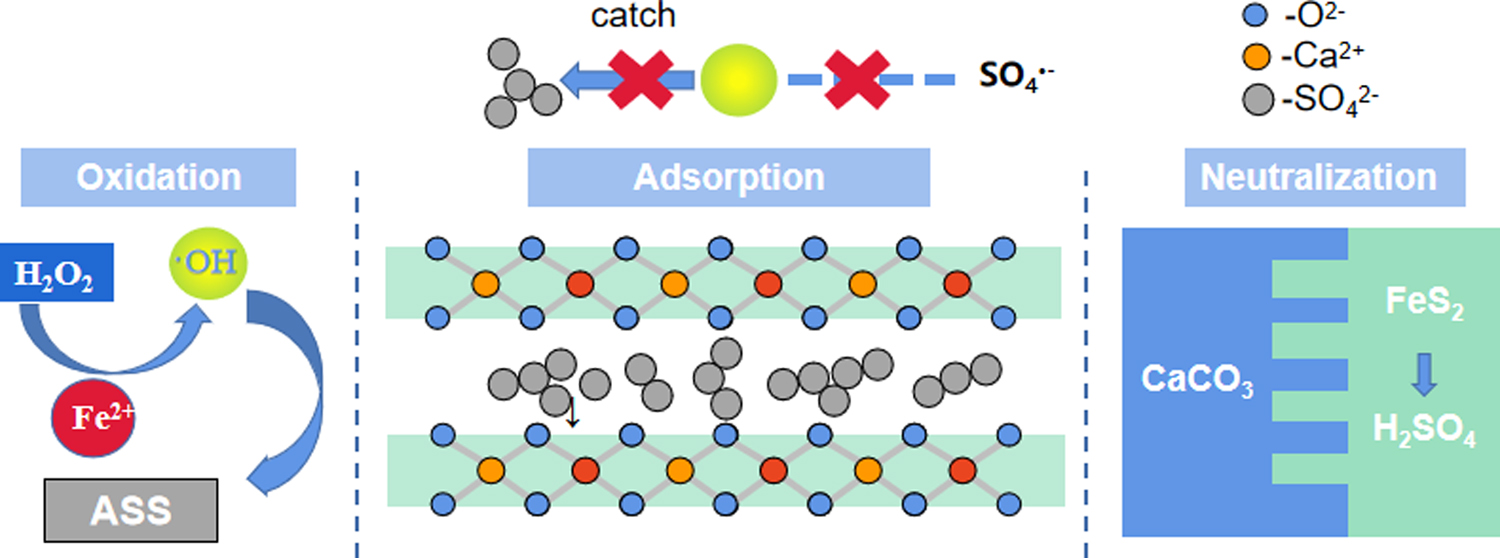
Phase transformations during the treatment of ASS by CAS.
The second step was LDH adsorption. CAS contains Ca-Al-LDH, which neutralized acid and also adsorbed SO42− generated by anion exchange (Barbosa et al., 2020). After SO42− and other anions were adsorbed by Ca-Al-LDH laminates, these anions were unable to capture the •OH produced by the Fenton reaction, that is, they were unable to produce weakly oxidizing SO4•− (Li et al., 2009). Thus, the Fenton reaction rate was slowed. The third step is the neutralization of H+ by calcium carbonate in CAS. The proportion of calcium carbonate in Ca-Al slag was high. CaCO3 improved the pH of acidic soil, passivated heavy metals in soil, and also oxidized silica. Aluminum formed a high-strength matrix stable layer; therefore, CAS was suitable for the rapid remediation of acidic soil in harbor areas.
Conclusion
An Fe-containing alkaline slag was used to form a Fenton system with H2O2, which was applied for the remediation of ASS, and the following results were obtained:
The microstructure of the slag was a rose petal-like morphology, and the main components were CaCO3 and Ca-Al-LDH, along with 1.3 wt% Fe2O3. The Fe(II): Fe(III) ratio was 1:1, which was the most important factor for initiating the Fenton activity between Ca-Al slag and hydrogen peroxide. When the ratio of slag and S in soil was 3:2, the pH increased to 6.32. Under the same conditions, the oxidation growth rate was slag>activated carbon≥biochar>pure hydrogen peroxide. The oxidation rate was increased by 50%, and the oxidation time was reduced by 50% after adding slag. The advanced CAS activity was attributed to three factors. First, the Fenton reaction accelerated the oxidation process. Second, LDH adsorbed oxidized SO42−. Finally, calcium carbonate neutralized sulfuric acid to produce calcium sulfate.
Footnotes

References
Supplementary Material
Please find the following supplemental material available below.
For Open Access articles published under a Creative Commons License, all supplemental material carries the same license as the article it is associated with.
For non-Open Access articles published, all supplemental material carries a non-exclusive license, and permission requests for re-use of supplemental material or any part of supplemental material shall be sent directly to the copyright owner as specified in the copyright notice associated with the article.
