




Abstract
The increasing of 1-hydroxy-1,1-diphosphonoethane (HEDP) in aquatic environments poses potential harm to the environment. Herein, the materials that silver nanoparticles/nanowires (Ag NPs/Ag NWs) and Fe3O4-decorated CoAl-layered double hydroxides (LDHs-Ag NPs@Fe3O4 and LDHs-Ag NWs@Fe3O4) were synthesized and applied to the degradation of HEDP in three-dimensional electro-Fenton system. Addition of Ag-doped LDHs@Fe3O4 particles greatly increased the HEDP removal rate compared with the addition of LDHs@Fe3O4 particles. The HEDP degradation rates using LDHs-Ag NPs@Fe3O4 and LDHs-Ag NWs@Fe3O4 particles were 73.34% and 79.64%. Furthermore, based on the characterization of synthesized particles, generation of free radical and H2O2, a possible mechanism of improved oxidation performance by the LDHs-Ag NWs@Fe3O4 particles was elucidated. The LDHs-Ag NWs@Fe3O4 particles possessed excellent stability and reusability, as evidenced by the stable degradation activity of 70.53% for HEDP degradation after four successive runs.
Introduction
Phosphonates, compounds having a wide range of applications in modern society (Nowack, 2003), have received considerable attention about their environmental impact and behavior (Paytan et al., 2003). Related research has linked phosphonates and their degradation products to eutrophication, the production of methane in the marine (Metcalf et al., 2012), the interference for the wastewater treatment plant (WWTP) operation (Rott et al., 2018b) and potential heavy metal remobilizing effect (Rott et al., 2018a). The 1-hydroxy-1,1-diphosphonoethane (HEDP) is a typical phosphonate. HEDP possesses excellent water solubility, high molecular stability, and the resistance of acid and alkali (Kolodynska et al., 2009; Rott et al., 2017). HEDP has wide application in circulating cool water systems as corrosion and scale inhibitors (Zhang et al., 2019).
The lack of proper handling and the increasing consumption have resulted in more and more HEDP existing in natural water body. It is unreliable to rely on biodegradation of HEDP naturally, due to the lack of enzyme repertoire inside the microorganism (Rott et al., 2018a). HEDP removal in the WWTP is limited and mainly due to the adsorption of activated sludge (Rott et al., 2019). There are few studies that have focused on the effective treatment of HEDP. For all these reasons, it is particularly desirable to adopt an efficient and innocent treatment technology for the decomposition of HEDP.
Heterogeneous electro-Fenton (EF) is a typical electrochemical advanced oxidation process. The heterogeneous EF system is widely used for the effective removal of refractory organic pollutants (He and Zhou, 2017; Liu et al., 2018). The heterogeneous EF can effectively overcome the demerits of conventional Fenton process, such as the narrow working pH range, high costs, risk of H2O2 transportation, iron ion deactivation, and the second pollution of iron sludge (Ouiriemmi et al., 2017).
As shown in Eq. (1), H2O2 is generated by cathodic reduction of oxygen. Subsequently, •OH generated through the classical Fenton reaction in Eq. (2) (Monteil et al., 2020). •OH is the crucial substance to degrade refractory organic pollutants. However, due to complex refractory organic substances, a more stringent requirement of the yield of H2O2 and energy efficiency was put forward to the practical applications of EF process. Therefore, it is still a challenge to explore an efficiency electrode system and highly active catalyst.
Traditional EF systems mostly utilize a two-dimensional (2D) electrode. A three-dimensional (3D) electrode system developed on the basis of 2D electrode, is a novel electrochemical reaction system (Zhang et al., 2013). During the operation of 3D electrode system, the conductive particles added between main electrodes (Yao-Kun et al., 2014) can be polarized under external electric field. Then, the conductive particles will turn into numerous microelectrodes where oxidants are synthesized (Zhou and Lei, 2006).
Compared with 2D electrode, the 3D electrode system can enhance the specific surface area, mass transfer efficiency, and shorten migration distance of reactants (Li et al., 2017). The 3D EF system is the combination of EF process and 3D electrode. The feasibility of 3D EF has been demonstrated by effectively treating various kinds of organic pollutants, such as pesticide (Ghanbarlou et al., 2020), pharmaceutical wastewater (Zhang et al., 2019), and dyeing wastewater (Wang et al., 2008).
The particles in the 3D EF system are requested to possess both the catalytic and conductive functions. Ag is known to be an efficient catalyst and electrode material as the result of several unique advantages, such as high electrical conductivity and electrocatalytic activity. Simultaneously, Ag possesses the characteristic of high oxygen reduction reaction (ORR) activity. Ag is widely used for the reductive dechlorination of organic chlorides, the oxidation of phenol, and the reduction of dyes (Scialdone et al., 2010; Aneggi et al., 2017; Reddyg et al., 2021).
In particular, Ag nanoparticles possess large specific surface area and lots of catalytic active sites (Liao et al., 2019). The Ag nanoparticles are considered as a bridge to couple the EF and electrocatalysis system. Nevertheless, the Ag nanoparticles used as catalyst will suffer the issues of poor stability and easy aggregation. To overcome these problems, a strategy is to incorporate the Ag nanoparticles into supporting materials (Liao et al., 2016).
Layered double hydroxides (LDHs) are a class of clay-based materials with ordered layered structure (Jack et al., 2015). Because of the unique layered structures, LDHs possess plenty of sites for the production and conversion of H2O2 (Thomas et al., 2020). LDHs have received great attention in the application of Fenton system (Huang et al., 2018; Younis et al., 2020). Hence, to incorporate Ag nanoparticles into LDHs forming LDHs-Ag particles is feasible in the 3D EF system.
Performance of the Ag nanoscale would be affected by different nanostructures, such as in particle and wire (Wiley et al., 2008). Ag nanowires are considered to possess superior properties in terms of high conductivity, electrocatalysis, and stability. Ag nanowires have been applied to electrodes (Lee et al., 2008), sensor (Li et al., 2011), and electrochemical catalysis (Zhao et al., 2017). We selectively adopt Ag nanoparticles and Ag nanowires as basic materials.
This study focused on the efficient degradation of HEDP using novel 3D heterogeneous EF. Silver nanoparticles/nanowires and Fe3O4-decorated CoAl-layered double hydroxide (LDHs-Ag NPs@Fe3O4 and LDHs-Ag NWs@Fe3O4) particles were added in the 3D EF system. The catalytic activities of the two particles were compared. More importantly, the differences of physical properties, generation, and performance of related free radicals between LDHs-Ag NPs @Fe3O4 and LDHs-Ag NWs@Fe3O4 were investigated and further inferred the mechanism.
Materials and Methods
Materials
The 1-hydroxy-1,1-diphosphonoethane (HEDP, CAS No. 2809-21-4, 96%) was purchased from MACKLIN (Shanghai, China). Nanometer silver power (60–120 nm), H2SO4 (CAS No. 7664-93-9, 95–98%), MgSO4·7H2O (CAS No. 10034-99-8, 99.99%), 4-chloro-7-nitrobenzo-2-oxa-1,3-diazole (NBD-Cl, CAS No. 10199-89-0, 98%), KMnO4 (CAS No. 7722-64-7, 99.5%), CoCl2·6H2O (CAS No. 7791-13-1, 98%), K3Fe(CN)6 (CAS No. 13746-66-2, 99.95%), and FeSO4·7H2O (CAS No. 7782-63-0, ≥99.95%) were ordered from Aladdin. All of the related reagents were of analytical grade and used without any further processing.
Preparation of particles
Synthesis of silver nanowires
Ag NWs was synthesized with AgNO3 as starting material by the modified polyol process, as previously reported (Li et al., 2015; Wiley et al., 2008). First, NaBr (220 mM), NaCl (210 mM), PVP (505 mM), and AgNO3 (265 mM) were prepared by dispersing into ethylene glycol. Afterward, 7.7 mL of EG, 0.2 mL of NaBr, 1.0 mL of PVP, and 1.0 mL of AgNO3 (265 mM) were mixed in a round-bottom flask. The flask was placed in an oil bath. Subsequently, the solution was heated to 170°C with bubbling nitrogen gas. During heating, the reaction solution was stirred vigorously for 15 min. After hyperthermic treatment, the solution was kept at 170°C for 1 h without stirring. Ultimately, the Ag NWs were obtained after 2–4 cycles of precipitated by acetone.
Synthesis of LDHs-Ag NWs@Fe3O4
The LDHs-Ag NWs were synthesized through the coprecipitation method (Kloprogge et al., 2004; Sui et al., 2012), with slight modification. Before the coprecipitation, Ag NWs (0.3 g) were dispersed into 100 mL deionized water through ultrasonication. Next, the solution containing 100 mL of Co2+ (CoCl2·6H2O, 0.03 mM), Al3+ (AlCl3·6H2O, 0.01 mM), and CO32− (Na2CO3, 20 mM) was added slowly to the Ag NWs solution at constant pH of 10 by using 0.12 M NaOH. After addition, the solution was aged by stirring for 0.5 h and then kept at 75°C for 24 h. After that, the product was filtered and dried.
To synthesize LDHs-Ag NWs@Fe3O4 particles, FeCl3•6H2O (6.4 mM) and FeSO4•7H2O (3.2 mM) were dripped into an Erlenmeyer flask containing 100 mL LDHs-Ag NWs (3 g) solution and stirred at 80°C in N2 atmosphere. After dripping, the mixture solution was heated to 85°C. Then 10 mL NH3•H2O (25–28%) was added into the flask, and then kept at 85°C for 0.5 h. The LDHs-Ag NWs@Fe3O4 particles were collected after filtering and drying. For comparison, The LDHs@Fe3O4 and LDHs-Ag NPs@Fe3O4 particles were prepared based on the similar procedures above. The above solution containing synthesized products must be centrifuged and rinsed until the pH of filtrate was around 7 by deionized water before drying.
Characterization of the materials
Morphological and elemental analyses (EDS mapping) of the synthesized materials were characterized by scanning electron microscopy (SEM; ZESISS Sigma 500). The crystal structure of the composites was monitored with an X-ray power diffraction (XRD; Bruker D8 Advance). Brunauer–Emmett–Teller (BET) measurements were performed to characterize the specific surface area and N2 was used as the adsorbate gas. The samples were tested by an ASAP 2460 surface area analyzer from Micromeritics within the range 0.05≤P/P0≤1. In addition, sample outgassing was performed under vacuum at 100°C for 12 h.
Experimental set-up and procedure
A 500-mL cylindrical single compartment glass was used as electrochemical cell to perform the heterogeneous EF experiments. The cell was equipped with two graphite sheets (4 × 6 cm) as cathode and anode, which situated 2 cm apart from each other. The experiment was powered by a SS-3030KD DC power supply (0–10 A ± 0.1 A). To ensure a superior mixing of the solution and particles, a mechanical stirrer with PTFE bar was used. In addition, an air pump was used to insufflate air into the cell at a rate of 0.1 L/min. The experiment was carried out at 25°C and 0.05 M Na2SO4 was added to the solution as electrolyte. Initial concentration of HEDP was 100 mg/L.
Before the experiments, 500 mg particles were added to the reaction system and then stirred for 30 min to achieve adsorption–desorption equilibrium. In addition, each degradation experiment was carried out thrice, and the average values and error bars were depicted in the corresponding figures.
To evaluate the feasibility of the synthesized Ag-doped LDHs@Fe3O4, the HEDP degradation experiences were carried out with 1 g/L of particles in 3D EF system. The oxidative degradation of pollutants did not mean that the pollutants were directly transformed into harmless CO2 and H2O, due to the refractory intermediate products that were quickly formed during the EF process. To assess an effective treatment, COD removal rate was a reference to effectively evaluate the complete removal of organics. At time intervals of 30 min during the experiment, a 10 mL sample was taken out and filtered through 0.22 μm filter films for HEDP and COD analysis. In addition, the performance of HEDP removal using 2D electro-Fenton, LDHs and LDHs@Fe3O4 was also tested as a comparison. The 2D electro-Fenton experiments were performed with 0.119 g FeSO4•7H2O salt.
In the process of EF reaction, the efficient degradation of target pollutants mainly ascribed to strong oxidation of free radicals, such as •OH and •O2− (Duesterberg et al., 2008). The productions of H2O2, •OH and •O2− in the 3D EF system with LDHs-Ag NPs@Fe3O4 and LDHs-Ag NWs@Fe3O4 particles were determined to discuss the possible mechanism of the LDHs-Ag NWs@Fe3O4 and LDHs-Ag NPs@Fe3O4 particles. To verify the role of hydroxyl radical and superoxide radical during the 3D EF degradation of HEDP, the hydroxyl radical and superoxide radical scavengers, isopropanol (20 mM) and P-benzoquinone (10 mM), were separately added to the reaction system. The measurement of H2O2, •OH, and •O2− were conducted with no HEDP addition in 3D EF system.
For reusability experiments of the LDHs-Ag NWs@Fe3O4 particles, the particles were filtered, rinsed repeatedly with deionized water, and dried at 65°C under vacuum condition for the consecutive experiments.
Analytical methods
The concentration of HEDP was determined by a UV spectrophotometer at the wavelength of 470 nm. The degradation kinetic of HEDP can be fitted by the pseudo-first-order reaction in Equation 3.
Where C0 is the HEDP concentration at times of t = 0 and Ct is the HEDP concentration at times of t = t.
Chemical oxygen demand (COD) was measured to evaluate the mineralization degree of the HEDP according to fast-digestion spectrophotometry method, based on the Chinese standard test methods, HJ 924–2017. The organic matter was oxidized while the Cr (VI) was reduced to Cr (III). The COD date was obtained by detecting the change in absorbance of Cr (III).
The spectrophotometric determination of H2O2 was conducted using potassium titanium (IV) oxalate (Sellers, 1980). •OH generated in the electrochemical process was indirectly determined by salicylic acid (Martínez-Tarifa et al., 2010). The measurement of superoxide ion radical was carried out by monitoring its reaction with 4-chloro-7-nitrobenzo-2-oxa-1,3-diazole (NBD-Cl) (Olojo et al., 2005). The product of superoxide ion radical and NBD-Cl was measured by a fluorescence analyzer (F-700) using slit widths of 5 nm for the excitation and emission wavelengths, respectively. The fluorescence analyzer was operated by setting the excitation wavelength at 470 nm, and emission scans were performed between wavelength ranges of 220 and 700 nm.
In addition, the degradation intermediates were determined by ultra-performance liquid chromatography coupled with a triple-stage quadrupole mass spectrometer (UPLC-MS/MS, TSQ Quantum Ultra) equipped with a waters cortecs C18 column (2.1 × 50 mm 1.7 μm).
The samples were extracted with chloroform thrice. The oven and detector temperatures were set at 170°C and 230°C, respectively. Nitrogen was used as the carrier gas at a flow rate of 60 mL/min. A mixture of H2O (A)/methanol (B) was used as mobile phase with flow rate of 0.3 mL/min. The eluent gradient was as follows: started and held at 90% for 1 min. Then, decreased to 10% and held for 11 min. At last, back to 90% for 1 min. The analysis was carried out in negative electrospray ionization (ESI) multiple reaction monitoring mode. The mass spectrometer was operated under sheath gas temperature of 350°C and capillary voltage of 3.5 kV.
Results and Discussion
HEDP degradation with different materials
HEDP and COD removal rates of the LDHs@Fe3O4, LDHs-Ag NPs@Fe3O4, LDHs-Ag NWs@Fe3O4, LDHs, and 2D electro-Fenton are compared in Fig. 1a, respectively. First of all, the HEDP removal rate was only 32.62% for the system with LDHs, which was much lower compared with 2D electro-Fenton, LDHs@Fe3O4, LDHs-Ag NPs@Fe3O4 and LDHs-Ag NWs@Fe3O4.
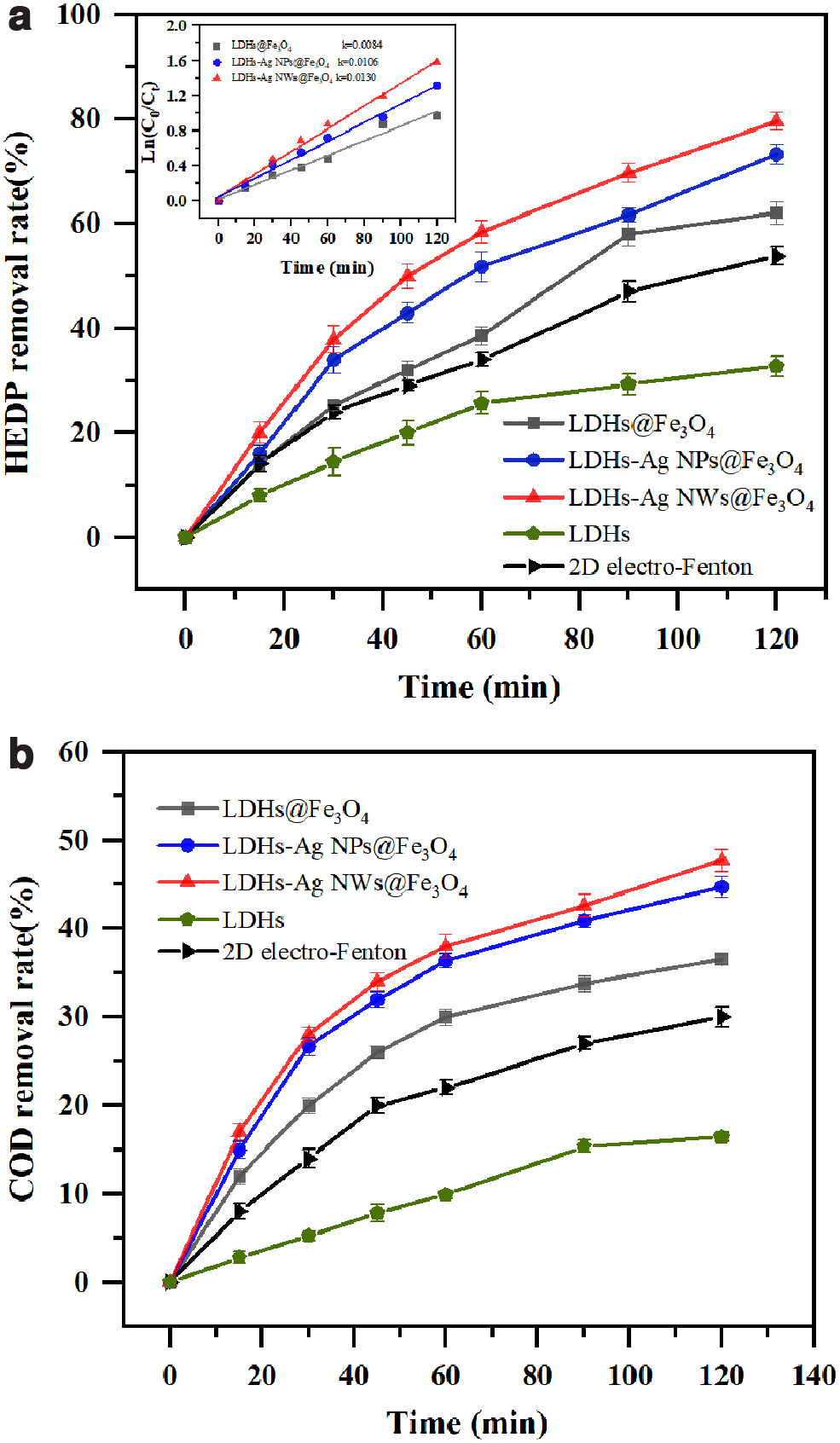
Degradation of HEDP with different materials
This phenomenon can be explained by the fact that Fe2+ could efficiently accelerate the conversion of H2O2 to •OH (Eq. 2), which ultimately achieved the improvement of HEDP removal rate. Furthermore, the HEDP removal rates in all the 3D electro-Fenton systems were higher than that in 2D system. The conductive particles were polarized and formed into numerous microelectrodes in 3D electro-Fenton system, which achieved higher mass transfer efficiency and shorter migration distance of reactants (Zhang et al., 2019).
Worth noting, the Ag-doped LDHs@Fe3O4 particles exhibited a clear superiority as compared with LDHs@Fe3O4 for the degradation of HEDP. Degradation efficiency of the LDHs-Ag NPs@Fe3O4 and LDHs-Ag NWs@Fe3O4 particles has been further improved by ∼11% and 17% in comparison to LDHs@Fe3O4 particles. It was necessary to emphasize that the Ag-doped LDHs@Fe3O4 particles were suitable for efficient HEDP degradation in 3D EF system.
Furthermore, as shown in Fig. 1a, the HEDP degradation rate of LDHs-Ag NWs@Fe3O4 particles was higher than LDHs-Ag NPs@Fe3O4 particles. After the treatment for 120 min, the final HEDP removal rate reached 79.64% by LDHs-Ag NWs@Fe3O4 particles, which was obviously superior to conventional anaerobic degradability for 28 days (<4%) (Rott et al., 2018b). According to insert panels of Fig. 1a, the degradation of HEDP conformed to the pseudo-first-order kinetics model. Meanwhile, the first-order kinetics equation fitted the HEDP degradation curves well, with R2 higher than 0.9. The rate constant of LDHs-Ag NWs@Fe3O4 reaction system (0.0130 min−1) was reasonably higher compared with LDHs-Ag NPs@Fe3O4 system (0.0106 min−1).
As presented in Fig. 1b, COD removal rate was 16.43%, 30.00%, 36.51%, 44.70%, and 47.72% for LDHs, 2D electro-Fenton, LDHs@Fe3O4, LDHs-Ag NPs@Fe3O4, and LDHs-Ag NWs@Fe3O4, respectively. The order of COD removal rate was LDHs-Ag NWs@Fe3O4 > LDHs-Ag NPs@Fe3O4 > LDHs@Fe3O4 > 2D electro-Fenton > LDHs, which further demonstrated the superiority of doping Ag nanowires compared with Ag nanoparticles.
Characterization of Ag-doped LDHs@Fe3O4 materials
The SEM micrographs of Ag nanowires, LDHs-Ag NPs@Fe3O4, and LDHs-Ag NWs@Fe3O4 are shown in Fig. 2. The images showed the integrated and well-defined linear structure of Ag nanowires. The morphology and size of Ag nanowires were relatively uniform (Fig. 2a, b). The formation of the unique nanowire structure was mainly derived from anisotropic confinement and unidimensional growth (Sun et al., 2003).

SEM images of Ag nanowires
After modification, obvious linear structure was not observed on the surface of the LDHs-Ag NWs@Fe3O4 particles (Fig. 2d), indicating that the Ag nanowires were well anchored into LDH sheets. The insertion of Ag nanowires could effectively prevent lamellar agglomeration. Therefore, the activity sites on the LDHs increased, leading to superior oxidizing property (Long et al., 2014). Furthermore, the phenomenon of covering and package by spherical substance was noted in Fig. 2b and d, which could be attributed to the Fe3O4 crystals on the LDHs-Ag NPs and LDHs-Ag NWs. The clusters of Fe3O4 crystals grew in situ on the surface of the LDHs-Ag NPs and LDHs-Ag NWs, which provided excellent structural stability (Zhang et al., 2019).
The EDS spectrum (Fig. 2e, f) confirmed the presence of C, O, Fe, Al, Ag, Co elements in the LDHs-Ag NPs@Fe3O4 and LDHs-Ag NWs@Fe3O4 particles, which validated the successful synthesis of materials. As shown in Table 1, the atomic weight percentage of Ag element was 1.70% for LDHs-Ag NPs@Fe3O4 and 7.40% for LDHs-Ag NWs@Fe3O4 particles, demonstrating that part of the Ag was exposed. Therefore, besides possessing the function of structure adjustment, Ag nanomaterials also could exert the ability of conductivity and catalysis. Furthermore, the higher atomic weight percentage of Ag element on the surface of the LDHs-Ag NWs@Fe3O4 particles promoted oxidation of the HEDP.
EDS Characteristics of Layered Double Hydroxides-Ag NPs@Fe3O4 and Layered Double Hydroxides-Ag NWs@Fe3O4
LDH, layered double hydroxides.
Figure 3 shows the XRD patterns of the LDHs@Fe3O4, Ag nanowires, LDHs-Ag NPs@Fe3O4, and LDHs-Ag NWs@Fe3O4 particles. The peaks at 38.1°, 44.3°, and 64.4° of Ag nanowires and LDHs-Ag NWs@Fe3O4 particles were attributed to the (111), (200), and (220) planes of Ag, respectively. The peak of Ag indicated the doping of Ag nanowires in LDHs-Ag NWs@Fe3O4 particles. The sharp and intense diffraction peaks of Ag nanowires demonstrated their high crystallinity. No obvious impurity peaks were observed, indicating the high purity of the synthetic Ag nanowires.
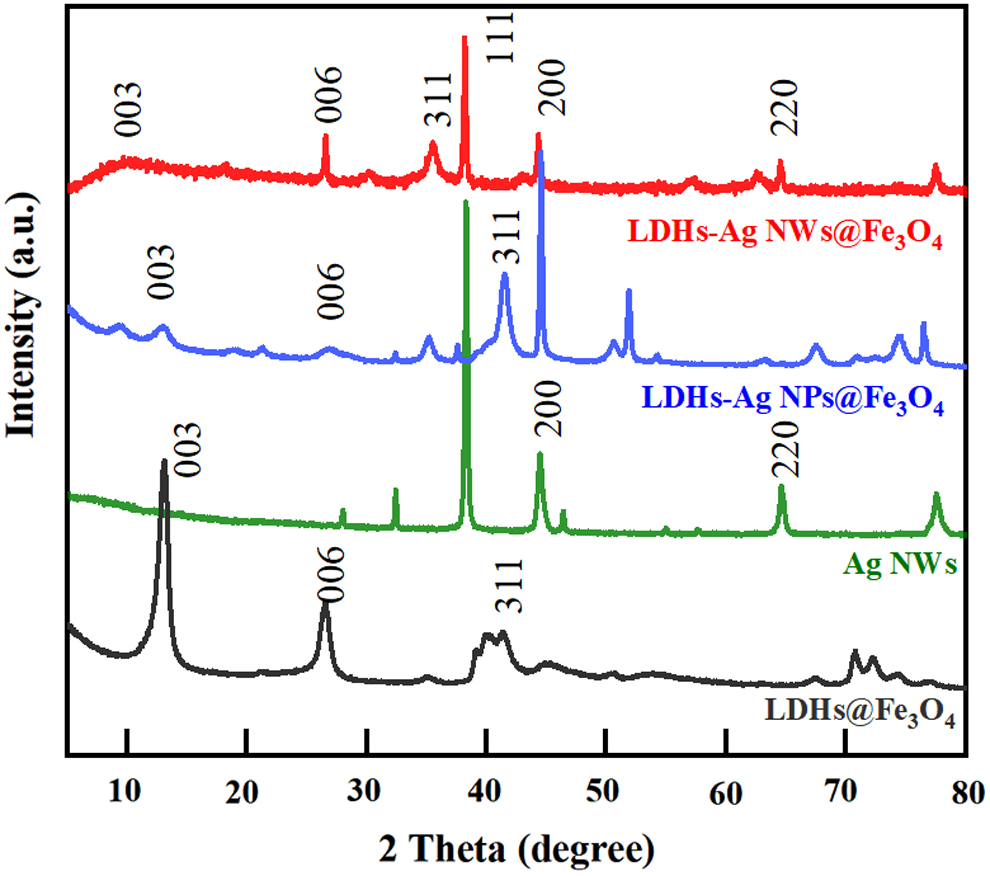
XRD patterns of LDHs@Fe3O4, Ag nanowires, LDHs-Ag NPs@Fe3O4, and LDHs-Ag NWs@Fe3O4.
For LDHs@Fe3O4, diffraction peaks at 13.4° and 27.0° were assigned to (003) and (006) crystal faces of LDHs, respectively (JCPDS: 38–0487). However, for LDHs-Ag NWs@Fe3O4 particles, the diffraction peak indexed as (003) showed weak crystalline features, because of slow crystal growth and low crystallinity by the doping of Ag nanowires.
The results also implied the good dispersion of the LDHs. Worth noting, the crystallinity of LDHs-Ag NPs@Fe3O4 particles was relatively higher compared with LDHs-Ag NWs@Fe3O4, which accounted for the size difference of Ag nanoparticles. At the same time, comparing LDHs@Fe3O4 and LDHs-Ag NPs@Fe3O4, the diffraction peaks were shifted to lower 2θ values after the doping of Ag nanowires, confirming the improvement of layer spacing (Wu-fei et al., 2015).
The N2 adsorption–desorption isotherms and pore diameter distribution of the LDHs-Ag NPs@Fe3O4 and LDHs-Ag NWs@Fe3O4 particles are presented in Fig. 4a and b. The two isotherms were identified as type IV, indicating that the LDHs-Ag NPs@Fe3O4 and LDHs-Ag NWs@Fe3O4 particles belonged to mesoporous materials. A typical H3 type hysteresis loop was observed, which was the characteristic of flake granular materials. The BET surface area of the LDHs-Ag NWs@Fe3O4 particles was higher compared with LDHs-Ag NPs@Fe3O4 particles, yielding values of 59.5 and 36.0 m2/g, respectively. The Ag nanoparticles tended to accumulate due to the van der Waals forces. The increase of surface area of the LDHs-Ag NWs@Fe3O4 particles presumably arose from the high dispersion of the linear structure of the Ag nanowires.
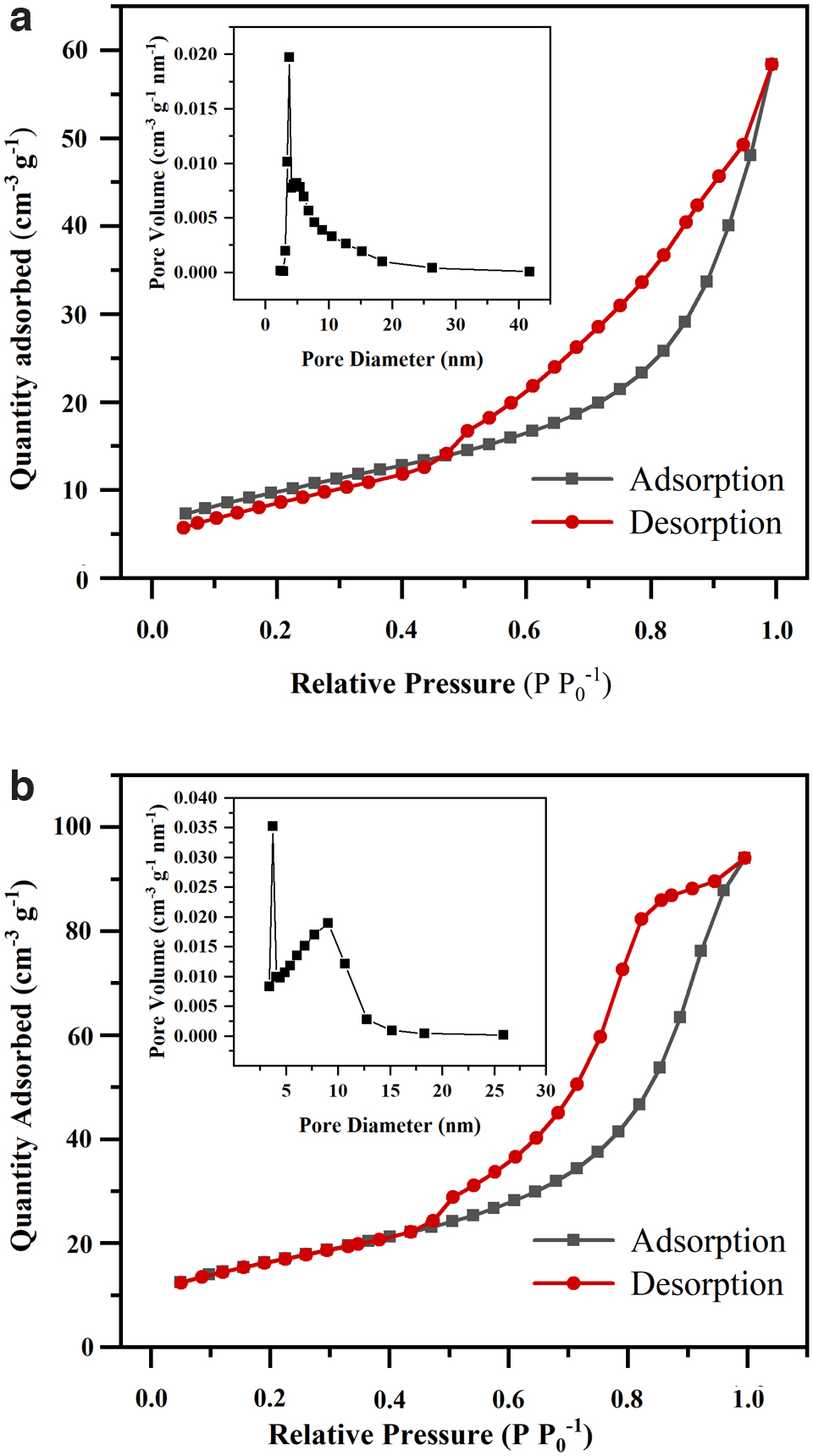
N2 adsorption–desorption isotherms of LDHs-Ag NPs@Fe3O4
Moreover, the high aspect ratio of Ag nanowires could effectively increase the layer spacing of the LDHs, which was consistent with the results of XRD in Fig. 4a. According to the BJH analysis, the pore sizes of the LDHs-Ag NPs@Fe3O4 and LDHs-Ag NWs@Fe3O4 particles were determined to be 8.24 and 7.01 nm. The higher specific surface area and smaller pore size of the LDHs-Ag NWs@Fe3O4 particles would provide more active sites to facilitate the production of H2O2, thus leading to higher HEDP degradation rates.
Three-dimensional EF degradation mechanism of LDHs-Ag NPs@Fe3O4 and LDHs-Ag NWs@Fe3O4
As shown in Fig. 5b, with the presence of isopropanol, only 23.73% of HEDP was removed within 120 min, implying that •OH played an important role on HEDP degradation. Considering the fading reaction of the P-benzoquinone and HEDP developer, COD was used as an evaluation indicator. The red line in Fig. 5b showed that the COD removal rate was 26.03% in the absence of •O2−. These results suggested the generation of •OH and •O2− in the 3D EF system. Moreover, •OH exhibited a clear preponderant role as compared with •O2− during the degradation of HEDP.

H2O2 accumulation comparisons among LDHs-Ag NPs@Fe3O4 and LDHs-Ag NWs@Fe3O4
As previously reported and the results obtained in this work, the possible HEDP degradation mechanism in 3D EF system was proposed. During the running of 3D EF system, the particles will rapidly turn into microelectrodes. H2O2 would be synthesized by O2 reduction of cathode and microelectrodes (Eq. 1). Once H2O2 was generated by oxygen reduction, it would be instantly reduced to •OH as the heterogeneous Fe2+ being oxidized to Fe3+ (Eq. 2). Simultaneously, •O2− was generated by the two main approaches: (i) the reaction of H2O2 and •OH (Eq. 4); (ii) the cyclic regeneration of heterogeneous iron ions (Eq. 5) (Duesterberg et al., 2008).
Regarding the improvement of HEDP removal rate by adding Ag-doped LDHs@Fe3O4 particles among the summarized in Figs. 1a and 5 evidenced that this phenomenon was related to the generation of H2O2, •OH, and •O2−. Ag was considered to be one of the best conductive substances as a noble metal. In the 3D EF system, the addition of Ag increased the conductivity of particles, which further improved the rate of electron transfer. More importantly, Ag-based materials possessed high activity toward ORR, which could accelerate the O2 mass transport and the synthesis of H2O2 (Eq.1) (Erikson et al., 2018).
As shown in Fig. 5d, a slightly higher amount of •O2− was noticed by using Ag-doped LDHs@Fe3O4 particles, which could be accounted for two points: (i) the increase of H2O2 generation enhanced the amount of the available reactant to generate •O2− [Eqs. (4) and (5)]; (ii) catalysis reaction of Ag nanomaterials [Eqs. (6)–(8)] (He et al., 2011; Liu and Hurt, 2010).
The amount of •O2− decreased gradually in the presence of LDHs@Fe3O4, which might ascribe to the layer aggregation of LDHs. The agglomeration of LDH layers was accounted for the large surface area and surface energy, which made them thermodynamically unstable (Zhou et al., 2012). Finally, the active sites of LDHs@Fe3O4 decreased, resulting in the reduction of •O2−.
On the basis of improving the degradation rate of HEDP by Ag-doped LDHs@Fe3O4 particles, LDHs-Ag NWs@Fe3O4 particles possessed superior performance as compared with LDHs-Ag NPs@Fe3O4. A slightly higher amounts of H2O2 and •OH were noticed by using LDHs-Ag NWs@Fe3O4 particles (Fig. 5a, c). The higher H2O2 and •OH generation of LDHs-Ag NWs@Fe3O4 particles benefited not only from the superior conductivity of Ag nanowires compared with Ag nanoparticles (Yu et al., 2012), but also by the high ORR reactivity. The nanostructure of Ag would affect the ORR reactivity. The Ag nanowires have been intensively confirmed to possess higher ORR activity than Ag nanoparticles (Erikson et al., 2018). At the same time, the specific activity of Ag nanowires increased with the decrease of the wire diameter (Alia et al., 2012).
More importantly, the results of XRD (Fig. 2a) and BET (Fig. 3) provided intense signals that the doping of Ag nanowires effectively enhanced the specific surface area of the particles compared with Ag nanoparticles. Potentially, the interlayer spacing of LDH layer could be enlarged by the embedding of Ag nanowires since the high aspect ratio. The expansion of LDH interlayer spacing could further lead to the increase of active sites and shortening of nanoscale ion transmission distance (Long et al., 2014). It was thus necessary to emphasize that the change of the specific surface area of LDHs by Ag nanowires had a connection with the superior performance of LDHs-Ag NWs@Fe3O4 particles in terms of H2O2 and •OH generation.
Furthermore, it has been reported that the decomposition of H2O2 mainly occurred in situ on the catalytic sites of iron embedded on the surface of particles rather than iron ions in solution (Hou et al., 2016). A much higher amount of iron leaching was noticed with the LDHs-Ag NPs@Fe3O4 particles in EF process (Fig. 6), which revealed the internal reason of higher degradation activity for LDHs-Ag NWs@Fe3O4 particles.

The amount of leaching iron of LDHs-Ag NWs@Fe3O4 and LDHs-Ag NPs@Fe3O4.
The generation of •O2− among LDHs-Ag NPs@Fe3O4 and LDHs-Ag NWs@Fe3O4 particles presented unique trend in Fig. 5d. The yield of •O2− by LDHs-Ag NWs@Fe3O4 particles was higher compared with LDHs-Ag NPs@Fe3O4 for the first 30 min, which ascribed to the higher exposure of Ag nanowires than Ag nanoparticles by the results of EDS in Table 1. However, the exudation of iron caused more Ag exposed to the solution as the experiment proceeded. The lager specific surface area of Ag nanoparticles and more iron exudation of LDHs-Ag NPs@Fe3O4 as compared with Ag nanowires led to more production of •O2−. In general, the LDHs-Ag NWs@Fe3O4 particles still possessed superior performance in terms of HEDP degradation. The possible mechanism of the oxidation performance difference is presented in Fig. 7.

The possible mechanism of the oxidation performance difference.
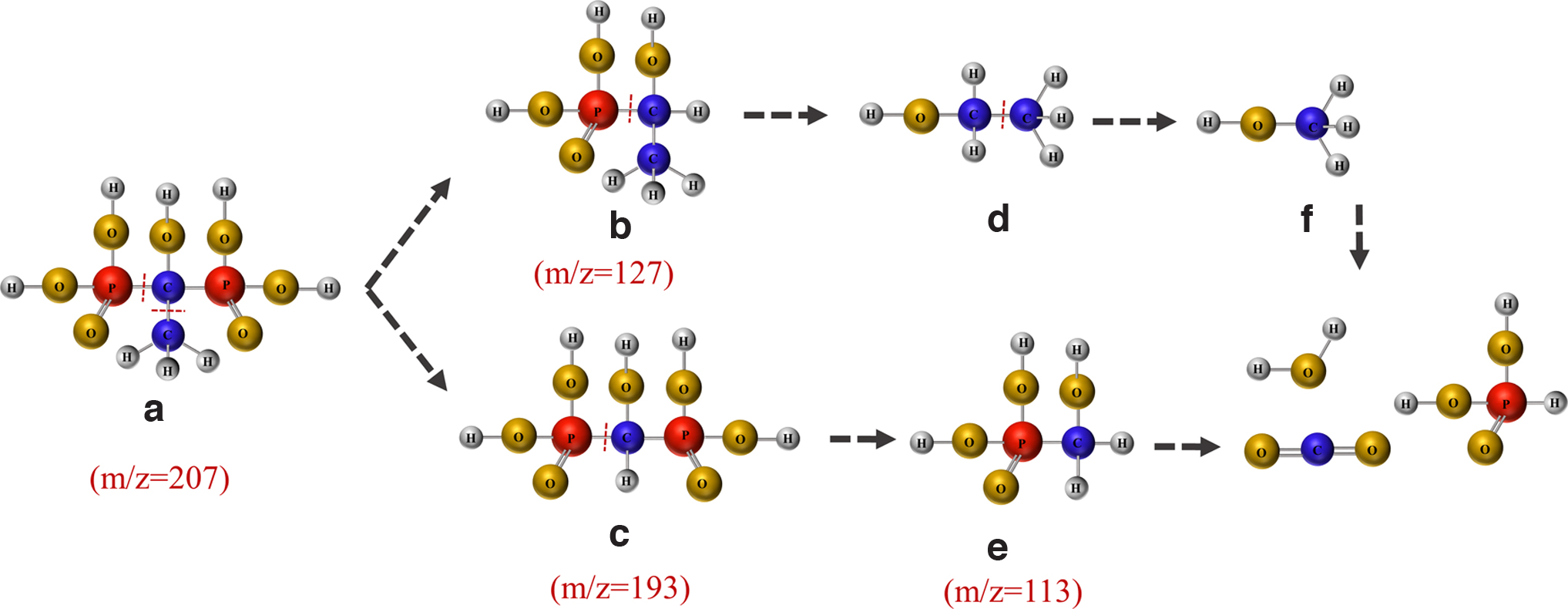
To clarify the degradation pathway of HEDP in the 3D EF process with LDHs-Ag NWs@Fe3O4 particles, UPLC-MS/MS was used to identify the intermediates. The three main detected byproducts were 1-hydroxy-1-phosphonoethane (C2H6O4P, m/z = 127), 1-hydroxy-1,1-diphosphonomethane (CH6O7P2, m/z = 193), and 1-hydroxy-1-phosphonomethane (CH5O4P, m/z = 113) (Supplementary Fig. S1).
The possible HEDP degradation pathway is proposed in Fig. 8. In the first pathway, •OH and •O2− attacked on -C-P- can transform HEDP into 1-hydroxy-1-phosphonoethane. Then further oxidation of 1-hydroxy-1-phosphonoethane by bond breaking reaction generated ethanol. Ethanol experienced coherent oxidation to form methanol. Another possible degradation way was related to demethylation. The release of the methyl of HEDP was identified as 1-hydroxy-1,1-diphosphonomethane. It experienced further oxidation to form 1-hydroxy-phosphonomethane and finally transformed into H2O and CO2.
Reusability of the LDHs-Ag NWs@Fe3O4 particles
To evaluate the reusability of the LDHs-Ag NWs@Fe3O4 particles, the consecutive experiments were carried out by the reuse of particles several times. As shown in Fig. 9, the HEDP and COD removal rates slightly decreased with the cycle running, which might ascribe to the loss of iron active sites. After four cycles, the LDHs-Ag NWs@Fe3O4 particles still maintained relatively high activity. HEDP removal rate by LDHs-Ag NWs@Fe3O4 particles after four cycles decreased about 9%, which was superior to conventional LDHs@Fe3O4 (∼12%) (Huang et al., 2018). The results confirmed the superior stability and reusability of the LDHs-Ag NWs@Fe3O4 particles.

Cyclic experiment of LDHs-Ag NWs@Fe3O4.
Conclusions
In this study, the LDHs-Ag NPs@Fe3O4 and LDHs-Ag NWs@Fe3O4 particles were synthesized for the degradation of HEDP in a 3D EF system. On the basis of the clear increase of HEDP removal rate by the doping of Ag, LDHs-Ag NWs@Fe3O4 particles exhibited superior degradation activity than LDHs-Ag NPs@Fe3O4 particles. The characterizations of the LDHs-Ag NWs@Fe3O4 particles showed higher specific surface area and layer spacing compared with the LDHs-Ag NWs@Fe3O4 particles.
Through radical scavenger experiments, •OH confirmed to exhibit a clear preponderant role as compared with •O2− during the degradation of HEDP. Furthermore, the oxidation performance improvement of LDHs-Ag NWs@Fe3O4 particles was connected to the higher yields of H2O2 and •OH, which mainly ascribed to the larger specific surface area and less iron leaching of LDHs-Ag NWs@Fe3O4 particles. The higher yield of •O2− by the addition of LDHs-Ag NPs@Fe3O4 particles had no significant impact on the degradation of HEDP as compared with LDHs-Ag NWs@Fe3O4 particles. At last, the consecutive experiments confirmed the superior stability and reusability of the LDHs-Ag NWs@Fe3O4 particles.
Footnotes
Authors’ Contributions
H.-q. L. and Q.L. developed the idea for the study, Q.R. and D.L. did the analyses, and Q.R. wrote the article.
Author Disclosure Statement
No competing financial interests exist.
Funding Information
This research was supported by the International Scientific and Technological Innovation and Cooperation Project of Sichuan (No. 2019YFH0170).

References
Supplementary Material
Please find the following supplemental material available below.
For Open Access articles published under a Creative Commons License, all supplemental material carries the same license as the article it is associated with.
For non-Open Access articles published, all supplemental material carries a non-exclusive license, and permission requests for re-use of supplemental material or any part of supplemental material shall be sent directly to the copyright owner as specified in the copyright notice associated with the article.
