




Abstract
The assessment of nitrous oxide (N2O) and carbon dioxide (CO2) emissions from wastewater treatment processes using aerobic granular biomass is still scarce and most of them deal with synthetic wastewater in well-controlled conditions. Also, the greenhouse gases footprint from aerobic granular process has been poorly described despite a strong impact on climate change. This work quantified and analyzed the N2O and CO2 emissions, as well as the treatment efficiency of a pilot-scale sequencing batch reactor with aerobic granular sludge (AGS) fed with real domestic wastewater. The operational conditions applied to the reactor allowed the development of AGS (1.7 ± 0.40 gVSS/L), with good settleability (SVI30 < 50 mL/g) and removal efficiencies of 84% for BOD5 and 65% for NH4+-N. The relative amount of nitrogen denitrified to N2O was 22.9%, which corresponded to an emission factor (
Introduction
Over the last 200
Wastewater treatment plants (WWTPs) emit N2O to the atmosphere, being responsible for 3.2–10% of the total of these emissions (Law et al., 2012). The amount of GHGs emitted by WWTPs is related to the treatment process (Yan et al., 2014; Singh and Kansal, 2018). Studies have reported that high amounts of N2O are generated during biological nutrient removal (BNR) reactions, such as nitrification and denitrification (Han et al., 2019; Liu et al., 2020; Ross et al., 2020). The IPCC (Bartram et al., 2019) guidelines propose the value for the N2O emission factor (EF) of 1.6% for centralized aerobic treatment systems. Due to this, the control and minimization of N2O emissions have become essential points for the proper functioning of WWTPs.
Wastewater treatment by sequencing batch reactors (SBRs) is widespread and applied worldwide. In these systems, ammonia is transformed into gaseous nitrogen during the operational cycles of the reactor, through nitrification and denitrification reactions. N2O generation may occur as an intermediate product or as a byproduct of the biochemical reactions (Duan et al., 2017; Guimarães et al., 2017; Liu et al., 2020). Conditions that stimulate N2O formation include insufficient oxygen supply during the aeration phase, as well as microbial inhibition by excess oxygen or carbon scarcity during denitrification in the anoxic and settling phases (Massara et al., 2017; Vieira et al., 2019; Peng et al., 2020).
Currently, SBRs with aerobic granular sludge (SBR-AGS) have been proposed for the biological treatment of domestic and industrial effluents (Winkler et al., 2018). It has been proven that AGS is a feasible option to treat different types of wastewater, and capable of remove organic pollutants such as phenol, heavy metals and nutrient as well (Foley et al., 2010; Franca et al., 2018; Wang et al., 2018a). While GHG emissions were recently assessed during conventional or modified activated sludge processes in full-scale WWTPs (Tumendelger et al., 2019; Gruber et al., 2020; Ribeiro et al., 2020), studies dealing with N2O emission from aerobic granular biomass fed with real domestic wastewater are still scarce (Guimarães et al., 2018; Jahn et al., 2019; Thwaites et al., 2021).
Studies that address this topic generally refer to synthetic sewage-fed systems (Wei et al., 2014; Reino et al., 2017) and are not representative of real domestic wastewater, which presents a more complex composition, in addition to load variations (Wang et al., 2018a). Recent studies refer to off-gas and dissolved N2O and other GHG gases (CH4, CO2) monitoring in full-scale AGS WWTP (Baeten et al., 2021; Thwaites et al., 2021; van Dijk et al., 2021). These studies evaluated how different factors affect these emissions, such as seasonal temperature and rain fluctuations, wastewater salinity, continuous or sequence batch operational modes, dissolved oxygen (DO) concentrations, and organic loads.
Besides monitoring N2O emissions, it is also useful to quantify CO2 emissions produced by biomass growth through oxidation of biodegradable organic matter (Law et al., 2013; Jaromin-Gleń et al., 2020). When considering CO2 production in WWTPs, a distinction should be made between indirect and direct emissions (Massara et al., 2017). Although degradation of organic matter is sometimes considered a zero emission process because the CO2 produced is involved in the natural carbon cycle (Bartram et al., 2019), resulting in negligible impacts on the greenhouse effect, studies show that a fraction of influent organic carbon is not of biogenic origin. Part of influent organic carbon is derived from petroleum-derived products (cosmetics, drugs, personal care products, etc.), being known as fossil organic carbon (FOC).
FOC present in wastewater is considered a source of CO2 emission, being one of the contributors to the net carbon footprint of wastewater treatment systems (Bao et al., 2015; Mannina et al., 2016). In biological wastewater treatment systems, CO2 is generated by the degradation of organic matter by aerobic and anaerobic processes. Direct CO2 emissions by WWTPs are considered short-lived biogenic carbon emissions, and therefore do not contribute to total GHG emissions (Bartram et al., 2019).
Therefore, both N2O and CO2 emissions should be monitored during BNR and organic carbon oxidation processes in wastewater treatment, respectively. Estimates of the production potential of these gases provide information on the treatment configuration effectiveness and give a better understanding of the processes involved, and of the complete wastewater cycle (Bao et al., 2015). To compare GHG emissions from wastewater treatment systems, it is appropriate to determine the gaseous emission volume per unit, that is, the amount of GHG emitted per cubic meter of treated effluent (Pascale et al., 2017).
It is also important to consider the effects of temperature on the distribution of N2O between the liquid phase and the gaseous phase. Due to the fact that N2O solubility decreases with increasing temperature, it was expected that the percentage of dissolved N2O in the system effluent would be higher in locations with colder weather, or at times of the year with lower temperatures (Reino et al., 2017; Bao et al., 2018).
In this context, the objective of this study was to evaluate and quantify the behavior of N2O and CO2 emissions from an SBR-AGS for the treatment of domestic wastewater. The treatment performance was evaluated through physicochemical and biological parameters and by following the granular biomass development. Quantifications of N2O (dissolved and gaseous) and CO2 were made using online measurements during reactor operating cycles. In addition, the global warming impact (GWI) caused by these two compounds emitted by the biological reactor during the wastewater treatment was quantified by calculating the flow-based emission factors (FBEF).
Materials and Methods
Experimental setup
The pilot reactor (SBR-AGS) had a cylindrical shape and acrylic composition, 2.18 m high, with an internal diameter of 25 cm and a working volume of 107 L. The volumetric exchange rate was 65%. Aeration was performed by a compressor (Wayne Wetzel professional-WV 15, 230L–3 hp; Wayne-Shultz, Brazil) in which the compressed air passed through the airline equipped with filters, pressure regulating valves, and a rotameter. The air flow of 32 Lair/min was supplied through a circular membrane diffuser (EPDM—340 mm diameter; B&F Dias, Brazil) positioned at the bottom of the reactor (Daudt et al., 2019).
The influent was pumped from the sewer system of Florianópolis, SC, Brazil (27°35′49″S/48°32′56″W), by means of a submerged pump (Schneider BSC—94—¾ CV 60 Hz), to a 5,000 L storage tank. The wastewater flowed by gravity to a 1,000 L buffer tank with a mechanical stirrer, to feed the biological reactor.
The SBR-AGS worked with 6-h operating cycles, with the following phases: plug-flow feeding at the reactor's bottom (1 h); anoxic period (30 min); aerobic period (3 h 56 min); settling (30 min); and discharge (4 min), all established according to Guimarães et al. (2018). The authors recommended the slow feeding and the anoxic (idle) phase to provide putative anaerobic conditions to select for phosphate-accumulating organisms and to enhance the denitrification. During the anoxic phase, aeration pulses (10 s) were applied every 15 min to keep the biomass in suspension, preventing the granules from settling. The pulses had a very brief duration to avoid causing interference in the monitoring of gases. There was no biomass inoculation during the reactor start-up.
The average sludge retention time (SRT) was 24 ± 10 days. Considering the reactor dimensions and the cycle configuration, the hydraulic retention time was 10.69 h, and the minimum settling velocity was 3.74 cm/min. Biomass developed naturally through operation. The reactor operated at room temperature (17–22°C) without pH control.
Treatment performance and biomass characterization
After a start-up period of 4 months (Schambeck et al., 2020), the reactor was monitored over a course of 106 days, when the system had already reached a stable operation. Mature granules (50% diameter ≥210 μm) (Wagner and Da Costa, 2013) were used, and there were only small fluctuations in performance, in terms of the parameters considered in this research.
Sample collections were performed weekly, resulting in 16 samples collected during the reactor monitoring period, with the following physical-chemical and biological parameters, measured according to APHA (2017): DO, pH, redox potential, and temperature measured by a multiparameter probe (YSI 6820 V2; Xylem); and total suspended solids and volatile suspended solids (VSS) measured by the gravimetric method. The physicochemical parameters were biochemical oxygen demand (BOD, model BOD-Track; Hach®); chemical oxygen demand (COD, DR/4000; Hach); total phosphorus (TP) (molybdovanadate method, SM4500P), and nitrogen series: total and ammoniacal (TN and NH4+-N, Set: 2714100 and Set: 2606945; Hach), and nitrite and nitrate (NO2−-N, NO3−-N, Dionex™ ICS-5000; Thermo Scientific). These were determined according to APHA (2017).
The granular biomass development was monitored by using the sieving method described by Laguna et al. (1999). The granular classification followed Liu et al. (2010), who consider biomass to be predominantly granular when the diameter of at least 50% of the particles is greater than 200 μm. The biomass settleability was measured by the sludge volumetric index (SVI), using the methodology developed by Schwarzenbeck et al. (2004), for settling times of 5, 10, and 30 min. The morphology and structure of the granules were observed by optical microscopy using an inverted microscope (Bel Photonics, Italy).
N2O and CO2 emission
Gaseous N2O was measured using a gas analyzer (Guardian SP, Edinburgh, United Kingdom), based on dual wavelength nondispersive infrared technology, with a detection range from 0 to 1,000 ppm and an accuracy of 2 ppm. The N2O concentration data were collected at intervals of 15 s. The dissolved N2O was measured using a probe (Unisense Environment A/S, Denmark), and the values were indicated by the equipment in “mg N2O-N/L.” The sensor presented its reading ranging from 0 to 1.5 mg N2O-N/L, with a detection limit of 0.005 mg N2O-N/L.
The CO2 emitted by the reactor was measured by a carbon dioxide analyzer (model C-02; Instrutherm Measuring Instruments, Brazil). Its operation relies on the natural properties of CO2 molecules to absorb light at a specific wavelength, which is proportional to the CO2 concentration. The reading range of the CO2 analyzer was from 0 to 6,000 ppm, with 1 ppm resolution and 3% accuracy. The equipment had an automatic data collection mode (data logger), enabling the recording of results once every second. The value of the atmospheric concentration of CO2 (blank) was discounted from the value marked by the gas analyzer, so that only the CO2 generated in the treatment process was accounted for.
A total of nine measurements were performed during the reactor monitoring period, resulting in the mean and the standard deviations result presented in the following sections.
The EF was calculated according to Equation (1).
EF = emission factor [%];
mTN = total nitrogen mass [g N2O];
GWI of N2O and CO2
In addition to separately quantifying the N2O and CO2 EFs, a comparison was made between the GWI for each of these GHGs. First, it was necessary to determine the N2O FBEF in terms of CO2-equivalent, that is, the N2O EF was expressed in a standard unit, with CO2 being the reference gas. This standardization of units allows the comparison of EFs from different gases. The calculation of the N2O FBEF expressed in terms of CO2-equivalent [ ] was made according to Equation (2). Factor 265 was used, according to data from the Fifth Assessment Report (AR5) of the IPCC (2014). This conversion factor indicates that for the same quantity of N2O and CO2, the amount of heat stored by N2O is 265 times higher than the amount stored by CO2, over a 100-year period.
265 = conversion factor according to IPCC (2014).
The total flow-based emission factor (FBEFTotal) was calculated according to Equation (3).
FBEFTotal = total flow-based emission factor [g CO2-eq/L];
The fraction of the GWI corresponding to each GHG (N2O and CO2) was determined from Equations (4) and (5), respectively.
FEBFTotal = total flow-based emission factor [g CO2-eq/L].
FBEFTotal = total flow-based emission factor [g CO2-eq/L].
The complete calculations to quantify gaseous and dissolved N2O as well as CO2 are described in the Supplementary Material S1.
Results and Discussion
Treatment efficiency and biomass characterization
Table 1 presents the characteristics of the influent and effluent wastewater, removal efficiencies, and physical characteristics of the biomass. Over the 106 days of the monitoring period, loads of 0.70 ± 0.09 kg TCOD/(m3·day) and 0.07 ± 0.01 kg NH4+-N/(m3·day) were applied to the reactor.
Influent and Effluent Characterization, Removal Efficiencies, and Biomass Characteristics During the Experimental Period (106 Days)
Ø refers to % of diameter; n refers to the analyzed samples.
BOD, biochemical oxygen demand; SCOD, soluble chemical oxygen demand; SVI, sludge volumetric index; TCOD, total chemical oxygen demand; TP, total phosphorus; TSS, total suspended solids; VSS, volatile suspended solids.
The values of the influent wastewater suggest low-strength sanitary wastewater (SCOD = 170 mg/L; BOD = 248 mg/L) according to Metcalf and Eddy (2003). The reactor was efficient in removing carbonaceous organic matter (78% total chemical oxygen demand (TCOD), 77% soluble chemical oxygen demand (SCOD) and 84% BOD5). The TP influent was according to medium strength values for domestic wastewater (5 mg TP/L) (Metcalf and Eddy, 2003) and removal was partially achieved (40%). The average ammoniacal nitrogen removal was 65%, with an effluent concentration of 11 mg NH4+-N/L. The reactor's performance attended the Brazilian standards for the wastewater discharge legislation (≤120 mg BOD/L; ≤20 mg NH4+-N/L). The high nitrate values in the treated effluent (26 mg/L) show the occurrence of nitrification (Vasilaki et al., 2019).
During the reactor start-up, AGS development was observed even with conditions of low applied loads (0.70 ± 0.09 kg TCOD/[m3·day] and 0.07 ± 0.01 kg NH4+-N/[m3·day]), without the addition of an external carbon source, and without biomass inoculation. The average biomass concentration in the SBR-AGS (1.7 ± 0.40 gVSS/L) was below that reported in other studies, which showed concentrations up to 6 gVSS/L (Poot et al., 2016; Pronk et al., 2017). However, this result is consistent with the system's feeding conditions, that is, real domestic wastewater, without any external source of carbon or nutrients. Granules with a diameter greater than 212 μm represented 56% of the reactor's biomass (Fig. 2), which, according to Liu et al. (2010), characterizes a predominantly granular reactor. The major fraction of the granular biomass (38%) was in the range of 212–300 μm.
Optical microscopy of the granular biomass on days 8 and 99 (Fig. 1) shows the biomass structural stability from the beginning to the end of the reactor operation. The SVI values (<80 mL/g; SVI30/SVI10 = 0.80 ± 0.07) (Table 1) confirm the presence of dense and compact biomass, with good settleability (Wagner and Da Costa, 2013).
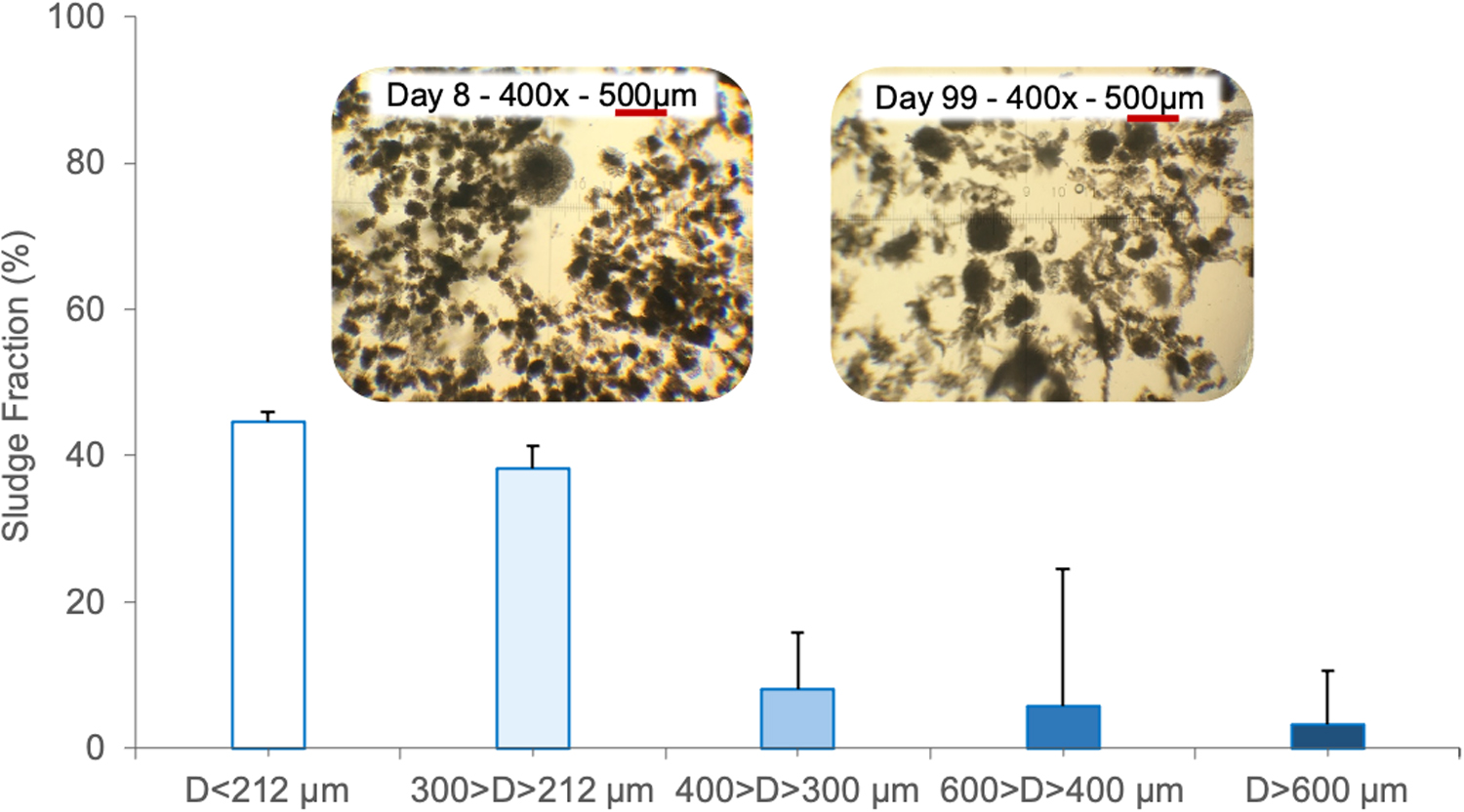
Particle size distribution of the granular biomass during the experimental period and granular sludge microscopy on days 8 and 99.
During the monitored period, most of the developed granules had an irregular star shape and filamentous growth on the surface. The high fraction of particulate organic matter present in real wastewater, the applied shear stress, the available carbon and nutrients, and the reactor's configuration may have been the major factors responsible for that (Wagner et al., 2015; Franca et al., 2018; Xavier et al., 2021).
Figure 2 shows the pH and DO profiles and the nitrogen compounds (ammonia, nitrite, and nitrate) during a standard cycle of the SBR-AGS. Throughout the reactor cycle, the DO values were below 0.5 mg/L during the filling and the anoxic phases, followed by a variation between 8 and 10 mg/L during the aerobic phase. The redox potential was measured in the filling (anoxic/anaerobic) and the reaction (aerobic) phases, for each of the nine analyzed cycles. During the filling phase, the redox potential value was in the range of −70 ± 50 mV, followed by the aerated phase in the range of +200 ± 50 mV. As for the pH, there was a reduction of 7.3–5.1 during the aerobic phase, this drop being associated with the nitrification process due to the consumption of alkalinity (Hoffmann et al., 2007).
The profiles observed for the nitrogen series (Fig. 2B) show that nitrate and ammonia were reduced in the filling phase, probably due to influent dilution effects. The nitrification occurred from the beginning of the aerobic phase, simultaneous with the pH drop (Fig. 2A, B). In this phase, the production of nitrite (5 mg NO2-N/L) and its oxidation to nitrate (26 mg NO3-N/L) were observed, indicating nitrification, with a predominant nitrite-nitrification when ammonia concentration reached around 10 mg NH4+-N/L.
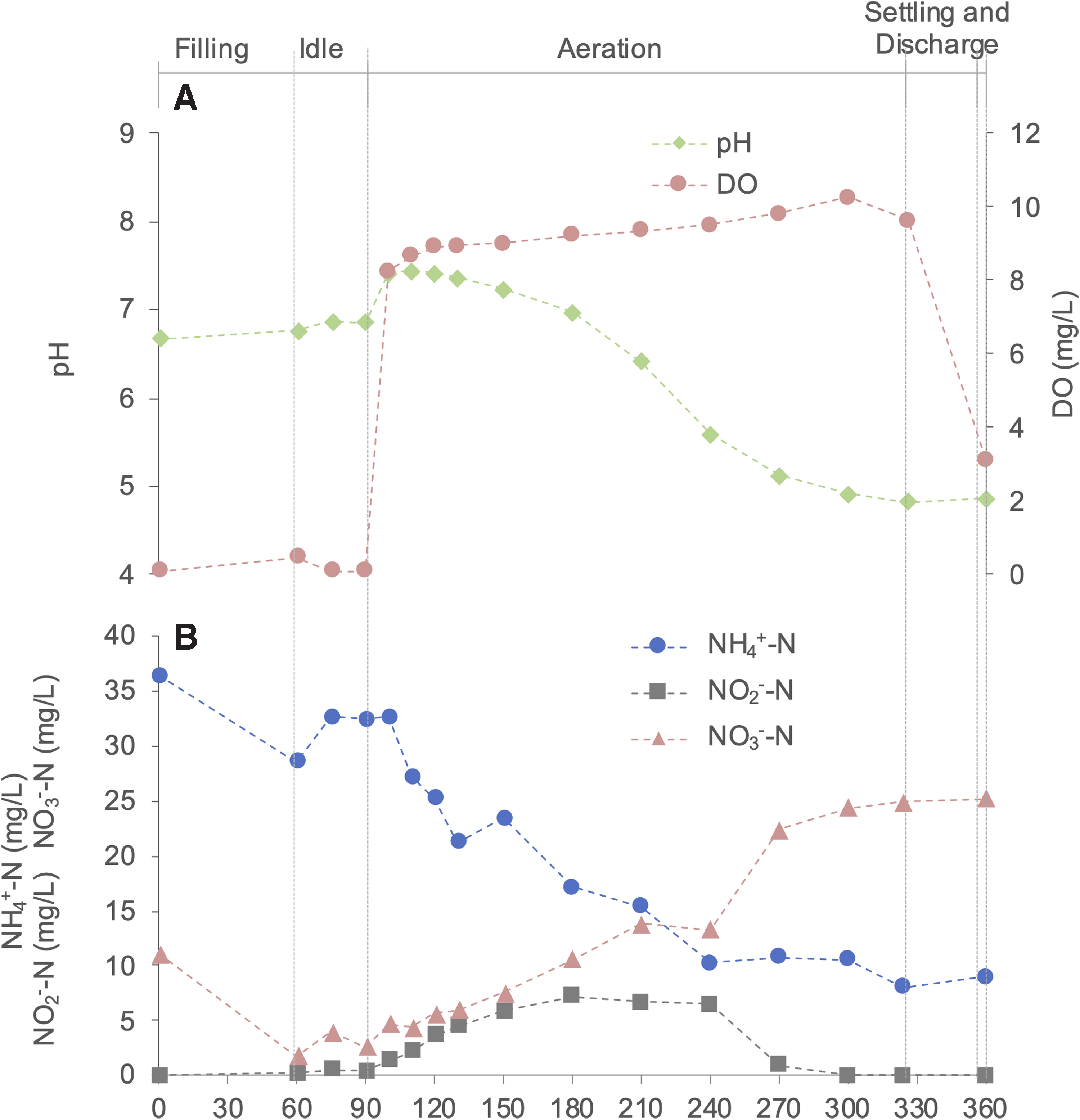
Average cycle profile for pH, DO
In most of the monitored period, the temperatures were between 15°C and 25°C, allowing the presence of ammonium oxidizing bacteria (AOB) in the system. According to Bao et al. (2018), when temperatures increase from 10°C to 30°C, AOB present higher ammonium oxidation activity, increasing the nitrification.
The SCOD/TN ratio was 3.14, with low-strength influent accounting for the reduced C/N ratio. A minimum stoichiometric COD/TN ratio of 3.5 is proposed by Verstraete and Philips (1998), while other proposed values range between 3 and 6 (Lahdhiri et al., 2017). According to Metcalf and Eddy (2003), higher COD/TN ratios result in reduced nitrification and increased denitrification, since more carbon is available for biological nitrogen removal. It is worthwhile to consider that the idle (anoxic) phase just after the feeding phase was used to increase denitrification, besides improving the phosphorus biological removal. However, reduced denitrification was obtained since low nitrite and nitrate concentrations were obtained due to their dilution in the influent.
Operational conditions, such as cycle duration (6 h), alkalinity (240 mg CaCO3/L), DO (>8 mg/L), pH (∼7.5), temperature (∼18°C), and SRT (24 days), prevented the occurrence of nitrite accumulation, commonly observed in other studies with AGS (Hoffmann et al., 2007; Reino et al., 2017; Guimarães et al., 2018), which is undesirable to minimize N2O generation (Kampschreur et al., 2008).
CO2 and N2O emission profile
Figure 3 shows the variation in CO2 and N2O (dissolved and gaseous) over a standard SBR-AGS cycle. In Fig. 3A, it is possible to observe the CO2 emissions over an operational 6-h cycle of the SBR-AGS. Similar to that verified for N2O emissions (Fig. 3B), CO2 emission was not constant during the operation cycle. Occasional emissions occurred when aeration pulses were applied (during the anoxic phase), with the highest peak in the first minutes of the aeration phase (12.6 mg CO2/s). The emissions during the pulses were insignificant compared to the total emissions, which was expected, as the pulses served only to maintain the biomass in suspension. After the peak, the emission gradually decreased, varying between 3.6 and 0.7 mg CO2/s.
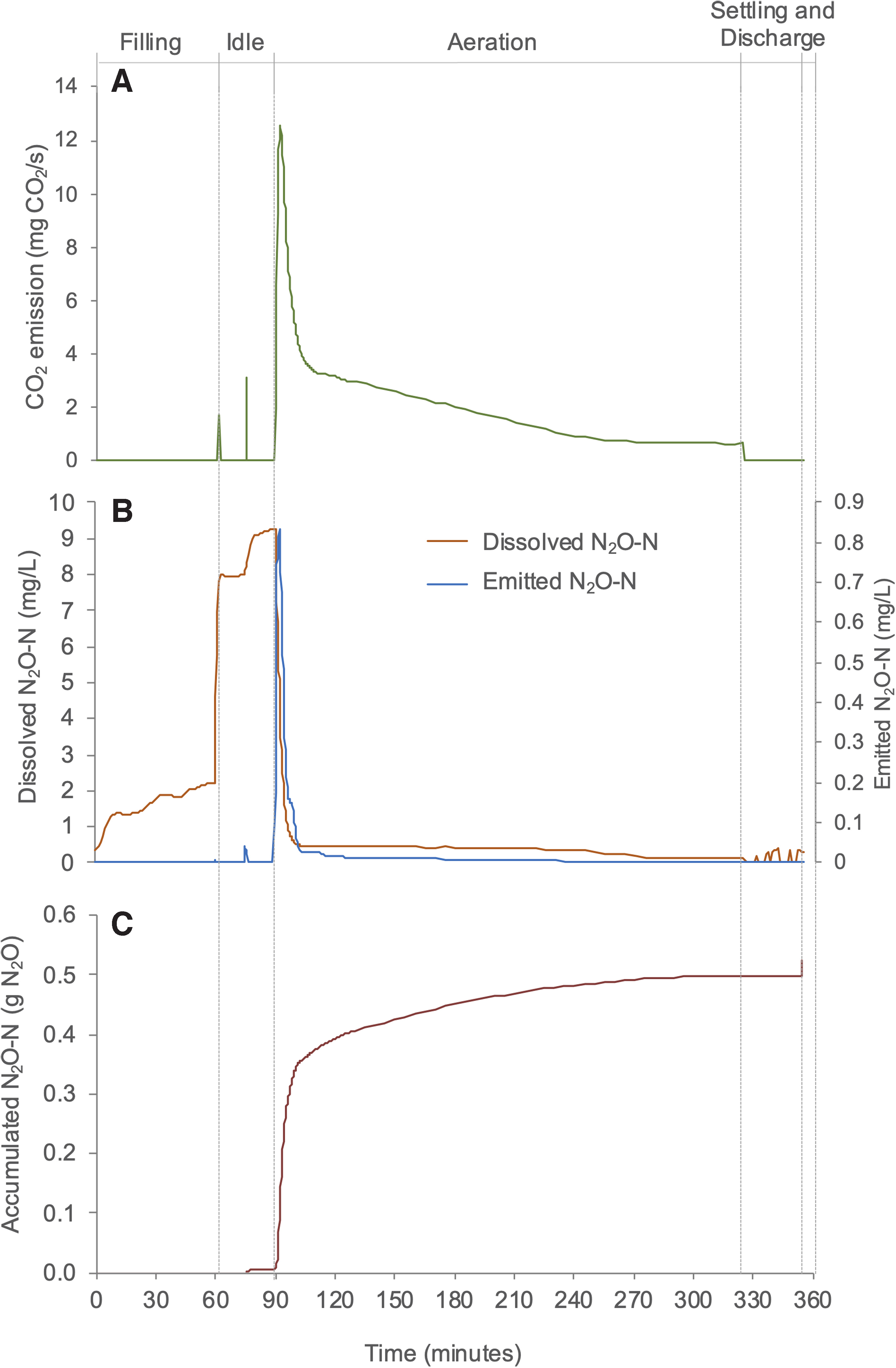
Average SBR cycle profile for emitted CO2
The CO2 emission during the entire aerobic phase was consistent, since most of the carbon removal occurs during this phase. Thus, the CO2 emission is directly associated with the metabolism of aerobic microorganisms (Pascale et al., 2017). When aeration ceases, CO2 emission stops, as there is no airflow in the system.
In Figure 3B, it can be seen that during the filling and anoxic phases (when there was no air flow in the reactor), an increasing dissolved N2O formation occurred in the liquid medium, reaching a peak of 9.0 mg N2O-N/L, while the N2O emission was zero. At the beginning of the aerobic phase, due to the agitation caused by intense aeration, the dissolved N2O concentration in the mixed liquor dropped to values below 0.5 mg N2O-N/L and was released into the atmosphere in the form of gaseous N2O. Values of ∼0.82 mg N2O/s were achieved, after which the emission decreased until reaching values close to zero.
Similar profiles were also observed by Bao et al. (2018) in two SBRs, and by Vieira et al. (2019) in three full-scale biological reactors. The authors attributed the generation of dissolved N2O to the heterotrophic denitrification process, with consequent gas emission in the moments of aeration, corroborating the results of this research.
Ding et al. (2017) also reported N2O generation with DO concentration. According to these authors, when the DO concentration was kept at low levels, oxidation of NH4+ to NO2− occurred, with the generation of N2O by nitrifying denitrification. When the oxygen became excessive (>7.5 mg/L), due to the inhibition of denitrification, the emission of N2O was reduced and the generation of NO3− increased. In this study, from the beginning of aeration, DO concentrations were already quite high (>7.0 mg/L), not favoring the occurrence of nitrifying denitrification. This could explain the low N2O emission observed during the aerobic phase, just after the observed peak emission.
According to Han et al. (2019) and Yang et al. (2013), N2O released during the aeration phase is due to the action of denitrifying microorganisms in the anoxic phase of the reactor cycle. Because there is no airflow during the anoxic phase, the generated N2O accumulates, and is retained (dissolved) in the system. Mello et al. (2013) measured the N2O emission by an activated sludge treatment system with intermittent aeration and found, in accordance, that less than 1% of the amount of generated N2O was emitted to the atmosphere in the absence of aeration.
It is important to note that, in this study, small amounts of N2O were released during the brief aeration pulses, which occurred in the anoxic phase. These punctual emissions, however, were much lower than the overall N2O emission during the 6-h cycle. In fact, the only reason the aeration pulses were performed was to maintain the biomass in suspension, avoiding sedimentation of granules.
N2O production in the liquid phase and emission of N2O to the gas phase were also monitored by Reino et al. (2017). The authors investigated the effects of temperature on N2O dynamics in an SBR with partial nitrification. When a temperature of 20°C was applied, the N2O emission was 2.5 times higher than the emission obtained at 10°C. The authors suggested the hypothesis that the penetration of oxygen into the granules is influenced by temperature. In lower temperature conditions, there is an increase in the depth of oxygen penetration, which would cause a smaller fraction of AOB to be subjected to anoxic conditions. This would reduce the generation of N2O from the metabolic route of nitrifying denitrification.
In addition, according to the authors, N2O emission was higher for higher temperatures, because besides greater generation of this compound, a more intense stripping process also occurs. Similar results were obtained by Bao et al. (2018), who observed an increase in AOB activity due to temperature increase (between 10°C and 25°C) and the consequent increase in N2O emission. However, the N2O production was mainly due to heterotrophic denitrification, when the DO level was below 0.5 mg/L.
The accumulated N2O released by the SBR-AGS in a standard cycle is shown in Fig. 3C. The highest level of N2O accumulation occurred in the first minutes of the aeration phase, as previously verified in Fig. 3B. In this period, the accumulated amount reached 0.35 g N2O. Subsequent ly, it was still possible to verify the increase in the accumulated mass of N2O released, although with less intensity. This result corroborates what was reported by Vieira et al. (2019), where 95% of N2O emissions measured in a WWTP occurred in the aeration tanks. In the settling phase, the accumulation of N2O emitted was null, since there was no airflow in the system.
The last contribution to the amount of accumulated N2O occurred at the end of the SBR-AGS cycle, marked by discharge of the effluent. This contribution refers to the dissolved N2O contained in the treated effluent that was discharged from the system.
The SBR-AGS achieved low TN removal (29%), and most of the effluent nitrogen corresponded to nitrate (26 mg NO3-N/L). Of the total denitrified nitrogen, the emission of N2 exceeded the emission of N2O by a ratio of ∼4:1. The percentage of total nitrogen converted to N2 was 77.1% ± 4.3%, while the nitrogen denitrified to N2O (22.9% ± 4.3%) was within the range obtained by Foley et al. (2010), who reported percentages between 0.06% and 25.3% in different effluent treatment systems. Likewise, Ge et al. (2017), when studying a biofilm SBR, found that 15.47% of the nitrogen removed by denitrification was converted to N2O and 72.25% to N2.
The hydroxylamine, nitrifying denitrification, and the heterotrophic denitrification are the three known N2O production pathways. The heterotrophic denitrification seems to be the most probable N2O production pathway observed in this study, attributed to the high DO concentration applied in the aeration phase, causing the nitrate accumulation. Also, high DO concentration stimulates AOB nitrite isomeric reductase enzyme (Nir) for NO2-N consumption to generate N2O during the oxidation of NH4+ and NH2OH (Sun et al., 2018).
The anaerobic feeding and the idle phase may have provided the required conditions for heterotrophic denitrification (Vasilaki et al., 2019). However, the low carbon concentration due to the diluted nature of the influent may had impacted the complete denitrification, with the generation of N2O. Other pathways have been related to NO2− accumulation, which was not observed in this study.
Although low DO concentrations have been proposed for simultaneous nitrification/denitrification in AGS systems, several authors related oxygen-limited conditions to N2O emissions (Baeten et al., 2021; Thwaites et al., 2021). Low DO concentrations (0.1–0.3 mg/L) combined with high ammonium can respond for high N2O emissions through the nitrifying denitrification pathway, due to incomplete reduction of nitrate to nitrogen gas.
Dijk et al. (2021) observed that a full-scale WWTP working with a dynamic DO set point resulted in higher N2O emission compared to a fixed set point (2.5 mg/L). Dynamic oxygen set point reduced the oxygen supply to optimize the nitrification/denitrification, but resulted in increased N2O emissions, due to increased microbial DO consumption during organic loading peaks. Thwaites et al. (2021) suggested that increased DO concentrations reduce the N2O emissions due to limited nitrite accumulation.
The simultaneous nitrification/denitrification is a possible advantage offered by AGS, due to its well-established granular structure and biofilm nature, which provide the required anoxic zones for denitrification even in the aerobic phase. The small granules obtained during the reactor operation (<200 μm) may not have structured anoxic layers and may not perform the simultaneous nitrification/denitrification. Preliminary studies with the same reactor system used in this work (Daudt et al., 2019) emphasized the importance of an anoxic/anaerobic phase before aeration to ensure denitrification. The results indicated that the extension of the anoxic phase was an effective way to significantly reduce N2O emission and improve treatment efficiency.
In AGS with simultaneous nitrification and denitrification, the N2O can be emitted by different pathways, making it difficult to distinguish which pathway is the major contribution to N2O emissions. The combination of fluctuating influent concentrations and the variety of N2O formation pathways results in complex solutions to avoid N2O emissions (Vasilaki et al., 2019; Dijk et al., 2021). Excessive DO concentration may result in increased OPEX (operating expenses) and C-footprint, so dynamic control of DO concentration may provide better conditions to avoid N2O emissions and efficiently remove nitrogen from the influent.
The EF (5.67%) was higher than the IPCC default value for aerobic treatment plants (Bartram et al., 2019), as can be seen in Table 2. The IPPC standard value is contained in an EF range from 0.016% to 4.5%, based on 30 full-scale activated sludge systems. Vasilaki et al. (2019) reported an EF range from 0.0025% to 5.6% based on 51 full-scale WWTPs analyzed during 10 years. According to the authors, SBRs generally present higher EF compared to other treatment systems, ranging between 2% and 5.6%.
Conversion of Influent Total Nitrogen to Nitrous Oxide Gas (Emission Factor %) (Mean ± Standard Deviation) and Comparison with the Literature
EF (%) = (kg N2O-N/kg TN)*100.
AGS, aerobic granular sludge; CAS, conventional activated sludge; EF, emission factor; N2O, nitrous oxide; SBR, sequencing batch reactor; SOA, static/oxic/anoxic; TN, total nitrogen.
Higher N2O EFs for SBRs are attributed to sudden changes in NH4+ and NO2− concentrations within the cycle or the accumulation of dissolved N2O during the anoxic phase. Ribeiro et al. (2020) observed an EF of 0.054% in a full-scale conventional activated sludge (CAS) system, whereas Chen et al. (2020) found EF values varying from 1.51% to 4.32% in a static/oxic/anoxic treatment process. Sun et al. (2013) obtained an EF of 6.52% in a full-scale SBR, and Chen et al. (2011) noted EF values varying between 8.07%, 5.37%, and 3.93% for an AGS reactor. Kampschreur et al. (2009) reported EF values ranging from 0.001% to 14.6% for different treatment systems.
According to Table 2, lower EF values are related to full-scale reactors, while higher EF is observed for pilot-scale or laboratory-scale experiments. Full-scale reactors usually work with lower DO concentration when compared to that in bench- and pilot-scale studies.
CO2 and N2O (emission and release) and the GWIs of SBR-AGS
Table 3 shows the CO2 emission values. The
Values of Carbon Dioxide and Nitrous Oxide Emission and Release Parameters (Mean ± Standard Deviation) (n = 9)
CO2, carbon dioxide; FBEF, flow-based emission factor; FBRF, dissolved N2O flow-based release factor; PBEF, population-based emission factor; PBRF, population-based release factor.
The average N2O emitted as gas was 0.804 g N2O-N/day. Considering the volume of treated effluent in each cycle, and assuming a per capita effluent generation of 160 L/(person·day) (Metcalf and Eddy, 2003), there is a
Although the observed
The N2O released in the liquid fraction corresponded to 2.9%, while the N2O emitted to the gas fraction contributed to 97.1% of the total amount of N2O produced by the system. It is important to consider the effects of temperature on the distribution of N2O between the liquid phase and the gaseous phase, which explains the difference between the percentages obtained. This study was carried out in a subtropical climate, where average temperatures were around 20°C. Due to the fact that N2O solubility decreases with increasing temperature, it was expected that the percentage of dissolved N2O in the system effluent would be higher in locations with colder weather, or at times of the year with lower temperatures.
The

CO2-equivalent FBEF and GWI from the CO2 and N2O emissions. FBEF, flow-based emission factor; GWI, global warming impact.
The results verified in this research are in accordance with what was verified by Bao et al. (2016), in a study involving the assessment of GHG emissions (N2O, CO2, and CH4) by two real-scale wastewater treatment systems. For both systems, it was found that N2O emissions were the main sources of direct GHG emissions, being responsible for 88.5% and 90.0% of emissions from the A/O and SBR processes, respectively. Daelman et al. (2013) observed that N2O contributed to 78.4% for the carbon footprint, while the CO2 contribution was 8.1%. Including operational parameters as electricity, the total carbon footprint, including N2O contributions, can increase to 97% (Vasilaki et al., 2020). The authors found that 48 kg of CO2-equivalent are generated for the removal of 1 kg of NH4+ from the wastewater, including electricity and direct N2O emission.
This relatively higher impact of N2O in comparison to CO2 emissions indicates that, when aiming to minimize the GWI from a wastewater treatment system, it is especially important to achieve a BNR in which the N2O formation is avoided or, at least, kept to a minimum.
Conclusions
The operational conditions applied to the SBR allowed the development of AGS (1.7 ± 0.40 g VSS/L) with good settleability (SVI30 < 50 mL/g). The treatment performance showed the following removal percentages: 84% of BOD5 and 65% of NH4+-N, attending the Brazilian standards for the wastewater discharge legislation.
The CO2 emissions were observed during the entire aerobic phase in the SBR cycle, when most of the carbon removal occurred due to aerobic metabolism. However, dissolved N2O occurred mainly during the filling and anaerobic phases, due to the heterotrophic denitrification process, followed by gaseous N2O stripping to the atmosphere during aeration. The structural singularity of AGS compared to CAS flocs results in DO gradients, providing conditions for several N2O formation pathways.
Although CO2 flow-based emission was higher, the N2O carbon footprint measured in terms of CO2-equivalent and the GWI was five times higher than the impact of CO2 emissions. N2O emissions were responsible for more than 80% of the total impact, which reinforces the need to maintain monitoring of N2O emissions in AGS wastewater treatment processes, to minimize the generation and emission of N2O. This emphasizes the need for an integrated assessment of the treatment performance and the carbon footprint evaluation for SBR-AGS.
Footnotes
Acknowledgments
The authors thank the Environmental Integrated Laboratory (LIMA) and the Laboratory of Gaseous and Liquid Effluents (LABEFLU) of the Department of Environmental Engineering, at the Federal University of Santa Catarina, for the analytical and structural support.
Authors' Contributions
G.C.D. performed the methodology, investigation, data curation and analysis, and draft writing. B.S.M. performed the data obtention, methods, and data curation draft writing. C.M.S. performed the data obtention, draft writing, and draft analysis. N.L.J. worked on the article writing, data analysis, and discussion. R.H.R.C. supervised this research, including project administration and final article writing.
Author Disclosure Statement
No competing financial interests exist.
Funding Information
This work was supported by Coordenação de Aperfeiçoamento de Pessoal de Nível Superior–Brasil (CAPES) (Finance Code 001) and Conselho Nacional de Desenvolvimento Científico e Tecnológico (CNPq) (Finance Code 404144-2016-0), and by internal funds of Federal University of Santa Catarina.

References
Supplementary Material
Please find the following supplemental material available below.
For Open Access articles published under a Creative Commons License, all supplemental material carries the same license as the article it is associated with.
For non-Open Access articles published, all supplemental material carries a non-exclusive license, and permission requests for re-use of supplemental material or any part of supplemental material shall be sent directly to the copyright owner as specified in the copyright notice associated with the article.
