




Abstract
Polymer inclusion membranes (PIM) have gained global attention in the removal of heavy metals from aqueous samples. Mercury is a toxic metal that can cause serious health effects to humans even if present in traces. Hence, its removal from water bodies and wastewaters is a necessary action. The present work, thus, aims at studying the removal of Hg2+ ions by using PIM with a new and unexplored neutral carrier, namely, Tri n-butyl phosphate and Dioctyl phthalate as a plasticizer. One hundred percent removal was attained for feed phase mercury concentrations from 0.01 to 2 mg/L and about 96% for 10 mg/L under optimum conditions (thickness of the membrane: 30 μm, feed phase acid: 0.3 M, strip phase alkali: 0.4 M, carrier: 3% and stirring speed: 400 rpm). The PIM system has been successfully demonstrated to remove trace concentrations of mercury in spiked seawater, thermal powerplant wastewater discharge, and contaminated lake water samples. The PIM was highly stable (60 h) and selective for Hg2+ ions. Also, the most significant factor in the transport of mercury through the PIM was determined as the feed phase mercury concentration using the Taguchi method. Thus, the proposed PIM system could be used for the selective removal of mercury ions from water and wastewater samples.
Introduction
In recent times, the environment has witnessed an increase in heavy metal contamination, mainly due to anthropogenic activities (Keeler et al., 1995). Mercury gets converted to a toxic form once released into the environment and by bioaccumulation can cause serious damage to wildlife and humans (Landis et al., 2004). Worldwide, there are norms and regulations to control the concentration of mercury in water bodies (US EPA, 1997).
Despite the regulatory measures, the concentration of mercury seems to increase in natural systems (Parsons et al., 2007). The Minamata Convention aims at safeguarding the health of humans and the environment from mercury and its compounds. Its success depends on the control and management of mercury emissions from developing countries such as India. Globally, India is the second top emitter of mercury and needs a sound framework for strengthening research, policy, and economy to contain the emissions (Sharma et al., 2019).
There are also reports on the Chlor-alkali plants in India that have already contaminated the sea water and freshwaters, with trace concentrations of mercury (Ram et al., 2009). Similarly, studies have demonstrated improper usage and disposal of mercury from a thermometer factory that led to the contamination of water bodies (Lin, 2015). Also, reports indicate the bioaccumulation of mercury in fishes that could reach humans and cause deleterious effects (Subhavana et al., 2020). Thus, the need for efficient technologies that could remove mercury selectively at low concentrations from water samples is of paramount importance.
The removal of mercury in aqueous solutions using extraction methods such ass precipitation, coagulation, adsorption, solvent extraction, chemical oxidation and reduction, ion exchange process, liquid–liquid extraction, cementation, liquid membranes and electrolysis have been reported (Sharma et al., 2015). Liquid membranes have become popular in large-scale applications due to high selectivity and easy implementation (Mercader-Trejo et al., 2009), with less use of chemicals (Chakrabarty et al., 2010).
Polymer inclusion membrane (PIM) offers high stability with negligible carrier loss over other liquid membranes, thus making it a suitable candidate for the removal of heavy metals from aqueous solutions (Sgarlata et al., 2008). The selectivity of the membrane was dependent on the strength and stoichiometry of the complex species formed by the carrier with mercury ions (Mercader-Trejo et al., 2009).
The PIM is an emerging green solution for the removal of heavy metals from aqueous solutions (Pospiech and Kujawski, 2015). The PIM separates the heavy metal from aqueous solutions in a single step, combining the extraction and stripping process with fewer chemicals and provides high selectivity, stability, and quick transport (Ines et al., 2012). In addition to it, PIM offers the benefit of designing the membrane to the requirements needed in an easy way (Kuswandi et al., 2019). The PIM comprises a polymer, plasticizer, and ion carrier. Polymer provides mechanical strength to PIM, whereas plasticizer provides elasticity, flexibility, and compatibility between the components (Ines et al., 2012).
The PIM finds its application in environmental water monitoring. It has been used for sampling, preconcentration, and sensing a pollutant in natural waters, especially for heavy metals (Kuswandi et al., 2019). Recently, an ionic liquid-based PIM special device has been tested for the preconcentration of mercury in natural waters by Elias et al. (2019). Also, the other area in which PIM has gained popularity is in the development of optical sensors. These sensors have shown promising results with high selectivity and sensitivity (Kuswandi et al., 2019).
Very few works have attempted the removal of mercury in a PIM system. The PIM with a synthetic carrier (Calix [4] arene derivative) was used for studying the selective transport of Hg2+ ions from an acidic mixture containing mercury, lead, and cadmium by Sgarlata et al. (2008). A commercial carrier such as Cyanex 471X was used by Mercader-Trejo et al. (2009) for the removal of Hg2+ ions in a cellulose triacetate (CTA)-based PIM system with 2-nitrophenyl octyl ether as a plasticizer.
Among the various carriers reported for the removal of heavy metals, Tri n-butyl phosphate (TBP), a neutral carrier, is established to be superior in terms of extraction capacity to amine-based carriers (Ren et al., 2015). The PIM with TBP as a carrier has been successfully employed for the removal of heavy metals, namely, cadmium, lead (Arous et al., 2010), and rare earth metals such as lanthanum (Makowka and Pospiech, 2019). The use of TBP as a carrier in a PIM system for the removal of mercury form aqueous solutions has not been reported in the literature to date.
Statistical methods are gaining popularity over the classical approach due to less consumption of time and energy. In addition to it, the effect of each parameter and also their interaction on the process could also be studied by using statistical methods (Bezerra et al., 2008). Taguchi's method is widely used for the improvement of a process or product (Jou et al., 2014). It gives an optimal condition of parameters that are more reliable and are less affected by noise (Kargari et al., 2006).
The present work aims at studying the removal of mercury ions by PIM with TBP as a carrier and Dioctyl phthalate (DOP) as a plasticizer. DOP was chosen, as it is a less expensive and more flexible plasticizer (Sharaf et al., 2018). The main objective is to determine the removal efficiency of the PIM system with TBP as a carrier. Optimization of parameters, namely, the concentration of strip phase alkali, concentration of feed phase acid, the concentration of carrier, relative centrifugal force, and concentration of mercury ions in feed phase, was performed.
Further, the contribution of each parameter on removal efficiency was calculated by using the Taguchi method. The study also attempts to determine the applicability of the PIM system by evaluating the selectivity of Hg2+ ions with other metals and testing with real wastewater samples.
Materials and Methods
Materials
All the reagents used in this study were of analytical grade. Mercury chloride (HgCl2), n-Hexane, DOP, CTA, and hydrochloric acid (HCl) were procured from Merck. TBP and stannous chloride (SnCl2) were obtained from Sisco Laboratory. Sodium hydroxide (NaOH) and rhodamine B were obtained from Central Drug House. Double-distilled water was used for preparing aqueous solutions.
PIM preparation
The PIM was prepared by dissolving the polymer matrix (CTA), plasticizer (DOP), and ion carrier (TBP) in n-Hexane to prepare a homogenous solution. The solution was poured into a flat-bottom glass petri dish and was allowed to evaporate overnight at room temperature. A transparent, flexible polymer film with a smooth surface was obtained from it. The film was carefully peeled from the petri dish and was used for the study after rinsing with distilled water. Membrane thickness was measured by using Mitutoyo digimetric micrometer, Japan (Model: MDH 25MB) with an accuracy of 0.1 μm. The thickness of the membrane was found to be same both before and after the transport process.
PIM system
The PIM system consists of two glass tanks of equal volume (200 mL), as shown in Fig. 1. The cylindrical tanks of the system are connected by glass rim and rubber o-rings. The rubber o-rings are, in turn, supported by a Teflon holder. The PIM was placed between the rubber rings. The PIM system was then placed on a magnetic stirrer (model 841; Deep Vision Limited) to provide stirring to the solutions on both sides of the reactor, as shown in Fig. 1.

Schematic diagram of PIM system. PIM, polymer inclusion membrane.
Experiments
Feed (150 mL) and strip phase (150 mL) solutions were taken on either side of the PIM system. Batch experiments were conducted at room temperature with stirring. The effect of thickness of the membrane, feed phase acid concentration, strip phase alkali concentration, carrier concentration, relative centrifugal force, and concentration of mercury ions in feed phase was determined. All the experiments were performed in triplicate. Samples were collected from feed and strip phase solutions at regular intervals and were analyzed for the concentration of mercury.
Analysis
Sample solutions with a low concentration (1–20 mg/L) of mercury were analyzed by using a visible spectrophotometer Visiscan 167 (Systronics). The concentration of Hg2+ ions was determined by using the method demonstrated by Loo et al. (2012). Sample solutions with trace levels (0.1–1,000 μg/L) of mercury were analyzed by using a Cold vapor atomic fluorescence spectrophotometer (Model: 10.025, Millenium Merlin; PS Analytical, London, United Kingdom).
Trace-level concentration of other heavy metals used for the study was determined by using inductively coupled plasma optical emission spectroscopy (ICP-OES), namely, ICAP 6500 (Thermo Fisher Scientific Private Limited). The pH of the feed and strip solutions was measured by using a digital pH meter (model: Li 120) supplied by Elico.
Scanning electron microscope (SEM) images of the PIM samples were obtained by using JEOL-JSM-IT 200.
Removal efficiency
The removal efficiency was calculated for the experiments by using Equation (1) proposed by Pancharoen et al. (2010). Co is the concentration of mercury ions initially present in the feed phase, and Ct is the concentration of mercury ions present in the feed phase at time t.
Application studies
Mercury spiked seawater, thermal powerplant wastewater discharge, and a contaminated lake water sample were used for the application purpose. Under optimum conditions, the PIM system was tested with these samples, to determine its applicability.
Seawater sample was collected and spiked with mercury in three sets with different concentrations (10, 5, and 0.1 mg/L) of Hg2+ ions by the method developed by Bhandare and Argekar (2002). A wastewater sample was collected from a thermal plant in Chennai. The sample was filtered by using Millipore filter paper (pore size: 0.4 μm) and then acidified with HCl. A contaminated lake water sample was collected from Kodaikanal Lake, India. The sample was filtered by using Millipore filter paper and then taken for study.
Design of experiments
Taguchi, a statistical method, was employed to design the experiments by using Minitab version 17 software. The effect and interaction of the factors, namely, feed phase acid concentration, strip phase alkali concentration, concentration of carrier, and feed phase mercury concentration, were studied. The factors and their corresponding levels were chosen based on the uni-variant experiments, as shown in Table 1. L9 orthogonal array designed with four factors at three levels resulted in nine experimental runs (Table 2). Each experiment was performed in three trials with the PIM system, as described in Fig. 1. The corresponding removal efficiency obtained in the experimental runs was calculated by using Equation (1).
Process Factors Range and Their Levels
Experiments Designed Using Taguchi Method
Results and Discussion
Choice of feed phase acid
Acid for feed phase was chosen by studying the removal efficiency of various acids in the PIM system. Acids used for the study include HCl, HBr, and HI. Mercury forms halide compounds in aqueous solutions with acids [Eq. (2)]. Experiments with the acids (concentration—0.1 M) containing mercury (concentration—10 mg/L) as the feed phase and NaOH (concentration—0.1 M) as the strip phase were performed at room temperature. HCl exhibited a removal efficiency of 75.2%, whereas the values for HBr and HI were 69.6% and 63.1%, respectively.
The results indicate that HCl is superior in forming halides with mercury ions than the other two acids. This observation may be due to the interatomic distance between the ions of chloride and mercury (2.28 Å). The other two halides having a larger interatomic distance of 2.42 and 2.63 Å may be the reason for exhibiting less performance in forming halide complexes with mercury (Maron et al., 2008). Also, the higher efficiency of removal observed using HCl could be associated with its dissociation constant values. Dissociation constants are inversely proportional to stability constants. In this case, HCl (1.3 × 10¹⁵) has less value of stability constant compared with HBr (9.2 × 10¹⁰) and HI (5.6 × 1029) (Clever et al., 1985).

Effect of thickness of the membrane
The thickness of the membrane plays a significant role in the transport of metal ions across PIM (Arous et al., 2010). Thus, membranes with a varying thickness were investigated for the transport experiments. It could be inferred that as thickness increases, transport across PIM decreases. The maximum removal efficiency (83%) was attained with a membrane thickness of 30 μm. The results obtained indicate the influence of membrane thickness on the diffusion of metal ions across the membrane. A similar trend was also reported on a CTA-based PIM system with carriers, di(2-ethylhexyl) phosphoric acid for removal of Cr (III) ions by Konczyk et al. (2010) and 2-Nitro phenyl octyl ether for removal of Cr (VI) ions by Kaya et al. (2013).
Effect of the concentration of feed phase (HCl)
The concentration of the feed phase was varied from 0.1 to 0.7 M in the PIM system, with all the other factors being constant. Experiments were performed with 0.1 M NaOH, 3% of TBP, and 10 mg/L of Hg2+ ions as initial concentration in the feed phase at 600 rpm. The results obtained are presented in Fig. 2. Increasing the concentration of the feed phase from 0.1 to 0.3 M increases the transport of Hg2+ ions across the membrane, as reflected in the removal efficiency values. This is because of the increasing availability of H+ ions in the feed phase. H+ ions protonate TBP and facilitate the transport of mercury across the membrane.
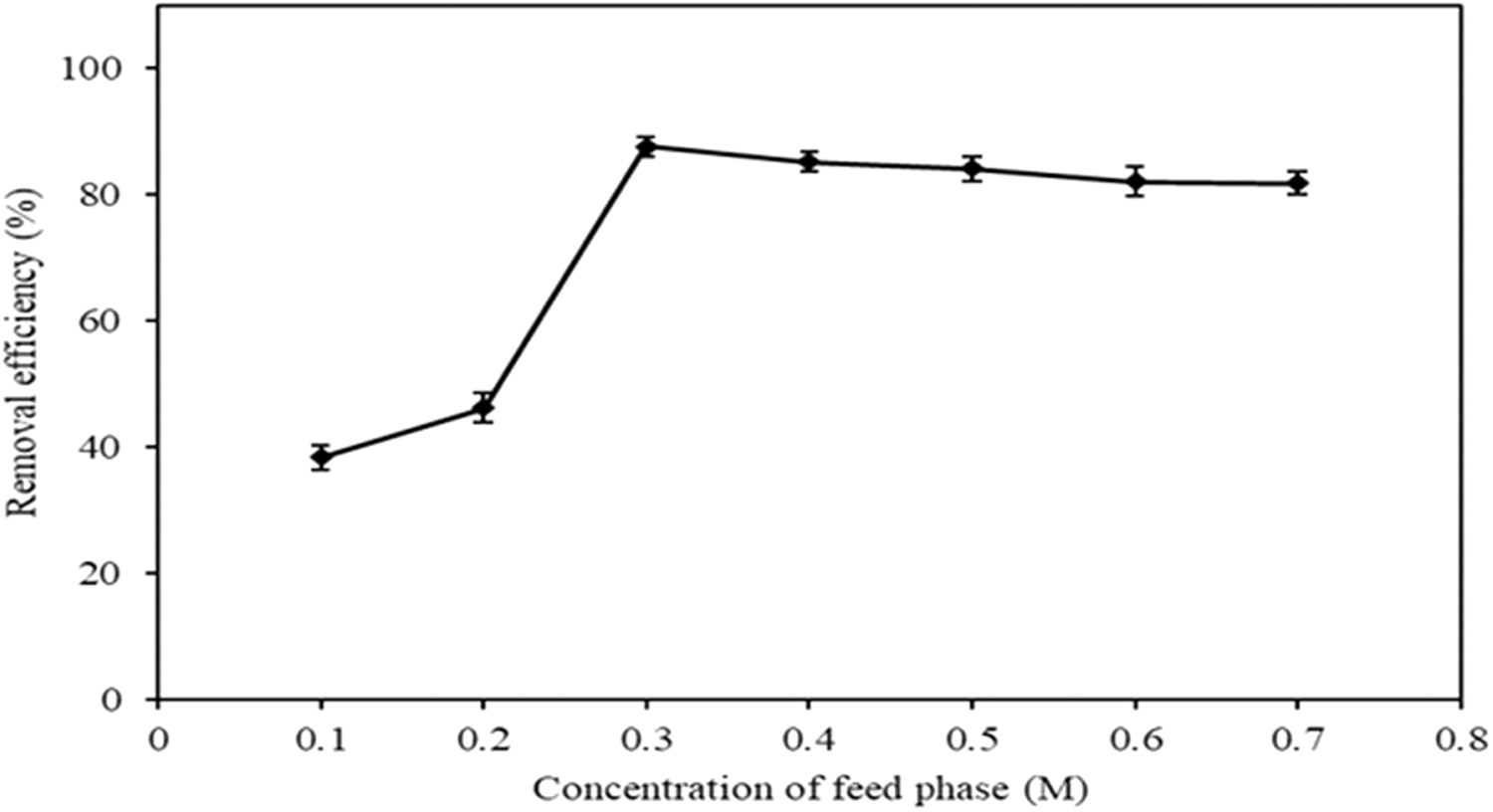
Effect of the concentration of feed phase (HCl) on removal efficiency (%; thickness of the membrane: 30 μm, NaOH: 0.1 M, initial concentration of Hg2+ ions: 10 mg/L, TBP: 3%, stirring speed: 600 rpm). HCl, hydrochloric acid; NaOH, sodium hydroxide; TBP, Tri n-butyl phosphate.
For concentrations above 0.3 M, there was no noticeable change in the removal efficiency. The removal efficiency was maximum (87.67%) at 0.3 M of feed phase acid. Transport of Hg2+ ions from the feed phase to strip phase across PIM is dependent on the concentration gradient of hydrogen ions. Hydrogen ions protonate TBP, which, in turn, reacts with the mercury ions present in the feed phase to form complexes. In the presence of a high concentration of hydrogen ions, mercury readily forms complexes with chloride ions that are excess in the feed phase (Bohrer, 1983). However, increasing the concentration of chloride ions in the feed phase decreases the removal of mercury due to the presence of anionic mercury chloride species (Mercader-Trejo et al., 2009).
Effect of the concentration of strip phase (NaOH)
In this study, NaOH was used as a strip solution as it is non-hazardous and easy to dispose of, unlike chemicals such as ethylene diamine tetraacetic acid (EDTA) (Sgarlata et al., 2008). The influence of the concentration of strip phase on removal efficiency was determined by varying the concentration of strip phase from 0.1 to 0.7 M (Fig. 3) with 10 mg/L as the initial concentration of Hg2+ ions. Then, 0.3 M HCl and 3% of TBP were used for the experiments.

Effect of the concentration of strip phase (NaOH) on removal efficiency (%; thickness of the membrane: 30 μm, HCl: 0.3 M, initial concentration of Hg2+ ions: 10 mg/L, TBP: 3%, stirring speed: 600 rpm).
Initially, removal efficiency increases with the increasing concentration of NaOH. The OH− ions are involved in the regeneration of TBP present in the membrane. As OH−- ions concentration increases from 0.2 to 0.4 M, mercury is actively transported across the membrane. The maximum removal efficiency of 88.98% was achieved at 0.4 M of strip phase concentration. After it, an increase in the concentration of the strip phase did not cause any significant change in the transport of Hg2+ ions across the membrane. Increasing the concentration of NaOH increases the availability of OH− ions that form HgO as precipitates.
At high concentrations, precipitates clog the membrane, cause hindrance to the transport process (Chakrabarty et al., 2010), and may be the reason behind the observed low removal efficiencies at high concentrations of NaOH.
Effect of the concentration of carrier
The concentration of TBP was varied (1–10%) to study its influence on the transport of Hg2+ ions by the PIM system (thickness of the membrane: 30 μm, HCl: 0.3 M, NaOH: 0.4 M, initial concentration of Hg2+ ions: 10 mg/L, stirring speed-600 rpm). Figure 4 shows the results obtained by varying the concentration of carrier on removal efficiency. Increasing the concentration of carrier initially increased the removal efficiency of Hg2+ ions by the PIM system. The increased availability of carriers to form ion-pair complexes with mercury may be the reason behind this behavior. At 3% of carrier concentration, the removal efficiency was maximum, that is, 92.67%.
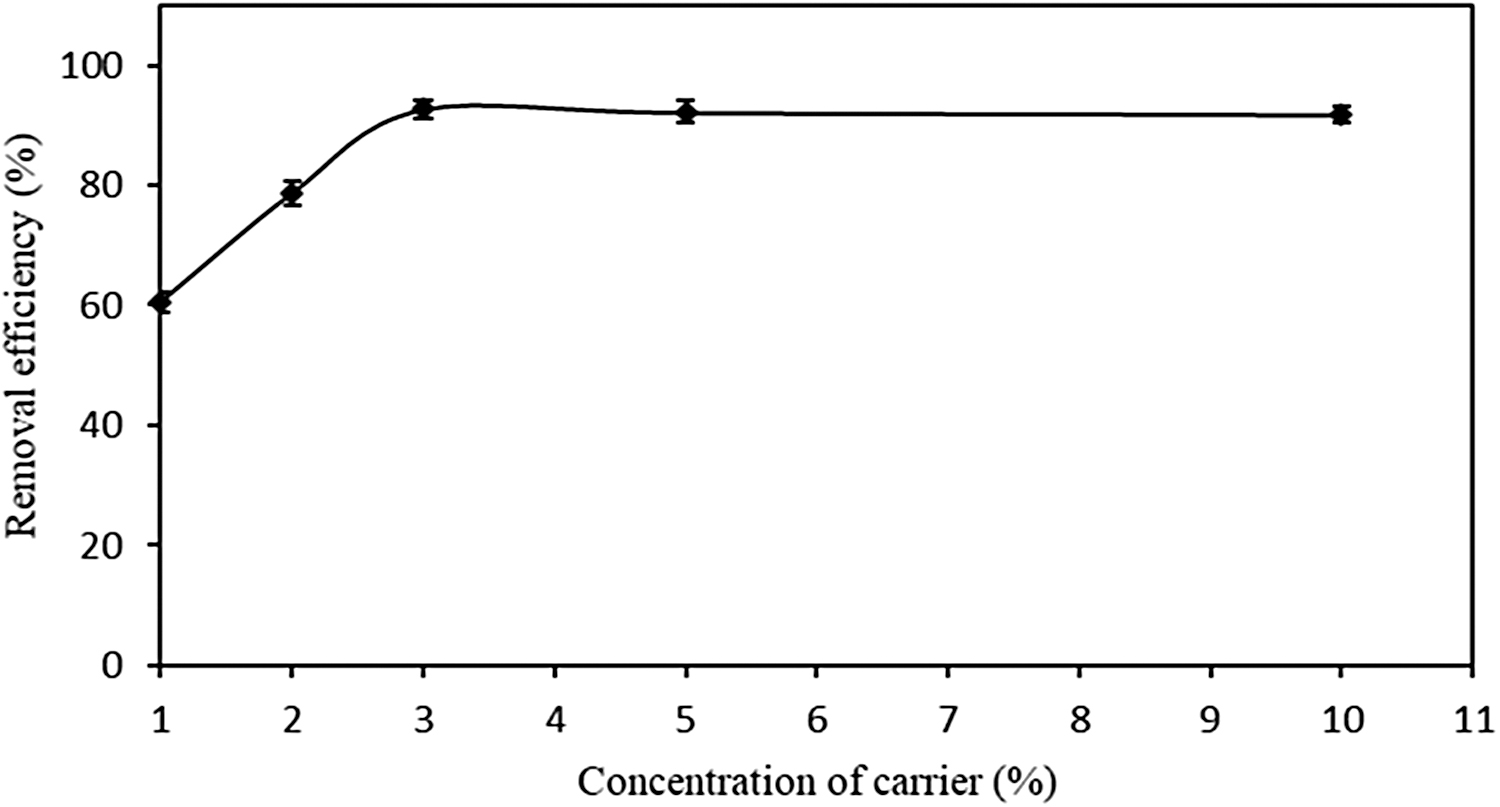
Effect of the concentration of carrier (TBP) on removal efficiency (%; thickness of the membrane: 30 μm, HCl: 0.3 M, NaOH: 0.4 M, initial concentration of Hg2+ ions: 10 mg/L, stirring speed: 600 rpm).
Effect of relative centrifugal force
Relative centrifugal force was varied from 0 to 4.82 g, corresponding to the stirring speed from 0 to 600 rpm. Maximum transport occurred with the centrifugal force of 2.14 g, corresponding to 400 rpm with a removal efficiency of 93.05%. After this maximum value, the removal efficiency decreased slowly. The observation may be due to the possible displacement of carrier molecules from the membrane due to high turbulence (Chaturabul et al., 2015).
Effect of initial concentration of Hg2+ ions in feed phase
The initial concentration of Hg2+ ions was varied in the feed phase solution from 0.01 to 20 mg/L to study the performance of the PIM system in various concentrations of mercury. The other parameters were maintained at a constant value, namely, 0.3 M of HCl, 0.4 M of NaOH, 3% of TBP, and 400 rpm as stirring speed. Figure 5 shows the results obtained in the study, that is, the effect of the initial concentration of Hg2+ ions in the feed phase. The PIM system was capable of completely removing Hg2+ ions that were initially present in the feed phase.
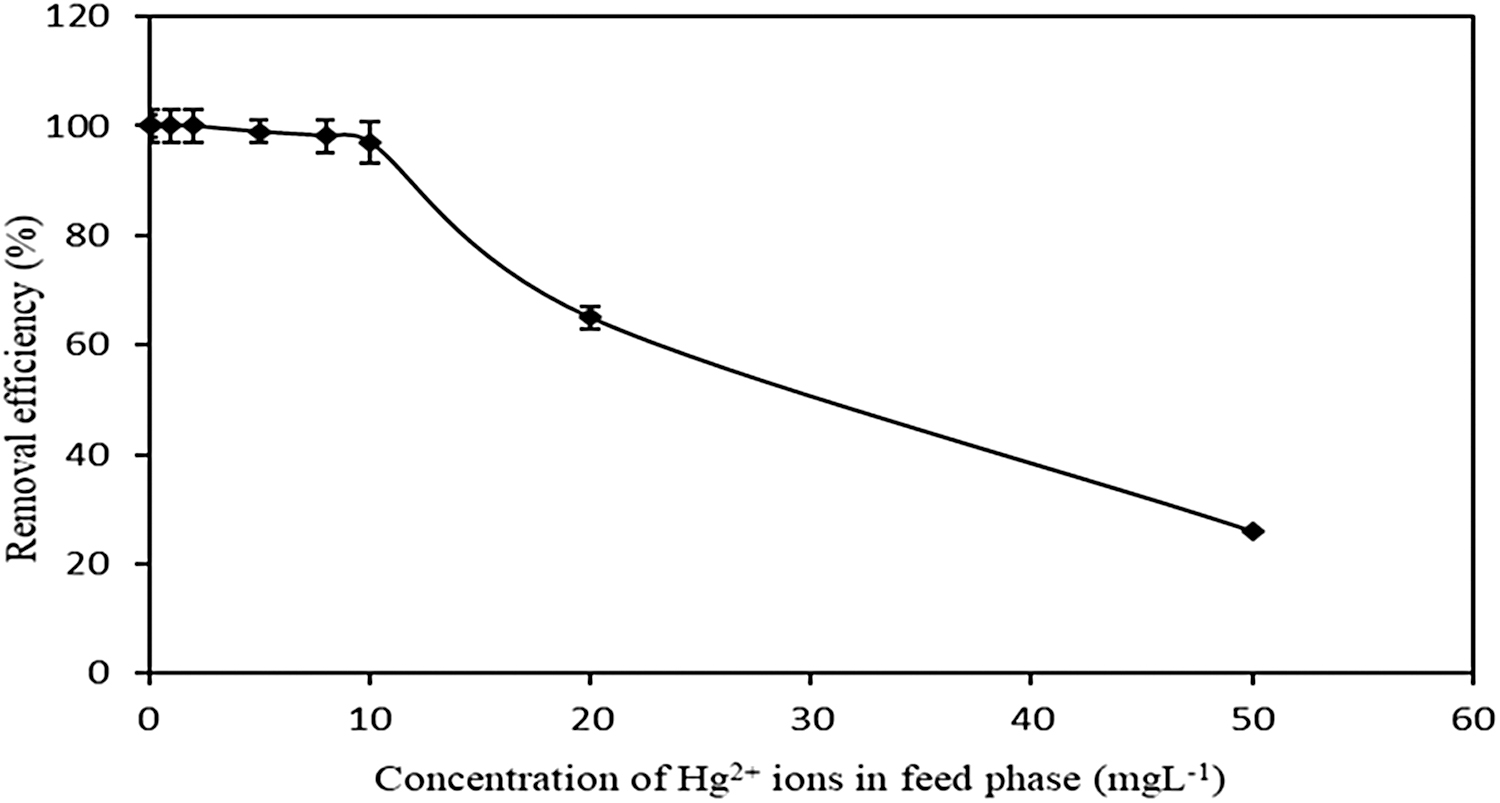
Effect of initial concentration of Hg2+ ions in feed phase (thickness of the membrane: 30 μm, HCl: 0.3 M, NaOH: 0.4 M, TBP: 3%, stirring speed: 400 rpm).
One hundred percent efficiency of removal was observed for the Hg2+ ions concentration from 0.01 to 2 mg/L. For the Hg2+ ions concentration from 2 to 10 mg/L, above 96% of removal efficiency was achieved by the PIM system. The removal efficiency and the transport across the membrane decreased with a further increase of the concentration of Hg2+ ions. The trend may be due to a decrease in the permeability of the strip phase that leads to clogging of Hg2+ ions in the membrane (Mercader-Trejo et al., 2009). In other words, the membrane gets saturated with the ion-pair complexes whereas its decomplexation in the stripe phase is a likely rate-limiting step (Arous et al., 2010).
Optimum conditions
Table 3 sums the optimum conditions obtained by varying one factor at one time for the removal of Hg2+ ions in the PIM system (concentration range from 0.01 to 10 mg/L).
Summary of Optimum Conditions Obtained in This Study
HCl, hydrochloric acid; NaOH, sodium hydroxide; TBP, Tri n-butyl phosphate.
Transport mechanism
This section deals with the mechanism underlying the transport of Hg2+ ions across the PIM. The feed phase consists of solute molecules in a dissolved state, which then diffuses through the liquid boundary layer. It reacts with the carrier and forms a complex. The complex containing the metal ions diffuses through the membrane phase and reaches the strip solution due to the concentration gradient (Malik et al., 2011).
The co-transport mechanism of Hg2+ ions by the PIM system involves the reaction of solute particles at the feed phase and its diffusion, followed by a reversible reaction at the membrane phase, diffusion of the complex containing a solute, and finally, a chemical reaction at the strip phase. Equations (3) and (4) represent the chemical reactions that occur in the feed phase. In the feed phase, the chloride ions of the acid react with Hg2+ ions and form HgCl42− [Eq. (3)].
At the same time, the TBP present in the membrane phase gets protonated by the acid [Eq. (4)]. Equation (5) represents the reaction that takes place in the membrane phase of the PIM system. The TBP in protonated form combines with HgCl42− ions and forms an ion-pair complex (Xiao et al., 2016). The ion-pair complex (HgCl42−.2(RO)3POH+) diffuses through the membrane due to concentration gradient and reaches the strip phase. In the strip phase, the alkali reacts with the complex to separate Hg2+ ions from the complex [Eq. (6)]. The TBP, thus, regenerated during the reaction diffuses back to the membrane phase. The schematic diagram of the entire co-transport mechanism is presented in Fig. 6.

Schematic representation of co-transport mechanism of Hg2+ ion through PIM.

Figure 7 shows the concentration-time profile for the transport of Hg2+ ions across the PIM system at optimum conditions. It presents the concentration profile of Hg2+ ions in three phases, namely, feed, strip, and membrane over time. The concentration of Hg2+ ions decreases in the feed phase over time, as it increases in the strip phase. The trend indicates the influence of exposure of the membrane in the transport process.
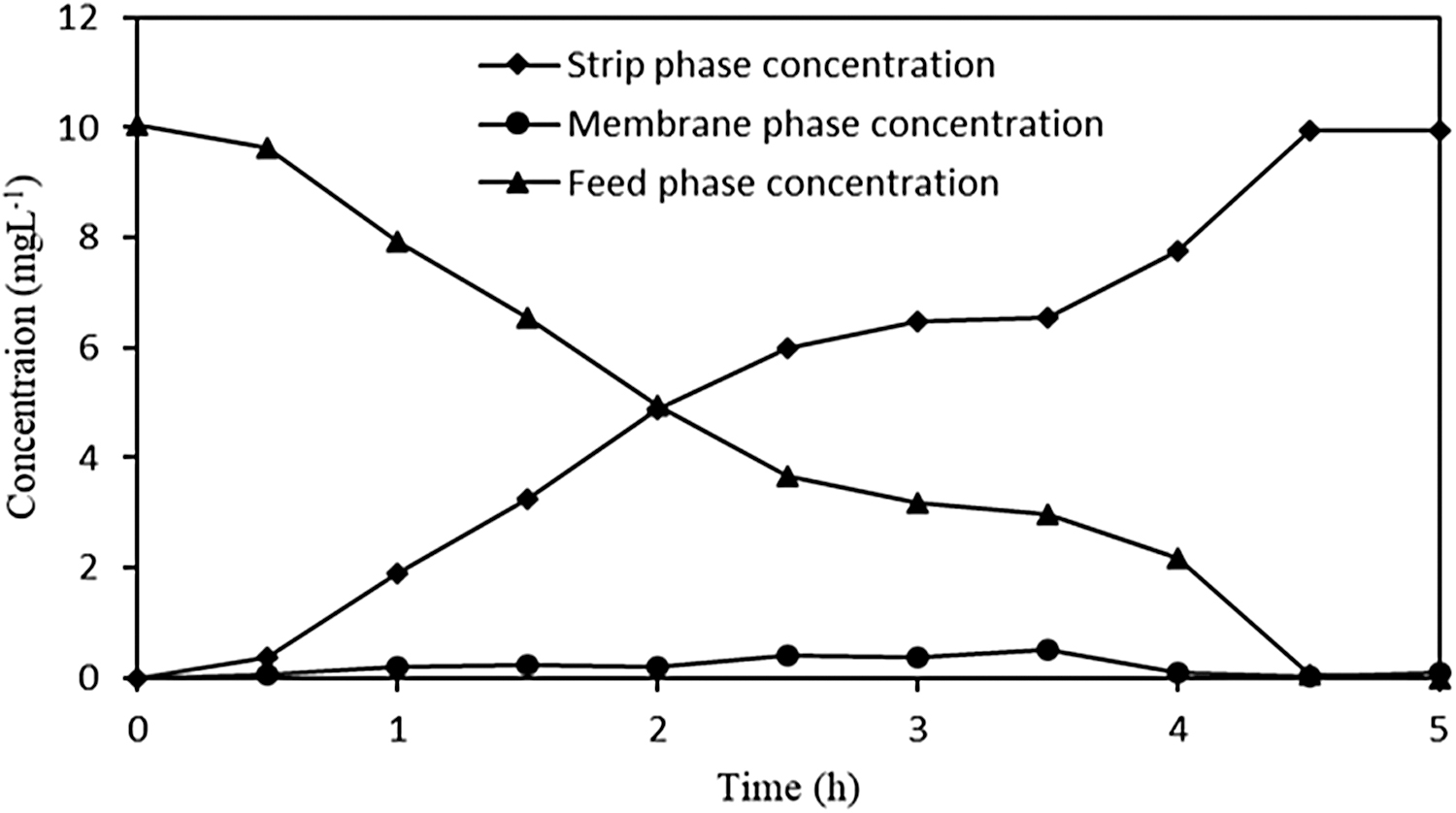
Effect of time on concentration of Hg2+ ions (thickness of the membrane: 30 μm, HCl: 0.3 M, NaOH: 0.4 M, TBP: 3%, stirring speed: 400 rpm).
The concentration gradient of the ion-pair complex formed between the mercury ions and TBP is the driving force of the transport across PIM. The concentration of Hg2+ ions increases with time and reaches a maximum of 1.5% around 3 h, after which it decreases due to the effective removal of Hg2+ ions from the feed phase to the strip phase. Mercader-Trejo et al. (2009) reported a similar observation of negligible retention of Hg2+ ions in CTA-based PIM with Cyanex 471X as a carrier.
Selectivity studies
Effective removal of mercury by the PIM was studied in binary mixtures containing mercury and other heavy metals. The selectivity of the PIM system for mercury was determined by using this study. As in real-time situations, wastewater or groundwater samples contain mercury along with other metals. India is one of the top emitters of mercury (Sharma et al., 2019). In addition, there are reports on the contamination of water bodies by this toxic metal due to effluents from Chlor-alkali industries (Ram et al., 2009).
In these effluents, the major metals present with mercury are cadmium, zinc, and nickel (Blue et al., 2008). Hence, in the present study, these three metals were used. Mercury and metals were mixed in two different concentrations (10 and 50 mg/L) to prepare binary mixture solutions. In the feed side of the PIM reactor, mixture solutions were placed. At optimum conditions, transport experiments were carried out. Table 4 displays the results obtained for each binary mixture.
Selectivity of Mercury Ions in Binary Mixtures
The removal efficiency of mercury ions by the PIM system was above 95% for all the studies, demonstrating the high selectivity of the membrane. Even though zinc and cadmium metals form tetrahedral ions similar to mercury, these metal ions were not transported actively by the PIM. This trend shows a high affinity of the TBP-based PIM for mercury ions. A similar report regarding the high selectivity of a Calix [4] arene-based PIM system with mercury was demonstrated by Sgarlata et al. (2008).
They studied the removal of mercury ions in a mixture with lead and cadmium. They suggested complex interactions in the PIM system for the observed high selectivity for mercury ions. First is the strength and stoichiometry of the metal ions at the feed-membrane interface. The other factor is the high values for the stability constant of mercury with the strip phase (EDTA). Mercader-Trejo et al. (2009) studied the selectivity of Cyanex 471X based PIM for Hg2+ ions in a mixture containing 13 other metal ions, namely, Cd, Co, Cu, As, Ba, Pb, Mn, P, Zn, S, K, Mg, and Ca. They reported the high selectivity of PIM for mercury (72%) over all the other metal ions.
Stability of PIM
The stability of PIM over supported liquid membrane is one of the most attractive benefits. It depends on the composition of PIM, namely, carrier, plasticizer, and organic solvent (Radzyminska-Lenarcik and Ulewicz, 2019). Experiments were carried out under optimum conditions to establish the stability of PIM. The same membrane was used for each experimental run, whereas the feed and strip solutions were freshly fed after each run. The removal efficiency was around 97% for about 12 experimental runs (60 h). The membrane was stable for 60 h (12 runs), after which there was a drop in the removal efficiency. The observed stability of TBP-based PIM is higher than that reported by Mercader-Trejo et al. (2009).
They used Cyanex 471X based PIM for the removal of mercury from aqueous solutions. They determined the stability of the membrane to be 49 h with the immersion of PIM in water for 12 h for each run. In this study, PIM was used continuously for 14 runs.
Morphology studies
Surface morphology of the PIM was performed by using SEM, and the images are presented in Fig. 8. Figure 8a and b are images of the CTA membrane with TBP as a carrier. It could be seen that the membrane is homogenous and non-porous. The SEM images of PIM after the transport experiment are shown in Fig. 8c and d. The membrane surface was found to be altered due to the transport of mercury ions.
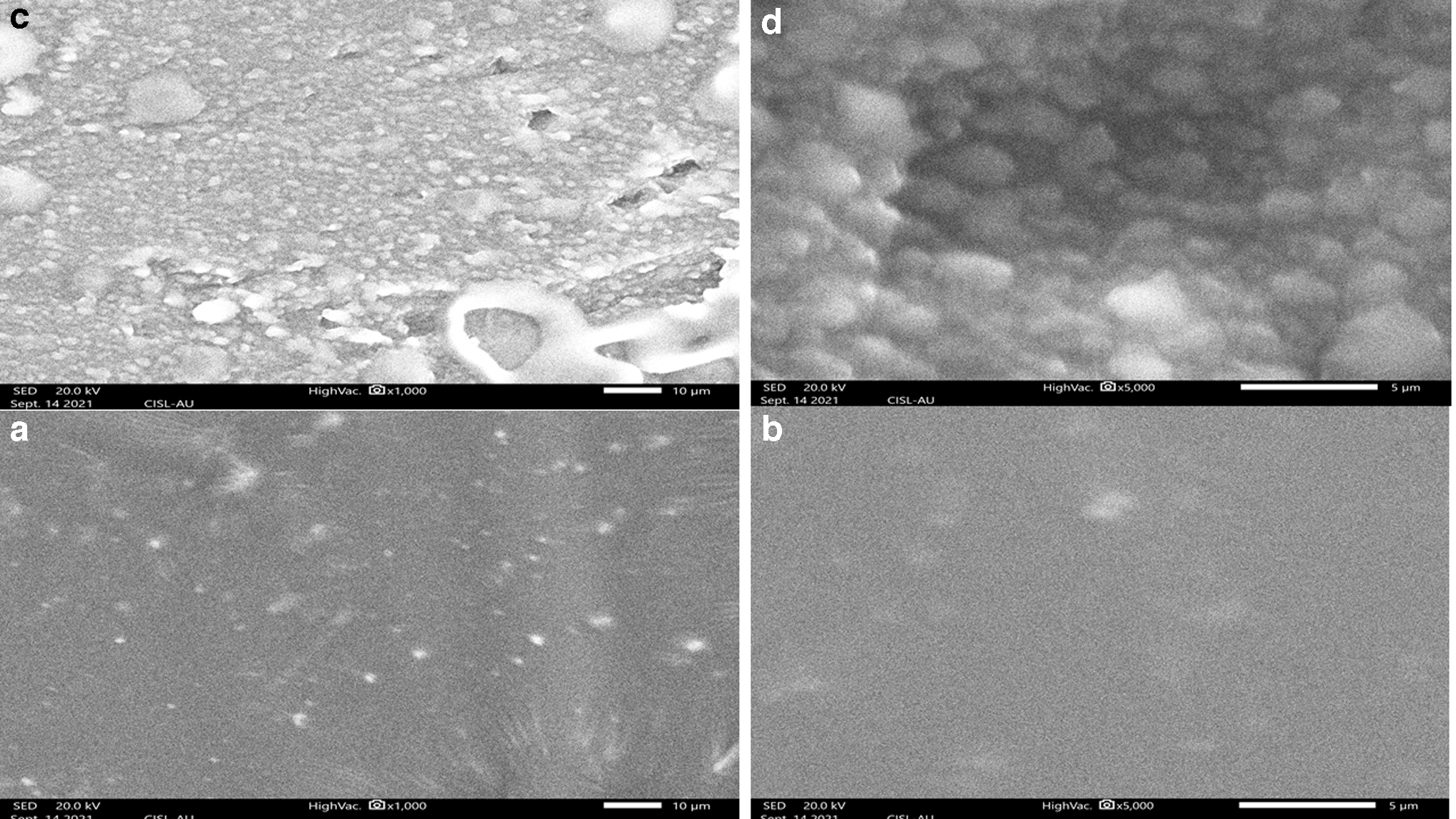
SEM images of PIM
Application studies
The PIM system was tested with spiked seawater, thermal power plant wastewater discharge, and contaminated lake water. Table 5 presents the results obtained for each sample, the corresponding removal efficiency, and the time taken for the process. The removal efficiency of 96% was achieved in 4 h with seawater 1 (concentration of Hg2+ ions: 10 mg/L). Seawater 2 and 3 with a lesser concentration of Hg2+ ions, about 100% removal efficiency was attained at 3 and 1 h, respectively. Wastewater and contaminated lake water samples contained 0.018 and 0.042 mg/L of Hg2+ ions. This value is higher than the permissible limit for mercury in water bodies as per EPA, US. The present PIM system completely removed Hg2+ ions from these samples within a few minutes of reaction time (Table 5).
Application of Polymer Inclusion Membrane System to Different Water Samples
Taguchi method
Statistical analysis of the transport experiments for Hg2+ ions by the TBP-based PIM system was carried out by using the Taguchi method. The multivariate approach aims at identifying the optimal conditions to improve the transport process across the PIM. Taguchi method calculates signal to noise (S/N) ratio and means to determine the influence of each factor on response. Removal efficiency is the response considered in this investigation.
S/N ratio
In the Taguchi method, a signal is a desirable value, whereas noise is undesirable. S/N ratio is the ratio of mean to standard deviation. Taguchi method employs this ratio to determine the optimum conditions for the experiments. S/N ratio was calculated as per Equation (7). The performance of the system was based on the characteristic condition, namely, the larger the better. In Equation (7), n is the number of repetitions in a trial and Yi is removal efficiency (Puviyarasan and Senthilkumar, 2012). Table 6 presents the removal efficiency obtained for each experimental run and their average value. The corresponding S/N ratio values calculated by using the Taguchi method are also presented in the table.
Experimental Results and Signal-to-Noise Ratio Values
S/N, signal to noise.
The mean response of the S/N ratio and the means (experimental data) for each factor are given in Tables 7 and 8, respectively. From these tables, it is clear that feed phase mercury concentration is the most significant factor in the removal of Hg2+ ions across PIM. The other factors have an almost similar influence on the response, as indicated by their corresponding delta values. Feed phase acid concentration, strip phase alkali concentration, and concentration of carrier have less influence on the removal efficiency of Hg2+ ions by PIM. The increase or decrease of these factors may not cause an observable change in the removal efficiency values.
Mean Response Values for Signal-to-Noise Ratio
Mean Response Values for Means
Analysis of variance results
Analysis of variance (ANOVA) determines the influence of each parameter on response, namely, removal efficiency. The purpose of the analysis is to investigate the factor that will significantly affect the performance characteristic (Kargari et al., 2006). Percentage contribution (ρ) determines the total variation in an experiment and the significance of each factor. It is based on the sum of squares value for each factor. It gives an idea of the relative impact of a factor to reduce the variation. Equation (8) is used for calculating the percentage contribution of each factor (Subromonian et al., 2014).
Here, SSQ is the sum of squares and SST is the total sum of squares. Table 9 presents the ANOVA results. It is evident from the table that feed phase mercury concentration is the most significant factor. Figure 9 shows the percentage contribution of the factors. Again, it is clear from the figure that feed phase mercury concentration is the most significant factor as indicated by its high value (68%).

Percentage contribution of process factors.
Results of Analysis of Variance
DF, degree of freedom; MS, mean squares; SS, sum of squares.
The optimum conditions arrived based on these results are 10 mg/L of feed phase mercury concentration, 0.1 M of feed phase acid concentration, 0.4 M of strip phase alkali concentration, and 3% of carrier concentration.
Confirmation analysis
Equation (9) shows the formula used for calculating the predicted response (removal efficiency) in the Taguchi method. In the Equation, Tm is the mean S/N ratio, To is the mean S/N ratio at optimum condition, and n is the number of main factors that affect the response. The value obtained using the equation is 95.2%. Confirmation analysis was done by experimenting at optimum conditions that resulted in 96.4% of removal efficiency.
Conclusion
Removal of Hg2+ ions using a PIM with TBP as a carrier and DOP as a plasticizer has been successfully developed. The newly developed TBP-based PIM has demonstrated its efficacy in removing mercury ions in trace levels of concentration (0.01–10 mg/L) in aqueous solutions. The optimum parameters of the PIM system determined in the study for complete removal of Hg2+ ions from trace-level concentrations are 0.1 M HCl, 0.4 M NaOH, and 3% TBP.
Among the various process parameters, the most significant contributor in the transport across PIM is the concentration of mercury in feed phase solution, as determined by the Taguchi method. It is interesting to note that all the other factors displayed influence on the transport process when the optimization was carried out by varying one variable at one time. However, as the multi-variate optimization process was carried out using the Taguchi method, the other factors exhibited less significance and contribution to the transport of mercury in the PIM system.
The developed PIM has successfully demonstrated almost complete removal of mercury from wastewater and water samples. The other advantage of the TBP-based PIM is its high stability for about 60 h and high selectivity for mercury. As a consequence of the observed results and inferences, the proposed PIM with TBP as a carrier is a promising option for the selective separation and removal of mercury from contaminated water samples and wastewaters that contain a trace-level concentration of the metal. This is also demonstrated by the application studies of the PIM system in the present study.
Footnotes
Authors’ Contributions
A.S. performed investigation, formal analysis, resource and software procurement, validation, visualization, and writing the draft. K.P. was involved in conceptualization, investigation, methodology, project administration, supervision, visualization, and reviewing the original draft. R.S. was involved in conceptualization, administration of the project, and reviewing the original draft.
Acknowledgment
The author Mr. A. Saravanan is thankful to the Management NLC India Limited, Neyveli for their immense support.
Author Disclosure Statement
No competing financial interests exist.
Funding Information
The author Mr. A. Saravanan is immensely thankful to Basic Scientific Research Fellowship granted by University Grants Commission, Government of India, New Delhi for the financial assistance received.