




Abstract
In the current condition, plastic has been ubiquitous, and plastic wastes generated are rising everyday. Plastic recycling and landfill are the only ways followed by the authorities in India, and due to enormous quantity of waste generation landfilling is not feasible. These plastic wastes can be converted into valuable fuel source through pyrolysis. Plastics like high-density polyethylene, low-density polyethylene, polypropylene, and mixture were pyrolyzed without the use of catalyst in a self-designed reactor. The oil was subject to 13C nuclear magnetic resonance and liquid chromatography-mass spectroscopy analysis to understand chemical composition. Physical characterizations namely density, kinematic viscosity, calorific value, fire point, flash point, water content, and carbon residue were carried to compare the oil with conventional fuels. The interpretation when compared with conventional fuels resulted that thermal pyrolysis can help in the recovery of valuable resources which may be used as an alternative fuel, helps in waste management, and reduction in the plastic generation at the site.
Introduction
Over the past century plastic has put strong foothold in the human life. In each product that is manufactured, plastics of varied composition with different properties, characteristics, and uses are found and have become necessary commodity after water and have become an indispensable part globally. Properties of plastics such as durability, flexibility, long-lasting, inexpensive, and lightweight have made them user friendly. Past few decades have seen the surge of plastic production and turning this plastic into threat and pushing the authorities and scientists to find newer ways to handle these plastic wastes. The solid wastes collected from the municipal corporation mainly consist of plastics like low-density polyethylene (LDPE), high-density polyethylene (HDPE), polypropylene (PP), polystyrene (PS), polyvinyl chloride (PVC), and polyethylene terephthalate (PET).
In India, the prices of petroleum fuels are increasing at a very greater rate in a less period of time, which has made it necessary to develop a renewable alternative fuel as these renewable fuels would benefit the environment and also help in the growth of the economy (Wankhade and Bhattacharya, 2017). Globally it is only 9% of the waste plastics that are recycled, 12% are being incinerated, and the remaining are dumped into land and water bodies (Mangesh et al., 2020b). Presently, the landfilling of plastic waste is mostly carried out in the entire globe, which is not the solution as it has become extremely difficult to locate the places for landfilling. This in turn results in soil degradation, groundwater contamination, imbalance in the wildlife, affects climate change, and so on.
The focus of our research is to convert these waste plastics into fuel or energy.
Plastic pyrolysis a thermochemical process has drawn attention as one of the recycling techniques carried out in the inert atmosphere by disintegrating the larger molecules into smaller molecules when subjected to high temperature (Mandal et al., 2016; Qureshi et al., 2020). Pyrolysis of different types of plastics results in different quantities of yields usually in the form of liquid and wax as the resultant product (Rahimi and Garciá, 2017). The yield depends on a few physical parameters such as temperature, retention time, type of plastic, moisture content, particle size, and size of the reactor. These resulting yields are converted to fuels or chemicals (Serrano et al., 2012). Pyrolysis is being carried out by most of the researchers as they result in a high amount (80%) of yield at a constant temperature around 300–450°C (Anuar Sharuddin et al., 2016). It is heard that pyrolysis of all types of plastics can be carried out except PVC and PET as they cause corrosion and blockage in the pipelines (Lopez-Urionabarrenechea et al., 2012).
The process carried out in this article focuses on converting the liquid yield as a heavy fuel oil substitute or any energy source for commercial purposes, therefore, resulting in lower economic costs, making awareness for the public and private sectors, and reducing the number of plastics generated at the landfills. We considered HDPE, LDPE, PP, and their mixture for this study as these are the majority of plastic wastes available in the household (Garforth et al., 1998; Kodera et al., 2006; Lin et al., 2010; Shah et al., 2010).
Experimental Section
Materials used
Polymers
Polymers namely HDPE, LDPE, and PP granules were procured commercially and used without further processing. Polymers were granular with 5 mm dimensions without any added colors. These granules were weighed in pure and mixed forms with equi ratio for pyrolysis.
Reactor design and handling
The challenging part was to identify the common articles available in the laboratory that are used to develop the reactor. Reactor of capacity 5 L was built using stainless steel with T-shaped open-close pressure valves attached to the lid of the reactor; water-cooled condenser of 2 ft in length and air pump motor for water circulation to the condenser were considered; thermocouple with analog display, high-temperature silicone sealant, vacuum pump, conical flask, beaker, ice pack, and electric stove (Fig. 1).

Pyrolysis experimental setup.
Analytical procedure
Pyrolysis
The experiment was set up and carried out in the open space. The experiment was carried out four ways, that is, the plastic granules of HDPE, LDPE, and PP of 1 kg each were weighed separately and the experiment was carried out separately for each type of plastic. In addition, the plastic granules of HDPE, LDPE, and PP were weighed in equal amounts and made up to 1,000 g. They were transferred into a self-made reactor. The reactor was then sealed using a high-temperature silicone sealant and left to dry for at least 15 h. With the help of a vacuum pump, the air in the reactor was removed. The reactor was placed on the electric stove, and the condenser was connected through the silicone tube with the other end left for a collection of pyrolyzed oil. The experimental setup is as shown in Fig. 1.
The experiment was run for 4 h. At the initial stage, the pressure valve was closed until the temperature reached 100°C. The vapor formation started to occur at 150°C, and the gas vapors started to flow through the condenser at around 200°C. The gas vapors were made to dissolve in the water placed at the collection end of the condenser. Once the liquid started to occur at 230°C, the water placed at the collection end was removed and a conical flask was placed for liquid collection. As the temperature started to rise, the liquid flow started to increase. The temperature of condenser was maintained at 35–40°C to improve the yield. The electric stove was switched off, and the reactor was allowed to cool as the liquid formation at the neck of the condenser had stopped.
Separation of pyrolyzed oil mixture
Distillation is one of the traditional methods used almost everywhere in laboratories and industries for the purification of the samples. As plastics found in the landfills are usually a mixture of different types, the experiment was given more importance on the mixed plastics. The liquid yield collected through pyrolysis was distilled with the help of a heating source, sample placed in a round bottom flask, condenser, distillate flask, and thermometer. Three hundred milliliters of pyrolytic oil was considered, and it was distilled by heating the same in the round bottom flask. A total of six distilled samples were collected at different temperatures between 105–165°C, 165–190°C, 190–230°C, 230–270°C, 270–300°C, and 300–345°C to differentiate the physical and chemical characteristics.
Characterization method
13C nuclear magnetic resonance (13C NMR) is equipped to categorize the substructures and functional groups existent in the obtained pyrolyzed oil by distinguishing the correlation bond between heteronuclear chemical shifts (Ben and Ragauskas, 2011). Various analytical techniques are available to study the structure of pyrolysis oil, but the NMR technique is considered to be beneficial and is used broadly to interpret the structure.
The intermediate compounds obtained through pyrolysis were analyzed using liquid chromatography-mass spectroscopy (LC-MS) (Xevo G2-XS). The detailed technical specifications of 13C NMR and LC-MS instruments are provided in Tables 1–3.
Technical Specification of 13C Nuclear Magnetic Resonance
Technical Specification of Liquid Chromatography-Mass Spectroscopy
Gradient Program
The physical and chemical properties were observed which has been discussed in Results and Discussion section.
Results and Discussions
Amount of yield collected from mixed plastics
A mixture of HDPE, LDPE, and PP: The vapor formation started to occur at 200°C, the liquid from the condenser started to flow between 220°C and 290°C. The maximum amount of yield was collected at 290°C. It was observed for the mixture of 1,000 g of plastics; 1,100 mL of liquid was collected leaving no residue behind the reactor (Table 4).
Yield of Mixed Plastics
HDPE, high-density polyethylene; LDPE, low-density polyethylene; PP, polypropylene.
Probable pyrolysis oil composition includes toluene, benzene, xylene, 1- and 3-methyl cyclopentane, cyclohexene, 1-hexene, di and trimethyl benzene indane, fluorene, naphthalene, 1-octene, 1-nonene, and 1-decene (Miandad et al., 2016, 2017).
The product distribution obtained for pure plastics (HDPE, LDPE, and PP) is mentioned in the Supplementary Data S1.
13C NMR characterization
Advantage of NMR to study the pyrolysis oil is (1) suitable solvent can be used to dissolve the obtained oil which makes it easier to gather data about the functional groups present which is independent of the instability of the components present in the oil; and (2) the data of the functional groups and its chemical shift range are well recorded making it simpler for identifying the functional group present by interpreting the peaks by referring the data of functional group chemical shift (Hao et al., 2016).
13CNMR was considered, its natural abundance is 1.1%, as the chemical shift range varies from 0 to 240 ppm making the signals less overlapping, therefore leading to more accurate results. The solvent peak can be observed (e.g., CDCl3) which cannot be observed in 1H NMR; the effect of the substituent on the adjacent carbon atom does not affect the chemical shift (Karunakaran et al., 2018). The above points made it advantageous in characterizing the sample accordingly.
The analysis of the spectra for mixed plastics showed us that there are a greater number of intense peaks from 8 ppm up to 42 ppm depicting the aliphatic C–H groups. From 70 to 73 ppm aliphatic C–O group, between 105 and 110 ppm aromatic C–H group and between 130 and 140 ppm aromatic C–C group were observed (Fig. 2) concerning the experimental results from DEPT NMR of raw, catalytic, and hydro treated catalytic fast pyrolysis oils (Happs et al., 2016).

13C NMR of mixed plastics pyrolyzed oil. 13C NMR, 13C nuclear magnetic resonance.
LC-MS analysis of plastics
Even though gas chromatography-mass spectroscopy (GC-MS) has been widely used in the detection of dibenzofurans, dioxins, and many other gaseous compounds, the use of LC-MS is becoming more common. LC-MS is a technique that combines the physical separation capabilities of LC with the mass analysis capability of MS by detecting from microgram or even nanogram quantities.
The six distilled samples of pyrolyzed oil of mixed plastics were considered. LC-MS analysis of mixed plastics resulted in the following compounds as shown in Table 1.
From the analysis, we found the nearest compounds to the mentioned compounds (M) and classified them as M+, M + 1, M + 2, M − 1, and M − 2 compounds. The peaks in the mass spectrum (x-axis) were observed, and the corresponding percentage (y-axis) in LC was noted down (Table 5).
Compounds Resulted in Liquid Chromatography-Mass Spectroscopy Analysis
The resulting LC-MS spectra exhibited compounds of molecular weight from 100 to 980, but we analyzed and compared a few compounds that indicated the similarities of diesel as listed in Table 2. Therefore, we can conclude that LC-MS of pyrolyzed plastics has a common similarity with the GC-MS analysis of diesel fuel (Liang et al., 2005; Mangesh et al., 2020a, 2020b).
Comparison of the LC-MS results with the GC-MS results obtained by researchers
We have understood that both LC-MS and GC-MS are separation methods for chemicals in a sample where chromatography is used for separation of chemicals and mass spectrometer for further identification of unknown compounds through their molecular weights. LC-MS uses solvents like acetonitrile as mobile phase, whereas GC-MS uses inert gases like helium; nevertheless, their application is the same.
When comparing the results of GC-MS and LC-MS, we found a few same and similar compounds that are listed in Table 6.
Comparison of the Liquid Chromatography-Mass Spectroscopy Results with the Gas Chromatography-Mass Spectroscopy Studied in Various Literature
Characteristics of pyrolyzed oil
The characteristics of mixed plastic pyrolyzed oil obtained at 290°C are shown in Table 7.
List of Properties and Instruments used in Analyzing Mixed Plastic Pyrolysis Oil
Viscosity
We know that viscosity varies with the feedstock used, temperature, pyrolysis conditions, and other phenomenons. The higher the viscosity, the higher the consumption of fuel, the rise in the temperature of the engine, and also the load on the engine. That is, thin density oils have lower viscosity and can flow through easily at lower temperatures than the thicker density oils as they have a higher viscosity. Therefore, the viscosity shouldn't be very low or very high as they might cause less friction or excessive friction, respectively (Khan et al., 2016). Figure 3 shows the comparison of the viscosity of different oils concerning the pyrolyzed oil.
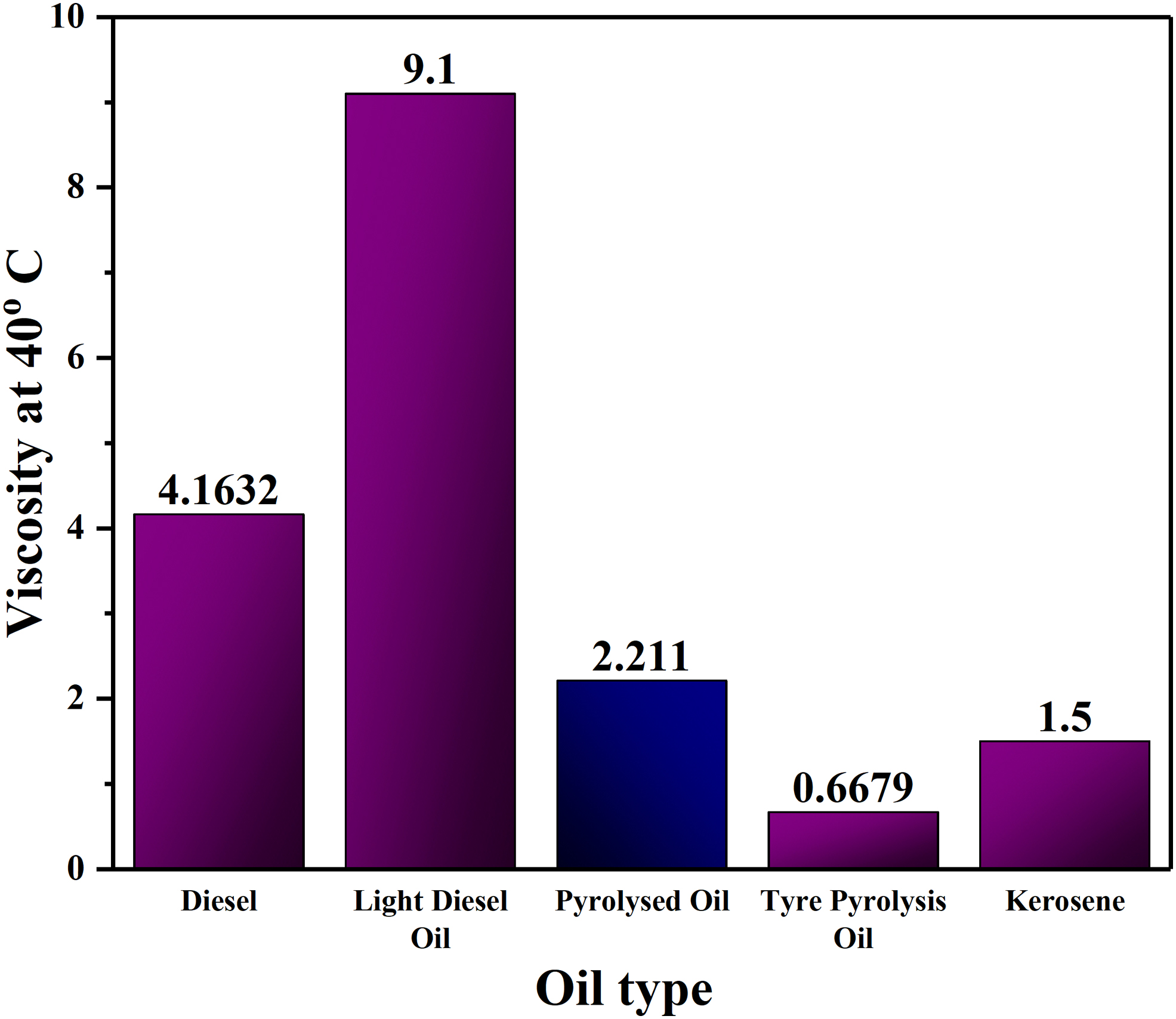
Viscosity of pyrolyzed oil with different fuels.
Density
The density of any substance is measured by mass per volume. Density is one of the essential properties of fuel oil. Oil with a low density consumes more fuel resulting in damaging the engine; therefore, if the density of the fuel is high, the consumption of fuel is less. Hence, from Fig. 4 ,it can be inferred that the density of pyrolyzed oil was found to be 0.7734 g/cc, which is neighboring to the densities of kerosene, diesel, and gas oil. As a result, we can conclude that pyrolyzed oil may be replaced with conventional fuels.
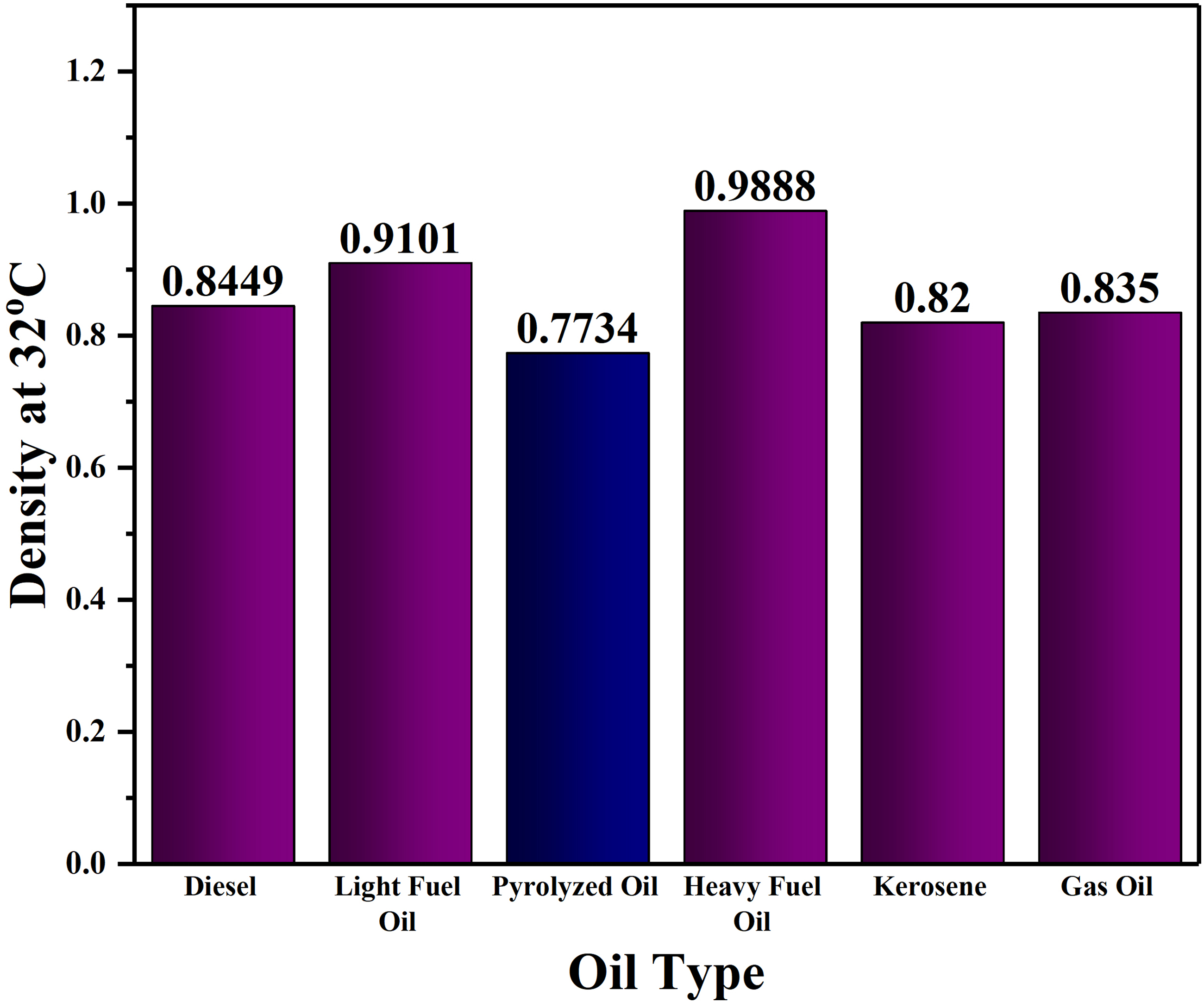
Comparing density of pyrolyzed oil with different fuels.
Calorific value
Calorific value refers to the amount of heat liberated during the process of combustion. It is one of the significant properties of the fuel. We found that the calorific value of the pyrolyzed oil was 10,938 Kcal/kg. Below bar graph represents the comparison of the calorific value of pyrolyzed oil concerning the different kinds of fuel. Figure 5 depicts the calorific values of different types of fuel oil.
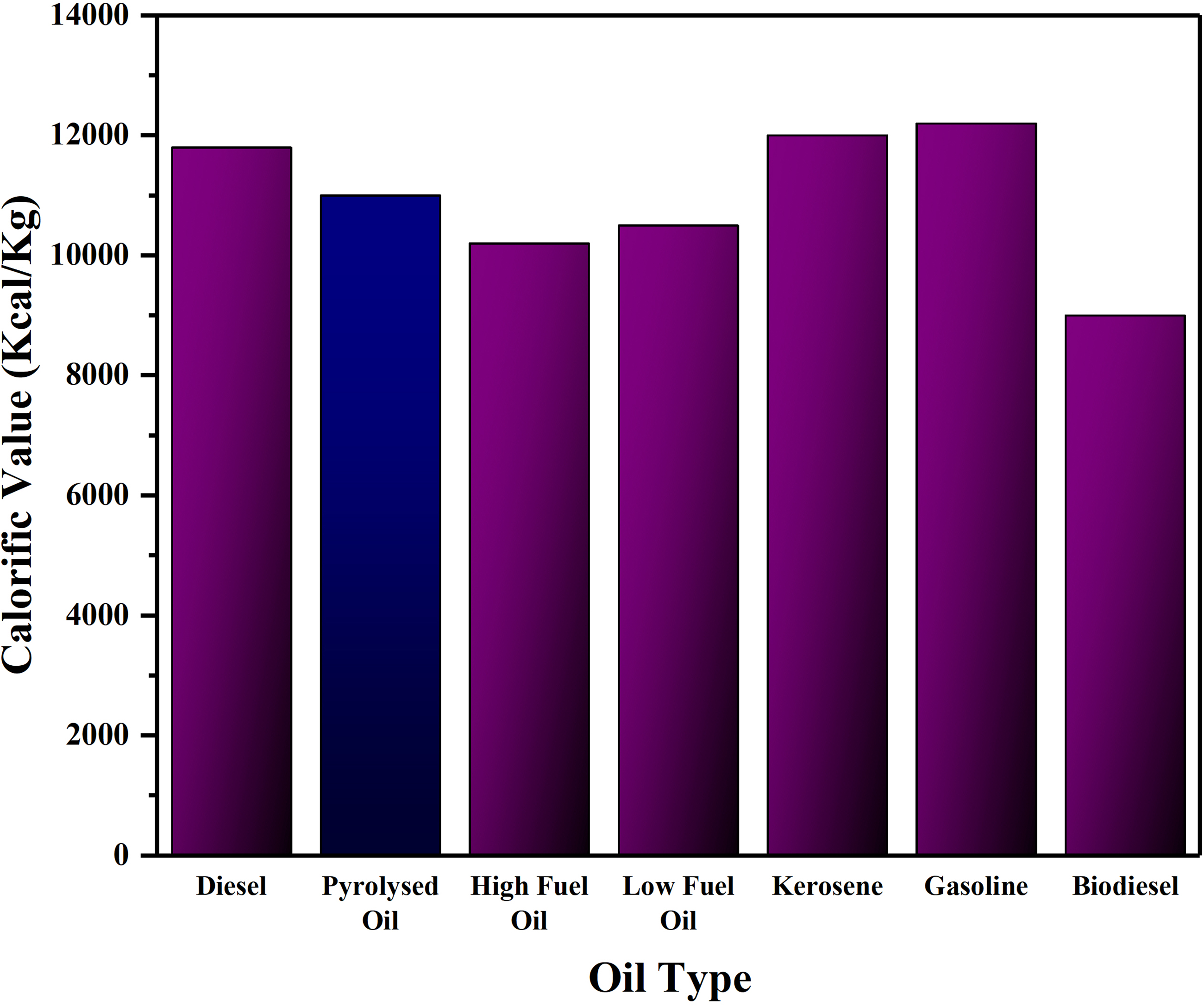
Calorific values of different types of fuel oil along with pyrolyzed oil.
Fire point
For fuel, the fire point is the lowest temperature at which the fuel vapor of the material will continue to burn for at least 5 s after ignition by an open flame. The fire point is higher than the flash point because the vapors produced at the flash point are not sufficient enough to ignite the fuel. Usually, the fire point of any liquid is around 5–10°C which is higher than the flash point; it was found that the fire point of pyrolyzed oil was <32°C.
Flash point
The flash point for fuel is the lowest temperature at which the fuel vaporizes to result in an ignitable mixture in the air. Cleveland open cup apparatus used for measuring the flash point was found to be <32°C. The flash point of the diesel, kerosene, etc. is higher than the pyrolyzed oil, which specifies that these are easy to handle. As a result, the pyrolyzed oil has a higher amount of volatile materials, which is a safety sign in both handling and transporting.
Carbon residue
Carbon residue tells us the tendency of the fuel oil to form carbon deposits on a hot surface, usually on a burner or injection nozzle in vehicles, when the constituents that are vaporizable evaporate. The carbon residue of pyrolyzed oil reported was NIL. In one of the studies carried out by researchers it was found to be 0.05% (Sudhir et al., 2015); in another study, it was reported to be 0.5% (Khan et al., 2016). Hence, pyrolyzed oil may help replace the commercial fuel oils as they form higher deposits, which in turn required frequent cleaning and can result in increased fouling of gas channels. Figure 6 displays the carbon residue of different fuel oils.

Carbon residue of different fuel.
Comparison of the characteristic result of pyrolyzed oil with the range accepted by the norms of diesel fuel
Since the experiment focuses on real-time application, the obtained results were compared with the standard Indian diesel requirement provided by the Central Pollution Control Board (CPCB) (Thirumurthy, 2010) (Table 8).
Comparison of the Characteristics Result of Pyrolyzed Oil with the Standard Norms of Diesel Fuel
Conclusion
This study makes clear that fuel production from plastics is attractive as they speak about the issues of waste management, reduces the problem faced in the disposal of waste plastics, and alternative generation of energy. The pyrolysis of mixed plastics resulted in the production of fuel oil, which is a valuable energy resource recovery. The experiment was carried out without the use of catalyst since the cost of the catalyst is high and their regeneration is an enormous task. The yield produced by mixed plastics produced no char. All these plastics helped in the formation of aromatic and aliphatic C–C and C–H groups at a steady heating rate. It was seen that liquid yield increased when maintained constant temperature for at least 1.5–2 h. The maximum yield obtained was nearly 85% at 2 h. Compared to the above physicochemical properties of pyrolyzed oil with other commercial fuels like diesel, we could see that obtained fuel oil can be utilized to make highly efficient fuel with less economic cost. But further research and studies need to be considered for utilization of the pyrolyzed oil as a fuel.
Footnotes
Acknowledgments
The University of Mysore has helped in the characterization of 13C NMR and LC-MS. Ganesh Laboratories have also helped in the characterization of the physical and chemical properties of the sample.
Authors' Contributions
All authors critically gave their feedback and supported to shape the work and write the article. K.G.K. data interpretation and article preparation; S.D. data interpretation and results analysis; K.T.V. designing, conceptualization, and direction of entire work.
Availability of Data and Materials
All data generated or analyzed during this study are included in this published article.
Author Disclosure Statement
No competing financial interests exist.
Funding Information
JSS Academy of Higher Education and Research, Mysore REG/DIR(R)/URG/54/2011-12/5293. This project has received funding from the JSS Academy of Higher Education and Research (JSS AHER), Mysore.

References
Supplementary Material
Please find the following supplemental material available below.
For Open Access articles published under a Creative Commons License, all supplemental material carries the same license as the article it is associated with.
For non-Open Access articles published, all supplemental material carries a non-exclusive license, and permission requests for re-use of supplemental material or any part of supplemental material shall be sent directly to the copyright owner as specified in the copyright notice associated with the article.
