




Abstract
Peanut shell char with high alkali metal and ash content was used in this study to remove nitrogen oxide (NO) from simulated flue gases. Effects of acid pickling and nitrogen doping of the biochar (BC) materials on the removal selectivity were investigated in a fixed bed reactor. Results show that CaO, MgO, SiO2, AgO2, CuO, and so on contained in the ash of peanut shell are not conducive to the pore development of biochar and grafting of nitrogen-containing functional groups during the nitrogen doping process. Ash pickling improves the development of pore structure, and decreases the ratios of H/C, O/C, and (O+H)/C. The NO ratio and reaction selectivity of biochar follow the order as pickling treatment (BC-A) > raw peanut shell char (BC) > nitrogen doping treatment (BC-N). Through a combined effect of ash pickling and nitrogen doping, BC-A-N has the highest NO removal ratio and reaction selectivity because of the improved pore characteristics and introduction of nitrogen-containing functional groups.
Introduction
Combustion of fossil fuels results in the formation of nitrogen oxides (NOx). In “Emission Standard of Air Pollutants for Thermal Power Plants (GB13223-2011),” the Ministry of Environmental Protection of China required the emission of NOx from existing thermal power boilers to be <100 mg/m3. In some key areas, the emission limit of NOx is reduced to 50 mg/m3. CARBONOx technology has been proposed to realize NO removal because of the abundance of reductant sources, and its relatively low environmental impact. Coal char/activated carbon were used as the material in CARBONOx technology (Gupta et al., 2004; Zhang et al., 2021). However, coal is a nonrenewable resource with a complex structure and low C–NO reaction activity. In the case of activated carbon, its complex preparation process and high cost hinder its large-scale application.
Biochar (BC) derived from biomass has environmentally friendly characteristics such as low sulfur and nitrogen contents and carbon neutrality (Senneca, 2007; Arias et al., 2008; Zhang et al., 2020c; Gong et al., 2021; Zhang and Duan, 2022). The annual production of peanut shells in China is ∼5 million ton. Peanut shells are by products produced during the production of processing enterprises. They are often discarded as wastes, resulting in a huge and regrettable waste of resources. The development of proper utilization of peanut shells is necessary.
However, previous research has shown that the NO reduction efficiency of biochar derived from peanut shells is not high (Zhang et al., 2020a), and the emission of NO exceeds the national standard emission concentration limit of 100 mg/Nm3. This is attributed to residual oxygen in the flue gas. Flue gas usually contains 3–6% residual oxygen, which is much higher than its NO concentration. Significant amounts of unmodified biochar are consumed by oxygen at high temperatures because C–O2 reactions are favored over C–NO reactions. The modification of biochar can improve its antioxidant ability and reaction selectivity, thus improving the efficiency of heterogeneous NO reduction.
Nitrogen doping is a chemical modification method for carbon materials. The nitrogen doping of char not only promotes NO reduction but also inhibits C–O2 reactions, thus improving the selectivity of char for NO removal (Matzner and Boehm, 1998; Williams and Reed, 2003; Chyang et al., 2007). At present, this method is mainly used to modify coal char and activated carbon; thus, the effect of nitrogen doping on the NO reduction ability of biochar is still unclear. Biochar derived from woody plants has high carbon and low ash contents (<1% by mass), whereas peanut shell derived from herbaceous plants and Gramineae plants, which contain more inorganic minerals than woody plants (Duan et al., 2014), has high ash and low carbon contents, which include many metal elements.
Although multiple studies have shown that metal elements can promote the chemical adsorption of NO and activity of the reaction between coal char and NO at low temperatures (Illán-Gómez et al., 1996; Holikova et al., 2005; Bueno-López et al., 2007; Lopez and Calo, 2007), it has also been found that some metal elements interact with oxygen-containing groups of biochar, impairing the formation of nitrogen-containing functional groups during nitrogen doping (Zhang et al., 2015). Therefore, the effect of the metal elements in biochar on the nitrogen-doping process and the C–NO reaction process is not consistent.
Compared with coal char, peanut shell char has a higher specific surface area and abundant oxygen-containing functional groups. However, the pore structure (specific surface area) of biochar is inferior to that of commercial activated carbon, which leads to the insufficient adsorption of NO during the heterogeneous reduction of NO (Zhang et al., 2020b). Unmodified peanut shell chars have a relatively low adsorptive capacity, therefore, it is necessary to further study the modification technology of biochar to obtain more oxygen-containing functional group structure and pore structure and improve the adsorptive capacity (Zhang et al., 2021). For example, peanut shell char was modified by H3PO4-loaded sawdust to well-shape the biochar without visual cracks (Li et al., 2014). It was modified by KMnO4 solution to improve the pore structure (An et al., 2021). It was also modified with polyethyleneimine for enhancement of adsorptive capacity (Ma et al., 2020).
Acid pickling is commonly used to remove ash but can also remove by-products, such as inorganic salts and tar, on the surface of biochar; this process significantly changes the surface structural characteristics of biochar and improves its adsorption performance. However, the metal contents of the biochar ash decrease as well. In this study, pickling pretreatment has dual functions of pore modification of peanut shell biochar and removing some metal components in its ash. Therefore, it can be used to compare the NO removal characteristics with that of direct nitrogen doping biochar and that of nitrogen doping biochar after acid pickling to reveal the reactivity and selectivity of different modified biochars in C-NO reaction process.
Biochar deriving from peanut shells—with high ash contents—was subjected to acid pickling, direct nitrogen doping, and acid pickling and nitrogen doping. Brunauer–Emmett–Teller (BET), Fourier transform infrared (FTIR), and X-ray fluorescence spectrum (XRF) analyses were performed to determine the physical and chemical properties of the unmodified and modified peanut shell biochars. The effects of acid pickling and nitrogen doping on the NO removal ratio and selectivity of the peanut shell biochars were investigated in a fixed-bed reactor.
Experimental Section
Materials
In this study, peanut shells were used as the raw material to prepare biochar. The raw materials were crushed by a pulverizer, and then sieved by a standard steel sieve. Uniform particles with a particle size in the range of 0.5–1 mm were selected and stored for preservation. The peanut shells were pyrolyzed in a fixed-bed reactor. During the pyrolysis, the peanut shell samples were put into a fixed-bed reactor and heated for 30 min in N2 atmosphere. Pyrolysis temperature and time were controlled by a temperature-controlled heating system. The pyrolysis temperature was fixed at 773K.
Pyrolysis temperature is an important factor affecting the physical and chemical properties of biochar (Yang et al., 2007, 2022; Amin et al., 2020). Lower pyrolysis temperature (473K–773K) and longer pyrolysis time (≥30 min) favor the formation of surface functional groups of biochar (Pütün et al., 2007; An et al., 2021; Guo et al., 2021). Therefore, the pyrolysis temperature of 773K and the pyrolysis time of 30 min were adopted in this study.
During the acid pickling process, BC was soaked in 5% HCl solution at room temperature for 5.5 h, and then the impregnated biochar was filtered with deionized water to remove the acid solution remaining on the material surface and inner pore channel until the washing solution was close to neutral. Then the sample was dried in an oven at 378K for 12 h, and the biochar after acid pickling was named BC-A. During the process of nitrogen doping, a certain amount of BC and BC-A were weighed and pretreated at 673K for 1 h in 5%O2+N2 atmosphere, then the O2 valve was closed, and the temperature was increased to 773K in N2 protective gas.
This can be attributed to the fact that the oxides on the surface of biochar is favorable for nitrogen doping (Huang and Teng, 2003; Szymański et al., 2004). After that, the gas was switched to 20%NH3+N2 for pretreatment for 2 h, and the gas flow was both fixed at 300 mL/min. Finally, under the protection of nitrogen, the sample was cooled to room temperature and taken out. The peanut shell char obtained after nitrogen doping on the basis of BC and BC-A was named as BC-N and BC-A-N, respectively. The results of proximate analysis of the four kinds of peanut shell chars are given in Table 1.
Proximate Analysis of Four Kinds of Peanut Shell Chars
BC, biochar; BC-A, acid-pickled biochar; BC-A-N, nitrogen-doped acid-pickled biochar; BC-N, nitrogen-doped biochar.
Experimental facility
The experimental system consists of a gas supply system, a temperature control system, a fixed-bed reactor, and a data acquisition system, as shown in Fig. 1. Peanut shell char (BC) was prepared in N2 atmosphere, and the mixed gas of NH3, N2, and O2 was used in the nitrogen doping process to prepare BC-N and BC-A-N. In constant temperature and programmed temperature experiments, the simulated flue gas was composed of N2, O2 and NO. During the above tests, the flow rate of each gas was controlled by a MT-50 mass flowmeter and premixed by a mixer before entering the reactor. The fixed-bed reactor was a high-temperature quartz tube with a length of 450 mm and an inner diameter of 10 mm, and the constant-temperature section was >100 mm, so that the biochar was kept in the constant-temperature section during the reaction.
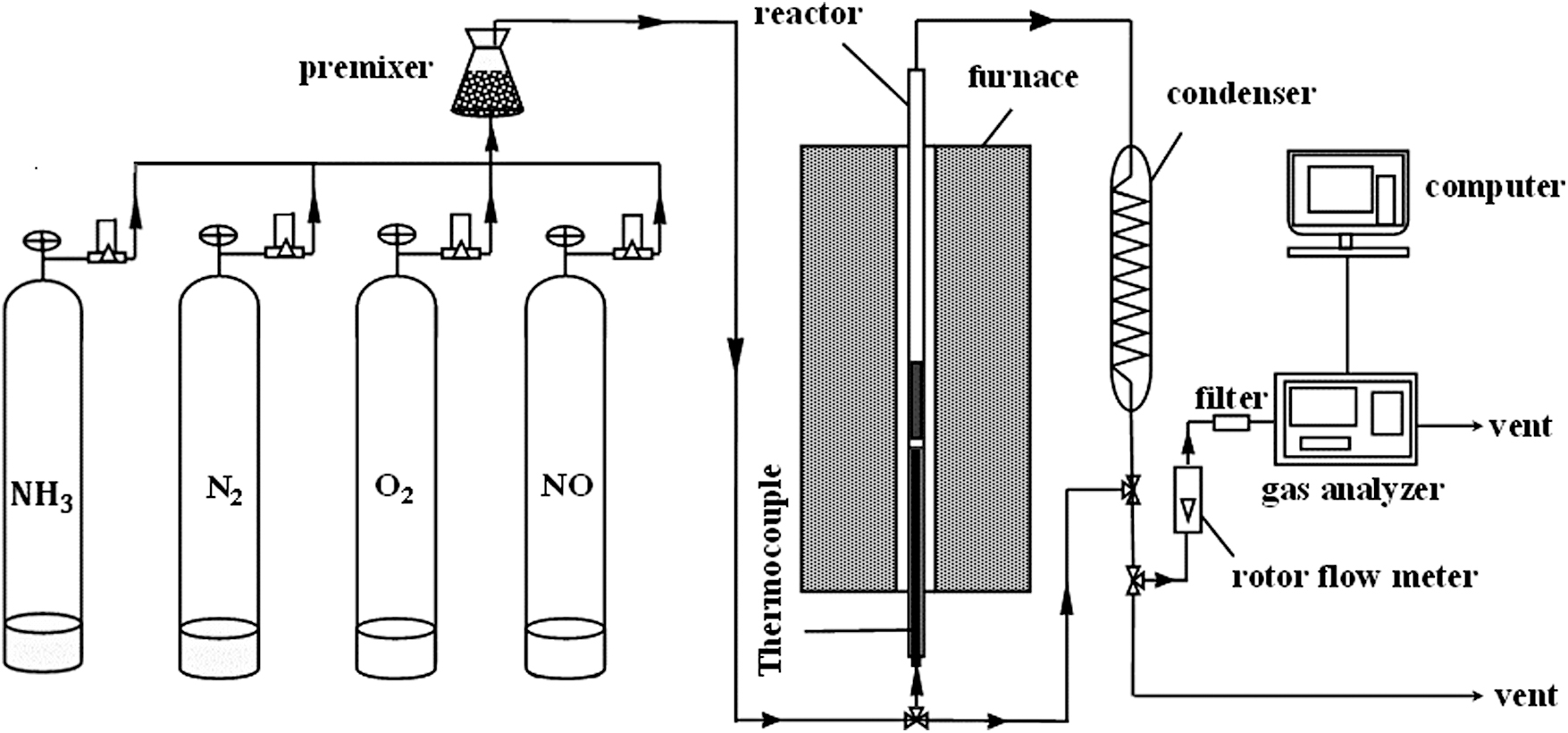
Schematic diagram of experimental setup.
In the temperature programmed experiment, the reaction temperature increased from 293K to 1,073K, and the heating rate was 10K/min. After being dried and filtered, the flue gas is monitored by an online infrared flue gas analyzer (Gasboard-3000 Plus), which can monitor CO2, CO, O2, and NO simultaneously. The sampling accuracy is 0.01%, 1 ppm, 0.01%, and 1 ppm, respectively. The measurement results were recorded by the computer, and the sampling interval is 1 s.
Material characterization
The physical and chemical properties of peanut shell chars were analyzed by infrared spectroscopy and X-ray fluorescence spectroscopy. The infrared (FTIR) test was carried out on the Nicolet6700 infrared spectrometer produced by Thermo Nicolet Corporation. XRF was measured on the ARL Advant'X IntelliPower™ 3600 scanning X-ray fluorescence spectrometer, which was produced by Thermo Fisher Scientific (United Kingdom). The specific surface area and pore size distribution of peanut shell chars were determined with automatic physical and chemical adsorption instrument (TriStar II 3Flex) of Micromeritics Instrument Corp. The specific surface area and pore size distribution were determined by BET equation and Barrett–Joiner–Halenda (BJH) method, respectively.
Data processing
The NO removal ratio of C-NO heterogeneous reduction reaction using different kinds of biochars can be calculated by Equation (1):
where, xNO is the NO removal ratio, %; t is the reaction time, s;
The reaction selectivity of peanut shell char is defined as the ratio between the amount of peanut shell char consumed by NO heterogeneous reduction and the amount of peanut shell char consumed by oxygen. The consumption of peanut shell char depends on the concentrations of CO and CO2 in the flue gas. The calculation method can be followed as Equation (2):
where Sel represents the C-NO reaction selectivity of peanut shell char, mg NO/g C; mNO and mC represent the amount of peanut shell char consumed by NO reduction and oxygen, respectively. CCO,out and
Results and Discussion
Specimen characterization
Figure 2 shows the FTIR spectra (400–4,000 cm−1) of the unmodified and modified peanut shell biochars and Table 2 lists the FTIR absorption peaks and assigns each peak to the corresponding functional group in the structure of the peanut shell biochars. The spectra of all the peanut shell biochars display intense absorption peaks near 3,420 and 1,150 cm−1, which are attributed to the N–H and O–H stretching vibrations of primary amine groups, hydroxyl groups, and water molecules (He et al., 2016); and the N–H, C–N, and C–H bending vibrations of aliphatic amines and alkanes, respectively (Yaumi et al., 2017; Zhang et al., 2022).
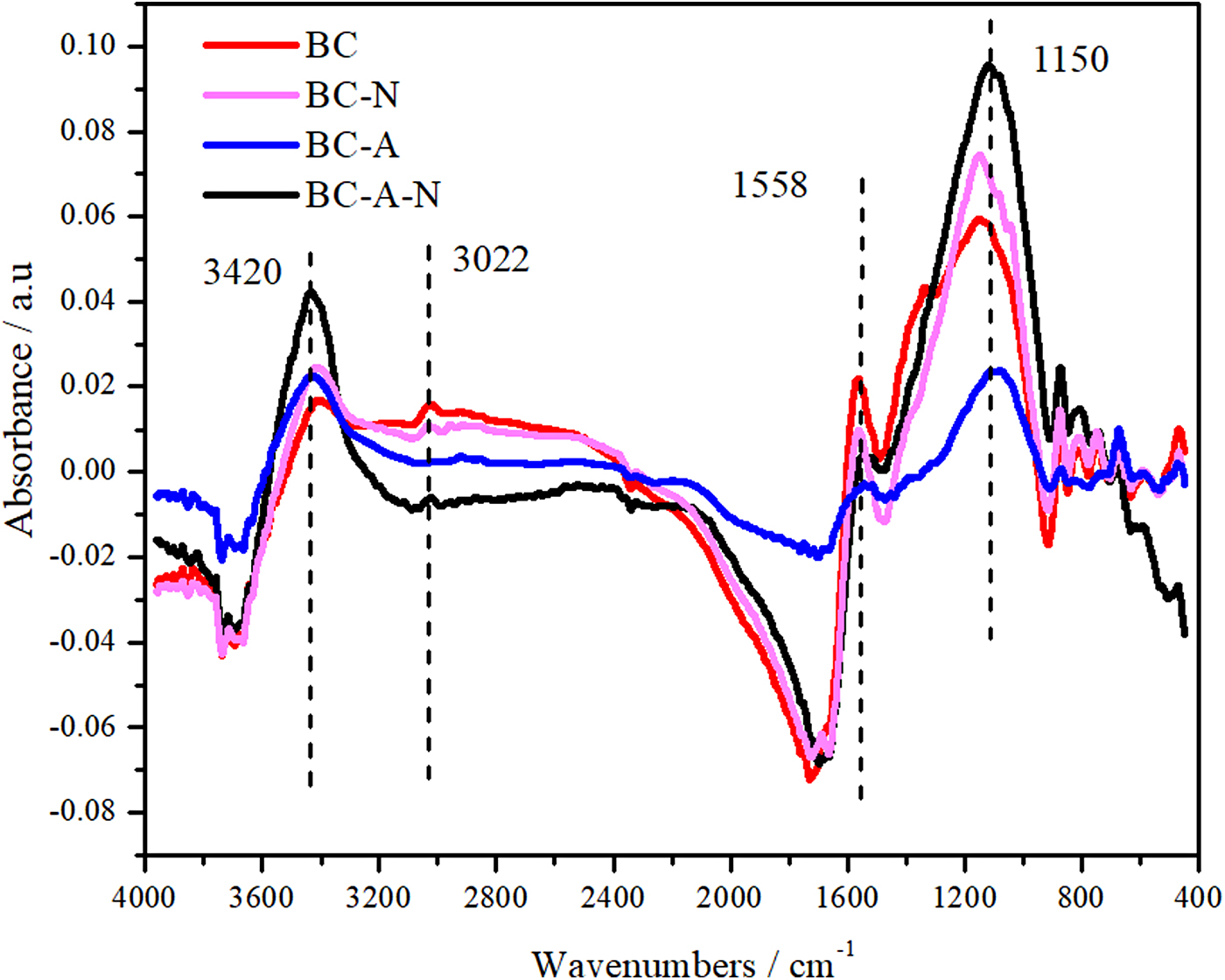
FTIR spectra of peanut shell biochars. FTIR, Fourier transform infrared.
Fourier Transform Infrared Absorption Peaks and Corresponding Functional Groups in Peanut Shell Biochar
The absorption peak at 1,150 cm−1 in the spectrum of nitrogen-doped peanut shell biochar (BC-N) is only slightly more intense that the corresponding peak in the spectrum of unmodified peanut shell biochar (BC), indicating that the success of direct nitrogen doping is limited, which suggests that the fuel characteristics of peanut shell biochar itself may inhibit the introduction of nitrogen-containing functional groups. The intensity of every absorption peak in the spectrum of the acid-pickled peanut shell biochar (BC-A) is lower than that of the corresponding absorption peaks in the spectra of the other peanut shell biochars, indicating that acid pickling changes the functional groups on the surface of the biochar and reduces the number of fat structures and hydroxyl groups (Wang and Lu, 2016).
However, the intensities of the absorption peaks near 3,420 and 1,150 cm−1 in the spectrum of the nitrogen-doped acid-pickled peanut shell biochar (BC-A-N) are the highest observed, suggesting that acid pickling and nitrogen doping significantly increases the number of nitrogen-containing functional groups on the surface of the peanut shell biochar. As active centers of the catalytic biochar–NO reaction, nitrogen-containing functional groups on the biochar surface promote the production of the active intermediate NO2 (Wan et al., 2008). The low-intensity absorption peaks near 3,022 cm−1 are attributed to the stretching vibrations of C–H bonds on sp2 hybridized carbons, and their strength on aromatic carbons is usually weak.
The absorption peaks centered at 1,558 cm−1 correspond to the C = C skeleton vibrations and O–H bending vibrations of aromatic rings. These absorption peaks in the spectra of BC-N and BC-A-N are weak, which may be due to the substitution of carbon atoms by nitrogen atoms in the graphitic carbon structure.
Figure 3A and B show the gas adsorption/desorption isotherms of the peanut shell biochars. According to the classification method of the International Union of Pure and Applied Chemistry (IUPAC) (Mahamud and Novo, 2008; Wu et al., 2013), these are type I adsorption isotherm with type H4 hysteresis loops. The adsorption isotherms reveal that direct nitrogen doping has little effect on the adsorption capacity of peanut shell biochar. Adsorption by BC-A and BC-A-N increase rapidly at low relative pressures. The adsorption capacity of BC-A-N exceeds that of BC-A; however, this difference is less pronounced at high relative pressure, indicating that acid pickling is conducive to the formation of micropores. Moreover, nitrogen doping after acid pickling further increases the number of micropores, which is consistent with the pore size distribution results of the peanut shell biochars shown in Fig. 3C.

The specific surface areas and pore volumes of the peanut shell biochars are listed in Table 3. The specific surface area of BC-N is 2.6% higher than that of BC, but its number of micropores (<2 nm) is slightly lower. The specific surface areas of BC-A and BC-A-N are 237.96 and 450.35 m2/g, respectively, which are 2.6 and 4.9 times higher, respectively, than that of BC, and their micropore contents are 4–5 times higher than that of BC. Table 4 lists the elemental contents of BC and BC-A, which show that acid pickling reduces the total elemental contents in peanut shell biochar from 8.71% to 5.50%; however, the individual elemental content decreases to different degrees.
The Specific Surface Areas and Pore Volumes of Peanut Shell Biochars
Elemental Contents of Peanut Shell Biochars Before and After Acid Pickling
The removal of Te, Ag, and Cu exceeds 95%, whereas 61.7% and 24.8% of alkali metals (K) and alkaline earth metals (Ca) are removed, respectively. The transition metal contents are reduced as well. Although the metalloid Si does not react with HCl, its relative content decreases by 22.7%.
Constant-temperature experiments
Figure 4A shows the outlet NO concentration curves (vs. reaction time) recorded during constant-temperature experiments. The NO removal ratios and biochar–NO reaction selectivity of the peanut shell biochars are shown in Fig. 4B. According to the FTIR spectroscopy results, the distribution of functional groups on the surfaces of the unmodified and various modified peanut shell biochars differs, indicating different biochar–NO reaction mechanisms. In the process of NO removal by BC and BC-A, NO first chemisorbs on the surface of carbon to form C(O) and C(N) complexes (Chambrion et al., 1997; Tighe et al., 2009), which provide active sites after decomposition and facilitate the reaction of NO with C(O). The reactions are as follows:

In the process of NO removal by BC-N, the surplus electrons on nitrogen atoms in the graphitic carbon structure are in high-energy states and can induce the formation of superoxide anions from O2 adsorbed on the biochar surface. These superoxide anions promote the production of NO2 (Reactions R7–R11), which directly reacts with adjacent CCCf(O) to produce carbon active sites (Reaction R12), thus promoting the reduction of NO (Reaction R7) (Sthr et al., 1991; Muckenhuber and Grothe, 2006). The main reactions are as follows:

In the process of NO removal by BC-A-N, besides the above-mentioned NO reduction mechanism, NO may be absorbed by the CO−(NH4)+ complex formed by interactions between NH3 and the acidic parts of carboxyl functional groups on the biochar surface to generate C(ONO) (Teng et al., 1999). At the same time, NH3 released at high temperatures can react with NO to produce N2 (Reaction R13).
As shown in Fig. 4, the NO removal ratio and biochar–NO reaction selectivity of BC-N are lower than those of BC, which is mainly due to differences in their pore structures and the types and distributions of their surface functional groups. Although the introduction of nitrogen-containing functional groups promotes biochar–NO reaction activity, the NO removal ratio of BC-N (68.24%) is slightly less than that of BC (69.57%). This is mainly attributed to the fact that the fuel properties of the peanut shell biochar itself may inhibit the introduction of nitrogen-containing functional groups.
BC contains significant amounts of inorganic minerals, which hinder the development of pores (Table 3) and simultaneously reduce the number of available oxygen-containing groups on the biochar surface. In addition, AgO2 and CuO in ash spontaneously react with NH3 during nitrogen doping, which limit the success of nitrogen doping and reduces the biochar–NO reaction selectivity of BC-N.
The NO removal ratio of BC-A is higher than that of BC; owing to the high ash content of peanut shell biochar, the reduction in ash content realized by acid pickling significantly optimizes the pore structure of the biochar surface (Table 3). Meanwhile, acid pickling increases the relative biochar content and reduces the ratios of H/C, O/C, and (O+H)/C. Consequently, more CO is generated in the reducing atmosphere, providing more reducing agent for NO removal; accordingly, the biochar–NO reaction selectivity of BC-A is similar to that of BC, but its NO removal ratio is higher.
The NO removal ratio (82.53%) and biochar–NO reaction selectivity (25.26 mg NO/g C) of BC-A-N are significantly superior to those of BC, BC-A, and BC-N. This can be attributed to the fact that some inorganic minerals in the peanut shell biochar are removed by acid pickling. Table 4 shows that acid pickling removes 24.8%, 8.6%, and 22.7% of Ca, Mg, and Si, respectively, as well as more than 99% of Ag and Cu; consequently, the contents of elements that can consume NH3 during nitrogen doping are low, which promotes the introduction of nitrogen-containing functional groups under high-temperature conditions. Acid pickling increases the number defects in the structure of the biochar and, concomitantly, the number of carbon active sites, which promote the formation of nitrogen-containing and oxygen-containing functional groups.
In addition, acid pickling increases the presence of acidic functional groups on the biochar surface, especially carboxyl groups with strong polarity, which enhance the adsorption of polar NH3 (Ahmed et al., 1993; Ku et al., 1994) and promote NO reduction.
Temperature-programmed experiments
Temperature-programmed experiments were performed to elucidate the kinetic mechanisms of the biochar–NO reactions of the peanut shell biochars. Figure 5 shows the recorded outlet gas concentrations and the results in Fig. 5A, 5B, 5C, and 5D are related to BC, BC-N, BC-A, and BC-A-N, respectively. According to the change in outlet NO concentration, the reaction process can be divided into three stages: stage I (physical adsorption), stage II (NO reduction), and stage III (biochar consumption).

In stage I (293K–480K), when the reaction temperature is relatively low, O2 and NO physically adsorb on the surface of the peanut shell biochar, resulting in an outlet NO concentration that is less than the inlet NO concentration (500 ppm). The different pore structures of the biochars result in different adsorption capacities. BC-A-N has the highest specific surface area and realizes the lowest stage I outlet NO concentration (401 ppm). As the temperature increases, the NO adsorbed by the peanut shell biochars begins to desorb, which causes the outlet NO concentration to gradually increase and exceed the inlet NO concentration, peaking in the temperature range of 471K–485K.
In stage II, outlet CO2 and CO concentrations are successively detected, while the outlet O2 and NO concentrations decrease with increasing temperature. At higher temperature, the Reactions (3, 4, and 6) are improved (Orikasa et al., 1997; Li et al., 1998), which can be proved by the CO and CO2 appearing in the flue gas successively and their concentrations are gradually increased. Peanut shell biochar contains graphitic carbon; accordingly, the distance between carbon atoms in the basal plane is ∼1.14 × 10⁻¹⁰ m, indicating strong combination. However, the distance between the hexagonal basal planes is as high as 3.345 × 10⁻¹⁰ m, indicating relatively weak combination. In this stage, the reaction temperature is the main factor controlling the biochar–NO reaction rate; lower temperatures limit the biochar–NO reaction rate, resulting in relatively high outlet NO concentrations.
However, from ∼600K, the outlet NO concentrations begin to decrease. The minimum outlet NO concentration realized by BC is 87 ppm at a temperature of 670K. However, the thermal decomposition of oxygen-containing groups on the biochar surface at high temperatures interferes with Reactions (R4) and (R6) and reduces the number of active sites, leading to a rapid increase in outlet NO concentration. Similarly, the minimum outlet NO concentration realized by BC-N is 92 ppm at 648K, which exceeds those realized by the other peanut shell biochars. This is mainly because the ash in the peanut shell biochar hinders the development of surface pores during nitrogen doping, preventing the insertion of NO and O2 between adjacent crystal basal planes.
However, a small amount of nitrogen-containing functional groups is still introduced in BC-N during nitrogen doping, which limit the consumption of C by O2, leading to an increase in outlet NO concentration that is less rapid than that observed in the case of BC. The outlet NO concentration (268 ppm) achieved by BC-N is significantly lower than that of BC (∼400 ppm) at 782K.
The formation of CO and CO2 in the flue gas occurs later in the case of BC-A than in the case of BC-N, indicating that the biochar–NO reaction activity of BC-A is weak. The main reason is that acid pickling reduces the metal element contents of the ash of the peanut shell biochar, reducing catalytic activity and increasing the reaction activation energy. However, the pore structure of the biochar surface is optimized by acid pickling, which facilitates the insertion of NO and O2 between adjacent crystal basal planes and improves the NO removal ratio. The minimum outlet NO concentration achieved BC-A is 84 ppm, which is lower than those achieved by BC and BC-N. Moreover, a decrease in the ash content is accompanied by an increase in reductant, prolonging the reaction activity of the biochar–NO reaction. Therefore, the minimum outlet NO concentration is recorded at 787K.
Nitrogen doping significantly increases the number of nitrogen-containing functional groups at the periphery and the edge of BC-A-N carbon crystals, improving the reaction activity on these surfaces to facilitate the chemisorption of NO at high temperatures (Reactions R7–R12) and improve antioxidant capacity and biochar–NO reaction selectivity. The high-temperature biochar–NO reaction activity of BC-A-N is superior to that of BC-A owing to the combined influence of good pore characteristics and nitrogen doping. The minimum outlet NO concentration achieved by BC-A-N is 54 ppm at 830K, which is significantly lower than those achieved by the other peanut shell biochars.
In stage III, that is, during biochar consumption, the outlet NO and O2 concentrations increase while the outlet CO and CO2 concentrations decrease. In this stage, owing to the continuous consumption of biochar by O2 in the previous stage, the amount of biochar decreases, and the outlet NO concentration increases significantly.
Conclusion
Compounds such as CaO, MgO, SiO2, AgO2, and CuO in peanut shell ash hinder the development of pores in peanut shell biochar and the introduction of nitrogen-containing functional groups during nitrogen doping. Acid pickling enhances the pore structure of biochar and reduces the ratios of H/C, O/C, and (O+H)/C. For BC, BC-N, BC-A, and BC-A-N, the lowest NO concentrations during the temperature-programmed test are 87, 92, 84, and 57 ppm, which appear at temperatures of 670K, 648K, 787K, and 830K, respectively. BC-A-N achieves the highest NO removal ratio and reaction selectivity owing to its good pore characteristics and numerous nitrogen-containing functional groups. In the next, we will try to apply the research results to the fields related to heterogeneous reduction of biochar, such as improving the efficiency of NO and CO2 simultaneous removal in the process of calcium looping.
Footnotes
Authors' Contributions
L.Q.H.: conceptualization, methodology, software, validation, formal analysis, investigation, and writing—original draft.
L.H.Z.: writing—reviewing and editing, visualization, and funding acquisition.
F.D.: conceptualization, writing—reviewing and editing, and supervision.
Author Disclosure Statement
No competing financial interests exist.
Funding Information
This material is based upon work supported by the National Natural Science Foundation of China (No. 51806002), the China Postdoctoral Science Foundation (No. 2020M680614), the Natural Science Foundation of Anhui Province (No. 2108085ME161), and Anhui Province University Excellent Talents Training Funding Project (No. gxyqZD2021108), which is gratefully acknowledged.