




Abstract
Polyoxometalates (POMs) have emerged as a promising modification material for high-performance membranes with increased hydrophilicity, permeability, and potential catalytic properties. In the present work, phosphotungstic acid was successfully modified onto the polysulfone-Al2O3 composite membrane through a simple surface modification method. The successful modification of POM was confirmed by scanning electron microscopy, Fourier transform infrared spectroscopy, and water contact angle measurement. The membrane permeation performance toward rhodamine B was evaluated. An evident enhancement of both water flux and dye rejection was obtained. Moreover, the retained dye on the membrane surface could be easily degraded through photoirradiation owing to the photocatalytic activities of POM. The POM-modified membrane has a desirable regeneration ability for six repetition cycles. The antifouling performance was also investigated using humic acid aqueous solution under 1 bar. The POM-modified membrane exhibited the water flux 3.8 times higher than the unmodified membrane. Compared with the 23.8% flux recovery ratio (FRR) of the unmodified membrane, a 67.1% FRR of POM-modified membrane was attained. The enhanced water permeability, superhydrophilicity, and antifouling performance of an as-prepared membrane made it a promising candidate for wastewater purification.
Introduction
Under the current coronavirus pandemic and population pressure, the problem of water shortage and environmental pollution has become increasingly prominent (Yadav et al., 2021). Membrane separation technology, as a superior water treatment method, which is mainly applied in the fields of seawater desalination and wastewater reuse, has attracted increasing attention in water treatment for the last decades (Yin and Deng, 2015). Compared with other traditional water treatment techniques, membrane separation technology has many advantages, including easier operation, lower external influence, and better effluent quality (Ahmad et al., 2015).
By virtue of the molecular-level filtration and simple process, it has been widely applied in water treatment, food, medicine, biology, metallurgy, and other fields and has produced huge economic and social benefits (Liao et al., 2021). Membrane material, as the core part of membrane separation technology, is always a research hotspot (Drioli and Fontananova, 2012; Nasir et al., 2013).
Organic polymer membranes are now widely used owing to their low costs and excellent flexibility (Ren and Wang, 2011; Mukherjee and De, 2018). They often exhibit low surface energy and strong hydrophobicity, which limits their application and developments. For example, it is easy to be polluted in the long-term use, which brings many adverse effects on the performance of the membrane, such as reduced flux, increased operation and maintenance costs, and shortened service life (Firouzjaei et al., 2020). Besides, constructing functional membranes, for example, adsorptive membranes (Cui et al., 2019; Gui et al., 2020; Huang and Cheng, 2020; Hao et al., 2021), catalytic membranes (Lan et al., 2019), and environmental responsive membranes (Fan et al., 2018; Zhao et al., 2020a; Chen et al., 2021), are addressing progressive interests.
In recent years, researchers have focused on the chemical modification of polymeric membranes with various components, for example, graphene oxide (GO) (Chen et al., 2017; Zhang et al., 2020a; Junaidi et al., 2021; Wei et al., 2021), carbon nanotubes (Al-Gharabli et al., 2018), zeolites (Hamid et al., 2021; Shi et al., 2021; Wenten et al., 2021), metal organic frameworks (Peng et al., 2014; Gong et al., 2020; Tahazadeh et al., 2021; Yuan and Zhu, 2021), polyoxometalates (POMs) (Shakeri et al., 2019a; Amini et al., 2020; Barzegar et al., 2021; Galiano et al., 2021), clay nanosheets (Ang et al., 2020), and metal oxide nanoparticles (Sherugar et al., 2021) (Kim et al., 2019; Ndlwana et al., 2020; Gao et al., 2021). Among those candidates, POMs have drawn our attention owing to their low costs, versatile composition, and intriguing properties.
POMs have been widely used as multifunctional self-assembled inorganic building blocks in the fields of catalysis (Wang et al., 2020), pharmacy, electronics, and magnetic materials (Horn et al., 2021) due to their excellent oxidizing and reducing properties, strong acidity, and antitumor (Zhao et al., 2020c) and antiviral properties (Zhao et al., 2020b).
At present, POMs exhibited great potential to construct functional membranes. For instance, Galiano et al. (2021) fabricated surfactant-encapsulated POM composite membranes with self-cleaning properties toward nonrestorable fouling. In the presence of H2O2, the tetra-ruthenium substituted POM [Ru4(H2O)4(μ-O)4(μ-OH)2(γ-SiW10O36)2]10− catalyst generates oxygen bubbles, achieving rapid foulant displacement. Shakeri et al. (2019b) prepared thin-film nanocomposite forward osmosis membranes incorporating superhydrophilic wheel POM, [Mo154(NO)14O420(OH)28(H2O)70]25−, and silica nanoparticles as well as GO-based thin-film nanocomposite forward osmosis membranes with supramolecular star polymers consisting of blue lemon POM {Mo368} as a crosslinker (Ghorbani et al., 2021). Both membranes exhibited excellent water permeability with antifouling and superhydrophilic properties.
Our group (Yao et al., 2016) developed robust and hydrophilic hollow fiber composite membranes with both desirable adsorptive and catalytic activities using [PV2Mo10O40]5−. An outstanding reactive black 5 rejection with easy membrane regeneration was achieved. Since most of the common POMs are very soluble in water, combining POMs with the membrane substrates can not only solve the recovery problem, but also collaborate with other nanocomponents for the enhancement of membrane properties.
Typically, hydrophilicity and mechanical strength of the membranes could be achieved and new possibilities could be resulted for the construction of functional membranes.
Herein, a flat sheet membrane based on polysulfone (PSf), alumina, and POM, [PW12O40]3− was prepared. Polysulfone, as a widely applied membrane material, has an excellent mechanical, thermal, and chemical stability. However, due to its hydrophobic nature, it is prone to deposition of many solutes, for example, proteins, causing fouling. The addition of alumina could not only introduce abundant hydroxyl groups, which is crucial for the further modification of POM, but also improves the hydrophilicity of the membrane substrate.
As the most common Keggin-type POM, [PW12O40]3− was economic, green, and stable with desirable photocatalytic properties. The main objective of this study is to investigate a novel and multifunctional composite membrane by incorporating photocatalytic Keggin-type POM onto the surface of the membrane. The effect of POM incorporation on the performances of the resulted ternary composite membrane regarding water permeability, dye rejection, and antifouling activity would be investigated.
To the best of our knowledge, this work is the first study of POM-functionalized membrane with both photocatalytic and organic fouling control properties.
Experimental
Materials and chemicals
Polysulfone (average Mn ∼22,000) used as the membrane matrix material was obtained from Sigma-Aldrich. N-methyl-2-pyrrolidone (NMP) was provided by Sinopharm Chemical Reagents Co., Ltd. as the solvent. Aluminum sec-butoxide, purchased from Shanghai Macklin Biochemical Co., Ltd., was used to fabricate the mix matrix membrane substrate. 3-Aminopropyl trimethoxysilane (APTMS; Macklin) was used as the coupling agent for membrane modification. Isopropanol (IPA) was provided by Sinopharm Chemical Reagents Co., Ltd. Phosphotungstic acid hydrate was supplied by Shanghai Sinopharm Chemical Reagent Co., Ltd. for membrane modification. Rhodamine B (RhB) was provided by Aladdin Industrial Corporation for the dye removal experiment. In the fouling experiment, humic acid (HA) obtained from Shanghai Macklin Biochemical Co., Ltd. was selected as a model pollutant. Deionized (DI) water was obtained by an ultrapure water system (Ulupure; UPT-I-10T).
Fabrication of POM-functionalized composite membrane
The PSf-Al2O3-PW12O40 ternary composite membrane was fabricated by a three-step modification. First, the predried PSf grains were added into the NMP solvent and stirred at 70°C to get a homogeneous dope solution. Then aluminum sec-butoxide was added into the dope solution (PSf/aluminum sec-butoxide/NMP at a 14:1.4:84.6 weight ratio). The dope solution was kept stirring at 70°C for 24 h. Before membrane casting, the dope solution was cooled down and degassed overnight. Then the dope solution was casted by a stainless-steel casting knife with a gate height of 250 μm onto the glass by an automatic thick film coater (MSK-AFA-II-VC) at room temperature. The casted film was soaked in pure water for 4 days to remove the residual solvent and stimulate the hydrolysis of aluminum sec-butoxide.
The POM modification of the composite membrane substrate mainly involved two steps. First, the membrane substrate was immersed in a mixture of APTMS, IPA, and DI water (APTMS/IPA/DI water at a 5:47.5:47.5 weight ratio) and heated at 60 ℃ for 6 h. Before the POM modification, the membrane was rinsed with DI water to remove the residual APTMS on the membrane surface. Finally, the membrane was immersed in a 5% phosphotungstic acid hydrate aqueous solution at 60°C for 12 h to realize POM incorporation onto the membrane.
Membrane characterization
The surface and cross-sectional morphologies of the prepared membranes were observed by a field emission scanning electron microscope (FESEM, SU8082; Hitachi, Japan) operated at a voltage of 3 kV. Energy-dispersive X-ray spectroscopy (EDX) coupled with the FESEM, which was operated at 20 kV, was used to analyze the elemental composition of the membrane. The water contact angle of membranes was measured through a goniometer SL2006 (Kino Tech Corp, China). Fourier transform infrared spectroscopy (FTIR) spectra were recorded by Nicolet 6700 (Thermo Fisher).
Pure water permeability of the membrane was measured by a laboratory-scaled cross-flow filtration setup with a peristaltic pump (YZ1515X-A; Baoding Longer Precision Pump Co., Ltd.) under a pressure of 1.0 bar. The system was stabilized for 30 min to eliminate the influence of membrane compaction and repeated three times to get the highest accuracy.
Dye removal protocol
Dye removal experiments involve two steps: dye rejection and membrane regeneration. Dye rejection of the membrane was tested by a laboratory-scaled cross-flow filtration system with the peristaltic pump. First, the membrane (13.85 cm2) was prepressed with pure water for 0.5 h under a pressure of 1 bar. Then, 200 mL of feed solution (RhB, 40 ppm) was circulated. The permeate was collected from the receiving side. The water flux of the permeate and dye rejection rate were recorded. The rejection rate is calculated by Equation (1) as follows:
where Cf and Cp are the dye concentrations of the feed and permeate solutions, respectively, which were determined using a ultraviolet visible (UV-Vis) spectrometer (UV756CRT; Shanghai Youke Instrument Co., Ltd.) at a wavelength of 550 nm. All experiments were repeated at least three times. After the dye rejection, the membrane was irradiated for 4 h by a 50 W xenon lamp, emitting from 200 to 2,500 nm, placed 16.5 cm from the membrane surface.
A contrast experiment was conducted with the unmodified membrane substrate without POM in the same way. The dye removal from the membrane was measured by UV-Vis diffuse reflectance spectroscopy (UV-3600; Shimadzu, Japan) and Raman spectroscopy (DXR; Thermo Fisher). The regeneration ability of the as-prepared membrane was investigated by repeating six dye separation and photocatalytic degradation cycles continuously under the same conditions.
Antifouling experiment
HA was chosen as a model contaminant to conduct the antifouling test owing to its similar structure to the natural organic matters that were found in drinking water. To evaluate the antifouling properties of the composite membrane, multicycle filtration experiments were carried out using HA in comparison with the unmodified membrane substrate.
Before the rejection test, each membrane should be precompacted with DI water under 1 bar for 30 min to ensure a stable water flux. Then the rejection performance of the membrane (13.85 cm2) was evaluated by filtrating 200 mL 0.1 g/L HA solution in the cross-flow filtration mode at room temperature. The flux marked as J was measured before HA filtration. After the HA filtration test for 30 min, the fouled membrane was washed with DI water for 10 min, and the recovered flux of the membrane was recorded as
The HA fouling process was repeated for three cycles.
Results and Discussion
Characterization of the membrane
The PSf-Al2O3-PW12O40 ternary composite membrane was fabricated through three-steps: the fabrication of the original PSf-Al2O3 membrane substrate, APTMS modification of the membrane substrate, and POM modification of the APTMS-treated membrane. We name the original membrane substrate, the APTMS-modified membrane substrate, and the POM-modified membrane as M1, M2, and M3, respectively. Morphologies of the prepared M1, M2, and M3 were observed by FESEM, as shown in Fig. 1. The cross sections of M1, M2, and M3 were characterized by macrovoids with finger-like structures extending from the upper surface toward the bottom surface.

FESEM images of
As shown in Fig. 1a and d, the upper and bottom surfaces of M1 native membranes revealed significant differences between the two sides. There were obvious pores with a diameter around 1 μm on the upper surface, while the lower surface was quite smooth. After APTMS modification, the pores disappeared indicating the successful coupling of APTMS onto the membrane (Fig. 1b), meanwhile from Fig. 1c we can see some small pieces were distributed on the upper surface scatteredly. An obvious difference was also observed between the lower surfaces of M2 and M3 as shown in Fig. 1e and f. The morphology of M3 was much rougher indicating that POM could be immobilized onto both surfaces of the membrane. From Fig. 1g to i, the modification of APTMS and POM would not change the porous nature of the membranes.
As shown in Supplementary Fig. S1, EDX analysis confirmed the successful incorporation of POMs on the membrane surface with the existence of P and W elements. A homogenous distribution of W element was observed, demonstrating that POMs were evenly distributed on the membrane surface.
To further confirm the POM immobilization onto the membrane, M1, M2, and M3 were examined by FTIR analysis (Fig. 2). After modification of POM, sharp and evident peaks at 1,078 cm−1, 981 cm−1, 898 cm−1, and 809 cm−1 emerged. They should be attributed to the characteristic asymmetric stretching vibrations of P − O in the central PO4, W = O in the exterior WO6 octahedron, W − Ob−W bridge, and W − Oc−W bridge (Zhang et al., 2020b), respectively. It demonstrated that [PW12O40]3− has been successfully immobilized onto the membrane surface with intact Keggin structures. The modification mechanism is illustrated in Supplementary Fig. S2.
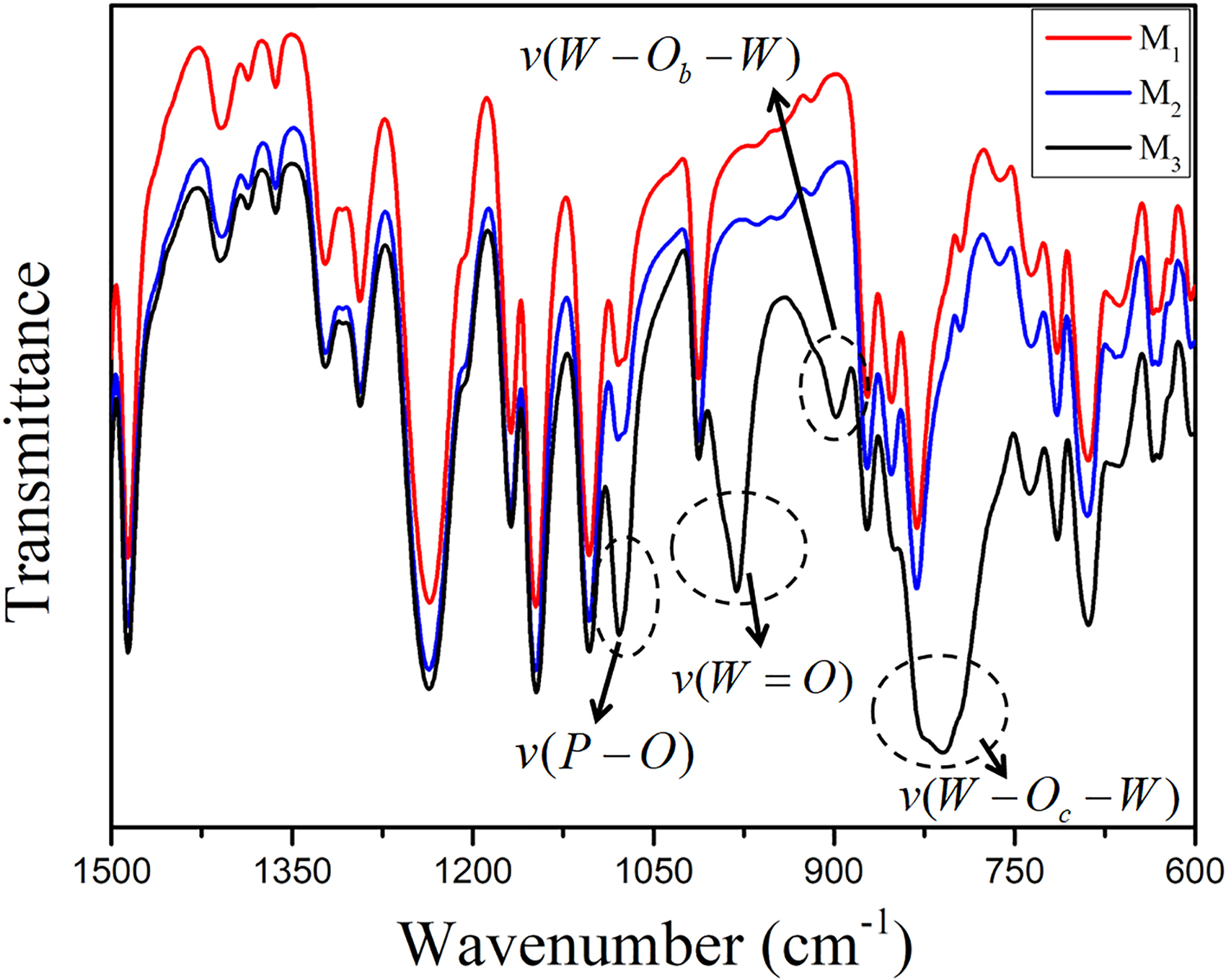
FTIR spectra of M1, M2, and M3. FTIR, Fourier transform infrared spectroscopy.
In the preparation process of dope solution, aluminum sec-butoxide was utilized instead of direct blending of Al2O3 nanoparticles. This is because aluminum sec-butoxide, which is in the fluid state, can be easily dissolved in the NMP solvent to form a homogeneous solution. After phase inversion together with the hydrolysis of aluminum sec-butoxide of dope solution, adequate hydroxyl groups originating from Al2O3 will be developed for further modification (Yao et al., 2016). Afterward, by treating the membrane with APTMS, amine groups would be anchored onto the membrane surface through hydrolysis and polycondensation of APTMS. Finally, POM was immobilized onto the membrane through electrostatic interaction with amine groups.
The characterization of M3 in terms of water contact angle, which was compared with M1 and M2, is shown in Supplementary Fig. S3. The water contact angle of M1, M2, and M3 was 59.8°, 55.9°, and 31.9°, respectively. Compared with M1, M2 has a slight improvement of hydrophilicity, while the hydrophilicity of M3 improved tremendously. The obvious decrease of water contact angle should be attributed to the superhydrophilic nature of [PW12O40]3− (Kozhevnikov, 2002) as the surface modification layer.
Dye removal performance of the membrane
The permeation performance of M1 and M3 in terms of RhB rejection and water flux is shown in Fig. 3. For M1, the RhB rejection rate decreased by 83.8% in 30 min. After 120 min, the rejection rate decreased to 5.7% with a water flux of 51.6 L/(m2·h·bar). This performance was not impressive as a membrane filter because the fabricated membrane substrate belonged to the ultrafiltration membrane whose dye rejection mainly resulted from the dye adsorption.
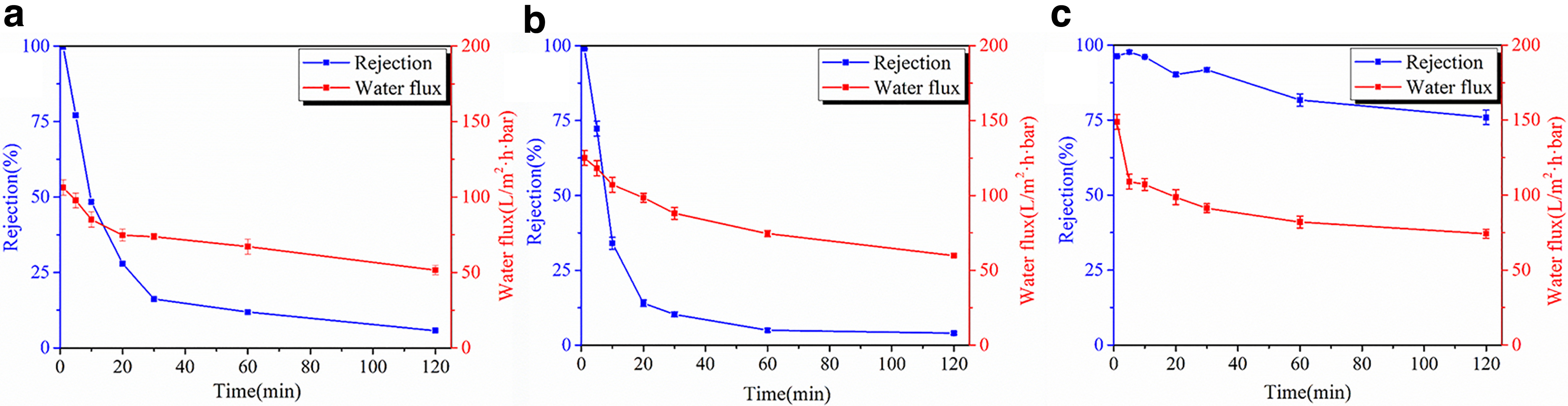
The dye rejection and water flux of
As shown in Fig. 3b, the water flux of M2 was slightly larger than M1 while a lower RhB rejection rate was observed for M2 after 120 min. After POM modification, the RhB dye rejection of M3 improved notably, while the water flux also increased. For M3, the RhB rejection rate showed a slow decline from 96.3% to 75.9% in 120 min, which was much better than M1. Different from M1 and M2, M3 presented a much slighter decline of water flux and reached a stable of 63.1 L/(m2·h·bar).
The excellent performance of M3 should be attributed to the following reasons. First, the functionalization of POM effectively improved the membrane hydrophilicity as illustrated in Supplementary Fig. S3. Higher hydrophilicity would bring more hydrogen bonds with H2O molecules and thus higher water permeability (Guo et al., 2020). Moreover, since phosphotungstic acids possessed a discrete structure with a diameter around 1 nm, they tended to narrow the pore sizes of the membranes gently instead of aggregating into bulks to block the inner structures of the membrane, as confirmed in Fig. 1i.
Consequently, M3 exhibited improved dye rejection rate with higher water flux. Besides, the membrane surface roughness was enhanced after modification. It might also amplify the membrane contact area with water and facilitate the water penetration (Yin et al., 2012). Compared with the reported polysulfone–polyamide nanofiltration membrane for RhB filtration (Maurya et al., 2012), M3 exhibited much higher water permeability (three orders of magnitude) with a similar dye rejection rate.
To confirm the catalytic functionality of M3, the photocatalytic activity of M1 and M3 was evaluated by the catalytic degradation of RhB under the irradiation of xenon lamp. As shown in Supplementary Fig. S4, M3 decolored from amaranth back to the pale pink, while the color of M1 nearly unchanged. UV-Vis and Raman analyses also supplied evidence for the degradation of RhB after catalytic degradation. It can be seen from Fig. 4a that after a dye removal test, an obvious peak at ∼550 nm was observed, which corresponded to RhB. After regeneration of M3 through irradiation, the peak disappeared. Similar results were also obtained by the Raman scattering. The peak of RhB, which was observed in 500–750 nm, disappeared with the observation of similar curves to the original M3 after membrane regeneration (Fig. 4b).

As reported in several studies (Farhadi et al., 2016; Li et al., 2020; Zhu, 2021), POM exhibits good photocatalytic activities for dye degradation (POM band gap is 2.82 eV) (Li et al., 2020) and immobilizing POM on solid supports could enhance the accessibility of surface-active sites and surface area resulting in improved photocatalytic performances. Through incorporating POM on the membrane surface, not only RhB could be rejected and enriched on the membrane surface but also enhanced photocatalytic performance of POM could be achieved. The comparison of the photocatalytic activity of M3 toward RhB degradation with recent published works is shown in Supplementary Table S1. Compared with another POM-modified membrane (PW12O40-quaternized chitosan membrane), which applied a more effective oxidizer, H2O2, instead of O2, M3 exhibited better photocatalytic performance.
The overall photocatalytic performance of M3 was also desirable compared with other types of photocatalytic membranes. The possible photocatalysis mechanism of POM has been discussed in Supplementary Data. The reusability of M3 has also been investigated for the RhB separation/degradation in consecutive six cycles. As shown in Supplementary Fig. S5, M3 remained active for six cycles, in which the dye degradation from the membrane changed from 90.4% to 82.7%, indicating that the as-prepared membrane could be well regenerated.
Antifouling property of POM-functionalized membrane
The antifouling performance of the POM-modified membrane determines its filtration quality and prolonged usage. In the wastewater treatment processes, polymeric membranes are likely to foul due to the adsorption and aggregation of foulants on the membrane surface. Thus, modification of membranes pursuing a low fouling tendency is favored in practical applications. The antifouling performance of M1 and M3 was investigated with HA as a frequently used fouling agent. Through running the fouling tests under the same conditions, it is evident that M3 was better than M1 in terms of the adhesion degree of contaminants on the membrane surface as shown in Fig. 5.
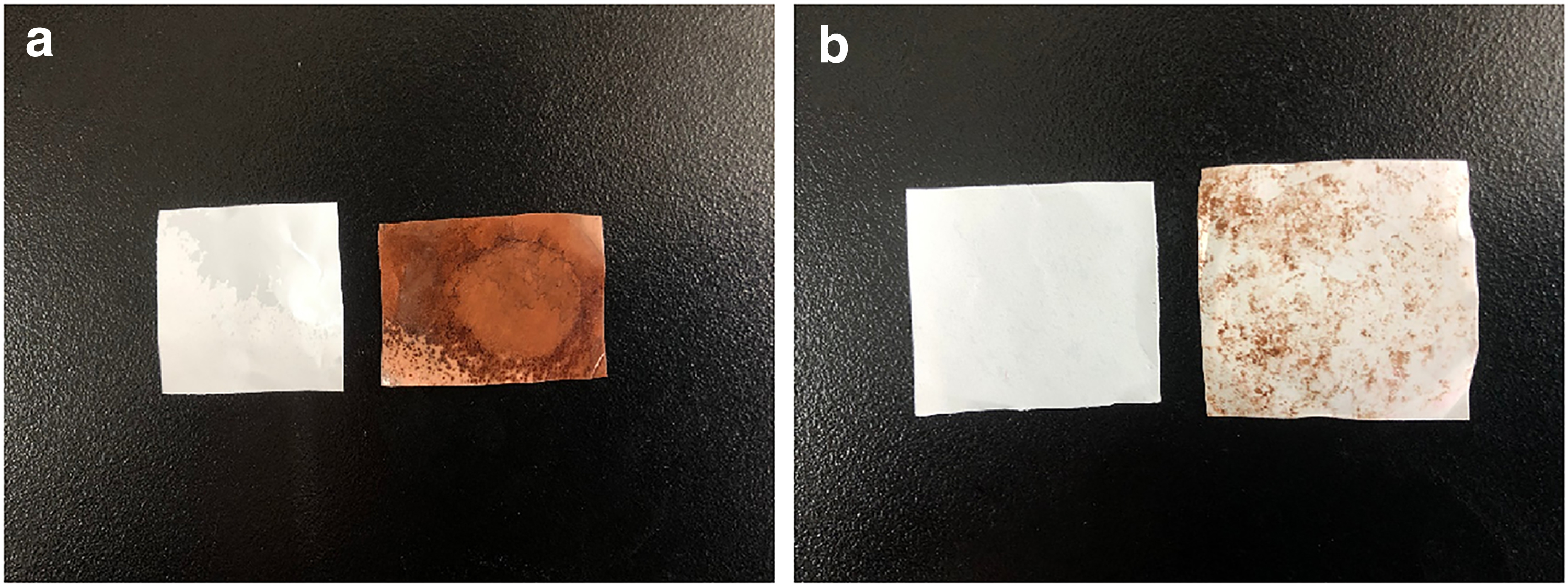
Images of
The excellent antifouling performance of M3 could be explained by two possible reasons. First of all, the membrane hydrophilicity was enhanced notably by the integration of POM. Higher hydrophilicity typically promises a better HA fouling mitigation effect (Teow et al., 2013). In addition to hydrophilic characteristics, POM on the surface of M3 was negatively charged, which would also contribute in lowering fouling propensity. Sufficient electrostatic repulsion that appeared between POM and HA aggregates would account for the fouling alleviation phenomenon.
The result of multicycle fouling experiment is illustrated in Fig. 6. Before the addition of fouling agent, M1, M2, and M3 were stabilized in the cross-flow filtration setup with pure water under 1 bar for 30 min. Afterward, the HA fouling agent solution was added and the permeate water flux declined dramatically in 1 min for both membranes due to the HA fouling and concentration polarization.

For the first cycle of HA fouling, M3 exhibited a higher water flux than M1, which agreed with the alleviated HA fouling phenomenon shown in Fig. 5. The antifouling performances of M1, M2, and M3 were evaluated by FRR after the membrane was fouled by HA solution. After washing with DI water, the water flux of M3 recovered by about 67.1%, while M1 and M2 exhibited an approximate FRR of 23.8% and 36.3%, respectively. The importation of superhydrophilic POM increased the hydrophilicity of the membrane, which was considered to be the main reason for the improvement of FRR. A hydration layer would form on the hydrophilic membrane surface through electrostatic attraction and hydrogen bonding. This hydration layer could mitigate the attachment of HA by acting as a barrier flanked between the membrane surface and HA molecules.
In addition, POM, which is negatively charged, brought the electrostatic repulsion between the membrane surface and HA leading to easier exfoliation of HA through washing. For three cycles of HA fouling, the water flux of M3 remained 3.8 times higher than M1.
Conclusion
In this work, the PSf-Al2O3-PW12O40 ternary composite membrane with photocatalytic, superhydrophilic, and antifouling performances was developed. The high-performance functional membrane was fabricated by modifying photocatalytic phosphotungstic acid on the membrane through a simple method under mild conditions. The effect of POM on membrane morphology, hydrophilicity, pure water flux, dye removal, and antifouling performances was well studied. A typical pollutant model, RhB, was used to evaluate the filtration performance of the as-prepared membrane.
The result showed that the modification of POM significantly improved both the dye rejection and water permeability. Moreover, the photocatalytic effect realizing the degradation of RhB for membrane regeneration was also attained after irradiation under a xenon lamp. The POM-modified membrane could be regenerated and reused for many cycles. The incorporation of POM could also enhance antifouling performance of the membrane. Through multicycle filtration of HA, which is a frequently used macromolecular organic foulant, an improved antifouling performance was also observed. The POM-modified membrane exhibited 67.1% FRR, while the FRR of the unmodified membrane was only 23.8%. Moreover, a water flux 3.8-fold higher than the unmodified membrane was also attained by the modified composite membrane.
The remarkable enhancement of antifouling performance could be explained by two possible reasons. First, the introduction of POM greatly improved the hydrophilicity of the membrane. In addition, the electrostatic repulsion between the membrane surface and HA was also beneficial for antifouling. Considering the simplicity and versatility of the POM modification method in this work, we believe it could be promisingly applied in the membrane separation and membrane antifouling fields. In our current work, RhB and HA were used to investigate the dye removal and antifouling performances.
In the future work, the filtration performance of the composite membrane could be further improved by optimizing the composition and casting conditions of dope solution and investigating the performances under more complex wastewater circumstances. Overall, the as-prepared PSf-Al2O3-PW12O40 ternary composite membrane possesses great potential in view of the economic and environmentally friendly membrane separation techniques.
Footnotes
Authors’ Contributions
Q.C.: methodology, validation, analysis, investigation, writing—original draft, and funding acquisition. Y.L.: methodology, validation, and analysis. Z.C.: methodology and writing—reviewing and editing. Z.Y.: conceptualization and writing—reviewing and editing. P.F.: writing—reviewing and editing. L.Y.: conceptualization, writing—reviewing and editing, supervision, and funding acquisition.
Author Disclosure Statement
No competing financial interests exist.
Funding Information
This work was supported by the Natural Science Foundation of Hubei Province [Grant No. 2020CFB279], the Scientific Research Program of Hubei Provincial Department of Education [Grant No. B2020052], and the Graduate Innovative Fund of Wuhan Institute of Technology [Grant No. CX2020071].

References
Supplementary Material
Please find the following supplemental material available below.
For Open Access articles published under a Creative Commons License, all supplemental material carries the same license as the article it is associated with.
For non-Open Access articles published, all supplemental material carries a non-exclusive license, and permission requests for re-use of supplemental material or any part of supplemental material shall be sent directly to the copyright owner as specified in the copyright notice associated with the article.
