




Abstract
Laboratory-scale fixed bed columns were designed and monitored to compare the mobility and removal of copper (Cu), manganese (Mn), and iron (Fe) from industrial wastewater using chemically modified rice husk (main filter medium). The first and third beds (A and C) were treated with sodium carbonates and phosphates, respectively, while the second bed (B) was rice husk ash. During the study, changes in the concentrations of these metals were monitored and measured for all treatments under an influent flow rate and hydraulic loading rate of 0.00288 m3/d and 0.508 m3/m2 d, respectively. Parameters that may influence the mobilization and removal rate of metals, including Redox and pH, were also monitored and measured. The experiment was conducted under ambient temperatures with redox potentials and pH ranging from −50 to 200 mV and 6.5 to 12, respectively. An accumulation in the Fe and Mn concentrations occurred during the first 6 weeks of system operation; a decline thereafter was noticed with Fe and Mn effluents of 28, 20, 15 mg/L and 29, 16, and 139 mg/L for treatments A, B, and C, respectively. There was however a stable decline in the Cu concentrations over time with a final effluent of 14 mg/L for all treatments. Under redox and pH ranging from slight reduction to oxidation and strong alkaline to acidic conditions, respectively, satisfactory Fe removal was accomplished through both A and C treatments, while a better Mn removal was achieved with A rather than C treatment. A greater removal of Cu was observed in A rather than B and C beds. It can be concluded that A was the best treatment among different modifications for Fe, Mn, and Cu removal from industrial wastewater. Furthermore, Redox potentials and pH were found to be imperative parameters controlling the mobilization and removal dynamics of Fe, Mn, and Cu.
Introduction
Since the beginning of industrial revolution, contamination by heavy metals has been known as a global issue. Heavy metal contamination induces serious health and environmental hazards due to its toxic nature (Jacob et al., 2018). Disposal of metal effluents such as copper (Cu), iron (Fe), and manganese (Mn) still sometimes carries levels exceeding the permissible limits (Carolin et al., 2017). These high levels might immediately accumulate in the food chain and living tissues, inducing a serious risk to the health and environment, due to the nonbiodegradable nature, endurance, and short- and long-term toxicities (Kelderman and Osman, 2007; Mohan and Sreelakshmi, 2008; Sahu et al., 2009; Carolin et al., 2017).
To meet the allowable limits of disposal, extensive efforts have focused on the efficient removal of metals from wastewater before discharge (Sahu et al., 2009; Ghorbani and Eisazadeh, 2012). Nevertheless, the focus should not be only on removal before discharge into navigable waters, but also before ocean or land disposal (Carolin et al., 2017). According to the World Health Organization and Environmental Protection Agency, the quality of surface water for healthy aquatic life should not exceed 0.3, 0.05, and 1 mg/L of Fe, Mn, and Cu, respectively (Shamsollahi and Partovinia, 2019).
When metals are discharged into water bodies, their load almost tends to bind as particulates (e.g., suspended matter and precipitates), thereby accumulating in the aquatic environments through sedimentation. The stability of metals binding on these solid compounds is a determinant parameter for effective mobility and bioavailability (Kelderman and Osman, 2007). The mobility and consequence toxicity basically depend on: metal content in wastewater, interconnection with other soluble species, and substrate capability to liberate metal from the solid phase (Violante et al., 2010).
In filter environments, metal binding forms could be transferred into substrate media through: dissolution/production of hydroxides/carbonate bound metals, decomposition and production of soluble/insoluble metal organic complex compounds, sorption/desorption, coprecipitation of metals by Fe/Mn oxides, precipitation of metal sulfides, and dissolution as sulfates (Calmano et al., 1993; He et al., 2005; Frohne et al., 2011).
pH and redox potentials are predominant parameters that affect mobilization of metals in microporous environment (i.e., transformation of metal species, mobility, bioavailability, and toxicity can be controlled by such properties) (Hsu et al., 2016). Redox is an electric variable, involving a transmission of electron from electron donators to electron acceptors, and hence determines the oxidation reduction conditions of environment (Calmano et al., 1993; Frohne et al., 2011). Redox reaction also affects the process related to metal binding (i.e., sorption and desorption, precipitation, complex formation, and speciation of the metals). pH is the second master variable which exhibits an important part in the mechanism of metal removal (Zhou et al., 1999), as it has the ability to modulate the metal complexation chemistry (Jacob et al., 2018).
Rice husk is an abundant and low-cost agricultural derivative that reduces waste output and potentially attenuates the adverse impacts of disposal into the environment (Kumar and Bandyopadhyay, 2006; Tee et al., 2009; Katal et al., 2012; Mor et al., 2016; Shen, 2017; Shamsollahi and Partovinia, 2019). It has been generally used as an excellent adsorbent as it contains high percentage of carbon and silica (El-Shafey, 2007; Ahmaruzzaman and Gupta, 2011; Moazed et al., 2011; Katal et al., 2012; Hegazi, 2013; Adekola et al., 2014; Zhang et al., 2014).
In relation to fixed bed columns treating metal contaminated wastewater using rice husk as a medium, little literature has focused on rice husk either as an ash (high silica content and porosity with large surface area) (Ghorbani and Eisazadeh, 2012; Li et al., 2016) or chemically modified (e.g., sodium carbonate [Na2CO3] and phosphate treated rice husks) (Kumar and Bandyopadhyay, 2006; Mohan and Sreelakshmi, 2008), which are both found to be efficient substrates for metal removal from wastewater (Ahmaruzzaman and Gupta, 2011). Therefore, a comparison was done in this study using fixed bed columns packed with chemically modified rice husk (the main filter medium) including: Na2CO3, phosphate, and ash of rice husk to highlight the mobilization and removal of Fe, Cu, and Mn from industrial wastewater. The impacts of redox and pH on the mobility and removal of these metals were also assessed.
Materials and Methods
Experimental and sampling procedure
A three parallel Perspex columns were setup in the laboratory. Rice husk was used as the main filter medium, with two supporting gravel layers on tops and bottoms under an ambient temperature regime (Fig. 1). The properties of the columns used in the experiment are listed in Table 1. The rice husk was obtained from a local rice mill, sieved through 1 mm sieve, washed thoroughly with distilled water (DI) and dried at 60°C for 2 h, and preserved at room temperature.
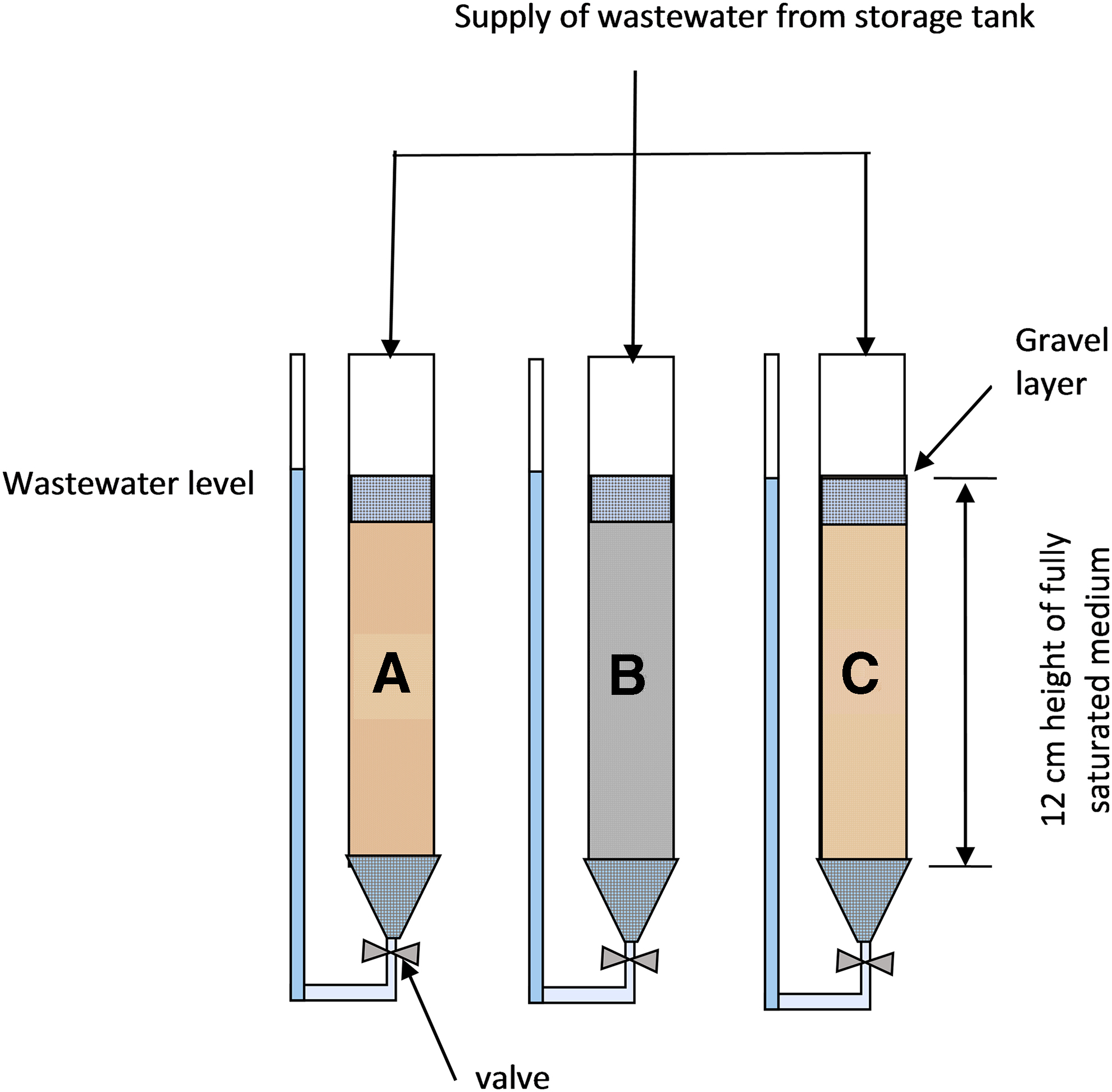
Schematic diagram of fixed bed columns.
Column Characteristics
Three treatment strategies were applied on the filter medium. The first strategy (Kumar and Bandyopadhyay, 2006) included treating the rice husk with 0.1 M/L of Na2CO3 solution for 4 h at room temperature. The excessive amount of Na2CO3 was removed with water and then dried at 40°C. The Na2CO3 treated rice husk was then ready for packing in the first column (column A). The second treatment strategy (Ghorbani and Eisazadeh, 2012) involved washing the substrate with acetone and sodium hydroxide (NaOH) (0.3 M/L), then dried at 60°C for 4 h, and thereafter ignited at 500°C for 5 h. The treated substrate (rice husk ash) was packed in the second column (column B). The third treatment strategy (Mohan and Sreelakshmi, 2008) incorporated treating the substrate with 1 M dipotassium hydrogen phosphate for 24 h; then the mixture was filtered and washed with DI water and dried at 70°C for 2 h. The phosphate treated rice husk was packed in the third column (column C). Table 2 shows physical/chemical properties of filter media exposed to treatment.
Physical/Chemical Properties of Filter Media Exposed to Treatment
LOI, loss on ignition.
Tap water was circulated in the system three times before commencing the experiment. Synthetic wastewater was prepared using 0.758 g/L CuSO4.5H2O, 0.075 g/L FeSO4.7H2O, and 0.022 g/L MnSO4.H2O, which were diluted in DI giving 194, 15, and 7 mg/L of influent concentrations of Cu, Fe, and Mn, respectively. The columns were then saturated with the synthetic wastewater from a header tank at an influent flow rate, hydraulic loading rate, and retention time of 0.00288 m3/d, 0.508 m3/m2 d, and 70 days, respectively. Once saturated, the flow was switched off to allow the treatment to progress under static saturated conditions, with keeping a positive head over the medium surface. Sampling was undertaken on a weekly basis, with three replicates, and the average was taken for data analysis.
Analytical measurements
Oxidation reduction potential was measured using digital ORP-200 meter (HM Digital, Inc.). pH was measured using pocket sized pHep HI 98107 meter (HANNA instruments). Water content of rice husk samples was determined using oven-dry technique procedure (Rasti et al., 2020). Metal ion concentrations were analyzed by atomic absorption spectrometry.
Results and Discussion
The medium of rise husk had water contents between 2.71% and 11.48%, with Redox potentials ranging from −50 to 200 mV throughout the period of study, indicating slightly anaerobic to aerobic states. The influent Redox potential of synthetic wastewater was 35 mV. In general, consistent results of Redox reactions were found overtime, with relative errors of 16.84, 3.5, and 20.72 for treatments A, B, and C, respectively.
For A and C treatments, there was a gradual rise in the Redox potentials during the first 5 weeks of system operation, indicating slightly anaerobic conditions (50–78 mV). Then, the values approached to maximum of 197 and 185 mV, respectively, at day 42 of system operation. Oxidation conditions thereafter governed the substrate with average values of 170 and 182 mV, respectively (Fig. 2), which could be due to the oxidation activity of metal-sulfide binding metal liberation (Zang et al., 2017). In treatment B, the case was however different; the medium was fully under reduced conditions of all times, with a slight change in the redox value (−14 mV) at day 42 of system operation and then restabilized around 0 mV; this was apparently due to the generation of metal hydroxides from the reaction of NaOH (added to this particular bed) with metal sulfates (Bourg and Loch, 1995).

Effect of time on Redox potentials.
pH values ranged from 12 to 6.5, suggesting strongly alkaline to slightly acidic conditions over the experimental period (Fig. 3). The influent pH level of synthetic wastewater was 10. The range of pH was between 9 and 10 during the first 4 weeks of system operation in A and C beds, respectively. Thereafter, a gradual drop was observed until approaching stabilized values of 6.4 and 7.3, respectively (a slight acidic to neutral conditions), whereas bed B attained a strong alkaline condition over the whole experimental period. Teixeira concluded that the increase in pH is the most immediate consequence of ash, which contains soluble bases stimulating more negative particle charges and enhancing repulsion (lower adsorption) between metals and the adsorbent surfaces, as the high amounts of Si available in the rice husk ash compete with metals for the adsorption sites and therefore lower the adsorption performance (Teixeira et al., 2019). In addition, the rise could be due to proton consumption (El-Shafey, 2007).

Effect of time on pH.
In general, Bourg and Loch (1995) confirmed that metal cation adsorption or precipitation can be developed under alkaline conditions, while they tend to desorb/dissolve from solids at acidic conditions, because low pH diminishes the firmness of metal associations and reduces metal retention (Zang et al., 2017). Acidic to neutral pH level would encourage mobilization of metals bound to carbonates and permit them to compete for negative sorption places in the media (Calmano et al., 1993; Kelderman and Osman, 2007; Zang et al., 2017). This was generally accomplished in bed A when metal sulfates reacted with Na2CO3 producing metal carbonates.
It can be seen from Figs. 2 and 3 that there is generally a negative relationship between Redox potentials and pH except bed B, which is in agreement with the results reported by Bourg and Loch (1995); Zhou et al. (1999); Kelderman and Osman (2007); Frohne et al. (2011) reported that high redox potential (oxidation state) produces protons and subsequently lowers the pH levels, whereas low redox potential (reduction reaction) depletes protons and therefore raises the pH level.
Influent Fe concentrations were 15 mg/L with a relative standard error of 7.8, 4.4, and 14.2 for A, B, and C treatments, respectively. Some researchers worked with modified rice husks to remove Fe in fixed bed columns under influent concentrations of 12 mg/L (Hegazi, 2013); 2–40 mg/L (Zhang et al., 2014); and 126 mg/L (Adekola et al., 2016). In A and B beds, when redox potentials developed from 60 to 197 and −35 to −14 mV, respectively, a rise in the Fe concentrations occurred until reaching maximum values of 86 and 63 mg/L, respectively, at day 42 of system operation (Fig. 4). Wong and Yang (1997) stated that oxidized conditions encouraged Fe transformation to insoluble forms, producing ferric/ferrous hydroxide at high pH levels. After that time, a gradual decline was detected in the Fe concentrations until approaching effluents of 28 and 20 mg/L. In C treatment, Fe followed the same trend manner, but with a greater peak reaching to about 172 mg/L at that period. However, the decline was rapid after the turnover point approaches an effluent value of 15 mg/L.
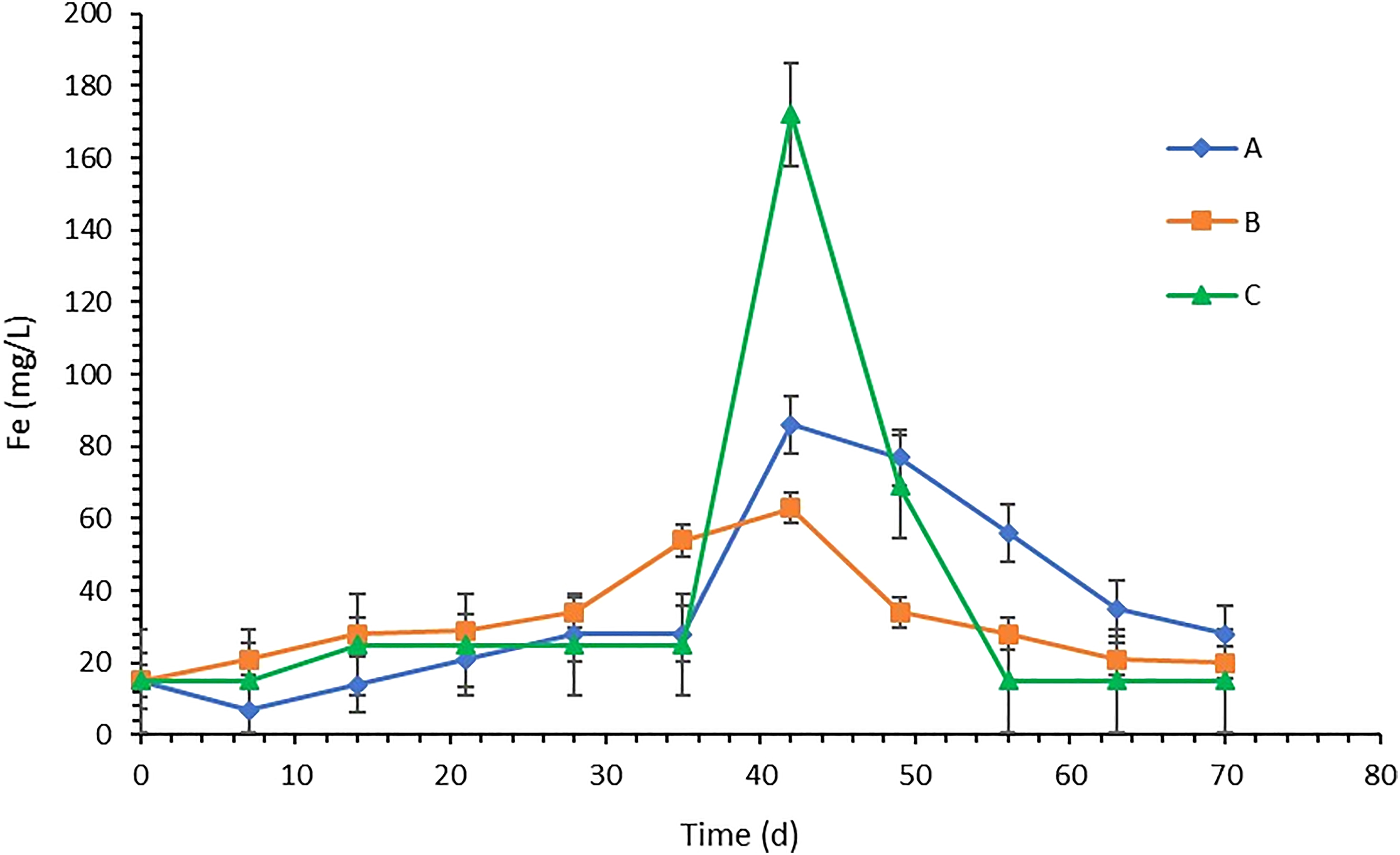
Effect of time on Fe. Fe, iron.
In substrate, adsorption of Fe is normally attained under the aerobic state, because Fe ions have a high tendency toward the production of soluble complexes with humic acids. Coatings of organic matter on metal hydroxides might also have a supplemental role in the Fe accumulation (Calmano et al., 1993). However, a complete reduction of Fe hydroxide can be expected when this process is catalyzed using microorganisms, which require an adequate time to create anaerobic states (Frohne et al., 2011). Therefore, the time period might not have been adequate for the total reduction (Calmano et al., 1993; Kelderman and Osman, 2007).
Influent Mn concentrations were 7 mg/L with a relative standard error of 16.1, 3.9, and 34.2 for A, B, and C treatment, respectively. Some researchers worked with modified rice husks to remove Mn in fixed bed columns under influent concentrations of 5–20 mg/L (Li et al., 2016); 2–40 mg/L (Zhang et al., 2014); and 23 mg/L (Adekola et al., 2016). As in Fe, the same trend was observed for Mn data at day 42 with peak values of 182, 53, and 326 mg/L for treatments A, B, and C, respectively (Fig. 5), with no difference between the performance of A and B beds, but slightly in C treatment. After that time, the difference was apparent between all treatments particularly C bed with effluents of 29, 16, and 139 mg/L for A, B, and C, respectively. Therefore, the high redox potential might have oxidized Mn sulfates to soluble Mn after 42 days of system operation (Wong and Yang, 1997; Kelderman and Osman, 2007). In addition, Bourg and Loch (1995); Calmano et al. (1993); and Patil et al. (2016) suggested that when the environment is only slightly reducing or slightly oxidizing and pH fills within acidic to neutral pH range, Mn hydroxides would be solubilized.

Effect of time on Mn. Mn, manganese.
Influent of Cu concentration was 194 mg/L with a relative standard error of 18.1, 15.8, and 16.1 for A, B, and C, respectively. Some researchers worked with modified rice husks to remove Cu in fixed bed columns under influent concentrations of 100–450 mg/L (Shamsollahi and Partovinia, 2019) and 3 mg/L (Adekola et al., 2016). In A treatment, there was a significant decline in Cu concentrations within the first week of system operation, then the decline was somewhat consistent during the second 2 weeks; after that, the significant decline was back between 28 and 35 days, and the trend finally approached a steady state at day 42 with an effluent of 14 mg/L for all treatments (Fig. 6). In C treatment, a rapid decline of Cu level was noticed in the first week, and then an insignificant change in Cu appeared between weeks 2 and 4, approaching a steady state at 42 days of system operation. This might indicate that Cu directly coprecipitates with Fe/Mn hydroxides during the first 42 days under the experimental conditions. In fact, the relatively high pH in that time period might have stimulated the metal for cation exchange or adsorption/coprecipitation onto hydroxides (Bourg and Loch, 1995; Gong and Donahoe, 1997; Zhou et al., 1999; Frohne et al., 2011).
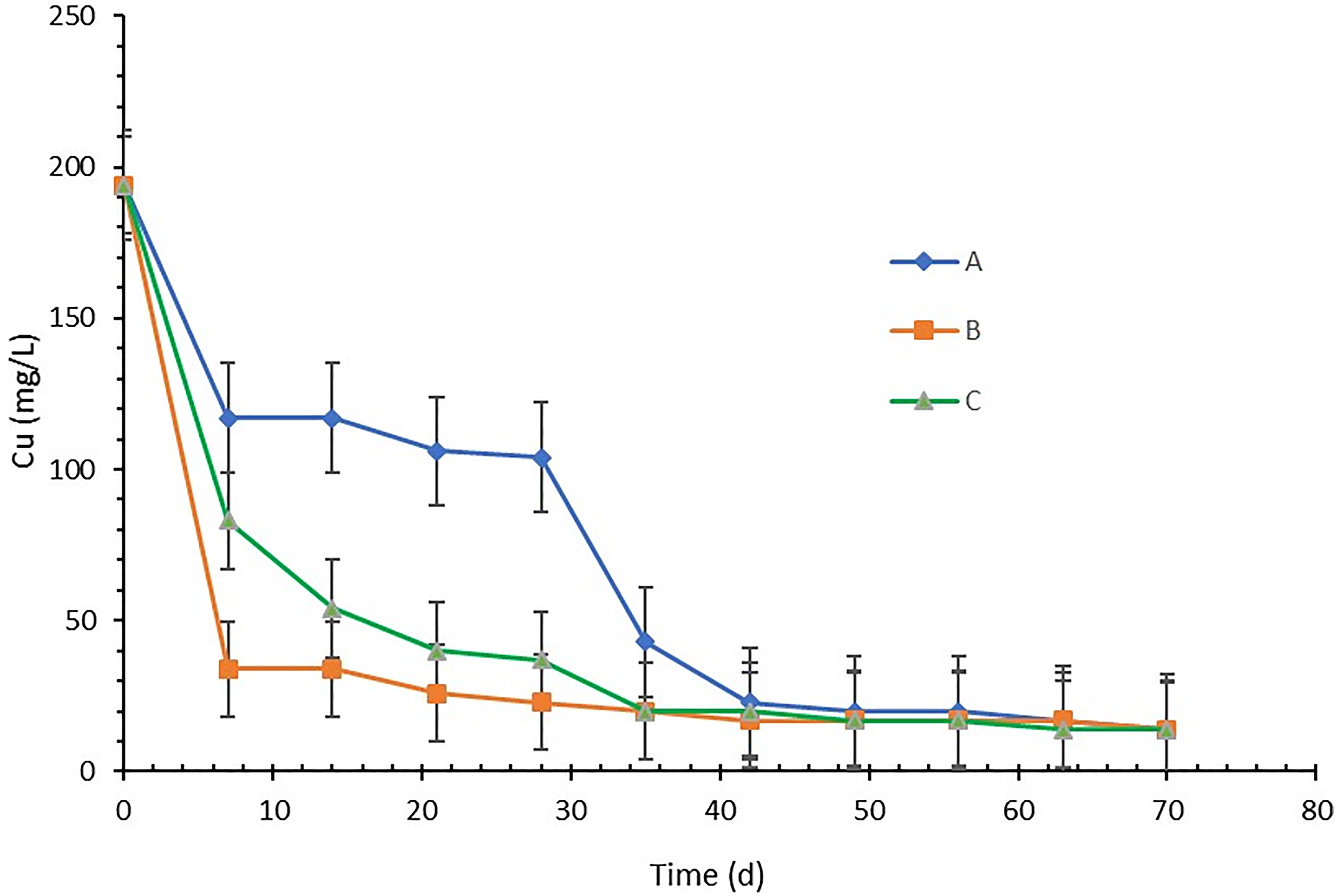
Effect of time on Cu. Cu, copper.
A small difference was noticed between B and C treatments until day 35, since that time the difference was completely vanished. Wong and Yang (1997) stated that solubility of Cu correlates positively with redox potential, but negatively with pH. However, it was found that the change in redox potential had more determined impact on Cu accumulation than pH. This is because Cu could be mobilized by sulfate reduction through the production of Cu-rich sulfide colloids (Violante et al., 2010).
Overall, the trend behavior of Fe and Mn concentrations was relatively similar overtime, with a clear difference among all treatments at day 42 of system operation. At this turnover time, an accumulation in the Fe and Mn concentrations was observed since Redox began changing toward the oxidation state; the case was however different for the Cu trend, which was relatively under a stable decline in each treatment of all times with removal efficiency of 93%.
Under the experimental conditions (slightly reducing to oxidizing conditions), the solubility of heavy metal cations decreases due to the precipitation of hydroxides, which is faster than carbonates and phosphates (Bourg and Loch, 1995). Therefore, substrate treated with Na2CO3 performed better than other treatments.
Conclusions
Redox and pH had profound effects on the mobilization and removal of Fe, Mn, and Cu using rice husk as the main filter medium in fixed bed columns that operated for 70 days. The redox and pH values indicated slightly anaerobic to completely aerobic conditions and strong alkaline to slightly acidic conditions, respectively, over the whole experimental period.
Only Cu levels kept declining over time until reaching stable effluent values of 14 mg/L for all treatments. This was different in case of Fe and Mn, which had relatively a similar behavior with a temporary accumulation at the 6th week of system operation under a slight reduction and strong alkaline conditions, and then a decline occurred over the rest of the experimental period with the dominance of oxidation and slight acidic conditions. Overall, Cu tended to be adsorbed stronger than Fe and Mn.
No clear effect could be noticed for ash of rice husk (bed B) on the mobilization and removal of Fe, Mn, and Cu under redox and pH ranging from slight reduction to oxidation and strong alkaline to acidic conditions. Therefore, there is a need here to extend the research conducted to better understand the role of this treatment modification on the metal's removal from saturated rice husk filters and why this treatment depresses this impact.
In A and C beds, good removal of Fe was accomplished, while Mn removal was achieved better in A rather than C bed. However, a greater removal of Cu occurred in A rather than B and C beds. All in all, A was the best treatment among different modifications for Fe, Mn, and Cu removal from industrial wastewater.
It can be concluded that metal removal basically depends on pH, oxidation–reduction potential. However, a difference in the rates of metal solubilization among three treatments may be due to the different physical and chemical properties of the amended substrates with the predominance of adsorption and chemical precipitation as the main removal mechanisms.
Revealing a new functional group on rice husk adsorbents could be performed using Fourier transform infrared spectroscopy. In addition, an observation of the major changes in the pore structure of the developed rice husk adsorbents could be done using scanning electron microscopy.
Further improvement of metal contaminated wastewater quality before discharge to meet the requirements of disposal is recommended.
Footnotes
Acknowledgment

Authors' Contributions
R.A.-S.: Writing-review and editing (equal); methodology (lead); conceptualization (equal); formal analysis (equal). Z.A.H.: Conceptualization (equal); writing—original draft (lead); writing—review and editing (equal). T.F.C.: Software (lead); conceptualization (support); writing—review and editing (support).
Declaration
Each of the listed authors are submitting the article in their own personal professional capacity and are not employees of any U.S.-sanctioned government.
Author Disclosure Statement
No competing financial interests exist.
Funding Information
This research was not financially supported by any organization.