




Abstract
This study was conducted to investigate the impact of chemical oxygen demand (COD) and aerobic operational modes on nitrogen and phosphorus removal from a sequencing biofilm batch reactor (SBBR). The anaerobic/oxic/anoxic (A/O/A) SBBR was operated at different influent COD/TN [COD/total nitrogen (TN)] ratios (1–4). The SBBR was operated at different operational modes (A/O/A mode and anaerobic/oxic (A/O) mode). The results showed that, in the A/O/A SBBR, the TN was mainly removed in aerobic process through simultaneous nitrification and denitrification (SND). The maximum SND efficiency of 79% was achieved at COD/TN ratio of 4. The intracellular stored polymers [polyhydroxybutyrate (PHB) and glycogen] were analyzed in the A/O/A SBBR. The advanced nitrogen removal in the A/O/A SBBR was attributed to the PHB and glycogen-driven postdenitrification at COD/TN ratios of 2 and 3. The low phosphorus removal efficiency appeared due to the low phosphorus uptake rate during the aerobic stage at the influent COD/TN ratio of 1–2 and the secondary phosphorus release during the anoxic stage at the influent COD/TN ratio of 4. The advanced phosphorus removal efficiency above 83% ± 2% and TN removal efficiency above 98% ± 2% were obtained when the influent COD/TN ratio was 3 in the A/O/A SBBR system. Compared with the A/O SBBR system, the A/O/A SBBR achieved better nitrogen removal performance due to the anoxic denitrification. In total, the A/O/A SBBR operated at influent COD/TN ratio of 3 was an optimal way to obtain high efficient nitrogen and phosphorus removal simultaneously. Under the conditions of abundant carbon source in influent wastewater, the release of secondary phosphorus in A/O/A SBBR should be avoided by optimizing and controlling the anoxic duration.
Introduction
Biological sewage treatment systems have been developed to meet the stringent sewage discharge standards. Lo et al. (2010) proposed a compact and flexible sequencing biofilm batch reactor (SBBR) for high-effective simultaneous nitrogen and phosphorus removal (SNPR). Various subzones in biofilm systems serve as the niches for different bacteria. Besides, the sludge retention time can be maximized in biofilm systems, and the suspended activated sludge system can potentially operate even when the sludge retention time (SRT) is relatively short. Thus one single reactor can develop various types of bacteria by changing the SRT, such as nitrite oxidizing bacteria, ammonia oxidizing bacteria, glycogen accumulating organisms (GAOs), phosphorus accumulating organisms (PAOs), and denitrifying PAOs (DNPAOs) (Yin et al., 2015). Simultaneous nitrification and denitrification (SND) and phosphorus removal with biofilm systems have been reported (Rahimi et al., 2011; Duan et al., 2013).
To fully use organics in wastewater, modified systems were developed (Tsuneda et al., 2006; Miao et al., 2015; Yin et al., 2015) to realize the anaerobic/oxic/anoxic (A/O/A) process. DNPAOs play a positive role in the SNPR in the A/O/A process in an SBR if there is reasonable quantity of carbon substrate just before aerobic conditions (Tsuneda et al., 2006). Glycogen and polyhydroxybutyrate (PHB), which provide electrons for endogenous denitritation, are two intracellular organic carbon storage polymers in the A/O/A process (Miao et al., 2015). The external carbon augmentation could be eliminated in the A/O/A biofilm systems and the total nitrogen (TN) removal could be potentially improved, according to Yin et al. (2015). The SNPR would also be maximized due to the influent organic carbon.
Organic carbon takes a key part in successful denitrification. Meanwhile, phosphorus removal can be linked to the cycling of PHB and glycogen using the enhanced biological phosphorus removal theory (Fuhs and Chen, 1975; Smolders et al., 1994). Thus besides the nitrogen removal, organic carbon is associated with phosphorus removal in wastewater treatment. The availability of carbon source in wastewater can be evaluated by the COD/TN (chemical oxygen demand/total nitrogen) ratio. The impact of COD/TN ratios of 1–4 on nitrogen removal in biofilm systems was studied under the A/O/A operational mode by Miao et al. (2015), and the results presented that the effluent TN decreased to under 10 mg/L at the highest COD/TN ratio of 4. However, only few data have been reported on the influence of COD/TN ratios on phosphorus removal in the A/O/A biofilm system.
Meanwhile, the operational mode is also an important factor achieving nutrient removal during wastewater treatment processes. Significant impacts of the anoxic-aerobic and full aerobic mode on nitrogen removal were investigated by Zhang et al. (2015). The most of SND systems use the anaerobic/oxic (A/O) operational mode (Wan et al., 2009; Hu et al., 2013). Meanwhile, the A/O/A biofilm process had been verified to have high nitrogen and phosphorus removal efficiency (Yin et al., 2015). It is of great significance to comparatively explore the influence of operational modes (A/O/A mode and A/O mode) on nitrogen and phosphorus removal in the biofilm process.
The aim of this study was to investigate the impact of influent COD/TN ratios on nutrient removal in the SBBR with A/O/A mode to reveal the features of nitrogen and phosphorus removal. Besides, the effect of operational modes (A/O/A mode and A/O mode) on the SBBR process was presented. The SBBR was carried out under different influent COD/TN (1–4) and operational modes (A/O/A mode and A/O mode). The effects of carbon source on nitrogen removal were extensively examined at C/N ratios ranging from 1 to 4 and correlated with the PHB storage. The nitrogen and phosphorus removed in the different process were analyzed, and it is demonstrated that the A/O/A process is suitable for treatment of the wastewater with the low ratio of COD/TN.
Materials and Methods
SBBR description
An SBBR 0.5 m high and 0.2 m in diameter was used in the work. The total working volume of the SBBR was 13 L, containing 12% plastic fibers by volume. Synthetic wastewater with 3,000–3,350 mg/L suspended solids was used in the experiment. A fine air diffuser was equipped at the reactor bottom to introduce the airflow for aeration. The airflow was maintained constant, and the dissolved oxygen (DO) concentration varied from 1.45 mg/L to 2.20 mg/L to keep the aeration rate at 40 L/h. The automatic operation of the SBBR was realized using a time controller. A water bath with a thermostatic heater was used to maintain the SBBR temperature at 30°C ± 2°C. The pH value of 7.0–7.8 was kept in operation. The complete solution mixing was ensured by a submersible pump. The SRT was controlled at 15 days. The SBBR seed was the activated sludge from Wastewater Treatment Plant of Chang'an District of Xi'an, China, and ran for over 1 year at the A/O/A mode.
Synthetic wastewater and operation
The wastewater used in this work was synthesized following Ge et al. (2016), which was composed of NH4HCO3 (NH4+−N), 50 mg/L; MgSO4.7H2O, 50 mg/L; CaCl2, 16 mg/L; KH2PO4, 44 mg/L; NaHCO3, 1,500 mg/L; COD (as glucose), 50–200 mg/L; and microelement liquor, 1 mL/L.
In the A/O/A SBBR experiment, the COD/TN ratio in influent wastewater was adjusted through COD (as glucose) concentrations with constant 50 mg/L NH4+−N, and the COD/TN ratios of 1–4 were achieved with 50, 100, 150, and 200 mg/L COD, respectively. The A/O/A process consisted of the following steps: feeding (10 min), anaerobic period (50 min), aerobic period (190–270 min), anoxic period (380–460 min), and decanting (10 min). The real-time control method was used to determine the end point of aeration (Peng et al., 2008). The whole cycle lasted for 12 h. The hydraulic retention time was calculated to be 17 h for a 70% exchange volume.
For comparison, the other operating mode (A/O mode) consisted of the following steps at COD/TN ratio of 4: feeding (10 min), anaerobic period (50 min), aerobic period (240 min), decanting (10 min), and idling (50 min). The aeration was finished when nitrification was completed and the whole cycle sustained for 6 h. The hydraulic retention time of 8.5 h was achieved for the same exchange volume of 70%.
Analytical methods
Standard methods (APHA-AWWA-WPCF, 2001) were used to measure the ammonia (NH4+−N), nitrite (NO2−-N), nitrate (NO3−-N), and COD. Instead of an independent TN test, TN was obtained by adding the obtained ammonia, nitrite, and nitrate together. The data of pH, DO and temperature were probed and collected as online data. The glycogen content was determined according to the anthrone method (Liu et al., 2007). The PHB concentration was measured with the UV spectrophotometry method (Law and Slepecky, 1961). The calculation of the nitrite accumulation ratio (NAR) and SND efficiency (ESND) was performed by following the schemes proposed by Zeng et al., (2003, 2014), respectively. NAR was calculated according to the following formula:
Where
where
Results and Discussion
Nutrient removal at various conditions
The TN, COD, and P removal performances of the SBBR process are shown in Fig. 1. The influent TN of complete experiment was 47.80 ± 4.12 mg/L, and the effluent TN of the A/O/A SBBR was 8.17 ± 1.46, 3.77 ± 2.35, 1.26 ± 1.37, and 0.88 ± 1.36 mg/L at influent COD/TN ratios of 1–4, respectively. At influent COD/TN ratios of 1 and 2, complete TN removal was not obtained during the operation because of the deficient biodegradable organic substances. The advanced TN removal efficiency of 98% ± 2% was obtained at influent COD/TN ratios of 3–4. When the influent COD varied from 50 mg/L to 200 mg/L, the effluent COD was 27.13 ± 3.84 mg/L. The advanced phosphorus removal efficiency of 83% ± 2% was produced at influent COD/TN ratio of 3. So, the higher the influent COD/TN ratio is, the better the nitrogen removal performance is; but the adequate carbon condition was possibly not suitable to achieve a high efficiency of phosphorus removal under 12-h cycle operation in the A/O/A SBBR.
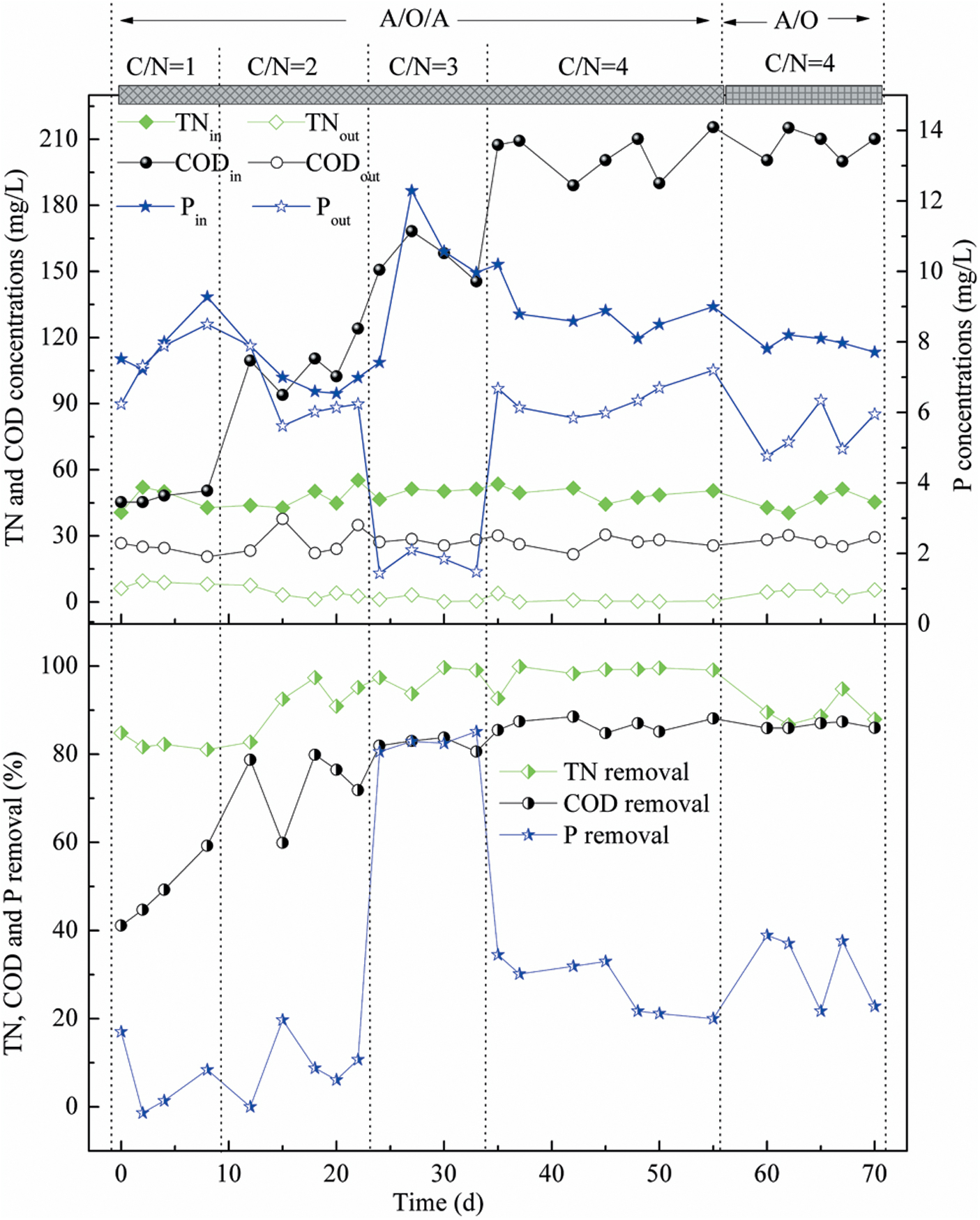
The TN, COD, and phosphorus removal performance of the SBBR process under different conditions: the A/O/A SBBR at the influent C/N ratios of 1, 2, 3, and 4; the A/O SBBR at the influent C/N ratio of 4. A/O/A, anaerobic/oxic/anoxic; COD, chemical oxygen demand; SBBR, sequencing biofilm batch reactor; TN, total nitrogen.
The optimal TN removal efficiency was 90% ± 3% in the A/O SBBR, with the effluent TN of 4.67 ± 1.20 mg/L and influent COD/TN ratio of 4. The A/O mode had lower TN removal efficiency compared with the A/O/A mode at the same influent COD/TN ratio, indicating that adding postanoxic period after this mode could strengthen the nitrogen removal efficiency.
Impacts of COD/TN ratios
To better understand the nitrogen and phosphorus removal pathway at various influent COD/TN ratio conditions, four typical cycle profiles of A/O/A SBBRs at COD/TN ratios of 1–4 were analyzed as blow and shown in Figs. 2 and 3, respectively.
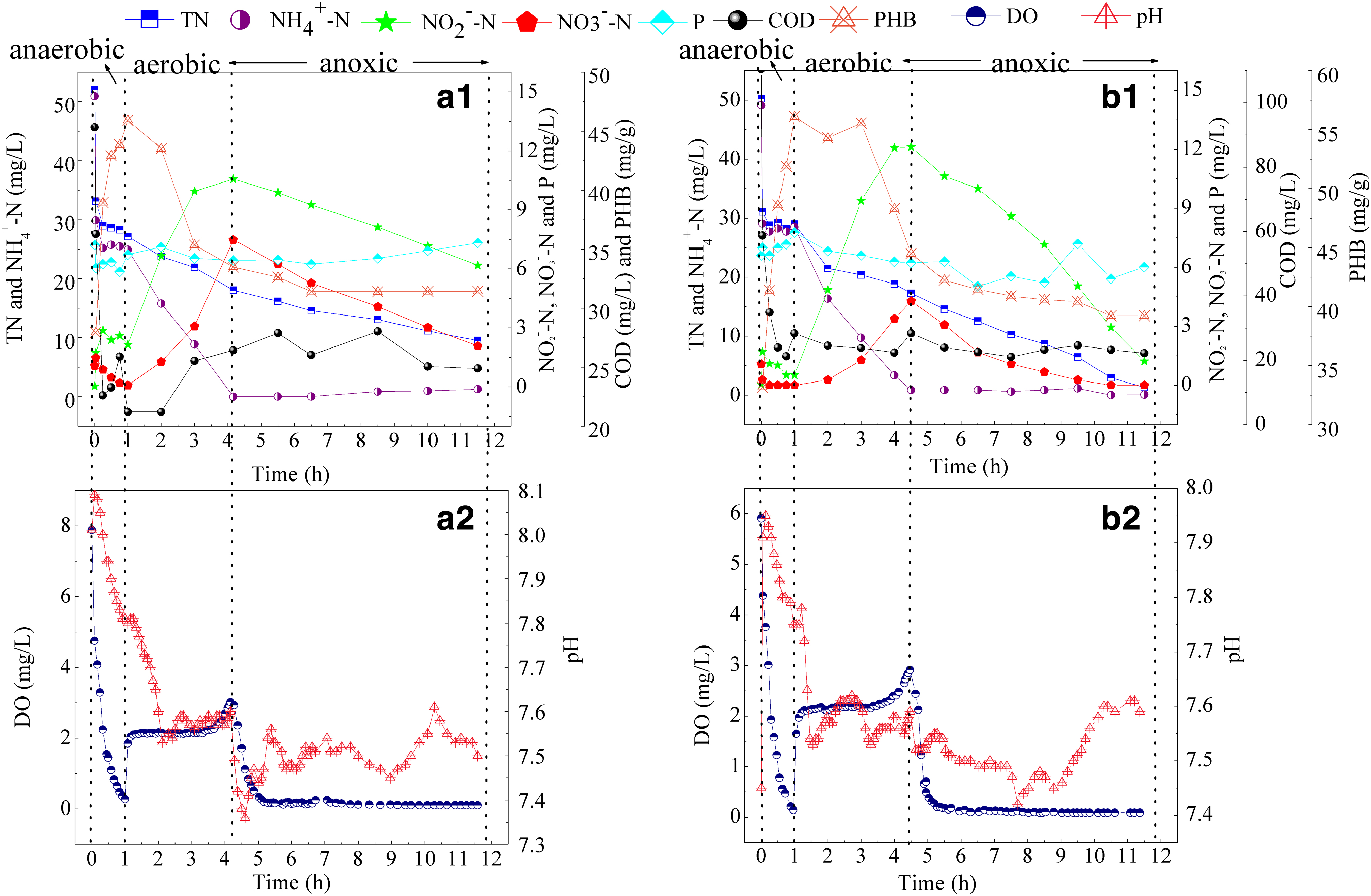
Typical profiles of nitrogen compounds and control parameters in the A/O/A SBBR at influent C/N ratios of 1 and 2: a1 and a2 are the typical profiles of the C/N ratio of 1; b1 and b2 are the typical profiles of the C/N ratio of 2.

Typical profiles of nitrogen compounds and control parameters in the A/O/A SBBR at influent C/N ratios of 3 and 4: c1, c2, and c3 are the typical profiles of the C/N ratio of 3; d1, d2, and d3 are the typical profiles of the C/N ratio of 4.
COD/TN ratio = 1
As shown in Fig. 2a1 and a2, it appeared as a serious carbon source deficiency for nitrogen removal at influent COD/TN ratio of 1, and the effluent TN after 12-h cycle operation remained at 10.54 mg/L. And the NO2−-N under the low influent ratio was easier to be converted to NO3−-N during nitrification, implying that the stronger DO competition ability of nitrite oxidizing bacteria may occur under lower COD concentration in liquid. In addition, there are barely any denitrifying phosphorus removal, aerobic phosphorus uptake, and anaerobic phosphorus release in this case.
COD/TN ratio = 2
As shown in Fig. 2b1 and b2, there are also no denitrifying phosphorus removal, aerobic phosphorus uptake, and anaerobic phosphorus release in this case, indicating that phosphorus removal in the A/O/A SBBR was impaired by low influent COD/TN ratio. Carbon cannot be taken up by other heterotrophic organisms without an electron acceptor (Lemaire et al., 2006), and the selective advantage of PAOs can be realized by adding carbon in anaerobic period. Unfortunately, NOx−-N in the present cycle was provided from the residual in last cycle due to low carbon in cases 1 and 2 (Fig. 2a1 and b1). Therefore, due to carbon competition between denitrifying organisms and PAOs, the advanced phosphorus removal did not occur at the presence of NOX−-N in the designated anaerobic zone (Pitman et al., 1983). Meanwhile, polyphosphate kinases or PHB oxidation was hampered possibly by the phosphorus uptake inhibition caused by nitrite accumulation (Zhou et al., 2007).
In addition, PAOs use poly-P as energy source to uptake organic substrates as PHB under anaerobic conditions. Thus the PHB synthesis process by PAOs must be accompanied by the release of phosphate, whereas the performances of PHB synthesis in anaerobic period and TN removal based on PHB degradation appeared in the cycles at COD/TN ratios of 1 and 2 without phosphate release, indicating that polyphosphate hydrolysis was probably not the energy source for substrate uptake for some bacteria. Coincidentally, GAOs were this type of microorganisms having the ability to synthesized PHB, and there were apparent similarities between the metabolism of GAOs and that of PAOs (Mino et al., 1998). The GAOs use the internally stored glycogen (not poly-P) as energy source, which reduced the power for anaerobic organic substrate uptake (Cech and Hartman, 1993; Mino et al., 1994). There was still residual organic substrates for GAOs because of the reduced uptake of organic substrates at low COD/TN ratio in PAOs (Liu et al., 1997). Therefore, GAOs may be the main microorganism responsible for the nitrogen removal at low COD/TN ratio conditions.
COD/TN ratio = 3
As shown in Fig. 3c1–c3, the PHB accumulation and phosphorus release consumed carbon source and glycogen during the anaerobic period (50 min), implying that the anaerobic condition was facilitative for carbon source storage in PAOs, GAOs, and other microorganisms, which could acquire energy, reducing power from glycogen degradation through polyphosphate hydrolysis and/or glycolysis in synthesizing PHB (Liu et al., 1996).
In this case, the DO concentration of 2.14 ± 0.10 mg/L was achieved during the aerobic period at 40 L/h aeration rate (Fig. 3c3), and the accumulated NO2−-N concentration after the aeration was 11.73 mg/L. The TN loss was 15.60 mg/L based on SND. The removal of a large part of NOx−-N occurred simultaneously with the uptake of phosphorus in the postanoxic period. The concentration of NOx−-N dropped when the COD content changed slightly (Fig. 3c1), implying an internal instead of external relationship of the carbon source between phosphate uptake and denitrification at anoxic conditions in the SBBR.
The whole postanoxic denitritation lasted for 6.3 h. In the period of 5.5–7.5th h (Fig. 3c2), the PHB content decreased with a small change in glycogen, implying that the primary carbon source for denitritation during this period was the PHB. In the remaining period of 7.5–11.8th h, the PHB content was maintained invariably, but the glycogen content started to decrease, meaning that PHB was used by the microorganisms less likely for denitrification rather than for cellular functions at lower PHB concentration (Qin et al., 2005). PHB was superior to glycogen as for endogenous denitrification, which was in accordance with the study found by Miao et al. (2015).
COD/TN ratio = 4
As shown in Fig. 3d1–d3, the PHB accumulation and phosphorus release also consumed carbon source and glycogen during the anaerobic period. Meanwhile, the accumulated NO2−-N concentration (4.09 mg/L) after the aeration in this case was lower than that (11.73 mg/L) in the above case, while the 20.71 mg/L TN loss based on SND in this case was significantly higher than that (15.60 mg/L) in the above case.
It is worthy of attention that the secondary phosphorus release (2 mg/L) occurred during the 8–12th h of the cycle in this case (Fig. 3d1). Sufficient carbon source and high efficient SND led to a small remaining NO3−-N/NO2−-N available for the postdenitrification, untimely depletion of NO3−-N/NO2−-N in the anoxic period, and then secondary phosphorus release, which was absent in the previous case (Barnard and Fothergill, 1998). The NO2−-N denitrification occurred along with the time without untimely NO2−-N depletion, indicating that the secondary phosphorus release was attributed to the sufficiently long anoxic period instead of the high influent COD/TN ratio. The postanoxic period needs to end when the NO3−-N/NO2−-N was denitrified completely to avoid the following secondary phosphorus release. So the secondary phosphorus release could be avoided in A/O/A SBBRs by reasonably adjusting the postanoxic period duration (e.g., 2.5 h) (Fig. 3d1
Effects of operational modes in the SBBR process
The time courses of nitrogen transformation in A/O SBBRs were studied at influent COD/TN ratio of 4, as shown in Fig. 4. In this mode, 5.39 mg/L NOx−-N was accumulated during the last moments of the aeration, with 89% TN removal efficiency based on the SND. In the A/O/A mode, 5.57 mg/L NOx−-N was accumulated after the aerobic period under the same influent nitrogen with the A/O mode, whereas the effluent TN decreased to zero by adding a postanoxic period after the A/O mode, and the postanoxic denitrification strengthened the nitrogen removal performance. Meanwhile, the phosphorus release in the anaerobic period and aerobic phosphorus uptake both occurred in the A/O mode, and the amount of phosphorus release and uptake in the A/O mode were much larger compared with the A/O period in the A/O/A mode. In total, compared with the A/O mode, the A/O/A mode was more suitable for nitrogen removal in the SBBR.

Typical profiles of nitrogen compounds and control parameters in the anaerobic/oxic SBBR at the influent C/N ratio of 4.
Impacts of COD/TN ratios and operational modes on nutrient removal in the SBBR
Figure 5 shows the changes of the PHB and phosphate concentration during the operation in the SBBR. Adding an anaerobic period after the feeding displayed positive effect on carbon source storage (Liu et al., 1996). The amount of PHB stored in the anaerobic phase is small (17.98 mg/g) with limited organic substances at low COD/TN ratio of 1 (Fig. 5), and it went up to 33.28 and 38.10 mg/g when the influent COD/TN ratio increased to 3 and 4, respectively (Fig. 5). The PHB consumption in the cycle increased from 14.48 mg/g at low COD/TN ratio of 1 to 30.02 mg/g at high COD/TN ratio of 4 (Fig. 5).
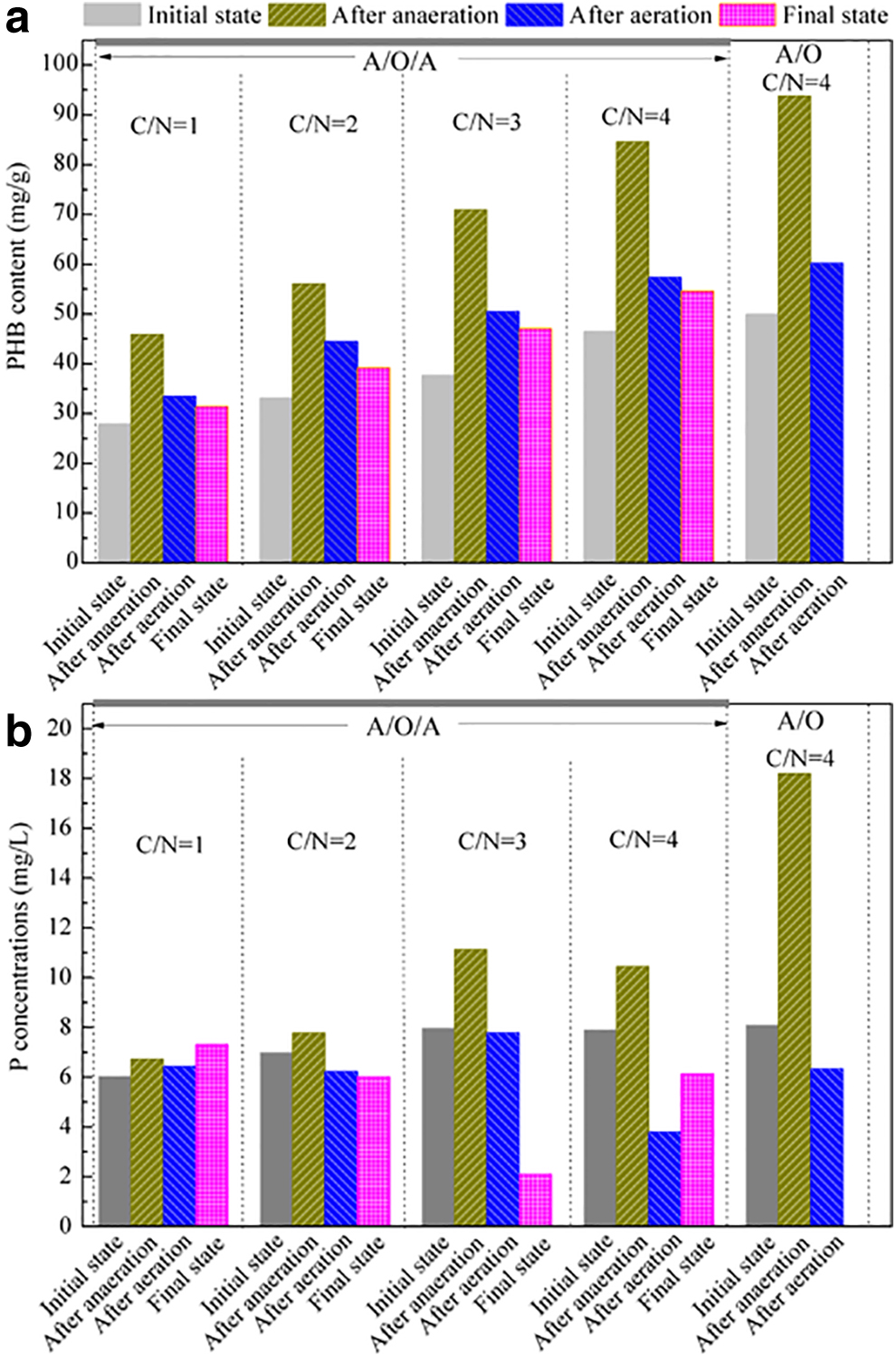
The effects of C/N ratio and operational mode on the PHB
As shown in Table 1, the ESND values were 28%, 41%, 53%, and 79% at influent COD/TN ratios of 1–4, with TN removal efficiencies of 82%, 97%, 92%, and 100%, respectively. For influent COD/TN ratio of 1, due to deficient organic substances, the amount of carbon source stored was marginal because most of the organic carbons were consumed in reducing residual NOx−-N from previous cycle. For influent COD/TN ratios of 2 and 3, the PHB and glycogen-driven postdenitrification resulted in the advanced nitrogen removal in the A/O/A SBBR. For influent COD/TN ratio of 4, due to abundant organic carbon sources, the SND with efficiency of 79% was the primary mechanism of the TN removal during the aerobic period in the A/O/A SBBR.
Comparison of the Nitrogen and Phosphorus Removal Under Different C/N Ratios and Operational Modes in the Sequencing Biofilm Batch Reactor System
A/O/A, anaerobic/oxic/anoxic; A/O, anaerobic/oxic; C/N, COD/influent total nitrogen; NAR, nitrite accumulation ratio; ESND, the efficiency of simultaneous nitrification and denitrification.
The advanced phosphorus removal efficiency (83%) was obtained at COD/TN ratio of 3 (Table 1). The phosphorus removal efficiency (64%) during the aeration peaked at COD/TN ratio of 4, meaning that the adequate carbon source was suitable to phosphorus uptake in aeration. The release of secondary phosphorus in A/O/A SBBR should be avoided by optimizing and controlling the anoxic duration under the conditions of abundant carbon source in influent wastewater.
Comparing the SBBR operated at the A/O/A mode and A/O mode at the same COD/TN ratio of 4 (Fig. 5 and Table 1), the TN removal efficiency of the A/O/A operation (100%) was higher compared with the A/O mode process (89%). There was no significant difference between the SND efficiencies of the A/O/A mode and A/O mode. The higher TN removal performance of the A/O/A process may be caused by the addition of the postanoxic period after the A/O mode, which improved the NOx−-N reduction through the postanoxic denitrification. Thus, the A/O/A mode was superior to the A/O mode in nitrogen removal for SBBR systems.
Conclusions
The impacts of COD/TN ratios and operational modes on nitrogen and phosphorus removal in SBBR were studied. For the A/O/A SBBR, higher COD/TN ratio was beneficial to achieve effective nitrogen removal, and the advanced nitrogen removal was achieved at COD/TN ratio of 4 as the residual organic substrate driven denitrification. The advanced phosphorus removal efficiency (83%) was achieved in the influent C/N ratio of 3 through phosphorus uptake in aeration and denitrifying phosphorus removal. The highest phosphorus removal efficiency (64%) during the aeration was achieved at the C/N ratio of 4, while the second phosphorus release occurred at the anoxic period. Therefore, a reasonable anoxic duration regulation needed to be noted to phosphorus removal at the C/N ratio of 4. Compared with the A/O SBBR, the postanoxic denitrification led to better nitrogen removal in the A/O/A SBBR. This A/O/A SBBR coupled improvement of traditional process with establishment of innovative processes to solve the problem of carbon source. The A/O/A SBBR could be a potential approach for nitrogen and phosphorus removal from wastewater.
Footnotes
Authors’ Contributions
J.Z. designed experiments, in cooperation with G.G.; C.L. implemented data analysis. G.G. prepared the article. J.Z. supervised all research. All authors reviewed the article.
Author Disclosure Statement
No competing financial interests exist.
Funding Information
This work was supported by the Ankang Science and Technology Project - general project (Grant No. AK2021-SF-05).