




Abstract
Subsurface wastewater infiltration systems (SWIS) have been considered an efficient and economical technology for sewage treatment in recent years, especially in rural and remote areas. However, the migration and transformation of NH4+-N in SWIS remain unclear. This study investigated the fates of 15NH4+-N tracer and pollutants removal performance in SWIS under different hydraulic loading rates (HLRs). The results indicated that an increase in HLR negatively affected the performance of SWIS in removing N and organic pollutants from the sewage. Considering the shortages of land resources and the pollutant removal efficiency, we recommend an HLR of 10 cm/day as an optimal rate. After 15N labeling, 22.3% of 15NH4+-N remained in the system in the form of 15NO3−-N, 12.8% remained in 15N-Organic nitrogen, and 4.6% remained in the original 15NH4+-N form at HLR of 10 cm/day. Furthermore, within the tested loads of 6, 10, and 14 cm/day, 15N retention in the middle layer was dominant in SWIS, and the relative contribution to the total 15N retention ranged from 59.4% to 76.7%. Overall, our results are valuable for comprehending the N migration and transformation mechanism, and it helps improve the pollutant removal efficiency in SWIS.
Introduction
Recently, due to the intensive industrial activities and rapid development of the social economy, sewage emissions have been increasing over time (Sun et al., 2021). In remote regions such as small towns and rural areas, most domestic sewage is discharged into the environment before completely purified due to a lack of budget and environmental awareness, leading to many risks to the ecological environment and human health, especially in developing countries (Wu et al., 2015; Yang et al., 2016). According to the China Water Resources Bulletin (2020), industry and agricultural water consumption accounted for about 80% of the water resource in the country. Therefore, proper sewage treatment is critical to reduce environmental pollution.
Subsurface wastewater infiltration systems (SWIS) have been used widely as a practical option for wastewater treatment owing to simple construction, lower operation costs, and excellent pollutant removal efficiency (Li et al., 2020a; Pang et al., 2020). Nitrogen (N), organic matter, and pathogens could be purified by microbial degradation, chemical reaction, and soil adsorption in SWIS (Liang et al., 2019). Many studies have found that design parameters such as hydraulic load, carbon (C)-N ratio, intermittent operation, and aeration influence the efficiency of a given method to remove contaminants (Zhang and Jian, 2016; Khaoula et al., 2017).
Pang et al. (2020) found that intermittent aeration has a great benefit to removal N. Compared with no aeration, the purification efficiency has increased from 37% to 87%, and speculated that it might be due to the inability to form a better aerobic environment in the system (Pang et al., 2020). However, Li et al. (2018) found that even without aeration, the removal efficiency for N still reached >90% under the C/N ratio of 4 to 10. Overall, although the influences of various design factors in SWIS on pollutant removal efficiency have been investigated, the underlying reasons and their linkages remain unclear.
N removal in ecosystems includes multiple pathways, such as losses through hydrological and gaseous pathways, plant absorption, and microbial assimilation (Yang et al., 2016). Therefore, to explore the N migration and transformation mechanism, it is crucial to understand the N transformation dynamic in SWIS. Stable isotope technique is a useful method for tracing fates and migration of chemical in the environment (Zhu et al., 2019; Zhou et al., 2020). For instance, it can be used to determine the transformation and removal paths of the pollutants in natural ecosystems (Fan et al., 2019), which provides new insight into the establishment of management strategy. Previous studies in SWIS mainly focused on 15NO3−-N, and Li et al. (2020b) used K15NO3 to reveal that in addition to the nitrification and denitrification, the contribution of co-denitrification to the release of N2O. However, few reports application of 15NH4+-N to explore the N fate pathway in SWIS, hindering the comprehension of N migration and transformation mechanism.
Hydraulic loading rate (HLR) is an important factor that affects the purification performance and long-term operation of SWIS (Pang et al., 2020). Previous studies indicated that under the low HLR conditions of 0.01–0.08 m3/(m2·d), the performance of N removal in SWIS was satisfactory (Zhang et al., 2015). In contrast, Li et al. (2019) found that increasing the HLR from 0.05 to 0.15 m3/(m2·d) was beneficial for N removal. Considering the low HLR will restrict the application of SWIS for areas with limited land resources and densely populated, the main objectives of this study were to (1) investigate the effects of HLR on fates of 15NH4+-N tracer and effluent quality, and (2) quantify the relative contribution of different soil layers to the total 15N retention in SWIS.
Materials and Methods
System description
Three parallel soil columns made of plexiglass were constructed (180 cm in height and 30 cm internal diameter) and operated indoors with a temperature of 21.2 ± 1°C (Fig. 1). Each column was divided into two layers, and the bottom was 20 cm of pebbles to support the matrix. The top was 140 cm in height and filled with a matrix of brown soil, coal slag, and fine sand uniformly mixed in a volume ratio of 12:5:3. The total organic was 25 ± 2 g/kg with porosity 55.4% and pH 7.2. A distributing pipe was installed in the 70 cm depth below the soil surface and was wrapped by 10 cm deep gravel (5–10 cm diameter) to avoid clogging. Influent was infiltrated through the column and collected at the bottom. Four sampling points were placed in the upper (50 cm), middle (85 cm), and lower (120 cm) layers to collect soil samples.

Schematic diagram of the simulation device.
System operation
According to the average potential evapotranspiration of the lawns in China (5–15 cm/day), HLR was designed to three conditions, that is, low (6 cm/day), medium (10 cm/day), and high HLR (14 cm/day). The desired HLR for each treatment was controlled by a peristaltic pump. The experimental wastewater was composed of dissolved pollutants to minimize the impacts of variability in wastewater quality. The ranges of influent after pretreatment were 280–290 mg/L for chemical oxygen demand (COD), 39–45 mg/L for NH4+-N, 2.1–2.9 mg/L for NO3−-N, 1.6–1.7 mg/L for NO2−-N, and 0.86–0.96 mg/L for total phosphorus. The intermittent operation has been proved to enhance pollutants removal efficiency in SWISs (Li et al., 2020a). In this study, the systems were replenished with influents for 12 h at 12 h intervals, which means wet and dry periods were equal. All SWISs were operated for >1 month before sampling to allow systems mature.
Sampling and analytical method
During the first 19 days of the experiment, we collected effluent samples every 3 days between 8 and 9 a.m. to analyze the water quality. Concentrations of COD, NH4+-N, NO3−-N, and NO2−-N were analyzed according to the standard methods (APHA, 2005). The pollutant removal efficiency was calculated as follows:
where η is the pollutant removal efficiency, %; Cin is the influent pollutant concentration, mg/L; and Cout is the effluent pollutant concentration, mg/L.
On the 20th day, three soil layers' samples were taken using an auger (2 cm in inner diameter). Four soil cores were taken randomly in each layer and were mixed into one composite sample. Then, solution of 15NH4+-N tracer was added to the SWIS to trace its fate in the SWIS. For each SWIS, 0.4 g of 15NH4Cl (99.12 atom%, 0.11 g 15NH4+-N) was dissolved in 1 L of water and added to the system using a peristaltic pump. The amount of 15NH4+-N applied to SWIS was <4% of soil NH4+-N pools, thus would not cause significant disturbance in the soil N cycling (Fig. 2). For the next 6 days (21–26 days), soil samples were collected as described earlier.

Concentrations of NH4+-N, NO3−-N, and ON in upper, middle, and lower soil layers under HLR of 6 cm/d
Within 8 h of sampling, 10 g fresh soil was extracted with 2 M potassium chloride solution (a soil/solution ratio of 1:4). Concentrations of total dissolved N (TDN), NH4+-N, and NO3−-N in the extracts were quantified by colorimetric method using a continuous chemical analyzer (SmartChem200, Italy). Organic nitrogen (ON) was estimated as the difference between the concentrations of TDN and inorganic N (Zhang et al., 2018; Zhou et al., 2021). TDN, NH4+-N, and NO3−-N in the extracts were converted to N2O, and their 15N contents were analyzed using a continuous-flow isotope ratio mass spectrometer (IsoPrime 100, IsoPrime Limited, UK) connected to a cryofocusing unit (Trace Gas Preconcentrator, Isoprime Limited, UK). The δ15N of ON was calculated using the following mass and isotopic balance equation as follows:
Three parallel samples (both water and soil) were sampled and tested. Statistical analysis was carried out using SPSS 19.0.
Results and Discussion
N and COD removal performance
In SWIS, N removal mechanisms include nitrification and denitrification, microbial assimilation, soil fixation, ammonia volatilization, and plant uptake (Liang et al., 2019). NH4+-N is the dominant N form in domestic sewage, accounting for >70% of total N (Pan et al., 2016; Li et al., 2019). In SWIS, NH4+-N is mainly removed by nitrification coupled with denitrification as shown by the following equations:
In this study, NH4+-N concentration of effluent was 2.4 ± 0.2, 3.3 ± 0.2, and 6.0 ± 0.4 mg/L when HLRs were 6, 10, and 14 cm/day, respectively (Fig. 3a). The results showed that the NH4+-N removal efficiency decreases with increasing HLR. Increasing HLR can lead to reduced NH4+-N removal efficiency of the SWIS by reducing the number of nitrifying bacteria in the substrate in several ways (Sun et al., 2018). First, high HLR could shorten the contact time between wastewater and matrix, resulting in a decreased matrix oxidation–reduction potential (ORP), which is unfavorable for the growth of nitrifying bacteria (Li et al., 2011). Second, due to the long generation period of nitrifying bacteria, high HLR could accelerate the replacement of biological membrane on matrix surface and hinder the growth of the nitrifying bacteria (Pan et al., 2013).
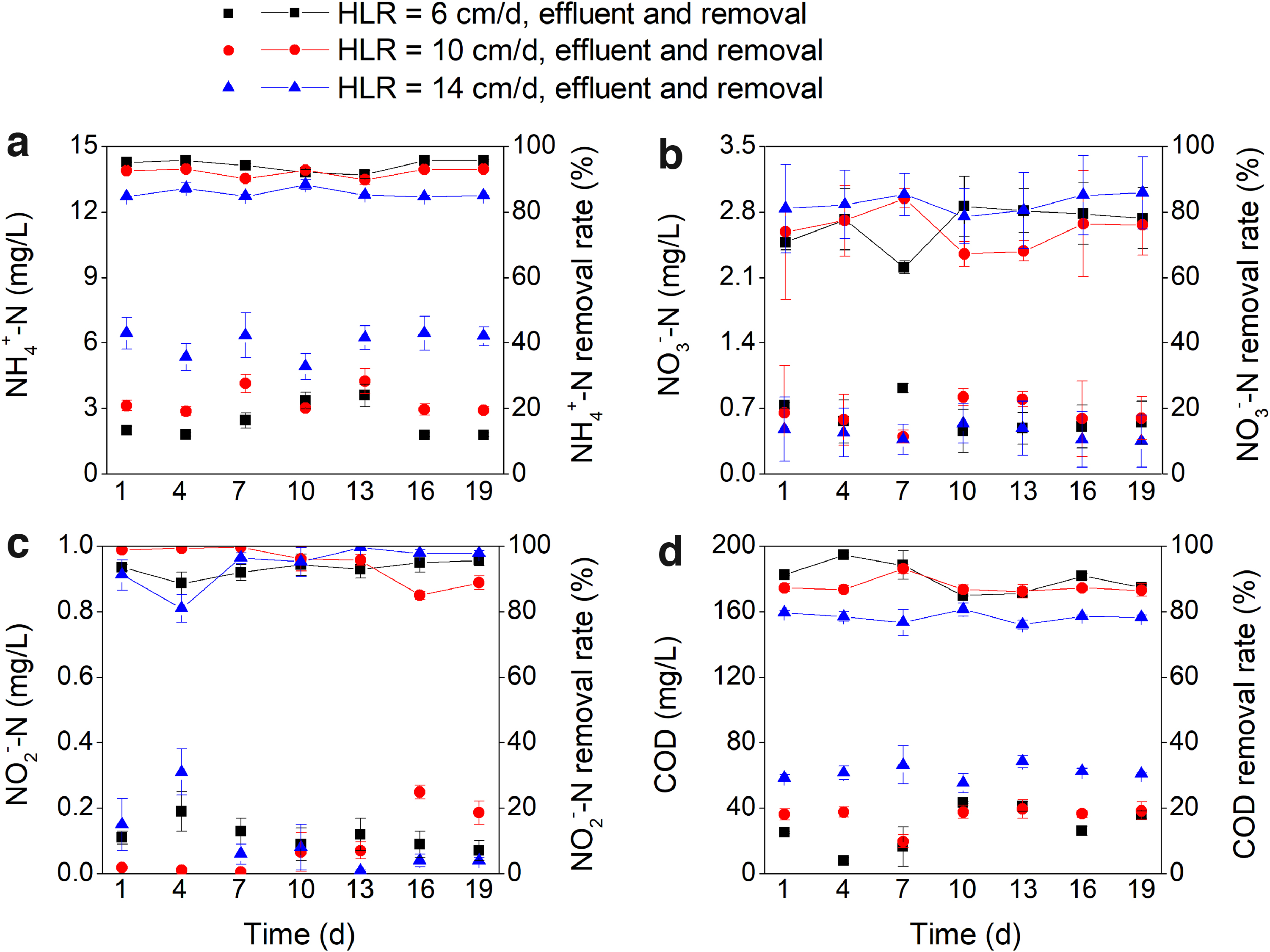
Effluent concentration and removal rate of NH4+-N
Moreover, serious clogging will occur when HLR is increased to 12.5 cm/day and above, so nitrification is quickly reduced, and soil permeability is decreased significantly (Li et al., 2012). In addition, the removal rates at low, medium, and high HLR were 75.87 ± 2.52%, 74.74 ± 2.19%, and 82.67 ± 1.07% for NO3−-N and 93.1 ± 0.88%, 94.74 ± 2.16%, and 94.06 ± 2.4% for NO2−-N, respectively (Fig. 3b, c). NO3−-N and NO2−-N could be volatilized after being reduced to NO, N2O, or N2 through denitrification in SWIS (Wunderlich et al., 2012; Wang et al., 2018). Such removal performance indicated the HLR had almost no impact on the NO3−-N and NO2−-N, and intense denitrification took place. Overall, although NH4+-N removal efficiency was limited by HLR, the effluent qualities of the three N forms satisfy the first class of Discharge Standard of Pollutants for Municipal Wastewater Treatment Plant (GB18918-2002) in China.
On average, COD removal rates reached 87.67 ± 0.91%, 90.15 ± 1.72%, and 78.3 ± 0.6% when HLR were 6, 10, and 14 cm/day, respectively (Fig. 3d). At low and medium HLR, average COD concentrations of the effluents were 35.13 and 28.06 mg/L, reflecting the COD remove efficiency of SWIS (Fig. 3d). However, effluent COD concentrations were 61.9 mg/L at high HLR, which failed to satisfy the aforementioned standard. Such results demonstrate that the effect of COD removal is inhibited by increasing HLR. A previous study by Pang et al. (2020) also showed that COD removal rates decreased from 85.4–66.9% to 49.6% as the HLR increased from 5–20 to 40 cm/day.
In SWIS, COD could be absorbed by the soil, decomposed by aerobic and anaerobic microbial processes, and mineralized as an energy source (Zheng et al., 2018). Owing to the shortened hydraulic retention time caused by high HLR, the organic matter cannot be completely oxidized (Li et al., 2019; Pang et al., 2020). In addition, increased HLR can produce strong scouring on the surface of the medium, which could also be the reason for the reduced COD removal efficiency (Li et al., 2012). Overall, considering land resource shortages and pollutant removal efficiency, a HLR of 10 cm/day can be recommended as the optimal level in SWIS.
Fates of 15N tracer under different HLR conditions
Our results indicated that the removal rate of influent NH4+-N pollutant after SWIS treatment reached >80%, but the fate of residual NH4+-N in the system was still unclear. For this purpose, three soil columns were fed with 15NH4Cl, and then traced the 15N isotope abundance of different N forms and soil layers to investigate the fate of NH4+-N in SWIS. During the first 3 days, 39%, 46%, and 51% of the added 15N tracers were retained in the system when HLR was 6, 10, and 14 cm/day, respectively. The accumulation of 15N gradually decreased afterward. For the recommended HLR of 10 cm/day, 22.3% of the 15NH4+-N was nitrified to 15NO3−-N, whereas 12.8% was assimilated into 15N-ON by microorganisms. Only 4.6% was retained in the original 15NH4+-N form.
However, we noted that ∼50% of the added 15N tracers were undetected in this study. We speculated that the uncovered fraction was removed by N-gas emission when the NH4+-N is oxidized into NO3−-N and NO2−-N, and then denitrified into N2O or N2, so as to achieve permanent removal of pollutants (Pan et al., 2017). Our finding is consistent with previous studies that showed 35–42% of NH4+-N was removed by denitrification and plant assimilation in a constructed wetland and bioretention system (Lee et al., 2014; Fan et al., 2019). Although some evidence also showed that NH4+-N could leave system as NH3 (Yang et al., 2022), the contribution of this pathway to remove NH4+-N was likely negligible at the soil pH of near neutral in our study because ammonia volatilization is generally significant at high alkalinity environment (Wu et al., 2019).
After 15N labeling, the amount of 15NH4+-N did not change significantly at low HLR (Fig. 4a). By contrast, the amount of soil 15NO3−-N increased rapidly and substantially at low HLR and peaked at 43.2 mg on day 2, indicating intense nitrification took place (Fig. 4b). As the HLR increased to 10 and 14 cm/day, 15NH4+-N and 15N-ON amounts increased in the first 3 days and decreased afterward (Fig. 4). This could be attributed to the number of nitrifying bacteria in SWIS decreasing with increasing HLR (Sun et al., 2018). Under such conditions, more NH4+-N is adsorbed by negatively charged soil organic matter and preferential assimilation by microbes over time (Fraterrigo et al., 2011; Daelman et al., 2015).

15N amount of 15NH4+-N
As time passed, 15NH4+-N and 15N-ON could be re-released to the system and get leaked, resulting in decreased 15NH4+-N and 15N-ON accumulation in SWIS. By contrast, the amount of 15NO3−-N decreased to 26.3 and 25.5 mg 15N when the HLR was 10 and 14 cm/day (Fig. 4b). Most denitrifying bacteria are anaerobic heterotrophs, which use carbon sources as electron donors to reduce N oxides under anaerobic conditions (Li et al., 2019). After increased HLR from 6 to 10 and 14 cm/day, carbon availability for denitrification increased, resulting in the increased reduction of NO3−-N to N2 or N2O through denitrification and the decreased 15N-NO3− accumulation in SWIS.
In addition, denitrification is regulated by multiple functional genes of the microbes (Yang et al., 2022). For example, nitrite reductase genes (nirS and nirK) regulate the reduction of NO2−-N to N-gas (Tang et al., 2018), and nitrous oxide reductase (nosZ) gene regulates the transformation of N2O to N2 (Lennon and Houlton, 2016). Pan et al. (2017) found that increased carbon availability provided appropriate nutrient conditions for denitrifying bacteria growth, and increasing the abundance of nirS, nirK, and nosZ genes. Overall, these underlying mechanisms to some extent explained the fates of 15NH4+-N tracer under different HLR conditions in SWIS.
Contribution of different soil layers to total 15N retention in SWIS
Our results showed that the upper, middle, and lower layers contributed 8.9–22.9%, 59.4–76.7%, and 14.3–18.1%, respectively, to the total 15N retention across the three levels of HLR (Fig. 5), indicating that the middle layer was the dominant sink for the 15N retention in SWIS. The difference in the proportional contribution of different soil layers to 15N retention could be explained by their contrasting characteristics. For instance, the concentration of dissolved oxygen is known to decrease with increasing soil depth, mainly due to the limited oxygen diffusion from the air into the substrate (Pan et al., 2016). Generally, the matrix environment in SWIS could be divided into aerobic, facultative, and anaerobic zones from the upper layer to the lower layer according to ORP (Li et al., 2019).

Proportional contribution of upper, middle, and lower layers to total 15N retention under HLR of 6 cm/d
The lower soil layer, which corresponds to the anaerobic zone in SWIS, is more conducive to denitrification to generate N2O and N2 (Granger and Wankel, 2016). Thus, greater gaseous loss of the added 15N is expected at the lower layer, which is the most plausible reason that explains the consistent small contribution of this layer to the total 15N retention under the three HLR conditions in our study. The small contribution of the upper layer to the total 15N retention could be related to reduced water content. The sampling of the upper layer was done slightly above the distributing pipe, which can limit the water content of the upper layer, especially at the low HLR (6 cm/day), resulting in a relatively low contribution to the total 15N retention.
However, we observed that the contribution of the upper layer to the total 15N retention was improved when HLR increased (Fig. 5). As the HLR increased, more sewage rose under the action of capillary force, which could increase the adsorption of 15N by soil organic matter, hence the contribution of the upper layer to the total 15N retention increased (Fig. 5). In contrast, the higher contribution of the middle layer to total 15N retention was maintained at a high level under the three HLR conditions (Fig. 5). This layer, being the facultative zone of SWIS, can provide a better ORP environment and soil porosity for effective nitrification and microbial assimilation of the added 15N tracer (Li et al., 2018). Overall, the middle layer always dominated the total 15N retention in SWIS.
Conclusions
Our study revealed that HLR negatively affects pollutant removal efficiency of SWIS. When the HLR was 6 and 10 cm/day, the quality of the effluents satisfied the first class of Discharge Standard of Pollutants for Municipal Wastewater Treatment Plant (GB18918-2002). Taking the limited land resource and treatment efficiencies into account, an HLR of 10 cm/day is recommended to remove pollutants. Results of the 15N labeling experiment showed that 39–51% of 15N tracer remained in the system during the first 3 days and decreased in the following 3 days. At HLR of 10 cm/day, 22.3%, 12.8%, and 4.6% of the added 15NH4+-N remained in the system were in the form of 15NO3−-N, 15N-ON, and 15NH4+-N, respectively. In addition, under each given HLR condition, the 15N retention in the middle layer was dominant in SWIS, with its relative contribution ranging from 59.4% to 76.7%. Overall, our results are valuable to comprehend N migration and transformation mechanism and improve the N removal efficiency in SWIS.
Footnotes
Acknowledgments
Thanks to the Xiusen Yang and Xuan Li of the Institute of Applied Ecology, Chinese Academy of Sciences, Shenyang, China, for helping during analyzing the isotopes of soil N.
Author Disclosure Statement
No competing financial interests exist.
Funding Information
This study was supported by the Fundamental Research Funds for the Central Universities (grant nos. N2001016 and N2001012), the Key Technologies Research and Development Program (grant no. 2019YFC1803804).