




Abstract
Wet scrubbing is an economical and effective denitration method in low-temperature flue gas. ClO2 is a highly efficient oxidant and is economical. Using ClO2 to remove NO can be expected to become a more ideal method. A detailed study of using ClO2 to remove nitrogen oxides (NOx) in low-temperature flue gas is performed, and meaningful results have been obtained. With the increase of the molar ratio of ClO2:NO, from 0.5 to 1.0, the oxidation efficiency of NO increases linearly, from 55% to 90%. With the increase of moisture concentration, from 0.5% to 9%, the NO oxidation efficiency increases slowly, from 75% to 90%. With the increase of flue gas temperature, NO oxidation efficiency and the denitration efficiency decrease slowly. The presence of SO2 improves the denitration efficiency, from 75% to 80% with 20 ppm SO2. The acidic absorbent is beneficial to denitration, but will also aggravate the escape of HCl, ∼20 ppm. NOx is converted into nitrate in the sorbent when the supply of ClO2 is sufficient, otherwise nitrite will be produced. The NOx in the outlet gas is almost NO2. Through experimental research, a new idea for denitration by ClO2 is proposed, using acid sorbent to oxidize NO and alkali sorbent to absorb NO2. This study is of great help to the subsequent engineering application.
Introduction
As one of the main air pollutants, nitrogen oxides (NOx) can form acid rain and acid fog to destroy the ecological environment and combine with volatile organic compounds to form photochemical smog, damaging the ozone layer and causing global warming (Gan et al, 2018; Liang et al, 2021; Tan et al, 2021). To control NOx emission, great efforts have been made and several technologies have been developed, including selective noncatalytic reduction (Cai et al, 2021; Masera and Hossain, 2021), selective catalytic reduction (SCR) (Lanza et al, 2021; Wu et al, 2020), wet scrubbing (Yang et al, 2018; Zhou and Wang, 2020), adsorption (Liu et al, 2021c; Xie et al, 2019), and electron beam irradiation and so on (Chmielewski et al, 2018; Zwolinska et al, 2020). However, the denitration in low-temperature flue (<200℃) gas is still a difficult problem.
SCR technology is the current industrial denitration technology around the world. However, its operating temperature is ∼350℃, and it is only effective when in contact with hot flue gas. The SCR reactor is usually located behind the economizer and in front of the high-efficiency dust collector and the flue gas desulfurization system (Xu et al, 2017b). The alkali metal in the dust and dust itself, as well as the heavy metal and SO2, will poison and inactivate the catalyst and greatly shorten its service life (Ma et al, 2021; Wang et al, 2019).
In actual industrial conditions, many boiler flue gases are low temperature (<200℃). For example, the temperature of sintering flue gas is usually 120–180℃. Moreover, due to the limited temperature that can be tolerated by dust remover bag, the flue gas in the process of bag dust collection before desulfurization and denitrification shall be controlled <200℃ (Govindan et al, 2012; Wang et al, 2019).
Wet scrubbing is a very economical and effective denitration method in low-temperature flue gas (Fang et al, 2011). In the previous study (Li et al, 2019; Xia et al, 2015), the desulfurization and denitrification were performed at the same time by wet scrubbing. The desulfurization efficiency was ∼100%. But, the inert nature of NO has posed a persistent problem. NO accounts for >90% of NOx in the flue gas. The low solubility of NO in the aqueous solution appreciably increases the liquid phase resistance to the mass transfer.
It is very important to oxidize the relatively insoluble NO to the soluble NO2. Strong oxidants, such as O3, KMnO4, Na2S2O8, H2O2, and NaClO2, have been used to oxidize NO (Hu et al, 2018; Li et al, 2019; Liu et al, 2021a; Lourens et al, 2016; Zhao et al, 2020). The cost of these oxidants, as well as ClO2, is listed in Table 1. Notably, the required molar quantity of oxidants in Table 1 is only the theoretical value. The usage in practical application is always higher than the theoretical value. For example, to obtain a satisfactory denitrification efficiency, the molar ratio of O3 to NO is usually up to 1.5:1–2:1 in practical engineering applications (Ma et al, 2016). As shown in Table 1, ClO2 and H2O2 have obvious economic advantages. However, the oxidation efficiency of H2O2 is low, only ∼30% (Han and Zhong, 2011). In terms of economy, ClO2 is a more promising NO oxidant.
The Economy of ClO2 Compared with Other Oxidants
Note: the price of O3 is calculated based on 10 kWh of industrial power per kilogram.
ClO2 is a highly efficient oxidant with 1.511 V standard electrode potential. ClO2 has been widely used as a bleaching agent in paper-making industry (Kaur et al, 2017; Song et al, 2019). Researchers studied NO removal with ClO2 solution in a bubble reactor, and achieved a denitration efficiency of ∼60% (Deshwal and Hyung-Keun, 2009; Jin et al, 2006). While the spray tower is more suitable for industrial application, the research of denitration by using ClO2 in spray tower is still few. To provide reference for engineering application, a detailed study for using ClO2 to remove NOx in low-temperature flue gas is carried out, including the kinetic simulation of NO oxidation and the experimental study in a spray tower.
Simulation Details and Experimental Setup
Simulation details
A detailed model consisting of 106 chemical reactions is established for kinetic simulation (Supplementary Table S1). The kinetic and thermodynamics parameters are obtained from the CHEMKIN database and the National Institute of Standards and Technology chemical species database (C.K.D.o.t.).
According to the SENKIN module of CHEMKIN package (Kee et al, 1996), the kinetic simulation and sensitivity analysis are carried out. The key elementary reactions are as follows:
The reactions R1, R2, R7, and R8 are the key reactions affecting the oxidation of NO. The reactions R7, R8, and R9 are the key reactions affecting the oxidation of SO2. The reaction R3 (ClO2 + SO2 = ClO + SO3) has less influence on the oxidation of SO2 because of its relatively slow reaction rate.
To verify and compare with the experimental result in the literature, the PSR reactor in CHEMKIN package (Kee et al, 1996) is used for kinetic simulation, and the diffusion mixing correction is carried out, with the correction coefficient of 0.2. For studying NO oxidation, referring to the experimental study of Yang Di (Yang, 2016), the same conditions (initial concentration of NO is 100 ppm, water content is 0.45%, O2 content is 6%, residence time is 5 s) are selected.
Comparison results (Fig. 1) show that, when ClO2:NO molar ratio is 0.5 and 0.7, the calculated results of NO oxidation rate are slightly higher than the experimental results. And when ClO2:NO molar ratio is 0.9, the calculated rate of NO oxidation is slightly lower than the experimental result. The simulation results are basically in agreement with the experimental results.

Kinetic simulation and literature experimental results comparison.
In view of the simultaneous oxidation of NO and SO2, the experiment of Mimi et al. is used as a reference (Mi, 2014); the same conditions (initial concentration of NO is 300 ppm, initial concentration of SO2 is 1,000 ppm, water content is 8%, O2 content is 6%, and gas temperature is 70℃) are selected. The simulation results are also in good agreement with the experimental results.
Experimental setup
The experimental platform (Fig. 2) mainly consists of gas simulating system, spray absorption system, and analysis system.

Schematic diagram of the experimental apparatus.
Gas simulating system
NO is used to simulate the NOx in the actual flue gas. N2 is the equilibrium gas. All gases are supplied by cylinder gas. The temperature of flue gas and the concentration of each gas component can be controlled accurately. All the gases are metered through mass flowmeters (MFC, Beijing seven-star electronics Co., Ltd., China).
Spray absorption system
The absorption of NO is conducted in a spray empty absorption tower with 400 mm length and 76 mm internal diameter. The simulated gas continuously flows through the system. The absorption liquid is collected under the tower in a cylindrical tank. And the absorption liquid is continuously pumped to the top of the tower from the cylindrical tank. A pH-electrode (PHSJ-4A PH meter; LeiCi Instruments) is immersed into the liquid to measure the pH value. The liquid storage tank is equipped with temperature control device, which can control the temperature of absorption solution. The spray flow rate can be controlled by peristaltic pump to adjust the liquid–gas ratio.
Analysis system
The system includes flue gas analyzer and ion chromatography. The concentrations of NO, NO2, SO2, and other flue gas components are analyzed by continuous emissions monitors (Rosemount Analytical NGA2000; Emerson Process Management Co., Ltd.). And the ion chromatography (883 basic Ion chromatography analysis, Metrohm measuring instruments Co., Ltd.) is used to analyze the concentration of nitrate and sulfate in absorbent solution.
NOx concentration is measured at the inlet and outlet of the gas. Three-way valves regulate the gas stream, which can be measured. And the system runs steadily for 10 min before measuring. The average value within 8 min after stabilization is taken as the measured value. Through measurement and calculation, the error of using this method to measure the concentration of NOx in the gas is ∼2%. The removal efficiency of NOx is defined as
where
Results and Discussion
Kinetic simulation of NO oxidation by ClO2
Based on the detailed reaction mechanism, the kinetic simulation is performed to provide reference and guidance for the subsequent experiments. The influences of temperature, ClO2:NO molar ratio, residence time, and other factors are investigated. The working conditions of kinetic simulation are summarized in Table 2. Simulation results are illustrated in Figs. 3 and 4, and briefly analyzed as follows:
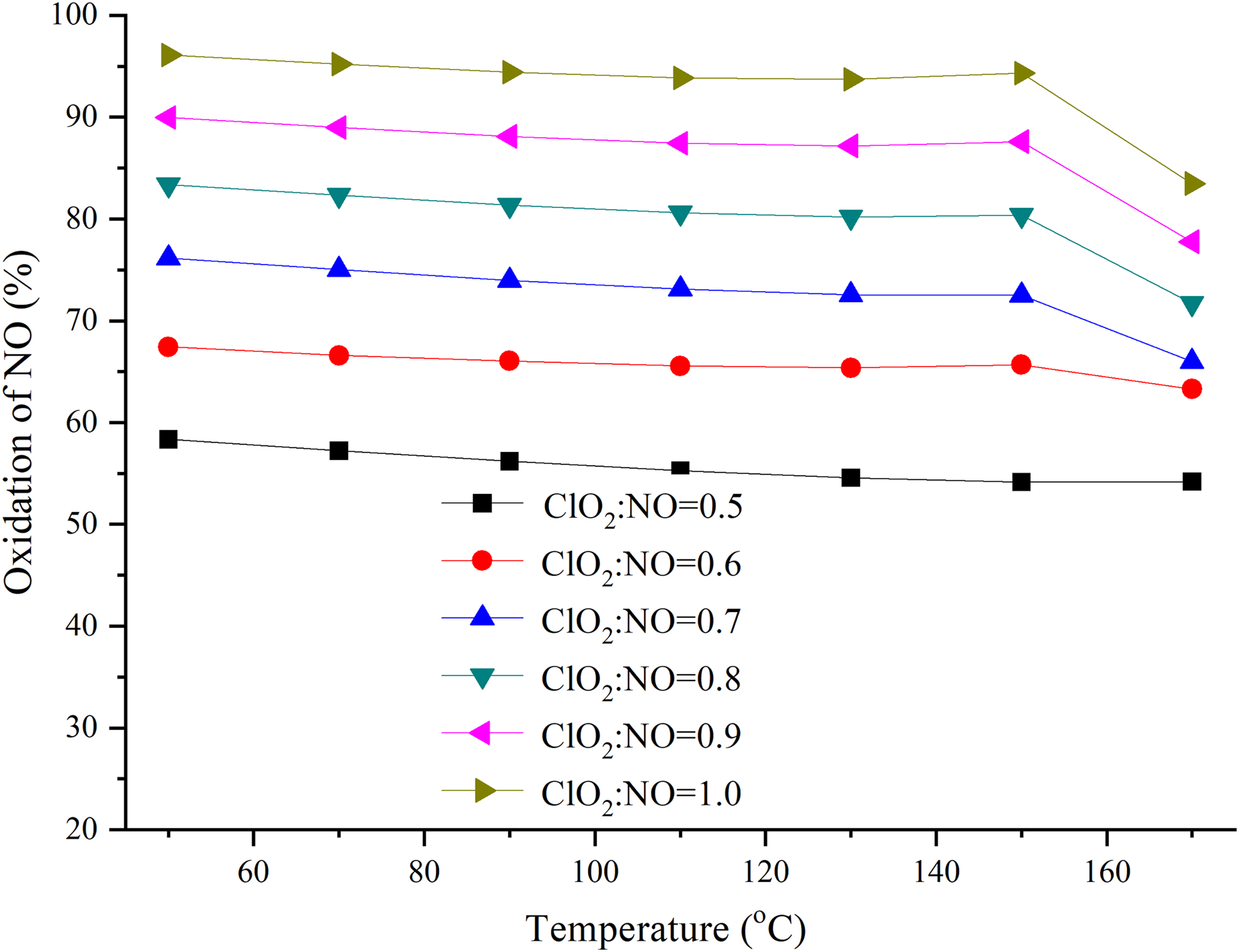
The effect of temperature (kinetic simulation).

Results of kinetic simulation of NO oxidation by chlorine dioxide.
Working Condition of Kinetic Simulation
Experimental study on the denitration by ClO2
On the platform of spray empty tower, experimental research on spraying and removal of NO by ClO2 is carried out. The experiment investigates the effects of flue gas temperature, residence time, liquid–gas ratio and the concentration, the temperature and pH value of ClO2 solution. This experimental research aims to explore better working conditions.
Effect of ClO2 concentration
In view of the influence of the concentration of ClO2, two sets of independent working condition tests are carried out. The test (a) is carried out under the normal temperature denitrification condition: the residence time is 2.72 s, NO concentration is ∼100 ppm, O2 content is 6%, and the liquid–gas ratio is 16 L/m3, the flue gas temperature and spray liquid temperature are 15℃. The test (b) conditions are as follows: the reaction residence time is 2.72 s, NO concentration is 130 ppm, O2 content is 6%, liquid–gas ratio is 16 L/m3, the flue gas temperature is 70℃, and the liquid temperature is 40℃.
Experimental results are shown in Supplementary Fig. S1. According to the results of the two groups of tests, when the ClO2 concentration is 0.1–1 g/L, the denitration rate gradually increases from ∼50% to ∼70%. The appropriate ClO2 concentration ensures sufficient oxidant supply and is conducive to the oxidation of nitric oxide. When the ClO2 concentration is >1 g/L, the denitration rate remains basically stable and may decrease slightly.
This may be due to the reaction under appropriate conditions, such as reaction residence time, temperature, and other factors. The reaction rate between ClO2 concentration of appropriate concentration and NO reaches saturation. In acidic environment, excessive ClO2 concentration may lead to the disproportionation reactions (6ClO2 + 3H2O = 5ClO3− + Cl− + 6H+, ClO2 + Cl = ClO + ClO), so that the removal efficiency of NO slightly decreases. According to test results, it is better to set the concentration of ClO2 at 0.5 g/L. At this concentration of ClO2, >70% denitrification rate can be obtained.
Effects of flue gas temperature
For low-temperature flue gas, experimental research on denitrification in the range of 50–130℃ flue gas temperature is conducted. The experimental conditions are as follows: ClO2 concentration is 0.5 g/L, reaction residence time is 2.72 s, NO concentration is 130 ppm, oxygen content is 6%, liquid–gas ratio is 16 L/m3, and liquid temperature is 40℃. As shown in Fig. 5a, the denitration rate basically decreases slowly with the increase of flue gas temperature. When the flue gas temperature increases from 50℃ to 130℃, the denitration rate decreases from 69.8% to 62.9%, which indicates that the temperature affects the stability of ClO2. In the spray state, the introduction of high-temperature flue gas makes ClO2 disproportionate to generate ClO2− and ClO3−, resulting in a great decrease in ClO2 stability (Zhu and Chen, 2005).
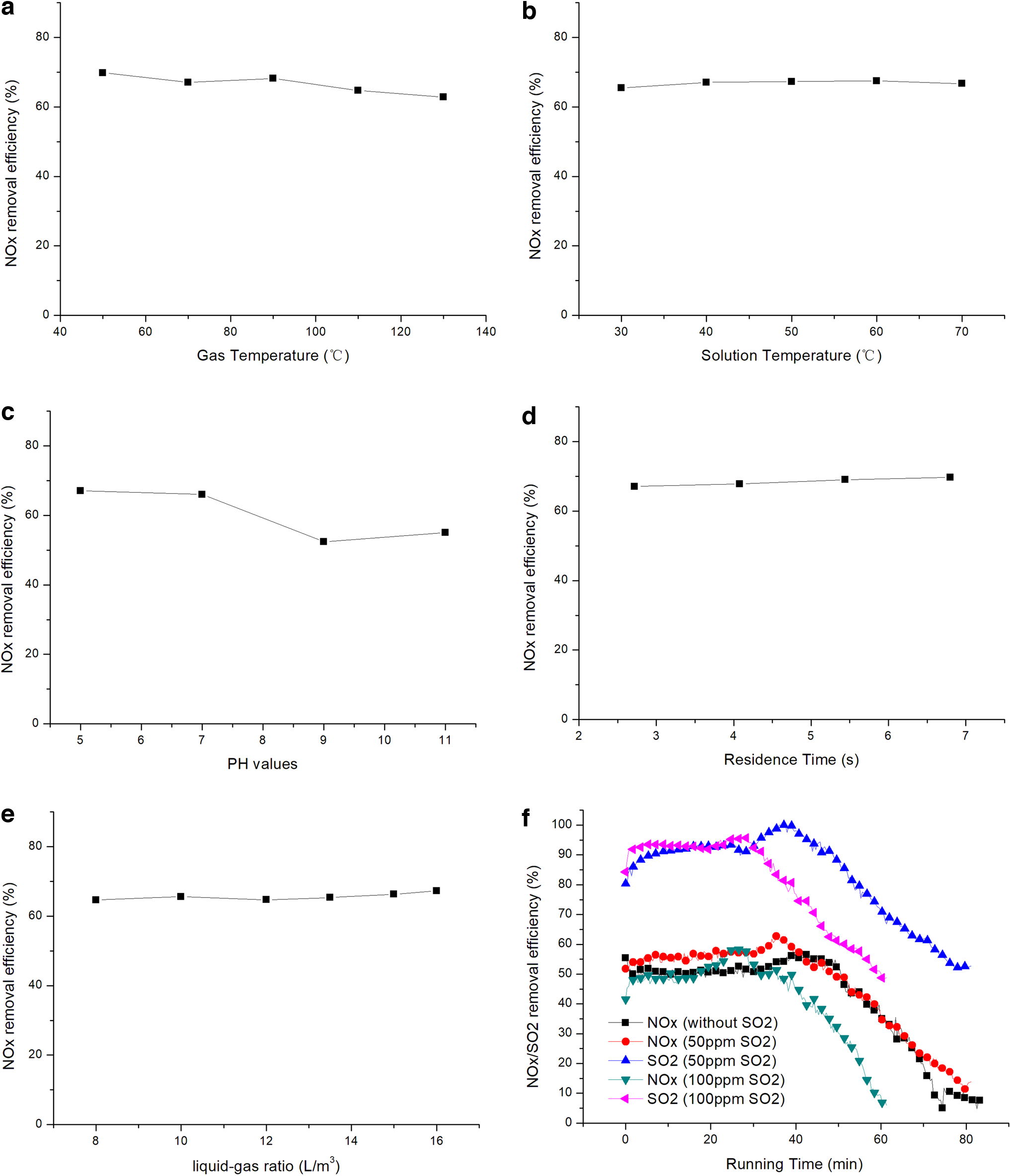
Experimental results of the denitration by chlorine dioxide.
Effect of sorbent temperature
The sorbent in spray tower can generally be maintained at 40–60℃ through continuous heat exchange of flue gas. Therefore, the denitrification in the absorbent temperature range of 30–70℃ is investigated. The experimental conditions are similar to those observed in the Effects of Flue Gas Temperature section, and the flue gas temperature is 70℃.
As shown in Fig. 5b, the denitrification efficiency remains stable in the range of 30–70℃. The temperature of the absorbent solution has little effect on the denitrification efficiency. Although the temperature affects the stability of ClO2, compared with the higher flue gas temperature, the temperature of the sorbent at 30–70℃ has little effect. This indicates that the inhibitory effect of high temperature on the stability of ClO2 mainly occurs in the spray area.
Effect of pH value of sorbent
The denitrification in the range of pH value 5–11 of the sorbent is investigated. The experimental conditions are similar to those observed in the Effect of Sorbent Temperature section. The temperature of the sorbent is 40℃. The pH value is adjusted by adding nitric acid or sodium hydroxide. As shown in Fig. 5c, acidic sorbent is beneficial to ClO2 denitrification, and its denitrification efficiency is significantly higher than that of alkaline sorbent. When pH value is 5, the denitrification efficiency is ∼67.1%, and when pH values are 9 and 11, the denitrification efficiencies are only 52.4% and 55.0%, respectively.
This means that the oxidation of ClO2 is related to the acidity and alkalinity of the solution. The stronger the acidity of the solution, the stronger the oxidation ability of ClO2. This may be because the pH value of the solution seriously affects the stability of ClO2. The oxidation of ClO2 is related to the acidity and basicity of the solution, the more acidic the solution the stronger its oxidation ability (Hoikyung et al, 2008). The appropriate concentration of ClO2 solution disproportionated at different pH values to form ClO3−.
When the ClO2 solution is in alkaline environment, ClO2 will be more easily disproportionated to form ClO2− and ClO3− (chlorate): 2ClO2 + 2OH− = ClO2− + ClO3− + H2O, which greatly reduces the stability of ClO2. When the ClO2 solution is in acidic environment, the amount of ClO2 disproportionation in acidic solutions is slower than that observed in alkaline conditions. The denitrification rate decreases only slightly from 67.1% to 66.0% when the pH of the absorption solution increases from 5 to 7. This is due to the fact that ClO2 solution is relatively most stable at pH of 6 (Liu et al, 2021b).
Considering the corrosion of the sorbent to steel, the pH value of the sorbent should not be too low. Moreover, excessive acidity of absorbent will lead to more HCl escape, which is analyzed in section 3.3 in detail. In addition, when the pH value of the sorbent increases from 5 to 7, the denitrification efficiency decreases slightly; therefore, the sorbent should be weakly acidic (pH: 5–7). Because NOx and SO2 are acidic gases, the pH value of the sorbent will gradually decrease with the system operation. It is necessary to maintain the pH value by slowly adding alkaline compounds such as NaOH. Considering that ClO2 solution itself is acidic, NaOH and other alkaline compounds should not be mixed with ClO2 solution directly.
Effect of reaction residence time
Reaction residence time directly determines the height and volume of absorption tower, and has an important impact on process cost. By adjusting the height of spray tower, denitrification in the reaction residence time range of 2.72–6.80 s is studied. The specific test conditions are similar to those observed in the Effect of pH Value of Sorbent section. As shown in Fig. 5d, the denitrification efficiency remains basically stable within the residence time range of 2.72–6.80 s. With the extension of residence time, the increase in denitrification efficiency is very low.
The experimental results are basically consistent with the kinetic simulation, which indicates that the reaction residence time of 2.5–3 s is basically enough. This may be due to the use of atomization nozzles in the experimental spray zone, which makes the sprayed absorption solution fill the entire spray atomization zone with very fine and uniform atomized droplets under peristaltic pump spraying. And this makes the gas–liquid contact more effective, and the NO removal reaction more successful.
The influence of liquid–gas ratio
By adjusting spray flow with peristaltic pump, the denitrification efficiency in the range of liquid–gas ratio 8–16 L/m3 is studied. The experimental conditions are similar to those observed in the Effect of Reaction Residence Time section, and the reaction residence time is 2.72 s. As shown in Fig. 5e, the denitration efficiency remains stable within the range of liquid–gas ratio of 8–16 L/m3 (the flow rate of flue gas is 10 L/min, and the liquid flow rates were 80, 100, 120, 140, and 160 mL/min, respectively).
With the increases of the liquid–gas ratio, the denitrification efficiency increases slowly and remains basically stable. A liquid-to-gas ratio >10 L/m3 is sufficient for ClO2 to absorb NO. This is because the experimental spraying area adopts the atomization nozzle, which makes the spraying absorption solution fill the whole spraying atomization area with very fine and uniform atomized droplets under the peristaltic pump spraying. And this makes the gas–liquid contact more effective, and the reaction between ClO2 and NO in solution has been fully reacted.
Effect of the presence of SO2
The influence of the presence of SO2 on the denitrification of ClO2 is studied. The specific test conditions are similar to those observed in the Effect of Reaction Residence Time section. NO concentration is maintained at 130 ppm by adding SO2 of 0 ppm, 50 ppm, and 100 ppm and comparing each other. As shown in Fig. 5f, at the early stage of trial operation, SO2 is conducive to ClO2 denitration when the supply of ClO2 is sufficient. Especially when SO2 of 50 ppm is added, the denitrification efficiency increases from ∼50% to 55–60%. As the experiment progresses, ClO2 is gradually consumed, and the denitrification efficiency begins to decrease.
Figure 5f shows that for the blank test without SO2, the denitrification efficiency begins to decrease at the turning point time of ∼50 min; on the contrary for the test with 50 and 100 ppm SO2, the denitrification efficiency begins to decrease at the turning point times of ∼40 and 30 min, respectively. This indicates that SO2 also can be oxidized and absorbed by ClO2, which has a competitive effect on the denitrification of ClO2. The existence of SO2 will increase the consumption of ClO2. These experimental results are in good agreement with the kinetic simulation and the experimental results in the literature.
In summary, the presence of SO2 facilitated ClO2 denitrification and enhanced the denitrification rate in the early part of the test run when ClO2 is in sufficient supply. It is due to that, in the presence of a small amount of SO2 (50 ppm), the following reactions may occur in solution: ClO + SO2 = Cl + SO3, ClO2 + Cl = ClO + ClO, ClO + NO = Cl + NO2 (Liu et al, 2021b). It leads to a certain degree of improvement in NO removal efficiency. However, the presence of large amounts of SO2 will inevitably compete with the oxidation of NO by ClO2, resulting in a significant decrease in NO removal efficiency.
In addition, as shown in Fig. 5f, at the beginning of the spray test, with sufficient ClO2 supply, the SO2 removal efficiency is ∼90%. This is basically consistent with the kinetic simulation analysis. In a high-humidity spraying environment, SO2 can react quickly with water, and can be oxidized by ClO2 to SO3, and then enters the liquid phase.
Analysis of outlet gas after denitrification
For the denitrification experiment discussed in the Effect of ClO2 Concentration section, flue gas analyzer is used to detect the flue gas components after denitrification. As shown in Fig. 6a, the results show that NOx in flue gas after denitrification is NO2, and no NO has been detected. This indicates that NO has been oxidized and absorbed completely. And thus, it is better to set an alkali tower at the tail to further remove NO2. Using acid sorbent to oxidize NO and alkali sorbent to absorb NO2 may be a new idea for efficient denitration.

It is also found that there is a certain amount of HCl in the flue gas, 1–20 ppm. According to the analysis reported in the literature (Jin et al, 2006), the reaction of HCl formation is as follows: 5NO +3ClO2 + 4H2O → 5HNO3 + 3HCl. If SO2 exists, the reaction of HCl formation is as follows: 5SO2 + 2ClO2 + 6H2O → 5H2SO4 + 2HCl. It is further found that the HCl escape is negatively correlated with the residual NO2. As shown in Fig. 6a, HCl escape is negatively correlated with ClO2 denitrification efficiency. Considering that HCl escape may be related to the pH value of sorbent, so the relationship between HCl escape and pH value of sorbent is tested and analyzed. As shown in Fig. 6b, HCl escape decreases rapidly with the increase of pH value. However, with the increasing pH value, there is decrease in denitrification efficiency. It can be concluded that the sorbent acidity is conducive to denitrification, but it also aggravates HCl escape.
Solution ions analysis after denitrification
The concentration of nitrate and sulfate ions in the sorbent after denitrification is measured and analyzed by ion chromatography. For the denitrification experiment discussed in the Effect of the Presence of SO2 section, the concentration of nitrate and sulfate ions in the sorbent is calculated according to the absorption of NOx and SO2 in the process of denitrification. The test results and calculation results are shown in Supplementary Fig. S2. It can be seen from Fig. 5f and Supplementary Fig. S2 that the concentration of ions in sorbent after denitrification is basically consistent with the absorption and removal of NOx and SO2 during denitrification.
The more the amount of absorption, the longer the absorption time, and the higher the ion concentration in the absorption solution. For NOx, the calculated value of ion concentration is ∼50% higher than the detection value of nitrate. The calculated value included nitrate and nitrite. It could be speculated that the mass ratio of nitrite: nitrate is ∼1:2, which may be due to the insufficient supply of ClO2 in the later stage of denitrification test. For SO2, the calculated value of ion concentration is ∼5–10% higher than the sulfate detection value. This may be because a small amount of SO2 converts to SO32− and HSO4−.
Conclusion
Use of ClO2 to remove NOx in low-temperature flue gas requires better working conditions: ClO2 concentration is 0.5 g/L, residence time is 2.5–3.0 s, pH value of sorbent is 6–7, the temperature of sorbent is ∼60℃, and liquid–gas ratio is 10–12 L/m3. Moreover, some special experimental phenomena and problems are encountered, such as the effect of SO2 presence, the pH drop under long-term operation, the escape of HCl, and the treatment of outlet gas. From more in-depth analysis, corresponding solutions are put forward. Furthermore, a new idea for denitration by ClO2 is proposed; using acid sorbent to oxidize NO and alkali sorbent to absorb NO2. This study is of great help to the subsequent engineering application.
Footnotes
Authors' Contributions
J.J. and Z.W. carried out the experimental study. Z.W. and Q.H. analyzed the experimental result. Z.W. was a major contributor in writing the article. All authors read and approved the final article.
Author Disclosure Statement
No competing financial interests exist.
Funding Information
This research was supported by Zhejiang Provincial key research and development program (grant no. 2020C03084).

References
Supplementary Material
Please find the following supplemental material available below.
For Open Access articles published under a Creative Commons License, all supplemental material carries the same license as the article it is associated with.
For non-Open Access articles published, all supplemental material carries a non-exclusive license, and permission requests for re-use of supplemental material or any part of supplemental material shall be sent directly to the copyright owner as specified in the copyright notice associated with the article.
