




Abstract
In the oil and gas industry, sulfonated drilling fluid, as a water-based drilling fluid, is applied on a large scale. The waste fluid mixed with drilling cuttings forms solid waste-sulfonated drilling waste (SW-SDM). Considering the water-soluble refractory organic matter in SW-SDM and the possible leaching of soil organic matter, processing SW-SDM to protect soil and groundwater from pollution is urgent. The present article systematically investigated the degradation of benzo[a]pyrene (BaP) in SW-SDM by iron (Fe) activated persulfate (PS) oxidation with special attention to revealing the influence of background Fe on degradation. The experimental results demonstrated that BaP in SW-SDM could be partly degraded by the activated PS oxidation system. Parameters such as the pH and dosages of PS and Fe may greatly influence the experimental results. A higher dosage of Fe inhibits degradation, whereas the addition of a small amount of Fe or even no Fe may facilitate the degradation of BaP. Naturally present Fe(II), Fe(III), and dissolved Fe from SW-SDM itself may activate PS for BaP degradation. The feasibility of the SW-SDM treatment was evaluated. Finally, the degradation intermediates of BaP by Fe and PS oxidation in soil were enriched by solid phase extraction and identified by gas chromatography-mass spectrometry to propose a transformed pathway.
Introduction
Solid waste-sulfonated drilling waste (SW-SDM) comes from discarded sulfonated drilling fluid, which consists of sulfonated phenolic resin, sulfonated extract, sulfonated lignite, and other additional ingredients.
The special three-sulfonated system endows the sulfonated drilling fluid with many excellent properties, such as high-temperature resistance and salt resistance. Consequently, sulfonated drilling fluid have been extensively used in deep well drilling in recent years. However, some of the organic matter in sulfonated drilling fluid is water soluble, and these pollutants may leach from SW-SDM after being washed away by rain, soils near well or storage yard can be contaminated with pollutants from SW-SDM (Zhao et al, 2021). Moreover, the content of hazardous organic matter such as polycyclic aromatic hydrocarbons (PAHs), surges with depth increases (Gautam et al, 2022). Environmental persistence, high toxicity, and ability to migrate long distances of PAHs are associated with increasing ecological risk (Zhao et al, 2021). In addition, smelly, irritating gases escape from aged drilling waste, and the experimenter may experience symptoms such as dizziness, vomiting, nausea, palpitation, and physical weakness after inhaling these gases (Jiang et al, 2022; Mao et al, 2020).
As an extremely complicated mixture, it has high chemical oxygen demand (COD), high chroma, high concentration of additives, and a large number of polycyclic aromatic hydrocarbons harmful to the environment and human health (Gawryluk et al, 2022; Guo et al, 2013; Njuguna, et al, 2022; Xie et al, 2022). However, unique sulfonated system made SW-SDM a stable matter that is difficult to deal with. Most PAHs in it are persistent organic pollutants (POPs), and their complex fused ring structure makes it a refractory organic contaminant. Its effect on human health and the environment is also well known, and in this process, the contribution of BaP is difficult to ignore. In conclusion, studying the elimination of BaP from SW-SDW is important.
The activated persulfate (PS) method is a sulfate radical-based advanced oxidation technology that has gained much attention from researchers in the petroleum industry in the past decades because of its immense potential in treating PAHs in SW-SDM (Chen et al, 2022; Zhao et al, 2013). In the activated PS method, the activator triggers the PS to generate sulfate radical (SO4−•), and SO4−• with a very strong redox potential (E0 = + 2.6 v), which enables the oxidation of PAHs, and the corresponding redox potential of most oxidants is lower than that of SO4−•. Elective reaction for BaP is another advantage over other technologies.
A previous study (Tsitonaki et al, 2010) concluded that the selective reaction sequence of SO4−• is non-aromatic carbon double-bond organics > π-electron substances containing aromatic rings >substances containing α-H matter >substances containing non-α-0H matter. BaP reacts with SO4−• before matter without π-electron due to the higher response priority of SO4−• for π-electron. The longer lifespan (t1/2 = 30–40 μs) enables contact between the pollutant and SO4−• (Ushani et al, 2020), the high reaction rate (106–109 M/s) contributes to the treatment efficiency. Sun et al (2022) reported the high PAH degradation and mineralization rate achieved by iron (Fe)-activated PS, which can be attributed to sulfate radical, while this degradation process is not affected by the number of aromatic rings. Hence, the activated PS method is suitable for SW-SDM.
This method has many advantages and great potential. In addition to the reasons above, adaptability to a broad pH range and safety are considered a part of its merit, but challenges such as reusability, metal activator leaching, and metal activator deposition need more attention.
A key factor in activating PS is the activator, and several methods are available, such as thermal, citrate chelated Fe, alkaline, and a hydrogen peroxide (H2O2)-PS binary mixture (Zhao et al, 2013). However, some of the activation methods are practically undesirable. For example, thermal and microwave radiation may cause higher energy consumption and cost, transition metal is an effective, less expensive activator for PS, and Fe is a suitable activator due to its abundance and negligible toxicity among transition metals. In the traditional Fe activated PS method (Ge et al, 2021; Mo et al, 2017; Sun et al, 2021; Wu et al, 2022; Xu et al, 2018; Zhang et al, 2017), ferrous salt, zero-valent Fe (ZVI), steel slag, and natural minerals containing Fe have been used as PS activators, and these have their own strengths and weaknesses (Gawryluk et al, 2022; Hou et al, 2021).
Natural mineral is widespread in earth soil, and because of the drilling, not only natural minerals but also some artificial Fe alloys are abrased from the drill. Therefore, natural minerals and Fe alloys can be considered when activating PS, and the high cost of purchasing or synthesizing these activators is inevitable. Many researchers have already reported the effect of Fe minerals on activating PS for the degradation of pollutants (Fan et al, 2018) Although the mechanism is not yet clear, two kinds of activating pathways have been proposed: (1) activator Fe2+ may be released from the mineral during dissolution. (2) Crystalline Fe minerals can effectively activate PS for pollution degradation. Moreover, the alloy in the sample may have played an important role in PS activation. Therefore, the degradation of BaP in SW-SDM using in situ Fe activated PS is worthy of exploration.
Materials and Methods
Materials and reagents
Sulfonated drilling waste samples were collected from the Shunbei oil field in Xinjiang Province, China. These samples were stored in a closed container in a low-temperature, dark environment. The general characteristics of the waste samples are as follows (Table 1):
Properties of Sulfonated Drilling Waste
BaP, benzo[a]pyrene; COD, chemical oxygen demand.
PS was purchased from Kelong Chemical Co. Ltd. (Chengdu, China). Fe powder was obtained from Shanghai Aladdin Bio-Chem Technology Co. Ltd. All chemicals used were of analytical grade and without further purification. All experiments were conducted with ultrapure water (18.25 MΩ cm). Sulfuric acid and sodium hydroxide were used to adjust the pH of the reaction system.
Experimental methods and operation
The temperature of the factory providing SW-SDM is mostly around 25°C. In order to apply this research to practical projects, we set the experimental temperature as room temperature (25 ± 1°C).
Before treatment, the SW-SDM sample must be thoroughly mixed to ensure uniformity of BaP and Fe, but the test results showed a certain gap in their contents. The soil sample was mixed again to distribute the contaminants and Fe evenly before the batch experiment. In this case, only by comparing the removal rate of each group of samples can the experiment be meaningful.
Beakers (2 L) were used as the reactors for the batch experiments. Each beaker was filled with 600 g of contaminated soil, followed by the addition of 1,200 mL of ultrapure water. The batch reactors were stirred with an electric mixer at a rotation speed of 60 r/min (the stirring speed did not affect the degradation rate of BaP, but only the minimum speed to prevent the soil sample from sinking) to prevent the sinking of soil, and the treatment was completed in 40 min. Once Fe powder was added to the sections, the reaction time for each stage was 40 min, and the total reaction time was the sum of each interval. Therefore, the degradation of BaP was studied under different conditions.
Analytical method
The slurry sample in the beaker was processed by suction filtration, backwashing, and drying to obtain a semi-finished sample. Then, 1 g of each sample was placed in a 50 mL centrifuge tube, and 15 mL of n-hexane was added to the tube. Extraction using an ultrasonicator with ultrasonic frequency of 40 KHZ at 20°C for 1 h followed. The samples were centrifuged for 5 min at 8,000 rpm. The extracted liquor was transferred into another 50 mL centrifuge tube. Subsequently, the residue was extracted again twice with 15 mL of n-hexane. All the extracted liquor was merged into one tube, blown with nitrogen at 40°C until nearly dry, and fixed to a volume of 2 mL of n-hexane. Finally, the samples were filtered with a 0.22 μm organic membrane filter, and then the BaP concentration was tested using high performance liquid chromatography (Javier, 2006).
Results and Discussion
Degradation effect of BaP under different conditions in SW-SDM
To determine the role of in situ Fe in the treatment of SW-SDM, the dosage of additional Fe powder in the batch experiment was reduced. Degradation rate should increase with decreasing Fe powder dosage. Treatment without additional Fe powder can obtain an evidently better degradation result, in which the residual BaP concentration is lower than that processed with additional Fe powder. The decomposition results of BaP are shown in Fig. 1a.

Researchers (Hou et al, 2021) proposed that an insufficient amount of Fe is not allowed to activate PS. Considering the relatively higher concentration of total Fe in the sulfonated soil, the reasonable explanation of the experimental phenomenon may be that in situ total Fe is already sufficient or even well above the proper concentration for the activated PS to generate SO4−•, and the sum concentration of additional Fe powder and in situ total Fe should surge beyond the threshold level of the right concentration for activating PS.
The overdosed Fe did not facilitate the oxidation of BaP in SW-SDM and instead acted as an inhibitor that hindered the hazard-free treatment (Hou et al, 2021; Liang et al, 2004; Oh et al, 2009). Our independent quencher experience confirmed BaP cannot be degraded when 20 mmol/L of methyl alcohol is added to the reaction system, which means that the key for degrading BaP by dosing only PS is the same as the normal activated PS method, that is, the active substance that oxidates BaP here is still SO4−•, and non-free radicals have no apparent effect on organic degradation.
Therefore, although Fe2+ is the main active substance that activates PS to generate free radicals, an Fe overdose in mud may generate superfluous Fe2+ to consume SO4−•. The more Fe powder is supplied to the SW-SDM samples, the more SO4−• may suffer an attack from Fe2+, whereas fewer active substances are unable to achieve a better degradation result. Therefore, dosing with a small amount or even no Fe powder can kill two birds with one stone. On the one hand, taking full advantage of in situ Fe, the demand for additional Fe powder is lower than that of traditional treatment, and the cost of treatment can be reduced. However, the proper dosage of additional Fe powder provides a suitable environment for BaP oxidation while the degradation rate increases.
In addition to the quantity of Fe powder in the reaction system, the dosing method can remarkably influence the reaction behavior. Dosing the same quantity of Fe powder at different times provides an engaging result, as shown in Fig. 1b. The more parts the same quantity Fe powder are divided into, the higher the degradation rate that can be achieved when the total quantity of Fe powder is 500 mg/kg. Owing to the nonuniformity of SW-SDM, the Fe content has an immense disparity. The addition of a low quantity of Fe can ensure that the activator is above the limiting value to activate PS and lower than the threshold value to avoid consuming sulfate radicals, which means that the reaction in the treatment can be continued by periodically dosing the reagent with the proper proportion. Consequently, this operation can ensure that PS is continuously activated by Fe at a slow rate. In this way, unnecessary wastage of the active oxidant component is avoided. For example, an overdose of Fe generates Fe2+ at a higher concentration that may consume SO4−•.
PS dosage can also substantially influence BaP degradation in the soil sample (Sun et al, 2021). Generally, the removal rate of the target pollutant is higher with the increasing addition concentration of PS, but too much PS may result in a side reaction, and an excess of sulfate radicals is self-quenching (Crincoli et al, 2020; Venâncio et al, 2022; Wang et al, 2018). Although our research also verified this conclusion, the result means that the in situ Fe activated PS method may have some characteristics similar to the traditional activated PS method. Figure 1c shows that the addition of PS at a dosage of 2,000 mg/kg achieved a better treatment effect, and the BaP resident concentration was lower with the increase in PS dosage, whereas dosing too much PS would waste reagent rather than boost its effect on degrading BaP. This result revealed that neither the traditional activated PS method nor in situ Fe can boost the treatment effect by adding more treating agents, but its ability to treat POPs still makes it a promising method for the treatment of refractory organic contaminants.
pH can have a critical influence on the conventional activated PS method, but SW-SDM is a hazardous waste, and its PS oxidation, especially when taking advantage of in situ Fe in the waste itself, has rarely been studied. This situation verified that activated PS with in situ Fe is also influenced by the acid-based property. The effect of pH on BaP degradation is shown in Fig. 1d.
The graph shows that an acidic environment is better for BaP removal, whereas degradation barely occurs under alkaline conditions. An acidic environment prevents BaP degradation. A slightly acidic condition at pH of 6 achieved the best degradation rate of 41%. The changes in COD under optimum experimental conditions were tested, and the maximum degradation rate was 76.85%. The reaction that took place in a sub-acidic environment performed better because in situ Fe minerals released Fe ions at a relatively low speed.
Exploration for effect of mineral containing Fe
The main chemical compositions of the SW-SDM samples are shown in Table 1. The SW-SDM samples had an extremely high concentration of Fe, which is much higher than that of normal arable soil. To investigate what in situ Fe is capable of in the deal process, determining the Fe system composition is important. X-ray diffraction (XRD) was performed on the SW-SDM samples from the secondary exploration and secondary spudding stages of drilling. Despite the immense difference in composition between the two samples, different kinds of characteristic peaks of material containing Fe in both patterns of the samples were still found. The XRD patterns and standard cards of the Fe materials are shown in Fig. 2.

Contrast characteristic peaks with the Joint Committee on Powder Diffraction Standards (JCPDS) by using Jade 6.5 found that multiple type of substances that include not only natural minerals containing Fe but also alloys may come from the abrasion of drill in the drilling. Figure 2a shows five characteristic peaks of material containing Fe, strontium iron oxide (Sr2FeO4), chalcopyrite (CuFeS2), and vivianite (Fe3(PO4)2) are natural minerals contained in the stratum. They were crushed and then scattered in SW-SDM. Rare earth alloys such as Fe11TiY and YFe10Mo2 may be a part of drill worn in the drilling. Srebrodolskite (Ca2Fe2O5), goethite (FeO(OH)), toilite-2H (FeS), and alloys such as Fe11TiY, Fe11HoNb, and Co16Fe35.6OY5.28 were observed in the sample, as characteristic peaks shown in Fig. 2b. Whether Fe in SW-SDM comes from the abrasion of drill or natural Fe minerals, a wide variety of substances containing Fe activated PS was verified by former experimental data.
According to the JCPDS card, the crystal structures of the detected minerals and alloys are listed in Table 2.
Crystal System and Space Group of Iron Containing Minerals Detected with X-Ray Diffraction
Regarding the minerals, Fe(II) and Fe(III) can be found in the constituents of minerals, and Fe2+ activates PS directly when it is leached into the reaction system. Taking CuFeS2 for example, it dissolves and releases Fe2+ in an acidic environment. The reaction can be clarified as shown in Eq. (1) (Lilian et al, 2010; Tian et al, 2021; Zhang et al, 2020)
Additionally, an oxidative reaction may occur when Fe3+ extracts Fe(II) from CuFeS2, as shown in Eq. (2) (Watling, 2006)
Consequently, CuFeS2 is involved in the Fe2+/Fe3+ circle (Zhou et al, 2018). Furthermore, the release of Fe2+ is very slow which lowers the risk of SO4−• consumption, which means that Fe2+ coming from minerals can be utilized effectively.
Although Fe3+ has no ability to activate PS directly, Fe3+ reacts with Fe0 or S2O82− to generate Fe2+ persistently, as shown in Eqs. (3 and 4), respectively.
With Fe3+ leaching from minerals such as Ca2Fe2O5 (Zhou et al, 2005), Fe2+ is generated and maintains a relatively stable concentration. Therefore, BaP in SW-SDM degraded well without additional Fe.
Fe in alloys can be regarded as an Fe powder that can play the role of additional Fe powder, and its most important role is the Fe source and supplement of the Fe2+/Fe3+ cycle, while the dosage of other elements is too small to ignore their effect. However, its presence still exerts some influence on the effect of the Fe component, such as a slower reaction velocity.
Considering the diversity of Fe containing substances, determining the function of all Fe containing materials is difficult. Therefore, the Fe content of in the system must be simplified. The effect of ferric salt and ferrite may be equal to that of Fe ions dissolving from minerals, Fe alloy can be regarded as ZVI, and the Fe mentioned above forms an Fe circle, similar to the traditional ZVI activated PS method. In addition to the activation of Fe2+, given the physical and geochemical complexity of the soil medium, activation reactions may occur on the surface of the mineral. Although the overall catalytic capacity of numerous Fe containing minerals may be better than that of specific minerals in isolation, the total Fe containing minerals can still be divided into two parts: Fe(II) minerals and Fe(III) minerals. PS activation occurs on the surface of the minerals mentioned above and can be described by Eqs. (5 and 6) (Yan et al, 2019)
Accordingly, the entire reaction can be simplified as a flow pattern (Fig. 3), where the combined effect of ion activation and mineral contact activation constructs a mild system suitable for the persistent degradation of BaP. In this system, Fe2+ directly participates in the activation reaction, whereas drill cutting is replenished as a normal Fe powder. Natural mineral grain activates PS in two ways: (1) leach Fe2+ for activation immediately (2) PS contacts divalent Fe oxide and is activated by it directly, SO42− continuously degrades BaP.
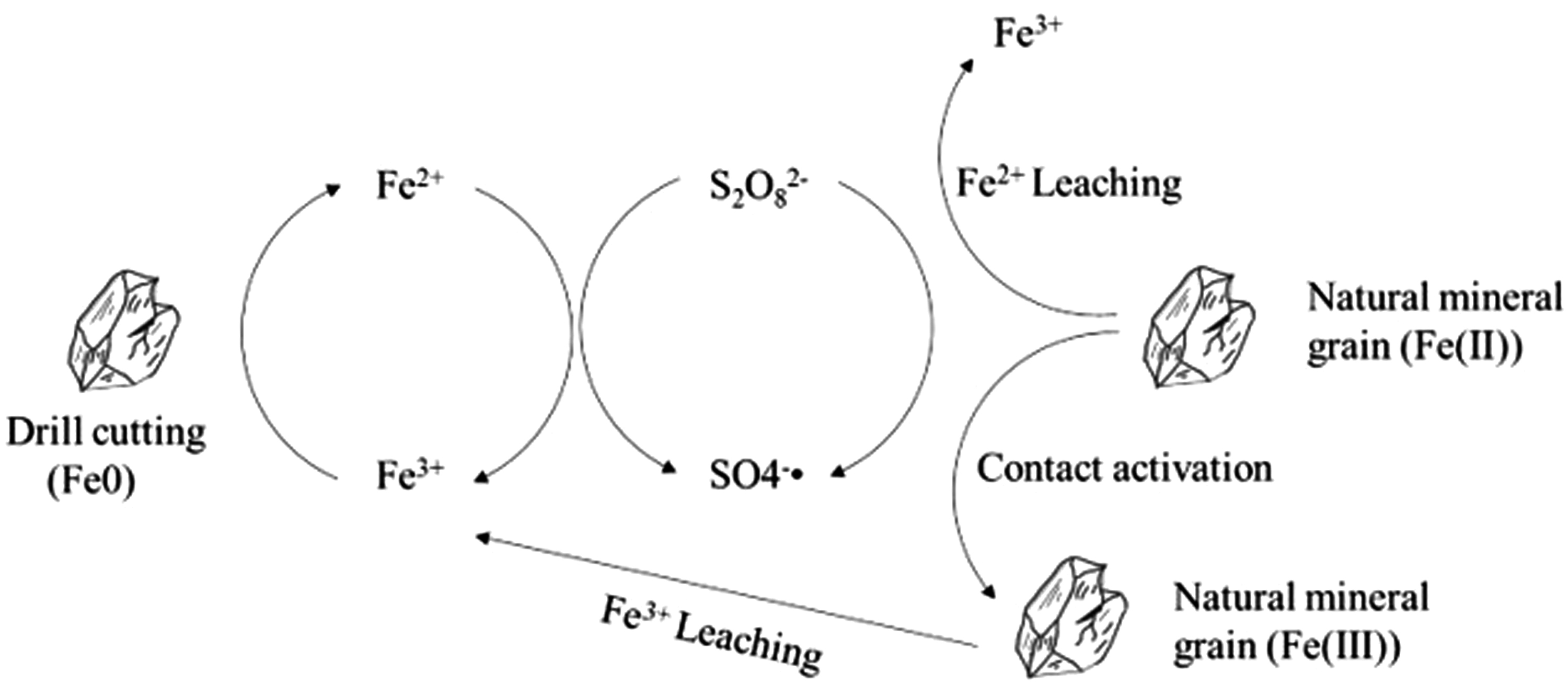
Simplified mechanism diagram of PS activated in SW-SDM.
To prove the deduction above, scanning electron microscope and energy dispersive spectroscopy (EDS) were used to test the samples of original SW-SDM and SW-SDM after treatment, as shown in Fig. 4a–d.

Figure 4a and b, show that a substance with an irregular shape was scattered around the surface of the soil particle, and the edge of the adhesion material seemed sharp. In the SW-SDM after treatment, the surface of the soil particle was much smoother compared with the sample without treatment, the material adherent on the surface of the soil was less than the prior one, and what still adhered to the particle became blunt. Therefore, part of the mineral debris was dissolved while PS activated by Fe ion was generated from Fe containing mineral degraded organic matter.
The EDS of SW-SDM also confirmed the above reasoning. Figure 4c and d) show, an intensity reduction of Fe peak while weight and atom proportion of Fe decreased from 2.11 and 0.76 to 1.12 and 0.49, respectively, according to the intelligent quantitative results of EDAX APEX platform, which means some of the Fe was consumed in the reaction, consistent with our hypothesis. Some other ingredients also changed. For example, the proportion of Ti (ingredient of Fe containing mineral) reduced from 2.73 (wt%) to 0.33 (wt%), C and O reduced from 19.82 to 39.56 (wt%), respectively, to 13.61 and 25.59 (wt%), respectively. A possible explanation is that carbons and mineral partly dissolved in the reaction like Fe matter. Therefore, the quantity of Ca was abnormal while its weight proportion surged from 13.49 (wt%) to 37.96 (wt%). The reason might be that dissolving CaCO3 released C and O, but PO42− and SO42− still made Ca2+ turn into sediment. As a result, the proportion of Ca increased instead of decreased.
Degradation pathway of BaP
To better understand the degradation of BaP with in situ Fe activated PS and determine whether the degradation pathway of natural minerals activating PS is the same as the traditional activated PS method, gas chromatography-mass spectrometry (GC-MS) technology was utilized for the qualitative analysis of oxidation intermediates. The chromatograms of the extracted samples suggest that multiple transformation products were formed during BaP degradation by sulfate radicals because of the appearance of new peaks compared with that of the blank control, whereas the characteristic peak of BaP was wiped.
According to a GC-MS library search, several organic compounds were detected at different stages of degradation, in contrast to the blank sample. A possible degradation pathway for BaP is proposed, as shown in Fig. 5.
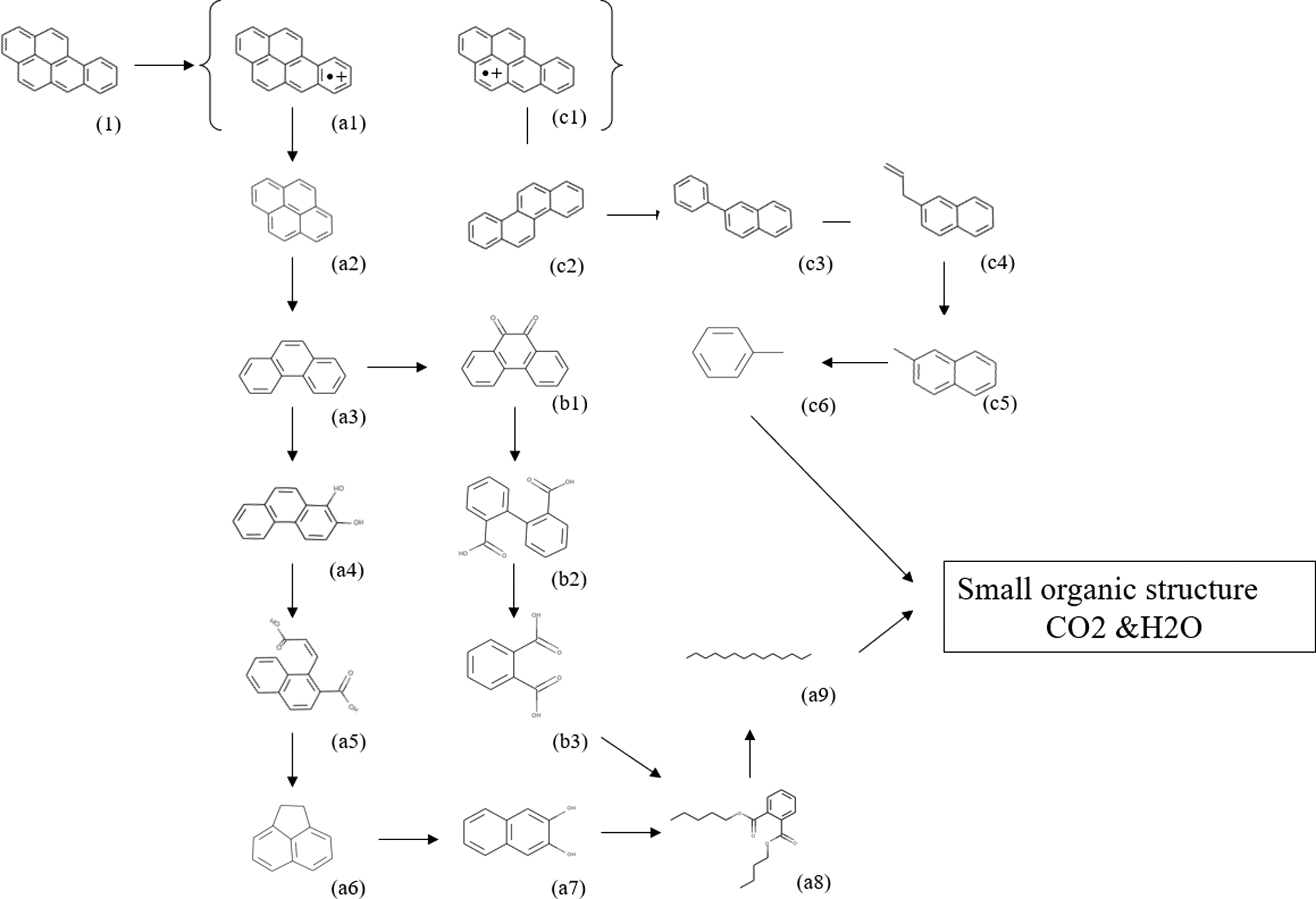
Proposed degradation pathway of BaP contained in SW-SDM, products
Generally, three ways exist for SO4−• to degrade organic pollutes, addition, hydrogen abstraction, and direct electron transfer (Lian et al, 2017), whereas direct electron transfer is more likely to occur with benzene ring (Zhao et al, 2017) (Fig. 6).

Direct electron transfer pathway for degradation of organic pollutants by SO4−• (Sharma et al, 1997).
This work hypothesized two intermediate products might persist at the beginning of degradation chain when direct electron transfer takes place at a different ring of BaP (Keum et al, 2021), and then degradation pathways are derived from compounds (a1) and (c1).
In pathway a, isolated BaP ring may be attacked by SO4-• first. Oxidation and ring opening occur at this ring in this process. As a result, intermediate products such as pyrene (a2, m/z = 202) form. Likewise, pyrene turns to phenanthrene (a3, m/z = 178) with SO4−• direct electron transfer. According to the degradation mechanism described in an earlier study (Gao et al, 2013; Wang et al, 2020), this hypothesized two unstable materials that were not easy to detect with GC-MS. Therefore, the following reaction can be that 1,2-dioxygenation like method takes place at the ring of phenanthrene, while the product in this process is hypothesized as 1,2-dihydroxyphenanthrene (a4, m/z = 210). The double bond between two hydroxyl groups breaks and then produces CVNA2 (a5, m/z = 244), CVNA2 should change as acenaphthene (a6, m/z = 154) while acenaphthene turns to 2,3-dihydroxynaphthalene (a7, m/z = 160) in the way of deoxygenation like method, and then the opening ring changes into dibutyl phthalate (a8, m/z = 278).
In pathway b, phenanthrene generates another product called 9,10-phenanthrenedione (b1, m/z = 208) (Lee et al, 2020; Nguyen et al, 2020) and then turns into 2,2′-diphenic acid-TMS derivative (b2, m/z = 242) (Hidayat and Yanto, 2018) and phthalic acid (b3, m/z = 166). Pathways a and b converge on dibutyl phthalate (a8, m/z = 278) (Guo et al, 2022) by transforming into straight chain aliphatic hydrocarbon such as tetratetracontane (a9, m/z = 618), and aromatic hydrocarbons with complex structures can finally be oxidized to small organic structures, H2O and CO2.
In addition, when SO4-• attacks and oxidizes another benzene ring of BaP, chrysene, 5,6-dihydro- (c2, m/z = 230) (Rachna et al, 2019), naphthalene, 2-phenyl- (c3, m/z = 204) (Rachna et al, 2018), 2-Allylnaphthalene (c4, m/z = 168), 2-Methylnaphthalene (c5, m/z = 142), and simple toluene (c6, m/z = 92) may be harvested. Moreover, an intermediate product with molecular structure of degradation pathways a, b, and c ultimately transforms into small organic matters, H2O and CO2, and aromatic hydrocarbons such as BaP partly mineralize successfully.
Conclusion
In this article, the effect of in situ Fe on activating PS degrades refractory organic BaP, and different forms of Fe, such as mineral Fe and Fe scraps as activators, persistently react with PS to generate sulfate radicals. Then, sulfate radicals oxidize macromolecular organic matter into simple compounds, CO2 and H2O, and can remove nearly half of the BaP in the sample without any Fe addition. Moreover, a possible degradation pathway is proposed based on the intermediate products detected during the BaP oxidation of radicals. Utilizing Fe in solid waste as an activator can reduce the additional dosage of Fe and strengthen its degradation. This article provides a new approach for the sustainable remediation of PAHs in SW-SDM.
Footnotes
Authors' Contributions
B.W.: conceptualization, funding acquisition, resources, supervision, validation. S.L.: conceptualization, investigation, methodology, writing original, writing—review and editing. C.D.: investigation, methodology, data curation, formal analysis. W.M.: methodology, writing—review and editing.
Author Disclosure Statement
No competing financial interests exist.
Funding Information
No funding was received for this article.