




Abstract
Heavy metal pollution has received increasing attention worldwide in recent decades. However, the characterization of heavy metal elements in coastal soils has been still poorly understood. In this study, eight metal elements Cd, Cr, Cu, Hg, Ni, Pb, Zn, and As were monitored in coastal soil samples, which were collected from Qingdao on the east coast of China, in 2019. The spatial distribution, pollution level, ecological, and health risks of heavy metals were then evaluated. The experimental results indicated that >50% of the sampling sites for Cd, Pb, Zn, and Hg exceeded the reference background values. In addition, the geoaccumulation index showed that 84%, 96%, and 92% of soil sample sites for Cd, Pb, and Hg were in pollution, respectively; both Cd and Hg had potential ecological risks with 50% and 22% in mild potential ecological risk, 37% (Cd) and 6% (Hg) in moderate potential ecological risk, and <10% the serious potential ecological risk, respectively. Furthermore, the averages of hazard index for all the elements were <1 indicated that the health risks for all eight heavy metals were in low level. Finally, compared with the data of 10 years ago, the concentrations, enrichments, and ecological risks of Pb increased fastest with 17%, 150%, and 17%, respectively. This indicates that with the rapid economic growth of Qingdao, the controlling of Pb in soil should be implemented with a high priority in the near future.
Introduction
Heavy metal pollution in soil has attracted widespread attention and has been listed as a priority for monitoring and controlling pollutants because the contamination by heavy metals is one of the most significant threats to the ecosystems and the environment, as well as human health (Lacarce et al, 2012; Lequy et al, 2017; Liu et al, 2018; Marchant et al, 2017; Su et al, 2022; Toth et al, 2016; Zhao et al, 2021). The previous report conducted by the Chinese government indicated that the soil has been severely polluted due to human activities in the industrial and agricultural sectors (Xu et al, 2021).
In addition, a national scale review study has revealed that the heavy metal pollution and associated risks in industrial regions are more severe than those in agricultural regions, whereas 80% of industrial and domestic pollutants are originated from urban areas covering <2% of the earth surface only (Yang et al, 2018). Xu et al (2021) showed that the concentrations of heavy metals in the coastal industrial areas of China were higher than the average level of Chinese urban regions (Wang et al, 2012; Yuan et al, 2021), and indicated that the health risks associated with soil heavy metal pollution in the coastal areas would keep increasing with economic growth, implying a correlation between soil heavy metal pollution and economic development.
In 1978, the first Special Economic Zones were established in four coastal cities (Shenzhen, Zhuhai, Shantou in the Guangdong Province, and Xiamen in the Fujian Province) in China (Jian, 1985). Owing to the rapid industrialization and urbanization, heavy metals are being accumulated in the soils in these areas and, therefore, more assessment of heavy metals in soils should be conducted in these regions (Zhang et al, 2014). Qingdao, as an important economic center and coastal city in eastern Shandong Province, is also one of famous tourist destinations. With the rapid expansion of the city and economic development in recent years, heavy metal pollution in Qingdao from human activities such as coal burning, motor vehicles, and industry has attracted attention. However, few studies with comprehensive and systematic analysis of the distribution of the heavy metals in the soils of Qingdao especially in terms of ecological risk and health risk have been reported (Li et al, 2020).
This study aimed to assess the pollution levels and associated risks of heavy metals in the soils of Qingdao, Shandong Province. A total of 121 soil samples from different sites were collected and eight heavy metal elements (HMEs), including Cu, Cr, Ni, Zn, Pb, Cd, As, and Hg, were analyzed. Based on the obtained data, we evaluated the heavy metal pollution levels in the soils of Qingdao and the spatial distributions of these heavy metal were also discussed.
In addition, the potential health, ecological risks, and the health risk for adults and children caused by heavy metals in the contaminated soils have been evaluated. Finally, we compared the heavy metals data in the soils of Qingdao with those of 10 years ago and assessed the changes of geoaccumulation index, ecological risk, and health risk. This study was the first time to compare the pollutions, ecological risks, and health risks of eight HMEs in the same region using two sets of soil data with a 10-year interval, providing a comprehensive picture of the changes in the soil quality of a coastal city with economic development.
Materials and Methods
Sampling and analytical methods
A comprehensive analysis of soil types, topographical features, and landscape features was conducted in May–June 2019. Total of 121 sampling sites were selected (Fig. 1), and a handheld Global Positioning System was used to record spatial information at each sampling point. Following 10 × 10 m within the “plum-shaped” clothing of five sample points, a nonmetal sampler was employed to take 0–20 cm of surface. Each of sample point collected about 200 g of soil, then transferred and well mixed in a clean self-sealed plastic bag (total 1 kg). After the collected soil samples were naturally dried, the foreign objects such as gravel and plant residues were screened out by a 0.25 mm sieve and the samples were stored in a bag for further analysis.

Study area and sampling sites for soils.
To quantify the heavy metals, the microwave with a typical concentrated acid mixture of HNO3-HF-HClO4 was used to digest the soil samples, then the concentrations of Cu, Cr, Ni, Zn, Pb, and Cd were determined by Inductively Coupled Plasma Mass Spectrometry (ICP-MS) coupled with iCAP RQ (Thermo Fisher, USA), and the concentrations of As and Hg were measured by Atomic Fluorescence Spectrometer (AFS-8220; Beijing Titan Instruments, China). For Cu, Cr, Ni, Zn, Pb, and Cd, the analyses and quality assurance/quality control (QA/QC) followed the method of HJ803-2016 (MEP, 2016), whereas As and Hg followed the method of HJ680-2013 (MEP, 2013) and GB/T22105.1-2008 (MEE, 2008), respectively.
Modification of contamination factor and geoaccumulation index
The pollution level of heavy metals in the soil was evaluated using the previously reported pollution index (Marrugo-Negrete et al, 2017). Contamination factor (CF) [Eq. (1)] represents the ratio of the measured concentration of the HMEs in the soil (Cn) to the background concentration of the element in Shandong soil (
where CF is single factor pollution, and it will be considered as enrichment upon CF >1, and loss with CF <1, Supplementary Table S2 listed the more detailed categorization for MCF.
Furthermore, the geoaccumulation index (
The pollution classification criteria for
Classification Criteria for the
Potential ecological risk assessment
Hakanson potential ecological risk index (
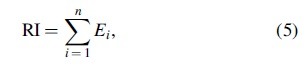
where Tn is the toxicity coefficient of the heavy metal, and Tn of Cu, Cr, Ni, Zn, Pb, Cd, As, and Hg were set with 5, 2, 5, 1, 5, 30, 10, and 40, respectively (Chai et al, 2017; Jamshidi-Zanjani and Saeedi, 2013). Both of Hakanson potential ecological risk index (
Health risk assessment
The health risk assessment model developed by the US Environmental Protection Agency (USEPA) was used to assess the noncarcinogenic and carcinogenic effects on humans exposed to heavy metals. Considering the differences in vulnerability of different age groups, this study divided the population into two main groups: adults and children. In general, individuals are exposed to hazardous contaminants through three pathways: oral ingestion, inhalation, and dermal absorption, which can be estimated according to the Exposure Factors Handbook (USEPA, 1997). The average daily intake (ADI) was calculated using the following equation (USEPA, 1989):
Ingestion:
Inhalation:
where ADI is the average daily intake (mg/kg-day), Cn is the heavy metal concentration in a particular exposure medium (mg/kg),
Dermal absorption:
where
The noncarcinogenic risk was assessed by calculating hazard quotient [HQ, refer to Eq. (9)] values (Yang et al, 2018). For a site contaminated by multiple heavy metals, a HI [refer to Eq. (10)], which sums up HQ for each heavy metal, was applied to assess the overall noncarcinogenic risk. When HQ >1.0 means that the uptake of soil through ingestion, inhalation, or dermal absorption may result in serious health risks, whereas the exposed population would be assumed with no potential risk when HI is below the unity.
where
Results and Discussions
Characteristics of heavy metals in soil
Table 2 shows the concentrations of HMEs identified in all the soil samples. Based on the median concentrations of Cd, Pb, Zn, and Hg, >50% of the sampling sites for these four HMEs exceeded the reference background values, and the average concentrations of Cd, Pb, Cu, Zn, and Hg even exceeded the reference soil background value by 1.9, 1.7, 0.24, 0.84, and 4.0 times, respectively, which indicated a trend of enrichment in the topsoil (Table 2). Especially, among these five elements, soils in industrial regions were more severely polluted by Pb, Cd, and Hg, which was consistent with the previous study (Yang et al, 2018); therefore, this suggested that heavy metal pollution could mainly come from industrial in Qingdao.
Characteristics of Heavy Metals Identified in the Soils (mg/kg)
CV, coefficient of variation; SD, standard deviation.
In addition, it has been reported that the three HMEs is one of the big three heavy metal poisons, but the influence of any essential biological function for these three heavy metals has not still be known (Wuana and Okieimen 2011), whereas Cd and Hg are the most polluted HMEs in China (Ren et al, 2022). The average concentrations of Pb, Cd, and Hg for surface soils worldwide are 32 mg/kg (Kabata-Pendias and Pendias, 2001), 0.36 mg/kg (Kubier et al, 2019), and 0.047 mg/kg, respectively. It clearly shows that both Pb and Hg concentrations in Qingdao exceeded the world average by about a factor of one. In addition, the concentration of Pb in our study also exceeded the average of China Urban area, whereas the concentrations of Cd and Hg were less than the averages of China Urban area (Wang et al, 2012; Yuan et al, 2021).
Therefore, among all the identified heavy metals, the higher priority should be to control the level of Pb in Qingdao soil. It is interestingly noted that the concentrations for all of these three elements were less than the average values of the coastal development areas by 25% (Pb), 80% (Cd), and 67% (Hg), respectively (Xu et al, 2021). These results indicated that Qingdao's soil pollution was lower than that of other coastal cities in China.
The coefficient of variation (CV) could reflect the average degree of variation for each sampling location. In this study, the CV value was 32% for Ni in the soil, representing little spatial variation, whereas the concentrations of Cu, Zn, and Hg showed larger spatial changes, with CV ranging from 84% to 117%. These indicated that the concentrations at the sampling locations fluctuated greatly, which could be affected by external factors (i.e., human activities). The spatial distributions of heavy metal allow the assessment of possible pollution sources by visually distinguishing the areas with high pollutant concentrations for each element. Using the Kriging interpolation, the spatial distribution patterns of the eight selected heavy metals were obtained in Fig. 2. Figure 2 shows that urban soils could be mainly influenced by industrial production and transport activities.
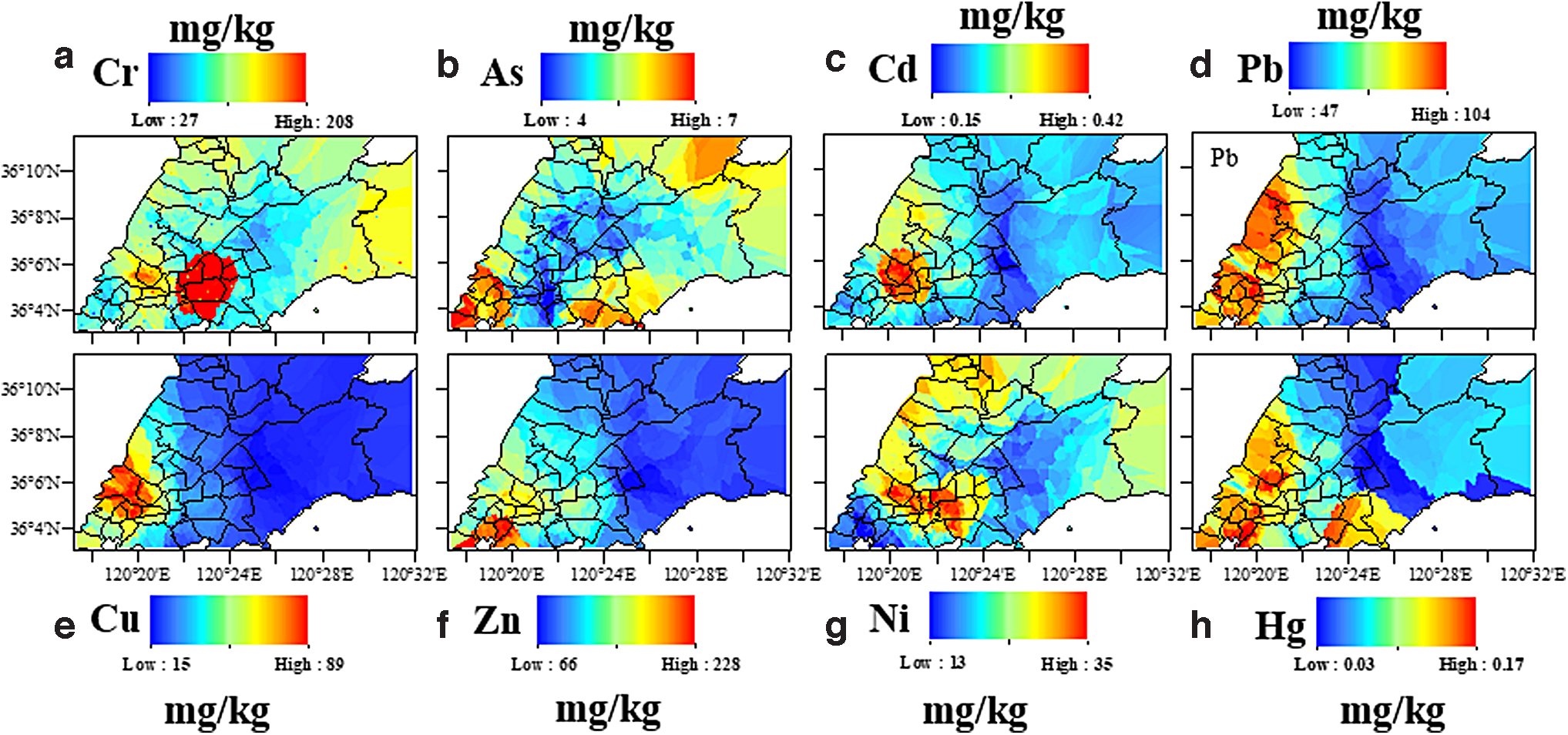
The spatial distribution patterns of the eight heavy metals' concentrations (mg/kg).
In addition, whereas As, Pb, and Hg represented the high concentrations in the southwestern region, Pb, Hg, and Cu were high in the western region. It might be because the western and southwestern coastal areas are the main old industrial layout of the city, and quite number of docks, railways, roads, chemical plants, thermal power plants, and power plants are all located in this area. Although some of the enterprises have been relocated, the overall influence from human activities was still quite large; for example, Zn represented a high concentration in the southwestern bay of Qingdao, and As and Hg also had high concentrations in the southeastern bay of Laoshan. This suggested that the intensive tourist traffic transportation could result in a higher heavy metal pollution.
Comprehensive evaluation of soil pollution
Figure 3a shows that the CF averages of Cd, Pb, Cu, Zn, Ni, and Hg are greater than 1, which indicates that all these elements were enriched in soil. Although the concentrations of Cd, Pb, and Hg from most of the sampling sites exceeded the background values of soil (Table 2), the concentrations of Cr, As, and Ni were lower than the background values. The MCF values showed that 49% of soil sampling sites exceeded 1.5 (Supplementary Fig. S1), indicating the point source pollution at those sites (Supplementary Table S2). Supplementary Figure S1 also shows that 21% of soil sample sites were classified as low and moderate degree of contamination, whereas 7% of soil sample sites were classified as high degree of contamination. In addition, the geoaccumulation index (
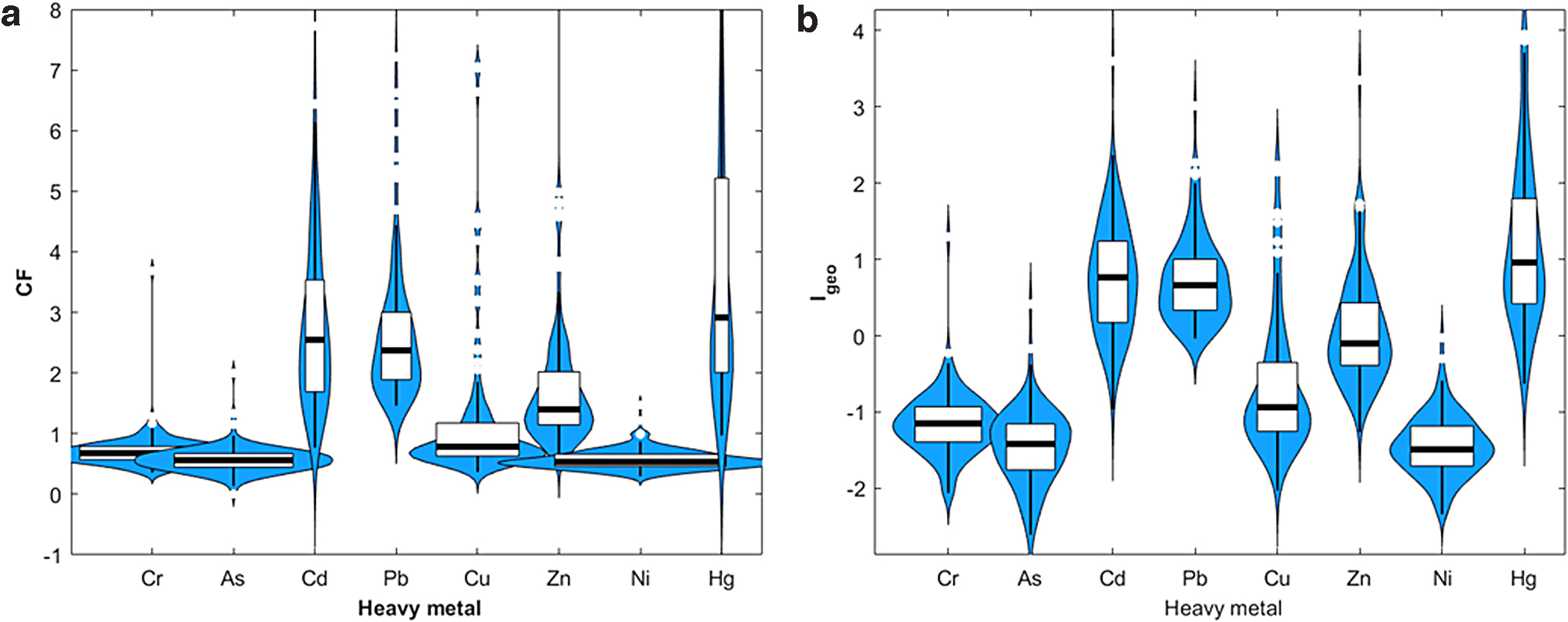
Single factor pollution
As shown in the Figs. 3b and 4, the

The proportions of geoaccumulation levels of each heavy metal element in all sampling sites. (Class represents geoaccumulation index according to Supplementary Table S2; percentage of 0% is not shown).
Comprehensive evaluation of potential ecological risk
To access the effects of heavy metals on ecological risk, Hakanson potential ecological risk index (

Values of single potential ecological risk (Ei) for heavy metals in the soil. (Class represents potential ecological risk index according to Supplementary Table S3).
The RI was calculated by the Ei of the identified eight HMEs (shown in Supplementary Fig. S2). It indicates that 45% of soil sample sites had potential ecological risk, whereas 37% and 7% of soil sample sites were moderate risk and considerable risk, respectively, and only 1% of soil sample sites reached to very high risk. In addition, it should be noted that the ratio of Ei to RI could indicate the influence level from different HMEs (Supplementary Fig. S3). Supplementary Figure S3 shows that Cd could be the most important elements affecting the potential ecological risks (52%), followed by Hg (27%) and Pb (9%). However, Cr, As, Cu, Zn, and Ni had less impact on potential ecological risks with the ratios <5%. As mentioned earlier that the influence of heavy metals on the potential risks was not that high; however, the toxic and highly polluted heavy metals might still have the greatest effect on the potential ecological risk (e.g., Cd).
Health risk assessment
Table 3 lists the averages of HQ and HI in relation to ingestion, dermal contact, and inhalation for identified eight heavy metals in the soil samples, and the cumulative probability distributions of the HIs of heavy metals for adults and children were also calculated (Fig. 6). As shown in Table 3 and Fig. 6, the mean values of HI for all the elements were <1, which revealed that the health risks were low. The HI of heavy metals for children and adults were in the following order: Cr > As > Ni > Pb > Cd > Cu > Hg > Zn. Among them, As and Cr caused the highest health risks, Cu, Hg, Pb, and Zn did not have much effects on both adults and children.

Cumulative probability distribution of the HI of heavy metals for
Evaluation of Health Risks for Different Heavy Metals in Surface Soils
In addition, Table 3 and Supplementary Fig. S4 also shows that
However, there was not much difference between adults and children for the probability of HIs, which might be due to the minimal health risks caused by dermal absorption. It can be concluded that As and Cr could be the main sources of potential noncancer risks brought by the inhalation of soil, which are consistent with the most regions of China (Yang et al, 2018). Therefore, we should pay attention to the potential health risks caused by the possibility of incidentally inhaled soil.
Comparisons of the identified eight HMEs with 10 years ago
Previous study (Xu et al, 2021) have represented that the concentrations trends of Cd, As, Hg, Pb, and Cr in soil showed an inverted U-shaped relationship with economic growth, and the health risks associated with the heavy metal pollution in soil kept increasing with the economic growth. It has been reported that the total GDP in Qingdao has been doubled from 2009 to 2019 according to the Shangdong Statistical Yearbook; however, the concentrations and health risks of Cd, Hg, and Pb increased even As and Cr decreased in our study.
The comparisons of concentration, geoaccumulation index, ecological risk, and health risk for eight HMEs between this study and that of 10 years ago in the same area are shown in Table 4. It shows that the concentrations of Pb, Cd, and Hg increased 17%, 15%, and 13%, respectively, and the enrichments of three elements also increased with the
Comparisons of Heavy Metal Elements in Urban Regions from Different Research Studies and Periods
Data were extracted only from the average of 47 sites in the same region with this study.
Conclusions
A total of 121 soil samples from different sites located in a coastal economic development city (Qingdao) of China were analyzed for 8 HMEs. Based on the obtained data, the enrichment, pollution level, ecological, and health risks of heavy metals were then evaluated; in addition, we also compared their concentrations, ecological, and health risks with those from 10 years ago. The data indicated that Cd, Pb, Cu, Zn, and Hg had an overall trend of enrichment in the topsoil. Cd, Pb, and Hg in most soil sample sites were classified as polluted, and among them, the Hg pollution was considered as the most serious, with 14% and 15% of the samples classified as moderately and heavily polluted, respectively. Almost half of soil sample sites had potential ecological risk, which are mainly contributed from Hg and Cd.
Based on the health risk assessment, although As and Cr might cause the highest health risks for both children and adults, which could be mainly affected through inhalation, Pb, Cu, Zn, and Hg would affect the children health through the pathway of oral ingestion, and Pb, Zn, and Hg could affect the adult health through the pathway of dermal absorption. Compared with the data of 10 years ago, the concentrations, enrichments, and ecological risks of Pb, Cd, and Hg have been increased. Although As and Cr of health risks decreased by 159% and 50%, respectively, the health risks for other elements increased 46–183%. Overall, this study provides a comprehensive study of soil heavy metal pollution, ecological risks, and health risks, which could provide a scientific picture for the ecological management of coastal urban soils.
Footnotes
Authors' Contributions
Conceptualization, resources, writing—original draft, writing—review and editing, and funding acquisition by C.Z. Methodology, software, formal analysis, and investigation by D.B. Data curation and validation by Q.Y. Formal analysis, investigation, and project administration by C.Y. Visualization and supervision by S.L.
Author Disclosure Statement
No competing financial interests exist.
Funding Information
This research was funded by the National Natural Science Foundation of China (71303140).

References
Supplementary Material
Please find the following supplemental material available below.
For Open Access articles published under a Creative Commons License, all supplemental material carries the same license as the article it is associated with.
For non-Open Access articles published, all supplemental material carries a non-exclusive license, and permission requests for re-use of supplemental material or any part of supplemental material shall be sent directly to the copyright owner as specified in the copyright notice associated with the article.
