




Abstract
Organic dyes and heavy metals are major contaminants in water seriously threatening human lives. In this work, we designed and fabricated a chitosan (CS) and quinoa bran (QB) aerogel for the adsorption of Congo red (CR) and Cu2+. The ice-templated assembly method was introduced to fabricate CSQB aerogel. SEM, FTIR, XRD, TGA, BET, and XPS were applied to characterize as-prepared aerogel. The adsorption properties of CSQB aerogel for CR and Cu2+ were investigated in different conditions, including initial concentrations, temperature, pH, and contact time. The adsorption kinetics results indicated that the adsorption of CR and Cu2+ follows pseudosecond-order and pseudofirst-order models, respectively. The adsorption isotherm analysis indicated that the Langmuir isotherm gave a better fit for the adsorption of CR and Cu2+ compared with the Freundlich isotherm. According to the Langmuir isotherm, the maximum monolayer adsorption capacities of CSQB for CR and Cu2+ were 182.48 and 96.25 mg/g, respectively. Besides, its removal efficiency for CR and Cu2+ only decreased 14.47% and 16.97% after five cycles of adsorption–desorption experiments in reusability tests. Therefore, this study provides a low-cost, highly efficient, and recyclable strategy for removing organic dye and heavy metal from wastewater.
Introduction
Nowadays, organic textile dyes and toxic heavy metal ions are discharged into the water system from industries, which could bring about a major threat to the ecological balance and human health around the world (Mo et al., 2022). Among them, organic dyes are difficult to degrade; they not only pollute the water but also accumulate in the organism through the water cycle and food chain, causing the somatic cells of the contact to be mutagenic, carcinogenic, and teratogenic, seriously threatening the organism physical health (Wu et al., 2018).
Congo red (CR) is a typical azo dye, and its metabolite benzidine is recognized as a human carcinogen (Li et al., 2021). Owing to its complex structure, CR is difficult to biodegrade. For these reasons, the removal of CR from effluents is a major concern. Heavy metal pollution has become a particularly serious environmental problem, because these pollutants can be accumulated in living organisms throughout the food chain, eventually leading to adverse effects on human beings (Jung et al., 2019; Zhou et al. 2022).
Copper is one of the most widely used toxic heavy metals and usually discharged from industrial effluents, and thus resulting in a large amount of Cu2+ appear in surface and underground water (Xing et al., 2015). Long-term drinking water with excessive copper may cause human vomiting, convulsions, and even death (Li et al., 2014).
In addition, under these conditions, removal of the accumulated Cu2+ is difficult, and the enzyme activity of microorganisms is inhibited, which also causes many adverse effects on the natural environment. Therefore, it is necessary to carry out research to find efficient, green, and safe ways to remove pollutants in water (Chen et al., 2016; Navarro et al., 2019; Parvin et al., 2019; Peng et al., 2017).
At present, the methods to remove dyes and heavy metals pollution in water mainly include adsorption (Peng et al., 2017; Wang et al., 2022), photocatalysis (Awfa et al., 2018; Mohajer et al., 2021), biological remediation (Wollmann et al., 2019), membrane filtration (Zhao et al., 2020), chemical precipitation (Azimi et al., 2017), etc. Among them, the adsorption method is favored by people due to its advantages, including simple operation, low cost, low pollution, and recyclability, especially its high efficiency when treating low-concentration wastewater (Far et al., 2020; Wu et al., 2014, 2021; Yu et al., 2017).
Aerogels have unique advantages in removing pollutants in water than traditional adsorption materials due to their ultrahigh specific surface area, high porosity, strong adsorption capacity, and stability (Fan et al., 2022). Chitosan (CS) is a natural linear polysaccharide composed of glucosamine and N-acetylglucosamine residues connected by β-(1, 4)-glycosidic bond.
It has excellent biocompatibility, renewability, and biodegradability, and can be used in wastewater treatment, drug carriers, food preservation, and other fields (Deng et al., 2017; Zhao et al., 2016). In recent years, chitosan-based aerogels have been widely used to treat contaminated wastewater (Tan et al., 2021; Vieira et al., 2021).
Quinoa is a kind of whole grain with high nutritional value. It is not only rich in protein, calcium, iron, zinc, vitamin E and other micronutrients, but also contains all essential amino acids (Vega-Galvez et al., 2010). It has the potential effect of improving people's health and preventing many diseases. However, eating quinoa with bran will have a bitter taste and hinder the absorption of certain nutrients. Therefore, as a by-product of quinoa processing, quinoa bran is usually discarded in most cases, which not only causes waste of resources, but also pollutes the environment (Verza et al., 2012).
In this work, the ice-templated assembly method was introduced to fabricate the chitosan–quinoa bran CSQB aerogel. The ice growth along a determined direction was observed, hence porous open channels were constructed, which can provide easy access for wastewater. The functional group of CSQB aerogel is efficient for adsorbing CR and Cu2+. Importantly, CSQB aerogel can be recycled, and large sample can be fabricated easily.
The structural properties of the CSQB aerogel were characterized first. Second, the adsorption capacities for the removal of CR and Cu2+ were investigated. The work provides a low-cost and efficient method for adsorbing CR and Cu2+ in wastewater, which can be used to adsorb other dyes and heavy metals.
Materials and Methods
Materials
Quinoa bran was obtained from Dulan County, Qinghai Province (China); chitosan, CR, sodium hydroxide (NaOH, >98%), hydrochloric acid (HCl, 36–38%), acetic acid (CH3COOH, 99% in purity), copper sulfate, and sodium diethyldithiocarbamate were purchased from Sinopharm Chemical Reagent Co. Ltd. All reagents were analytically pure.
Synthesis of the CSQB aerogel
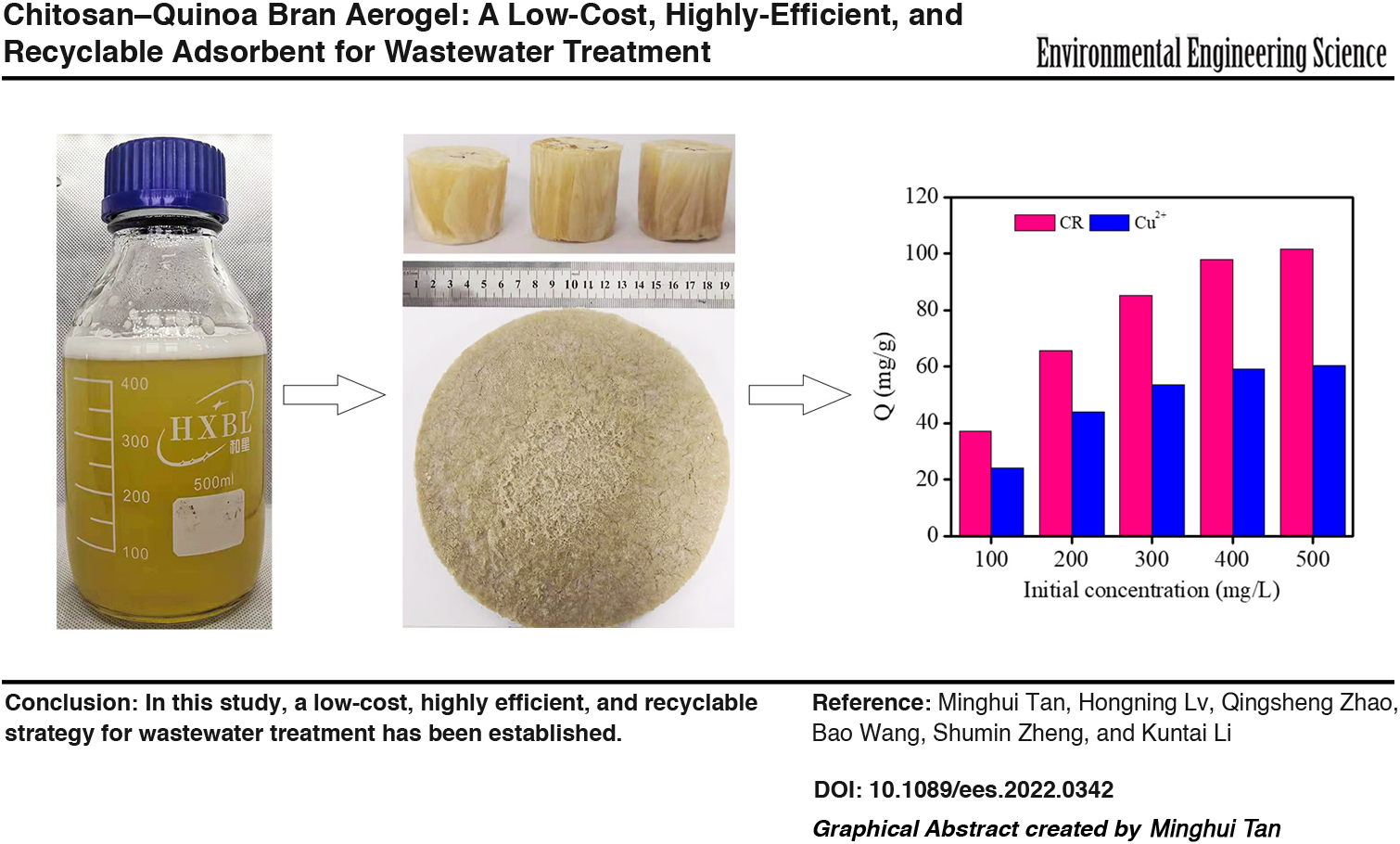
The CSQB aerogel was synthesized by the following method. First, 180 mg of chitosan and 10 mL of 2 wt% acetic acid solution were added into a flask, stirred for 30 min at 60℃. Then, 20 mg of quinoa bran was added to the chitosan–acetic acid solution and continued to stir for 1 h. The above homogeneous solution was transferred into a cylindrical polystyrene mold for freeze forming, and then dried in a vacuum-freeze dryer for 36 h. Finally, the freeze-dried composite was heated at 125℃ for 30 min, and the CSQB aerogel was obtained (Fig. 1a).

Characterization of the CSQB aerogel
The microstructure of the CSQB aerogel was observed by scanning electron microscope (SEM) (Merlin FE-SEM, Carl Zeiss, Germany). Fourier-transform infrared (FTIR) spectra were detected from 4,000 to 400 cm−1 on a Bruker FTIR spectrometer (TENSER 27; Bruker, Karlsruhe, Germany). The crystallization properties of CSQB were determined by X-ray diffraction (XRD, X'Pert Pro, PANalytical, The Netherlands) using Cu Kα radiation (40 kV and 40 mA).
The thermostable properties of the CSQB aerogel were determined by TG-DTA method in a nitrogen atmosphere at a heating rate of 10℃/min from 50 to 1,000℃. The elemental content and chemical species of the CSQB aerogel were analyzed using a Thermo ESCALAB 250 X-ray photoelectron spectrometer. The specific surface area of the CSQB aerogel was calculated from N2 adsorption–desorption isotherm conducted at 77 K by Quantachrome NOVA 3200e.
Adsorption studies
Ten milligrams of CSQB aerogel was added to 10 mL of a certain concentration (100 mg/L) of CR and Cu2+ solution. The adsorption process was carried out at 25℃, and the absorbance of the supernatant was determined by a UV-vis spectrophotometer for CR and an atomic absorption spectrophotometer with an airacetylene burner (AA-6300; Shimadzu, Japan) for Cu2+ after adsorption reached equilibrium. The effects of different factors (initial concentration, temperature, pH, and contact time) on the adsorption of CR and Cu2+ on CSQB aerogel were investigated.
For investigation of the effect of initial concentration on adsorption, the initial concentrations of CR and Cu2+ were varied from 100 to 500 mg/L, respectively. The effect of temperature on adsorption was evaluated under different temperature conditions (20–60℃). The effect of pH values was evaluated by adjusting the pH (CR: 4–10, Cu2+: 2–6) using 0.5 M HCl or NaOH solutions. The effect of contact time on adsorption was evaluated with different times (20–1,440 min).
After adsorption reached equilibrium, the samples were filtered, and the adsorption capacity Qt (mg/g) was calculated based on Eq. (1):
where C0 (mg/L) and Ce (mg/L) illustrate initial and equilibrium concentrations of CR and Cu2+ solution, respectively, V (mL) represents solution volume, m (g) is the mass of CSQB.
The renewability is an important property to evaluate the application value of an aerogel. After adsorption experiment, CSQB aerogel was eluted with 0.05 M NaOH solution for 24 h, then washed with deionized water and dried in vacuum freezing drying oven. The activated CSQB aerogel was then used for the next adsorption experiment of CR and Cu2+ directly. The adsorption performance of the desorption aerogel was tested and repeated five times.
Results and Discussion
Characterization of CSQB
Figure 1b–d illustrates the large-scale fabrication and microstructure characterization of CSQB aerogel. Due to the facile strategy of the preparation process, aerogel with a diameter of 10 cm and a thickness of 3 cm can be easily fabricated (Fig. 1c). From the SEM image (Fig. 1d), the CSQB aerogel exhibits a loose and porous structure, which may make an increasing accessible surface area for CR and Cu2+ adsorption.
FT-IR spectroscopy shows functional groups of chitosan, quinoa bran, and CSQB aerogel (Fig. 2a ). The absorption peaks at 3,437 and 2,918 cm−1 correspond to the vibrational peaks of O-H and aliphatic C-H, respectively (Ziaei et al., 2014). CSQB showed new vibrational absorption peaks at 1,648 and 1,478 cm−1 due to the C = N bond formed by the reaction between -NH2 from chitosan and -C = O from quinoa bran cellulose (Papageorgiou et al., 2010). The XRD patterns of CSQB (Fig. 2b) have diffraction peaks at 13.8° and 33.2°, corresponding to the (110) and (400) crystal plane of quinoa bran cellulose, and the peak at 20.7° corresponding to the (200/220) crystal plane of chitosan (Ahmed et al., 2022). These results of FTIR and XRD indicate that chitosan and quinoa bran cellulose were crosslinked successfully. According to the TG-DTG curve, the CSQB aerogel has two stages of weight loss between 50℃ and 1,000℃ (Fig. 2c).

The first stage of weight loss occurring at 50–200℃ was related to the loss of free and bound water in the CSQB aerogel (Hu et al., 2016), and the weight loss ratio was 5.5% (w/w). The second stage of weight loss occurring at 200–600℃ was attributed to the decomposition of the CSQB aerogel, and the weight loss ratio was 60% (w/w). The DTG curve shows that the maximum weight loss rate was −7.86%/min observed at the temperature of 294℃. To further understand the hierarchical pore structure of CSQB, the N2 adsorption–desorption test on CSQB aerogel was performed (Fig. 2d, e).
The results show that CSQB aerogel exhibits a IV isotherm with an H2-type hysteresis loop (IUPAC classification). The specific surface area (1.65 m2/g), total pore volume (6.03 × 10⁻³ cm3/g), and pore size (14.58 nm) are reported, as shown in Table 1, indicating that CSQB is mainly a mesoporous structure.
BET and Pore Parameters of Chitosan–Quinoa Bran Aerogel
BET surface area.
Total pore volume.
CSQB, chitosan–quinoa bran; CR, Congo red.
The surface chemical composition of CSQB aerogel can be further determined by XPS analysis. Figure 3 shows the XPS total survey (Fig. 3a), C 1s (Fig. 3b), N 1s (Fig. 3c), and O 1s (Fig. 3d) spectrum of CSQB aerogel. It can be seen from Fig. 3b that there are four binding energies of C at 283, 283.7, 284.8, and 286.2 eV, which are assigned to (C*H2–H2)n, C-C, sp2-C 1s, and C-O, respectively (Gupta & Khatri, 2017). For the N 1s XPS spectrum, there are two binding energies of N 1s corresponding to C-N (397.4 eV) and -NH3 (397.8 eV).
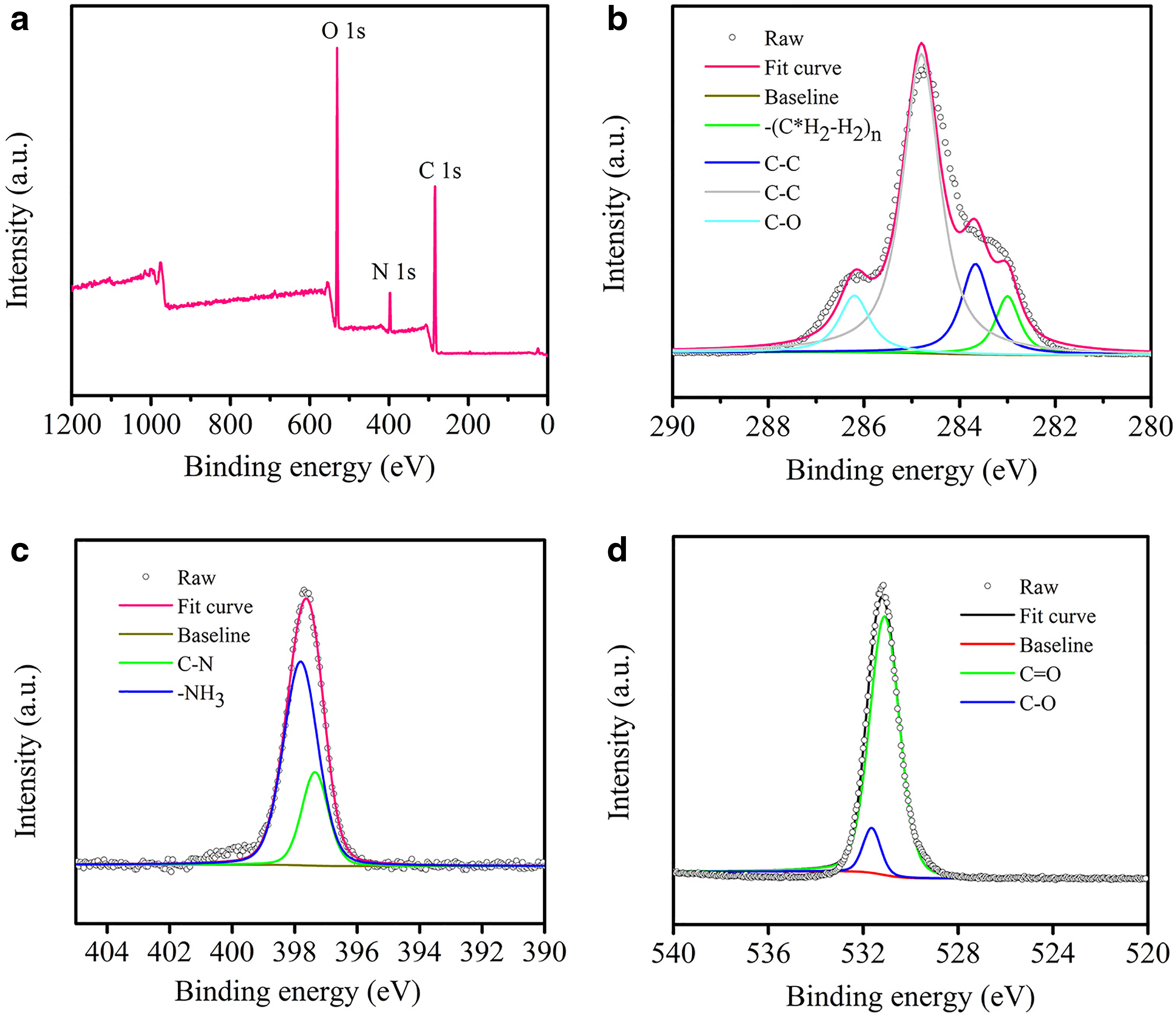
High-resolution XPS analysis of CSQB:
As for the O 1s XPS spectrum of CSQB, there are two peaks at 531 and 531.65 eV, which are attributed to the C = O and C-O, respectively. The element analysis of CSQB aerogel is shown in Table 2. From the data observed in the table, it can be seen that the proportions of C, N, and O atoms in CSQB aerogel are 60.18%, 7.86%, and 31.96%, respectively.
XPS Elemental Analysis of Chitosan–Quinoa Bran Aerogel
Adsorption behavior of CSQB for CR and Cu2+
Effect of initial concentration
Figure 4a shows the effect of initial concentration of CR and Cu2+ on adsorption capacity of CSQB aerogel. It can be seen from the figure that in the concentration range of 100–400 mg/L, the adsorption capacity of CSQB aerogel is positively correlated with the initial concentration of CR and Cu2+. The higher the initial concentration, the greater the diffusion driving force and the higher the adsorption site utilization of CSQB aerogel.

Effect of initial concentration
When the initial concentration of CR and Cu2+ is > 400 mg/L, the adsorption capacity of CSQB aerogel gradually tends to be saturated, which is due to the saturation of the adsorption sites on the aerogel (Kumar et al., 2013). When the initial concentration is 500 mg/L, the adsorption capacities of the CSQB aerogel for CR and Cu2+ are 101.74 and 60.44 mg/g, respectively.
Effect of temperature
It can be seen from Fig. 4b that with the increasing temperature, the adsorption capacity of CSQB aerogel for CR and Cu2+ gradually increased, indicating that the adsorption process was an endothermic reaction. When the temperature was 60℃, the adsorption capacity of CSQB for CR was the largest, which was 61.98 mg/g. While the adsorption capacity of CSQB for Cu2+ reached the maximum at 50℃, which was 63.77 mg/g.
With the increase of temperature, the molecular mobility and permeability of adsorbate molecules can be improved due to the decrease of solution viscosity (Dragan and Apopei Loghin, 2013). At the same time, more adsorbate molecules have enough energy to interact with the active adsorption sites on the absorbent surface with temperature rise (Shi et al., 2016).
Effect of pH
pH can effectively affect the surface charge distribution of CSQB aerogel and the chemical properties of CR and Cu2+, which is one of the factors that determine the adsorption capacity of CSQB aerogel. Since Cu2+ will precipitate at pH >6 (Sahraei et al., 2017), the pH range for Cu2+ was set at 2–6. It can be seen from Fig. 4c that the adsorption capacity of CSQB aerogel for CR gradually decreases with the increase of pH in the range of 4–10, and the adsorption capacity reaches the maximum at pH 4.0, which is 38.5 mg/g.
This is due to the protonation of the amino groups in CSQB to form -NH3+ group at lower pH, which effectively attract negatively charged CR dye. With the gradual increase of pH, the degree of amino protonation of CSQB decreased, and the adsorption capacity for CR gradually decreased. For positively charged Cu2+, the amino protonation degree of CSQB decreased with the increase of pH, which was favorable for the adsorption of Cu2+. The maximum adsorption capacity was 69.84 mg/g at pH 5.0 (Fig. 4d).
Effect of contact time
The effect of time on the adsorption capacities of the CSQB for CR and Cu2+ is shown in Fig. 4e. At the initial stage of adsorption, the adsorption capacity of CSQB aerogel for CR and Cu2+ increased rapidly, and then the growth rate became gentle. When the adsorption time reached 12 h, the adsorption capacity gradually became stable.
The reason for this phenomenon is that at the initial stage of adsorption, the aerogel has a loose structure with a large number of pores inside, and the CR and Cu2+ have a high probability to contact the active sites of the aerogel. After that, the adsorption rate gradually decreased, because the active sites of the aerogel had been occupied by CR and Cu2+, which hindered the further entry of CR and Cu2+, and the adsorption rate slowed down until equilibrium was reached (Zhang et al., 2018).
Adsorption kinetics
Adsorption kinetics mainly studies the relationship between adsorption capacity and time, which can reveal the factors affecting adsorption rate. The adsorption kinetics of CR and Cu2+ on CSQB are investigated by pseudo-first-order [Eq. (2)] and pseudo-second-order [Eq. (3)] kinetic models, which can be used to study the possible adsorption mechanism.
where Qt and Qe (mg/g) are the adsorption capacity at time t (min) and adsorption equilibrium, respectively; k1 (min−1) and k2 (g/[mg. min]) are the rate constants.
The linear fitting results and calculated parameters are shown in Fig. 5a and b and Table 3, respectively. The correlation coefficients for CR of the pseudosecond order (R2 = 0.9814) are higher than those of the pseudo-first-order (R2 = 0.8913), suggesting that the adsorption process of CR onto CSQB follows pseudo-second-order kinetic model, while the opposite situation for Cu2+is observed. Moreover, the calculated Qe for CR from the pseudo-second-order model (60.2047 mg/g) was closer to the experimental value (56.7181 mg/g) than that obtained from the pseudo-first-order model (49.3136 mg/g).

Adsorption kinetics (pseudofirst-order kinetic
Kinetic Model Parameters for Congo Red and Cu2+ Adsorption onto Chitosan–Quinoa Bran
While for Cu2+, the calculated Qe from the pseudofirst-order model (65.5308 mg/g) was closer to the experimental value (49.4555 mg/g) than the data from the pseudosecond-order model (71.4796 mg/g). The above results indicate that the adsorption behavior of CR and Cu2+ onto CSQB is governed by chemisorption and physisorption, respectively (Cechinel et al., 2014).
Adsorption isotherms
At a certain temperature, when the adsorption reaches equilibrium, the relationship between the equilibrium concentration (Ce) of the adsorbate and the adsorption capacity (Qe) of the adsorbent can be expressed by adsorption isotherm. The adsorption isotherm can reflect the surface properties and pore size distribution of adsorbent, and the interaction between adsorbent and adsorbate, thereby further revealing the adsorption performance of the adsorbent.
Different isotherm adsorption equations such as Langmuir, Freundlich, and Temkin are used to describe the isotherm adsorption process (Tan et al., 2015). In this study, the Langmuir and Freundlich isotherm equations were used to simulate the experimental data. The Langmuir model is derived based on the ideal monolayer adsorption theory, while the Freundlich model mainly describes the adsorption equilibrium of the multilayer adsorption process (Peng et al., 2018).
The corresponding mathematical equations are as follows:
where Ce (mg/L) is the equilibrium concentration of CR and Cu2+, and Qe (mg/g) is the equilibrium adsorption capacity of CR and Cu2+, Qm (mg/g) is the saturated adsorption capacity, KL is the Langmuir constant; KF and 1/n are the Freundlich parameters representing the adsorption capacity and strength, respectively (Song et al., 2017).
The fitting results of adsorption isotherms of CR and Cu2+ by CSQB are shown in Fig. 5c and d and Table 4. It is found that the Langmuir models are more suitable to describe the adsorption process of CR and Cu2+ by CSQB, because the linear correlation of the Langmuir models (R2 CR = 0.9645, R2 Cu2+ = 0.9510) is better than that of the Freundlich models (R2 CR = 0.9611, R2 Cu2+ = 0.9186).
Langmuir and Freundlich Isotherm Parameters of Congo Red and Cu2+ Adsorption onto Chitosan–Quinoa Bran
As a result, the adsorption process of CR and Cu2+ on CSQB belongs to uniform monolayer adsorption. Meanwhile, the values of 1/n in the Freundlich models are both <1, suggesting that the CR and Cu2+ adsorptions on CSQB aerogel are favorable (Valadi et al., 2020).
Adsorption thermodynamics
Temperature is commonly considered as an important factor for adsorption. Usually, entropy and energy changes should be considered in adsorption procedures. Thermodynamic studies were performed at five temperatures of 20°C, 30°C, 40°C, 50°C, and 60°C.
Thermodynamic parameters including Gibbs free energy change (ΔGo), enthalpy change (ΔHo), and entropy change (ΔSo) for the adsorption of CR and Cu2+ onto CSQB were calculated using the following equations:
where R is the universal gas constant (8.314 J/mol. K), T is the absolute temperature (K), and KL is the thermodynamic equilibrium constant (L/mol). ΔHo and ΔSo were determined from the slope and intercept of the linear plot of lnKL versus 1/T (Tarashi et al., 2022).
Table 5 shows the thermodynamic parameters of CR and Cu2+ adsorption onto CSQB. The negative increase of ΔGo indicates the spontaneous nature of the adsorption process and enhances the adsorption capacity at higher temperatures. Besides, the positive values of ΔHo confirm the endothermic adsorption process. The positive values of ΔSo indicate the affinity of adsorbent to adsorbate, and reflect that the adsorption process would also lead to the disorder of adsorbent–adsorbate interface (Hu et al., 2018).
Thermodynamic Parameters of Congo Red and Cu2+ Adsorption onto Chitosan–Quinoa Bran
Comparison of adsorption efficiency with other adsorbents
Table 6 compares the adsorption efficiency of CSQB aerogel and some other adsorbents reported in the open literature. The obtained results indicate that CSQB exhibit comparable or even superior adsorption capacity of CR and Cu2+ compared with other reported adsorbents. Although some adsorbents may have exhibited competitive adsorption efficiency, their removal conditions such as adsorbent amount were quite high. Therefore, CSQB aerogel showed relatively superior performance in wastewater treatment.
Comparison of Adsorption Capacities of Chitosan–Quinoa Bran and Some Reported Adsorbent Material for Congo Red and Cu2+
Regeneration study
The reusability of adsorbent is also a key factor to be considered in practical application. Figure 6 shows the removal efficiencies of CR and Cu2+ by CSQB aerogel after five cycles of adsorption–desorption experiments. It can be seen that the adsorption capacities of CR and Cu2+ are 85.53% and 83.03% of the initial value after five cycles. Therefore, CSQB aerogel has good reproducibility for adsorption, which could save a lot of cost for the large-scale production of adsorbent. CSQB aerogel has a potential application value in the field of wastewater treatment.

Recyclability of CSQB for adsorption of CR and Cu2+.
Conclusions
In recent years, natural polysaccharide-based aerogels have been recognized as a very promising adsorbent for pollutants in wastewater due to their excellent properties (a wide range of sources, good adsorption performance, and reusability). This study proposed a facile, low-cost, and efficient way to prepare aerogels for removal of CR and Cu2+ using chitosan and quinoa bran as raw materials. Structural characterization showed that CSQB aerogel has the characteristics of high porosity, high specific surface area, and thermal stability.
Adsorption experiments showed that the maximum adsorption capacities of CSQB aerogel for CR and Cu2+ were 182.48 and 96.25 mg/g, respectively. The adsorption isotherm conformed to the Langmuir model and belonged to monolayer adsorption. The results from this study can conclude that CSQB aerogel has potential to be a biosorbent for application in wastewater treatment.
Footnotes
Authors' Contribution
M.T. contributed to data curation, investigation, methodology, and writing—original draft. H.L. performed formal analysis. Q.Z. assisted with writing—review and editing. B.W. designed conceptualization, writing—review and editing. S.Z. provided resources, investigation, methodology, and supervision. K.L. contributed to funding acquisition and supervision.
Author Disclosure Statement
The authors have declared no conflict of interest.
Funding Information
The authors thank for the financial support provided by the program for scientific research start-up funds of Guangdong Ocean University (060302042006), and the special projects in key fields of colleges and universities in Guangdong Province (2021ZDZX4010).