




Abstract
Olive mill wastewater (OMWW) has high added-value compounds namely phenolic alcohols, phenolic acid, flavonoids, and lignans. OMWW causes a certain amount of toxicity/phytotoxicity because of its phenolic compounds, which demands removal to acceptable levels before being discharged into water bodies. Therefore, the treatment of phenolic compounds of OMWW is very much needed. Actually, electrochemistry method is becoming a substitute method for wastewater treatment using modified carbon as an electrode. The modification of granular activated carbon with zinc oxide (ZnO) nanoparticles was done based on the deep-coating procedure. Electrochemistry degradation of phenol, with a molecular formula C6H5OH, was studied using an activated carbon modified by ZnO as an electrode. The composite activated carbon-ZnO was characterized by Scanning Electron Microscope, X-ray Diffraction, Transformer Fourier Infrared Spectroscopy, and the measure of pHPZC. The techniques used in this work confirmed that ZnO was immobilized onto activated carbon surface. The morphology and the chemical composition of activated carbon have been changed after the ZnO grafting. Electrochemical performances of the electrochemical process were determined under different conditions, like pH, nature, and concentration of the supporting electrolyte. In this work, NaCl is used as a supporting electrolyte; phenol groups were oxidized by indirect electrochemical oxidation. The degradation of 95% of phenol was achieved after 30 min at the optimal operating conditions (pH = 2 in 3% NaCl). It was concluded that electrochemical oxidation using activated carbon-ZnO is a promising process for the destruction of all phenolic compounds present in OMWW. This opens new perspectives in the field of adsorbent materials, to prepare very efficient carbon for environmental phenol remediation.
Introduction
Organic compounds are common pollutants in the waste effluent issued by many factories, such as chemical plants, petroleum refineries, pharmaceutical factories, and olive industry. Olive mill wastewater (OMWW) is a huge environmental problem due to the high phenol level and the organic substances such as organic acids, polyalcohols, pectins, sugars, colloids, tannins, and lipids that it contains. The management of this pollutant has been widely researched. Phenolic compounds are one of the most dangerous organic contaminations in the waste water systems. In general, the presence of phenolic compounds in water is due to the wastes of many industrial effluents. For these reasons, there is a need for guidelines to manage these wastes with technologies that reduce the environmental impact as much as possible and lead to sustainable use of resources. So, careful treatment of phenol is necessary before discharging the wastewater into the receiving bodies of water.
The phenolic compounds present in olive stone and pulp tend to be more soluble in the water phase than oil. Consequently, the concentration ranges from 0.5 to 25 g/L in OMWW (McNamara et al., 2008). As demonstrated by El Hadrami et al. and Bianco et al. (2003), this phenolic fraction is characterized by great variety and complexity. These authors have identified 20 phenolic compounds in OMWW by using high performance liquid chromatography coupled with mass spectrometry.
Conventional methods for the removal of phenolic compounds from OMWW can be divided into three main categories: biological (Dias et al., 2004), chemical (Jaouani et al., 2005), and physical treatment (Aktas et al., 2001). Biological processes, using selected microorganisms such as archaea, bacteria and fungi in aerobic or anaerobic bioreactors, have been tested to treat OMWW. It is well known, that some components in the OMWW organic fraction such as phenols and polyphenols are phototoxic and resistant to biological degradation (Kallel et al., 2009). Unfortunately, dumping OMWW in evaporation ponds is the most common practice in the Mediterranean region.
For the physical treatment, adsorption has been used to treat the phenol containing effluents efficiently and adsorption is proved to be one of the most attractive and effective technique in either laboratorial explorations or industrial applications (Yang et al., 2015). According to Li et al. (2004), adsorption capabilities of many polymeric adsorbents depend on the solvent condition. These hydrophobic adsorbents cannot efficiently contact phenol in an aqueous solution, whereas exhibit an excellent adsorption capability for phenol in cyclohexane.
Nowadays, the uses of electrochemistry methods are becoming substitute methods for wastewater treatment. The phenolic wastewater has been investigated by a lot of researchers using electrochemical oxidation (Zhou et al., 2021).
Indeed, some electrochemical techniques provide a substitute solution to various environmental problems in the industrial process, because electrons provide an efficient, a cost-effective, an easily automatable, and a clean reagent (Martínez-Huitle and Panizza, 2018). As an example, Adhoum and Monser (2004) have studied the decolorization and the removal of phenolic compounds from OMWW by electrocoagulation. Electro-oxidation processes could be used for both a pretreatment to promote biodegradability and for mineralization of organic contaminants into water and carbon dioxide (Jiang et al., 2021) thanks to their cost-effective are satisfactory effect for the degradation of organic pollutants (Norra and Radjenovic, 2021).
In this framework, it should be highlighted that the nature of the electrode is a crucial part of electrochemical oxidation (Hwa et al., 2022). According to the literature, an efficient electrode for organic pollutant elimination should be electrochemically stable and inexpensive (Droguett et al., 2020). Graphite electrode has been used by Gao et al. (2021) to study the removal of nonylphenol ethoxylate (NPnEO) in high saline wastewater by electrochemical oxidation (Gao et al., 2021).
The modified activated carbon paste electrodes were used to detect phenol and its electrocatalytic oxidation. Recently, Ru
Recently, using an activated carbon as catalyst support was well set up, thanks to its low cost, high surface area, large pore volume, thermal stability, and better electronic conductivity. Zinc oxides (ZnO) are one of the very favorable modifiers, which catalyze the oxidation of phenolic groups (Hammani et al., 2017). So granular activated carbon (GAC) is used as a standard substrate for ZnO support (Jin et al., 2014) and semiconductor ZnO has gotten extensive attention in recent decades for its characteristics, including its catalytic activity (Nasseh et al., 2020).
It is well known that the photocatalytic activity of ZnO is almost similar to that of Titania, that is, ZnO is found to be as reactive as TiO2 under concentrated sunlight (as the band gap energy of ZnO is same as that of TiO2, i.e., 3.2 eV). However, in some cases, the photocatalytic activity of ZnO is considered to be less comparede with TiO2, due to photocorrosion tendency of ZnO. In aqueous solution, ZnO shows photocorrosion tendency with the illumination of ultraviolet (UV) light (Can, 2020; Pradhan et al., 2012).
In this study, a simple and a low-cost electrode was made based on ZnO supported on activated carbon (GAC-ZnO) for phenol electrocatalytic oxidation. ZnO powder was very active for the degradation of phenol. The semiconductor particles as ZnO have efficiency of electrocatalytic oxidation effect depends on their on several different characteristics of the semiconductor particles, such as their surface properties, and the position of their band gap potentials.
Incorporating ZnO onto activated carbon surface, pores or defects would be generated and pore size distribution would also be regulated. Therefore, the novel GAC-ZnO is anticipated to be applied in the future, for effective phenol waste degradation. In addition to that, the carbon materials were characterized using many techniques.
Materials and Methods
OMWW characterization
OMWW sample was obtained from the traditional Tunisian oil mill (Sidi Bouzid region: Ennour oil mill). Vacuum filtration through a 0.45 μm membrane and centrifugation were performed for the samples taken to remove organic and suspended matter.
Phenolic compounds of olive wastewater are identified using high-performance liquid chromatography (HPLC) (Agilent 1260 Technologies) involving of a vacuum degasser, an autosampler, and a binary pump with a maximum pressure of 600 bar. HPLC was equipped with a reversed phase C18 analytical column of 4.6 × 100 nm and 3.5 μm particle size (Zorbac Eclipse XDB C 18). The Self-Triggering detector was set to a scanning range of 200–400 nm. Column temperature was maintained at 25°C. For three extracts system, leaf part, and (Steam+Leaf), the volume of the injected sample was 2 μL and the flow rate of the mobile phase was 0.4 mL/min. Mobile phase B was a solution of milli-Q water and 0.1 M formic acid and mobile phase A was methanol.
Differential scanning calorimetry analysis (DSC) was carried out using a SETARAM apparatus (France). Initial sample masses of 16 mg were placed in a hemispherical crucible. Small masses are used to reduce the effects of side reactions, as well as mass and heat transfer limitations. Experiments were carried out under argon at a heating rate of 5°C/min.
Preparation and characterization of activated carbon doped with ZnO
Activated carbon doped with ZnO preparation
GAC was assiduously washed by deionized water to remove impurities and black dyes, and dried in a vacuum oven at 90°C for 24 h. The modification of GAC with ZnO nanoparticles was done based on the deep-coating procedure (Nasseh et al., 2020). For this preparation, an appropriate quantity of Zn
Activated carbon doped with ZnO characterization
The high-resolution images of field scanning electron microscopy (environmental scanning electron microscope Quanta 200) were caught to study the morphology and appearance of the used material. The presence of functional groups was verified using a Fourier Transform Infrared Spectroscopy (FTIR) (PerkinElmer). X-ray diffraction spectrometer (XRD) was analyzed with the Pert Pro model to define the composition, profile, and crystalline size of the nanoparticles. The determination of the pHPZC is important, so it was determined by adopting an appropriate experimental methodology. Initially, 0.1 M of NaCl was dissolved in 1 L of distilled water. Then, six beakers were filled with 100 mL sample of NaCl solution. The initial pH of these samples was adjusted to 2, 4, 6, 8, 10, and 12 using 0.1 M HCl or NaOH. Afterward, a 0.1 g of the GAC-ZnO composite catalyst was added to each beaker and the produced suspension was shaken at {∼300 rpm (shaker type) for 48 h. At the end of this test, the final pH values of the samples were recorded and plotted versus the initial pH values.
Preparation of electrode, electrochemical experiments, and cyclic voltammetry
The GAC paste was prepared by mixing the powder of GAC with a solution of polyvinylidene fluoride (PVDF) and n-Methyl-2-pyrrolidone (NMP) (PVDF is 5 wt % in solution) (Sigma-Aldrich Co.), then homogeneously trapped on the nickel (Ni) foam (Shih et al., 2020). NMP was vaporized at 105°C in a vacuum oven as to acquire the AC/Ni electrode. The resulting mixture was pressed onto a nickel foam, used as a current collector, at a pressure of 10 MPa. A Pt wire was used as a counter and placed in front of the working electrode and the reference (Ag/AgCl) was in the concentric position, the middling distance electrode-to-electrode was ∼0.5 cm.
Electrolytic solution was constituted by a synthesized phenol solution (50 mg/L; Sigma-Aldrich Co.). NaCl (99%; Sigma-Aldrich Co.),
To study the effect of the electrocatalytic properties of the GAC-ZnO material in the presence of 1% and 3% of NaCl, a cyclic voltammetry (CV) test was carried out. The electrochemical measurements were carried out at ambient condition using a Solartron SI 1287–1260 potentiostat/galvanostat. Cyclic voltammograms were taken between potential limits of −3 and 3 V versus Ag/AgCl for the prepared electrode, as seen in Scheme 1. The voltammetric sharp curve was at 3 V, and the CV curve, current densities were 0.003 A with 1% of NaCl.
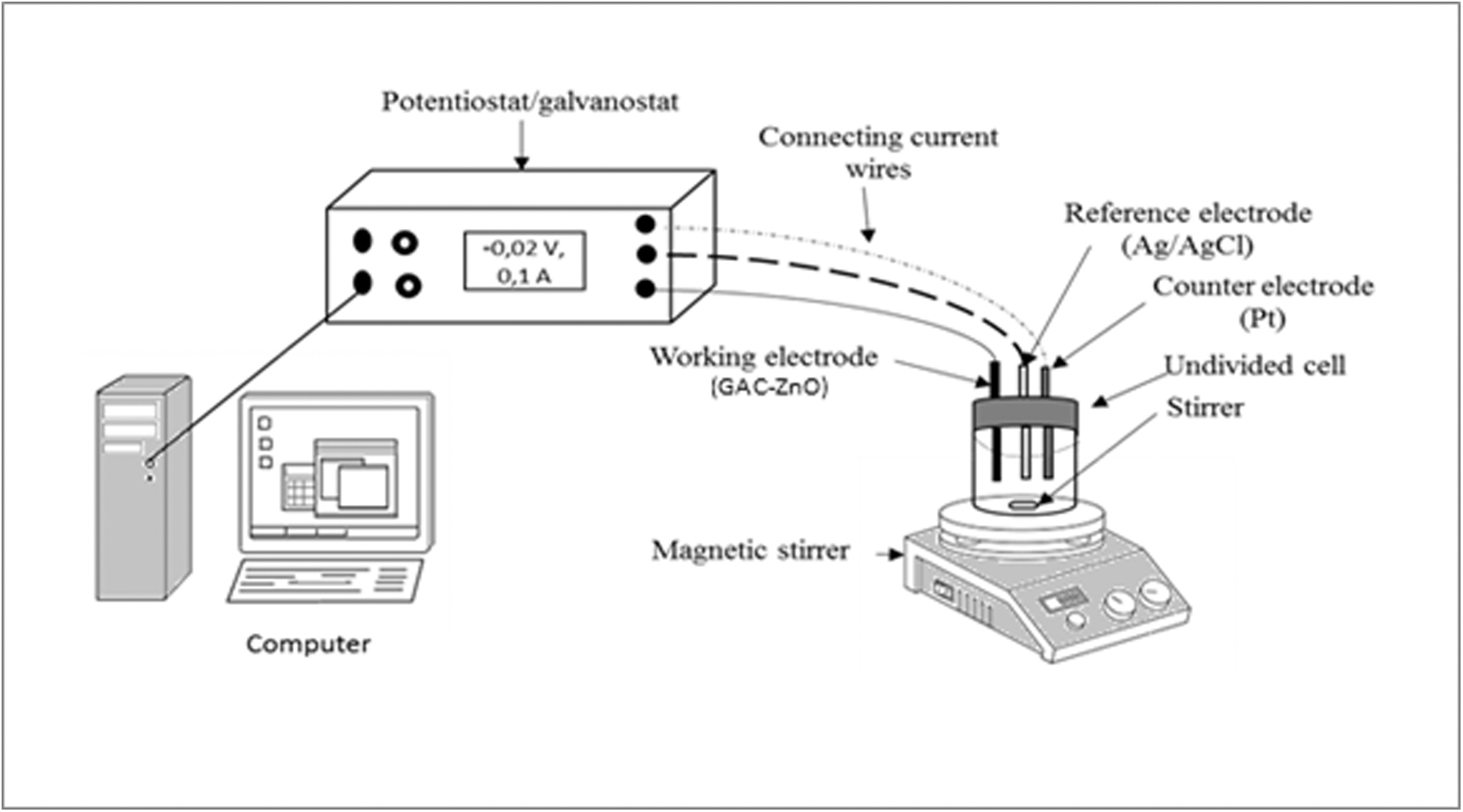
Experimental setup for electrochemical method.
It is well known that the potential control of phenol electrochemical degradation revealed that the electrochemical degradation of phenol was negligible at 0 V in a long lifetime reaction (90 h). So the electrode potential was switched to other potential values, −0.4, −0.2, 0.2, and 0.4 V, with three repeats each. To achieve a complete removal of phenol, the processes poised at 0.4 and 0.2 and needed very long lifetime reaction, while the time was less under negative potentials of −0.4 and −0.2 V, with the used carbonaceous material. The open circuit control spent the longest time of 90 h to degrade all phenol. Therefore, to sum up, working under a negative potential using carbonaceous material could be an appropriate choice to degrade phenol in aqueous solution (Zhou et al., 2020).
Results and Discussion
OMWW characterization
Physicochemical parameters
The parameter values given in Table 1 show that OMWW contains appreciable quantities of organic and mineral elements. The pH of OMWW is 5.6, which can be justified by the presence of organic acids. The dominance of toxic constituents and the presence of the phenolic compounds (6.75 g/L) explained by the chemical oxygen demand (COD) and the biological oxygen demand in five days (
Physicochemical Parameters of Olive Mill Wastewater
TOC, total organic carbon.
In addition, OMWW is characterized also by a high content of mineral matter, such as potassium, sodium, nitrogen, calcium, magnesium, chlorides and phosphates. The electrical conductivity was also high, which proves that the sampled effluent has excessive mineralization. The high value of turbidity confirms that it is a cloudy OMWW.
From Table 1, it can be seen that the physical-chemical analysis of vegetable water exceeds the values fixed by the standards related to the wastewater discharged into the natural environment, like pH, total dissolved solids, conductivity, turbidity, COD, BOD5, chromium, chloride, lithium, barium, calcium, potassium, and sodium. The OMWW meets Tunisian Environmental Protection Standards 106.02 (1989).
Phenolic compounds identification
Figure 1a shows that absorption common to all samples occurred at 3,400 cm−1 because of C–H bonds and OH groups of the type alcohol, phenol or carboxyl OH, and the hydrogen vibration of amide N–H functions. The two bands in the region 2,926 and 2,855 cm−1 are mainly caused by aliphatic C-H stretching. A shoulder at 1,740 cm−1 is caused by COOH groups. A shoulder around 1,400 cm−1 is attributed to the stretching of C=C in aromatic groups, and C=N in amides.

DSC curves (Fig. 1b) the compounds of OMWW; mostly, phenols were produced from the thermal degradation of the lignocellulosic structural material of the samples. Several authors described the thermal degradation olive wastes as a progressive decomposition of their cellulose, hemicelluloses, and lignin (Guizani et al., 2016).
The chromatogram obtained using HPLC to analyze OMWW sample is shown in Fig. 1c. HPLC profiles showed several peaks related to different phenolic compounds. Among these compounds, gallic acid [retention time (tr): 8.49 min (A)-8.45 min (B)], Tyrosol [tr: 13.89 min (A)-13.90 min (B)], p-coumaric acid (tr: 24.18 min (A)-24.61 min (B)], and the caffeic acid [tr: 18.99 min (A), 19.21 min (B)] were identified. Also, OMWW holds also valuable elements such as mineral nutrients, especially potassium, which could potentially be reused as a fertilizer and efficient antioxidant (Araújo et al., 2015).
The polyphenols could be used as antioxidants in food products thanks to their structures potential and biological properties (Leouifoudi et al., 2014). However, a monomeric phenolic compound was identified, which is called phenol (Table 2), detected at tr of 17.79 min (A)-17.80 min (B). Phenol is an extremely hazardous chemical, which has been listed as a priority pollutant by United States Environmental Protection Agency (Li et al., 2018). Therefore, in the next section, to simplify the investigation, phenol has been treated by electrolysis using the electrode of GAC doped with ZnO nanoparticles.
Identified Phenolic Compounds of Olive Mill Wastewater by HPLC
HPLC, high performance liquid chromatography.
GAC-ZnO characterization
The XRD patterns of GAC and GAC-ZnO were registered in the 2θ range from 10 to 80°. It represent a pic at 2θ = 24.5° which is indexed by the mesh parameters h k l (002) related to presence of carbon element in GAC. The other large pic at 2θ = 43° indicated that we have a turbostratic structure of carbon materials. After modification of GAC with ZnO, new XRD peaks emerged, as shown in Fig. 2a (blue pattern). These peaks are recorded at 2θ = 35°; 37°; 39°; 46.5°; 59.9°, and 67.6°, which confirmed the existence of ZnO on GAC surface. The whetted and intense peaks indicated that ZnO nanorods are of high crystallinity (Article, 2018).

Centered on the analysis of XRD patterns, a hexagonal crystal structure of GAC-ZnO composite was verified. FTIR analyses were used to pinpoint the structure of the material, warrant the formation of anticipated bonds, and find the type of these bonds. According to Fig. 2b, spacious absorption band observed in the middle of 3,400 and 3,500 cm−1 correlated to stretching vibration of hydroxyl functional groups. The adsorption peaks observed in 600, 1,050, and 1,610 cm−1 are linked to bending vibration of C-H and stretching vibrations of C = O and C = C, respectively.
The active groups detected at 720, 1,490, 1,710, and 2,980 cm−1 belong to stretching vibration of ZnO (Nasseh et al., 2020). Acquiring these groups is explicitly approving the existence, successfully covering of ZnO on the surface of activated carbon. Scanning electronic microscopy (SEM) images were taken to evaluate the apparent structure and size of the produced GAC-ZnO composite particles. These images grabbed for GAC and GAC-ZnO present the surface morphology and elementary composition before and after (Fig. 2c) supporting metal oxide, respectively. Compared with image A in Fig. 2c, we can see clearly in image B that some particles were not homogenously loaded onto the surface in the bulk of the GAC, despite the agglomeration of a few oxides.
These nanoparticles are exposed in image B as light-colored granules. It can be seen that the number of pores was amplified after modification with ZnO nanoparticles. In fact, this property of a large number of small pores represents an advantageous point for the GAC-ZnO composite to be an efficient catalyst, as these pores offer a high surface area and active sites for reaction with the pollutant molecules and then improve the pollutant decontamination directly and indirectly (Nasseh et al., 2020). Some of the carbon entities disappear after calcination process at 500°C for 2 h, and an important number of ZnO nanoparticles appeared crystallized at the exterior surface (Zhou et al., 2021).
Moreover, from the energy-dispersive X-ray spectroscopy (EDX) data, the element mass ratio of zinc and oxygen was absent in GAC material, and then increased in the hybrid material. Among them, the mass percent of Zn and O loadings reached and the mass ratio of carbon (C) decreased after the grafting process. This result further justifies that the ZnO oxide has been efficaciously immobilized on the surface of GAC after the impregnation method. The elements that appeared in the EDX spectrum of GAC-ZnO composite after grafting processes are C, Zn, and O. The mass ratio of Zn and O elements was high, which highlighted the successful interaction and shell of GAC with ZnO nanoparticles. In addition, ZnO nanoparticles are stable onto the GAC surface even after degradation process (Yu et al., 2016).
Table 3 shows the values of pH of zero charge correspond to GAC and GAC-ZnO, as its name indicates, to the pH below which the carbon surface will have a clear positive charge and conversely the pH above which the carbon will have a negative charge. The pH value required to give a net charge to the zero surface is called the point zero charge (PZC). In this study, the
pHPZC Values of Granular Activated Carbon and Granular Activated Carbon-Zinc Oxide
GAC, granular activated carbon; PZC, point zero charge; ZnO, zinc oxide.
The pHPZC was increased by the modification by ZnO, indicating the difference between the surface chemistry of GAC and GAC-ZnO. The phenomenon can be attributed to the reduction of carbonaceous material surfaces by the oxide coating and the decrease of acidic surface functional groups (Rashtbari et al., 2022). Also, introducing ZnO nanoparticles on GAC resulted in a further improved surface basicity, which is proved by the measurement of the
Choice of electrode support material
Nickel foam corrodes in acidic environments, but has good corrosion resistance in neutral and alkaline environments. However, the corrosion of the nickel foam is significantly reduced by applying a binder (PVDF was used in this research), or PTFE could be used in this case, to the surface of the nickel foam. Increasing binder loading in the catalyst layer can prevent the corrosion of nickel foam. However, it has been found recently that the performance of a cathode with a high binder concentration loading in the catalyst layer can be significantly improved by treating the cathode with a solution, such as isopropyl alcohol (Cheng and Wu, 2013).
Besides, various alternative catalysts to Pt have been tested in microbial electrolysis cell (MEC), including nickel (Ni), palladium (Pd),
Electrochemical studies
Cyclic voltammetry
Cyclic voltammetry is given in Fig. 3. GAC-ZnO electrode showed reduction peak at −2.56 V versus Ag/AgCl. This process corresponds to the formation of an important quantity of hydrogen peroxide (
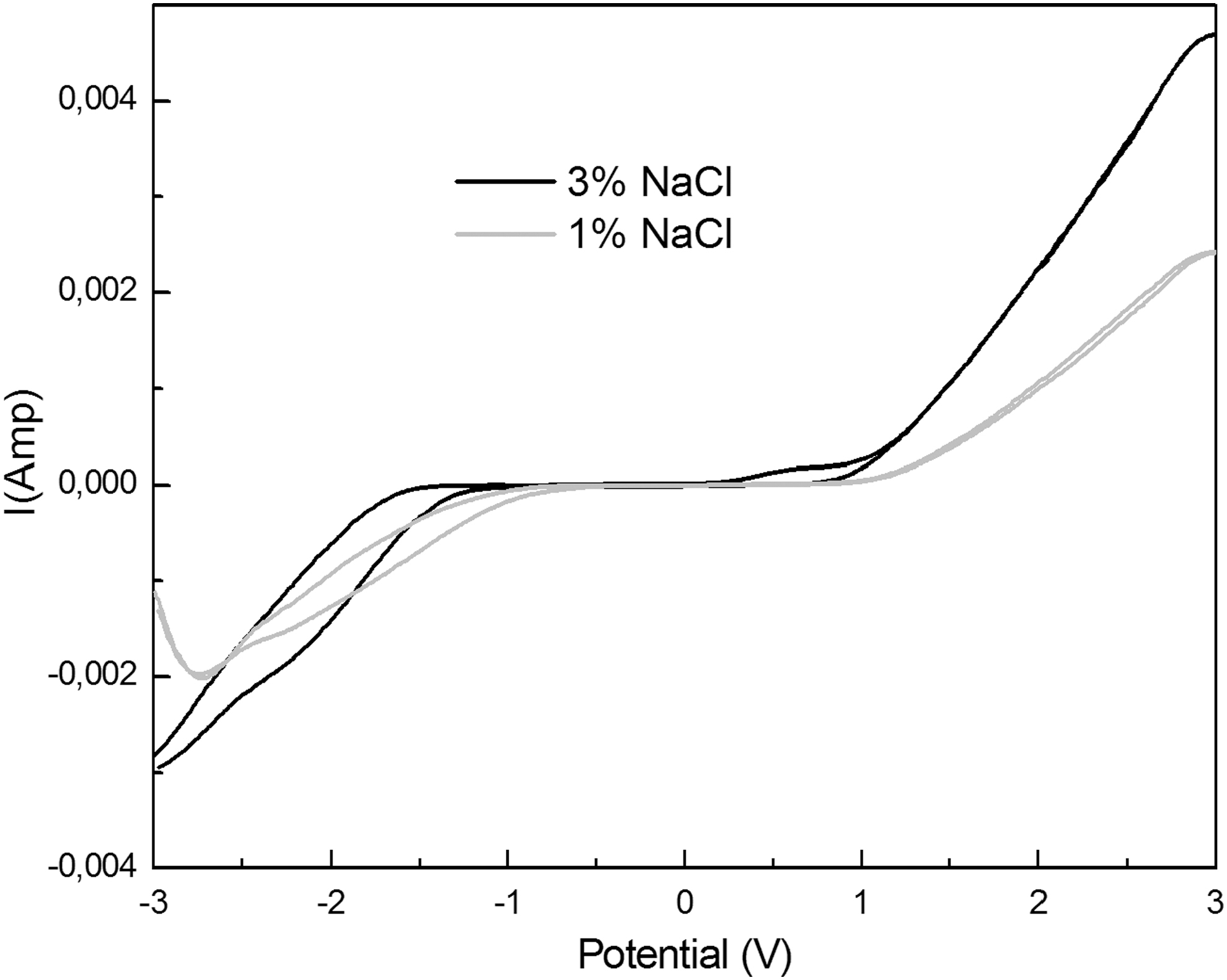
Cyclic voltammetry of GAC-ZnO in the presence 50 mg/L of phenol and of 1% and 3% of NaCl electrolyte (scan rate of 50 mV/s).
The results suggest that GAC-ZnO electrode shows a good electrocatalytic property in the presence of 3% of NaCl. To sum up, GAC-ZnO electrode in the presence of 3% of NaCl at potentiostatic negative (−2.56 V) is the optimum condition to study phenol degradation. Moreover, in 3% NaCl, phenol can be shown to improve an increase in current related to the oxygen progression reaction for the GAC-ZnO electrode. However, the response of other NaCl concentrations decreased when phenol was added. These results show that the interaction of the effluent with the electrode surface with 3% NaCl is distinct from that of other concentrations (Rguiti et al., 2018).
The cyclic voltammogram displays that under the same potential, feed current of GAC-ZnO with 3% NaCl electrode is higher than the other in CV plots. The reason is that in the CV tests; GAC-ZnO with 3% NaCl occurred more reactions of oxidation and reduction than GAC-ZnO with 1% NaCl in electrode surface (Li et al., 2017).
Phenol electrochemical degradation
The supporting electrolyte and pH value are essential parameters for the electrochemical degradation process. Furthermore, the generation of oxidative species from the supporting electrolyte can promote pollutant degradation.
In solutions rich with NaCl, active chloro-species such as chlorine, hypochlorous acid, or hypochlorite ion might be produced on cathode surface and subsequently oxidize organic matter (Zambrano and Min, 2019). So it can be suggested that NaCl was oxidized to give a strong oxidant of HOCl, could boost the degradation of phenol (Li et al., 2009); however, this condition could not be enough to produce the ideal sulfate-free radicals when
Effect of the supporting electrolyte
Performance of GAC-ZnO electrode for phenol degradation with different electrolyte: with the omission of naturally conductive wastewater and materials, the addition of electrolyte is required to provide an electroconductive in the middle of the electrochemical reactor (Zhang et al., 2021a), so different supporting electrolytes, such as NaCl,
As shown in Fig. 4a, with 1% NaCl as supporting electrolyte, the phenol degradation was about 64% after 120 min at a current density of 0.1 A. The phenomenon of phenol degradation is related to the generation of the mixture of Cl2, HOCl, and OCl− when NaCl is used as electrolyte, which improve the electrooxidation. Nevertheless, the active chlorine just cannot lead to a total mineralization of the pollutant (Yi et al., 2008).

This can also be due to the fact that HOCl could not be sufficiently formed with NaCl initial concentration to reach the total phenol removal. In fact, the initial concentration of NaCl was not enough to produce HOCl, although the phenol concentration decreased from 50 to 10 mg/L (∼90%) in 30 min after reaching NaCl percentage to 3% (Fig. 4b). So it can be said that the high concentration of NaCl lead to the production of enough quantity of the oxidant agent. On one side, the initial concentration of phenol was more or less high to achieve the total degradation after a short period.
On the other side, ZnO was not uniform at the surface of GAC-ZnO catalyst to exert all the catalytic activity (Gao and Wang, 2021) or the reason may be that the introduction of too much ZnO will cover the active sites on the electrode surface (Zhang et al., 2021b). We can also site that a significant factor sensible to the supporting electrolyte concentration is the conductivity of water to be treated. Because the current passing through the circuit is a function of the conductivity under a definite applied potential, conductivity of water increases as the supporting electrolyte is present in the medium with high concentration; thus, current passing through the circuit increases in potentiostatic mode, and subsequently the removal rate increases (Yildiz et al., 2008).
Moreover, supporting electrolyte type has an important effect on the degradation pathway. It can be seen that higher removal rates are only achievable with NaCl as supporting electrolyte. When chloride ions are available in the water, the reactions (2), (3), and (4) happen either on the electrode surface or in the bulk solution; because of these reactions, chlorine gas and hypochlorite ions are produced, which are strong oxidizing agents that form in the bulk solution.
Effect of pH
The physicochemical parameters of the wastewater also related with the electrochemical degradation method (He et al., 2019). It is very sensitive to the pH of aqueous solution, the most important factor in degradation processes. It is well noted that the initial pH value affects directly the charge and nature of interaction, enrolling oxidant and phenol solution (Li et al., 2017). Figure 4c shows the removal efficiencies of phenol in different initial pH solution for GAC-ZnO and Pt couple. HCl and NaOH solutions (0.1 M) were added to adjust the pH.
The phenol degradation efficacy was improved with the natural acidic pH value in solution, but the other pH values showed a minus effect on the phenol degradation. It means that alkaline condition demotes the phenol degradation efficiency. The high pH value can limit the production of oxidative radicals, which can rise the degradation rate of phenol (Zhang et al., 2018), while in acidic medium, the oxidative radicals can be formed by the anodic discharge of water in the indirect electrochemical oxidation of the organic pollutant at the anode (Belal et al., 2021).
As shown in Fig. 4c, at the end of 120 min, the phenol removal for selected pH values was achieved as: pH 3 (∼95%) > natural pH 5 (∼90%) > pH 8 (∼30%) > pH 10 (∼25%) > pH 7 (∼20%) > pH 9 (∼10%). It is clearly evident from the results that Cl2 (aq) (at pH 3.0) and HClO (pH 3.0–8.0), generated as main electroactive oxidizing species in acidic medium, have more marked effect on phenol electro-oxidation effectiveness than ClO− produced at pH >8.0; (Li et al., 2017). It is also described that low pH favors phenol elimination and obstructs the extent of oxygen evolution reaction, which is an unwanted side reaction consuming a fraction of the power supplied (Ni and Saxena, 2018). Moreover, it can be ascribed that
However, in the alkaline condition, it is not easy to find that the phenol and TOC removal shows a trend of decline, especially for TOC elimination. The effect of higher pH on electrochemical reaction can be simplified by two facts: one is that in alkaline condition, side influence would be serious, and the other is that the electrolyte would be expended too fast, resulting in deterioration in conductivity of solution. According to Giannis et al. (2007), the effect of voltage on the COD depended on the treatment period. The effect of different voltages on pH was insignificant, since for all voltage levels, the pH variation with time was practically the same (Giannis et al., 2007).
Phenol electrochemical oxidation was studied to reveal the relationship between the structure and electrochemical reactivity pollutant using Pt as anode and GAC-ZnO as cathode, if it is with electron-donating or with drawing substituents. The electron-donating groups are generated from the substrate; the phenols with these groups are also degraded at the anode Pt surface (Zhu et al., 2007).
Carbon-based cathode (GAC-ZnO) is electrically conductive and the endowed surface functional groups (by acid or
It is possible that
NaCl proves better degradation efficiency more than the other electrolytes because it release active chlorides (HClO, ClO−) which promote the degradation process of the phenol.
Effect of interelectrode spacing
Another important parameter to study is the interelectrode spacing. The removal efficiency of any organic pollutant decreases with the increase in electrode spacing and the removal efficiency is usually the greatest for the smallest interelectrode spacing. As an example, the removal efficiency of ceftazidime continued to increase with decreasing interelectrode spacing, until the smallest interelectrode spacing at 1 cm (Hu et al., 2016). The main reason for this phenomenon is that the effective current density between the electrodes decreases with increasing interelectrode distance at constant current, which means that the intermediate current density between the electrodes is higher when this distance is small.
Total organic carbon analysis
The capacity of phenol mineralization using an electrochemical oxidation system with Pt anode and porous GAC-ZnO carbon cathode was explained also by TOC analysis to check the total mineralization of phenol at cathodic potential −2.56 V. The TOC decay obtained is depicted in Fig. 5. Initial pH was decreased from 5 to 3, and the percentage of TOC removal was enhanced about 82–98%, respectively, by treatment of 120 min, which is compatible with the previous degradation results. During m-cresol destructions, by-products will be formed by this electrochemical treatment, and converted into CO2 and H2O. The TOC removal in 120 min increases as the initial pH decreased from 5 to 3. In acidic condition, the removal of phenol and TOC elimination increase with the decrease of pH value. Because in acidic medium there are more H which enhance the generation of H2O2 and OH and promote the degradation of phenol.
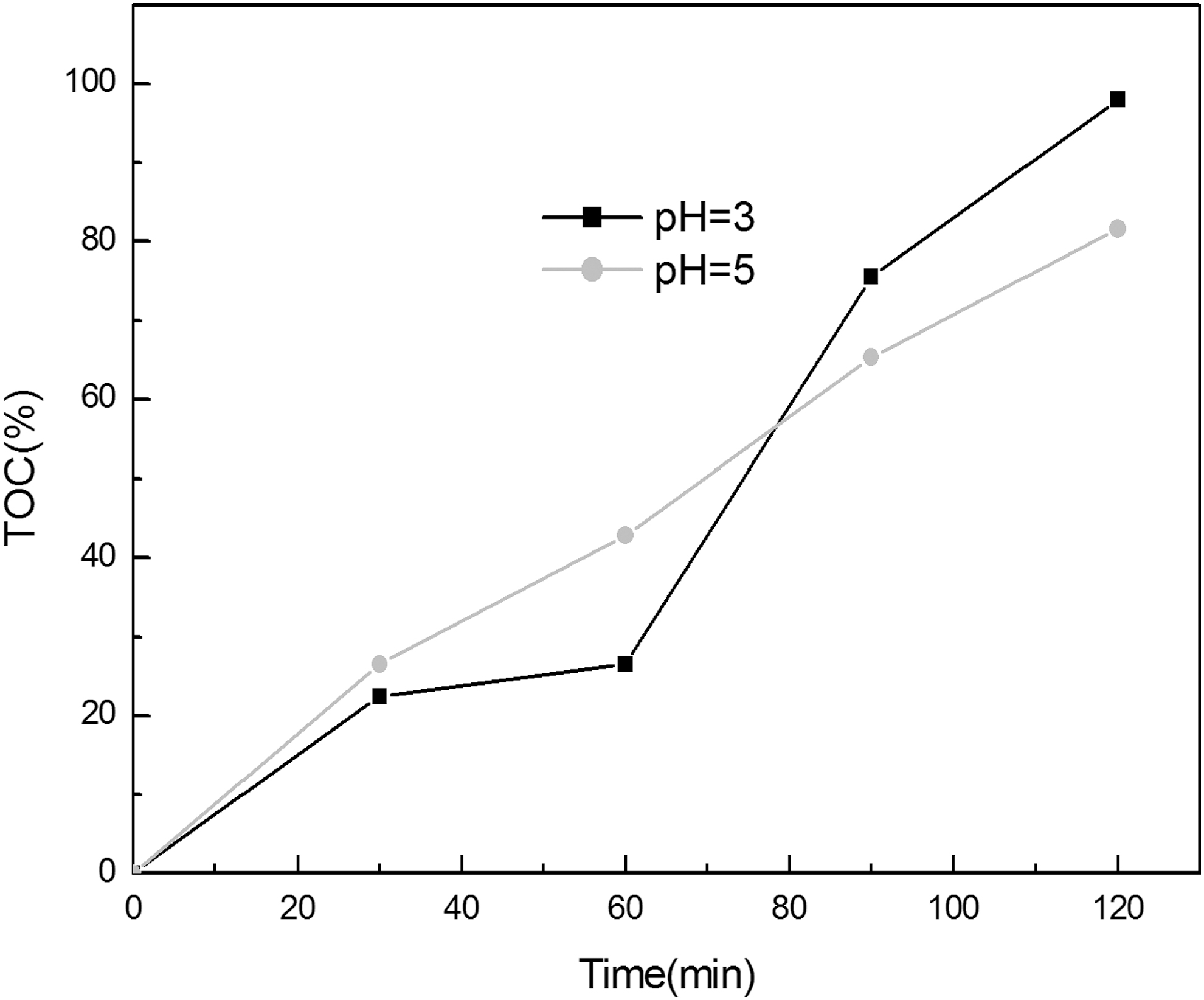
TOC analysis of 50 mg/L of phenol abatement in 3% of NaCl at the two optimal pH medium (pH 3 and pH 5) at −2.56 V. TOC, total organic carbon.
Role of ZnO in the degradation process
The presence of semiconductor materials (ZnO nanoparticles) is the main factor for photocatalytic activity, besides an environment-friendly element. The existing conduction and gap bands in its structure is the key characteristic of these nanoparticle material, because it is responsible for the electron transfer from the gap band phase to the phase of conduction by receiving the photon energy and simultaneously creating cavities (holes
In fact,

This indicates that the presence of the ZnO structure has enhanced the degradation activity of activated carbon since it enhances the process of several reactions involved for the formation of hydroxyl radicals (•OH), ZnO is responsible for improving the electrolytic activity of our electrode. In general, the process of phenol by the electrochemical degradation using GAC-ZnO electrode could be summarized by the following equation:
Phenol degradation mechanism by GAC-ZnO electrode
The possible degradation mechanism of the phenol treated by the electrochemical oxidation was deduced according to the UV–visible spectra of the phenol aqueous solution (Jia et al., 2021). The spectral data of the phenol treated at different times and the schematic diagram of possible phenol degradation mechanism are shown in Fig. 6. The target molecule has one characteristic absorption at about 270 nm. It is very clear that the above said peak disappears and no new peak appears after the solution was treated for 120 min. The results clearly show that phenol has been gradually degraded during the electrochemical oxidation. The peak 270 nm almost could not be found after 120 min. The results demonstrate that no formed by-product and the phenol have not transformed into other intermediates (organic acids) and was mineralized into
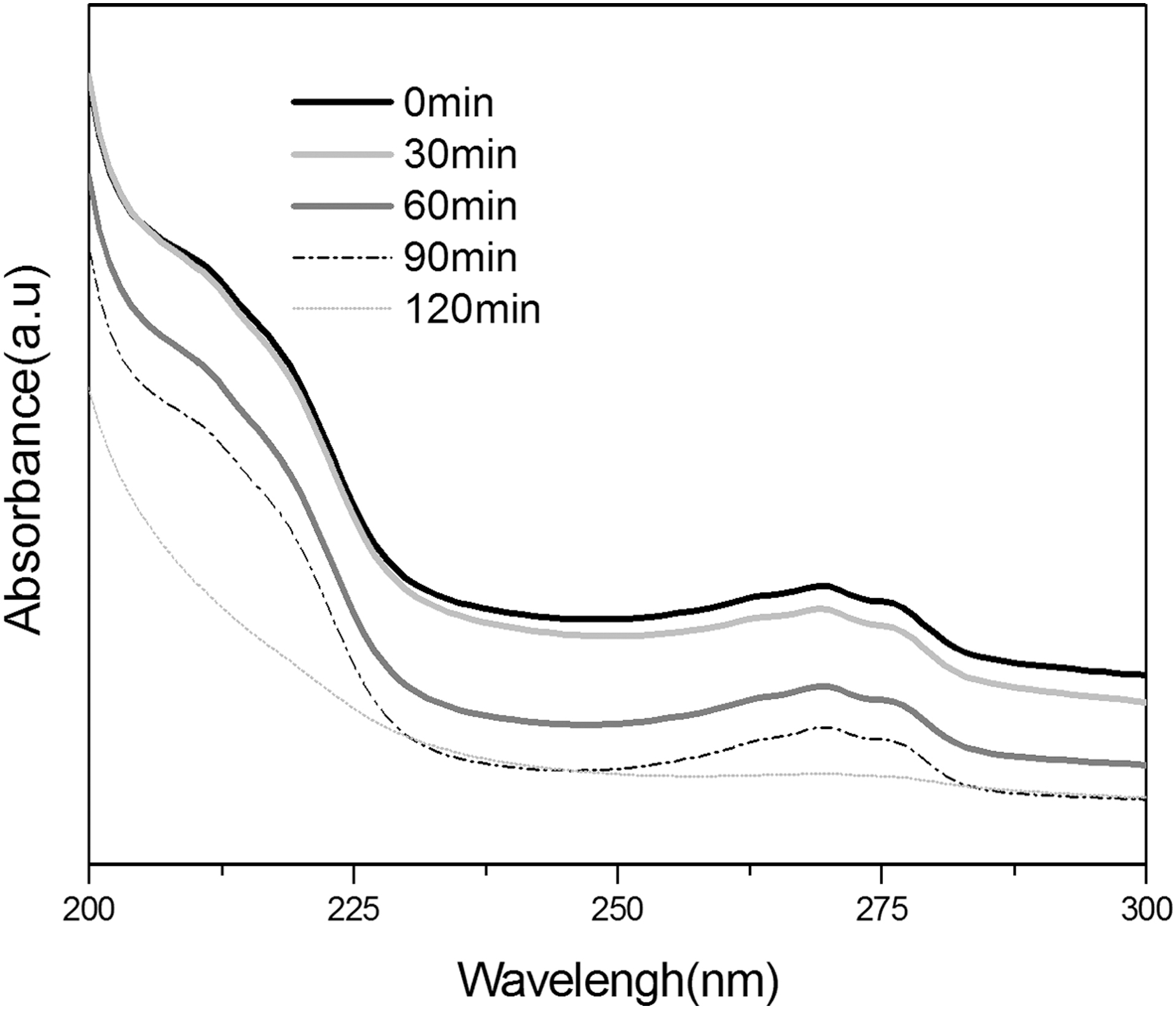
UV-Vis absorption spectra of phenol aqueous solution after degradation at different times. UV-Vis., UV-visible Spectroscopy.
It is possible to say that the anodic oxidation of phenol is a fast reaction and is under diffusion control. It is also assumed that phenol is combusted to CO2 and H2O near the electrode surface [Eq. (16)] (Kornienko et al., 2011).
Conclusion
Olive oil wastewater is a big environmental problem worldwide. Every year, a million tons of toxic wastes are produced, and most of them cause serious damage to the environment. It is known that different olive wastes contain phenolic compounds at high concentration. Therefore, it is necessary to either reduce the damage by oxidizing the OMWW or make it usable. In this work, electrochemical oxidation was used for the phenol molecule chosen as a model of phenolic compounds; for this, an industrial activated carbon was impregnated with ZnO oxide. The composite GAC-ZnO was characterized using XRD, FTIR, and SEM techniques, which confirmed that ZnO was successfully doped onto GAC surface. The composite based on ZnO was tested for its degradation capacity for phenol at different experimental factors in the electrochemical degradation process.
Type and concentration of supporting electrolyte and initial pH have an important effect on the degradation of pollutants and efficiency associated with the electrochemical process. The extent of phenol elimination was strongly influenced by an increase in NaCl electrolyte concentration and pH in acidic range. The favorable operating conditions for phenol degradation (∼95%) and 98% TOC abatement were achieved at pH ∼3 in the presence of 3% NaCl after 120 min. This opens new perspectives in the field of electrochemistry degradation, to prepare very efficient carbon for environmental phenol remediation by the preparation of carbon composite.
Footnotes
Authors' Contributions
A.A.: investigation and writing original draft and editing. D.J.E.: HPLC analysis. F.P.: supervision, conceptualization, and investigation. A.H.H.: chemical acquisition. M.J.: methodology, conceptualization, cyclic voltammetry experiments, and correction of the final version of article.
Author Disclosure Statement
There is no conflict of interest.
Funding Information
The funding for this paper is a national scholarship for PhD students given by the ministry of higher education.