




Abstract
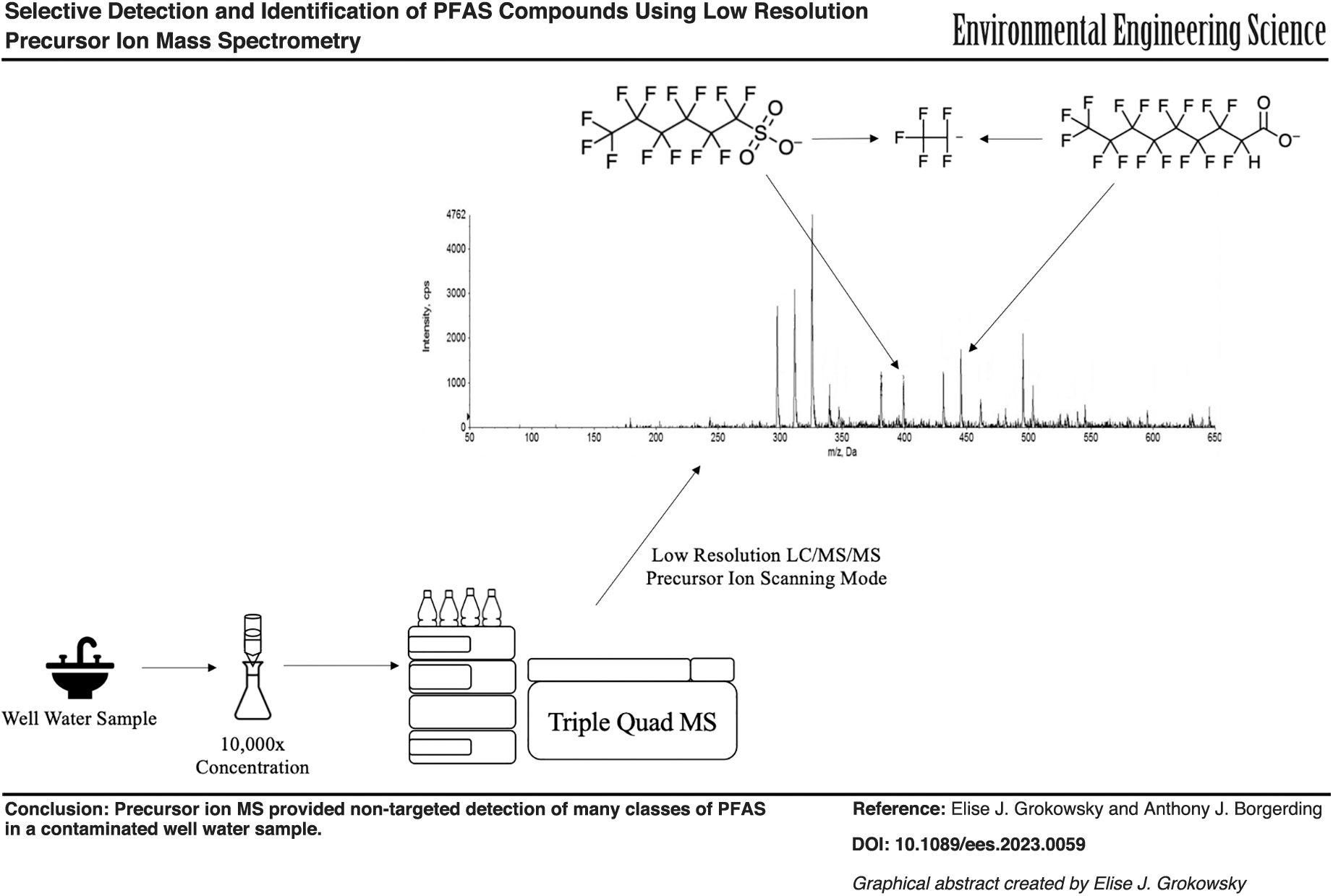
Using a low-resolution triple quadrupole mass spectrometer, a nontargeted approach for detecting and identifying perfluorinated alkyl substances (PFAS) has been developed and applied. Because many PFAS will fragment to C2F5− at m/z 119, we used precursor ion scanning mode to detect multiple classes of PFAS in a sample without the need for target ions as required by purely selective methods such as multiple reaction monitoring (MRM). Precursor ion scanning offers a relatively simple way to detect and identify nontargeted PFAS that is potentially accessible to more laboratories than approaches using high-resolution mass spectrometry. Specifically, we have used the method to measure traditional classes of PFAS-like perfluorinated carboxylic acids, sulfonates and sulfonamides, as well as recently developed PFAS-like hexafluoropropylene oxide – dimer acid (HFPO-DA, GenX), and other recently discovered classes like hydrogenated perfluorocarboxylic acids (HPFCAs) and unsaturated PFAS (UPFAS). Using a triple quadrupole mass spectrometer with a single common fragment results in a smaller fraction of PFAS that will be detected compared to the high throughput techniques, and the low-resolution mass spectrometry limits the selectivity somewhat. In addition to PFAS, precursor ion scanning of m/z 119 also detected alkylbenzene sulfonates, a class of very common surfactants that also fragment to a product ion at the same nominal mass. The method detection limits were ∼30 ng/L for perfluorooctanoic acid (PFOA) and perfluorooctane sulfonate (PFOS), including a 10,000 × concentration by solid phase extraction. We demonstrated the effectiveness of this approach to identify several classes of recently discovered PFAS compounds in well water samples from French Island, WI, which had been previously identified as having significant PFAS contamination.
Introduction
Perfluoroalkyl and polyfluoroalkyl substances (PFAS) are a chemically diverse class of compounds that have been produced since the 1940s (Evich et al., 2022; Lindstrom et al., 2011; Wang et al., 2017). These compounds consist of a chain of carbons bonded to fluorines with various functional groups at the end of the chains. The carbon-fluorine bond is significantly stronger than a carbon-hydrogen bond, giving the compounds desirable qualities such as water and oil repellency, high surface activity, and stability at high temperatures (Wang et al., 2017). These properties have led to the use of PFAS in hundreds of products such as firefighting foam, cosmetics, food contact materials, inks, textiles, leather, and apparel (Firouzjaei et al., 2022; Wang et al., 2017).
According to the U.S. EPA's Comptox Chemistry Dashboard, there are over 14,000 known PFAS compounds (US EPA, 2022). Because of their stability, PFAS are very resistant to biological breakdown, leading to bioaccumulation and persistence in nature (Gaines, 2023; Glüge et al., 2020; Wang et al., 2018).
The two most well researched PFAS are PFOS and PFOA, which were extensively used until long-term toxicological studies showed them to have negative health impacts requiring exposure controls (Firouzjaei et al., 2022; Fenton et al., 2021; McCord and Strynar, 2019). These two compounds have been increasingly phased out of industry usage, with alternatives such as short chain PFAS and perfluoroether acids replacing them and other long-chain PFAS (Evich et al., 2022; Lindstrom et al., 2011; McCord et al., 2020; Strynar et al., 2015). This shift presents two difficulties. First, there is little public chemical information available about alternative PFAS being produced and used, causing the tracking of these new compounds in the environment to be very challenging (Liu et al., 2015).
In addition, the alternatives are still within the PFAS classification, leading to the concern that the new compounds are just as harmful and persistent as the compounds they replace (Fenton et al., 2021; McCord and Strynar, 2019). The lack of information provided by manufacturers makes evaluating the qualities of these compounds very challenging (Strynar et al., 2015). In a 2013 study, 11 commercially available aqueous film-forming foam (AFFF) samples were analyzed for total PFAS content by organofluorine combustion ion chromatography followed by a targeted analysis using MRM for the quantification of 25 PFAS. Only 10–50% of the total PFAS in the sample were quantified by the target analysis, demonstrating the need for nontargeted methods (Weiner et al., 2013).
One nontargeted approach to gaining more information about PFAS contamination is to oxidize the nonfluorinated part of PFAS molecules to the carboxylic acids and then analyze the various perfluorocarboxylic acids (PFCAs). Doing so accounted for 69% more PFAS than by targeted analysis alone (Houtz and Sedlak, 2012).
High-resolution mass spectrometry has emerged as a useful tool for determining the presence and structure of nontargeted PFAS. When coupled with mass defect plots and other computational analyses, this technique has been successful at identifying many new classes of PFAS (Baduel et al., 2017; Barzen-Hanson et al., 2017; Rotander et al., 2015). A study of wastewater from a fluorochemical manufacturing plant in China utilized a high-resolution mass spectrometry method paired with computational techniques such as suspect screening and PFAS homolog analysis. They discovered over 15 classes of PFAS encompassing 90 PFAS compounds with 6 classes encompassing 37 novel PFAS (Wang et al., 2018). Despite the powerful analysis of PFAS demonstrated by high-resolution mass spectrometry, low-resolution mass spectrometry is still far more commonly used for PFAS analyses (Bangma et al., 2023).
Precursor ion scanning is a nontargeted technique used on triple quadruple mass spectrometers, where a level of selectivity is added by scanning a mass analyzer for precursor ions that fragment to a common product ion. It has been previously used in environmental analysis to measure classes of compounds with an intermediate level of specificity. Brominated, chlorinated, and iodinated disinfection byproducts (DBPs) have been successfully analyzed by precursor ion scanning to identify new compounds and better understand their degradation process (Pan and Zhang, 2013; Pan et al., 2016; 2017; Xiao et al., 2012; Zhai and Zhang, 2011). Like PFAS, DBPs are broad and complex classes of pollutants. A review of LC/MS/MS for detection of halogenated DBPs found precursor ion scanning to be an effective method for detecting both traditional and novel DBPs (Yang et al., 2019).
There are related high-resolution MS techniques that also utilize common fragment ions. These techniques rely on the ability of these instruments to rapidly acquire both full spectra and fragment ion spectra in parallel. Data filtration techniques, including searching for the presence of product ions known to be generated from a class of compounds, are then used to provide additional selectivity. This approach has been applied to PFAS, using extracted signals for a group of common product ions, as well as neutral losses, homologous series detection, and mass defect analysis to generate signals specific to a wide range of PFAS molecules (Hensema et al., 2021; Liu et al., 2015). It is important to note that these powerful techniques are not available on the more commonly used triple quadrupole mass spectrometers, which cannot acquire full spectra as quickly.
In this article, we outline an approach for nontargeted analysis of PFAS using triple quadrupole mass spectrometry with precursor ion scanning of m/z 119 (C2F5−) for detection and identification of many different classes of PFAS. We demonstrate both the effectiveness and the limitations of this approach through the analysis of well water samples from French Island, Wisconsin, a region with very pervasive PFAS contamination in private well water.
Materials and Methods
Standard preparation
Analyte and internal standard solutions were prepared from commercial standards by dilution to a concentration of 0.600 ppm with MilliQ water or acetonitrile (ACN) and further diluted from this primary standard. Analyte standards used were from Wellington Laboratories and can be found in Supplementary Table S1.
Water samples
Water samples were received from a private residence on French Island, an area near La Crosse, WI. Samples were taken from a tap whose source was a private well on the property (i.e., not a municipal water source). French Island is the location of a regional airport with a history of firefighting foam use. Samples were received in polyethylene terephthalate bottles and not preserved in any way. Before extraction, the samples were filtered through 0.25 μm nylon filters and acidified (see Solid phase extraction section).
Solid phase extraction
An Agilent Bond Elute 1,000 mg C18 cartridge was conditioned under vacuum at 1 drop per second consecutively with 5 mL ACN, 5 mL 50:50 ACN: H2O, and 5 mL H2O with 0.01% formic acid. The filtered French Island well water samples and MilliQ water blanks were acidified by adding 1 mL of 1% formic acid (FA) to a 1,000 mL sample before extraction. The 1,000 mL sample was passed through the solid phase extraction (SPE) cartridge, and the cartridge was dried for 12 min by pulling air through it. The analytes were eluted from the cartridges with 5 mL ACN, then evaporated under N2 with heat and finally reconstituted with 100 μL of MilliQ water.
LC/MS/MS analysis
Chromatographic separations were conducted on an Agilent 1,200 Series High-Performance Liquid Chromatography. Five microliters samples were injected onto an Agilent Poroshell 120 EC C18 2.7 μm column. The mobile phase consisted of 95:5 ACN:H2O w/0.1% FA (mobile phase A) and 95:5 H2O:ACN w/0.1% FA (mobile phase B). A flow rate of 0.2 mL/min was used. Initial conditions were 100% B held for 2 min, then a gradient to 100% A over 8 min, which was held for 1 min. The gradient was then shifted back to 100% B over 1 min, then held for the rest of the method for 11 min, for a total time of 23 min.
Low-resolution mass spectrometry analysis was performed with a Sciex 4000Q triple quadrupole mass spectrometer with an electrospray ionization source in negative ion mode. Instrument parameters were optimized on standards, with a collision energy of −40 eV utilized. In addition to precursor ion scans, product ion scans and full range quadrupole scans were performed in supporting studies. Choosing which of these modes on the mass spectrometer is used for a given experiment is done using Analyst software that operates the system.
The high-resolution mass spectrometry product ion measurement (for a confirmation study) was performed on a ThermoFisher Q Exactive Mass Spectrometer with a Dionex UltiMate 3000 RSLC System. This analysis was performed without a column in flow injection analysis mode. Five microliters of sample were injected into a flow of 400 μL/min of ACN.
LC/MS/MS approach for nontargeted detection and identification of PFAS
Precursor ion scans of the product ion C2F5− at m/z 119 is the initial and most important step in our approach. The outputs of this scan are peaks corresponding to ions that should come from PFAS compounds. A spectrum was then generated by summing all spectra in a selected time interval of the chromatogram. In this summed spectrum, peaks corresponding to PFAS were initially identified either because they had the m/z value of a common PFAS compound, or because they could be identified as part of a homolog series where a mass difference of 50 (corresponding to CF2) was observable. Product ion scans of m/z values detected in the precursor ion scan were then performed to get structural information to identify them more conclusively. In one case, a high resolution product ion scan was performed to give further evidence that the initial identification was valid.
Results and Discussion
Precursor ion scanning is a method that measures all precursor ions that fragment to a specific product ion. Product ion C2F5− at m/z 119 represents the terminal fragment of nearly all per- and polyfluorinated compounds and was chosen for our method. PFAS compounds do not always fragment in a predictable manner, so scanning precursors of C2F5− will fail to detect many PFAS compounds. Despite this limitation, the results below show its ability to detect many PFAS compounds selectively without the need for targeting precursor ion masses. Because the mass spectrometer scans for all precursor ions in each spectrum recorded, the output of precursor ion scanning mode is similar to a single-analyzer full scan. However, measuring only those precursors that fragment to an ion that is specific for PFAS offers this method an additional level of selectivity.
This method was validated by performing precursor ion scans of m/z 119 on a standard mixture containing common perfluoro acids and sulfonates, as well as a sulfonamide and HFPO-DA, a next-generation PFAS compound containing perfluoroether moieties. These chromatographic results can be seen in Fig. 1. All of the different classes of PFAS in the solution were detected in the chromatogram. Differences in signal intensity between compounds are due to differences in ionization efficiency (Enders et al., 2022; Liigand et al., 2021) and also to the difference in the fraction of C2F5− ions produced during fragmentation of the different PFAS precursor ions.
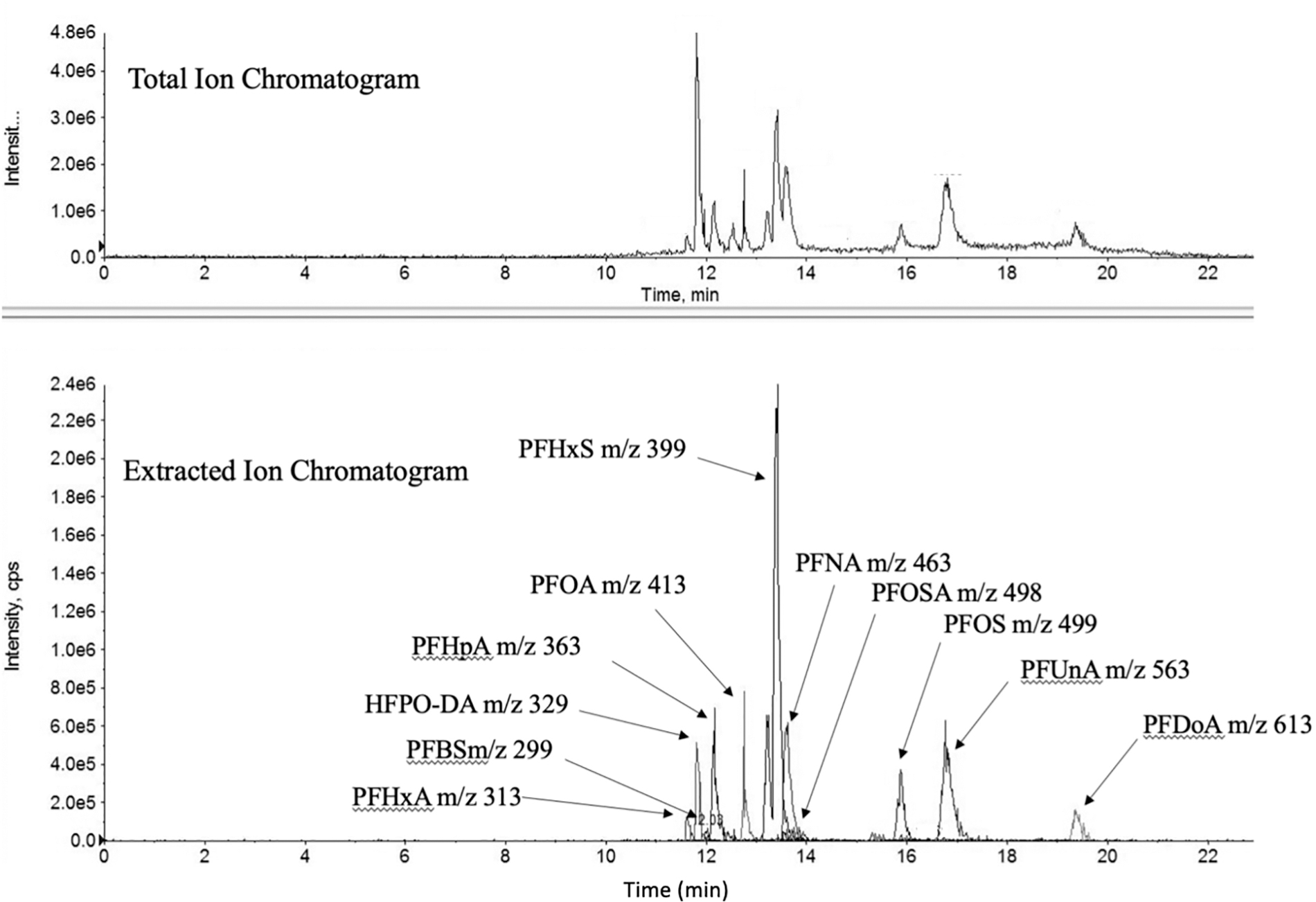
Chromatogram of a standard mixture of PFAS generated by a precursor ion scan of m/z 119. Top) Total ion chromatogram, Bottom) Extracted ion traces (1 Da mass window) for individual PFAS from the precursor ion scan. PFAS, perfluorinated alkyl substances.
Using this precursor ion method, PFOS and PFOA were routinely detected at concentrations in the ng/L range, with method detection limits for each of ∼30 ng/L (calculated as 3sy/m for data from standards ranging from 10 to 200 ng/L, including an SPE concentration factor of 10,000). Targeted methods such as MRM for drinking water routinely have detection limits of less than 1 ng/L, and less than 0.1 ng/L has been reported (Teymoorian et al., 2023). While the detection limits of the nontargeted precursor ion method are much higher than those for targeted methods, it is common when using quadrupole mass spectrometry to sacrifice detection limit to get the benefit of being able to find unknown compounds in a nontargeted analysis involving full scans.
Applying this method to environmental samples of well water from a private residence in French Island, WI resulted in the detection of many analytes of interest. Figure 2A shows a total ion chromatogram generated by precursor ions of m/z 119. The spectra shown in Fig. 2B, C represent the summed spectra from the highlighted regions of the chromatogram in Fig. 2A. The analytes corresponding to the precursor mass spectral peaks detected were sorted into four groups. Common PFAS and alkylbenzene sulfonates are highlighted in Fig. 2B. Hydrogenated perfluorocarboxylic acids (H-PFCAs) and unsaturated PFAS (UPFAS) are highlighted in Fig. 2C. Note that, in the French Island well water sample, the only perfluorinated sulfonate or acid to be detected was perfluorohexane sulfonate (PFHxS, Fig. 2B).

Results from a French Island well water sample using precursor ion scanning.
This illustrates the limitations of a targeted analysis such as MRM using a list of the most common PFAS. For this sample, where the source of PFAS contamination is aged perfluorinated firefighting foam, only one of the many PFAS compounds we detected in this sample would be detected using commonly used targeted lists. As discussed below, there were many other PFAS molecules that we detected in this sample.
Figure 2B also highlights a group of precursor ion peaks separated by m/z 14, corresponding to differences of CH2 in a group of compounds. This was a surprising result since the method was expected to be selective for perfluorinated compounds. To identify the compounds generating these peaks, we performed a product ion scan of m/z 325, which was one of the peaks in this series (Fig. 3). The precursor masses and their product ions match those previously found for alkylbenzene sulfonates (Borgerding and Hites, 1992). Alkylbenzene sulfonates are a very common hydrocarbon surfactant found in household detergents and firefighting foam (García et al., 2019; Scheibel, 2004).

Product Ion Scan of m/z 325, matching the fragmentation pattern of dodecylbenzenesulfonate.
Because our samples came from an area believed to be significantly contaminated by firefighting foam (WI DNR, 2023), the presence of alkylbenzene sulfonates was consistent with the sample history. The detection of these compounds, different from the expected PFAS, highlights a limitation of precursor ion scanning using fragment ions detected at unit mass resolution. The fragmenting scheme in Fig. 3 illustrates how linear alkylbenzene sulfonates fragment to an ion at m/z 119 corresponding to C8H7O− at the same nominal mass as that for CF3CF2−. Thus, unless high-resolution mass spectrometry is used, this precursor ion method is not perfectly selective for PFAS. However, classes of non-PFAS compounds detected by this method are easily distinguishable because they differ by masses other than 50.
Figure 2C highlights a third group of precursor ion mass peaks seen at m/z ratios of 445, 495, 545, 595, and 645. Because each peak is separated by 50 mass units, corresponding to CF2, they are easily identified as PFAS. As illustrated in Fig. 2C, the relative simplicity of the precursor ion scan on a triple quadrupole make a series like this easy to visually identify without the need for data filtering software. These masses do not match any of the traditional perfluorinated sulfonates, acids, or sulfonamides found on targeted lists. Product ion scans of m/z 445 and m/z 495 revealed very similar fragmentation patterns, shown in Fig. 4A, B. This demonstrates that these compounds were in the same class and differed only by the length of the perfluorinated carbon chain. Using information from these product ion scans, we have determined that these peaks correspond to single hydrogenated perfluorinated carboxylic acids (H-PFCA).

Product Ion Scans of m/z 445
H-PFCA have been previously identified in environmental samples and are theorized to be impurities formed in manufacturing (Song et al., 2018; Wang et al., 2020; Wang et al., 2009). The characteristic fragmentation of these compounds is the loss of m/z 64 from the precursor, which is illustrated in Fig. 4 (Song et al., 2018). While matching product ion spectra from previous studies is excellent confirmation of our identified structure, we performed product ion scans on a high-resolution mass spectrometer for hydrogenated perfluorononanoic acid (H-PFNA) to more absolutely confirm that our approach yielded the correct structure. The results (Supplementary Fig. S1) showed a mass at m/z 444.97290 corresponding to H-PFNA, which matches the theoretical mono isotopic mass within the 3 ppm uncertainty of the instrument.
Further confirmation was provided by the product ions generated by this ion. The product ion at m/z 380.97684 corresponds to cleavage of CO2F from the parent molecule, again matching the theoretical monoisotopic mass. The other product ion at m/z 118.99252 matches the theoretical monoisotopic mass of the fragment ion C2F5−. These measurements further confirm our identification of m/z 445 to be H-PFNA. The placement of the hydrogen on the carbon chain is indeterminant thus far. Because the compound fragments to m/z 119 and m/z 169, we can determine that the hydrogen is not placed on any of the terminal three carbons of the compound (Liu et al., 2015).
A compound from an additional class of PFAS was detected in the French Island water sample, with a precursor ion detected at m/z 461. A product-ion scan of this ion (Fig. 4C) shows a characteristic fragment ion at m/z 99 corresponding to SO3F−, identifying it as a fluorinated sulfonate. The precursor mass of 461 differs from that of PFOS (m/z 499) by 38 mass units. We surmise that this corresponds to a difference of F2, meaning that the precursor mass at 461 corresponds to an unsaturated PFOS molecule (UPFOS). Unsaturated PFAS molecules, notably UPFOS, have been identified in water and human serum samples in areas significantly impacted by AFFF contamination (McDonough et al., 2021).
Analysis of the precursor ion mass peaks from the French Island water sample extract shown in Fig. 2 show another group of peaks separated by 50 mass units; there is a series of peaks at m/z values of 381, 431, and 481. While this difference of 50 mass units identifies them as PFAS, they do not correspond to perfluorinated sulfonates, acids, or sulfonamides. While these peaks were initially thought to be precursor ions of another class of PFAS, further analysis of the data suggests otherwise.
As shown in Fig. 4, the masses at 381 and 431 correspond to fragments of H-PFCA compounds. Analysis of extracted ion chromatograms showed that these ions were produced at the same chromatographic retention time as corresponding H-PFCA molecules, leading us to hypothesize that these precursor fragment ions are formed in the ion source. This hypothesis is supported by a comparison of full scan spectra performed at two different declustering potentials in the ion source (Supplementary Fig. S2). When the declustering potential was lowered, the peak at m/z 381, which likely formed from hydrogenated PFOA (H-PFOA) in the ion source, disappeared.
Our results on the composition of the PFAS present in this sample are significantly different than what was obtained in a targeted analysis using MRM that was performed as part of a cleanup project near the site where our samples were taken (WI DNR, 2023). The purported source of contamination was the use of firefighting foams at several sites at an airport over several decades. The targeted list of analytes contained perfluorinated sulfonates and carboxylic acids, GenX, and fluorotelomer sulfonate (FTS) compounds. Near the location where these foams were most recently used, levels of PFOS, PFHxS, and 6:2 FTS exceeding 10,000 ng/L were measured. In samples taken from wells further away from this source, the concentrations fall off sharply. Groundwater sampled near the area where the samples used in this study were taken has concentrations of PFOS and PFHxS of ∼100 ng/L.
In some cases, the concentrations of PFHxS are higher than the concentrations of PFOS, which could explain why we did not detect PFOS in our samples. Perhaps more importantly, the targeted list used in the cleanup project did not include HPFCA or UPFAS compounds, while we generated strong signals using our nontargeted approach. In general, the simple low-resolution precursor ion method performed on the most commonly used instrument to measure PFAS was effective at nontargeted detection and identification of many different types of PFAS.
Conclusion
Analysis of French Island well water samples has demonstrated the effectiveness of precursor ion scanning on a triple quadrupole low-resolution mass spectrometer for both the detection and identification of classes of PFAS not on EPA target lists in environmental samples. Unlike previously described nontargeted methods for PFAS using high-resolution mass spectrometry, this approach uses a low-resolution instrument and demonstrates its potential (and limitations) for nontargeted PFAS analysis. This allows nontargeted approaches to PFAS analysis to be accessible to many testing and research laboratories that utilize triple quadrupole instruments. Given that new perfluorinated compounds continue to be developed and used, an accessible nontargeted mass spectrometry method such as this one is extremely important for detecting them in environmental samples.
Footnotes
Acknowledgment
We are grateful for and recognize the impact of the career of Debbie Swackhammer and the support she gave for female scientists.
Authors' Contribution
E.G.: Investigation, Visualization, Methodology (equal), Writing – Original Draft (lead), and Writing – Review and Editing (equal).
A.B.: Conceptualization (lead), Methodology (equal), Supervision, and Writing – Review and Editing (equal).
Author Disclosure Statement
The authors have no disclosures or conflicts of interest to report.
Funding Information
No external funding was used on the work described in this article.

References
Supplementary Material
Please find the following supplemental material available below.
For Open Access articles published under a Creative Commons License, all supplemental material carries the same license as the article it is associated with.
For non-Open Access articles published, all supplemental material carries a non-exclusive license, and permission requests for re-use of supplemental material or any part of supplemental material shall be sent directly to the copyright owner as specified in the copyright notice associated with the article.
