




Abstract
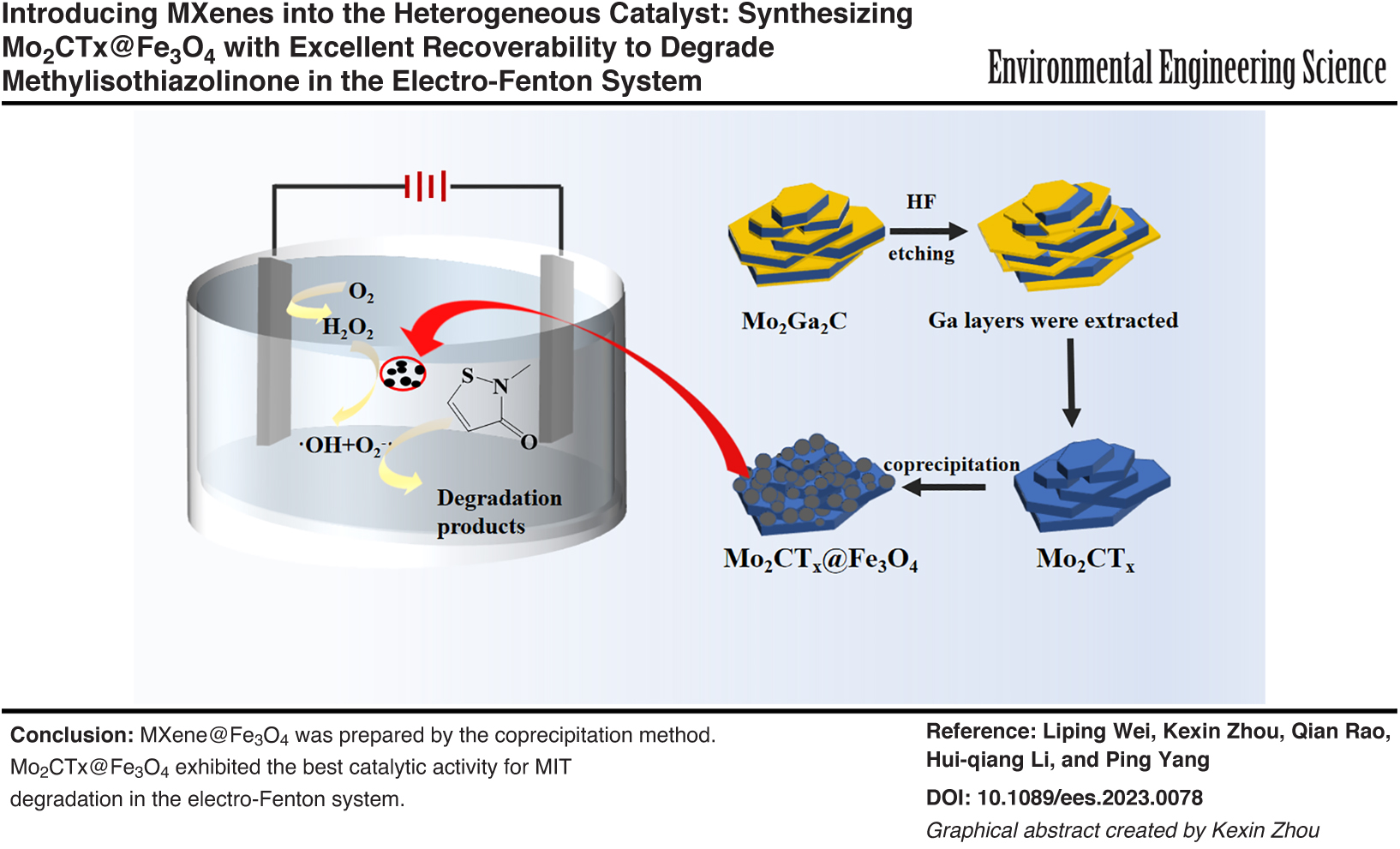
Methylisothiazolinone (MIT) is a commonly used bactericide in wastewater treatment. Residual MIT in wastewater can lead to high environmental risks and toxicity. In this work, an emerging material MXenes has been introduced into the heterogeneous electro-Fenton catalysts to degrade MIT. Ti3C2Tx@Fe3O4, V2CTx@Fe3O4, and Mo2CTx@Fe3O4 were assessed as catalysts for MIT removal.
The reasons for the differences among the three catalyst effects were analyzed according to different characterization results. Mo2CTx@Fe3O4 exhibited the best catalytic activity for MIT degradation. At pH = 3, the removal rate of MIT and corresponding chemical oxygen demand of catalyst Mo2CTx@Fe3O4 were 93.41% and 62.46% after 120 min.
Among the three catalysts, Mo2CTx@Fe3O4 had larger surface area and porosity. Mo2CTx@Fe3O4 had the highest surface iron content, which meant that Fe3O4 was more easily loaded on the surface of Mo2CTX. What is more, Mo2CTX had the strongest ability to accelerate the regeneration of Fe2+. The durability of Mo2CTx@Fe3O4 was also evaluated. After four cycles, the removal efficiency of MIT only decreased from 92.51% to 89%. This work supports the development of heterogeneous electro-Fenton catalysts and the degradation of MIT.
Introduction
Methylisothiazolinone (2
In the field of water and wastewater treatment, biocides are increasingly used to prevent biofilm buildup on the membranes of reverse osmosis (RO) systems (Li et al., 2016). And MIT was found at amounts of up to 160 mg/L in RO concentrates from wastewater reclamation plants (Tang et al., 2012). MIT was highly bio-toxic, which would affect the nitrification process (Amat et al., 2015). If released directly into the environment, the concentrated MIT can pose a higher environmental danger, as well as present challenges for bio-treatment if recycled in wastewater treatment plants (Wang et al., 2020b). As a result, effective MIT degradation methods need to be discovered.
Some investigations on MIT degradation have been conducted, including biological processes, electrochemical oxidation, photocatalytic degradation, and ozonation. Advanced oxidation processes (AOPs) have attracted extensive attention from many researchers because of their high mineralization efficiency and fast oxidation reaction, which have been applied to eliminate organic contaminants (Ma et al., 2021).
The Fenton process is the most widely used for wastewater treatment among the AOPs (Lin et al., 2022). The classical Fenton reaction refers to the activation of hydrogen peroxide (H2O2) by iron salts (Neyens and Baeyens, 2003). Instead, in the electro-Fenton system, H2O2 can be produced in situ and reacts with Fenton's catalyst, which produces .OH indirectly (Casado, 2019).
Many researchers have gradually begun to pay attention to heterogeneous Fenton catalysis to avoid the development of ferric hydroxide sludge and to avoid the effect of a limited pH range on homogeneous Fenton reactions (Zhu et al., 2019). The heterogeneous electro-Fenton reaction is constituted by Fenton chemistry and electrochemical synthesis of H2O2.
In heterogeneous catalysis, iron is stabilized within the catalyst's structure instead of being added directly. Therefore, heterogeneous Fenton catalysts can retain their stability to decompose H2O2 into ·OH, preventing the obvious leaching of iron ions and the generation of iron hydroxide precipitation (Rao et al., 2022; Zhu et al., 2019). There are a number of contentious issues or concerns in the development of heterogeneous Fenton catalysis, and one of the most important concerns is how to improve the catalytic activity (Zhu et al., 2019).
MXenes are an emerging family of two-dimensional (2D) transition metal carbides/nitride materials. MXenes are commonly made by etching out a layer (A) from a three-dimensional structure consisting of MAX, with a formula of Mn + 1XnTx, in which T signifies the functional group such as hydroxyl, oxygen, or fluorine and n is the integer (Kumar et al., 2022).
MXene sheets possess good electrical conductivity that are comparable to multilayer graphene, and the presence of -OH surface groups following the hydrogen fluoride (HF) treatment caused their high hydrophilicity with modest contact angles (Naguib et al., 2012). MXenes have high surface area and abundant surface-active sites. Importantly, the unique 2D-layered nanostructure and sheet surface electronegativity of MXenes can immobilize Fenton reagents inside the layer spaces and improve the distribution of functional nano-particles (Ihsanullah, 2020).
However, research on the application of MXenes in AOP is very limited, especially about the MXene-mediated heterogeneous Fenton-like reaction system for the rapid removal of MIT from water.
Herein, we synthesized three kinds of MXene (Ti3C2Tx, V2CTx, and Mo2CTx) by HF etching, and finally compounded the MXene@Fe3O4 hybrids by the coprecipitation method, so as to enhance the heterogeneous electro-Fenton efficiency. The influences of the three MXenes as Fe3O4 supporting materials on the removal efficiency of MIT and corresponding chemical oxygen demand (COD) were compared.
One of the desirable properties of the iron-based catalysts' supporting materials is the ability to perform multiple cycles and less leaching of Fe ions. Therefore, we also investigated the cycling of Mo2CTx@Fe3O4.
Material and Methods
Chemicals
Mo2Ga2C and V2AlC were purchased from Beijing Forsman Technology Co., Ltd. HF, FeCl3·6H2O, FeSO4·7H2O, H2SO4, NaOH, coumarin (C9H6O2), phenanthroline (C12H8N2), Na2S2O3, acetonitrile (CH3CN), and C4K2O9Ti∙2H2O were obtained from Chengdu Chron Chemicals Co., Ltd. 2-methyl-4-isothiazolin-3-one, Ti3AlC2, Na2SO4 was purchased from Aladdin reagent (Shanghai) Co., Ltd. All the chemicals used were analytical grade. All chemicals were used without any further purification.
Synthetic procedures
MXenes
In a typical synthesis, 2.0 g Ti3AlC2 powders were slowly added into 20 mL 40 wt% HF solution and stirred at 40℃ for 40 h to remove Al layer in a Teflon container. After HF treatment, the mixture was washed copiously by adding deionized water and centrifugation at 3000 rpm several times for 3 min per cycle until the pH of the supernatant of the last centrifugation was around 7.0. Subsequently, the sample was dried in a vacuum oven at 70°C for 24 h to yield Ti3C2Tx (Xi and Li, 2021). In addition, V2CTx and Mo2CTx were etched by this method.
MXene@Fe3O4
MXene@Fe3O4 was prepared by the coprecipitation method. First, stock solutions of 0.215 g FeCl2•4H2O, 0.583 g FeCl3•6H2O, and 1.7 mL HCl (6 mol/L) were prepared as a source of iron by dissolving the respective chemicals in 25 mL nitrogen-saturated deionized water. The mixed solution cited earlier was denoted as solution A. Similarly, stock solutions of 15 g NaOH and 0.4 g MXene (prepared Ti3C2Tx/V2CTx/Mo2CTx) were dispersed in 250 mL nitrogen-saturated deionized water as the alkali sources, denoted as solution B.
Solution A was slowly dropped into solution B, and then the precipitation was obtained by gentle magnetic stirring at 80℃ for 1 h. The precipitate was washed to neutral with deionized water and vacuum dried at 80℃ for 12 h to obtain MXene@Fe3O4 (Ti3C2Tx@Fe3O4, V2CTx@Fe3O4, Mo2CTx@Fe3O4).
Catalytic experiments
The relevant experimental parameters and steps are as follows: using a 100 mg/L MIT solution as a simulated wastewater treatment reaction, adding 50 mM of Na2SO4 as an electrolyte, setting the flow rate of the aeration pump at 0.2 L/min, and the speed of the mechanical stirrer was at 80 rpm to ensure that the catalyst was fully mixed in the solution system, and controlling the current to be constant at 300 mA.
Before each heterogeneous electro-Fenton experiment, adsorption saturation experiments were conducted on the catalyst under neutral conditions. The initial concentrations of MIT and Na2SO4, as well as other related parameters in the adsorption equilibrium experiment, were the same as those in the electro-Fenton experiment.
This experiment used a disposable syringe for water sample collection, with a sampling interval set at 30 min. Each sampling required a 0.45 μm needle filter for further collection and measurement. After each reaction, the surface of the electrode plate was cleaned with deionized water for 30 min to ensure cleanliness. Three parallel experiments were conducted for each group of experiments.
Analysis
UV–visible absorption spectra and fluorescence spectra were recorded on 752 UV–visible spectrophotometer (Jinghua, Shanghai) and F-7000 fluorescence spectrophotometer (Hitachi, Japan), respectively. All the samples were immediately filtered through a Millipore filter (pore size 0.45 μm). The concentration of MIT was measured by UV–Vis spectrophotometer (UV-2450, Shimadzu, Japan) at 273 nm.
The degradation efficiency was represented with (C0-Ct)/C0*100%, where Ct and C0 represent the instant and initial MIT concentrations, respectively. We used the standard dichromate method to measure COD. The concentration of H2O2 was determined by the potassium titanyl oxalate colorimetric method. Using coumarin as a quantitative probe to detect hydroxyl radical, the generated 7-hydroxycoumarin with strong fluorescence was detected at 456 nm (excited at 346 nm). 4-chloro-7-nitrobenzo-2-oxa-1,3-diazole (NBD-Cl) as a probe was used for the semi-quantitative determination of superoxide radicals. The concentration of ferrous ions was quantified by UV-vis spectrophotometry and 1,10-phenanthroline.
Results and Discussion
Synthesis and characterization
Scanning electron microscopy (SEM) was carried out to probe the morphology and structural feature of the three MAX, three MXenes (Supplementary Fig. S1d–f), and three MXene@Fe3O4 samples (Fig. 1a–c). Similar to those previous reports by Yi et al., (2020) and Matthews (Matthews et al., 2022), the layered Ti3C2Tx (Supplementary Fig. S1e) and V2CTx (Supplementary Fig. S1f) with a typical accordion-like architecture differed significantly from the pristine Ti3AlC2 and V2AlC MAX particles (Supplementary Fig. S1e, f insert), exposing much more basal plane and edge sites, which acted to support catalysts.
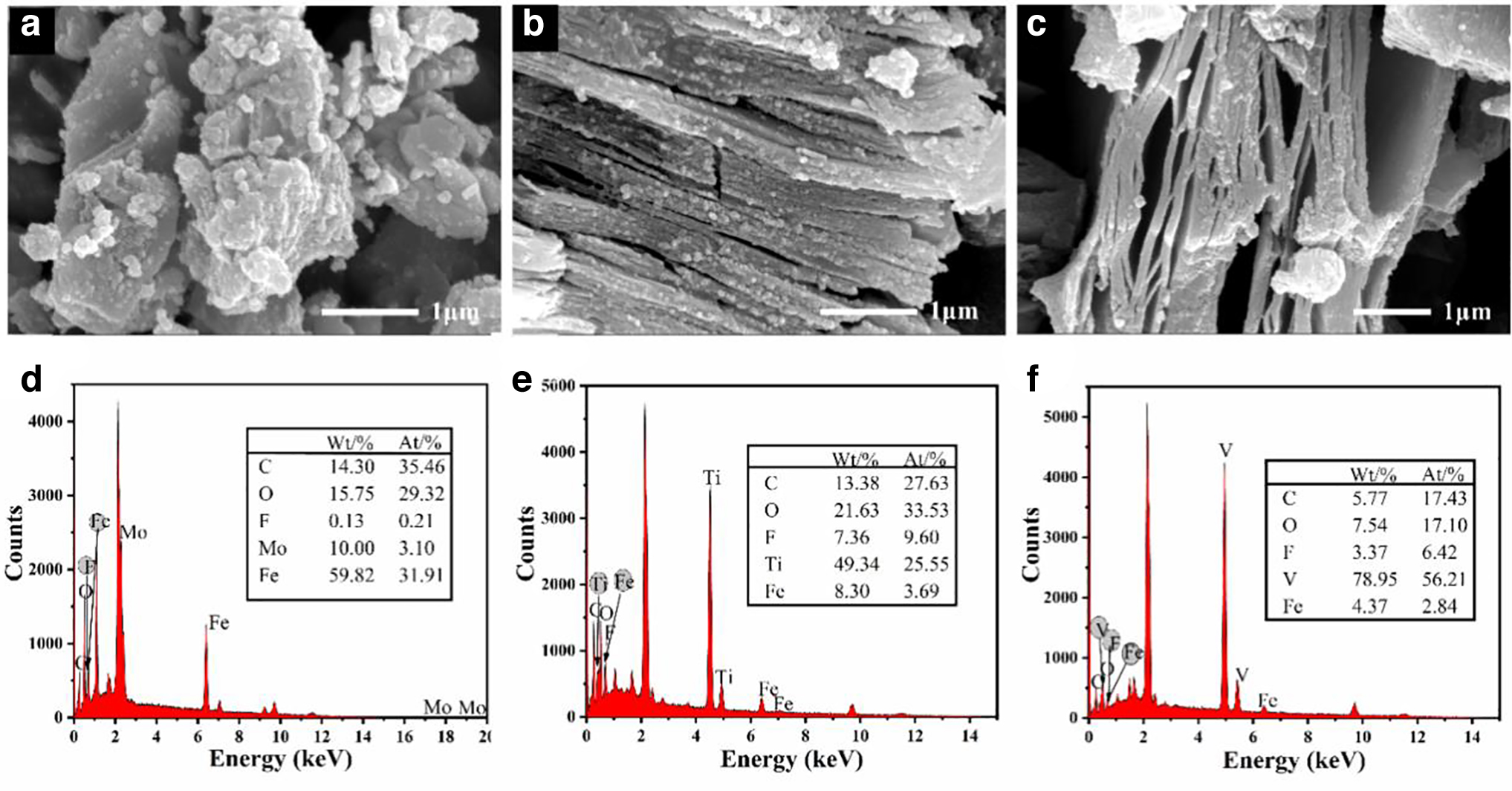
SEM patterns and EDS spectra of Mo2CTx@Fe3O4
The conversions to Ti3C2Tx and V2CTx were further confirmed by Energy Dispersive Spectrometer (EDS) elemental composition analysis and X-ray diffraction (XRD) results. As shown in Supplementary Fig. S1b, c, the signals of the Al element on Ti3C2Tx and V2CTx were very faint. EDS results in Fig. 1d–f also confirmed the presence of –F termination groups of MXenes.
The diffraction peak of Ti3C2Tx (Supplementary Fig. S2b) at 2θ = 39° was very weak after the HF exfoliation process, and it showed that the Al layer in Ti3AlC2 was almost eliminated by HF solution (Yi et al., 2020). The observed sharp XRD peaks of V2CTx in Supplementary Fig. S2c most probably originate from partially etched MXene particles that still contain Al (Thakur et al., 2019). Almost all MXene synthesized by HF etching would have a small amount of unreacted MAX phase (Naguib et al., 2012).
Supplementary Figure S1d showed the typical SEM image of Mo2CTX, which maintained the features of the MAX precursor. It could be seen from the figure that Mo2CTX had a layered structure. The EDS results in Supplementary Fig. S1a showed the presence of a large amount of Au in Mo2CTX. To better observe the morphology of the material, gold spraying treatment was carried out during the testing process, and the sample itself did not contain Au.
In the XRD patterns of Mo2CTX, Mo2CTX showed a wide peak at 7.3° after HF etching. It might be caused by the removal of Ga (Liu et al., 2021a). The yields of Mo2CTX, Ti3C2TX, and V2CTX were 43.39%, 77.13%, and 71.84%, respectively. The yields of Ti3C2TX and V2CTX were close to the respective theoretical yield. Due to the strong bonding of M-Ga in the precursor, it was more difficult to prepare Mo2CTx than Ti3C2Tx and V2CTx under the same conditions, so the yield of Mo2CTX was slightly lower than the theoretical yield.
As for the MXene@Fe3O4 composites, it could be observed that the MXene nanosheets were mixed with Fe3O4 nanoparticles (Fig. 1a–c). The EDS results of those three MXene@Fe3O4 composites are shown in Fig. 1d–f. It confirmed the presence of –F termination groups of MXene and the successful synthesis of ferroferric oxide. The atom percent of Fe in Mo2CTx@Fe3O4 was higher than that of Ti3C2Tx@Fe3O4 and V2CTx@Fe3O4. However, EDS only detected the surface atoms with a depth of a few nanometers.
The results detected by EDS only represented local element content and needed to be comprehensively analyzed in combination with other results. The crystal phase of the as-prepared materials was characterized using XRD. The XRD patterns of Ti3C2Tx showed typical peaks at 8.5°, 34.2°, 41.6°, and 60.4° attributed to (002), (101), (105), and (110) planes (PDF#52-0875), respectively.
Substantial reductions in the high index (101) and (105) planes of Ti3AlC2 confirmed the conversion of approximately all the Ti3AlC2 to Ti3C2TX (Rethinasabapathy et al., 2022). The XRD result of Ti3C2Tx@Fe3O4 (Fig. 2b) showed typical diffraction peaks of Fe3O4 at 30.2°, 35.6°, 37.1°, 42.8°, and 62.8° corresponding to the (220), (311), (222), (400), and (440) planes (PDF#19-0629), respectively.

XRD patterns of Ti3C2Tx
In the XRD pattern of Ti3C2Tx, it was recognized that the peaks at 17.8° and 27° represented Ti3C2(OH)2 (Qing et al., 2016). However, they disappeared as Fe3O4 nanoparticles were embedded in Ti3C2Tx (Li et al., 2021). The changes cited earlier proved the successful synthesis of Ti3C2TX@Fe3O4. The XRD patterns of Mo2CTX@Fe3O4 and V2CTX@Fe3O4 composites were consistent with the XRD patterns of Mo2CTX and V2CTX, respectively. No characteristic peak signal of Fe3O4 was detected in the XRD patterns of Mo2CTX@Fe3O4 and V2CTX@Fe3O4, but abundant Fe content could be detected in the EDS energy spectra.
X-ray photoelectron spectroscopy (XPS) was employed to investigate the chemical composition and the surface chemical state of MXene@Fe3O4 further. The high-resolution XPS survey spectrum of Mo2CTx@Fe3O4 revealed C 1s, O 1s, Mo 3d, Fe 2p, and Ga 2p peaks (Fig. 3A(a)). In the high-resolution XPS spectrum of Ti3C2Tx@Fe3O4 (Fig. 3A[b]), the distinct signals of C, O, Ti, F, and Fe elements were observed.

XPS spectra
The full spectrum in Fig. 3A(c) showed the coexistence of Fe, F, O, V, and C elements, consistent with the result of EDS. We further collected the data on chemical valence by fitting the high-resolution spectra of each element. Three pairs of peaks were identified in Mo 3d XPS spectrum (Supplementary Fig. S5e). The binding energies (BEs) of the Mo 3d5/2 peaks located at 228.0 eV corresponded to Mo-C of molybdenum carbides.
The Mo-C bond indicated that Mo2CTx was successfully synthesized. The BEs located at 229.2/232.2ev and 232.6/235.7ev corresponded to Mo4+ and Mo6+ species, respectively. The peaks of high-valence-state Mo were attributed to the inevitable partial oxidation of the active surface atoms of Mo2CTx (Mei et al., 2020). The peaks (Supplementary Fig. S5b) located at 283.54 eV and 286.05 eV were ascribed to the C–Mo bond and C–O/C = O (Cheng et al., 2018).
As presented in Supplementary Fig. S5, three samples all contained C–F corresponding peak (around 288.7eV). The indistinctive C–F might be derived by HF etching during the preparation process of MXenes (Wang et al., 2020a). The Ti 2p XPS spectrum (Supplementary Fig. S5d) was divided into three pairs of peaks. The two peaks at 454.9 eV (Ti 2p3/2) and 460.9 eV (Ti 2p1/2) could be ascribed to the Ti-C bond, respectively, indicating the presence of Ti3C2Tx (Peng et al., 2016).
The peaks (Supplementary Fig. S5a) located at 281.7 eV and 284.8 eV were ascribed to C-Ti-Tx and C-C (Yan et al., 2019). The V 2p spectrum (Supplementary Fig. S5f) showed that the surface of V2CTx was dominated by V4+ and V5+ (Liu et al., 2021b). The O 1s XPS spectrum was deconvoluted into tree component peaks at about 530.3 eV and 531.7 eV corresponding to V–O in oxide and O–H bond, respectively (Narayanasamy et al., 2020).
In addition, the peak at the binding energy value of around 715 − 735 eV was assigned to Fe 2p Fig. 3B showed that the binding energies of Fe 2p1/2 and Fe 2p3/2 were located at 724.4 and 710.6 eV, respectively, which suggested the successful synthesis of Fe3O4 on the MXenes (Yamashita and Hayes, 2008). For Mo2CTx@Fe3O4, Ti3C2Tx@Fe3O4, and V2CTx@Fe3O4, the XPS spectra displayed no major shift in the Fe 2p3/2 and Fe 2p1/2 peak values (Fig. 3B).
However, there were apparent changes in the peak intensity for Fe species in Fig. 3B. A low quantity of Fe2+ was also observed for Ti3C2Tx@Fe3O4 (Fig. 3B (b)) and still lower for V2CTx@Fe3O4 (Fig. 3B (c)) in comparison to Mo2CTx@Fe3O4 (Fig. 3B (a)).
Further, as the surface area and porosity characteristics are critical to the electrocatalytic performance, we also conducted Barrett–Emmett–Teller (BET) test. The N2 adsorption-desorption isotherms of Mo2CTx@Fe3O4, Ti3C2Tx@Fe3O4, and V2CTx@Fe3O4 are shown in Fig. 4. The detailed values of specific surface area, average pore diameter, and pore volume are presented in Table 1.
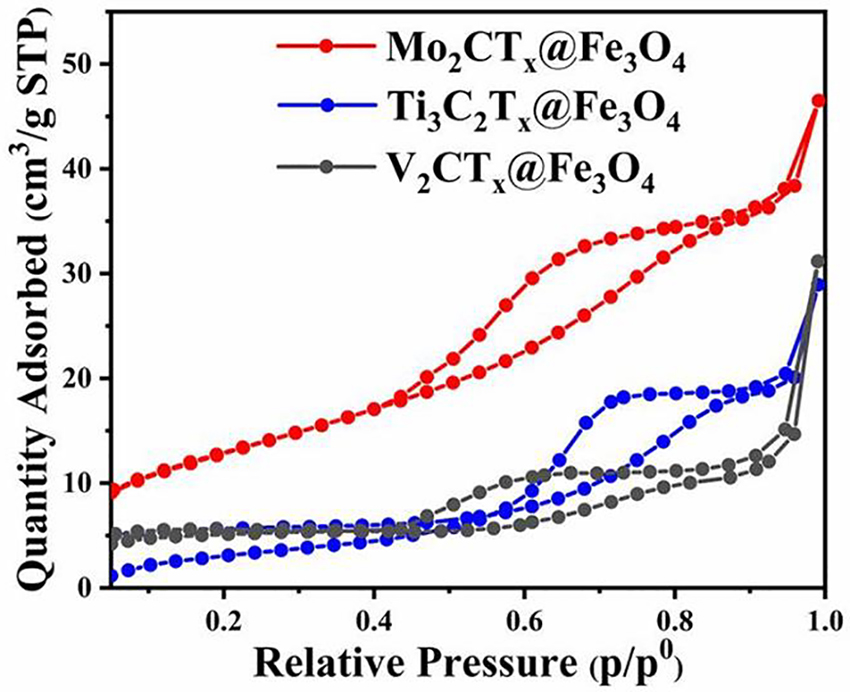
The N2 adsorption–desorption isotherms of Mo2CTx@Fe3O4, Ti3C2Tx@Fe3O4, and V2CTx@Fe3O4 (d).
Specific Barrett–Emmett–Teller Surface Area, Pore Volume, and Average Pore Diameter of the Ti3C2TX@Fe3O4, V2CTX@Fe3O4, and Mo2CTX@Fe3O4 Samples
According to the IUPAC classification (Thommes et al., 2015), three curves showed type IV isotherm (in) with one clear H2(b)-type hysteresis loop from P/Po ∼0.4 to 1.0, which was characteristic of mesoporous materials. The isotherm of samples possessed both mesoporous and microporous structures (Chandran et al., 2020). Different from the type H3 loop commonly found in plate-like particles, the H2 loop might be caused by the load of Fe3O4.
Moreover, the surface area of Mo2CTx@Fe3O4, Ti3C2Tx@Fe3O4, and V2CTx@Fe3O4 determined by BET was 47.66, 13.54, and 11.43 m2/g, respectively. Compared with Ti3C2Tx@Fe3O4 and V2CTx@Fe3O4, Mo2CTx@Fe3O4 had higher porosity and a larger surface area. A specific larger surface area provided a wider contact area of Fe3O4 and MIT, and afforded more exposed catalytic active sites, contributing to better catalytic performance. Higher porosity with bigger interconnected pores, on the other hand, would make it easier for reactants/products to access or escape the active areas (Wang and Tang, 2021).
Performance of catalysts in reactions
Catalytic degradation of MIT
The catalytic activity of the catalysts was evaluated through an electro-Fenton system. For comparison, the various catalysts of Ti3C2Tx@Fe3O4, V2CTx@Fe3O4, and Mo2CTx@Fe3O4 were investigated under the same conditions. And the results are shown in Fig. 5. The removal rate of MIT was calculated by measuring the concentration of MIT before and after the reaction, representing the removal of the compound.
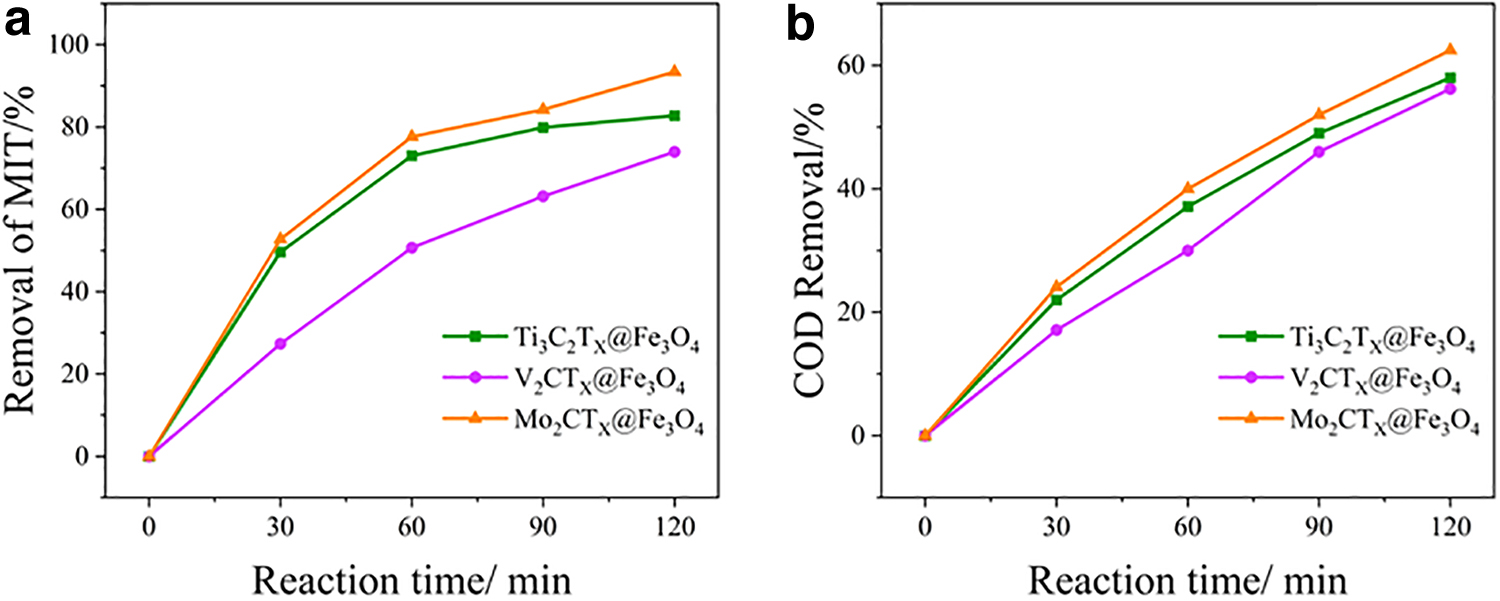
Removal of MIT by three catalysts: Ti3C2Tx@Fe3O4, V2CTx@Fe3O4, and Mo2CTx@Fe3O4
Accordingly, the COD removal rate tended to represent the complete mineralization degree of MIT. It was obvious that Mo2CTx@Fe3O4 had the best catalytic degradation effect of MIT, followed by Ti3C2Tx@Fe3O4, and V2CTx@Fe3O4 was the weakest. The COD removal rate (Fig. 5b) also had the same trend. We also conducted a control experiment using Fe3O4 as a catalyst.
Under the same experimental conditions, the removal rate of MIT after 2 h was 60.13%, confirming the role of MXene in the catalytic reaction. In the presence of Mo2CTx@Fe3O4, the COD removal efficiency at 120 min was 62.46% and the removal rate of MIT was 93.41% (supporting electrolyte = 0.05 M Na2SO4, initial pH = 3). In addition, when Mo2CTX was used as a catalyst to degrade MIT, the degradation rate of MIT was 73.01%, further indicating the synergistic effect of Mo2CTX and Fe3O4.
Wang et al. (2019) used a Ti/SnO2-Ab2O3/α, β-PbO2 electrode to degrade MIT, whereas the degradation rate of 100 mg/L MIT was 56.8% after 210 min of oxidation (supporting electrolyte = 0.1 M Na2SO4, initial pH = 5.35). At present, when the initial pH = 5 (Fig. 5a), using Mo2CTx@Fe3O4 as the catalyst, the removal rate of MIT and COD still reached 83% and 58.23%, respectively.
The electro-Fenton process combines an oxygen reduction reaction (ORR) and Fenton-like reaction for application in water treatment. In this work, hydrogen peroxide was not added, but 2-electron ORR occurred on the cathode plate [Eq. (1)]. In Supplementary Fig. S3a, V2CTx@Fe3O4 had the highest hydrogen peroxide concentration. Excessive H2O2 would eliminate free radicals [Eqs. (2) and (3)]. In addition, the rapid regeneration of Fe2+ was essential for the continuous production of ·OH.
Among Mo2CTX, Ti3C2TX, and V2CTX, Mo2CTX could accelerate the Fe(III)/Fe(II) cycle most quickly, which was mentioned later. When Mo2CTx@Fe3O4 was used as a catalyst, the formation rate of H2O2 was moderate and Fe2+ could be rapidly regenerated, so the amount of hydroxyl was the largest. Generally, active oxygen radicals (∙OH and ∙O2-) would be generated during H2O2 activation, which was responsible for the contaminant degradation. The trends of ∙OH (Supplementary Fig. S3b) and ∙O2- concentrations (Supplementary Fig. S3c) were consistent with the removal efficiency of MIT and COD.
As presented in Supplementary Fig. S1, three Mxenes had different lamellar structures, which affected not only the load of Fe3O4 but also the specific surface area. According to the EDS result, Mo2CTx@Fe3O4 had the highest surface iron content among three catalysts, which meant that Fe3O4 was more easily loaded on the surface of Mo2CTx.
Through the BET analysis, Mo2CTx@Fe3O4 had a high specific surface area and exposed more active sites. The porosity was also the largest, which would be conducive to the transport of Fe2+ in the electro-Fenton process. Mo2CTx, with a ternary precursor of Mo2Ga2C containing double A layers, was theoretically predicted to have high electrochemical and thermoelectric properties among all available MXenes (Wan et al., 2021). Ti3C2TX had excellent conductivity (Feng et al., 2020), which even exceeded the conductivity of Mo2CTX. Even so, the degradation effect of Mo2CTX@Fe3O4 on MIT was still stronger than that of Ti3C2TX@Fe3O4, indicating that conductivity did not dominate the reaction process.
There are two main reaction routes between heterogeneous catalysts and H2O2 (Thomas et al., 2021). The reaction of unavoidably leached Fe from catalysts with H2O2 under acidic condition homogeneous Fenton reaction [Eqs. (5) and (6)], and the reaction of surface Fe (≡Fe(II) and ≡Fe(III)) with H2O2 [Eqs. (7) and (8)].
It was generally believed that in the heterogeneous Fenton reaction, as long as the catalyst was stable under acidic conditions, the organic pollutants were mainly oxidized by the ROS produced by ≡Fe(III) or ≡Fe(II) (Zhu et al., 2019). Fe2+ played an important role in the electro-Fenton reaction. Of the three catalysts, Mo2CTX@Fe3O4 had the largest surface area.
The more catalytic active sites were exposed, the more Fe2+ could be absorbed on its surface to greatly promote the activation of H2O2. It has been reported that MXene could accelerate the conversion of Fe3+ to Fe2+ [Eq. (9)] (Song et al., 2021). The Fe 2p XPS spectrum (Fig. 3B) showed that the iron content of Mo2CTx@Fe3O4 was the largest in the synthesized MXene@Fe3O4, especially Fe2+.
The change of the content of different Fe species further illustrated a phenomenon that the addition of MXene could promote the conversion of Fe3+ to Fe2+ through the oxidation-reduction reaction between low valence atoms and Fe3+ (Chen et al., 2022). From Supplementary Fig. S5d–f, we could also see that the Mo–C bond was very strong.
The Ti-C peaks for Ti3C2Tx@Fe3O4 were weak, and the V–C bond in the V 2p XPS spectrum of V2CTx@Fe3O4 (Supplementary Fig. S5f) was almost absent. Among the three catalysts, Mo in Mo2CTX@Fe3O4 existed in a more reduced form. In other words, Mo2CTx had the strongest ability to accelerate the conversion of Fe3+ to Fe2+, which was also consistent with the degradation of MIT.
Based on the results cited earlier, we proposed a possible mechanism for the degradation of MIT in the heterogeneous electro-Fenton system. First, O2 underwent a 2-electron ORR at the cathode to generate H2O2, which reacted with Fe2+ loaded on the surface of MXene to generate ·OH.
At the same time, a small amount of ·O2- was generated during the electro-Fenton reaction process. Second, the reducibility of MXene could accelerate the transformation of Fe3+ to Fe2+, thereby producing more ·OH. Finally, active free radicals attacked MIT, causing it to decompose into intermediates or CO2 and H2O.
Catalytic performance of Mo2CTx@Fe3O4 at different pH
Initial pH had a significant effect on Fenton reaction. We controlled the initial pH in the range of 3–9 (Supplementary Fig. S6a, b). The removal efficiency of MIT decreased with the increase of initial pH, which accorded with the electro-Fenton reaction. The removal efficiency of COD also decreased. When pH >3, on the one hand, the homogeneous Fenton reaction of partially dissolved iron ions was disturbed.
On the other hand, H2O2 could become unstable and break up into O2 and H2O (Akerdi et al., 2017). The removal efficiency of MIT and COD still reached 76.6% and 49.1% after 120 min even at neutral pH. Nevertheless, in general, the Mo2CTX@Fe3O4 catalyst exhibited enhanced electro-Fenton performance over a wide range of pH values.
Recycling test
Actually, the stability of catalyst was of great significance for the catalytic reaction. Thus, cyclic experiments were carried out. Mo2CTx@Fe3O4 was collected with ultrapure water washing after each cycle, and then a new cycle was started after drying. The removal rates of MIT during the four consecutive runs were 92.51%, 92%, 91%, and 89%. There was almost no visible change in the MIT removal rate (Fig. 6) before and after four cycles.
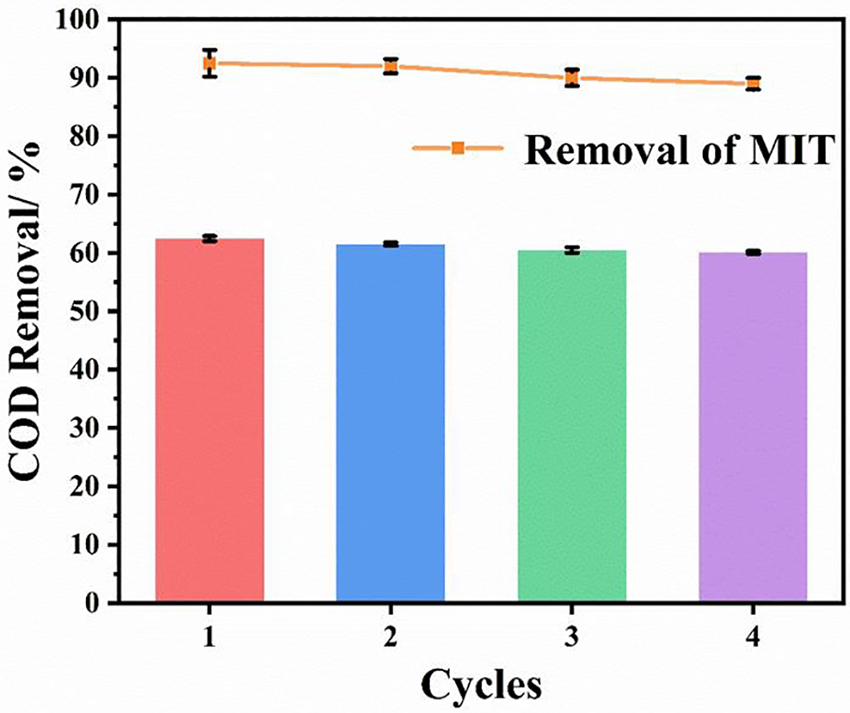
The reusability of Mo2CTx@Fe3O4.
These results confirmed that Mo2CTx@Fe3O4 could be reused at least four times without significantly reducing its efficiency, which would help reduce the cost of producing water treatment catalysts. The declining trend of the COD removal rate was also slight. Closely related to the stability and reusability of the catalyst was the absence of leaching of metal species from solid catalyst (Ganiyu et al., 2018). Only Fe2+ was involved in the catalytic process, so we measured its concentration, and the result is shown in Supplementary Fig. S4.
The content of Fe2+ leached by V2CTX@Fe3O4 was the highest, whereas the content of Fe2+ leached by Mo2CTX@Fe3O4 was initially high, but gradually decreased over time, whereas the content of Fe2+ leached by Ti3C2TX@Fe3O4 remained at a relatively low level. This indicated that Mo2CTX@Fe3O4 and Ti3C2TX@Fe3O4 had good reusability as catalysts.
Conclusion
Three types of MXene (Ti3C2Tx, V2CTx, and Mo2CTx) were synthesized by the commonly used HF acid etching method, used as heterogeneous Fenton catalyst-Fe3O4 supporting. MXenes had excellent ORR activity and stability, and MXene's multilayer structure could avoid aggregation of Fe3O4 to expose abundant active sites. Mo2CTx had relatively high electrochemical, provided a better place for in situ coprecipitate synthesis of Fe3O4, and also increased the specific surface area of the composites.
EDS and XPS results showed that Fe2+ content in Mo2CTX@Fe3O4 was higher than that of other catalysts. The rate of H2O2 generation by Mo2CTX was moderate, and Mo2CTX could accelerate Fe(III)/Fe(II) cycle faster. So Mo2CTX@Fe3O4 generated the most hydroxyl groups, which was consistent with the degradation rate of MIT.
In addition, Mo2CTX@Fe3O4 could be reused at least four times without significantly reducing its efficiency. Our research suggested that Mo2CTx@Fe3O4 is a promising catalyst for MIT degradation, and applying MXenes to modify iron-based materials is a feasible strategy for constructing heterogeneous Fenton catalysts.
Footnotes
Authors' Contributions
L.W.: Writing—original draft(equal); Formal analysis(equal). K.Z.: Writing—original draft(equal); Formal analysis(equal). Q.R.: Conceptualization(lead); Investigation(lead). H.-q.L.: Resources(lead); Writing—review and editing(lead). P.Y.: Supervision(lead).
Author Disclosure Statement
No competing financial interests exist.
Funding Information
This work was supported by the International Scientific and Technological Innovation and Cooperation Project of Sichuan (Grant No. 2019YFH0170).

References
Supplementary Material
Please find the following supplemental material available below.
For Open Access articles published under a Creative Commons License, all supplemental material carries the same license as the article it is associated with.
For non-Open Access articles published, all supplemental material carries a non-exclusive license, and permission requests for re-use of supplemental material or any part of supplemental material shall be sent directly to the copyright owner as specified in the copyright notice associated with the article.
