




Abstract
Showerhead filters are point-of-use devices installed just before showerheads to alter bathing water quality. Such products are gaining popularity but are presently not under any regulatory oversight. Sellers of showerhead filters make wide-ranging claims, including removing harmful substances, modifying pH, and adding elements to the water matrix, and tout health and cosmetic benefits, but without providing substantiating evidence upfront. This study evaluates selected water chemistry parameters, including pH and concentrations of vitamin C, fluoride, and chlorine, of five showerhead filters sold on AMAZON.COM and finds that most of the sellers' water quality claims are not met. Instead, some filters change a number of water quality parameters opposite to what is marketed, for example, water hardness and dissolved oxygen. We conclude that the sellers of showerhead filters are, at the very least, guilty of promoting misleading advertisements, but more likely culpable of exploiting pseudoscience to profit from consumers' poor literacy in water chemistry. This study is the outcome of a course-based research experience for senior undergraduate and junior graduate students implemented in a technical elective on environmental physicochemical processes. Through sharing the design and execution of this experimental investigation and discussing the wider pedagogical benefits, this study further aims to stimulate others to explore the integration of research and education. On a broader perspective, this study sheds light on the worrying contagion of pseudoscience in water quality engineering and underscores the urgent need to enlighten the public and promote their scientific literacy.

Introduction
In recent years, point-of-use (POU) water treatment filters have gained popularity among consumers in the United States and worldwide (Wu et al., 2021). POU filters are devices placed just after taps, faucets, or dispensing outlets to treat water for different purposes (e.g., drinking, cooking, and bathing). While the most common POU filter application is drinking water treatment, particularly to reduce pathogens and heavy metals in water before consumption, POU showerhead filters have also become a relevant market (Wu et al., 2021).
Based on data from AMZScout, a third-party product research tool for Amazon.com, average sales of the current top 10 best-selling POU showerhead filters on the online retail platform were ≈38,000 units/month in 2021 and 54,000 units/month in 2022 and are projected to grow substantially in 2023 (over 500,000 units were already sold from January to May 2023, i.e., averaging ≈103,000 units/month) (AMZScout, n.d.). Such filters ubiquitously advertise health and beauty benefits through improved quality of the shower water. Although termed “filters,” these products purportedly add compounds to the effluent water in addition to removing undesirable compounds.
As showerhead filters can modify tap water, which is regulated by the U.S. Environmental Protection Agency under the Safe Drinking Water Act (Kempthorne, 1996), it is pertinent to understand the effects of the products on water quality. Showerheads may present a notable potential exposure to waterborne illnesses and health impacts, with past studies finding disease-causing microbes, such as Legionella pneumophila and opportunistic pathogens, present in showerheads (Bollin et al., 1985; Feazel et al., 2009). Although some studies have examined the microbiology of showerhead, hose, and shower filter water (Feazel et al., 2009; Proctor et al., 2018; Sasahara et al., 2020), research on the water chemistry is sorely lacking.
At present, there is no oversight of showerhead filter water. Therefore, the sellers' claims are effectively not verified. For consumers, anecdotal reviews become the likely main source of information for validity of the claims (Komendantova et al., 2021). At the same time, there are numerous websites promoting showerhead filters as a health and safety imperative (Adelson et al., 2021; DiscountFilters, 2018).
In this study, the water quality of five popular showerhead filters sold on AMAZON.COM (abbreviated to Amazon hereafter) is evaluated and cross-checked with the sellers' marketed claims. The showerhead filters are challenged with feed solutions of environmentally relevant chemistries, and eight water quality parameters, namely pH, dissolved oxygen, hardness, fluoride, nitrite, nitrate, chlorine, and vitamin C levels, are analyzed. The effluent water quality is scrutinized in relationship to the claims and general health outcomes, and plausible physicochemical mechanisms for the observed changes are offered where applicable.
This study is conducted as a course-based research experience for senior undergraduate and junior graduate students (i.e., Master's students and first- and second-year doctoral students) in a technical elective on environmental physicochemical processes, and the students are coauthors on this article. Design and execution of the research project are shared, and the merits of integrating research with education are discussed. Finally, we offer our perspectives on the implications of the study findings on the proliferation of pseudoscience and the pressing need to elevate scientific literacy of the general public across broader water, health, and environmental topics.
Materials and Methods
Chemicals and showerhead filters
All chemicals used in this study are reagent grade and were used as-received (further information can be found in the Supplemental Information). Deionized (DI) water was obtained from a Milli-Q ultrapure water purification system (MilliporeSigma). Five showerhead filters were purchased from online retail platform Amazon and referred to as Filters A–E, that is, the filters are blinded in the presentation of results. Images of the filters are displayed in Supplementary Fig. S1, and Table 1 shows the seller-specified materials within each filter.
Filter Contents Disclosed by the Sellers
Note that nonchecked boxes do not necessarily indicate a definitive absence of that component, but rather that the sellers did not explicitly claim to have that material in their filters.
KDF, Kinetic degradation fluxion.
Sample collection
Water was pumped through the showerhead filters using a gear pump (WT3000-1FB, Baoding Longer, Hebei, China) at a flow rate of 1.8 L/min. Each filter was initially primed with 1.0 L DI water before the analyses. 300–500 mL of feed water (∼3.6–5.3 reactor volumes) was run through each filter to flush out any leftover priming solution, and the next ≈200–300 mL of effluent from the filters was collected for analysis. All experiments were conducted with feed water heated to 39 ± 2°C using a water bath (WBE10A11B, PolyScience, Niles, IL, USA), to simulate warm shower water.
Analysis of water quality parameters
Eight water quality parameters were characterized: pH, hardness (Ca2+ concentration), dissolved oxygen, vitamin C, fluoride, nitrate, nitrite, and chlorine. For all parameters except dissolved oxygen and vitamin C, feed waters were prepared by spiking the appropriate chemical(s) into deionized (DI) water. The feed waters for dissolved oxygen and vitamin C measurements were unmodified DI water. Methodologies for the analyses are detailed in the Supplemental Information.
Course-based research experience project design and execution
The semester-long (16 weeks) course, Environmental Physicochemical Processes, is intended for senior undergraduates (i.e., fourth year) and graduate students (including Master of Science [MS], and Doctor of Philosophy [PhD]). The course covers fundamentals and applications of key physicochemical processes relevant to water quality engineering and the natural environment. The five students enrolled in the spring 2021 semester, comprising one senior undergraduate, two MS students, and two PhD students, carried out the project as a group and coauthored this study.
The course meets for 1 h 15 min twice a week; for the spring 2021 semester, the class met virtually, as the campus had not fully reopened due to restrictions stemming from the COVID-19 pandemic. For that semester, the term project made up 40% of the overall grade. The graded deliverables were a written report (which formed the basis for this article), a mid-semester oral presentation with project updates, and a final oral presentation. The assessment criteria for the term project were (i) articulation of motivation and problem statement (5% of term project grade), (ii) breadth and depth of literature review (10%), (iii) technical rigor of experimental plan (25%), (iv) criticality of analysis and synthesis of findings (25%), (v) clarity of oral and written presentations (15%), and (vi) demonstration of understanding of physicochemical principles (20%).
Note that criterion vi specifically anchors the term project to the lecture material of the course. The grading expectations were communicated to the students throughout the semester. At the outset of the semester, the students used class time to collaboratively develop a term project within the theme set by the instructor for the present iteration of the course: “evaluation of commercial water purification products.” After brainstorming, preliminary literature review, and deliberation, the students, with inputs from the instructor, elected to study showerhead filters. Motivation for the project was driven by (a) relevance of the sellers' product performance claims to the course content, (b) paucity of existing research on the topic, (c) general lack of water quality regulations around showerhead filters, and (d) the potential for broad interest to the general public.
The students began the project by reviewing literature on the water quality associated with showerhead filters. Next, a list of parameters to test was composed, which were derived from the water quality claims of the selected filters and other known parameters of concern. Methodologies to characterize water quality were also surveyed, as the material was not covered in the lectures. The original list of parameters was then narrowed down to factors that were relevant to the most filters and have potentially significant physiological or health impacts. The class coordinated access to the department teaching laboratory and research space of the corresponding author's laboratory, within physical distancing rules, to conduct experiments.
To the extent possible given time and instrument constraints, U.S. Environmental Protection Agency-approved protocols were adopted for the tests (some water quality parameters were not selected for analysis as the required resources for characterization were beyond the reach of the class). Where strict adherence to standardized procedures was not possible, the students conferred with the instructor to find alternative methods that are still technically robust, thereby ensuring reliability of the test results. Reactor design principles from the course were applied to fabricate the experimental set-up from scratch. Operating conditions to consider included the following: flow rate, feed water temperature, bed volume, and sampling technique.
To facilitate execution of the study, the course instructor implemented a number of teaching adaptations. Chronological order of the lectures was thoughtfully altered to present modules most relevant to the study (e.g., redox, adsorption, and ion exchange) earlier in the semester. In addition, some of the modules were modified to include appropriate technical concepts that are potentially beneficial for the project (e.g., thermodynamics of ion exchange). Some materials that were usually covered in lectures were prerecorded for asynchronous viewing. This freed up class time for the students and instructor to update on project progress, troubleshoot difficulties encountered, and analyze test results.
Results and Discussion
All sellers make a plethora of claims about the water quality, and health and cosmetic benefits of the filter effluent
The five products selected for this study were among the most popular showerhead filters available on Amazon. At the time of the study, the number of customer reviews were as high as 34,388 (Filter A), with ratings of 4.1–4.5 out of 5.0 stars. Furthermore, all the filters were reasonably priced (USD$20–45), a likely factor contributing to their popularity. Tables 2 and 3 specify the water quality modification claims and alleged health and cosmetic benefits, respectively, publicized by the sellers for each product.
Water Quality Modification Claims Made by the Sellers for Each Showerhead Filter (Information was Accessed Over Several Days in April 2021)
Claim was made by the company under the Q&A section rather than in the direct-to-consumer advertisement.
Contradicting information provided by the seller, such as concurrent claims to remove and to not remove a compound.
Claimed Health and Cosmetic Benefits of the Showerhead Filters (Information was Accessed over Several Days in April 2021)
The number of water quality modification claims made varies considerably, with Filter C having the most (25) and Filter B having the least (6). Notably, some claims directly contradict one another (Table 2). Filter D states that the filter softens water (i.e., reduces water hardness) while simultaneously touting the ability of the filter to retain “beneficial minerals” such as calcium and magnesium, which are the two primary components of water hardness. The product also simultaneously claims to add and remove selenium. Opposing claims are also seen between sellers, for example, Filter C and Filter E remove iron, whereas Filter D adds the element to water. Filter A states in one customer Questions and Answers (Q&A) that the product does reduce bacteria and, in another Q&A, that it does not reduce bacteria.
Health and cosmetic claims are mostly on improving skin, hair, and nails. However, some vague marketed benefits were also noted, which we thought bordered on being brazen and bizarre, such as improved state of nerve centers and sleep quality. Although the claims vary considerably, every brand alleges to remove chlorine, affect pH, and improve hair and skin conditions. Note that the information was accessed over several days in April 2021. The sellers may have changed some of the above claims since then. Almost all the health and cosmetic claims in Table 3 are not readily verifiable within the defined scope of this study. To narrow down the scope, eight water quality parameters are selectively chosen to fact-check against the advertised functions of the showerhead filters.
Four filters affect pH as claimed
All filters claim to affect the pH. Specifically, Filter A claims to “balance the pH,” Filters D and E claim to increase the pH, Filter B claims to “maintain the body's natural pH,” and Filter C claims to “restore pH.” Because “balance” and “restore” pH are vague, we interpreted these to mean the filter would bring the pH toward neutral, that is, 7. “The body's natural pH” is also nonspecific; here, “maintain” is taken to mean bringing the pH to the skin surface pH of ≈5.5 (as a comparison, pH of most bodily extracellular fluids is ≈7.35–7.45) (Tortora and Anagnostakos, 1987).
All filters are evaluated with acidic, neutral, and basic feed solutions, and pHs of the effluents are summarized in Fig. 1a–c, respectively. Horizontal lines denote the initial pHs of the feed solutions. In addition, visual aids of stars and up arrows are included to indicate the claims to change the pH to 7.0 or 5.5 and increase the pH, respectively.

Resultant pHs of the filter effluents for feed solutions with an initial
Filter A is the only filter that decreases the pH with all three feed solutions of different initial pHs. This appears to be inconsistent with the seller's claim to “balance” the pH. Filters B and C both increase the pHs when the feed is acidic and neutral but decrease the pH when the feed is basic. In all three initial feed solution pHs, Filter B does not alter the effluent to the pH range typical of skin surface, if that is indeed the intended purpose (although the filter does slightly lower the pH of the basic feed solution). Filter C does seem to move the pHs toward neutral for the acidic and basic initial solutions, but the pH of the neutral feed solution is raised to the basic range (8.3).
Filters D and E increase the pH for all three feed solutions, performing as claimed. Filter D produces the largest changes, with H+ concentration decreasing by as much as two orders of magnitude (for the acidic and neutral feed solutions). However, as mentioned previously, surface pH of healthy skin is 5.4–5.7 (Braun-Falco and Korting, 1986), and alkalization is considered to be damaging, with changes in pH reported to play a role in the pathogenesis of skin diseases (Schmid-Wendtner and Korting, 2006).
The filters do not explicitly specify the mechanisms of pH modification but, here, some plausible explanations are posited based on the filter contents and claimed modifications to the water chemistry (Tables 1 and 2, respectively). The introduction of weak acids, for example, vitamin C, which is ascorbic acid (pKa,1 = 4.17), can lower the effluent pH. Filters A and B claim to add vitamin C, and Filter E lists vitamin C as a filter component. Conversely, the addition or removal of weak bases, such as CaCO3, would increase or decrease the effluent pH, respectively.
All the filters, except Filter B, claim to add or remove polyvalent cations (e.g., aluminum, iron, and lead). Because polyvalent cations are frequently present as hydrated metal aquo complexes in aqueous solutions, adding or removing the metal ions will alter the aqueous chemistry of the solutions and likely affect the effluent pHs. Overall, there are likely numerous, and often intertwined and competing, mechanisms for pH modification.
Concentrations of calcium ions are higher in filter effluents than in feed solutions
Hardness is a measure of dissolved polyvalent metal ions, primarily calcium and magnesium. Hard water decreases the effectiveness and solubility of soaps (USGS, n.d.); the latter effect can markedly increase soap deposits on the skin, causing elevated transepidermal water loss and irritation (Danby et al., 2018). Four filters explicitly claim to soften water or reduce scaling: Filters A–D. The accuracy of these claims is tested by analyzing the concentration of calcium ions in the filter effluents challenged with feed water spiked with Ca2+. The effluent Ca2+ concentrations are presented in Fig. 2 for initial feed Ca2+ of 0.98 mM (60 mg/L as CaCO3). The horizontal line denotes the initial feed concentration, and the empty bar indicates that the filter does not claim to affect water hardness. The down arrows indicate filters that claim to reduce the water hardness.

Calcium ion concentrations in the filter effluents. Initial concentration in the feed water is shown as a horizontal line at [Ca2+] = 0.98 mM. The empty bar indicates that the filter did not claim to affect water hardness. Downward-pointing arrows indicate that the filters claim to reduce water hardness. Columns and error bars are means and standard deviations, respectively, of at least duplicate experiments.
For all five filters, the effluent calcium concentrations are higher than or the same as the initial feed solutions. In particular, Filter A shows the greatest increase in Ca2+ concentration, with an effluent concentration 1.7 × higher than the influent Ca2+ concentration. Therefore, none of the filters perform as claimed. Although the filters do not specify their water softening mechanism, all but Filter B claim to contain zeolites. Certain natural zeolites have been shown to soften water through ion exchange, in which Ca2+ and Mg2+ are exchanged for presaturant ions (typically Na+) (Kumar et al., 2019). Ca2+ reduction by ion exchange with the zeolite was corroborated by the detection of Na+ peaks in the IC analysis of every effluent sample (Supplementary Fig. S2). However, any hardness removal, by zeolites or otherwise, is overwhelmed by other processes that increase calcium concentrations.
One possible explanation for the increase in Ca2+ concentration is the presence of calcium sulfite (CaSO3). All five filters, except for Filter B, claim to include CaSO3 in the filtration media. Dissolution of the readily-soluble salt will leach calcium into the effluents. Filters A, C, and D also report kinetic degradation fluxion (KDF) media, which appears to be a redox-active material (Lenntech, n.d.), as a filter component. We note that information on the working principles of KDF provided on the seller's website is limited and, in our assessment, falls short on technical coherence; rigorous scientific studies on the product are absent. Regardless, oxidation or reduction of the material could plausibly release Ca2+ into the aqueous solutions.
In addition, in the previous discussion, we posited that pH could be altered by the dissolution of carbonates or bicarbonates. If the solids are calcium (or magnesium) minerals, for example, CaCO3, it would explain the increase in hardness as well. On the whole, any water softening capabilities of the filters, if present at all, are completely negated and rendered insignificant by Ca2+ leached from other components of the filter media.
The filters decrease dissolved oxygen levels
Figure 3 shows effluent dissolved oxygen (DO) levels, with a horizontal line indicating the DO concentration of a sample that exits the control setup (same pump and tubing but without a filter). Filter A is the only filter that claims to increase DO levels and is represented by a filled column (empty columns of other filters indicate that claims are not made). The product information alleges DO will “help nourish skin, hair, and nails,” but the claim is not backed up by established peer-reviewed scientific studies. Regardless of the potential benefits of elevated oxygen concentrations, DO levels are lower in the Filter A effluent than in the control sample by 37%. All of the other filters depress DO levels as well, as seen in Fig. 3, with Filters B and D showing even larger depletions in DO than Filter A.

DO concentrations in the filter effluents. Horizontal line at 0.94 mg/L denotes the DO concentration of water that passed through the pump and tubing of the setup but not through any filter (i.e., control). The empty bars indicate that the filters do not claim to affect DO concentrations. Upward-pointing arrow indicates that the filter claims to increase DO levels. Columns and error bars are means and standard deviations, respectively, of at least duplicate experiments. DO, dissolved oxygen.
One of the contents of Filter A is calcium sulfite, an oxygen scavenger widely used in the pharmaceutical, medical, and food and beverage industries. In drinking water filters, calcium sulfite is often present for chlorine removal. SO32–(aq) from dissolution of CaSO3(s) can rapidly react with dissolved oxygen to yield SO42–(aq) (Barron and O'Hern, 1966), thus lowering DO concentrations. Calcium sulfite is listed as a component of all the filters except for Filter B and is likely responsible for the lower levels of DO observed in the filter effluents. Oxidation of transition metals, such as Fe (II) in minerals and stainless steel mesh to Fe (III), can also deplete DO, but the reaction kinetics are likely to be too slow to substantially affect water quality of the filter effluents. Overall, any oxygenating capacity of the filters, if present at all, is negated by O2-consuming processes.
Vitamin C added to the effluents is still well below the natural concentration in skin
Filters A, B, and E claim to add vitamin C (ascorbic acid) to the effluent water. Vitamin C occurs naturally in normal skin, aiding in collagen synthesis and protection against ultraviolet-induced damage (Pullar et al., 2017). The compound can be found in a plethora of topical skincare products, likely because of its antioxidant benefits (Al-Niaimi and Chiang, 2017; Wang et al., 2018). The titration results, presented in Fig. 4 (horizontal line at 2.3 μM denotes vitamin C concentration in a sample that has passed through the control setup), suggest that the compound is indeed added to the effluents.
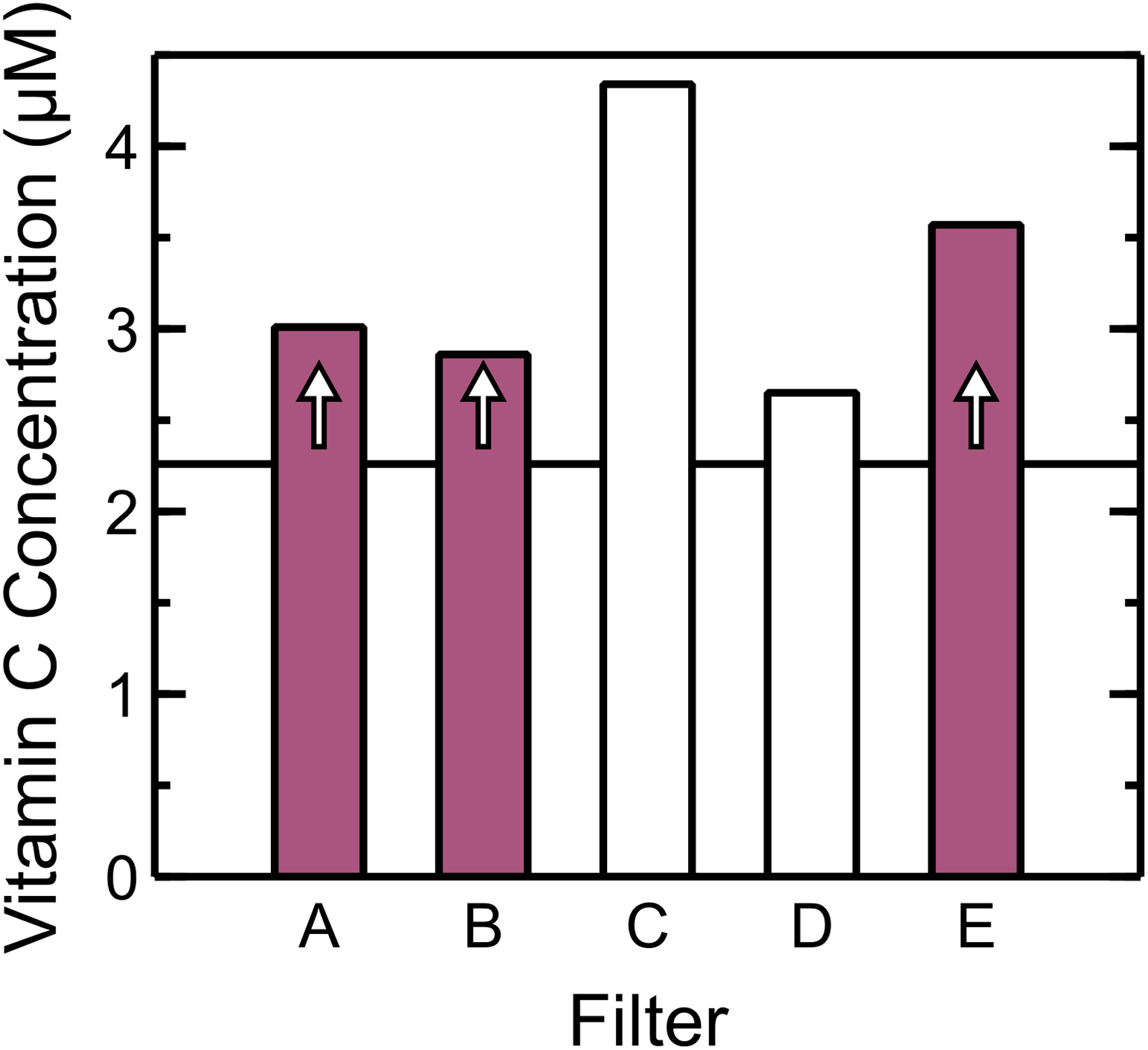
Vitamin C concentrations in the filter effluents. Horizontal line at 2.3 μM denotes the vitamin C concentration of water that passed through the pump and tubing of the setup but not through any filter (i.e., control). The empty bars indicate that the filters do not claim to affect vitamin C concentration. Upward-pointing arrows indicate that the filter claims to increase vitamin C levels.
However, the highest measured concentration is only 4.3 μM (Filter C, which notably does not claim to add vitamin C). This concentration is 2–3 orders of magnitude lower than the natural vitamin C concentration of the epidermis, which ranges from 0.35 to 3.7 mM (Pullar et al., 2017), and 4.8–5.4 orders of magnitude lower than the concentrations of recommended topical vitamin C serums, which range from 5% to 20% w/w vitamin C (Al-Niaimi and Chiang, 2017; Zielinski and Pinnell, 2005).
Vitamin C is not stable in aqueous solutions, as it readily oxidizes to dehydroascorbic acid, particularly in warm water and in the presence of dissolved oxygen (Blaug and Hajratwala, 1972; Duncan and Chang, 2012). In addition, transdermal absorption efficiency is generally low (Wang et al., 2018). Therefore, vitamin C present in the shower water, regardless of the concentration, is unlikely to have any significant physiological effect.
There is no statistically significant removal of fluoride, nitrate, or nitrite
Filters C

Fluoride concentrations in the filter effluents with initial fluoride concentrations of ∼2.5 × the MCL
The three filters that advertise fluoride removal do not have components specifically intended for that purpose. Therefore, the inability of the filters to remove the anion is unsurprising. Although Filter C acknowledges in their Q&A section on Amazon that their product is not designed to remove fluoride, they contradictorily claim otherwise in their product description (Table 2). Both Filters D and E double down on fluoride removal claims in their Q&A sections, in addition to touting the capability in their product specifications. Filter D states that zeolites, which are present in their filter, have been proven to significantly reduce fluoride levels. Past studies have indeed reported that zeolites can remove fluoride by ion exchange and adsorption (Bhatnagar et al., 2011; Onyango et al., 2004; Sun et al., 2011). However, zeolite-containing filters are unlikely to achieve meaningful F− reductions in the effluents.
In mixed electrolytes, ion exchange is governed by the relative concentrations of the different anions (Crittenden et al., 2012). In tap water, Cl− is predominant and will, hence, inevitably outcompete F− for ion exchange sites. Moreover, ion exchange is determined by the order of selectivity, with counterions of higher valency generally preferred (Kumar et al., 2019). Adsorption efficiency depends on the type of zeolite and metal ion loading; it is unclear whether the zeolite purportedly present in Filter D is suitable for removing fluoride from the specific water chemistry. Filter A, which also reports to contain zeolite, explicitly states that the filter cannot remove fluoride, adding that the anion is very difficult to remove in showerhead filters due to fast flow rates. According to the U.S. Environmental Protection Agency, distillation and reverse osmosis are the only recommended methods for fluoride removal in POU filtration systems (EPA, 2011).
Although none of the filters claims to remove nitrate or nitrite, the compounds are included in the evaluation as they are common water impurities with known health impacts (Ward et al., 2018). Supplementary Figure S3a–f of the Supplemental Information shows nitrate and nitrite concentrations of the effluents. Statistically significant concentration changes are observed for nitrate, which increases in the effluents of several filters rather than being reduced: Filter A (initial feeds at 0.5 × and 1 × MCL), Filter B (all feed concentrations), Filter C (0.1 × and 0.5 × MCL), Filter D (all feed concentrations), and Filter E (0.1 × MCL). We conjecture that the elevated nitrate levels are caused by dissolution of trace amounts of nitrate salts in the filter media.
The filters decrease chlorine levels by over 50%
Every filter claims to reduce chlorine levels, and all five meet this claim. Several filters advertise that removing chlorine will alleviate itchy skin, dry hair, and brittle nails. Studies of chlorine exposure in swimming pools substantiate the hair- and skin-related claims; additionally, one study specifically found that exposure to chlorinated shower or bath water can lead to dry and itchy skin for people with eczema (Couto et al., 2021; Seki et al., 2003). Benefits of dechlorinated water on nail health, however, remain unsubstantiated by scientific studies to the best of our knowledge. The removal efficiency of chlorine from each shower filter is determined at nominal concentrations of 3.0 and 5.0 mg/L sodium hypochlorite to simulate the odor threshold and the World Health Organization MCL, respectively, and the results are shown in Fig. 6a, b.
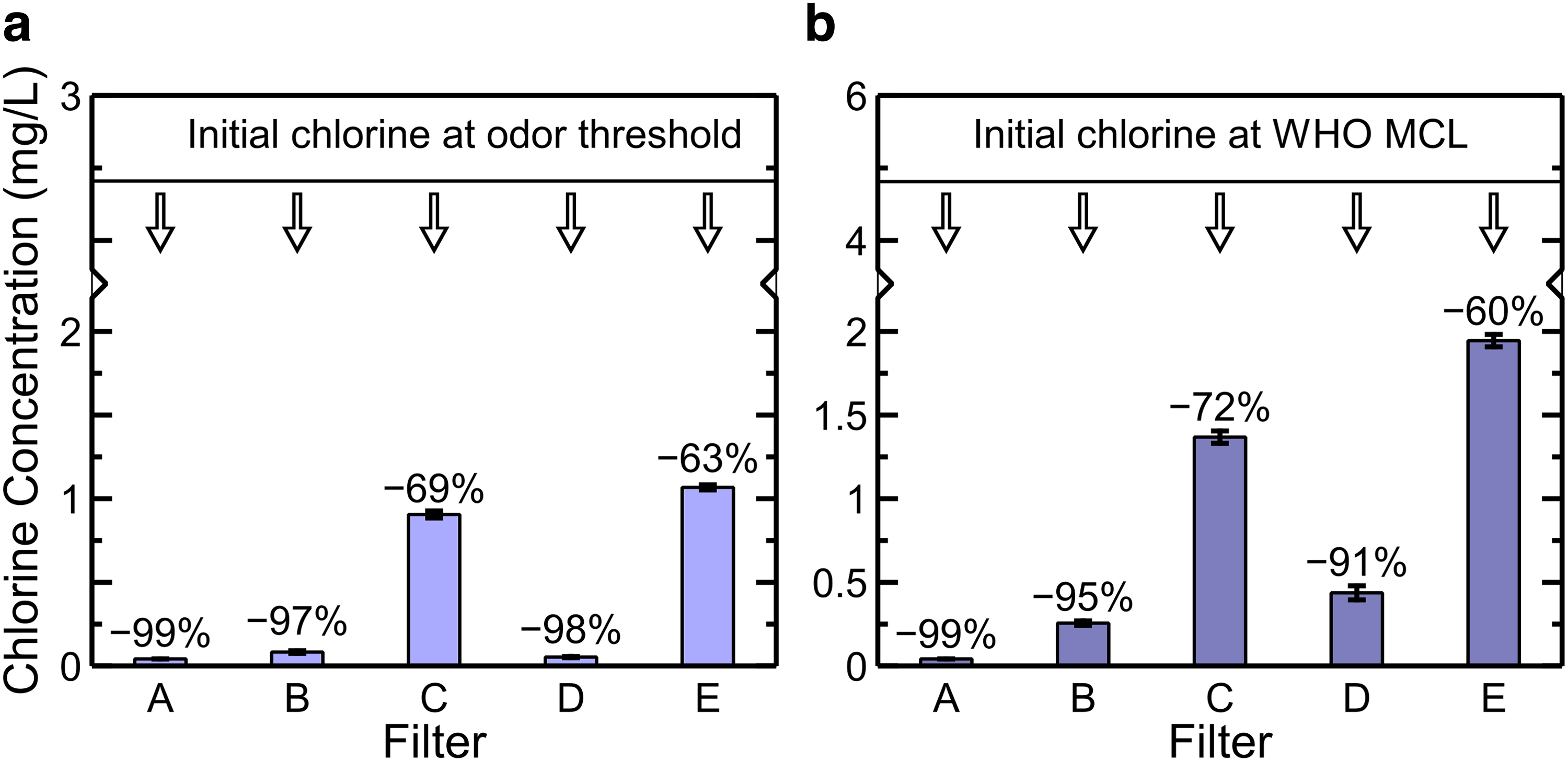
Chlorine concentrations in filter effluents from feed waters simulating the odor threshold
The filters remove 60–99% of influent chlorine. Filter A is the most effective, removing over 99% of chlorine at both concentrations, followed by Filters B and D, with 91–98% removal. On the contrary, chlorine removal performance is appreciably poorer for Filters C and E, with reductions of 69–72% and 60–63%, respectively. Overall, Filter A achieves ∼2-log reductions in chlorine, Filters B and D exhibit >1-log removals, whereas Filters C and E lower chlorine by around two-thirds.
Chlorine is a strong oxidizing agent and is readily consumed in redox reactions. By oxidizing redox-active filter components, such as vitamin C, calcium sulfite, KDF media, activated carbon, or transition metal cations in the stainless steel mesh, chlorine is reduced to chloride ions. Filters A and C explicitly name calcium sulfite, redox media (e.g., KDF media), and activated carbon as the primary mechanisms for chlorine reduction, and all five filters contain at least one of these reducing agents. Because the water flow rate in these experiments (1.8 L/min) is well below the typical flow rates in showers (≈7.6–9.5 L/min) (EPA, 2018), the actual hydraulic retention times will be ∼5 × shorter and, therefore, the extent of chlorine reduction is likely lower than the results observed here.
In addition, long-term efficacies of chlorine removal for the filters are not known. The amount of water passed through the filters in this assessment is essentially negligible relative to the volume flows over the product lifetimes. Further investigations will be needed to evaluate whether the ability of the filters to remove chlorine persists in longer terms.
Educational impacts
This study is an outcome of a class project for a technical elective. By discussing the incorporation of this research into the semester-long course, we hope to stimulate the conversation on connecting theory with practice and integrating research with education.
Educational integration
The course can synergistically support this research, primarily by providing theoretical background on the physicochemical processes relevant to the water chemistry. Examples of applicable course content include reactor engineering, adsorption, ion exchange, redox, advanced oxidation, colloidal science, and granular filtration. Strong foundational understanding of these topics equipped the students to deepen their analysis of the experimental data, for example, when modeling the kinetics of chlorine removal and fluoride adsorption, and to postulate plausible mechanisms for the observed changes in the water quality parameters. The application of theory introduced in class lectures to hands-on experiments enhanced the students' engagement with the course material and afforded them practical experience with advanced water quality engineering principles beyond the initial syllabus.
The knowledge and technical skills acquired through the research project are pertinent to a wide array of water research topics. More broadly, students honed collaboration, communication, and critical thinking skills crucial for professional and academic development.
This term project fits the definition of a course-based research experience (CRE; Auchincloss et al., 2014; Hanauer et al., 2022). The whole class collaborated in the research process of reviewing scientific literature, designing the experimental plan, interpreting and analyzing data, positioning the study in a broader context, and disseminating the findings to the scientific community (i.e., preparing this article for peer-reviewed publication). Further, the instructor advised and guided the project group members as a research team, allowing for student-led inquiries to drive the study forward (Buck et al., 2008; Indorf et al., 2019). Although most CREs are designed for undergraduate courses (i.e., course-based undergraduate research experience, CURE (Dolan, 2016), this study was purposefully conceived to extend the pedagogical benefits to graduate students.
In our MS program, students are not required to do research, and involvement in research can be constrained by availability of active research projects in the laboratories of the faculty members; CREs, therefore, represent more readily accessible avenues to research opportunities. For PhD students, who on the contrary are research-active, CREs provide a diversifying experience to augment laboratory skills and broaden research horizons.
It should be noted that because a formal evaluation plan was not established to specifically assess the efficacy of CRE as a teaching tool, potentially useful pedagogical data on the approach was not collected beyond the standard class evaluations. Nonetheless, several studies that surveyed students and faculty members have found positive outcomes associated with CREs. A 2015 review of 14 such studies, each with at least 15 students surveyed, cited “increased content knowledge,” “increased analytical skills,” and “persistence in science” among the probable outcomes; “increased communication skills,” “increased project ownership,” and “increased tolerance for obstacles” are among the possible outcomes (Corwin et al., 2015a; Dolan, 2016; Goorts, 2020). Future iterations of the course could adapt evaluation methods developed for CUREs to this graduate-level CRE.
Previous studies on CURE evaluations suggest tailoring the assessment to specific learning outcomes and review existing assessment instruments (Corwin et al., 2015b; Martin et al., 2021; Shortlidge and Brownell, 2016; Sirum and Hamburg, 2011). In this CRE, evaluations might target, for example, the ability to formulate and test hypotheses for a publication-quality study, understanding of the interdependence of course concepts in practical applications, and confidence in collaboration and communication skills. The term project investigates the veracity of retailer claims of showerhead filter water quality, a widely relatable topic. A past study reports that utilizing such real-world applications for CRE topics yields more positive student responses and increases the students' interest in further research opportunities (Tomasik et al., 2013).
Furthermore, the CRE of the term project fulfills the ABET criterion for students to possess “an ability to develop and conduct appropriate experimentation, analyze and interpret data, and use engineering judgment to draw conclusions” (ABET, n.d.). Overall, the experimental study was integrated with the classroom material, with research and education complementing and enhancing each other. This example of incorporating research into the class can serve as a reference for other courses in the authors' institution.
Implications
A majority of the water quality claims of the five showerhead filters investigated in this study are not met. No significant change in vitamin C or fluoride concentration is found. Moreover, despite claims to add dissolved oxygen and reduce hardness, the filters do the opposite, that is, reduce DO and add calcium. Judging the veracity of pH claims is not straightforward as several claims are vaguely phrased, for example, “restore” and “balance” pH. Two filters do perform as asserted, increasing the effluent basicity in some scenarios. Although the filters do remove chlorine, as claimed in the marketing of all five filters, it remains to be seen whether the removal efficiency can be sustained at actual operating flowrates and over lifetime use of the products.
Compared to drinking or bottled water (regulated by the U.S. Environmental Protection Agency and Food and Drug Administration, respectively), the water quality of showerhead filters is arguably not as critical, commensurate with the absence of regulatory oversight. However, showerhead filters can still have important implications for health and well-being. For example, users with eczema and other dermatological disorders might be led into false assurance that the products are treating their conditions based on skin enhancement claims (which all five filters feature; see Table 3) and other advertised improvements to the water quality.
Although the present study does not investigate the skin enhancement claims, the inability of the filters to meet most of the water quality claims does not inspire confidence that the products can promote dermatological health as marketed, not to mention the other claims, which we thought were more brazen, such as improved blood circulation, lung ventilation, nerve centers, and sleep quality. At the very least, the sellers are partially guilty of false advertising.
The above conclusions collectively suggest that the showerhead filter brands are knowingly taking advantage of consumers' poor literacy in water chemistry to profit from such scientifically unproven claims. Most sellers also present technical-looking information in their product details, for example, naming disinfection byproducts as compounds to be removed and having scientific-sounding “magnetic energy balls” and “negative ion balls” as filter materials. Willfully profiting from such pseudoscience is unethical. Contradicting claims, such as softening hard water while also adding calcium and magnesium, can appear comical to those conversant in water quality, but tragically will evade most laypeople. The claims in themselves can convey implicit messages. For example, advertising the increase of effluent pH can be misguidedly inferred by users as low pH water being undesirable (or, worse, the pH of tap water is unhealthily low).
Even if the intentions are well-meaning, such misinformation is confusing and misleading to consumers. Instead of the claimed benefits, showerhead filters can potentially pose water quality concerns, especially after prolonged use: lukewarm and damp conditions provide a favorable environment for microbial growth on the surfaces of the filter materials, warranting further studies, particularly on pathogenic microbes.
The water quality of showerhead filters is of broad interest to the general public, and the topic is, therefore, well-suited for CRE. This study can be an example to demonstrate that course-based research projects can produce impactful research outcomes. We hope sharing the design and execution of the technical elective term project that yielded this study can stimulate others to explore incorporating research-based projects into their course syllabi as a way to train students in authentic research activities. More broadly, the pseudoscience market (beyond just showerhead filters) is rapidly growing and increasingly unethical. The misinformation around COVID-19 is a grim example, with fatal consequences (Scales et al., 2021; West and Bergstrom, 2021; Zarocostas, 2020).
Governmental oversight or regulations will unlikely keep pace with the pseudoscience market. E-commerce platforms, such as Amazon, need to be held more accountable in stamping out scientific misinformation and blocking bad actors from peddling useless or harmful products to consumers. More important–and urgent–would be to improve scientific literacy of the general public through education, outreach, and communication.
Footnotes
Authors' Contributions
Experimental water quality measurements: E.D., J.V.d.M., J.C., and M.P. Data analysis and interpretation: E.D., J.V.d.M., J.C., M.P., and N.Y.Y. Educational impact discussion: J.C.F., A.B., E.D., and N.Y.Y. The article was written by E.D., L.D., and N.Y.Y. All authors revised and approved the final article.
Disclaimer
Any opinions, findings, and conclusions or recommendations expressed in this material are those of the author(s) and do not necessarily reflect the views of the National Science Foundation.
Author Disclosure Statement
No competing financial interests exist.
Funding Information
This material is based upon work supported by the National Science Foundation Graduate Research Fellowship under Grant No. DGE-2036197 (E.D.).

References
Supplementary Material
Please find the following supplemental material available below.
For Open Access articles published under a Creative Commons License, all supplemental material carries the same license as the article it is associated with.
For non-Open Access articles published, all supplemental material carries a non-exclusive license, and permission requests for re-use of supplemental material or any part of supplemental material shall be sent directly to the copyright owner as specified in the copyright notice associated with the article.
