




Abstract
Using macroporous cation exchange resin as the donor of exchangeable ions and carrier of products, ZnO@IER (namely, zinc oxide [ZnO]-loaded ion exchange resin) composites were successfully synthesized through the constant temperature oscillation and hydrothermal method. Scanning electron microscope results show that the gullies on the surface of D113 resin were inlaid with granular ZnO product and the size was <200 nm; D072 resin had a smooth surface structure, and when the hydrothermal time was 2 or 3 h, a perfect ZnO product with hexagonal structure could be obtained with side length of about 2–2.5 μm and thickness of hundreds of nanometers. Energy dispersive spectroscopy and X-ray diffraction characterization fully confirmed the existence of ZnO in the composite. In addition, ZnO@D072IER-2h had a significant degradation effect on methylene blue solution, and the photocatalytic degradation rate reached 92.5% within 200 min. The photocatalytic degradation of ZnO@IER composites for the methylene blue solution was due to superposition of photocatalytic effects of ion exchange resin and ZnO.
Introduction
At present, water pollution is becoming more and more serious all over the world. In the water pollutant system, there are usually organic substances that need oxidation. The treatment methods primarily include adsorption, electrolysis, biological treatment, and photocatalysis, etc. (Chaiwichian and Lunphut, 2021; Wang D et al., 2021; Wang G et al., 2021; Zhang et al., 2021); among them, as a green and environmentally friendly technology, photocatalysis has developed rapidly and been widely applied.
With development of photocatalytic technology, photocatalytic materials have become diverse correspondingly (Azim et al., 2016; He et al., 2016; Sutar et al., 2022; Wang J et al., 2021; Yang et al., 2010). Among various photocatalysts, zinc oxide (ZnO) has the advantages of easy availability of raw materials, low price, photosensitivity, nontoxic nature, and appropriate oxidation and reduction potential (Hong et al., 2018; Mirzaeifard et al., 2020; Mohammad et al., 2018; Russo et al., 2021). Specifically, ZnO nanoparticles in the form of nanosorbents, nanosized plates, nanocomposite film, and hybrid or doped nanoparticles have displayed more unique properties (Modi et al., 2022).
However, in practical application, powdered ZnO often has some disadvantages. When the powdered catalyst is put into use, there are many problems, such as easy loss, easy agglomeration, and difficult recovery. Therefore, it is necessary to develop a solid catalyst or fix the material with superior structure and excellent catalytic performance on a solid product, which can greatly avoid the above problems.
Ion exchange resin is a type of nano/micro-nanoreactor, which is a special type of chemical polymer (Abrams et al., 1997; Bagale et al., 2020; Li et al., 2020). Macroporous ion exchange resin has the advantages of porous and large specific surface areas (He and Shi, 2005; Rasmussen et al., 2005); it is mainly used for industrial water treatment, especially for removal of bicarbonate, carbonate, and other alkaline salts; and it can also be applied for the recovery and treatment of waste liquid containing zinc or nickel and separation and purification of biochemical drugs, etc. (Han et al., 2020; Zhang, 2001; Zhao and Cui, 2020).
It will be a very interesting research point to use macroporous ion exchange resin as an adsorption material or a reaction carrier in the preparation of inorganic materials. Few researchers have conducted in-depth research in this field.
In this article, on the basis of the unique internal structure and as an exchangeable ion donor, ion exchange resin was used as the carrier of materials and connected to ZnO with photocatalytic performance to prepare ZnO@IER composites with certain micromorphology. The photocatalytic effect of the composites on organic polluted water was systematically studied.
The as-prepared composites in this work combine the photocatalytic properties of micro-nano-ZnO with the adsorption characteristics of ion exchange resins, and they can play a significant synergistic role in the degradation of organic pollutants. In addition, the other highlight of this study is that the as-prepared composite is a type of solid photocatalyst, which is not easily lost or agglomerated in application.
At the same time, the recyclability and excellent mechanical properties of ion exchange resins also endow this photocatalyst with broader application prospects.
Experimental Process
Materials and instruments
The chemicals used in the experiment, such as ZnSO4·7H2O, HCl, and NaOH, are all analytically pure reagents purchased from China Xilong Chemical Co., Ltd. D113 weak acid acrylic and D072 strongly acidic styrene cation exchange resins are provided by the Nankai University chemical plant, and their performance indexes are listed in Table 1.
Performance Indexes of Ion Exchange Resins
The instruments included a thermostatic oscillator (SHA-B, Lichen Technology Group), hydrothermal synthesis reactor (100 mL), electric thermostatic drying oven (DHG-9030A, Shanghai Yiheng Technology Co., Ltd.), and ultraviolet-visible (UV-Vis) spectrophotometer (T6 New Century, Beijing Purkinje General Instrument Co., Ltd.).
Pretreatment of resins
According to GB/T5476-1996 of People's Republic of China, D113 and D072 macroporous cation exchange resins were pretreated with HCl and NaOH solution and then placed in an electric thermostatic drying oven at 40°C until the weight becomes constant.
Preparation of Zn-type ion exchange resins
One gram of D113 resin, 8 g of ZnSO4·7H2O, and 50 mL of deionized water were put into a conical flask, and the flask was continuously oscillated in a thermostatic oscillator at 30°C, 150 rpm, for 6–8 h to complete the full replacement reaction. Finally, the resin was separated and fully rinsed with deionized water until there was no SO42– in the filtrate, which was detected with 1% BaCl2 solution. Similarly, the Zn-D072 resin was prepared successfully.
Preparation of ZnO@IER composites under different hydrothermal reaction times
Two drops of 10% NaOH solution were added into 100 mL of deionized water and its pH value was about 10.9 (tested using a pH meter) and thus a standby alkaline solution was obtained. Fifty milliliters of the alkaline solution was added into the above Zn-D113 resin in a 125-mL conical flask with grinding mouth, and it was sealed with a grinding plug, and then the flask was oscillated in a thermostatic oscillator at 50°C, 150 rpm, for 2 h. Then, after standing under 50°C for 2 h, the Zn-D113 resin and solution were transferred to a 100-mL hydrothermal synthesis reactor.
The reactor was put into the electric thermostatic drying oven at 85°C for a hydrothermal reaction, and the reaction lasted for 2 h. Afterward, the reactor was naturally cooled to room temperature. The supernatant was measured for pH = 3.5 using the pH meter. Then, the supernatant was discarded directly, the obtained resin was washed with 5 mL of absolute ethanol 2–3 times, and finally the composites were successfully obtained and labeled as ZnO@ D113IER-2h.
According to the above method, the D072 resin was used as the raw material, ZnO@D072IER-2h was also prepared, and the pH value of the supernatant was 5.4.
The hydrothermal reaction time was changed to 3, 5, and 7 h to obtain the corresponding products for D113 and D072, which were labeled as ZnO@D113IER-3h, ZnO@D113IER-5h, and ZnO@D113IER-7h and ZnO@D072IER-3h, ZnO@D072IER-5h, and ZnO@D072IER-7h, respectively.
To take the D113 resin in the reaction as an example, Fig. 1 shows the preparation process of ZnO@D113IER composites.
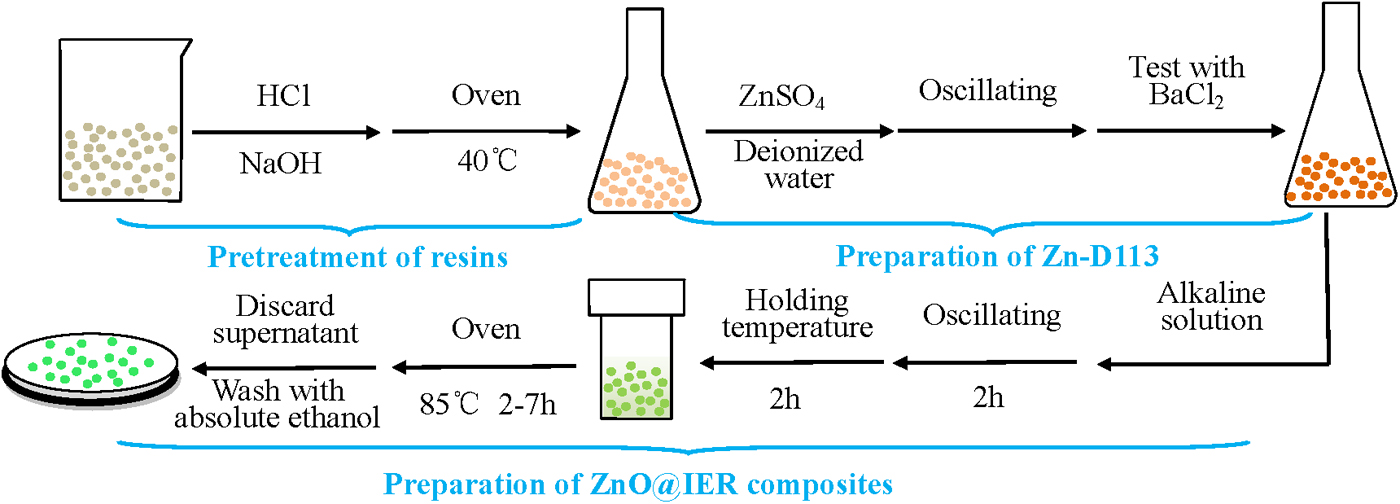
Preparation process of ZnO@D113IER composites.
Characterization
ZnO@IER composites and the original resins were characterized using a scanning electron microscope (SEM; SUPRA 55, ZEISS, Germany), energy dispersive spectrometer (EDS; SUPRA 55, ZEISS), and Empyrean X-ray diffraction spectrometer (XRD; D8 Advance, Bruker, Germany). The micromorphology of samples was observed, and the element composition and crystalline form were determined.
XRD operating conditions are as follows: the copper target is the light source; the tube voltage and tube current are 40 kV and 40 mA, respectively; and the scanning range is 2θ = 5–80°.
Photocatalytic experiment
To take the composites prepared by the D072 resin as the sample, the photocatalytic experiment was carried out systematically. The specific process was as follows: 20 mg of ZnO@IER and 150 mL of 0.015 g/L methylene blue (MB) solution were mixed and stirred in a dark room for 30 min until adsorption equilibrium, and then the mixture was placed under a 20-W UV lamp with a wavelength of 365 nm. The distance between the light source and the sample was about 10 cm, and magnetic stirring at room temperature was adopted.
The supernatant was collected at regular intervals for absorbance measurement, and the absorption wavelength (λ) of the UV-Vis spectrophotometer was set to 664 nm in advance. At the same time, the absorbance comparison experiments of the blank samples, including the pure MB solution and original D072 resin, were carried out. The photocatalytic degradation rate (η) (Liu et al., 2020) was calculated as follows:
where A represents absorbance of the solution before photocatalysis and At represents absorbance of the solution at the time of illumination t.
Results and Discussion
Characterization of SEM and EDS
Figure 2 shows SEM images of ZnO@IER composites prepared using D113 ion exchange resin, in which Fig. 2A depicts the micromorphology of the D113 resin magnified 100 times. It can be clearly observed that the resin particle diameter is about 0.7 mm, which is a very regular sphere with smooth surface.
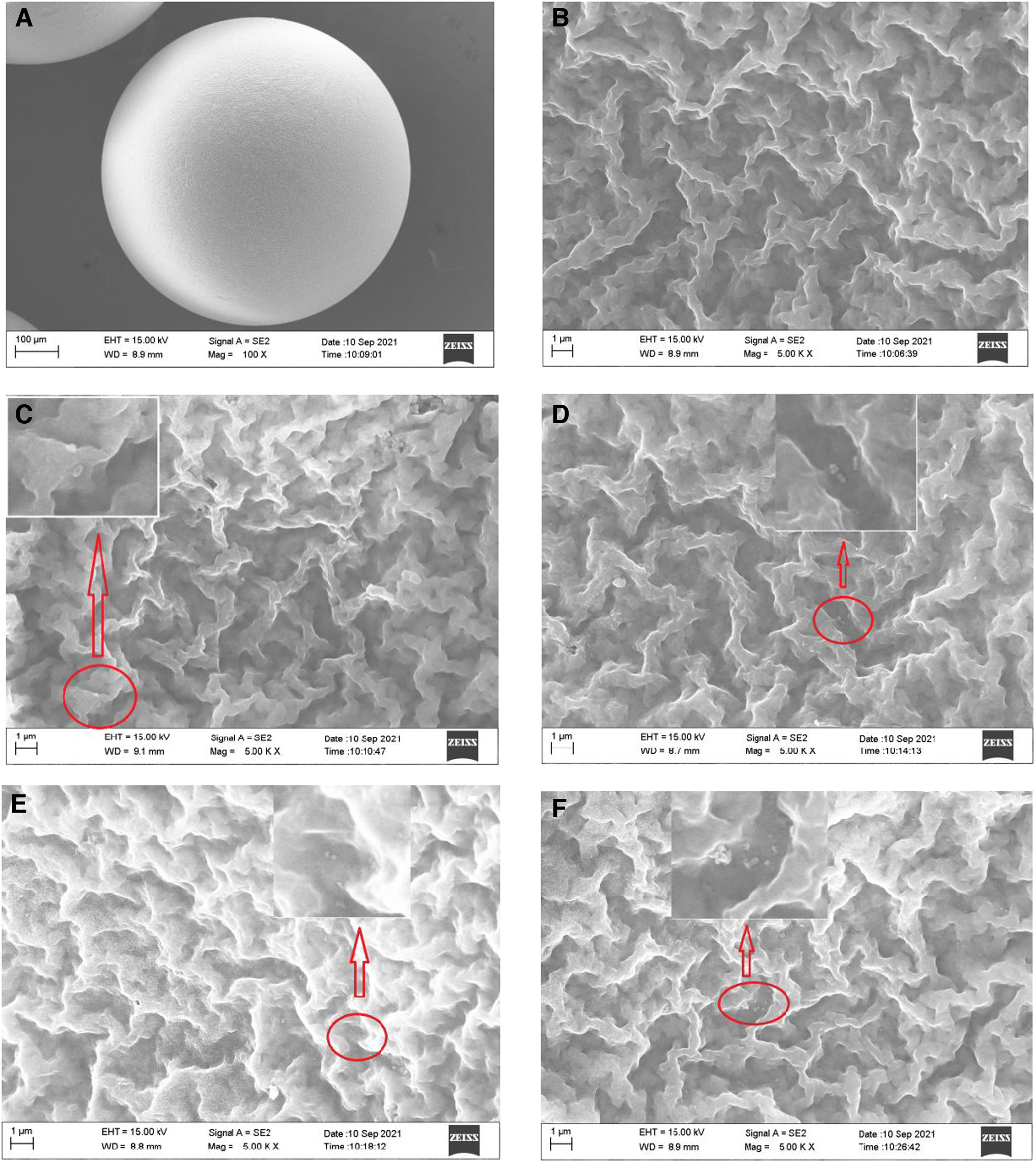
SEM images of ZnO@D113IER prepared at different hydrothermal reaction times.
Figure 2B displays the micromorphology of the resin surface magnified 5,000 times. It can be seen that the surface is a very obvious arrangement of gully structures with a width of 1–2 μm. This structure can increase the specific surface area of ion exchange resin, improve opportunities of contact between the exchangeable ions on resins and free ions in the solution, and accelerate the reaction speed.
Figure 2C–F shows SEM images of the products with hydrothermal reaction times of 2, 3, 5, and 7 h, respectively. It can be seen that water bath oscillation before the hydrothermal reaction does not change the surface morphology of the resin. By observing the amplified places that are circled, it reveals that a certain amount of a granular substance with a size of <200 nm is embedded in the gullies on the resin surface, which may be the ZnO product, and the amount of ZnO gradually increases with extension of hydrothermal time.
To further confirm whether the ZnO product exists on the surface of D113 resin, the ZnO@D113IER-7h product was selected for EDS characterization, and the EDS data results are shown in Table 2. These data suggest that apart from the C and O elements of the resin itself, there are S and Zn elements in the product. The S component was residual on the resin during resin transformation. Although the content of Zn is slightly less, it also strongly confirmed the existence of ZnO in the product. In addition, the EDS pattern of ZnO@D113IER-7h is shown in Supplementary Figure S1.
Energy Dispersive Spectroscopy Data Results of ZnO@D113IER-7h
Figure 3 presents SEM images of ZnO@IER composites prepared using D072 ion exchange resin, in which Fig. 3A shows the micromorphology of the D072 resin magnified 100 times. It can be observed that the resin particle diameter is about 0.55 mm, which is a regular sphere, but there are a few craters on its surface, as shown in the circled part of Fig. 3B.
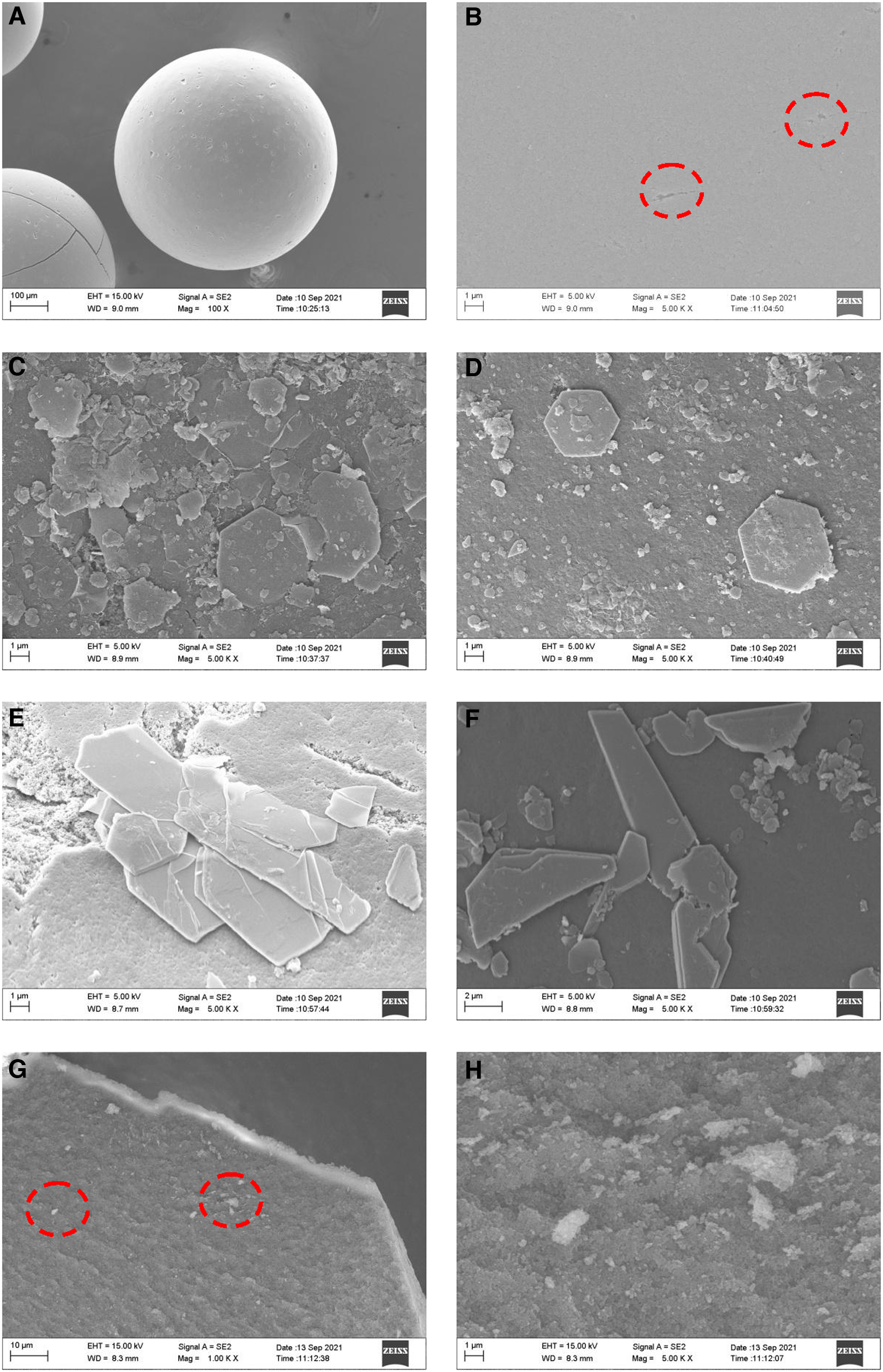
SEM images of ZnO@D072IER prepared at different hydrothermal reaction times.
It can be clearly seen from Fig. 3B (magnified 5,000 times) that except these craters, other places have a smooth structure, and this type of surface structure is obviously different from that of the D113 resin. This crater structure can just increase the specific surface area of the resin and improve the reaction speed. Meanwhile, this interesting structure is convenient for more Zn2+ to enter the particle interior and is also very conducive for more ZnO products to be adsorbed on the resin surface.
Figure 3C–F shows SEM images of products with hydrothermal reaction times of 2, 3, 5, and 7 h, respectively. It indicates that with the extension of hydrothermal time, products with different morphologies appear on the surface of resin particles. When the hydrothermal time is 2 and 3 h, products with a perfect hexagonal structure and other irregular fragments are found on the surface of the resin particle, and the side length of the hexagon is about 2–2.5 μm and thickness is hundreds of nanometers.
After prolonging the hydrothermal time, the products may tend to grow in one direction, resulting in emergence of products with a rectangular structure and other irregular sheet structures, and the size is significantly improved to a length of 10 μm. In addition, slight agglomeration of products is also observed. In brief, an extension of the hydrothermal time can significantly change the micromorphology of ZnO, and a shorter hydrothermal time is conducive to obtain products with better dispersion.
To further determine the composition of the product on the resin surface, ZnO@D072IER-2h was analyzed by EDS, and EDS data results are listed in Table 3. It can be seen that the Zn element is present in the product, and the content of Zn is significantly higher than that in Table 2, which can confirm that the product on the surface of the D072 resin is surely ZnO. In addition, the EDS pattern of ZnO@D072IER-2h is shown in Supplementary Figure S2.
Energy Dispersive Spectroscopy Data Results of ZnO@D072IER-2h
Moreover, after the hydrothermal reaction, the pH value of the supernatant changes from an alkaline condition at the beginning of the reaction to an acidic condition (pH = 3.5 and 5.4). This change also illustrates that the transformation of the existing environment of the ion exchange resin is due to formation of the ZnO product.
In addition, the ZnO@D072IER-3h product was selected and crushed carefully and then its fracture surface was characterized by SEM, as shown in Fig. 3G and H. From the SEM image magnified 1,000 times, it can be clearly surveyed that the white granular products are dispersed on the dark fracture surface of the resin particles, as shown in the circled part of Fig. 3G. When it is further magnified 5,000 times (Fig. 3-H), it can be more clearly observed that the small particles or aggregates of small particles with nanodiameter are adsorbed on the fracture surface.
Therefore, SEM results in Fig. 3G and H can verify that a part of ZnO products is generated and adsorbed inside the resin particles. At the same time, owing to the limitation of the pore size inside the particles, nanoscale ZnO and some ZnO aggregates can be obtained eventually.
Comparing Figs. 2 and 3, the biggest difference lies in the surface structure of resin particles, which greatly affects the morphology of ZnO products. Due to the existence of gullies on the D113 resin, the surface of resin particles is not smooth and cannot further adsorb more flaky ZnO products, resulting in adsorbed products that are nanoscale particles.
Because the surface of the D072 resin basically presents a smooth structure, it is conducive to adsorption and growth of sheet products. The different structures on the surface of these resins lead to significant differences in the micromorphology of the products, which are very interesting and worthy of further study.
Characterization of XRD
ZnO@D113IER, ZnO@D072IER, and original resins were ground in a mortar and then characterized by XRD. Results are presented in Fig. 4. Figure 4A shows a large amorphous peak, which is due to the organic skeleton structure of the D113 ion exchange resin. Meanwhile, the XRD peak of the D113 original resin between 11 and 32° is wider than that of the other four resins loaded by ZnO. This variation of peak width explains that the substances with a crystalline structure in the product account for a certain proportion, resulting in reduction of the peak width, which confirms the existence of ZnO in the product.
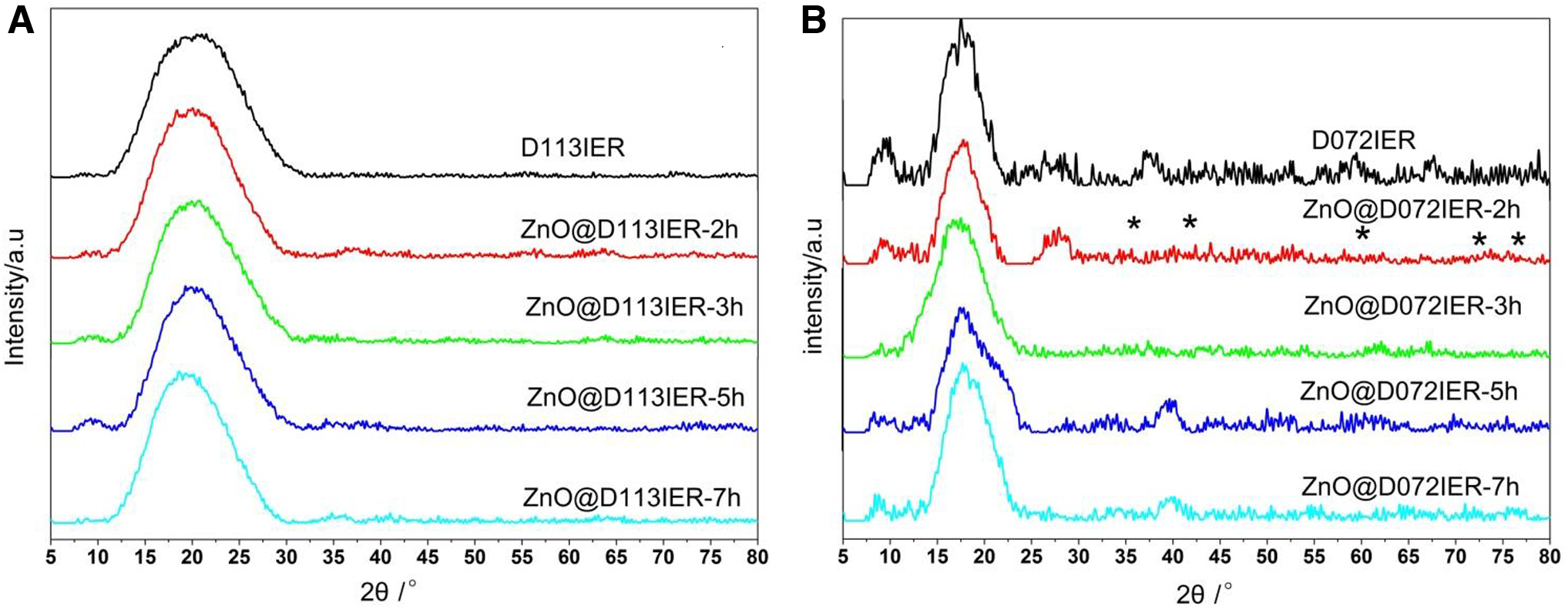
XRD patterns of
There is also a large amorphous peak in Fig. 4B, which originates from the organic skeleton structure of the D072 ion exchange resin, and the amorphous peak masks the crystalline peak of ZnO, which makes it difficult to be detected. Compared with the XRD patterns of the D072 original resin and standard patterns, it can be concluded that after preparing ZnO with resins as carriers, the crystalline peak of ZnO can still be found in XRD patterns; where * is marked, that is, 2θ = 36.4, 42.3, 61.4, 73.5, and 77.4, several tiny diffraction peaks appeared corresponding to (111), (200), (220), (311), and (222) crystal planes of the ZnO crystal structure, respectively, consistent with the standard diffraction spectrum, PDF65-0523.
The appearance of the above diffraction peak demonstrates the existence of the ZnO structure in the product, which is consistent with SEM analysis results in Fig. 3.
Formation mechanism of ZnO@IER composites
On the basis of the experimental process, the reaction formulas involved are shown in Equations (1)–(3):
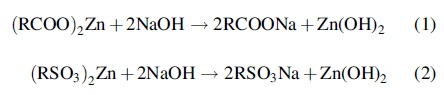
Figure 5 shows a schematic diagram of the formation mechanism of ZnO@IER composites. Both D113 and D072 ion exchange resins have macroporous structures. Therefore, when the ion exchange resin is added to the alkaline solution, the ion exchange resin is rapidly surrounded by OH– and Na+. At the same time, OH– and Na+ migrate freely into the pores of the resin.
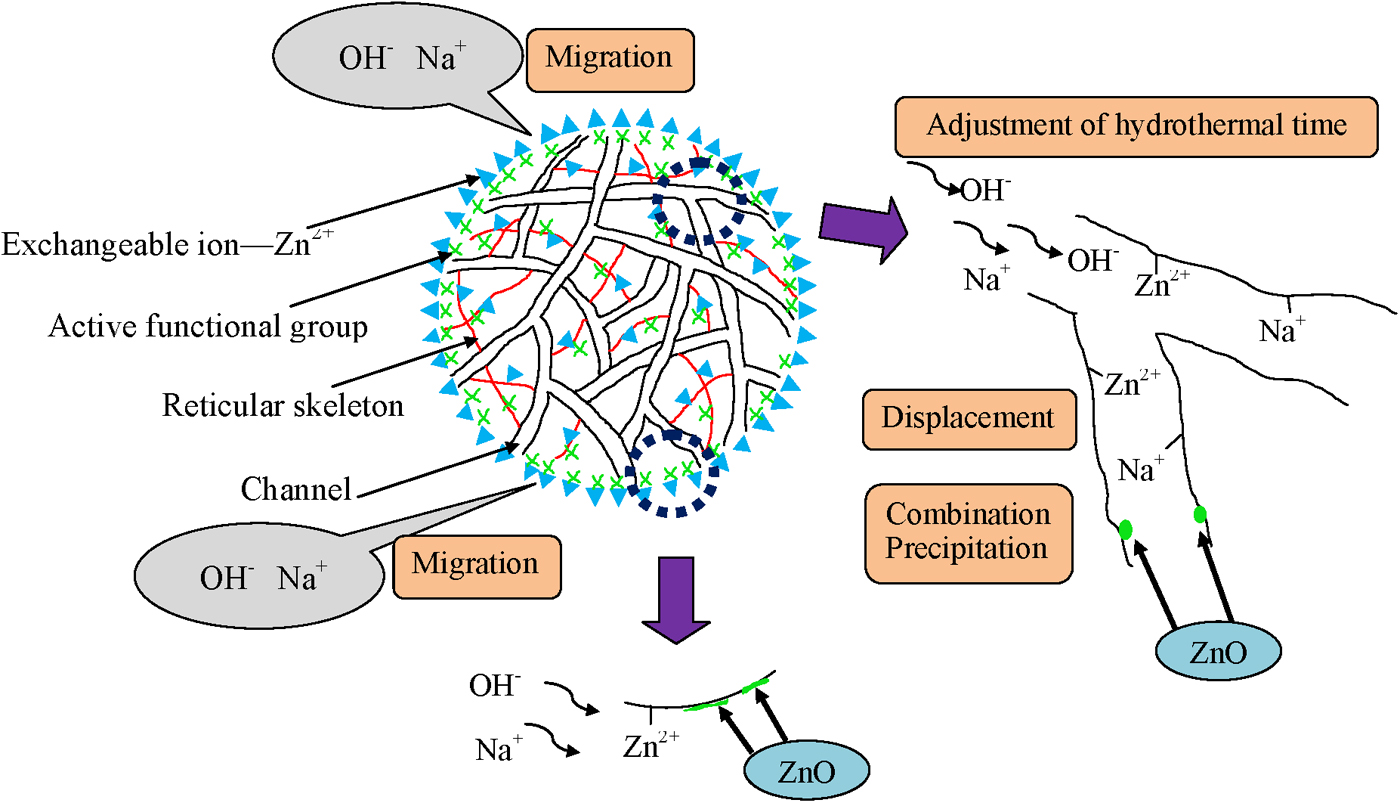
Schematic diagram of the formation mechanism of ZnO@IER composites.
Because the cation exchange resin easily adsorbs metal ions with more charge, the adsorption capacity of cation exchange resin for Zn2+ with two charges is greater than that for Na+ with one charge, but the ability of precipitation generated by the combination of OH– and Zn2+ in the solution is exactly greater than the adsorption capacity of ion exchange resin for Zn2+.
Therefore, to maintain the charge balance, Na+ is quickly replaced on the ion exchange resin, thus more Zn(OH)2 is naturally produced and adsorbed in the resin channel and on the resin surface. Subsequently, during the hydrothermal process, Zn(OH)2 is dehydrated and transformed into ZnO.
It is noteworthy that the internal pore diameter of the wetted macroporous resin is in the nanometer level, which can reach 100–500 nm (Inamuddin and Luoman, 2012). Therefore, ZnO generated inside the resin particle is also nanosized, that is, the ion exchange resin used in the experiment plays an important role in controlling the morphology of the product.
In addition, the D072 resin has a smooth surface and easily adsorbs ZnO particles. With the extension of hydrothermal time, these ZnO particles gradually grow in size and finally form sheet structures, as exhibited in Fig. 3. The surface of the D113 resin presents a gully morphology, which easily adsorbs and hides ZnO particles, but the limited space restricts further growth of particles, as shown in Fig. 2.
In brief, the ion exchange resin applied in the experiment not only provides the exchangeable Zn2+ ion but also regulates the morphology of products and stores products.
Photocatalytic experiment
Through the above characterizations, it can be seen that composites prepared with the D072 ion exchange resin as the raw material have better micromorphology and a higher proportion of ZnO. Consequently, ZnO@D072IER composites were adopted to carry out the photocatalytic experiment with the MB solution, and through the isosbestic point experiment, 664 nm was determined as the maximum absorption wavelength. The degradation curve of MB solution by ZnO@D072IER composites is displayed in Fig. 6.

Degradation curve of the MB solution by ZnO@D072IER composites.
As can be seen from Fig. 6, the single D072 ion exchange resin plays a significant role in adsorbing organic dye molecules, which is due to its high specific surface area and unique internal pore structure. In addition, the resin loaded by ZnO has a better degradation effect on the MB solution.
With extension of UV irradiation time, the degradation rate gradually increases and reaches more than 80% within 200 min of UV irradiation time, and the curves are always above the D072IER curve. This is mainly because there are many active sites on the surface of ZnO. Under irradiation with UV light, ZnO generates strong oxidizing groups, which can break down harmful contaminants into carbon dioxide, water, acid, and other simple salts (Modi et al., 2022; Rodwihok et al., 2021).
The free radical trapping experiments and electron spin resonance analysis by He et al. (He et al., 2023a; He et al., 2023b; He et al., 2022) further proved that h+ and ·O-2 radicals were the dominant reactive oxygen species in this photocatalytic system. Therefore, degradation of ZnO@D072IER composites for the MB solution is due to superposition of photocatalytic effects of ZnO and adsorption of ion exchange resin.
Furthermore, the degradation curves of composites prepared under different hydrothermal times are compared. Results show that when the hydrothermal time is 2 h, the degradation effect is the best, relatively, and the photocatalytic degradation rate reaches 92.5% at the UV irradiation time of 200 min. Then, with extension of hydrothermal time, photocatalytic degradation rates are 84.3%, 89.8%, and 88.1%, respectively, when the degradation time is 200 min. This is because the longer the hydrothermal time, the more complete the crystallization and the more uniform the particles. However, with the prolongation of time, the particle size will increase significantly and the agglomeration phenomenon will be obvious. Too large particle size will significantly reduce the photocatalytic activity of the catalyst.
On the contrary, the particle sizes of composites obtained within a shorter hydrothermal time are smaller, that is, the specific surface area is larger, which can enhance the contact chance between the catalyst and pollutants, making the photocatalytic oxidation process more complete, and the larger specific surface area can expose more active sites and further raise the photocatalytic activity of the catalyst.
In addition, simple salts generated by catalytic degradation of the MB solution will cover and be adsorbed on the surface of nano-ZnO and resin particles while also migrating and remaining inside the resin pores, which may hinder and slow down the photocatalytic effect of nano-ZnO and the adsorption characteristics of resin. As reaction time prolongs, this trend and degree of influence gradually strengthen. However, with continuous stirring, some salts may detach from the resin and oxides, which leads to fluctuations in the degradation rate.
Moreover, it is noteworthy that in the degradation process of ZnO@D072IER composites as photocatalysts for the MB solution, there are no suspended particles or turbidity in the solution, and after careful inspection, the ion exchange resins are not cracked or damaged, which indicates that ZnO@D072IER composites as solid photocatalysts have the advantages of not easy loss and easy recovery in application, which is different from the previous photocatalyst in the powder state.
The recovery and reuse of ZnO@D072IER will be further studied in subsequent experiments. At the same time, as a carrier, the as-used ion exchange resin has good heat resistance, a wide range of pH values, stable chemical properties, and high mechanical strength and can be reused multiple times due to its exchangeability, which is one of the highlights of the ZnO@IER composite photocatalyst.
Conclusions
In this article, ZnO@IER composites were successfully prepared with D113 and D072 ion exchange resins using constant temperature oscillation and hydrothermal reaction, and effects of different hydrothermal reaction times on the morphology and composition of composites are discussed in detail.
The results show that gullies on the surface of the D113 resin were inlaid with granular ZnO, and the ZnO size was <200 nm; the D072 resin had a smooth surface structure, and when the hydrothermal time was 2 or 3 h, perfect ZnO with a hexagonal structure, side length of about 2–2.5 μm, and thickness of hundreds of nanometers could be obtained on the resin surface.
After prolonging the hydrothermal time, products with rectangular and other irregular sheet structures could be obtained. EDS and XRD characterization also confirmed the existence of ZnO in the product. The ion exchange resin used in the experiment not only provided the exchangeable Zn2+ ion but also regulated the morphology of products and loading of products.
The results of the photocatalytic experiment demonstrate that the ZnO@D072IER composites prepared with the hydrothermal time of 2 h had a good degradation effect on MB solution, and the degradation rate reached 92.5% with UV irradiation time of 200 min. Degradation of ZnO@D072IER composites for the MB solution was due to superposition of photocatalytic effects of the ion exchange resin and ZnO.
This research can expand the application of ion exchange resin in preparation of inorganic materials and plays a positive role in promoting degradation of organic wastewater.
Footnotes
Authors' Contributions
Y.W., X.Y., and Z.L. conducted the experiments and measurements. Y.W. was also involved in designing the study and drafting the article. G.L. supervised the project and edited the article. All the authors read and contributed to the article.
Data Availability
All data included in this study are available upon request by contact with the corresponding author.
Author Disclosure Statement
No competing financial interests exist.
Funding Information
This research was supported by the Central Guidance on Local Science and Technology Development Fund of Liaoning Province, China (Grant No. 2020JH6/10500062).

References
Supplementary Material
Please find the following supplemental material available below.
For Open Access articles published under a Creative Commons License, all supplemental material carries the same license as the article it is associated with.
For non-Open Access articles published, all supplemental material carries a non-exclusive license, and permission requests for re-use of supplemental material or any part of supplemental material shall be sent directly to the copyright owner as specified in the copyright notice associated with the article.
