




Abstract
Antibiotic contamination has become a serious problem. As a category of catalysts, single-atom catalysts (SACs) exhibit efficient capabilities in antibiotic degradation. SACs can serve as catalysts to improve the efficiency of antibiotic degradation, thus reducing the efficacy of antibiotics. Among various SACs, nickel (Ni)- and copper (Cu)-based SACs present their unique advantages. The Ni-based SAC is characterized by good catalytic activity, high mechanical strength, and favorable thermal conductivity; the Cu-based SAC features a stable structure, high efficiency, environmental friendliness, and excellent thermal stability. These SACs (Ni/Cu-based SACs) and their complexes can fulfill functions in antibiotic degradation through the integration of their advantages. However, it is prone to generating more toxic intermediate products during the degradation of antibiotics, which may result in secondary pollution, thus blocking their industrial application. Therefore, developing new catalytic materials and modifying degradation pathways become important concerns. This article further predicts the application trend of SACs in the field of antibiotics and analyzes the problems in the degradation of antibiotics by SACs. These findings are expected to provide reference for the further degradation of antibiotics.
Introduction
Antibiotics can inhibit the growth of bacteria, protozoa, and fungi or destroy their structures. Besides, antibiotics are mainly applied to the treatment of human diseases and the prevention and treatment of animal and plant diseases in livestock and poultry breeding and plant planting (Awad et al., 2014, Batt et al., 2006; Berglund, 2015; Bielen et al., 2017). However, antibiotics have not been fully utilized by humans or other organisms. Most antibiotic agents could keep their original structures from being metabolized and enter the environment through human and animal excretion or sewage treatment plants or soil leaching, which exerts a significant impact on the ecosystem and human health (Castiglioni et al., 2008; Hoang et al., 2013; Larsson, 2014; Sodhi et al., 2021). After domestic production wastewater enters the sewage treatment plant, antibiotics cannot be effectively removed. Subsequently, the vast majority of antibiotics would enter surface water, thus causing pollution to water sources and groundwater through water circulation. In addition, antibiotics may enter farmland soil through irrigation and be transmitted and accumulated through the food chain, which poses a serious threat to human health. Various antibiotics have been detected in water, soil, animals, plants, and other samples. With the gradual improvement of modern analytical technology, the degradation of antibiotics and other new pollutants has received widespread attention. Antibiotics and other agents have a wide range of application in large dosages, which may bring multiple hazards. Moreover, antibiotics also pose a serious threat to humans, animals, plants, and other microorganisms. Therefore, the degradation of antibiotics has become an important topic in existing studies (Wu et al., 2020; Xu et al., 2021a; Zhai, 2014). Common methods for the treatment and disposal of antibiotics include physical adsorption, biodegradation, chemical oxidation, and membrane separation technology (Dolliver et al., 2008; Han et al., 2014; Kelsic et al., 2015;Sharma et al., 2021; Wang et al., 2019; Wei et al., 2020). The features of different methods for the treatment and disposal of antibiotics are listed in Table 1.
The Features of Different Methods of the Treatment and Disposal of Antibiotics
In terms of the chemical method for the treatment of antibiotics, some strong oxidizing substances or strong oxidizing agents are used to degrade antibiotics. This method is characterized by high efficiency and fast reaction speed. In the application of the chemical degradation of antibiotics, catalysts could affect the reaction rate in the chemical process and then promote the degradation of antibiotics. Based on more in-depth explorations, many new catalytic materials have been applied in the chemical reaction degradation of antibiotics and have produced favorable results (Gao et al., 2022; Sun et al., 2020; Sun et al., 2019). Among various catalysts, biocatalysts have been widely used in the degradation of antibiotics. Single-atom catalysts (SACs) are applied to the degradation of antibiotics based on the catalysis of biological enzymes. The comparison is shown in Figure 1.

The comparison of catalysts.
SACs exhibit higher catalytic efficiency and are more conducive to the degradation of antibiotics. Owing to the high atom utilization, high catalytic activity, and high activation of SACs, they have become popular materials in environmental catalysis. Specifically, SACs are catalytic materials formed by metals loaded on the surface of the carrier in the form of a single atom. Researchers have applied SACs in the field of antibiotic degradation (Luo et al., 2021). The nickel (Ni)-based SAC presents good catalytic activity, high mechanical strength, and favorable thermal conductivity; the copper (Cu)-based SAC displays stable structure, high efficiency, environmental friendliness, and excellent thermal stability. These SACs (Ni/Cu-based SACs) and their complexes can fulfill functions in antibiotic degradation through the integration of their advantages. This article introduces Ni/Cu-based SACs and relevant mechanisms and effects in the field of antibiotic degradation as catalytic materials. Besides, existing problems about these materials are also elucidated. These findings are expected to provide reference for the effective degradation of antibiotics and the further application of SACs.
Basic Information on SACs
Definition of SACs
SACs are catalytic materials formed by metals loaded on the surface of the carrier in the form of a single atom. SACs do not refer to zero-valent metal atoms. However, the active center is composed of metal atoms, which could coordinate with the carrier and are usually charged. The high catalytic activity of SACs can be attributed to the coordination of metal atoms with supports. Nevertheless, there are certain defects in these materials. When the single atom is too small, its surface area and free energy would increase, which makes the material agglomerate and leads to the loss of catalytic activity. This is also one of the problems in the application of SACs (Cheng et al., 2019).
Common types of SACs
There are various SACs, which can be prepared by different metal atoms and different supports, as well as different synthesis methods and coordination environments. Different SACs played different roles in different fields.
Basic preparation of SACs
Based on more in-depth insights into SACs, many methods have been obtained to synthesize SACs, and the synthesis process of SACs has been constantly improved. The main synthesis method is shown in Figure 2.
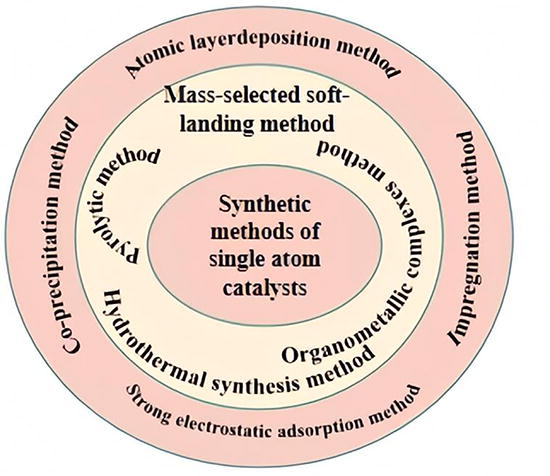
The schematic diagram for synthesis method of single-atom catalysts.
Mass-selected soft-landing method
The mass-selected soft-landing method can be utilized to vaporize the metal precursor by high-frequency lasers so that various metal masses could be loaded onto the surface of the carrier through the landing method. This method can be categorized into physical deposition, and hence, it could be applied to a relatively large number of carriers (Zhao et al., 2020). However, this method is not suitable for the mass production of SACs owing to its strict experimental conditions and low yields.
Atomic layer deposition method
The atomic deposition method can be used to expose the carrier material through the pulse steam of different reaction precursors, which would deposit each atomic layer of the material on the surface of the carrier one by one. This method features good uniformity and repeatability, and the morphology of the composite can be controlled accurately (Fonseca and Lu, 2021). However, limited by its high costs and poor stability, this method has not yet been used for the commercial preparation of SACs.
Coprecipitation method
The coprecipitation method can be used to add the precipitator into the solution containing two or more cations, and the solution can be prepared by the precipitation reaction to obtain a more uniformly dispersed catalyst with supports. Through this method, the solution could be uniformly dispersed. However, this method is limited by the low metal load, and hence, the overall performance of SACs may be reduced to a certain extent.
Impregnation method
As one of the most classical methods, the impregnation method can be used to expose the carrier to the solution containing metals so that the metal solution can be adsorbed or stored on the surface or internal structure of the carrier, thus removing various impurities. Then, the catalyst can be obtained through a series of processes, such as washing, drying, calcination, and activation (Yang et al., 2016). This method is characterized by simple procedures. However, it is difficult to ensure that a single metal atom could be adsorbed evenly on the surface of the carrier.
Strong electrostatic adsorption method
Strong electrostatic adsorption refers to the adsorption or attachment of metal ion complexes to the surface of the carrier through strong electrostatic action, and it is an important method for preparing SACs (Bo et al., 2019). However, this method may be affected by the pH and temperature of the solution and the uniformity of the carrier surface.
Organometallic complex method
The organometallic complex method refers to the preparation of SACs using the coordination reaction between organometals with precise structures or ligands and the carrier to make the metal anchored on the surface of the carrier. The reaction between ligands and supports could generate a more precise chemical bond to maintain the stability of SACs (Yang et al., 2013).
Pyrolytic method
In the preparation of SACs, the high-temperature cracking method is mainly used to prepare catalysts supported with non-noble metals, especially the SACs supported with cobalt (Co) and iron (Fe) (Wu et al., 2019). The method usually involves pyrolysis at a high temperature under injecting gases to make the carbon carrier containing nitrogen (N) coordinate with metals to form a monoatomic dispersion structure.
Hydrothermal synthesis method
Hydrothermal synthesis is a method for synthesizing materials by the chemical reaction of various substances in the aqueous solution at a specific temperature and pressure. Under specific hydrothermal conditions, the reaction activity of molecules in the solution can be improved, thus contributing to chemical reactions. The hydrothermal synthesis method has been widely used in the preparation of these materials.
Other methods
In addition to the aforementioned methods, SACs can also be prepared by photochemical reduction, solid phase solution, and high-temperature migration. Owing to the comprehensive understanding of these materials, various new methods for synthesizing SACs have also been found, making the preparation of SACs more effective. The synthesis methods and characteristics of common SACs are listed in Table 2.
Table of the Synthesis Methods and Characteristics of Common SACs
C, carbon; N, nitrogen; Ni, nickel; SAC, single-atom catalyst; SiO2, silicon dioxide; Al2O3, aluminium trioxide; ALD, atomic layer deposition.
Ni/Cu-Based SACs and Their Composite Catalysts
Ni/Cu-based SACs
Ni-based SACs
As a cheap metal, Ni is widely used in many new chemical reactions, such as photocatalysis, carbon dioxide (CO2) reduction, and hydrogen evolution. It has the advantages of low costs and environmental friendliness. Ni-based SACs mainly consist of metal–organic framework (MOF) compounds, carbon, N, and molybdenum disulfide (Shang et al., 2022; Vilé et al., 2021).
Cu-based SACs
Cu-based catalysts are widely used in various industrial catalytic reactions owing to their low cost and high activity. Cu-based SACs exhibit many active sites and good oxidation–reduction activity. They are ideal catalytic materials and are widely used in nitrate reduction, fuel cells, photocatalysis, CO2 reduction, biomedicine, and other fields (Marcinkowski et al., 2018; Zhao & Lu, 2019).
Composites of Ni/Cu-based SACs
Ni-based SACs feature good catalytic activity, high mechanical strength, and favorable thermal conductivity. However, these materials also have the defects of easy agglomeration, uneven dispersion, and slow reaction kinetics under many circumstances. Therefore, researchers have explored Ni-based SAC composites through integration with other materials. Ni-based SACs could be compounded with carbon, metal, nonmetal, and oxide to form the catalytic material of Ni-based SACs, thus enhancing the performance of Ni-based catalysts. Ni combines with carbon nanotubes (CNTs) to form Ni-SAC-CNT, which could significantly improve the Faradaic efficiency of carbon monoxide (CO) (Hwa Jeong et al., 2021). Cu-based SACs feature a stable structure, high efficiency, environmental friendliness, and excellent thermal stability. However, these materials are still limited by poor catalytic activity and high potential. In many previous studies, Cu-based SACs have been combined with metal, oxide, and nonmetal to improve the performance of Cu-based SACs. A composite material prepared from the defect sites of zirconia clusters is attached to MOFs, which could improve the oxidation process of CO (Abdel-Mageed et al., 2019). Besides, Cu-based SACs have been combined with N and oxygen (O) elements, and the complex could promote the conversion of O2 to methane (CH4) (Cai et al., 2021). A simple pair of Ni-based and Cu-based SACs can be seen in Table 3.
Table of Simple Comparison of Ni-Based and Cu-Based Single-Atom Catalysts
CN, carbon nitride; Cu, copper; N, nitrogen; Ni, nickel; O, oxygen; SAC, single-atom catalyst.
Degradation of Antibiotics by Ni/Cu-Based SACs and Their Complexes
Ni/Cu-based SACs and their complexes could efficiently degrade antibiotics owing to their high atom utilization, good activation, high activity, and high catalytic activity. Ni/Cu-based SACs and their complexes can exert favorable effects on oxide activation. It could achieve the degradation of antibiotics through many ways, such as photocatalysis, electrocatalysis, Fenton-like reaction, sulfate radical-based advanced oxidation processes (AOPs), and other forms, mainly through Fenton-like reaction. Regarding the basic principle of this reaction, Ni/Cu-based SACs form a unique coordination structure and electronic configuration through various combinations, showing good Fenton-like catalytic activity. It could activate hydrogen peroxide (H2O2), persulfate (PS), and other oxides to generate active free radicals for Fenton-like reaction, thus realizing the degradation of antibiotics. However, regarding the principle of the photocatalysis reaction, light is used as an energy to absorb photons and generate more photo-excited electron hole pairs. On that basis, antibiotics can be degraded into small-molecule intermediates (Jin et al., 2023). Electrocatalysis could degrade antibiotics by producing hydroxyl radical (•OH) through the action of electrons provided by an external power source and electrode catalysts. In terms of the principle of sulfate radical-based AOPs, the degradation of antibiotics can be catalyzed by activating peroxymonosulfate (PMS) or peroxydisulfate to generate highly active sulfate radicals.
About Ni-based SACs and their complexes, it has been demonstrated that biochar-supported nano zero-valent Fe/Ni bimetallic composites (BC@nZVI/Ni) can be prepared and used to activate PS, which exhibits favorable degradation effects on norfloxacin in water (Zhu et al., 2020). In addition, some researchers have used biochar (BC) as a carrier material to prepare nanoscale zero-valent Ni Fe (nZVI-Ni) bimetallic particles, which can activate PS in the water medium to degrade chlorinated pollutants (Shan et al., 2021). The N, P coordination Fe, Ni SACs (CN-FeNi-P) on carbon nitride have been prepared, and four catalytic sites of Fe, Ni, Fe-p, and Ni-p have been selected (Wei et al., 2021a). H2O2 can be activated to mineralize the pollutants under light, and the degradation activity of CN-FeNi-P in the light Fenton system for moxifloxacin is 3.7 times higher (Zhou et al., 2022).
There are few studies on the degradation of Cu-based SACs and their complexes. Some researchers have prepared N-Cu codoped biochar (N-Cu/BC) materials. Cu could provide active sites for the catalytic reaction to activate PS to degrade tetracycline (TC) (Zhong et al., 2020). In addition, a composite material obtained by embedding monoatomic copper (Cu-based SAC) in reduced graphene oxide has been used to degrade various antibiotics (Wei et al., 2021b). This system can enhance the degradation performance and degradation rate of sulfamethoxazole. It has been revealed that graphite carbon nitride containing Cu-based SACs could catalyze the activation of H2O2 to generate hydroxyl radicals (Wei et al., 2023). The Fenton filter and H2O2 electrolytic cell can be connected in series to form an organic wastewater treatment system. These findings confirm that Ni/Cu-based SACs and their complexes could activate PS and realize the degradation of antibiotics and other pollutants in water (Table 4).
Table of Degradation of Various Antibiotics by Ni-Based and Cu-Based Single-Atom Catalysts
BC@nZVI/Ni, biochar-supported nano zero-valent Fe/Ni bimetallic composites; C, carbon; Cu, copper; Fe, iron; H2O2, hydrogen peroxide; Ni, nickel; SO4•−, sulfate radical; MOX, moxifloxacin; TOC, total organic carbon; CuO, copper oxide; Cu2O, cuprous oxide; C3N4, graphitic carbon nitride; CN-FeNi-P, N, P coordinated Fe and Ni single-atom catalysts on carbon nitrides.
Prospects of Antibiotic Degradation by Ni/Cu-Based SACs
The challenges and development directions for the degradation of antibiotics by Ni/Cu-based SACs and their complexes are shown in Figure 3.
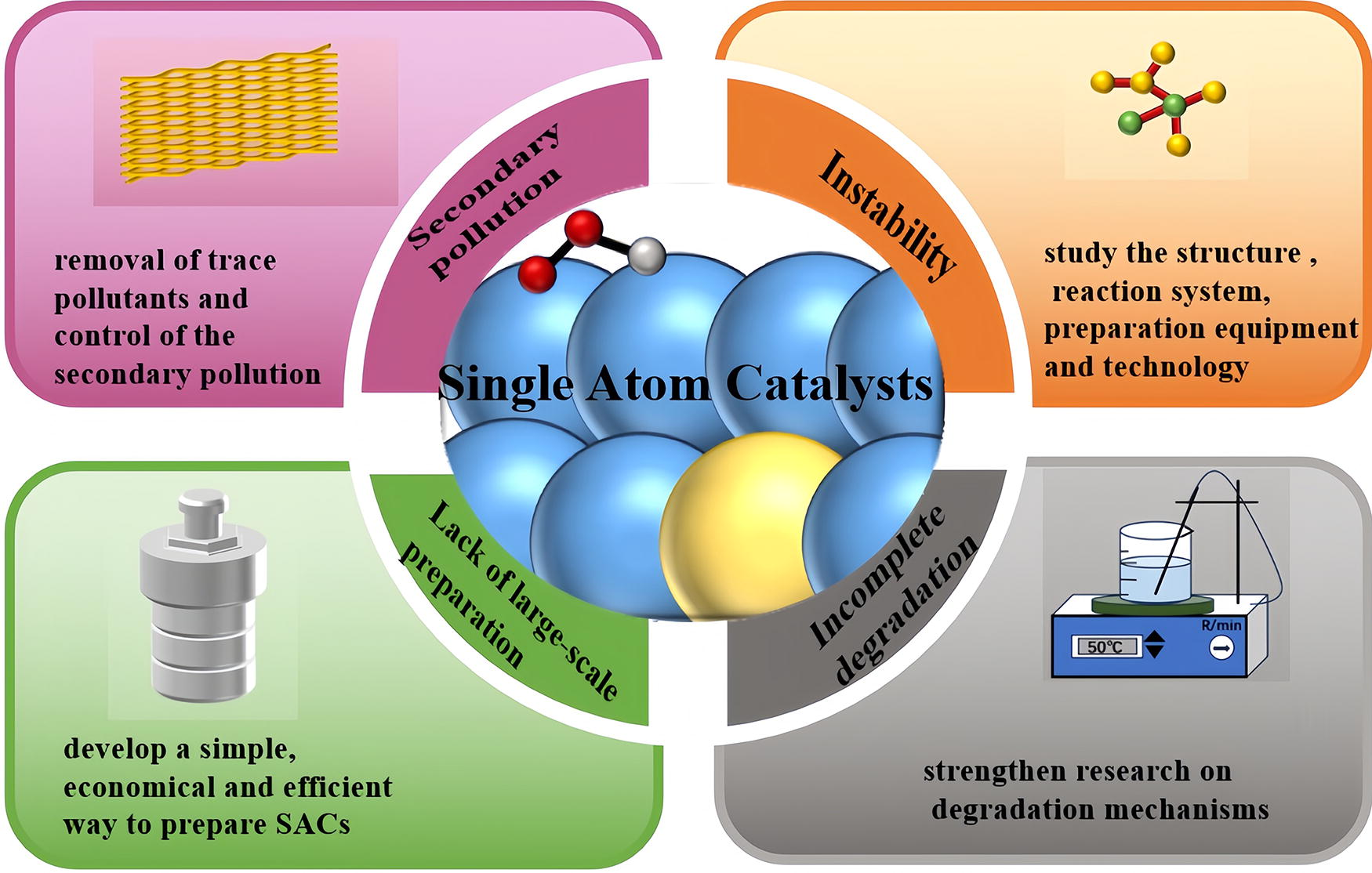
The challenges and development directions for the degradation of antibiotics by Ni/Cu-based SACs and their complexes. Cu, copper; Ni, nickel; SAC, single-atom catalyst.
Antibiotics, as a new organic pollutant, have attracted widespread attention in the water environment. As revealed in some studies, Ni/Cu-based SACs and their composite materials can be applied to antibiotic degradation owing to their high atomic utilization, good activation, high activity, and high catalytic activity. Ni/Cu-based SACs could be used for the degradation of antibiotics by direct catalysis, photocatalysis, or sulfate radical-based AOPs and their combination with Fenton-like reaction, which has been reported in some studies. Fenton-like reaction involves the use of free radicals as active species, in which H2O2 and PS are common oxides. At present, SACs have been proved to exert activation effects on oxides (such as H2O2 and PS), and hence, they are widely used in the degradation of antibiotics through Fenton-like reaction. The Fenton catalysts of SACs present favorable catalytic activity and efficient treatment capacities for organic pollutants. The main antibiotics that have been explored include TCs, sulfonyls, quinolones, and β-lactam. The combined degradation of SACs and Fenton-like antibiotics has achieved a good degradation effect in a certain period of time, and the degradation efficiency of some antibiotics could reach more than 90%, or even 100% under some circumstances. Different antibiotics would produce different degradation products under different degradation pathways and environmental conditions, and the complete degradation of antibiotics could be achieved under certain conditions. The degradation process would reduce the drug resistance of antibiotics, but the degradation products of some antibiotics might be more toxic than the antibiotics themselves. This method can be used to degrade antibiotics quickly and efficiently, but it is limited by the high investment and cost. At the same time, it is prone to produce more toxic intermediate products and lead to secondary pollution, thus blocking its industrial application.
Given the current progress of Ni/Cu-based SACs and their complexes in the degradation of antibiotics, Ni/Cu-based SACs exhibit good application prospects in the degradation of antibiotics. It could also be predicted that the combination of Ni/Cu-based SACs and Fenton-like reaction would become a more widely used way to degrade antibiotics. Through further investigations, an increasing number of Ni/Cu-based SAC composites with excellent performance have been prepared. They play an important role in the field of antibiotic degradation and promote the development of relevant materials. It could be predicted that the new materials based on Ni/Cu-based SAC composites would further promote the degradation of antibiotics. Furthermore, the overall mechanism of developing new Ni/Cu-based SAC composite materials and degrading antibiotics in various forms may be improved in the future. It is possible to use models to synthesize composite SAC materials and design various ways to degrade antibiotics for simulation. On that basis, the effectiveness of new composite SACs and various new degradation ways could be simulated through models, thus further promoting the degradation of antibiotics. In addition, the metal loading, dosage, pH, concentration of pollutants, temperature, and anions may affect the effect of SACs on the degradation of antibiotics. When the loading amount of metal-based single atoms increases, it is prone to agglomeration. Hence, different metal loading amounts would affect the catalytic effect. A highly excessive dosage of SACs cannot generate better catalytic effects. Owing to the stability of metal atoms, pH changes have small effects on the degradation efficiency of antibiotics. Besides, under the changes of temperature and pressure, the catalyst itself would undergo drastic changes. The higher the concentration of antibiotics in water, the worse the degradation effect. Even a small amount of anions could have an impact on the degradation of antibiotics.
There are also corresponding problems in the degradation of antibiotics by Ni/Cu-based SACs and their complexes. The residue of Ni/Cu-based SACs in the solution would cause secondary pollution. With an increase in metal loading, the greater the metal loading, the more active sites, and the more conducive to the catalytic reaction. In addition, the degradation of antibiotics is incomplete. Moreover, the stability of composite SACs still needs to be improved. At the same time, it is also necessary to further clarify and improve the mechanism of antibiotic degradation reactions in various ways, as well as the effect of actual water on the catalytic performance of SACs and the recovery and utilization of catalysts. Under hydrothermal treatment, high temperature, and high pressure, the catalyst itself would undergo drastic changes. Hence, the method to prepare stable metal SACs is worthy of further exploration.
The focus of subsequent studies on SACs should be placed on the following points. First, it is necessary to further investigate the catalytic degradation mechanism of SACs. At present, the mechanism of monoatomic catalysts is mainly calculated based on the density functional theory. The simulation of this method lacks some specific conditions, such as pH, electric field, and cation. Compared with homogeneous catalysis and heterogeneous catalysis, the catalytic mechanism of SACs needs to be further explored. Second, it is also required to realize the large-scale application of SACs. The wide application in practice requires the preparation method of SACs with low costs and simple procedures. Researchers still need to continue to study the structure and reaction system of SACs, as well as the preparation equipment and technology. There are still few reports on the large-scale preparation of SACs. Hence, it is urgent to develop a simple, economical, and efficient way to prepare SACs.
In order to ensure the activity and stability of SACs in complex water environments, it is necessary to construct SAC composite materials with high stability and activity and stable catalytic reaction processes. In addition, it is necessary to accurately control the coordination environment of the metal center of SACs to promote the catalytic performance of these materials. Moreover, SACs may be integrated into specific devices or reactors to derive the large-scale application of SACs. At the same time, strengthening the deep degradation of pollutants by SACs and the removal of trace pollutants are also of great significance.
Conclusions
This review summarizes the types and basic preparation methods of SACs and their application in antibiotic degradation. Besides, the acting mechanism, degradation principles, and existing problems of Ni- and Cu-based SACs related to antibiotics are also elucidated. In addition, the secondary pollution and incomplete degradation of antibiotics through SACs are analyzed. Based on these findings, the synthesis of stable SAC composite materials and new antibiotic degradation methods may be highlighted in future research. Moreover, the problems in the degradation of antibiotics by SACs are also analyzed. Furthermore, the application trend of SACs in the field of antibiotics is also predicted in this study. Overall, this review may provide reference for further explorations into the degradation of antibiotics.
Footnotes
Authors’ Contributions
G.H.: Investigation, Writing original draft, Reviewing and editing, Supervision, and Data curation. J.Y.: Reviewing and editing, Supervision, and Data curation. Y.L.: Reviewing and editing, Supervision, and Data curation. X.L.: Reviewing and editing, Supervision, and Data curation. Y.P.: Reviewing and editing, Supervision, and Data curation. J.L.: Reviewing and editing, Supervision, and Data curation. B.S.: Reviewing and editing, Supervision, and Data curation. M.W.: Reviewing and editing, Supervision, and Data curation. J.C.: Conceptualization, Methodology, Software, Investigation, Writing original draft, Reviewing and editing, Supervision, and Data curation.
Author Disclosure Statement
The authors declare no competing interests.
Funding Information
The authors were very grateful for the financial support provided by Weifang University of Science and Technology Fund (2021XKJS39, 2022KJ06), the Project of Weifang Science and Technology Development Plan (2021GX048, 2022GX038), and the Project of Weifang Science and Technology Small and Medium Enterprises Innovation Ability Improvement (2023TS1005).