




Abstract
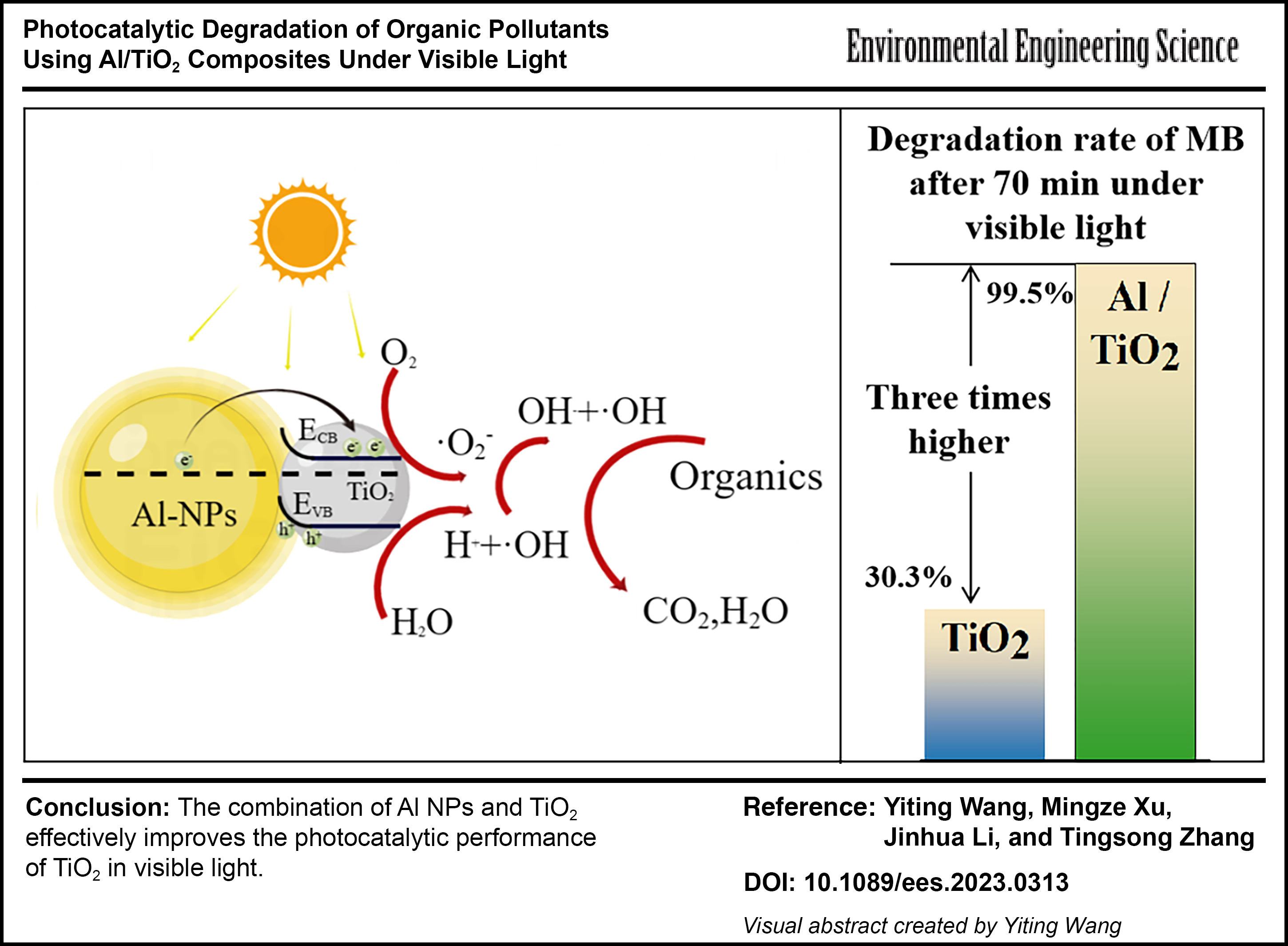
Titanium dioxide (TiO2) has been widely studied as a photocatalyst owing to its advantages of low cost, good stability, and nonpollution. However, they can only be excited by ultraviolet light, resulting in low utilization of solar energy and limited photocatalytic efficiency. In recent years, researchers have found that the nonprecious metal Al can effectively improve the photocatalytic performance of TiO2. However, the current studies focus only on enhancing the ultraviolet photocatalysis performance of semiconductors with Al on the substrate. In this study, Al nanoparticles (NPs) and TiO2 were prepared into composite materials. The effects of ligand, Al particle size, and the molar ratio of Al and TiO2 on the photocatalytic degradation of methylene blue (MB) by Al NPs and TiO2 composites (Al NPs/TiO2) were investigated. The results showed that the Al NPs/TiO2 prepared with a particle size of 200 nm of Al, glutathione as the ligand bridge, and an Al:TiO2 ratio of 2:1 were the most effective for the degradation of MB. The degradation rate of 5 mg/L MB solution within 70 min under visible light was up to 99.5%, which was three times higher than that of P25 TiO2. The photocatalytic performance was further enhanced under sunlight with a degradation rate of 99.7% within 50 min, which is four times higher than that of P25 TiO2 under the same light source. Therefore, Al NPs/TiO2 is a potential photocatalytic material for the treatment of organic pollutants in water.
Introduction
The energy crisis and environmental problems are the two major challenges facing the sustainable development of human beings in the 21st century. Photocatalytic technology provides us with a new method to solve environmental and energy problems perfectly (Ambaye et al., 2021; Awazu et al., 2008; Bao et al., 2014). For example, the treatment of organic wastewater and photocatalytic degradation technology can provide new ideas for the treatment of organic wastewater. The main principle is that the catalyst produces more electron–hole pairs under light and then reacts with water (H2O) to generate hydroxyl radicals, which can oxidize organic pollutants to carbon dioxide (CO2) and H2O (Mills and Hunte, 1997). This method can degrade organic pollutants to nontoxic CO2 gas. Then, photocatalytic CO2 reduction technology can reduce CO2 greenhouse gases to value-added industrial raw materials, which can not only solve environmental problems but also solve energy shortages (Sun et al., 2021; Tatiya et al., 2023; Wu et al., 2020; Xu et al., 2020; Zhao et al., 2021).
Titanium dioxide (TiO2) is one of the most widely used photocatalysts in environmental applications. It has excellent physical, chemical, and optical properties, such as nontoxicity, H2O insolubility, hydrophilicity, low availability, stability, and light corrosion resistance. Although the semiconductor TiO2 has good application prospects in the field of photocatalysis owing to its own advantages, it also has some drawbacks (Dambournet et al., 2010; Guo et al., 2019; Zhu, 2021). Because of the large bandgap (3.0 ∼ 3.2 eV), TiO2 is difficult to excite under visible light. Therefore, TiO2 exhibits only photocatalytic performance under ultraviolet (UV) light, resulting in limited catalytic activity of TiO2 under sunlight, limiting its effective utilization of sunlight. Another reason is that the electron–hole pair recombination rate is high and the carrier lifetime is too low, which affects the photocatalytic activity (Meng et al., 2019).
To effectively improve the utilization of visible light, reduce the electron–hole pair recombination rate, and extend the lifetime of charge carriers, researchers have conducted extensive modification studies on TiO2. The results show that the precious metals Au and Ag can widen the light response range of TiO2 to the visible light range, thus solving the problem of poor photocatalytic efficiency of TiO2 under visible light. Wang Guannan et al. found that the structure of mesoporous Au/TiO2 nanocomposite microspheres can effectively improve the visible light degradation efficiency of organic molecules (Wang et al., 2012). Yen Shin Chen et al. found that the local surface plasmon resonance (LSPR) effect of Ag nanostructures can be controlled by changing their geometric shape, thereby improving the photocatalytic performance of TiO2 (Chen et al., 2020). It has been found that the precious metals Au and Ag can broaden the light response range of TiO2 to the visible light range mainly because the resonance band of plasmons is in the visible light range. After being irradiated by visible light, the hot carriers generated by Au and Ag nanoparticles (NPs) are injected into the semiconductor to participate in catalytic reactions. However, the cost of Au and Ag is too high, and their reserves and the practical problem of TiO2 cannot be solved completely. Researchers have found that the excellent surface plasmon properties of Al in the visible light region enable it to meet the experimental needs of improving TiO2 photocatalytic performance and compensate for the high cost and low production of Au and Ag.
However, current research on improving the photocatalytic performance of Al is mainly conducted under UV light. For example, in the TiO2 structure on Al NP substrates, the contribution of Al surface plasmon resonance to photocatalytic enhancement is as high as 72%. Researchers have also demonstrated that not only the substrate structure but also the plasma resonance effect in the Al NPs/TiO2 composite structure is an important mechanism for photocatalytic enhancement (Hao et al., 2015; Honda et al., 2014a, 2014b; Piot et al., 2015).
Although there have been some achievements in the study of Al under enhanced UV light catalysis, research on enhanced photocatalysis under visible light is still immature (Bayles et al., 2022). However, it was found that the resonance band of the surface plasma of the metal NPs can be effectively controlled by changing the shape and size of the metal NPs so that the Al NPs can have good surface plasmon properties in the visible range as well as Au and Ag, which can tune the photoresponse range of the composites (Hoener et al., 2017).
Therefore, we believe that the photoresponsive range of Al NPs/TiO2 composites can be broadened by modulating the surface plasmon resonance band of Al NPs so that they can be excited for photocatalytic reactions in visible light. This design allows the preparation of low-cost and high-performance composite photocatalysts based on TiO2 that have visible light catalytic performance. Both commercial benefits of Al NPs/TiO2 composite catalysts are realized, and their excellent visible photocatalytic performance is guaranteed. This also provides the possibility of industrial application of novel low-cost Al NPs/TiO2 photocatalysts.
This article proposes using Al NPs to composite with semiconductor TiO2 to prepare Al NPs/TiO2 and studies the factors that affect the photocatalytic performance of Al NPs/TiO2, such as the type of ligand, particle size of Al, and quality of Al. The preparation conditions of Al NPs/TiO2 composites with the best photocatalytic activity are studied. Then, the mechanism by which Al NPs enhance the photocatalytic performance of TiO2 was analyzed through finite-difference time-domain (FDTD) simulation and other characterization methods.
Experimental Section
Synthesis of Al NPs/TiO2
All chemicals used in the experiments were obtained from General Chemical Reagent Co. Al particles from electro burst were purchased from Hongwu Materials Technology Co. Ltd. Glutathione (GSH), glutamic acid (GAG), cysteine (CYS), methylene blue (MB), crystal violet (CV), and 4-cyanovaleric acid were purchased from Aladdin Industrial Co. Styrene was purchased from Macklin Biochemical Co. Toluene was purchased from Sinopharm Chemical Reagent Co. P25 TiO2 was purchased from Degussa Chemical Company.
Take 0.5 mmol of Al NPs (the method of preparation of Al NPs follows themethod mentioned in the Supplementary data) with particle size of 200 nm added to 3 mL of deionized H2O and sonicate for 0.5 h, then add 0.25 mmol of ligands (GSH, GAG, and CYS) and stir for 0.5 h at room temperature, and then add 0.25 mmol of TiO2 and stir for 0.5 h at room temperature to obtain the sample of the Al NPs/TiO2 in aqueous solution. The sample of Al NPs/TiO2 aqueous solution was centrifuged, and after removing the supernatant, the remaining precipitate was placed in a vacuum drying chamber at 45°C for 10 h. After drying, the Al NPs/TiO2 were prepared by grinding them into powder.
The aforementioned processes are used to manufacture composites of Al NPs/TiO2 with a range of Al:TiO2 molar ratios (0.5:1, 1:1, 2:1, 4:1, 6:1, and 10:1) and particle sizes (40–500 nm). The difference is that the molar ratio of Al:TiO2 is changed when the ligand is GSH, the mass of TiO2 is 0.25 mmol, and the particle size of Al is 200 nm, and the particle size of Al NPs is changed when the ligand is GSH, the mass of TiO2 is 0.25 mmol, and the molar ratio of Al:TiO2 is 2:1.
Characterization
The UV–visible diffuse reflectance spectra of TiO2 and Al NPs/TiO2 were obtained using a UV–visible spectrophotometer (UV2450). The crystal structures and compositions of Al NPs, TiO2, and Al NPs/TiO2 were analyzed by X-ray diffraction (XRD, Rigaku D Max 2500V). The morphology of Al NPs and Al NPs/TiO2 was analyzed using transmission electron microscopy (TEM, JEM-2100). The morphology of Al NPs and the elemental composition of Al NPs/TiO2 were analyzed using scanning electron microscopy (SEM, JEM-2100) and companion energy dispersive spectrometer (EDS). The content of each element of Al NPs/TiO2 was tested by inductively coupled plasma optical emission spectrometer (ICP-OES; iCAP 7600). The chemical bonding between Al NPs/TiO2 was tested and analyzed using Fourier transform infrared (FTIR) spectroscopy. The carrier lifetimes of TiO2 and Al NPs/TiO2 were investigated using an ultrafast fluorescence lifetime spectrometer (FLS980). The photochemical properties of TiO2 and Al NPs/TiO2 were tested on an electrochemical workstation.
Degradation of MB under visible light
The photocatalytic performance of Al NPs/TiO2 was verified by the degradation efficiency of MB. The Al NPs/TiO2 prepared by the above method was dispersed in 100 mL of 5 mg/L MB solution. The mixture was stirred for 0.5 h in a dark environment, the xenon lamp was turned on to start irradiation, 0.5 m from the xenon lamp, and a filter was placed on the liquid surface to completely filter the UV light. To exclude the effect of temperature on the degradation efficiency, a low-temperature thermostat was used during the experiment to ensure degradation at room temperature (25°C). Then, samples were taken and centrifuged every 10 min. The absorbance of the centrifuged MB was measured by UV–visible spectroscopy. The initial values were recorded, and the concentration was examined. Through the Beer–Lambert law and the concentration absorbance standard curve of MB solution, it is demonstrated that changes in absorbance values can be used to represent the degradation of MB solution in experiments.
Results and Discussion
Characterization of Al NPs/TiO2
XRD analysis was used to investigate the material composition of the Al NPs/TiO2 composites. As shown in Figure 1a, the appearance of characteristic peaks at 2θ = 38.4°, 44.7°, 65.1°, and 78.2° is consistent with the XRD standard colorimetric card for Al (PDF 89–2769). The characteristic peaks at 2θ = 25.28°, 36.96°, 37.80°, 38.58°, 48.06°, 53.88°, 55.06°, 62.12°, 62.68°, 68.76°, 70.32°, 74.04°, 75.04°, and 76.02° are in accordance with the standard colorimetric XRD card (PDF 73–1764) for anatase TiO2. The characteristic peaks at 2θ = 27.44°, 36.08°, 39.18°, 41.22°, 44.06°, 54.32°, 56.64°, 62.74°, 64.04°, 65.48°, 69.00°, 69.78°, 72.40°, 74.40°, and 76.50° are in accordance with the standard colorimetric XRD card (PDF 21–1276) for rutile TiO2. In addition, there are no other impurity peaks, thus indicating that the composites contain only three crystal structures, anatase (TiO2), rutile (TiO2), and face-centered cubic (Al), which also indicates that there are no other impurities generated during the preparation of Al NPs/TiO2 nanocomposites (Bowering et al., 2006; Jeurgens et al., 2002; Zhou et al., 2017).

XRD images of Al NPs/TiO2
Because of the smaller optical bandgap energy of the semiconductor, the semiconductor will be more easily excited, and thus, photocatalysis will occur. Therefore, we tested the UV–visible diffuse reflectance absorption spectra of TiO2 and Al NPs/TiO2 using a UV–visible spectrophotometer and then calculated the absorption spectra by using Tauc’s formula to obtain the corresponding optical bandgap energy (Tauc, 1968). Tauc’s formula is:
The optical bandgap energy of TiO2 is equal to the junction of the extrapolated line of (ahv)1/2 and the hv axis, where a is the material’s absorbance, hv is the incident photon’s energy, C is the absorption side width parameter (nonzero constant), and Eg is the optical bandgap energy.
From Figure 1b–d, we can see that the optical bandgap energy of P25 TiO2 is 3.13 eV. The optical bandgap energy of Al NPs/TiO2 is approximately 2.95 eV, and the comparison of the two shows that the optical bandgap energy of Al NPs/TiO2 is smaller than that of TiO2. The composites of Al NPs/TiO2 reduce the optical bandgap energy, which is more conducive to photocatalytic reactions (Chen and Mao, 2007).
It can also be seen from Figure 1c that Al NPs/TiO2 has strong absorption in the UV region of 200 ∼ 400 nm, similar to TiO2; however, the addition of Al NPs broadens the absorption in the visible region as well, which broadens the photoresponse range of Al NPs/TiO2.
To investigate the connection of Al NPs and TiO2 (chemical bonds or weak physical adsorption), FTIR spectroscopic tests were carried out. Al NPs, GSH, and TiO2 were first tested separately, and then the FTIR spectra of the mixtures (Al NPs, GSH, and TiO2) and the Al NPs/TiO2 composite materials were tested. Figure 2a and Figure 2b show that the characteristic peak of the material in Figure 2a basically corresponds to the characteristic peak of the mixtures. No chemical reaction occurred in the process of simple mixing to generate new chemical bonds. However, the peak shape of the composite material changed greatly compared with that of the mixtures. According to the infrared (IR) characteristic absorption peaks corresponding to the functional groups, the IR characteristic absorption peaks of carboxyl and sulfhydryl groups are generally at 1,500–1,700 cm−1, and the IR characteristic absorption peaks of amino groups are generally at 3,300–3,500 cm−1. In Figure 2b, the amino group wavelength of Al TiO2 mixtures is 3,347 cm−1, and the carboxyl and sulfhydryl group wavelengths are 1,604 cm−1. In Figure 2b, the amino group wavelength of Al NPs/TiO2 is 3,422 cm−1, and the carboxyl and sulfhydryl group wavelengths are 1,650 cm−1 (Erdem et al., 2001; Ţucureanu et al., 2016). Comparison of the composites with the mixtures shows that the characteristic peaks of the amino, carboxyl, and mercapto groups in the complexes are displaced but not lost. These results suggest that the functional groups on GSH in Al NPs/TiO2 react with the surfaces of Al NPs and TiO2 to act as linkages. By analyzing the FTIR spectra, it is clear that Al NPs and TiO2 in Al NPs/TiO2 are connected by the formation of new chemical bonds and are not weakly physisorbed.
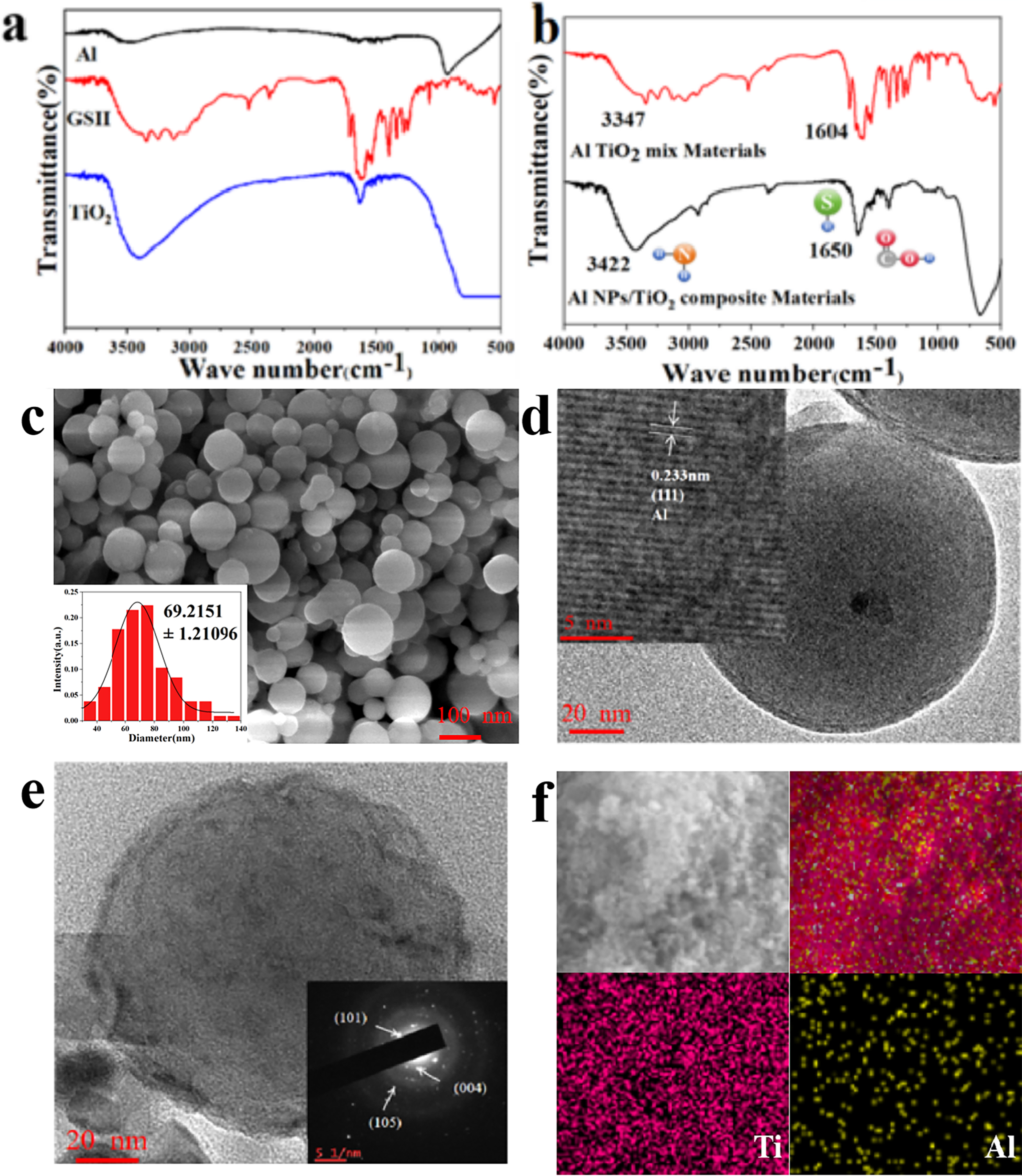
FTIR spectra of raw material
The particle size distribution of 70 nm Al NPs was observed by SEM. From Figure 2c, it can be seen that most of the Al NPs are concentrated between 60 and 80 nm with uniform particle size, which meets the experimental requirements. Then the surface morphology of Al NPs and Al NPs/TiO2 was described by TEM. As shown in Figure 2d, the surface of Al NPs presents a smooth state with a lattice spacing of 0.233 nm, which corresponds to the (111) crystal surface of Al. The dimensions of Al NPs/TiO2 in Figure 2e are similar to those of Al NPs in Figure 2d, suggesting that the main body of Al NPs/TiO2 is Al NPs. However, the surface of Al NPs/TiO2 becomes rough compared with that of Al NPs, and the surface diffraction results correspond to the surfaces of TiO2 (101), (105), and (004). The results indicate that the Al NPs/TiO2 composites are composites with Al NPs as the core and TiO2 as the surface.
Finally, we also performed EDS characterization experiments on the composites. The elemental distribution in Figure 2f shows that the Al and Ti elements are uniformly distributed. And because it is TiO2-wrapped Al NPs, the distribution of Al elements on the surface is less. From the above results, it can be seen that Al NPs and TiO2 are uniformly distributed in the composites. In summary, Al NPs/TiO2 was successfully prepared, as shown by XRD, FTIR, SEM, TEM, and UV–Vis spectra.
Results of MB degradation under visible light
The degradation rate of MB by Al NPs/TiO2 composite materials was mainly studied by changing the ligands (GSH, GAG, or CYS), particle size of Al (40, 70, 100, 200, 300, and 500 nm), and the molar ratio of Al:TiO2 (0.5:1, 1:1, 2:1, 4:1, 6:1, and 10:1) to verify the effects of various factors on the photocatalytic degradation of MB.
First, three ligands (GSH, GAG, and CYS) were chosen to investigate the impact of complexes generated by various ligands with Al on the effectiveness of MB degradation. The MB degradation rates of Al NPs, P25 TiO2, Al and TiO2, Al-GAG-TiO2, Al-CYS-TiO2, and Al-GSH-TiO2 were examined in the experiment. From Figure 3b, we can see that the degradation efficiency of Al NPs is zero, which proves that Al NPs do not have any degradation ability for MB. And the degradation of Al and TiO2 is worse than that of P25 TiO2, with almost no degradation effect in 70 min. This suggests that the addition of Al NPs in the absence of ligands actually reduced the degradation of TiO2. It is speculated that this may be because of the black Al NPs blocking the light. The degradation of Al-CYS-TiO2 was almost identical to that of Al and TiO2, indicating that CYS plays a weak role as a ligand. Compared with P25 TiO2, Al-GAG-TiO2 and Al-GSH-TiO2 showed better MB degradation, suggesting that these two ligands acted as ligand bridges connecting Al and TiO2 to form a composite photocatalyst. Among them, the composite photocatalyst with GSH as the ligand showed better degradation of MB. We believe that this may be because of the fact that it is the carboxyl group, sulfhydryl group, and amino group that act as the connecting bridge in the ligand. The carboxyl group can react with both TiO2 and Al, whereas the amino group and sulfhydryl group can react with TiO2, and together they act as a bridge. Although GAG and CYS also contain carboxyl, sulfhydryl, and amino groups, GSH has more groups and a longer carbon chain, which can bring Al and TiO2 closer together, thus improving the stability and reaction efficiency of the samples (Feng et al., 2019; Zhang et al., 2021).
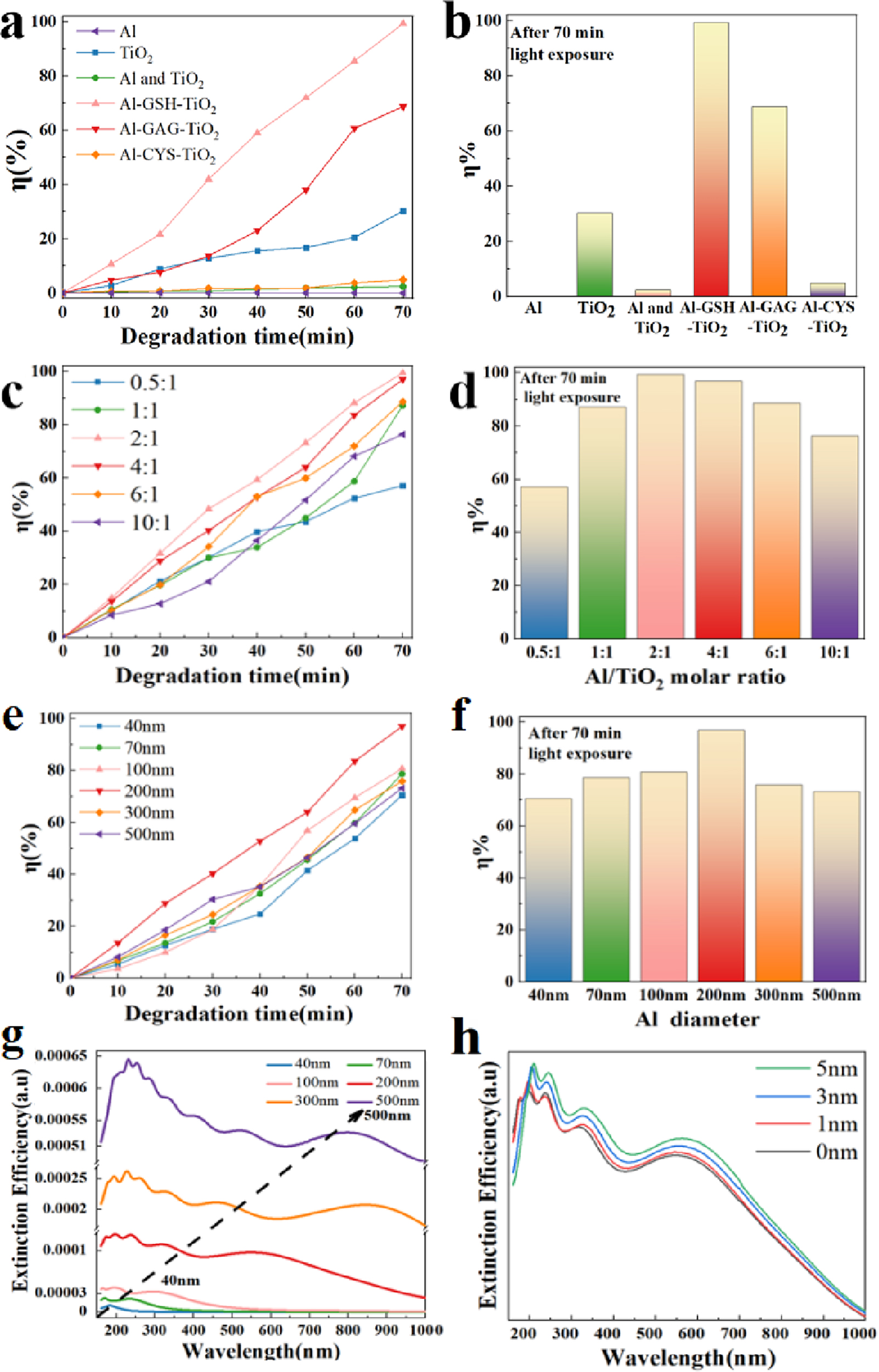
Photodegradation curves of Al NPs/TiO2 prepared with different ligands
The influence of the molar ratio of Al:TiO2 on the photodegradation effect of Al NPs/TiO2 is also worth studying. Composite materials with Al:TiO2 molar ratios of 0.5:1, 1:1, 2:1, 4:1, 6:1, and 10:1 were prepared. Their photocatalytic performance was analyzed. And their elemental composition was analyzed by ICP-OES, which was consistent with the molar ratio of our input raw materials, proving that there was no raw material loss in the compounding process. From Figure 3d, it can be seen that as the molar ratio of Al NPs to TiO2 increases from 0.5:1 to 2:1, the degradation effect on MB also increases. This is because as the mass of Al NPs increases, Al NPs also generate more hot carriers because of the LSPR effect, and more hot carriers participate in photocatalytic reactions, thereby improving the catalytic efficiency. However, as the molar ratio continues to increase, the degradation effect begins to decrease. This is because the amount of TiO2 and ligands is constant, and excessive Al NPs cannot composite with TiO2, making it more prone to agglomeration and deposition, resulting in a decrease in the degradation efficiency of MB.
The particle size of metal NPs affects their LSPR effect, which, in turn, affects the generation of hot electrons. In addition, because the metal NP composite with TiO2 will improve the photocatalytic performance because of hot electron injection, we believe that the photocatalytic performance of TiO2 can be influenced by modulating the particle size of Al. To investigate the effect of Al particle size on the photodegradation effect of MB in Al NPs/TiO2, Al with particle sizes of 40, 70, 100, 200, 300, and 500 nm was compounded with TiO2 via GSH. As shown in Figure 3f, the composites formed by Al NPs with different particle sizes exhibited different degrees of MB degradation rates within 70 min of light exposure, the photocatalytic effect of Al NPs/TiO2 increased and then decreased when the particle size of Al NPs increased, and 200 nm Al NPs/TiO2 showed the best degradation effect.
The experimental results were validated by FDTD software, which allows a more intuitive understanding of the influence of the particle size of Al NPs on the surface plasmon resonance effect. Therefore, the optical properties of Al NPs with diameters of 40 nm, 70 nm, 100 nm, 200 nm, 300 nm, and 500 nm were simulated (Khadir et al., 2017). From Figure 3g, it can be seen that as the diameter of the Al NPs increases, their LSPR wavelength gradually increases. The simulation results show that the optical properties of Al NPs continue to improve with increasing particle size. However, the degradation effect of the composites in the experiment decreases after the particle size is increased to 200 nm. It is speculated that the larger the size of the Al NPs is, although their optical performance improves, the scattering also increases. It is possible that most of the light scattering has been lost without excitation of electron oscillations, resulting in poor photocatalytic performance.
Al is prone to oxidation in air, forming an oxide layer on its surface. Therefore, we simulated the optical properties of Al NPs at 200 nm and aluminium oxide (Al2O3) thin films with different thicknesses. As shown in Figure 3h, as the thickness of the Al2O3 thin film increases, the absorption peak of the Al NPs does not disappear but undergoes a redshift. Therefore, we can determine that the presence of the oxide layer has a weak effect on the LSPR of Al NPs.
In this experiment, we found that the photocatalytic performance of Al NPs/TiO2 was best when the ligand was GSH, the particle size of Al NPs was 200 nm, and the molar ratio of Al NPs:TiO2 was 2:1. As shown in Figure 3, compared with P25 TiO2, the photocatalytic efficiency of Al NPs/TiO2 with the best parameters is greatly improved. Under visible light conditions, the degradation rate of 5 mg/L MB was 99.5% in 70 min, whereas the degradation rate of P25 TiO2 reached only 30.3%. The degradation rate of MB by Al NPs/TiO2 is approximately three times that of P25 TiO2.
In addition, we chose CV as a research object to investigate the photocatalytic effect of Al NPs/TiO2 on different dyes at the same time. As shown in Figure 4b, Al NPs/TiO2, which has the best photocatalytic performance, also has a certain degradation ability for CV, which is twice that of P25 TiO2. We also changed the light source to sunlight for the experiment. As shown in Figure 4d, the photocatalytic performance of the material is further improved, and the degradation can be completed in only 50 min. We also tested the degradation effect of Al NPs/TiO2 on different concentrations of MB. As shown in Figure 4e, the composites were effective in degrading MB at different concentrations. However, 5 mg/L MB solution can be a better measure of the photodegradation performance of the composites.
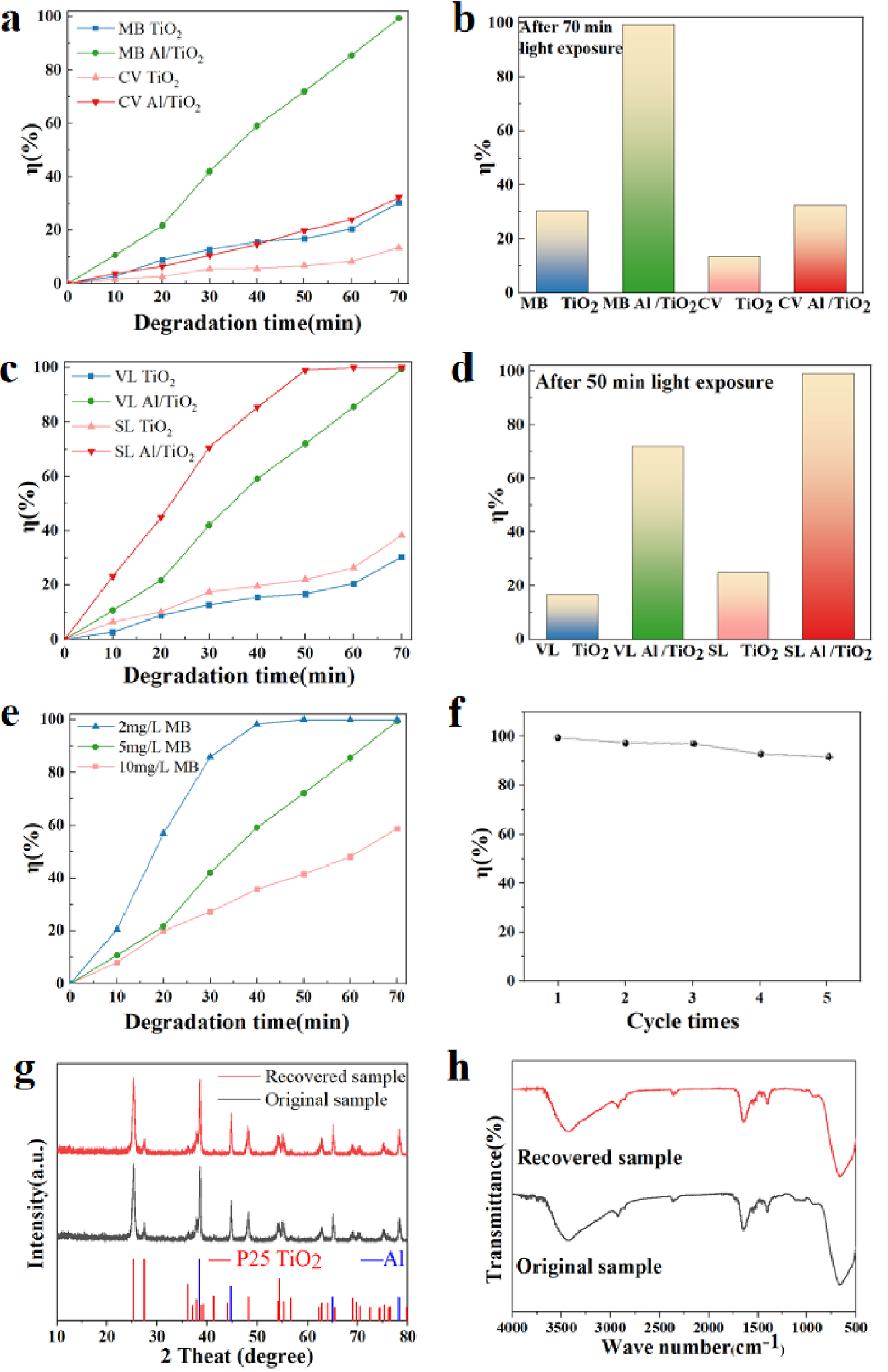
Degradation curve
We performed cycling tests of Al NPs/TiO2. As shown in Figure 4f, the composites maintained good photocatalytic performance in all five cycles. The structural stability of the composite catalysts was analyzed using XRD and FTIR. As can be seen from Figure 4g and Figure 4h, the composites maintained good structural characteristics before and after the catalysis, and the chemical bonds within the composites did not change significantly.
Table 1 summarizes the comparative performance of different photocatalysts for degrading MB under visible light. Compared with the literature results, the Al NPs/TiO2 composites prepared in this study have the advantages of convenient preparation process, fast degradation rate, and low raw material price.
Comparison of the Photocatalytic Performances of Al NPs/TiO2 and Other Materials
NPs, nanoparticles; TiO2, titanium dioxide; CoPcS, cobalt phthalocyanine sulfate; g-C3N4, graphite carbon nitride.
The Mechanism by which Al NPs Broaden the TiO2 Light Response Range
Characterization of photogenerated carriers
To further explore the charge separation efficiency of the photocatalysts after Al NPs composite, we analyzed the transient photocurrent and electrochemical impedance spectroscopy (EIS) internal resistance values of TiO2 and Al NPs/TiO2. As shown in Figure 5a, the photocurrent density of the composite material sample significantly increased compared with that of TiO2. Generally, the higher the transient photocurrent density of the material is, the higher the separation efficiency of photogenerated electrons and holes under illumination (Chen et al., 2023; Wang et al., 2020; Yang et al., 2018).
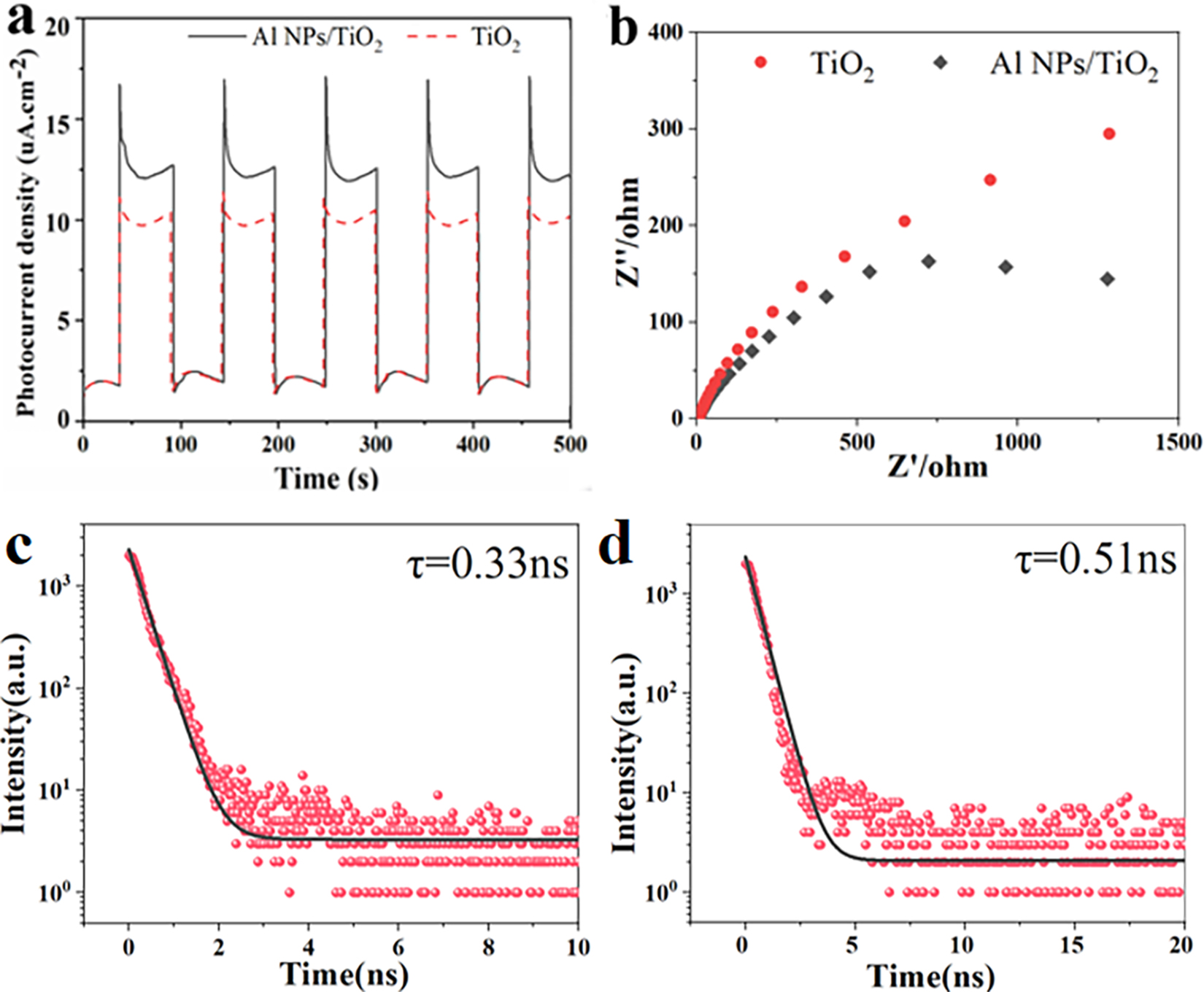
Transient photocurrent
As shown in Figure 5b, compared with TiO2, the impedance of the composite material decreases. In general, a lower material impedance in the EIS internal resistance diagram indicates a higher charge transfer rate and a more efficient separation of photogenerated electrons and holes (Alsalhi et al., 2019, Su et al., 2023, Zhang et al., 2019). In summary, it can be concluded that the incorporation of Al NPs leads to an increase in the photogenerated carrier separation rate in the composites. More photogenerated carriers are incorporated into the photocatalyst, thereby increasing the photocatalytic efficiency.
To further explore the photogenerated carrier lifetime of the photocatalysts after the composite of Al NPs and TiO2, we tested the transient fluorescence spectra of TiO2 and Al NPs/TiO2 (Li et al., 2021). As shown in Figure 5c and Figure 5d, the photogenerated carrier lifetimes of the composites were calculated to be 0.51 ns at 397 nm and 0.33 ns for TiO2 by exponential fitting of the transient fluorescence spectra, and the photogenerated carrier lifetimes of the materials before and after compositing were significantly extended. Because of the extended life span of photogenerated carriers, more photogenerated carriers can be used for photocatalysis, thereby improving photocatalytic efficiency.
Mechanism analysis
As shown in Figure 6, under visible light irradiation, Al particles undergo surface plasmon resonance, and the LSPR of Al generates a large number of hot carriers. Although Al2O3 films form easily on the surface of Al, the high density of defect states in the amorphous Al2O3 layer allows hot carriers to tunnel into the semiconductor. Therefore, the Al2O3 layer can support hot electron transfer generated by plasma resonance on the Al surface, increase the number of hot carriers in TiO2, and thereby improve photocatalytic efficiency (Robatjazi et al., 2017). In contrast, the surface potential of TiO2 is caused by its surface barrier. Therefore, when they come into contact with each other, they cause the TiO2 band to bend, creating a Schottky barrier. At this time, under visible light irradiation, the hot electrons generated by the Al LSPR effect have a high energy that can cross the Schottky barrier and migrate to TiO2, whereas the holes in TiO2 migrate to Al as the energy band bends because the blocking of the Schottky barrier makes it difficult for the photogenerated electrons and holes to meet each other again, which reduces the recombination rate of the photoelectrons and holes, prolongs the lifetimes of the photoelectrons and holes, and finally improves the photocatalytic activity of the semiconductor (Crowell and Sze, 1966).
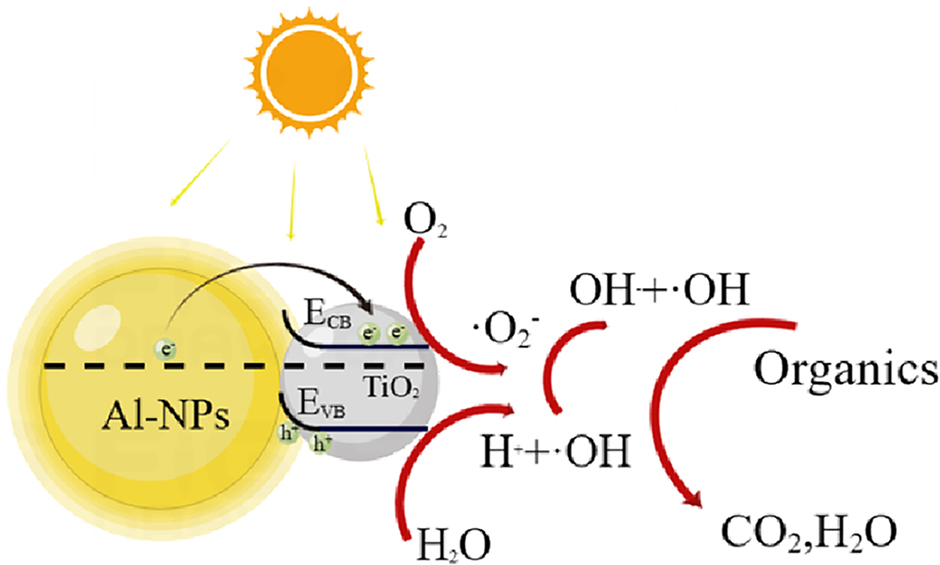
Al NPs/TiO2 photocatalytic degradation mechanism. NPs, nanoparticles; TiO2, titanium dioxide.
Conclusion
In this study, an Al NPs/TiO2 photocatalytic material was successfully prepared by compositing Al NPs with TiO2. The experimental results show that the composite material with GSH as the ligand, Al:TiO2 molar ratio of 2:1, and an Al particle size of 200 nm has the best photocatalytic performance. Compared with P25 TiO2, the photocatalytic performance can reach three times that of P25 TiO2. Therefore, it is demonstrated that the LSPR effect of Al NPs can effectively improve the photocatalytic performance of TiO2. The advantages of Al NPs/TiO2 composites include low cost and easy preparation. Al NPs/TiO2 composites have great potential for the photocatalytic degradation of organic pollutants in H2O, and they are expected to realize the industrial production of TiO2 in the field of photocatalysts.
Footnotes
Authors’ Contributions
Y.W.: Writing—original draft (lead), Material preparation (lead), and Data sorting (lead). M.X.: Conceptualization (lead), Writing—reviewing and editing (equal), Funding acquisition (lead), and Supervision (equal). J.L.: Writing—reviewing and editing (equal), Conceptualization (support), and Supervision (equal). T.Z.: Investigation (lead), Resources (lead) and Conceptualization (support).
Disclaimer
Each of the listed authors is submitting the article in their own personal professional capacity and is not an employee of any U.S.-sanctioned government.
Author Disclosure Statement
The authors declare that they have no known competing financial interests or personal relationships that could have appeared to influence the work reported in this paper.
Funding Information
This study was supported by the Science and Technology Development Project of Jilin Province (20220101030JC), the Education Department of Jilin Province (JJKH20230794KJ), and the “111” Project of China (D17017).

References
Supplementary Material
Please find the following supplemental material available below.
For Open Access articles published under a Creative Commons License, all supplemental material carries the same license as the article it is associated with.
For non-Open Access articles published, all supplemental material carries a non-exclusive license, and permission requests for re-use of supplemental material or any part of supplemental material shall be sent directly to the copyright owner as specified in the copyright notice associated with the article.
