




Abstract
The presence of antibiotics in irrigation water is an emerging problem. This study aimed to evaluate the effect of irrigation using water-containing ciprofloxacin on alfalfa (Medicago sativa) nitrogen and carbon fixation, number of root nodules, root and stem length, and root and stem weight. A surface layer of soil from Piracicaba, Brazil, was used in controlled conditions. The soil pH was adjusted to neutral levels, and alfalfa (M. sativa) was grown. Seeds inoculated with Rhizobium sp. were distributed in 12 pots comprising three treatments employing three repetitions and three controls. The experiment was conducted in a plant growth chamber, where six irrigations were carried out with contaminated water with ciprofloxacin at 0, 1, 10, and 100 μg L−1 for 40 days. The presence of ciprofloxacin in irrigation water decreased carbon fixation in alfalfa leaves by up to 8.9%, reducing the number of root nodules by 96% at 100 μg L−1 and leading to their elongation. However, it had no significant effect on soil nitrogen and carbon, similarly in stem length and, finally, in root and stem biomass. This indicates the tolerance capacity of alfalfa to the tested concentrations.
Introduction
Antibiotics are routinely prescribed to prevent and treat bacterial infections (Danner et al., 2019; Maldonado et al., 2023). In some countries, they are overprescribed by medical professionals, resulting in increased consumption (Rose et al., 2021). In addition, these medications’ widespread availability and relatively low cost have contributed to their overuse in many parts of the world (Ebert et al., 2011). Even in some low- and middle-income countries, patients may obtain antibiotics without proper medical prescription; this extensive accessibility has led to inappropriate use by patients and health care providers (Azanu et al., 2016). As a result, ∼1,000,000 tons of antibiotics are consumed worldwide each year (Danner et al., 2019). Furthermore, aside from therapeutic applications in livestock farming, subtherapeutic doses are often administered for nontherapeutic purposes, such as promoting animal growth for fattening purposes (Carvalho and Santos, 2016; Tolls, 2001). These antibiotics are not completely metabolized; 50–80% are excreted through feces and urine into wastewater treatment systems, which may persist because of inefficient removal processes (Danner et al., 2019; Xie et al., 2011).
Antibiotic compounds are ubiquitous in pharmaceutical, industrial, and domestic industries effluents (Zirena et al., 2021) originating from wastewater treatment plants (WWTPs) because of inefficient treatment (Ebert et al., 2011; Maldonado et al., 2022a). Quinolones have been reported in seawater samples from Antarctica, resulting in wastewater discharges following conventional WWTP treatment (Danner et al., 2019; Maldonado et al., 2022a). Ciprofloxacin (CFX) is a widely used antibiotic (Meng et al., 2023) whose residues are transferred to the aquatic ecosystem (Danner et al., 2019; Ebert et al., 2011). In this sense, municipal waste discharges and their use in crop irrigation comprise a significant concern, resulting in soil contamination (Azanu et al., 2016; Gomes et al., 2020a; Tasho et al., 2018).
The water in the environment is regularly used for different activities, like aquaculture, human consumption, crop irrigation, and others (Danner et al., 2019; Del Castillo et al., 2023). Even in other regions, wastewater effluent is used in crop fields (Azanu et al., 2016). This compound pollutes the soil structure and changes the native microorganisms, affecting their ecological function, as in nutrient cycling (Moreira et al., 2021). In the case of crop irrigation, the plants usually uptake the pollutants into the plant tissue, which affects other morphological changes in the plants (Del Castillo et al., 2023; Michelini et al., 2012; Piotrowicz-Cieślak et al., 2010; Zirena et al., 2022). Also, the antibiotics affect the endosymbionts bacteria of the plants; therefore, they impact plant development, root phytotoxicity, growth (Maldonado et al., 2022a), and another toxic effect, which has an impact on the standard progress of the plant (Ebert et al., 2011).
Adverse effects in this regard have been reported for some agricultural plant species grown in antibiotics presence such as bean (Phaseolus vulgaris cultivar FC 104), soybean (Glycine max cultivar KWS M6210), and corn (Zea mays cultivar KWS RB 9110) crops irrigated with water with enrofloxacin; it was found that reduced productivity in soybean and accumulation of the antibiotic in the tissues of the three crops (Marques et al., 2021). On the contrary, crops such as rice are resistant to contamination with tetracycline, sulfamethoxazole, roxithromycin, and ofloxacin. Similarly, in another study, ciprofloxacin accelerated seed germination by stimulating reactive oxygen species (ROS) accumulation in seeds (Gomes et al., 2019). On the contrary, CFX-contaminated soils impacted morphological changes in spinach root growth (Aristilde et al., 2010).
Alfalfa (Medicago sativa) is a plant widely used in animal husbandry (Basigalup and Manfredi, 2007) and made association with rhizobacteria (Hillis et al., 2011). Antibiotic pollution could affect the normal development of this plant (Kong et al., 2007). In this context, ciprofloxacin is an antibiotic usually found in the environment (Zirena et al., 2021) and has different effects on plants.
The present study evaluated the effect of irrigation using water containing CFX residues on alfalfa (M. sativa), analyzing carbon fixation and other morphological changes such as root length, nitrogen, carbon and nodule, also dry root mass, dry air mass, aerial height, leaves nitrogen, and air mass carbon. Our hypotheses suggest that irrigation with CFX-contaminated water will adversely affect the growth and development of alfalfa. Our research questions focus on understanding the extent and mechanisms of these effects. This approach is justified by the imperative need to investigate the consequences of antibiotic pollution on crops, and the novelty of the study lies in its comprehensive evaluation of the effects of CFX residues on alfalfa, including carbon and nitrogen fixation.
Materials and Methods
Soil preparation
The soil was collected from the surface layer (0–30 cm deep) of crop fields located in Piracicaba, SP, Brazil (22° 42′49″S, 47° 37′12″W), where dry farming is carried out. The soil was previously sieved through a 2.0 mm mesh according to Mendes et al. (2019), placed on a flat surface, and mixed with BASAPLANT lime substrate (COMPO EXPERT®, Munster, Germany) at a 1:1 ratio. Owing to its high acidity, the soil was limed using limestone and left to rest for 20 days before seeding, reaching a pH between 6 and 7, to guarantee adequate alfalfa development in pH near to neutral value (Pourbabaee et al., 2021). The carbon content of the soil, on average, was 4.35% and 0.19% for nitrogen.
Alfalfa seed inoculation
Alfalfa (M. sativa) seeds (5 g) were inoculated with Rhizobium sp. on an alcohol-sterilized metal tray, mixed with 8 mL of molasses and 5 g of phosphate until a semiwet paste that was then spread evenly on the tray. The mixture was left in the dark in the open for 12 h before seeding.
Experimental design and installation
The experiment was carried out with a completely randomized design consisting of 12 pots distributed in four treatments (0, 1, 10, and 100 µg L−1) composing three repetitions. About 3.5 kg of previously prepared soil was poured into 20X 16X 15 cm coded polyethene pots (width, height, and base, respectively). The soil came from a cultivated field combined with NPK (BASAPLANT-COMPOEXPERT) in a 1:1 ratio (Mendes et al., 2019). The sowing process was carried out using previously inoculated alfalfa seeds 1 cm from the surface, followed by irrigation with 5 mL of water. The germination process began 24 h after sowing, and the first stages of vegetative development and uniform leaves were observed 48 h after sowing (Basigalup and Manfredi, 2007). Thinning was carried out in all treatments, leaving only one plant per experimental unit. Treatments were carried out in a vegetative growth chamber at the CENA/USP Ecotoxicology Laboratory, ranging from 21.9°C to 27°C, with relative humidity set between 63% and 82.8%, CO2 concentration between 400 and 448 ppm and 12 h to artificial illuminations, and light irradiation set at 469 µmol s−1 m−2.
After 48 h of sowing, irrigation was done with 100 mL of water, with a frequency of 48 h for 16 days. After 24 days, six irrigations were made with 200 mL, contaminated with CFX concentrations (0, 1, 10, and 100 µg L−1) (Fig. 1).
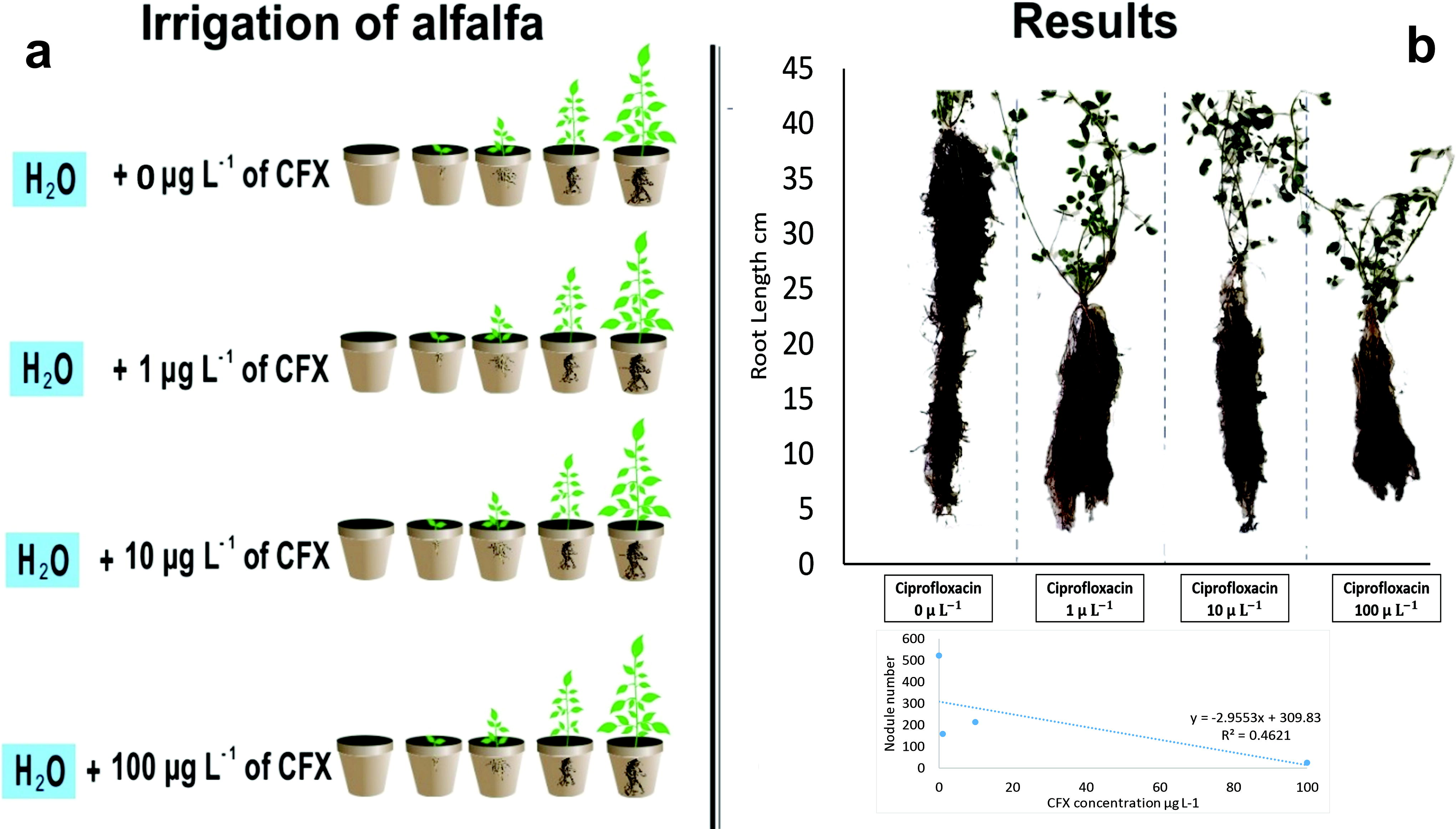
Installation of experimental design
Carbon and nitrogen determination in alfalfa leaves, roots, and soil
At 40 days of seed sowing, leaves, roots, and soil samples from plants exposed to each CFX treatment were placed in article bags, dried at 65°C, and ground until a fine powder was obtained for subsample preparations. The ground leaf subsamples were placed in tin capsules and loaded into a Thermo Quest-Finnigan Delta Plus isotope ratio mass spectrometer (Finnigan-MAT; CA, EE.UU.) connected to an elemental analyzer (Carla Erba 1110 model; Milán, Italy) to determine total carbon contents, expressed as a percentage (%) (Moreira et al., 2021). The methodology is based on isotope ratio mass spectrometry, which analyses gaseous molecules such as CO2, N2, CO, SO2, and H2. These molecules are introduced into a mass spectrometer and entrained with a helium flow. Before analysis, samples undergo a high-temperature reaction process, often accompanied by catalysts, aimed at converting the samples into species suitable for reference analysis (Moreno et al., 2017).
Root nodule determinations
Also, after 40 days of seed sowing, the alfalfa plants were harvested to determine the number of root nodules (Zirena et al., 2022). This process was carried out in plastic trays to separate the roots from the soil. The excess soil was left in the tray, and the roots were washed with water to remove soil residues and cleaned with tweezers and scissors (Pourbabaee et al., 2021). Root nodule counts were performed using a magnifying lens under a cold lamp.
Root number, stem length, and biomass determinations
Plants were carefully separated from the soil in plastic trays, and root lengths and dry biomass were measured with a ruler and analytical balance, respectively, from the beginning of the root (plant base) to the end.
Statistical analysis
The results of three replicates for each treatment were initially assessed for normality using the Shapiro–Wilk test. In addition, the Bartlett test for homogeneity of variance was applied. Subsequently, analysis of variance (ANOVA) was used to examine the effects of CFX on plant characteristics. ANOVA revealed significant differences. The Dunnett test (p < 0.05) was used for comparing means, given that the experiment included a control group. The analysis used R Studio version 4.2.1 (software developer and location).
Results and Discussion
Nitrogen and carbon in alfalfa leaves, roots, and soil
The CFX effects on nitrogen quantity on leaves (p value = 0.91), root (p value = 0.0934), and soil (p value = 0.37) are not significant (Fig. 2a). These results could be primarily attributed to the alfalfa’s ability to withstand contaminated environments, making it an ideal option for improving soil quality (Basigalup and Manfredi, 2007). Alfalfa has demonstrated its capability to tolerate and thrive in polluted soils, as evidenced in a study where this species was exposed to a hydrocarbon mixture; higher concentrations (200 mg/kg) had a more adverse effect, whereas lower concentrations were tolerated by alfalfa (Pourbabaee et al., 2021). In our study, antibiotic concentrations were lower, with a maximum concentration of 100 µg L−1. Moreover, the soil’s microbiological richness, along with the presence of symbiotic microorganisms associated with plants (Pourbabaee et al., 2021; Zirena et al., 2022), as an N2-fixing bacteria (Mujtaba et al., 2017) also contributed to mitigating the effects of antibiotics.

Effects of ciprofloxacin concentrations on nitrogen
Related to the effect on carbon in root and soil (p value = 0.279 and 0.37, respectively), neither is significant, which indicates that CFX does not affect these parameters (Fig. 2b). However, the carbon in leaves was influenced by CFX (p value = 0.00146). The Dunnett test (Table 1) indicates the primary distinction between the control group and the concentration of 100 µg L−1, demonstrating that the species tolerated intermediate concentrations. In contrast, the highest concentration has adverse effects (Maldonado et al., 2022b).
Dunnet Test for Influence of Ciprofloxacin on Carbon Content in Leaves and Root Nodules of Alfalfa at Piracicaba, SP, Brazil
Carbon content in plant tissues is associated with atmospheric CO2 capture through photosynthesis (Eloka-Eboka et al., 2020). The carbon content in the leaves of plants in the control group was 426.8 g kg−1 (Fig. 1b), decreasing with increasing irrigation water CFX concentrations, associated with CFX storage capacity in plant aerial tissues (Jayampathi et al., 2019; Maldonado et al., 2022a). This reduction may be because of the photosynthesis effect in plants (Maldonado et al., 2022a; Xie et al., 2011). According to Aristilde et al. (2010), CFX interferes with photosynthesis because it can mediate their action as quinone inhibitors in photosystem II (PS-II), a key enzyme in photosynthetic electron transport. On the contrary, Gomes et al. (2017) proposed that CFX leads to the overproduction of ROS, which, in turn, promotes oxidative stress, such as damage to thylakoid membranes and suppression of the synthesis of new proteins associated with the PS-II, resulting in photosynthetic activity decreases (Gomes et al., 2018).
At 100 μg L−1 CFX exposure, carbon concentrations in leaves reached 389.0 ± 6.9 g kg−1, an 8.9% decrease compared with the control group
Root number and nodule determinations
The number of secondary roots decreased as a function of increasing antibiotic concentration (Fig. 1b), indicating the adverse effects of CFX on alfalfa root were found. Significant differences in the number of alfalfa root nodules were also observed (p value = 0.00075). At 1 μg L−1, nodules numbered 157 ± 23 units, a 70% difference from the control group. At 10 μg L−1, this number increased to 200 ± 100 units, 59% less than the control group. At 100 μg L−1, the number of nodules decreased to 22 ± 11 units, which represents 96% less compared with the control group (Fig. 3a).
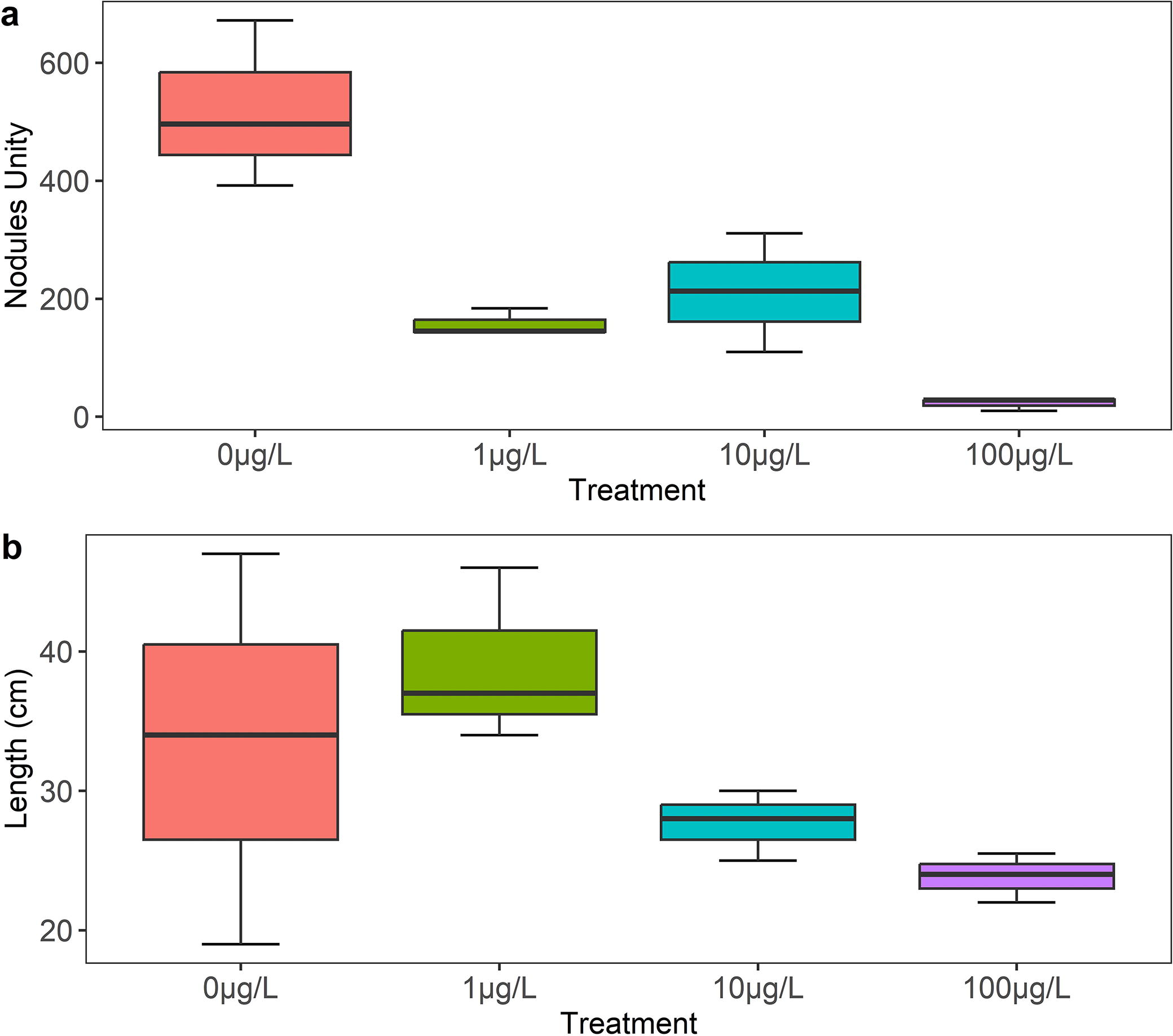
Boxplot of ciprofloxacin concentration effects on root nodule number
The effects of ciprofloxacin on alfalfa nodules are of concern since it would affect the nitrogen fixation process of the plant. The direct impact of CFX on Rhizobium sp. damages nodule formation and affects the rhizosphere area (Verma et al., 2020). In the rhizosphere, bacteria must enter root nodules, as demonstrated by Pourbabaee et al. (2021), who isolated 25 bacterial strains that have symbiotic relations with plants. Thus, plants exposed to ciprofloxacin reduced the number of root nodules compared with the control group, indicating that the presence of CFX in the soil can modify physicochemical and biological components (Ebert et al., 2011).
Antibiotics in the soil are likely to directly affect root nodule conformation and development because of their bactericidal properties, reducing beneficial bacterial soil populations (Pourbabaee et al., 2021; Verma et al., 2020; Zirena et al., 2022). It also reduces plant nodule-forming ability, which begins with the penetration of Rhizobium sp. bacteria into roots through symbiotic fixation (Hachana et al., 2021; Verma et al., 2020). In the present study, CFX exhibited maximum toxicity at 100 μg L−1, evidenced by a significant decrease in the number of root nodules (Fig. 3a). Different antibiotic concentrations, that is, low and high, result in different bacterial physiology consequences, both leading to bacterial cell death, which influenced in nodule development.
In this regard, CFX directly affects plant growth and reduces the symbiosis capacity of host plants by affecting the survival and growth of nitrogen-fixing bacteria (Pourbabaee et al., 2021; Sulieman and Tran, 2017). The reduction of beneficial microorganisms because of CFX exposure can, thus, reduce crop protection against pests and other pathogenic organisms, decreasing plant ability to tolerate abiotic and biotic (Gomes et al., 2020b). In addition, the alteration of the microorganisms directly affects the nitrogen-fixing function they perform, thus affecting the direction of the nitrogen-fixation process and even soil fertility (Sulieman and Tran, 2017). Biological nitrogen fixation contributes 180 million metric tons of ammonia annually, and 80% comes from symbiotic associations between microorganisms and plants (Tilak et al., 2005). Therefore, the antibiotic affects the rhizosphere. However, in this study, the influence of ciprofloxacin on the nitrogen stored in its structure is insignificant; more accurate studies would have to be conducted to reach more accurate conclusions.
Root, stem length, and weigh determinations
The results concerning effects on CFX like root length, stem length, root weight, and stem weight evidence that ciprofloxacin does not significantly influence these alfalfa parameters since all the p values corresponding to the ANOVA are above 0.05
Results of the Effect of Ciprofloxacin (μg l−1) on Alfalfa Roots and Stems. Values are the Means of Three Replicates in a Growth Chamber Study at Piracicaba, SP, Brazil
Root length, stem length, root weight, and stem weight evidence that ciprofloxacin has no significant effect. These results should be because of soil and plant microorganisms. Because in this study, the soil was prepared previously and inoculated with bacteria and added nutrients that have improved the soil quality and plant development (Basigalup and Manfredi, 2007; Tilak et al., 2005). Although the bacterial population was affected by antibiotics (Piotrowicz-Cieślak et al., 2010), there were nutrients in the soil that allowed the normal development of the plants (Sulieman and Tran, 2017).
Likewise, plants can absorb antibiotics from soil solutions through their roots and accumulate compounds in tissues (roots, fruit, and leaves) (Jayampathi et al., 2019), immobilizing the antibiotic compounds. Furthermore, soil sorption, fixation, mobility, and transport have been well documented (Gomes et al., 2020a; Marques et al., 2021; Piotrowicz-Cieślak et al., 2010). Roots, however, are typically more affected by antibiotic accumulation (Bellino et al., 2018) because of adverse effects on root length, elongation, and the number of secondary roots (Michelini et al., 2012; Piotrowicz-Cieślak et al., 2010). Our results show that although there is no significant difference, there is a reduction in root length as the concentration increases (Fig. 3b). Possibly because of high CFX root phytotoxicity, as these are the most critical plant absorption and accumulation tissues (Maldonado et al., 2022a). Even this may be associated with the inhibition of DNA gyrase, which catalyzes the ATP-dependent supercoiling of DNA (Ebert et al., 2011), consequently altering root elongation and apical meristem cell division (Bellino et al., 2018). Our findings are similar to most studies on antibiotic effects on plant root elongation (Bellino et al., 2018), with more significant effects at increasing CFX concentrations, indicating higher antibiotic absorption at higher concentrations (Azanu et al., 2016).
Similarly, in a study when alfalfa was exposed to tetracycline, the results showed that the root length was significantly decreased at 100 µg L−1 (Hillis et al., 2011). Conversely, Kong et al. (2007) found that oxytetracycline inhibited the shoot and root growth by 61% and 85%, respectively. That shows the negative impact of antibiotics on alfalfa development. Decreased root elongation can affect water accessibility (Michelini et al., 2012; Piotrowicz-Cieślak et al., 2010), nutrient absorption, and biochemical and enzymatic soil–plant interactions (Tasho et al., 2018). Thus, root growth is one of the most important factors affecting plant growth and the ability to resist environmental stress (Hachana et al., 2021). CFX can, thus, affect alfalfa production, as it is a long-cycle crop, altering biomass production, number of leaves, branching patterns, and fresh/dry weight, among others (Michelini et al., 2012; Tasho et al., 2018). Furthermore, plants may also potentially transfer antibiotics from the soil to the food chain, directly affecting agricultural activities when wastewater is reused directly or indirectly for irrigation, which has become more frequent because of water shortages in many food-producing regions (Jayampathi et al., 2019; Piotrowicz-Cieślak et al., 2010). Therefore, the slight affectation of CFX in the root corroborates that the tested doses did not significantly affect the morphological characteristics of alfalfa, which is good to a certain degree; however, it would also represent a health risk since the antibiotics accumulated in the plant could be transferred through the food chain to humans (Leung et al., 2012; Maldonado et al., 2022b; Merma Chacca et al., 2022).
Conclusions
CFX minimizes the nitrogen content in the stems, leaves, and roots. However, it notably influences leaves’ carbon content, particularly at the highest concentration tested. Furthermore, there is an observed impact on the number of root nodules, indicating its effect on Rhizobium sp. In addition, root length has a slight influence in both instances, with a more pronounced effect noted at the highest concentration of CFX (100 µg L−1). Regarding other plant variables such as root and stem weight, as well as stem length, there is no significant effect among the treatments tested, which evidences that, in general, alfalfa tolerates the concentrations considered in this study. However, this is also a concern because of the possible accumulation of CFX by the plant.
Footnotes
Acknowledgments
The authors thank Huijing Zhong, for the first English editing version of the article.
Authors’ Contributions
F.Z.V. conceived and designed the research and secured the funding. T.E.L.P. drafted the article. ODVL designed and conducted the experiments. L.V.J. designed and conducted the experiments. N.C.G. designed and conducted the experiments. R.S.L. analyzed the data. I.M. analyzed the data and drafted the article. C.N.C.Q. conceived and designed the research. V.L.T. secured the funding and finalized the article.
Author Disclosure Statement
The authors declare that they have no known competing financial interests or personal relationships that could have appeared to influence the work reported in this article.
Funding Information
The