




Abstract
Propineb is a widely used protective fungicide in farmland. To investigate the effects of propineb on cadmium (Cd) accumulation and the physiological characteristics of wheat seedlings under Cd stress, we performed a hydroponic experiment with artificially added Cd. The results indicated that the application of propineb leads to a decrease in Cd accumulation in the shoots of wheat. During the low-Cd treatment experiment, propineb caused Cd to transfer from the soluble component to the cell wall. In terms of the chemical morphological distribution of Cd in wheat seedlings, propineb reduced the proportions of ethanol extracted state and deionized water extracted state, whereas the proportions of acetic acid extracted state and hydrochloric acid extracted state increased. The photosynthetic rate of wheat seedlings significantly increased, but there was no significant effect on the chlorophyll content. Foliar application of propineb increased the O2− clearance rate and hydrogen peroxide content in the wheat. However, the catalase content decreased. This study indicates that the application of propineb could decrease Cd accumulation in wheat seedlings and partially improve the physiological functions of plants. This study provides useful information for studying the effects of pesticides on Cd accumulation in crops and the physiological characteristics of Cd stress.
Introduction
Cadmium (Cd) pollution in agricultural soils has become increasingly serious owing to the acceleration of anthropogenic activities. Wastewater irrigation, mining, nonferrous metal smelting, improper disposal of solid waste, atmospheric sedimentation, and the abuse of pesticides and fertilizers are the primary sources of Cd pollution in agricultural soils (Huang et al., 2019). Cd accumulates in plants through bioaccumulation and is highly toxic to plant growth and development. Morphologically, it causes plant dwarfism and therefore a decreased yield; physiologically, it causes a decrease in crop photosynthetic capacity and oxidative stress (He et al., 2017). Crops containing excessive Cd can easily pose a threat to human health after consumption (Chen et al., 2022; Hussain et al., 2021; Wang et al., 2023).
Wheat (Triticum aestivum L.) is one of the three major food crops worldwide, and over half of the world’s population relies on wheat as a staple food. The U.S. Department of Agriculture reports that the world’s annual wheat production is 7.89 million tons, the highest of any food crop (United States Department of Agriculture, 2024). However, owing to the presence of severe Cd pollution in some wheat fields, there are occasional occurrences of Cd exceeding the standards set in wheat, posing a serious threat to public health (Zhang et al., 2020). Therefore, excessive Cd content in wheat requires widespread attention.
There are many methods to prevent and control excessive Cd levels in crops, including the addition of fixed materials such as biochar to the soil, the application of chelating and microbial agents, planting crops with low-Cd accumulation attributes, and regulating soil pH and water content (Chen et al., 2016; Liu et al., 2022; Pan et al., 2023; Thanwisai et al., 2023; Yang et al., 2021). In recent years, significant results have been achieved by using the antagonistic effect between zinc (Zn) and Cd to inhibit crop uptake and accumulation of Cd. This is achieved through the external application of Zn-containing substances (Rizwan et al., 2019a).
Various agronomic measures are required during wheat planting to ensure normal growth, development, and harvesting. Spraying fungicides to prevent and control diseases is necessary for daily field management. Propineb (C5H8N2S4Zn) is a broad-spectrum, fast-acting, protective, and low-toxicity dithiocarbamate (DTC) fungicide. This protection can provide Zn to crops, improving their physiological functions and thereby enhancing their disease prevention and disease resistance capabilities. It is difficult to develop resistance, and its prevention and control effects are significantly better than those of similar fungicides. In addition, Zn, as an essential nutrient element for plant growth and development, can supplement nutrients for crops after entering the plant body, which is beneficial for plant growth and development (Cabot et al., 2019).
In previous studies, we found that the application of DTCs such as propineb can effectively control the uptake and accumulation of Cd in wheat, and there was no negative impact on the crop yield (Gao et al., 2022). However, research on the related mechanisms is still relatively scarce, and hence, there is a lack of research on the plant physiological mechanisms regulating crop Cd tolerance. Also research on molecular resistance and control mechanisms is insufficient. Therefore, it is necessary to conduct in-depth studies to clarify relevant regulatory mechanisms.
This study used winter wheat seedlings as experimental material and conducted a hydroponic experiment to investigate the effects of propineb on Cd distribution and accumulation. We also investigate the effects of propineb on the photosynthetic and antioxidant characteristics of wheat under Cd stress, as well as its possible mechanisms of action. This study provides a theoretical basis and technical support for the safe production of Cd-polluted wheat fields using conventional agronomic measures such as pesticide spraying.
Materials and Methods
Materials
The wheat variety Jimai 44, a common wheat variety on the market, was purchased from an agricultural materials store in Xinxiang City, Henan Province. Propineb (70% wettable powder) was purchased from Shandong Bainongsida Biotechnology Co., Ltd.. All chemical reagents were purchased from Tianjin Chemical Reagent Co., Ltd. and were analytical grade unless otherwise indicated. All test kits were purchased from Solarbio Science & Technology Co., Ltd.
Test methods
The experiment performed adopted a dual-factor, fully combined design. The first factor is the Cd concentration of the nutrient solution. Based on the actual investigation results of the Cd pollution concentration in the field (Gao et al., 2022), the amount of Cd added was set to 0, 0.1, 0.5, or 1 mg/L, denoted as Cd0, Cd0.1, Cd0.5, and Cd1, respectively. The second factor was the spraying dose of propineb, which was not applied (F0), a low recommended dose (dilute 1 g of propineb with 800 g of water, F1), or a high recommended dose (dilute 2 g of propineb with 800 g of water, F2). There were 12 treatments (Cd0F0, Cd0.1F0, Cd0.5F0, Cd1F0, Cd0F1, Cd0.1F1, Cd0.5F1, Cd1F1, Cd0F2, Cd0.1F2, Cd0.5F2, and Cd1F2), and each treatment was repeated three times.
The selected plump wheat seeds were washed with tap water. They were then disinfected with hydrogen peroxide (H2O2) for 30 min and rinsed thrice with deionized water. The seeds were placed evenly on a breeding plate, and an appropriate amount of deionized water was added to avoid light and promote germination. After germination, the light avoidance setup was removed, and the seeds were grown on the breeding plate for approximately a week. They were then transferred to Hoagland nutrient solution with uninterrupted aeration. After 3 weeks, the seedlings were transferred to a 2.5 L water culture pot, with four seedlings per pot (Supplementary Data S1). The Cd treatment was performed at the early stage of seedling jointing, and propineb was sprayed once on wheat leaves after 3 and 10 days. Foliar spraying was stopped when the coating was uniform and droplets began to fall from the foliar surface. During the spraying process, the water culture facilities were tightly covered to prevent the solution from falling into the nutrient solution and polluting the root system. Three weeks after the last spray, plant samples were collected for measurement.
Measurement indicators and methods
Growth characteristic parameters of the wheat seedlings
The chlorophyll a and b contents were extracted using ethanol: 0.10 g of fresh samples was weighed for this measurement. After being ground and filtered with ethanol, colorimetric measurements were performed at wavelengths of 665, 649, and 470 nm to calculate chlorophyll content. Using a portable photosynthetic instrument (3051D, Zhejiang Topu Yunnong Technology Co., Ltd), the photosynthetic rate of wheat seedling leaves was measured under controlled light conditions before sampling, with each treatment repeated 5 times (Chen et al., 2023). When harvesting the wheat seedlings, the fresh weight and length of the shoots and roots were measured (Supplementary Table S1).
Cd content in wheat seedlings
We divided the wheat seedling samples into the shoot and root parts, washed them with tap water and deionized water sequentially, weighed the fresh weight, froze them in liquid nitrogen, and stored them in a refrigerator at −80°C: 1.00 g was added to 8 mL concentrated nitric acid (premium grade), covered, soaked for 12 h, and placed on an electric heating plate for digestion. The digestion sequence was heated at 80°C for 1.5 h, 120°C for 1.5 h, and 150°C for 3 h. Then, we opened the stopper, raised the temperature to 175°C, and reduced the solution to about 1 mL in the tube. After cooling, water was added to a constant volume of 50 mL, covered, shaken well, and filtered through a filter paper. Cd content was measured using inductively coupled plasma mass spectrometry (ICP-MS, ICAPQc, ThermoFisher Scientific) (Cheng et al., 2018). Quality assurance for plant samples and blank samples used the certified plant standard sample (Trace Elements in Spinach Shoots, 1570). The recoveries of Cd in samples ranged from 95% to 120%, and the relative standard deviation was below 15%. Duplicate and blank samples were included in each batch experiment for quality control.
Subcellular Cd content present in the wheat seedlings
A total of 3.00 g of crushed fresh wheat seedling shoot sample was weighed and placed in a 50 mL centrifuge tube. We added 30 mL of extraction solution (0.25 mol/L sucrose + 50 mmol/L Tris HCl buffer [pH 7.5] + 1.0 mmol/L dithio red sugar alcohol), vortexed it for 5 min at 2,000 r/min, and then filtered it in a funnel with an 80 μm pore size nylon mesh. The filtrate was then transferred to a dedicated freezing centrifuge tube for the next step. The residue was washed multiple times with a small amount of deionized water into a glass digestion tube, and this was the cell wall component. The filtrate was centrifuged at 4°C 11,900 r/min for 45 min using a high-speed freezing centrifuge, and the obtained supernatant was the cell-soluble component. The precipitate obtained was washed multiple times with a small amount of deionized water into a glass digestion tube. This was the organelle component. All components were dried, cooled, digested, and analyzed using ICP-MS (Xin and Huang, 2014).
Chemical morphological distribution of Cd in the wheat seedlings
There were six forms in this study: ethanol extracted state (FE), deionized water extracted state (FW), sodium chloride extracted state (FNaCl), acetic acid extracted state (FHAc), hydrochloric acid extracted state (FHCl), and residue state (Fr). The extraction solutions were 80% ethanol, with inorganic Cd mainly complexed of nitrate/nitrite, chloride, and aminophenol Cd extracted; distilled water (d-H2O), extracting water-soluble Cd from organic acids; 1 M NaCl, extracted Cd bound to pectin and protein; 2% acetic acid, extracted undissolved phosphoric acid Cd, including CdHPO4 and Cd3(PO4)2; 0.6 M HCl, extracted oxalic acid Cd (Huang et al., 2022).
Specific steps: 2.00 g wheat seedling shoot sample was weighed and placed in a dedicated frozen centrifuge tube. We added 25 mL of the corresponding extraction solution, then shook it at 25°C for 12 h, centrifuged at 20,000 r/min at 25°C for 10 min, and transferred the extraction solution to a 50 mL glass digestion tube. We then added another 25 mL of extraction solution, shook at 25°C for 12 h, centrifuged at 20,000 r/min at 25°C for 10 min, and transferred the extraction solution to a 50 mL glass digestion tube (a total of 50 mL of extraction solution). The residue remaining in the centrifuge tube was extracted for the next round. The extracted solution was discarded after NaCl extraction. After the final round of HCl extraction was completed, the remaining residue was transferred to a digestion tube with water, and the extraction solution was evaporated to dryness at 80°C. After digestion and constant volume, it was determined by ICP-MS.
Antioxidant system of the wheat seedlings
The absorbance was determined using an Ultraviolet Visible Spectrophotometer (TU-1810PC, Beijing Persee). The operation steps were as follows: the wheat seedling shoot sample was ground with liquid nitrogen, and the extraction solution precooled to 4°C was added. Vortex mixing was performed and the sample was left to stand for extraction for 20 min. Centrifugation at 4°C was performed, and a certain volume of supernatant was taken, and then the corresponding enzymatic reaction reagent was added. After the reaction, the absorbance of the reaction solution was measured at the corresponding wavelength, and the enzyme activity or substance content was calculated. The measurement wavelengths were 560 nm for superoxide dismutase (SOD), 470 nm for peroxidase (POD), and 530 nm for superoxide anion radicals (O2−) and 240 nm for catalase (CAT), 508 nm for H2O2, and 600, 532, and 450 nm for malondialdehyde (MDA).
Data analysis
All of the data were subjected to descriptive statistics, correlation, and factor analyses using IBM SPSS Statistics 26.0. The data were calculated using Microsoft Excel 2019 and were expressed as mean ± standard error (n = 3). Single-factor analysis of variance was used to compare treatments, significantly different means between treatments were separated by the least significant difference (LSD) method at the 0.05 level, and Origin 2021 was used for graphical processing.
Results
The effect of propineb on Cd accumulation in the wheat seedlings
Effect of propineb on Cd content in the wheat seedlings
The effect of propineb treatment on the Cd content in wheat seedlings is shown in Figure 1. As the concentration of Cd increased, the Cd content in wheat seedlings significantly increased. After applying propineb, the Cd content in the shoots of wheat seedlings significantly decreased, with the highest reductions of 82.5% (F2), 55.3% (F2), and 38.3% (F1) in the Cd0.1, Cd0.5, and Cd1 treatments, respectively. The Cd content in the roots of wheat seedlings also significantly decreased, with the highest decreases of 56.8% (F2), 36.3% (F2), and 69.2% (F1) under the Cd0.1, Cd0.5, and Cd1 treatments, respectively.
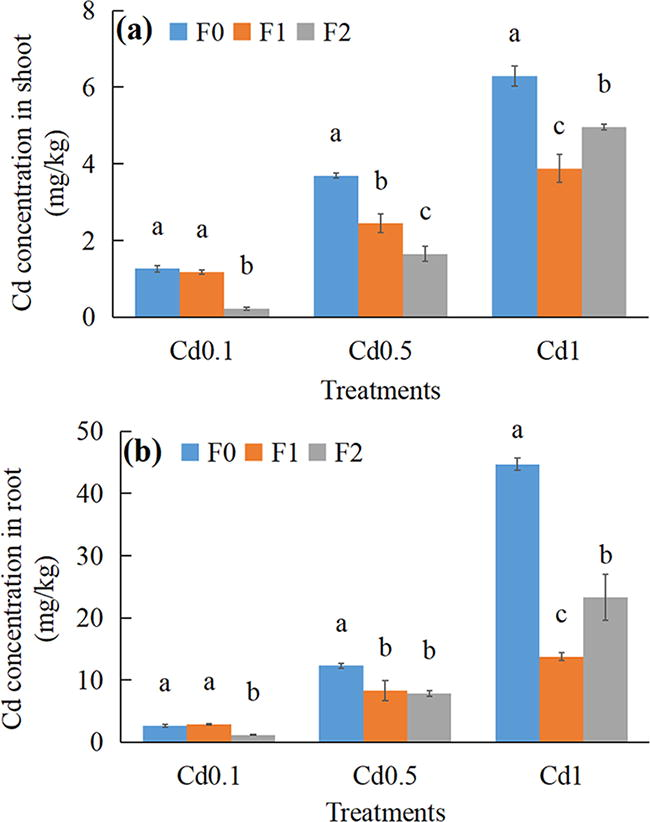
Effect of low to high doses of propineb on Cd content in shoot
The effect of propineb on the Zn content of wheat seedling shoots is shown in Figure 2. After application, the Zn content increased significantly, with the highest increases of 239.2% (F2), 289.5% (F1), 123.1% (F2), and 233.9% (F2) in the Cd0, Cd0.1, Cd0.5, and Cd1 treatments, respectively. This indicates that spraying propineb could increase the Zn content in wheat seedlings.

Effect of low to high doses of propineb on Zn content in shoot of wheat seedlings. Zn, zinc.
Effect of propineb on the subcellular distribution of Cd in wheat
The effect of propineb spraying on the subcellular distribution of Cd in wheat seedlings is shown in Supplementary Figure S1. Overall, the Cd content was higher in the soluble components and cell walls, but lower in the organelles. After the application of propineb, the Cd content in the cell walls decreased, with the highest reductions of 73.2% (F2), 10.6% (F2), and 51.5% (F1) found with the Cd0.1, Cd0.5, and Cd1 treatments, respectively. The Cd content in the soluble components showed an overall downward trend, with decreases of 89.1% (F2), 65.6% (F2), and 25.9% (F1) under the Cd0.1, Cd0.5, and Cd1 treatments, respectively. In the organelles, low doses of propineb increased the Cd content, whereas high doses of propineb decreased the Cd content.
The proportion of Cd in the subcellular cells of wheat seedlings after propineb application is shown in Figure 3. At low Cd concentrations (Cd0.1 and Cd0.5), the proportion of Cd in the cell wall increased from 39.1% to 46.0% (F2) and 28.6% to 34.8% (F2), respectively. At high Cd concentrations (Cd1), the proportion of Cd in the cell wall decreased from 60.0% to 33.2% (F2). At low Cd concentrations (Cd0.1 and Cd0.5), the proportion of Cd in the soluble component decreased from 53.3% to 44.6% (F2) and 60.1% to 51.5% (F2), respectively. At high Cd concentrations (Cd1), the proportion of Cd in the soluble component increased from 33.2% to 60.6% (F2).
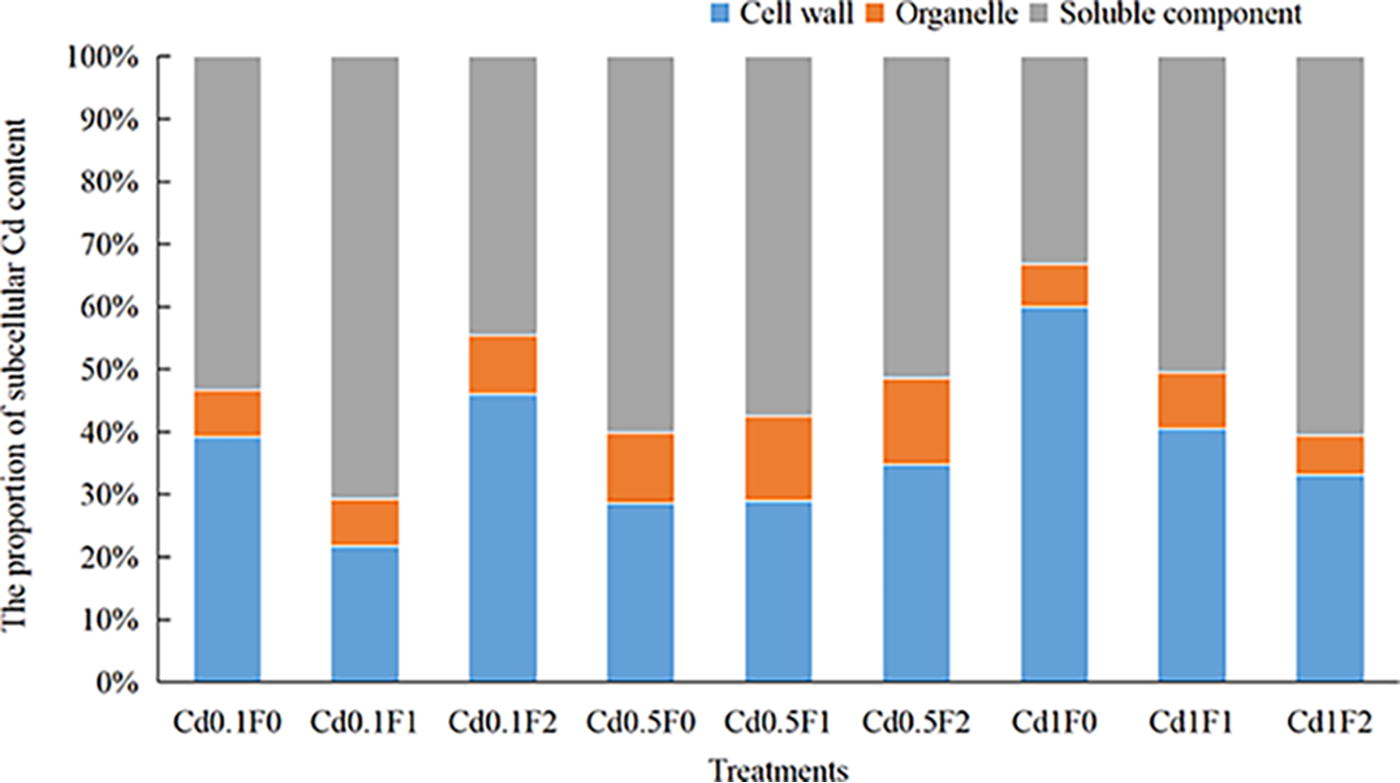
Effect of low to high doses of propineb treatment on proportion of subcellular Cd content in wheat seedlings.
Effect of propineb on the chemical morphological distribution of Cd in wheat
The effect of propineb spraying on the chemical form of Cd in wheat is shown in Figure 4. Among the various chemical forms, FNaCl accounted for the highest percentage (50%). The proportions of the other chemical forms in descending order were FE, FHAc, FW, and FHCl.
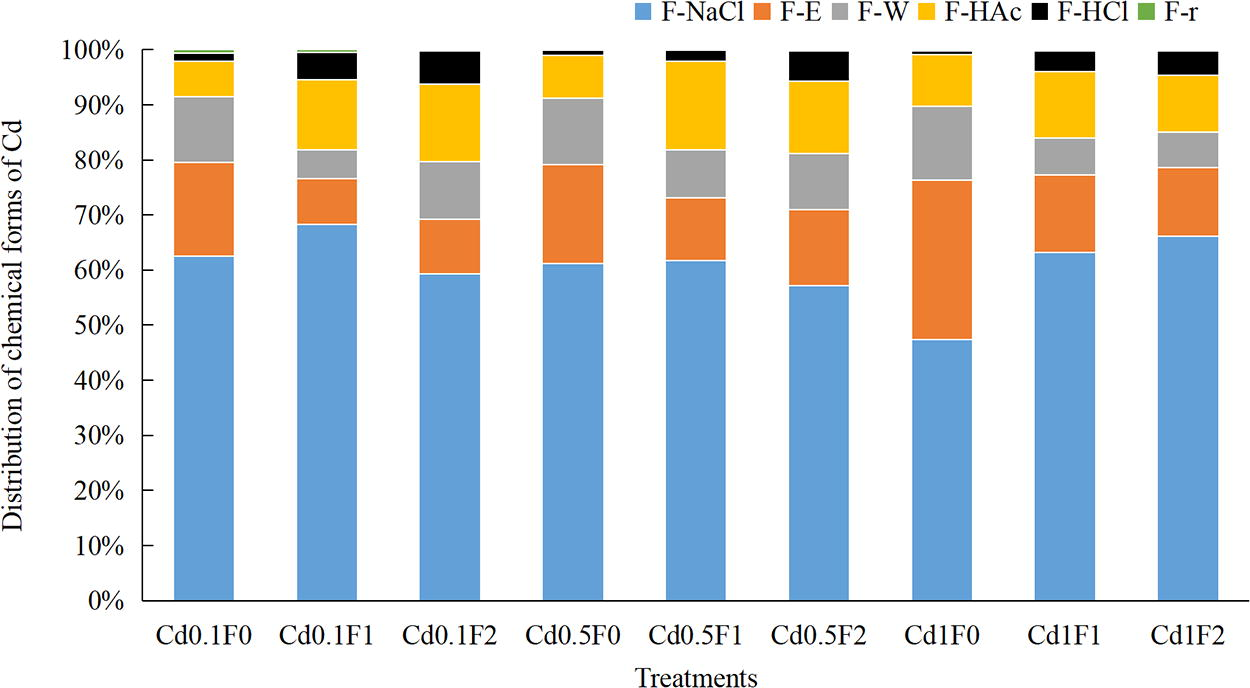
Effect of low to high doses of propineb treatment on distribution of Cd chemical forms in wheat seedlings.
At the same Cd concentration, with an increase in the dosage of propineb, the proportion of FE under treatments of Cd0.1, Cd0.5, and Cd1 decreased from 16.9%, 18.0%, and 28.9% to 8.2% (F1), 11.4% (F1), and 12.4% (F2), respectively. And the proportion of FW under treatments of Cd0.1, Cd0.5, and Cd1 decreased from 11.9%, 12.0%, and 13.4% to 5.4% (F1), 8.8% (F1), and 6.5% (F2), respectively. The proportion of FHAc under treatments of Cd0.1, Cd0.5, and Cd1 increased from 6.5%, 7.8%, and 9.4% to 14.1% (F2), 16.0% (F1), and 12.0% (F1), respectively. And the proportion of FHCl under Cd0.1, Cd0.5, and Cd1 increased from 1.5%, 0.9%, and 0.7% to 6.0% (F2), 5.4% (F2), and 4.5% (F2), respectively. In addition, the proportion changes of FNaCl and Fr had no obvious regularity.
Effect of propineb on the growth of wheat seedlings under Cd stress
As shown in Figure 5a, the root length of the wheat seedlings decreased sequentially with increasing Cd addition. After the application of propineb, with the treatments of Cd0, Cd0.1, and Cd0.5, the root length decreased in sequence with an increase in the propineb application dose. The highest decrease being 19.0% (F1), 25.6% (F2), and 30.3% (F2), respectively. Under the Cd1 treatment, the root length increased with an increasing application concentration, with a maximum increase of 19.9% (F2). As shown in Figure 5b, the shoot fresh weight of the wheat seedlings decreased sequentially with increasing Cd addition. With Cd0 and Cd0.1 treatments, the fresh weight of the wheat seedlings decreased with an increase in the concentration of propineb, with the greatest decreases of 22.4% (F2) and 17.8% (F2), respectively, whereas under the Cd0.5 and Cd1 treatments, the fresh weight of the wheat seedlings increased with an increasing concentration of propineb. The greatest increases were 23.2% (F2) and 27.8% (F1), respectively. These results indicated that under high Cd concentrations, propineb treatment increased root length and fresh weight, promoted wheat seedling growth, and alleviated Cd stress.
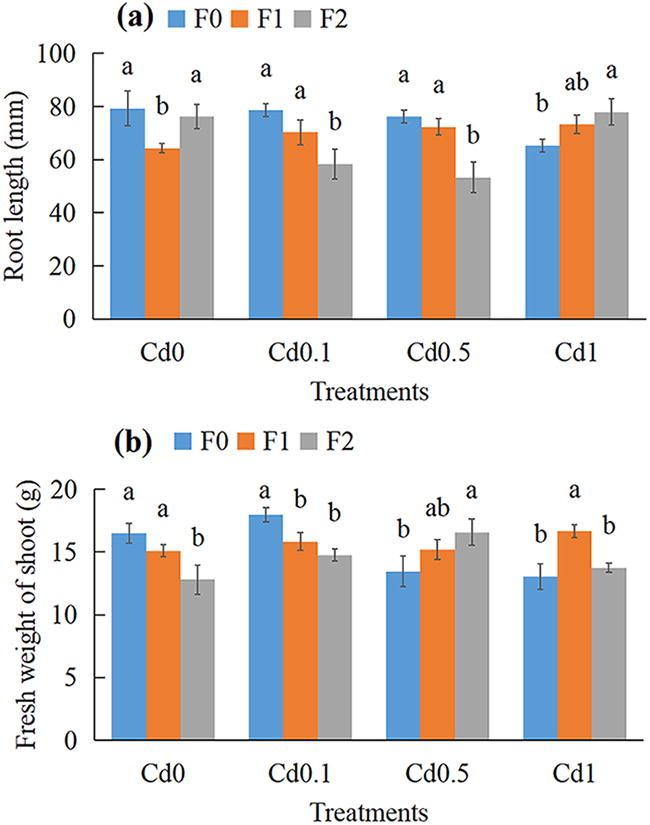
Effect of low to high doses of propineb treatment on root length
The effect of propineb on the photosynthesis rate of wheat seedlings under Cd stress
Under different Cd levels, the effect of propineb spraying on the chlorophyll content of wheat seedlings was not the same. Under the Cd0, Cd0.1, and Cd1 treatments, chlorophyll a content increased, with a maximum increase of 19.4% (Cd0F1), while chlorophyll b content decreased, with a maximum decrease of 21.6% (Cd0.1F2). With the Cd0.5 treatment, the chlorophyll a content decreased, with a maximum decrease of 10.4% (F2), and the chlorophyll b content increased, with a maximum increase of 76.2% (F2) (Fig. 6). Spraying propineb under Cd stress significantly increased the photosynthetic rate of wheat. The highest increases in photosynthetic rate under the Cd0, Cd0.1, Cd0.5, and Cd1 treatments were 97.7% (F2), 114.7% (F1), 93.8% (F2), and 16.0% (F1), respectively. These results indicated that propineb enhanced crop photosynthesis, but the increase was relatively small at high Cd concentrations.
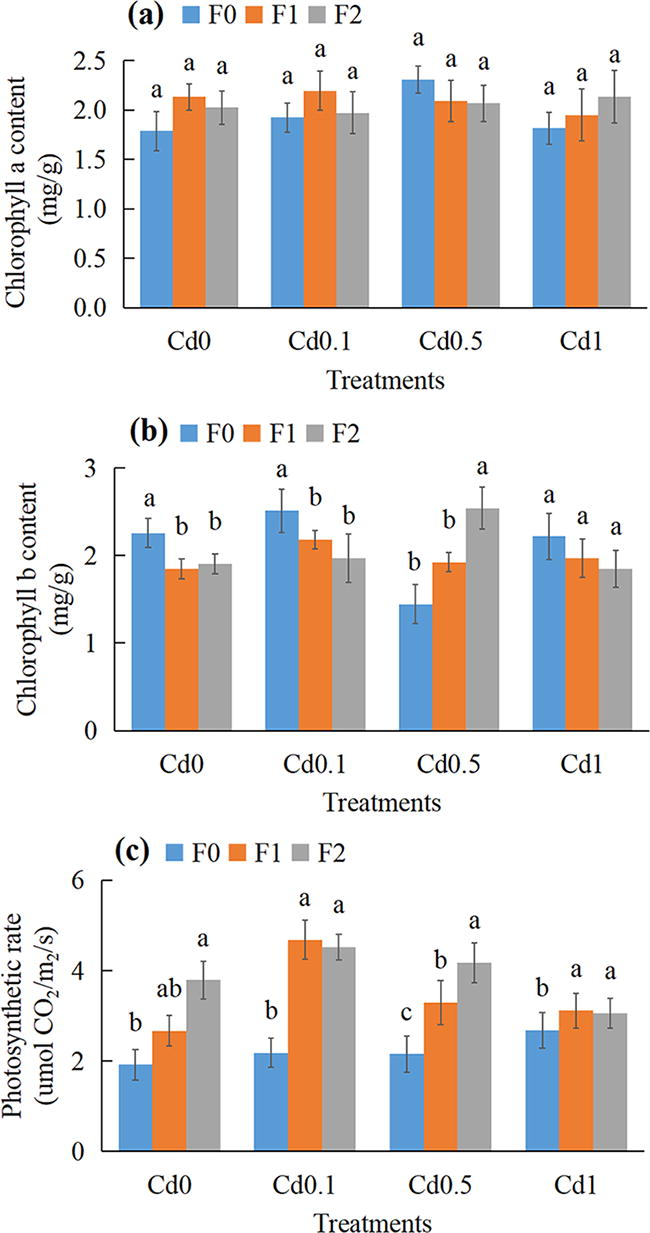
Effect of low to high doses of propineb treatment on chlorophyll content and photosynthetic rate of wheat seedlings.
Effect of propineb on the antioxidant system of wheat seedlings under Cd stress
The effect of propineb on the antioxidant system of wheat seedlings under Cd stress is shown in Supplementary Figure S2. The CAT content decreased with an increase in Cd concentration in the nutrient solution. After spraying with propineb, the CAT content showed a decreasing trend, and the decrease was positively correlated with the amount of propineb applied. The highest CAT decreases were 18.1% (F2), 15.4% (F2), 32.9% (F2), and 20.4% (F2) in the Cd0, Cd0.1, Cd0.5, and Cd1 treatments, respectively. The H2O2 content increased with an increase in Cd concentration, with a maximum increase of 166.0% (Cd1). After the application of propineb, the H2O2 content further increased, with the highest increases of 84.2% (F2), 14.8% (F1), 1.6% (F1), and 27.8% (F2) under the Cd0, Cd0.1, Cd0.5, and Cd1 treatments, respectively. The MDA content increased with increasing Cd concentration, with a maximum increase of 204.7% (Cd1), whereas spraying propineb increased the MDA content, with the highest increases of 160.5% (F2), 8.8% (F2), 11.3% (F2), and 25.2% (F2) in the Cd0, Cd0.1, Cd0.5, and Cd1 treatments, respectively. The POD content increased with the increase of Cd concentration, with a maximum increase of 47.7% (Cd1). After the application of propineb, the POD content further increased under the Cd0, Cd0.1, and Cd0.5 treatments, with the highest increases of 56.8% (F2), 39.1% (F2), and 20.0% (F2), respectively. Under the Cd1 treatment, the POD content decreased slightly, but the decrease was not significant. As the concentration of Cd in the nutrient solution increases, the activity of SOD decreases, with a maximum decrease of 31.2% (Cd1). The effect of spraying propineb on the SOD content had no obvious pattern. As the concentration of Cd treatment increases, the clearance rates of O2−. in the wheat also increased, and spraying with propineb further increased the clearance rates of O2− However, this increase was not statistically significant. The highest increases found under the Cd0, Cd0.1, Cd0.5, and Cd1 treatments were 7.2% (F2), 2.6% (F1), 2.1% (F1), and 3.3% (F2), respectively.
Discussion
The effect of propineb on Cd absorption and Cd accumulation in wheat seedlings
In recent years, relevant research has been conducted on the use of antagonistic effects on heavy metals such as Cd for the safe utilization of polluted soil (Rizwan et al., 2019b). Generally, Cd is transported by proteins involved in transporting trace elements. Therefore, the exogenous application of Zn can compete with Cd at the adsorption site of the transport carrier protein, thereby inhibiting the transport of Cd by the carrier protein, reducing plant uptake of Cd, and therefore reducing plant Cd toxicity (Sanaeiostovar et al., 2012; Ullah et al., 2018). In this study, the Zn content in the wheat seedlings significantly increased, whereas the Cd content decreased after spraying with propineb, indicating an antagonistic effect between the Zn present in the propineb molecules and Cd, effectively inhibiting the absorption and transport of Cd by the wheat seedlings. This finding is similar to that of Sanaeiostovar’s study on wheat (Sanaeiostovar et al., 2012).
The cell wall is the first barrier for Cd to enter plant cells and is rich in Cd-friendly substances such as lignin and pectin, as well as cation exchange sites, making Cd effectively fixed and difficult to transfer to other parts of the plant (Mariem and Patrice, 2016; Wei et al., 2023). In this experiment, Cd was mainly found in the soluble component, indicating the strong mobility of Cd in wheat seedling cells. The application of propineb increased the proportion of Cd in the cell wall and decreased the proportion in the soluble component under the low-Cd treatment, indicating that propineb could fix more Cd on the cell wall and prevent its transfer to other parts of the cell; however, this effect did not change the dominant proportion of Cd found in the soluble component.
The toxicity and mobility of various chemical forms of Cd decrease with the increase of the polarity of the extraction agent, showing an overall order of FE-FW-FNaCl-FHAc-FHCl. The mobility and toxicity of FE and FW were the strongest, leading to a positive correlation between the FE and FW content and the Cd content in wheat shoots (Zhao et al., 2015). The results of this study showed that as the use of propineb increased, the chemical forms of Cd were changed from soluble FE and FW to insoluble FHAc and FHCl, thereby reducing the mobility and toxicity of Cd and effectively immobilizing it.
Effect of propineb on the photosynthesis rate of wheat seedlings under Cd stress
Under Cd stress, crop photosynthesis is inhibited, chloroplasts are destroyed, and photosynthetic enzyme activities and chlorophyll synthesis are affected. Cd can transport electrons to nontarget molecules by disrupting the electron-transfer chain of respiration and photosynthesis, leading to reactive oxygen species (ROS) production. Cd can also reduce the activity of related enzymes by inhibiting free radicals (Larbi et al., 2020). These phenomena may be due to the following reasons: first, Cd2+ interacts with enzymes after entering plants, inhibiting chloroplast synthesis; second, the increase in intracellular reactive oxygen species leads to more H2O2 and O2 diffusion into chloroplasts, and these participate in the degradation of chlorophyll. Also Cd2+ stress directly leads to a disordered arrangement of mesophyll cells, disrupting the structure of the cell intima, and thereby reducing chlorophyll content (Naciri et al., 2021). In the present study, propineb spraying increased the photosynthetic rate and chlorophyll a content of wheat seedlings under Cd stress, indicating that propineb can effectively alleviate the nonstomatal limitations of wheat leaves under Cd stress, improve leaf respiration ability and the chlorophyll content, and restore and maintain leaf photosynthesis (Qian et al., 2023).
Effect of propineb on the antioxidant system of the wheat seedlings under Cd stress
ROS produced by plants during normal metabolic processes maintain a balance between their scavenging abilities. However, this balance can be disrupted by stress, leading to cellular damage (Xu et al., 2020). Cd stress can stimulate the activation of antioxidant enzymes and osmoregulation systems in plants to reduce the damage caused by adverse environment arising (Bano et al., 2023). Studies have shown that Cd can produce O2− in plants, and excessive ROS can cause membrane lipid peroxidation. MDA is one of the main products of cell membrane lipid peroxidation, and its accumulation is a manifestation of ROS toxicity. The MDA content present can reflect the degree of stress damage to plants (Atamanalp et al., 2023); the higher the MDA content, the greater the degree of stress damage to plants. In addition, high concentrations of Cd can cause an interaction between wheat H2O2 and O2− to produce hydroxyl radicals, which can then convert fatty acids into toxic peroxides, damaging biofilms, and leading to MDA accumulation (Wei et al., 2023). Excessive free radicals can continue to accumulate, causing changes in membrane proteins and lipids, altering the permeability of cell membranes, increasing lipid peroxides in the cell membranes, and causing irreversible damage to plants (Mariem and Patrice, 2016). SOD, CAT, and POD are important protective enzymes of the antioxidant enzyme subsystem. They can remove ROS from the body of the plant, which is beneficial for maintaining a dynamic balance between ROS production and quenching, thereby inhibiting membrane peroxidation (Kapoor et al., 2019; Sánchez, 2017). In this experiment, under low-Cd stress, the addition of propineb increased SOD and POD activities, as well as the O2− clearance rate, but it also caused a decrease in CAT activity and an increase in MDA and H2O2 content, indicating a partial improvement in wheat’s self-protection ability (Sánchez, 2017).
Conclusion
Under Cd stress, spraying propineb increased the photosynthetic rate of wheat seedlings, and some physiological and antioxidant indicators were also improved. The subcellular distribution and chemical morphological distribution of Cd indicated that the application of propineb effectively immobilizes Cd in wheat seedlings, reducing its migration rate and toxicity. Spraying propineb increased the Zn content in wheat seedlings, and Zn had an antagonistic effect on Cd, thereby inhibiting accumulation of Cd in wheat seedlings, improving antioxidant capacity of wheat, and reducing Cd stress. Therefore, the application of propineb could not only prevent and control wheat diseases but also effectively reduce the threat of Cd to wheat safety production. This win–win Cd reduction method has been effectively validated in both theory and practice and has broad application prospects.
Footnotes
Acknowledgments
The authors acknowledge Yunying Peng, Qiang Han, and Haiyan Wang for their support in the laboratory.
Authors’ Contributions
L.M.: Writing—original draft. Z.G.: Investigation and validation. Y.L.: Investigation and formal analysis. B.L.: Software. Q.H.: Methodology. L.Z.: Writing—reviewing and editing. X.Q.: Conceptualization, writing—reviewing and editing, and funding acquisition. Y.S.: Conceptualization and supervision.
Author Disclosure Statement
No competing financial interests exist.
Funding Information
This work was supported by the

References
Supplementary Material
Please find the following supplemental material available below.
For Open Access articles published under a Creative Commons License, all supplemental material carries the same license as the article it is associated with.
For non-Open Access articles published, all supplemental material carries a non-exclusive license, and permission requests for re-use of supplemental material or any part of supplemental material shall be sent directly to the copyright owner as specified in the copyright notice associated with the article.
