




Abstract
N-nitrosodimethylamine (NDMA) is a potentially carcinogenic byproduct of disinfecting drinking water. NDMA has been classified as a Group B2 carcinogen by the U.S. Environmental Protection Agency (EPA). The pathway of NDMA formation during chlorination has been proposed; however, it is still necessary to identify the most influential factor in this process. The objective of this study was to compare the factors and conditions that lead to the formation of NDMA from dimethylamine (DMA) to identify the primary factors responsible for the occurrence of this compound in drinking water. The study examined the formation of NDMA in chlorinated water under seven different conditions, considering three factors (NO2−, NO3−, and NH3). All factors were maintained at their actual concentrations in tap or surface water. The highest levels of NDMA were observed at pH 6 when NO3− and NH3 were present, with concentrations of 22.7 ng/L and 9.79 ng/L, respectively. At pH 6, NDMA levels were observed to be 22 times higher than at pH 8. Chlorine alone was not sufficient to convert DMA to NDMA within a short period of time, specifically at least 5 h, in the absence of other factors. The concentration of NDMA increased to 41.6 ng/L in the presence of NH3. After 16 h, the presence of NO3− led to a gradual increase in NDMA levels to 19.0 ng/L. However, no further increase was observed at this point. The findings suggest that NO3− and NH3 are important factors of NDMA in chlorinated drinking water. Although previous mechanisms have not given much attention to these factors, they are expected to play a significant role in the formation of nitrosamines in both natural water and drinking water. Controlling the factors or pH appeared to be crucial for managing NDMA formation, and further research on reducing N-nitrosamines is necessary.
Introduction
N-nitrosamines (NAs) such as N-nitrosodimethylamine (NDMA), N-nitrosomorpholine (NMOR), N-nitrosopyrrolidine (NPYR), N-nitrosopiperidine (NPIP), N-nitrosodiethylamine (NDEA), N-nitrosomethylethylamine (NMEA), and N-nitrosodipropylamine (NDPA) are disinfection byproducts (DBPs) commonly found in drinking water (Krasner et al., 2013). When consumed in drinking water at a concentration of 7 ng/L, NDMA has an estimated excess cancer risk of 10−5. NDMA is classified as a Group B2 carcinogen (probable human carcinogen) by the U.S. Environmental Protection Agency (EPA) (IRIS, 1987a). NDMA poses a higher cancer risk compared with other DBPs such as bromoform and dichloroacetic acid, which have excess cancer risks of 10−5 at concentrations of 4 μg/L and 23 μg/L, respectively (IRIS, 1996; IRIS, 1987b). Throughout the extended surveillance period from 2013 to 2018, Hashemi et al. (2022) reported the detection of NAs at various levels in treated water samples collected from 33 drinking water treatment plants in South Korea. The concentrations varied within the ranges of 0.3–11.4 ng/L for NDMA, 0.1–3.6 ng/L for NMEA, 0.1–8 ng/L for NDEA, 0.1–9.46 ng/L for NMOR, and 0.1–15.3 ng/L for NDBA. NDMA is the predominant NA detected in chlorinated drinking water, typically found at concentrations between 0.6 ng/L and 112 ng/L (EPA, 2007; Delalu and Marchand, 1989; Asami et al., 2009; Jurado-Sánchez et al., 2012; Han and Kim, 2010). This suggests that the level of NDMA in water could exceed 7 ng/L by up to a factor of 16, posing a potential cancer risk.
Secondary amines, the precursors of NAs, have been detected in both raw and drinking water (Mitch et al., 2003; Wang et al., 2011; Park et al., 2019). Dimethylamine (DMA), an organic precursor of NDMA, has been found in surface water at concentrations ranging from 0.62 μg/L to 1.15 μg/L, and in drinking water, at concentrations from 0.20 μg/L to 2.54 μg/L (Park et al., 2018). Previous research has shown that DMA can be chlorinated and oxidized, leading to the formation of NDMA during disinfection processes such as chloramination or chlorination (Mitch and Sedlak, 2002b; Schreiber and Mitch, 2005; Chen and Young, 2008; Kristiana et al., 2013). The formation pathway of NDMA proposed to be as follows (Fig. 1).

When DMA or chlorinated DMA [(CH3)2N-Cl] reacts with monochloramine or ammonium ions (NH4+), unsymmetrical dimethylhydrazine (UDMH) is formed. UDMH is an intermediate compound involved in the synthesis of NDMA. It was revised to explain the slow formation rate of UDMH resulting from the reaction between DMA and monochloramine. Dichloramine (NHCl2) was proposed as the primary reactant with DMA for the production of chlorinated UDMH. The pathway was enhanced by including the unified (UF) model of chloramine chemistry (with 14 reactions), the model by Schreiber and Mitch (with eight reactions for NDMA formation), and relevant acid–base chemistry (with 14 equilibrium expressions). The proposed pathway suggests that chlorinated UDMH is formed by the reaction of DMA with NHCl2, followed by NDMA formation through a reaction with O2. Radicals (ONOOH/ONOO−) formed from chloramine decomposition react with DMA to produce NDMA.
Nitrogen-containing species have the potential to serve as factors to NDMA. According to an alternative nitrosation mechanism, NDMA can be generated through the reaction of the nitrosyl cation (NO+) derived from the nitrogen-containing species such as N2O3. This reaction is pH-dependent, with NO+ formed from nitric acid under acidic conditions (pH 3.4) (Fig. 2). However, NHCl2 can be decomposed at a neutral pH, leading to the formation of NDMA from (CH3)2NH+ and ONOOH (Pham et al., 2021). HNO, the intermediate formed via NHCl2 hydrolysis, undergoes slow equilibrium reactions leading to the formation of both NO− and N2O. In this state, HNO and NO− react with O2 to form peroxynitrous acid/peroxynitrite acid (ONOOH/ONOO−), which is unstable and decomposes into NO2− and NO3− (Kirsch et al., 2003). Pham et al. (2021) investigated NO2− and NO3− as indicators of ONOOH/ONOO−, which can lead to the formation of NDMA through reactions with (CH3)2NH [k = (2.1 ± 0.4) × 107 M−1s−1] or (CH3)NNHCl [k = (1.3 ± 0.8) × 107 M−1s−1]. When decomposing NHCl2 at 800 μeq Cl2 L−1 under pH 8–9, the formation yields of NO2− and NO3− were 10–26 μM and 14–16 μM, respectively. In Korea, NO3− is present in tap water at concentrations ranging from 3.43 to 10.7 mg/L (Park et al., 2019). Previous researches have investigated the potential of NO2− to serve as factors to NDMA in water disinfection processes. NDMA was detected at a concentration of 2 μg/L when equimolar amounts of DMA and NO2− (0.1 mM) were added (Choi and Valentine, 2002). Thus, it is crucial to consider the impact of NO2− and NO3− in water at a neutral pH so as to effectively manage and control NDMA levels in drinking water and protect public health. This can be achieved by identifying factors and assessing both physical and chemical factors of the water. Previous studies have seldom considered the concentrations of factors in water when determining the optimal conditions and mechanisms for NDMA formation. Hence, to understand the formation of NDMA after chlorine-based disinfection, the concentrations of factors in domestic drinking water should be measured. NH3 in tap water is regulated below 0.5 mg/L by the Ministry of Environment (ME); however, considering the importance of chloramine in the NDMA formation, unintentional effects of NH3 in raw water during drinking water treatment should also be considered (ME, 2021).
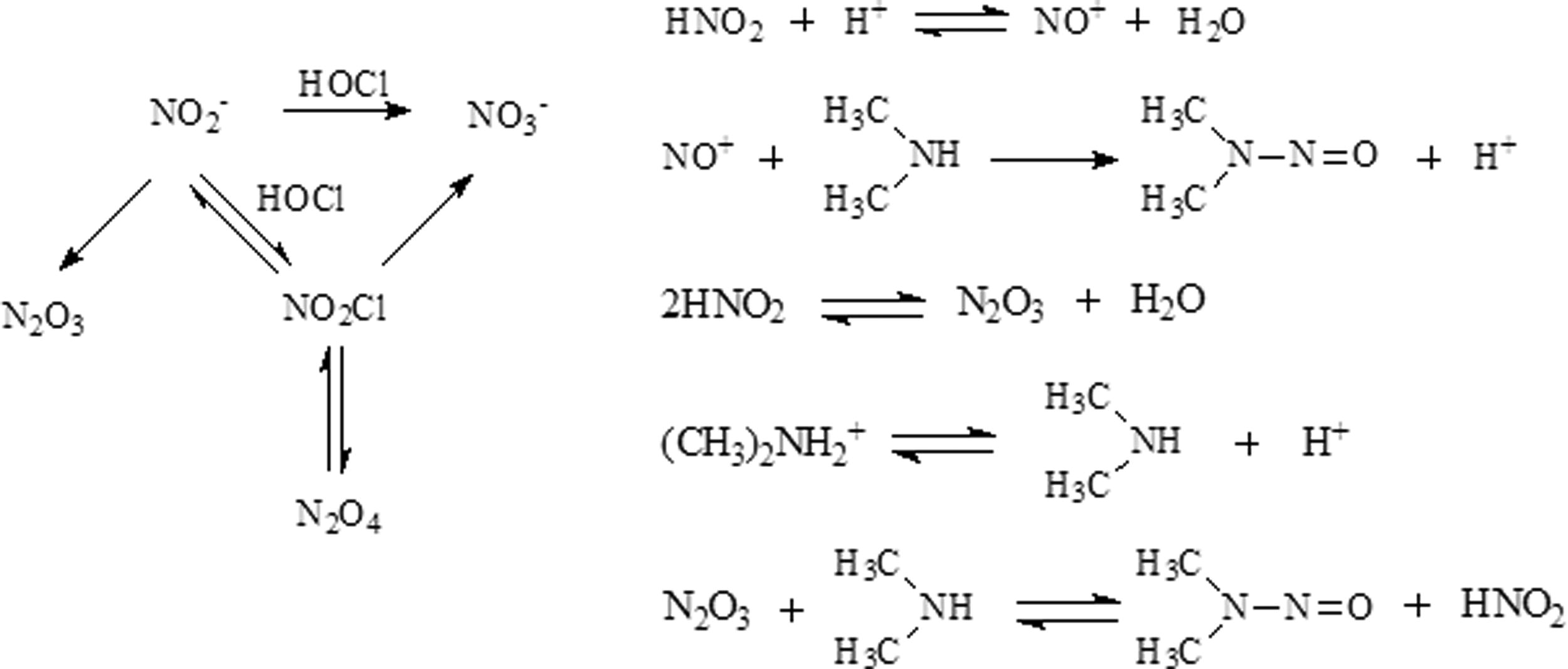
Proposed mechanism for the formation of NDMA in water (Mitch and Sedlak, 2002a; Choi and Valentine, 2003).
Therefore, the objective of this study was to characterize the formation of NDMA from DMA after chlorination in real-world water conditions. The effects of formation factors (NH3, NO2−, and NO3−), pH, and time on the formation of NDMA were observed. Finally, we suggested some strategies to reduce the occurrence of NDMA in drinking water.
Materials and Methods
Materials
All standard solutions of nitrosamines (NDMA, NMOR, NPYR, NPIP, and NDPA), secondary amines (DMA, morpholine, pyrrolidine, piperidine, and dipropylamine), and N-nitrosomethylbutylamine (NMBA) were purchased from Sigma-Aldrich (St. Louis, MO, USA). NMBA was used as a surrogate standard (SS) for quantitative analysis. Carboxen 572, sodium phenolate, sodium nitroprusside, sodium hypochlorite, and sodium thiosulfate were also obtained from Sigma-Aldrich. All organic solvents used in this study were of high-performance liquid chromatography grade. Acetone, methanol, hexane, and dichloromethane were purchased from Honeywell Burdick & Jackson Inc. (Muskegon, MI, USA). Sodium hydroxide, sodium bicarbonate, sodium sulfate, sodium nitrite, sodium nitrate, hydrochloric acid (35%), and acetic acid were purchased from Daejeong (Siheung, Korea), whereas dansyl chloride [5-(dimethylamino)naphthalene-1-sulfonyl chloride] was obtained from Calbiochem (San Diego, CA, USA). The ammonia solution (25%), NaOCl (5%), and hydrobromic acid (48%) were procured from Wako (Osaka, Japan). H2SO4 (97%) was obtained from SHOWA (Tokyo, Japan).
For sample preparation, a denitrosation solution was prepared by diluting 1 mL of 48% hydrobromic acid with acetic acid to a final volume of 10 mL. A dansylation solution was prepared by diluting 25 mg of dansyl chloride with 50 mL of acetone. A buffer solution with a pH of 10.5 was prepared by dissolving 0.6 g of sodium hydroxide and 2.0 g of sodium bicarbonate in 50 mL of ultrapure water. All solutions were stored at 4°C and were used within 2 weeks.
NDMA formation during chlorination
Determining the concentrations of DMA and factors
We aimed to study the transformation of DMA to NDMA in chlorinated water using three factors: NH3, NO2−, and NO3−. Seven conditions (T1–T7) were tested to compare the presence or absence of each factor. DMA was added to all samples, and the treatments were described in Table 1. The situation was considered the worst-case scenario because of a slightly elevated concentration, with DMA levels detected up to 2.5 μg/L in domestic tap water (Park et al., 2018). The concentrations of the factors used were based on their actual levels in tap or surface water. In a nationwide survey of tap water conducted by Park et al. (2019), various factors were identified: 0.39–0.90 mg Cl2/L for free chlorine, 0.02–0.18 mg Cl2/L for combined chlorine, pH levels ranging from 6.35 to 7.56, total nitrogen levels between 3.25 and 9.61 mg N/L, and NO3− concentrations ranging from 3.43 to 10.7 mg/L. In Korea, the standard for ammonia nitrogen in tap water is set at 0.5 mg/L. It may be necessary to consider the reaction between ammonia nitrogen in surface water and chlorine used in water treatment. NH3 levels were measured in the surface water of Gongji Stream and Soyang River in Chuncheon, Gangwon State. The Soyang River is situated close to the Soyang Water Treatment Plant.
Comparison of NDMA Formation Under Various Chlorination Conditions (n = 3)
The samples were prepared at pH 7 and incubated with gentle agitation for 5 h at 25°C.
DMA, dimethylamine; NDMA, N-nitrosodimethylamine.
Experiment of NDMA formation
Ultrapure water (1 L) was prepared in a dark brown glass bottle, and the pH was adjusted to 6–8 using 1 M sodium bicarbonate and 1 M hydrochloric acid. DMA (3 μg) was added to 1 L of water, and all samples were prepared in triplicate. Then, additional substances were simultaneously incorporated into the samples based on the test conditions: 1 mg/L of NH3, 3 mg/L of NO2−, and 6 mg/L of NO3−. NaOCl was added until the free chlorine concentration of 1 mg Cl2/L was reached. The concentration of chlorine was measured using the Free & Total Chlorine and pH Photometer (MARTINI instruments Mi411, Milwaukee, Hungary), and the combined chlorine in ultrapure water used in all samples was less than 0.02 mg Cl2/L. The samples were gently shaken at 25°C in a VS-8480SRN incubator (Vision Scientific Co. Ltd, Daejeon, Korea). After 5 h, approximately 100 mg of sodium thiosulfate was added as a quenching agent for chlorine.
Experiments were conducted to observe the effects of pH and time on NDMA formation under two specific conditions (T3 and T5). Effects on pH were tested at pH levels of 6, 7, and 8, whereas the effects on time were examined at various time intervals (0.5, 1, 5, 10, 16, and 24 h). Each test was conducted three times.
Analysis
NH3 in surface water
To confirm the NH3 concentration of the surface water, the surface water of Gongji stream and Soyang River in Chuncheon, Gangwon-do, was collected on February 12, 2018. The water sample was collected in a 150 mL dark brown glass bottle, adjusted to pH 2 or less with 5 N H2SO4, and stored at 4°C until analysis.
The measurement was in accordance with the official method ES04355.1 of the ME (2017). Water sample (30 mL) was put in a 50 mL volumetric flask; 10 mL of 12.5% sodium phenolate solution and 1 mL of 0.15% sodium nitroprusside solution were added and mixed. Then 5 mL of 1% sodium hypochlorite solution was added, and ultrapure water was filled up to the mark line. After 30 min at room temperature, it was measured using a UV-Vis spectrophotometer (UV-9100, Human Co., Seoul, Korea) at 630 nm.
Determination of NDMA in water
The analytical method used in this study was based on the method developed by Park et al. (2019). The method of solid-phase extraction and dansylation using NMBA as an SS has already been validated for linearity (greater than 0.99), accuracy (recovery range from 89.5% to 100.8%), and precision (relative standard deviation from 0.5% to 7.09%) (Park et al., 2019; Jung et al., 2016). The 500 mL samples were each supplemented with 2 μL of NMBA (5 mg/L, SS). After connecting a silica gel trap to a cartridge containing 2.0 g of Carboxen 572, the sample was passed through at a flow rate of 8–10 mL/min. The water in the absorbent cartridge was removed using a vacuum pump (−30 kPa). The analytes were eluted from the cartridge using 15 mL of dichloromethane at a flow rate of 8–10 mL/min. The eluate was concentrated to 1 mL using a gentle stream of nitrogen and then washed with 1 mL of 1 N hydrochloric acid for 5 min with vigorous shaking to remove secondary amines from the sample. The remaining water was removed by passing the eluate through a Pasteur pipette containing 50 mg of sodium sulfate. The purified eluate was then transferred to a 15 mL centrifuge tube.
The sample was derivatized by adding 150 μL of the denitrosation solution and mixing vigorously for 10 s. The mixture was then allowed to stand at 40°C for 30 min and dried using a gentle stream of nitrogen. Then, 150 μL of buffer solution (pH 10.5) and 150 μL of dansylation solution were added to the sample and mixed vigorously for 10 s. The mixture was then incubated at 40°C for 30 min, after which 50 μL of ultrapure water was added. The final sample was transferred to a 1 mL vial.
An HPLC-fluorescence detector (HPLC-FLD) (Waters Co., Milford, MA, USA) was used for quantitative analysis. Samples were introduced into the system using a Waters 717 autosampler, with an injection volume of 40 μL. The column used was a Skypak C18 column (4.6 × 250 mm × 5 μm; SK Chemicals, Seongnam, Korea) connected to a Waters 515 pump. The mobile phase was a mixture of water and acetonitrile in a ratio of 45:55 (v/v), with a flow rate set at 1 mL/min. A Waters 474 detector was used, with excitation and emission wavelengths of 340 nm and 530 nm, respectively.
Results and Discussion
Characterization of NDMA formation through chlorination
The formation of NDMA from DMA was evaluated under seven conditions (T1−T7), which were designed to study the NDMA formation from DMA during chlorination, a common disinfection method in Korea. The aim was to identify how NDMA formation is affected by suspected factors such as free Cl2, NH3, NO2−, and NO3−. Specific conditions consist of the factors outlined in Table 1. The concentration of NH3 was set at 1 mg/L, slightly higher than the concentrations detected in the actual surface water samples, which ranged from 0.06 to 0.08 mg/L. The factors present in raw or tap water are believed to have the potential to form NDMA. The formation of NDMA was initially investigated under two experimental conditions. DMA was added with and without the addition of free Cl2. NDMA was not detected under both experimental conditions. This result suggests that chlorine alone cannot convert DMA to NDMA in water without the presence of other factors. In contrast, when other factors are added such as NH3, NO2−, and NO3−, the NDMA concentrations ranged from 1.8 to 8.7 ng/L. NDMA formation with free Cl2 and NH3 was observed at the concentration of 5.6 ± 0.4 ng/L. It is possible for NH3 to react with HOCl, resulting in the formation of NH2Cl, which can then lead to the formation of UDMH. NH2Cl can undergo additional reactions to produce NHCl2, NCl3, and other products, which can then be decomposed into chlorinated UDMH or DMA (Table 2). The effects of NO2− and NO3− on the formation of NDMA were evaluated under neutral pH conditions. The concentrations of NDMA with NO2− and NO3− were 1.8 ± 1.2 ng/L and 8.0 ± 2.4 ng/L, respectively. This indicates that NO3− produced more NDMA than NO2−. NH3 was added to solutions containing NO2− and NO3−, respectively. The NDMA levels were found to be 3.4 ± 0.8 ng/L and 8.7 ± 3.4 ng/L, respectively. When free Cl2 and NO2− were added, the concentration of NDMA with NH3 was approximately double the concentration without NH3. It can be inferred that NH3 may have a stronger impact on the formation of NDMA than NO2−. This is supported by the lower levels of NDMA formation when adding free Cl2 and NH3 without NO2− and NO3−. The highest concentrations of NDMA were found when adding free Cl2, and NO3− with or without NH3. The results suggested that NH3 and NO3− could be significant factors of NDMA in drinking water. In addition, we discovered that the concentration of NDMA may be higher than 7 ng/L, which corresponds to the excess cancer risk (10−5), if DMA is higher than the maximum concentration (2.5 μg/L) of tap water in Korea, and NDMA formation by some factors such as free Cl2, NH3 and NO3− is not controlled.
Reaction Rates Associated with the Formation of NDMA
UDMH, unsymmetrical dimethylhydrazine.
The formation mechanism of NDMA involves the conversion of DMA, the precursor, to UDMH or chlorinated UDMH through a reaction with chloramines. This is followed by oxidation to NDMA. The presence of chlorinated DMA is responsible for the occurrence of UDMH, and its formation is characterized by a slow rate. The formation of UDMH is enhanced with an increase in pH, as reported by Mitch and Sedlak (2002b). Chloramines can retain chlorine in the water distribution system, leading to an increase in the NDMA formation in water. When only introducing HOCl into the water, the rate of NDMA formation was 100 times slower than the addition of NH2Cl. Mitch and Sedlak (2002b) also observed that the highest concentrations of NDMA occurred when NH2Cl was added to water containing DMA. However, in previous studies of the contradiction that the formation of intermediate UDMH is slower than that of NDMA, NHCl2 has been studied for the NDMA formation and its decomposition as a more important reactant than NH2Cl. Choi et al. (2002) found that the concentration of NDMA increases with higher levels of NH3. They also discovered that DMA can form NDMA with HOCl in the absence of NH3, although the resulting concentration of NDMA is minimal. The concentration of NH3 in the source water typically ranges from 0.3 to 12 mg/L, according to the World Health Organization (2003a). If NH3 is not properly removed prior to the chlorination process, it can lead to the formation of NDMA, which can be problematic. Schreiber and Mitch (2007) found that NDMA formation was completed within 1 h when the molar ratio (Cl2:NH3) was 1.8, with no residual free chlorine or chloramine. In the study carried out by Park et al. (2015), a similar level of NDMA generation was observed from poly(epichlorohydrin dimethylamine) (polyamine) and poly(diallyldimethylammonium chloride) (polyDADMAC). The peak concentrations of NDMA were observed 24 h after the addition of polyamine and polyDADMAC, with molar Cl2:NH3 ratios of 1.8 and 1.4, respectively. This observation is consistent with a notable increase in residual chlorine concentration. In the present study, the ratio was determined to be 0.23 (corresponding to 14 μM of free chlorine and 60 μM of NH3), indicating a significantly decreased breakpoint ratio. The formation of NDMA is suggested to have taken place at a slow rate. The reaction equations and rates related to NDMA formation are illustrated in Table 2 by previous studies. Below the breakpoint, the NHCl2 may be increased with increasing the molar Cl2:NH3 ratio, and above the endpoint, inorganic NHCl2 may be decomposed to free chlorine, resulting in other products. The concentration of HOCl in equilibrium with NH2Cl is relatively low, measuring less than 10−12 mM (Choi and Valentine, 2002). NHCl2 is formed via various reactions with chloramines and NH3 and plays an important role to make chlorinated DMA and UDMH, leading to form NDMA. Even though this study did not analyze changes of the factors, the NDMA formation might be affected by the formation of chloramines from HOCl and equilibrium between chloramines, leading to form chlorinated UDMH. The formation rate of chlorinated UDMH (k = 52 M−1s−1) is much higher than that of UDMH (k = 2.3 and 8.1 × 10⁻² M−1s−1).
In a previous study, Schreiber and Mitch (2007) found that the highest NDMA yield was obtained when the molar ratio of Cl2:NO2− was less than 1 at pH 6.9, which is similar to the molar ratio at 0.22 (14 μM of free Cl2 and 65 μM of NO2−) used in this study. However, the presence of NO2− may actually decrease the rate of NDMA formation when NH2Cl is present (Mitch and Sedlak, 2002b). Only 10−21 g/L of NDMA was formed at a concentration of 100 μM for both NO2− and DMA. However, in another pathway, it has been suggested that reactive nitrogen species (RNS) (ONOOH/ONOO−) resulting from decomposition by hydrolysis of this NHCl2 potentially affects the NDMA formation, even at neutral pH, contributing to the equilibrium of these RNSs and to form NO2− and NO3-. We suspect that NO3− may be a more important factor than NO2− for the formation of NDMA. This suspicion is supported by the 4-fold increase in the formation of NDMA observed in the presence of NO2− than in NO3− (T4 and T5 in Table 1). Further research is needed to fully understand the role of NO3− in the formation of NDMA following chlorination.
Effects of pH on NDMA formation
pH is one of the important factors in controlling the formation of DBPs such as trihalomethane (THMs) and haloacetic acid (HAAs) and removing influencing factors. Wang et al. (2022) identified pH as the primary factor in reducing DBP formation. They suggested that oxidizing dissolved organic carbon at acidic pH could decrease the formation of THMs and HAAs. NDMA formation experiments were conducted at pH levels of 6, 7, and 8, which are commonly in drinking water. In this study, precursor and factors were introduced for two specific conditions (DMA was added to water chlorinated with NH3 or NO3−), including factors that are believed to affect the formation of NDMA. The results are presented in Table 1 (T3 and T5). The concentrations of NDMA increased as the pH decreased in both experimental conditions (Fig. 3). When DMA and free Cl2 were added, the concentration of NDMA was 22.7 ± 3.32 ng/L with NH3 and 9.79 ± 1.84 ng/L with NO3− at a pH of 6. The concentration of NDMA was below the method detection limit in both experimental conditions at pH 8. The findings suggest that the concentration of NDMA was four times higher at pH 6 than at pH 7 when adding NH3. This suggests that pH has a greater impact on NH3 than on NO3−. HOCl has a pKa value of 7.53 and is predominantly present in the form of HOCl at pH 6. As pH increases, HOCl is converted to OCl−. NH3 has a pKa value of 9.24 and predominantly exists as ammonium (NH4+) in a pH range of 6 − 8 (Deborde and Gunten, 2008). An increase in the ratio of HOCl/OCl− is believed to lead to the formation of chloramines and chlorinated DMA, which subsequently reacts with NHCl2, NH3, and NH4+ to form intermediates such as chlorinated UDMH, ONOOH, and others.
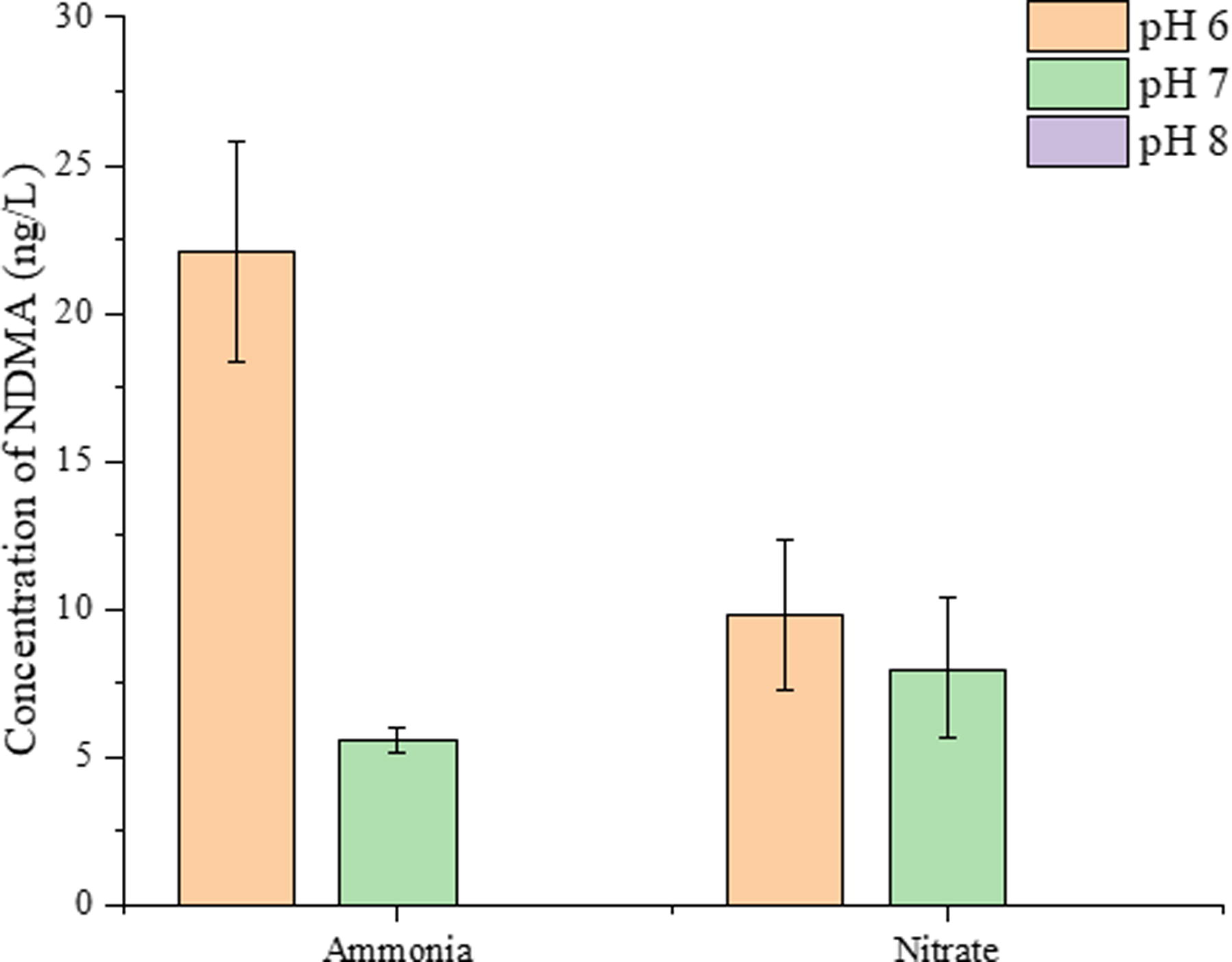
The formation of NDMA occurred when NH3 and NO3− were added to chlorinated water under specific pH conditions. (At pH 8, NDMA was not observed. The concentrations of the precursor and factors in the experiment were as follows: 3 µg/L of DMA, 0.06 mg Cl2/L of free chlorine, 1 mg/L of NH3, and 6 mg/L of NO3−. The samples were prepared in triplicate and incubated with gentle shaking at 25°C for 5 h.) DMA, dimethylamine.
According to Kim and Clevenger (2007), the highest formation of NDMA was observed at pH 8 when DMA and NH2Cl were added in a 1:1 molecular ratio. This finding can be attributed to the breakdown of NH2Cl at higher pH levels. DMA is highly soluble in basic conditions because of its pKa value of 10.73. UDMH rapidly oxidizes to NDMA, with a yield of less than 1% in neutral pH conditions. The rate of NDMA formation increases at higher pH levels (Mitch and Sedlak, 2002b). The formation of NDMA in water is significantly affected by pH, particularly in the presence of NH3. The pH of tap water is typically regulated within the range of 5.8–8.5 (ME, 2021). As NH3 is rarely present in actual tap water, it is not considered a major factor in NDMA formation at low pH, so finding an appropriate pH that can minimize the production of various DBPs and additional removal processes will be needed.
Temporal formation of NDMA
Chlorine has the potential to persist in drinking water even after the water has been disinfected using chlorination. The aforementioned process can produce DBPs, such as NAs. The concentration of NDMA was monitored over a 24-h period under two specific conditions (DMA was added to water chlorinated with NH3 or NO3−), referred to in Table 1 (T3 and T5), to study the formation characteristics of NDMA in relation to the reaction time with residual chlorine. When DMA and free Cl2 were added, the NDMA formation with NH3 gradually increased and reached 41.6 ± 11.3 ng/L after 24 h (Fig. 4). The concentration of NDMA increased gradually, reaching 3.62 ± 5.54 ng/L after 5 h, followed by a rapid increase to 19.0 ± 18.0 ng/L after 10 h. The NDMA formation with NO3− rapidly increased to 4.45 ± 1.84 ng/L in 0.5 h; it then continued to rise gradually and reached 7.98 ± 2.37 ng/L after 5 h. The highest recorded concentration of NDMA over a 24-h period was 12.7 ± 6.2 ng/L. It was observed that the initial formation of NDMA by NH3 occurred at a slower rate than the rapid formation observed with NO3−. The initial formation rate of NDMA was approximately twice as fast with NO3− than with NH3 within a 5-h period, according to the following equations.
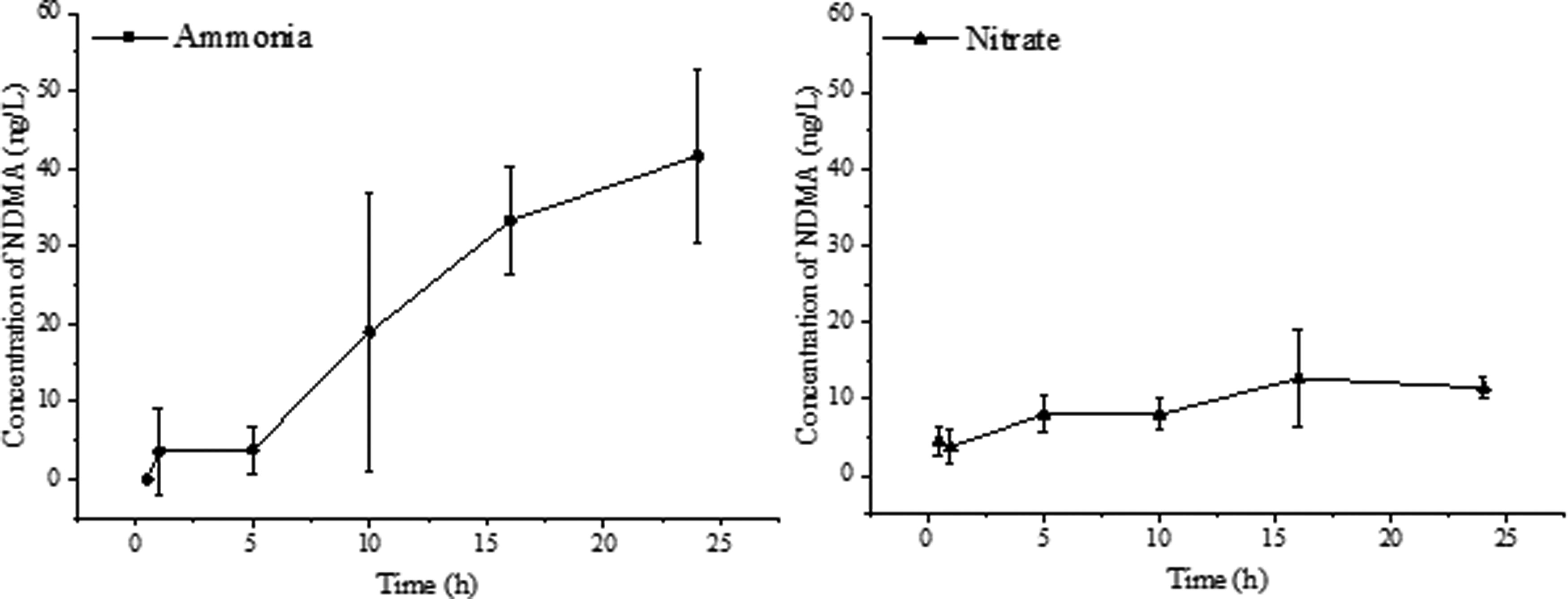
Formation of NDMA in chlorinated water over time following the addition of NH3 and NO3−. The concentrations of precursor and factors used were 3 µg/L of DMA, 1 mg Cl2/L of free chlorine, 1 mg/L of NH3, and 6 mg/L of NO3−. The samples were prepared in triplicate and incubated at 25°C with gentle shaking.
However, over a 24-h period, the formation rates were 9.46 × 10 M−1s−1 and 6.40 × 10 M−1s−1 for NO3− and NH3, respectively. This indicates that NH3 continuously and more rapidly forms NDMA over longer periods of time.
Previous studies have reported the formation rates of chlorinated DMA and UDMH by NH2Cl ranging from 1.40 × 10⁻¹ to 2.1 × 10⁻¹ M−1s−1 and from 8.1 × 10⁻² to 2.3 M−1s−1, respectively (Delalu and Marchand, 1989; Schreiber and Mitch, 2006; Morris and Isaac, 1983). The conversion rates of UDMH to NDMA were reported to range from 1.1 × 10⁻¹ M−1s−1 to 0.3 M−1s−1 (Choi and Valentine, 2002), as shown in Table 2. The modified pathway of NDMA formation via NHCl2 exhibited reaction rates of 52 M−1s−1 and 1.4 M−1s−1 for the formation of chlorinated UDMH and NDMA, respectively (Schreiber and Mitch, 2006). The reported rates in this study were higher than those in previous studies, even when the reaction duration was the same (24 h). This difference is likely because the calculations were based on a first-order reaction from DMA to NDMA. The variation in the molar ratio of the factors may also have had a significant impact. According to Schreiber and Mitch (2006), the oxidation of UMDH by NH2Cl, which is formed by the reaction between DMA and chlorine, led to an elevation of NDMA levels. The increase in NDMA concentration is dependent on the molecular ratio of DMA to NH2Cl. The highest rate of NMDA formation was observed when the molecular ratio of DMA to NH2Cl was 1:1 (Choi and Valentine, 2002). The formation of NDMA decreased as the ratio increased. The pH increased significantly from 6.8 to 11.6 within 80 min after the addition of 1 mM DMA and 1 mM NH2Cl, using similar experimental conditions (Mitch and Sedlak, 2002b). Mitch and Sedlak (2002b) observed that the chlorination breakpoint occurs when the concentration of HOCl is 1.5 times greater than that of NH3. They discovered that the concentration of NH3 was three times higher than that of HOCl, suggesting that NH3 may play role in the formation of NDMA. Park et al. (2015) suggested that the breakpoint of NDMA formation is a molar Cl2:NH3 ratio of 1.8 that is much larger than in this study. Therefore, the continued formation of NDMA in this study interpreted to subendpoint phenomena.
Furthermore, the UDMH generated can react with NHCl2, leading to the reformation of DMA (Schreiber and Mitch, 2006). The addition of NH3 leads to a complex reaction, where the rate of formation starts off slower than that of NO3− and then gradually increases. NO3− in water can undergo transformations into different chemical species, such as NO+, N2O4, and N2O5 (Poskrebyshev et al., 2001). It has been proposed (Krasner et al., 2013; Mitch et al., 2003; Mitch and Sedlak, 2002b) that these compounds can react with DMA, leading to the formation of NDMA. HOCl plays a significant role in the formation of N2O4 and N2O5 (Choi and Valentine, 2003; Schreiber and Mitch, 2007). Furthermore, HOCl can contribute to the formation of NDMA, which undergoes hydrolysis to maintain equilibrium by forming DMA and NO2− (Williams, 2004). NO2− and NO3− may play important roles during NDMA formation and are also byproducts of ONOOH/ONOO− reactions that occur via NHCl2 decomposition. The study confirmed that NDMA can form quickly or increase continuously depending on the factor type.
Proposal to reduce the occurrence of NDMA in tap water
Chlorine is primarily used in drinking water treatment plants to disinfect raw water and deactivate microorganisms (NIER, 2013). We hypothesized that DMA, NH3, and NO3− are significant factors of NDMA in chlorinated water. NH3 can help in understanding its important role in the formation process, even though it is rarely found in treated water. These factors typically become more concentrated as the pH decreases and the reaction time increases. The concentration of NH3 in tap water in Korea was reported to be below 0.5 mg/L (ME, 2021). NO3− levels were measured to be 5.50 ± 2.96 mg/L and 7.32 ± 3.84 mg/L during the summer and winter, respectively (Park et al., 2019). A study conducted in Korea found that tap water across the country contained the levels of NDMA ranging from 0.13 ng/L to 80.7 ng/L (Park et al., 2019), which raised concerns regarding the potential risk of cancer. To prevent the occurrence of NDMA, it is crucial to control the factors during the water treatment process. Advanced water treatment methods, including biologically activated carbon (BAC), assimilable organic carbon, and granular activated carbon, can effectively reduce the levels of DMA and NDMA by eliminating organic compounds. It has been reported that NDMA and influencing factors can be partially removed by biological treatments, coagulation, filtration, adsorption on activated carbons, reverse osmosis, and ultraviolet (UV) (Sgroi et al., 2018). Kim et al. (2019) suggested advanced water purification methods, such as UV-based oxidation or a posttreatment process involving ozone/hydrogen peroxide with BAC, to reduce the occurrence of NAs, including NDMA, by simulating the drinking water treatment process. Noe et al. (2023) also identified the efficiency of reducing NDMA formation from ranitidine, a precursor, through preozonation in decarbonated water. However, implementing these processes nationwide can be costly. Alternatively, the formation of these compounds can be prevented by maintaining a neutral pH or reducing NO3− levels.
The formation of NAs after adding the main factors (NH3 and NO3−) confirmed the presence of other secondary amines in raw water. The factors were added to chlorinated water, and the concentrations of NAs were determined at different pH levels (Fig. 5). The five NAs (NDMA, NMOR, NPYR, NPIP, and NDPA) showed a negative correlation with pH. Although the formation of NDPA did not change significantly with pH, there was a higher formation of this compound at pH 6 than at pH 8. In addition, the other NAs showed 3–22 times higher levels at pH 6. The concentration of NDMA showed the highest increase, followed by of NMOR. The pH significantly affected the formation of NDMA and other NAs.
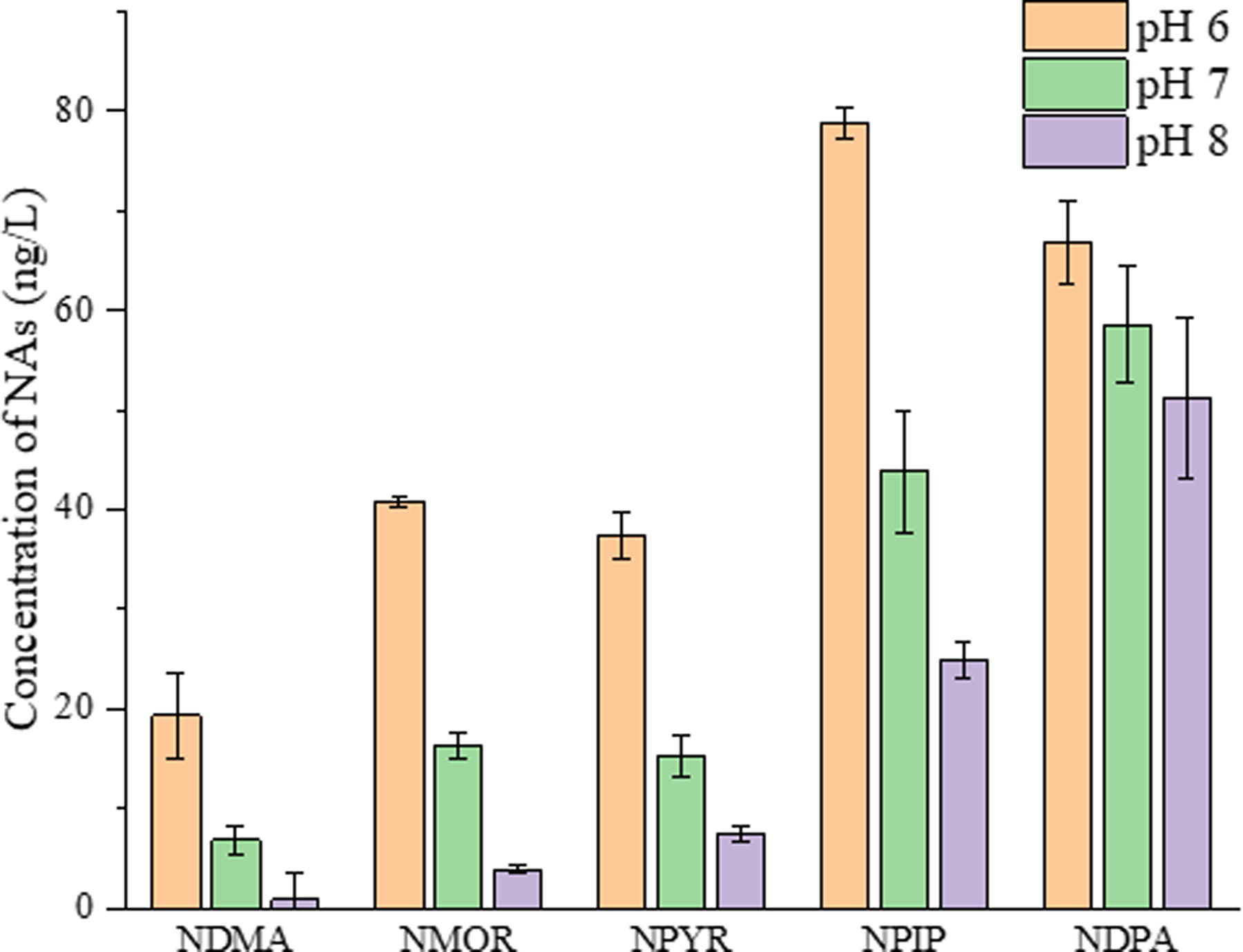
The formation of N-nitrosamines (NAs) occurred when the main precursors (NH3 and NO3−) were added to chlorinated water under specific pH conditions. The concentrations of the precursor and factors used in the experiment were as follows: 3 µg/L of secondary amines, 1 mg Cl2/L of free chlorine, 1 mg/L of NH3, and 6 mg/L of NO3−. The samples were prepared in triplicate and incubated with gentle shaking at 25°C for 5 h.
There is concern about NH3 and NO3− potentially generating NAs in water with chlorine at a neutral pH. In untreated water, the concentration of secondary amines varied from 0.59 to 1.15 μg/L (Park et al., 2018), whereas the average concentrations of NH3 and NO3− are 12 mg/L and 18 mg/L, respectively (WHO, 2003a, 2003b). These concentrations can be increased by human activities such as agricultural runoff, waste runoff, and the improper disposal of human or animal waste. Chlorine concentrations in surface water vary based on the watershed type. According to a study, the chlorine concentration in urban watersheds was 81 mg/L, in agricultural watersheds it was 21 mg/L, and in forest watersheds it was 3.5 mg/L. Chlorine can occur naturally through various sources, including oceanic sources, natural weathering, geological deposits (such as halite or brine), and volcanic activity (Mullaney et al., 2009). Based on the distribution of precursor and influencing factors in the environment and the findings of this study, there is a potential ecological risk for the occurrence of NAs. Research on the presence and distribution of nitrosamines in natural and drinking water is essential. In addition, there is a concern that the presence of nitrate in drinking water may increase the risk of cancer by internally producing NAs within the body (Darvishmotevalli et al., 2019). Stringent factor control measures are necessary to effectively mitigate this risk.
Conclusions
It was observed that NDMA, a potent carcinogen, is formed from DMA when water is chlorinated. The actual concentrations of precursor and factors commonly found in Korea were measured to accurately reflect real-world conditions. We hypothesized that NH3 and NO3− are the primary factors for the formation of NDMA in chlorinated water. The pH levels play a crucial role in the formation of NDMA, with an inverse relationship between the two factors. The formation of NDMA in tap water may be more complex than observed in this study. Therefore, it is recommended to implement strategies to mitigate or control the physical and chemical factors that contribute to the formation of NDMA. Increasing the pH level has the potential to reduce the formation of NDMA from its primary factors. This study is intriguing as it examines the current distribution of factors and proposes alternative methods for their control. This research can serve as a starting point for studying ways to control these factors and is expected to be a valuable resource for other researchers interested in investigating the practical aspects of NDMA formation and control. This research emphasizes the significance of NO3− in drinking water and proposes that it may have a natural occurrence. Other NAs exhibited similar formation characteristics, highlighting the need to investigate their occurrence and distribution in untreated water.
Footnotes
Acknowledgments
This research was conducted with a grant from National Research Foundation and was supported by Professor Hekap Kim and students at the Environmental Risk Analysis (ERA) Lab.
Authors’ Contributions
D.P.: Data curation, formal analysis, investigation, methodology, validation, and writing—original draft. H.K.: Conceptualization, project administration, supervision, and writing—review & editing.
Author Disclosure Statement
The authors declare that they have no conflict of interests.
Funding Information
This work was supported by the