




Abstract
Phosphorus in wastewater from pressed vegetables is a significant contributor to water pollution, emphasizing the importance of its removal and recycling for ecological management. In this study, an improved method of coprecipitation pyrolysis of Mg(OH)2 and FeCl3•6H2O was used to successfully synthesize iron-magnesium biochar composite (FeMg@BC2) from corn cob. Compared with iron-modified biochar (Fe@BC), magnesium-modified biochar (Mg@BC), and iron–magnesium-modified biochar (FeMg@BC1) prepared by traditional coprecipitation methods, the improved iron–magnesium biochar had higher yield, specific surface area, and crystallinity. The study investigated the impact of modified biochar dosage, initial solution pH, and coexisting ions on the adsorption capabilities of modified biochar for phosphate removal. The results demonstrated that the addition of 1.0 g/L FeMg@BC2 was highly effective in removing phosphate from simulated wastewater when the phosphate concentration was 80 mg/L, achieving a removal rate exceeding 95%. Using an adsorption isotherm model, the maximum phosphate adsorption capacities of Fe@BC, Mg@BC, FeMg@BC1, and FeMg@BC2 were estimated to be 40.76, 46.97, 96.78, and 107.97 mg/g, respectively. Particularly, FeMg@BC2 exhibited superior phosphate adsorption capacity, and its adsorption mechanism mainly included electrostatic attraction, surface precipitation, and ligand exchange. The desorption test of phosphorus-loaded modified biochar revealed that the desorption rates of FeMg@BC2 from simulated wastewater and pressed vegetable wastewater using a 0.5M NaOH solution were 92.2% and 84.8%, respectively. After three cycles of adsorption in pressed vegetable wastewater, the phosphorus removal efficiency of FeMg@BC2 at 1.0 g/L remained about 50%. Therefore, the utilization of FeMg@BC2 for phosphorus recovery from pressed vegetable wastewater showed promising potential.
Introduction
Phosphorus is an essential element for the growth and development of plants and animals, but excess phosphorus in water causes eutrophication of water bodies, jeopardizing the environment for agricultural production and biological growth and posing a great threat to drinking water quality and food safety (Xu et al., 2023). It has been reported that phosphorus levels in water bodies exceeding 0.02 mg/L result in eutrophication (Feng et al., 2022). In recent years, the discharge of wastewater from vegetable waste treatment has raised significant concerns regarding water pollution and soil quality degradation. Anaerobic digestion has emerged as a viable method for treating high-concentration organic wastewater (Cai et al., 2021). However, the presence of excessive levels of ammonia nitrogen and phosphate has negative impacts on the growth of microorganisms, leading to disruptions in the anaerobic digestion process and resulting in unstable treatment outcomes (Ahmed and Lo, 2020). Therefore, there is a need to develop a renewable and easily prepared adsorbent that could address the issue of vegetable wastewater discharge while efficiently recovering phosphate from aqueous solutions. This approach is crucial for promoting the sustainability of agroecology and environmental protection (He et al., 2022).
Currently, various techniques are used for phosphate recovery from water, including membrane filtration, chemical precipitation, adsorption, and biotechnology (Shi et al., 2022). Among these techniques, adsorption technology has emerged as an effective method for wastewater treatment because of its speed, simplicity, wide applicability, and high efficiency. Although chemical precipitation methods such as struvite crystallization have significant advantages in removing phosphorus from wastewater, the formation of chemical precipitation requires the provision of expensive magnesium sources and requires additional chemicals to increase solution pH (Rahman et al., 2014). The dephosphorization efficiency of biotechnological methods such as polyphosphate-accumulating organisms is often limited by environmental factors such as carbon source, pH value, temperature, and dissolved oxygen (Zhang et al., 2024).
Biochar is a commonly chosen adsorption material for phosphate removal because of its affordability, stable negative carbon structure, high ion exchange capacity, and large specific surface area (Lehmann et al., 2021). However, raw biochar has limited adsorption capacity for phosphorus, and a modification step is always required to improve its phosphorus recovery efficiency. Pretreatment or posttreatment of biochar with metal salts seems to be one of the most effective methods (Jellali et al., 2023). The improvement of the surface area, micropores, and other properties of calcium–magnesium-modified biochar promotes physical adsorption and enhances phosphorus recovery (Jin et al., 2024). High-content magnesium-based nanomaterials are deposited on the surface of biochar. The ligand exchange mechanism is also an important reason for improving the phosphorus recovery rate (Fang et al., 2022). Similarly, iron exhibits a high affinity for phosphate ions and can promote the phosphorus adsorption process through electrostatic interactions, making iron-based adsorbents also promising contenders for phosphorus removal from wastewater (Jin et al., 2024).
The combination of layered double hydroxide and biochar is expected to serve as an adsorbent and catalyst. This modification allows biochar to gain more adsorption sites and a larger surface area, facilitating the recovery of phosphorus from liquids (Lu et al., 2021). Using biochar as a carrier can enhance the dispersion and stability of bauxite, whereas double hydroxide can significantly improve the ion exchange capacity of biochar. When the same biochar is modified with magnesium, the adsorption efficiency of phosphorus is 4.2–7.8 times higher than that after aluminum treatment (Lv et al., 2022). Factors such as the raw materials, synthesis temperature, pH value, and metal components of double hydroxide biochar can have a significant impact on the surface functionality, elemental composition, crystal structure, morphology, and structural properties of the composite. There are limited studies comparing the adsorption capacity of double hydroxide biochars prepared by different methods, especially in the removal of contaminants from pressed vegetable wastewater.
In this study, corn cobs were carefully selected from a variety of sources to create four modified biochar composites at different temperatures using low-cost Mg(OH)2 and FeCl3•6H2O modification methods, as opposed to the traditional coprecipitation approach. These modifications resulted in bimetallic oxide-enhanced biochars with increased yield, crystallinity, and adsorption properties. The research delved into the impact of reaction time, phosphate concentration, and initial pH on the adsorption capacity of simulated wastewater. Model parameters for kinetics and adsorption isotherms were used to explain the adsorption process, elucidate the mechanism of modified biochar before and after phosphate adsorption, and assess the removal efficiency of modified biochar in treating pressed vegetable wastewater. This study offers a valuable technique for creating adsorption composites from renewable biomass sources. It serves as a technical guide for economic and efficient treatment of vegetable waste wastewater using adsorption biochar composites.
Materials and Methods
Materials and chemical reagents
The waste corncob biomass was sourced from a farm in Gouya Mountain, Lanzhou City, Gansu Province. The sample underwent a rigorous cleaning process with deionized water and was then dried in a 60°C oven. It was further crushed using a pulverizer, sieved through a 100-mesh sieve, and finally stored in a ziplock bag. The pressed vegetable wastewater was obtained from an environmental company in Lanzhou and stored in a refrigerator at 4°C. The physical and chemical properties are shown in Supplementary Table S1. All the chemical reagents required for this study were of analytical grade.
Modification and preparation of biochar
The preparation method of modified biochar was carried out following the synthesis steps outlined by Bian et al. (2023a). Initially, corn cob powder (50 g) was added to a 500 mL flask containing 0.2 M FeCl3•6H2O and 0.4 M MgCl2•6H2O solution and mixed well. Subsequently, the flask underwent sonication at 25°C for 30 min to ensure the uniform binding of iron and magnesium ions to the biomass surface and pores. The pH was then adjusted to 10 by gradual addition of 2.5M NaOH solution, and the mixture was slowly stirred before being aged in a 60°C water bath for 4 h. The solid mixture was collected by filtration, washed three times with deionized water, and dried in a 60°C oven for 24 h. The modified biochar was finally subjected to pyrolysis in a tube furnace under a nitrogen atmosphere at a flow rate of 200 mL/min. The temperature was ramped up at a rate of 10°C/min until reaching 500°C, where it was maintained for 2 h. Subsequent to pyrolysis, the sample was cooled to room temperature and stored in a ziplock bag for future use. The modified biochar produced through this method was denoted as FeMg@BC1. The preparation method for FeMg@BC2 was similar, with the exception of using Mg(OH)2 instead of MgCl2·6H2O and omitting the step of adjusting the pH with NaOH solution. Fe@BC and Mg@BC were prepared in the same procedure as FeMg@BC1. Biochar served as a control, and its preparation procedure remained the same except that no iron or magnesium solution was added.
Characterization of modified biochar
The surface morphology of the modified biochar was observed by scanning electron microscopy (SEM) (Gemini SEM 500, Germany), and energy spectroscopy (EDS) (Oxford Ultim Max 100, UK) was used to detect the surface elements and sample content. The specific surface area and aperture characteristics were analyzed by Bruner–Emmett–Teller (Micromeritics ASAP2420, USA). X-ray diffractometer (XRD) (D8 Discover, Bruker, Germany) was used to detect the crystal structure of the modified biochar surface. Fourier transform infrared spectroscopy (FTIR) (Nicolet iS5, USA) was used to characterize functional groups.
Batch adsorption experiments
A 1 g/L potassium dihydrogen phosphate mother solution was prepared and diluted to the desired concentration for the adsorption experiments. The effects of different dosages (0.5–10 g/L) and initial pH (3–11) on phosphate adsorption were investigated. One hundred milliliters of phosphate solution with concentration of 80 mg/L was added to the conical flask with BC, Fe@BC, Mg@BC, FeMg@BC1, FeMg@BC2, respectively. The conical flasks were then shaken in a thermostatic shaker at 150 rpm and 25°C for 24 h. The solutions were passed through a 0.45 um filter membrane and used for analytical assays. In order to explore the influence of coexisting anion (Ca2+, Cl−, NO3−, SO42−, CO32−), 40 mg/L and 80 mg/L of CaCl2, NaCl, Na2SO4, NaNO3, or Na2CO3 were added to phosphate solutions (80 mg/L) to measure the phosphate adsorption performance of modified biochar.
According to the Chinese national standard “Determination of total phosphorus in water quality ammonium molybdate spectrophotometric method” (GB 11893-89), the residual phosphate content was determined by ultraviolet-visible spectrophotometer (UV-5500 PC) at 700 nm. The adsorption capacity at equilibrium (Qe, mg/g) and removal efficiency (%) were calculated by the following equations:
Adsorption kinetics. About 0.1 g of Fe@BC, Mg@BC, FeMg@BC1, and FeMg@BC2 were added to 100 mL of a phosphate solution with an initial concentration of 80 mg/L. The mixture was then placed in a constant temperature shaking box at 25°C and 150 rpm. Samples were collected at various time intervals (5, 10, 15, 30, 60, 120, 240, 480, 720, and 1440 min), and the residual phosphate content in the solution was determined after filtration. The pseudo-first-order and pseudo-second-order kinetic models are detailed in Supplementary Data S1.
Adsorption isotherm. To examine the adsorption isotherm of the absorbent, 0.1 g of Fe@BC, Mg@BC, FeMg@BC1, and FeMg@BC2 was added into 100 mL phosphate solutions with different initial concentration (40–500 mg/L). The phosphorus adsorption equilibrium data can be indicated by Langmuir and Freundlich isotherm models, model equation as shown Supplementary Data S2.
Recovery of phosphorus from pressed vegetable wastewater
About 0.1 g of BC, Fe@BC, Mg@BC, FeMg@BC1, and FeMg@BC2 were added to a conical flask containing 100 mL of pressed vegetable wastewater (total phosphorus content of 83 mg/L), respectively, and the flasks were shaken at 25°C in a constant temperature oscillator for 24 h and then filtered to detect the residual phosphorus concentration.
Phosphorus desorption test
Phosphorus-loaded biochar derived from vegetable press wastewater and phosphate solution was placed in 150 mL conical flasks, followed by the addition of 50 mL of NaOH solutions at concentrations of 0.1, 0.25, and 0.5 mol/L. The flasks were subsequently incubated in a constant temperature shaker at 25°C for 2 h, after which the phosphorus content in the desorbed solution was quantified.
Results and Discussion
Physicochemical properties of modified biochar
Table 1 illustrates that biochar had a relatively small specific surface area ratio and pore volume (3.4344 m2/g and 0.0134 cm3/g), indicating an underdeveloped pore structure, and the average yield was reported to be only 35.17%. After modification with iron and magnesium, the surface morphology of the biochar became rougher, leading to an increase in specific surface area and pore volume for Fe@BC, Mg@BC, FeMg@BC1, and FeMg@BC2. However, the average pore size of the modified biochar decreased sequentially. It was attributed to the binding of metal ions to the pore structure of the biochar, resulting in the occupation of some mesoporous channels (Xu et al., 2023). Consequently, the surface deposits or metals bound in the pore channels significantly boosted the yield of the modified biochar.
Specific Surface Area, Pore Volume, Pore Size, and Yield of Biochar
The FeMg@BC1 and FeMg@BC2 displayed a type IV isotherm with a lagging return line (Supplementary Fig. S1), indicating a pore size distribution dominated by mesopores (Jena et al., 2021). It was worth noting that FeMg@BC1 and FeMg@BC2 exhibited a more pronounced presence of mesopores, as depicted in Supplementary Fig. S1 and supported by the mesopore characteristics detailed in Table 1. FeMg@BC1 and FeMg@BC2 exhibited notable advantages over biochar, with specific surface areas of 55.5767 m2/g and 71.6935 m2/g, respectively. These values were ∼16 and 21 times higher than those of biochar. In addition, their pore volumes were measured at 0.1506 m3/g and 0.1574 m3/g, representing an increase of around 12 times compared with biochar. The pyrolysis yields for FeMg@BC1 and FeMg@BC2 were 68.12% and 65.62%, respectively. These findings suggested that the incorporation of iron and magnesium into the biochar structure played a key role in enhancing the morphology and pore structure of the material.
The SEM results (Supplementary Fig. S2) showed that the pore structure on the surface of unmodified biochar was limited and underdeveloped. After modification, iron and magnesium elements were uniformly distributed on the surface of biochar with obvious surface roughness and granularity, and the pore structure changed significantly; especially many folds appeared on the surface of FeMg@BC1 and FeMg@BC2, and part of the microporous structure was blocked by sediments. This indicated that the biochar successfully combined iron and magnesium. The modification process enhanced the pyrolysis reaction and formed the morphological features and pore structures of the loaded metals (Tan et al., 2022).
Before adsorption, the elemental maps (Supplementary Fig. S3) showed only elements such as C/O contained in the biochar itself and metal oxides deposited on the surface or pore structure, and no elemental phosphorus was detected, confirming that there was no accumulation of phosphorus in the modified biochar itself. After phosphorus adsorption, the surfaces of Fe@BC, Mg@BC, FeMg@BC1, and FeMg@BC2 (Fig. 1) became rougher, and the dense pore structure provided sufficient adsorption sites for phosphate. SEM/EDS elemental maps revealed a high concentration of phosphate crystals on the surfaces of FeMg@BC1 and FeMg@BC2; it suggested that there was a potential interaction between the metal components and the phosphates, which might interact with each other to form metal–phosphorus compounds (Rahman et al., 2021).
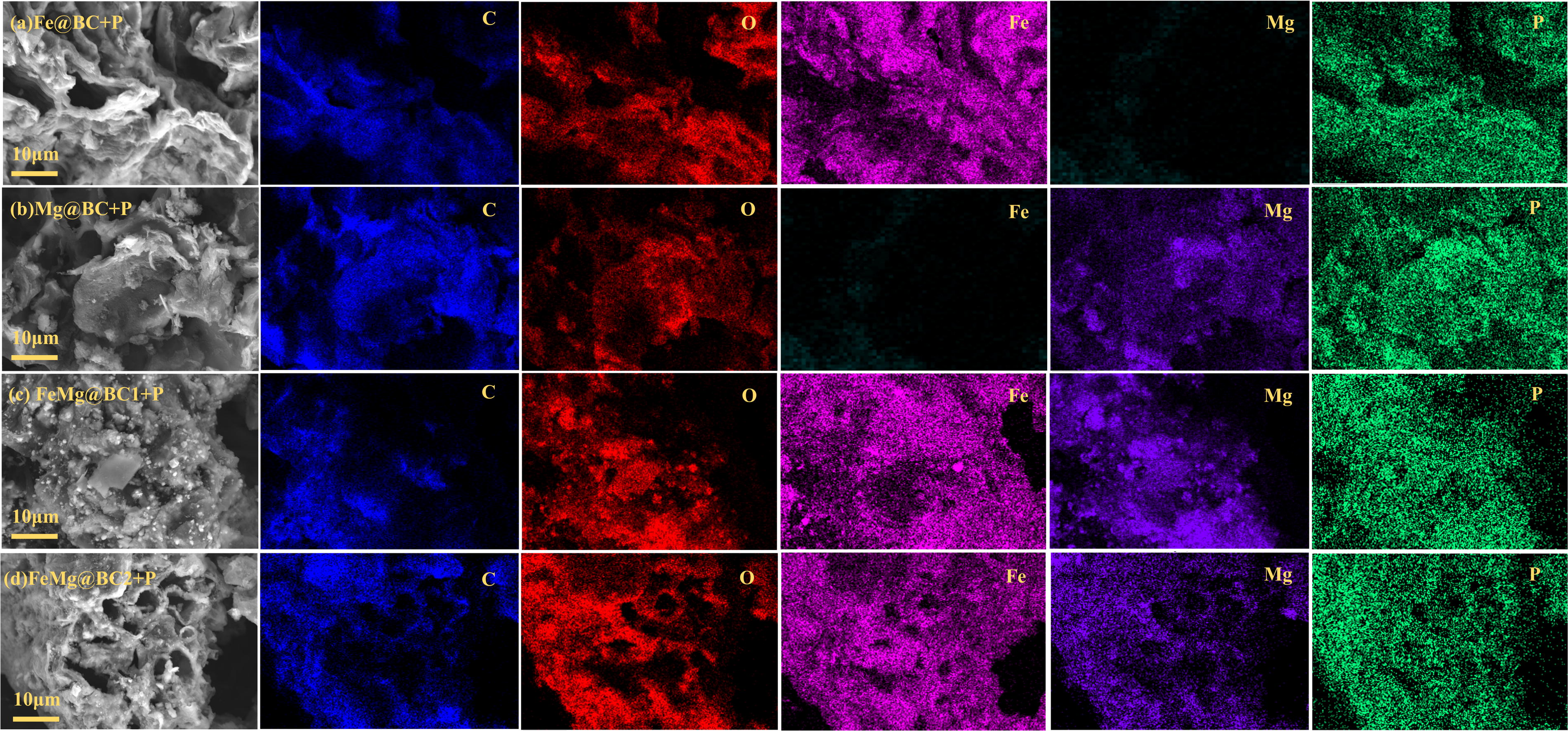
SEM/EDS elemental maps of Fe@BC
XRD and FTIR analysis
The XRD patterns of modified biochar before and after phosphorus adsorption are displayed in Fig. 2. Before phosphorus adsorption, the absorbent materials exhibited distinct differences (Fig. 2a). The broad diffraction peaks at around 35.4° and 62.45° were attributed to the presence of Fe3O4 or iron oxides, suggesting successful iron loading onto the biochar. Similarly, broad diffraction peaks at 42.51° and 62.18° were observed on Mg@BC, FeMg@BC1, and FeMg@BC2; this suggested that magnesium was successfully bound to the biochar surface through the modifier reaction or the formation of magnesium oxide at elevated temperatures (Fang et al., 2014). Fe@BC, FeMg@BC1, and FeMg@BC2 exhibited characteristic peaks of Fe3O4 at 30.8°, 35.5°, and 62.45°, respectively, with broad diffraction peaks at 62.16° mainly because of the presence of MgO. After phosphate adsorption (Fig. 2b), the diffraction peaks at 26.5° of Fe@BC confirmed the presence of NaFePO4; peaks at 53.8° of Mg@BC indicated the formation of Mg(PO4)3 crystals (Rahman et al., 2021); characteristic peaks of Fe(H2PO4)2 crystals appeared at 14.46°, 30.60°, and 38.28° (Xu et al., 2023), whereas characteristic peaks of MgHPO4•7H2O crystals were observed at 16.49°, 20.91°, and 21.53°(Rahman et al., 2021). These results demonstrated the successful loading of phosphorus onto the modified biochar.
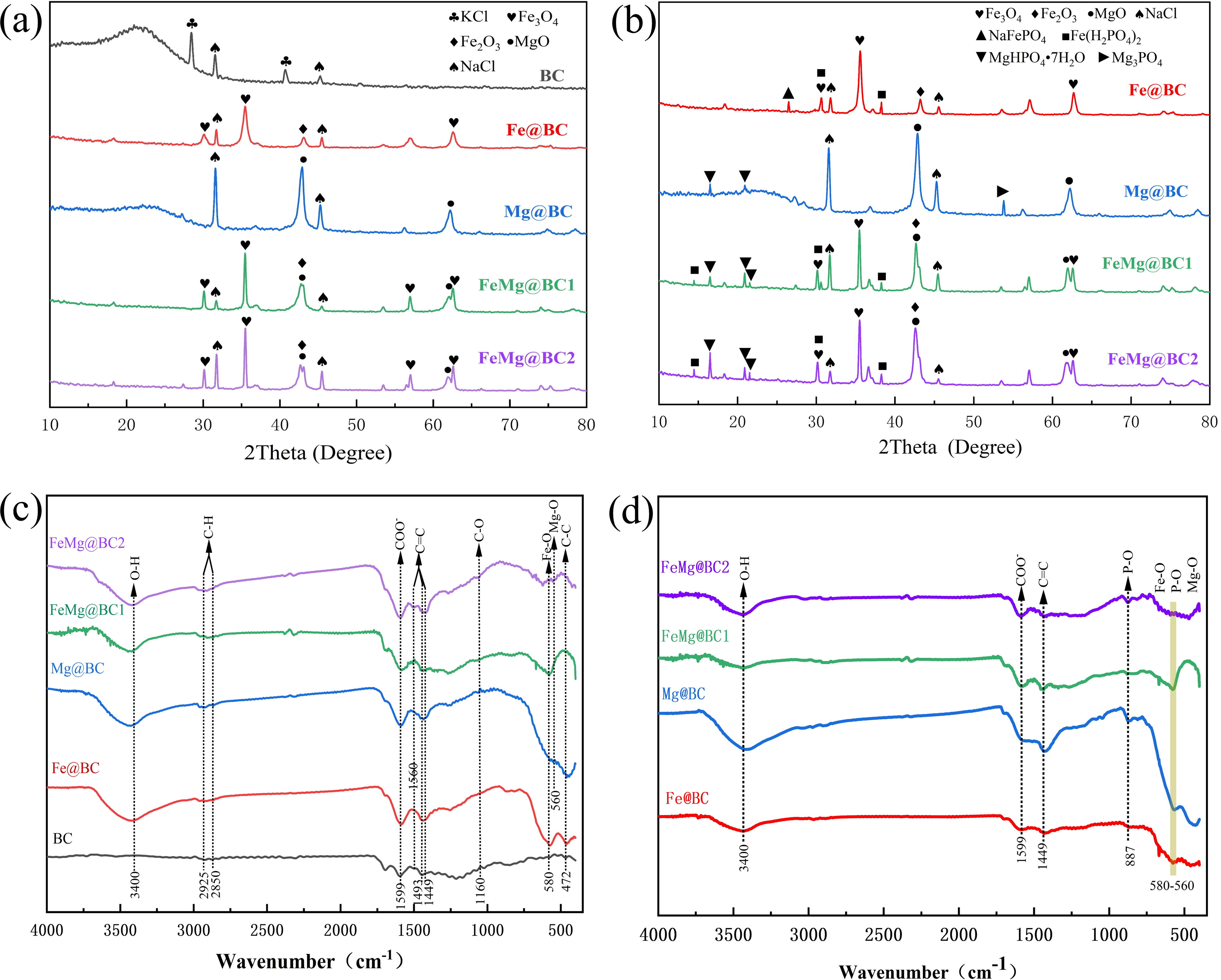
XRD pattern
Figure 2c and d display the infrared spectra of various biochars, all exhibiting characteristic absorption peaks at 3400 cm−1 associated with-OH groups. The modified biochar displayed peaks at 2925 cm−1 and 2850 cm−1 attributed to aromatic C-H stretching vibrations (Likun and Zhang, 2020). In addition, the peak at 1599 cm−1 was attributed to carboxyl C=O stretching vibrations. Vibrational peaks at 1449 cm−1, 1493 cm−1, and 1560 cm−1 were assigned to aromatic C=C vibrations (Fang et al., 2014). The stretching vibration at 1160 cm−1 was related to C-O functional groups, whereas the peak at 472 cm−1 indicated C-C stretching vibrations (Zornoza et al., 2016). Notably, Fe@BC and FeMg@BC1 exhibited fluctuating vibrational bands at 580 cm−1, associated with the formation of iron oxides (Tang et al., 2021). The characteristic peaks at 560 cm−1 in Mg@BC and FeMg@BC2 were attributed to magnesium oxide stretching vibrations, confirming the successful loading of iron and magnesium onto the biochar (Li et al., 2023). The FTIR spectra revealed that FeMg@BC1 and FeMg@BC2 had a greater variety of functional groups on their surfaces compared with pristine biochar, indicating that the mixed modification with both metals promoted the formation of functional groups. The adsorption of phosphorus by FeMg@BC1 and FeMg@BC2 was characterized by new fluctuating vibrational bands in the 1119–1037 cm−1 range, mainly attributed to P-O bond vibrations (Wang et al., 2021b). Overall, the presence of oxygenated functional groups and aromatic compounds in the biochar facilitated the recovery of phosphate from pressed vegetable wastewater.
Influencing factors of phosphorus adsorption by modified biochar
Biochar dosage
The impact of varying biochar dosages on phosphate removal is illustrated in Fig. 3a. Given the limited phosphate adsorption capacity of biochar, this aspect would not be further discussed (Peng et al., 2020). As the adsorbent dosage increased from 0.5 g/L to 1.0 g/L, the removal efficiency of phosphorus by Fe@BC, Mg@BC, FeMg@BC1, and FeMg@BC2 also increased, reaching 48.11%, 54.75%, 92.58%, and 93.28%, respectively. It was similar to previously reported findings (Li et al., 2021; Wan et al., 2017). Interestingly, a slight decline in phosphorus removal by these four modified biochars was observed when the dosage was further increased from 2.0 g/L to 3.0 g/L, with this effect being more pronounced in the magnesium-based biochar. This trend might be attributed to the excess adsorbent leading to increased dissolution of MgO, subsequently raising the OH− and pH levels of the solution. Although MgO derived from pyrolysis had low solubility, its dissolution was enhanced by PO43− and HPO4− (Wang et al., 2021a).
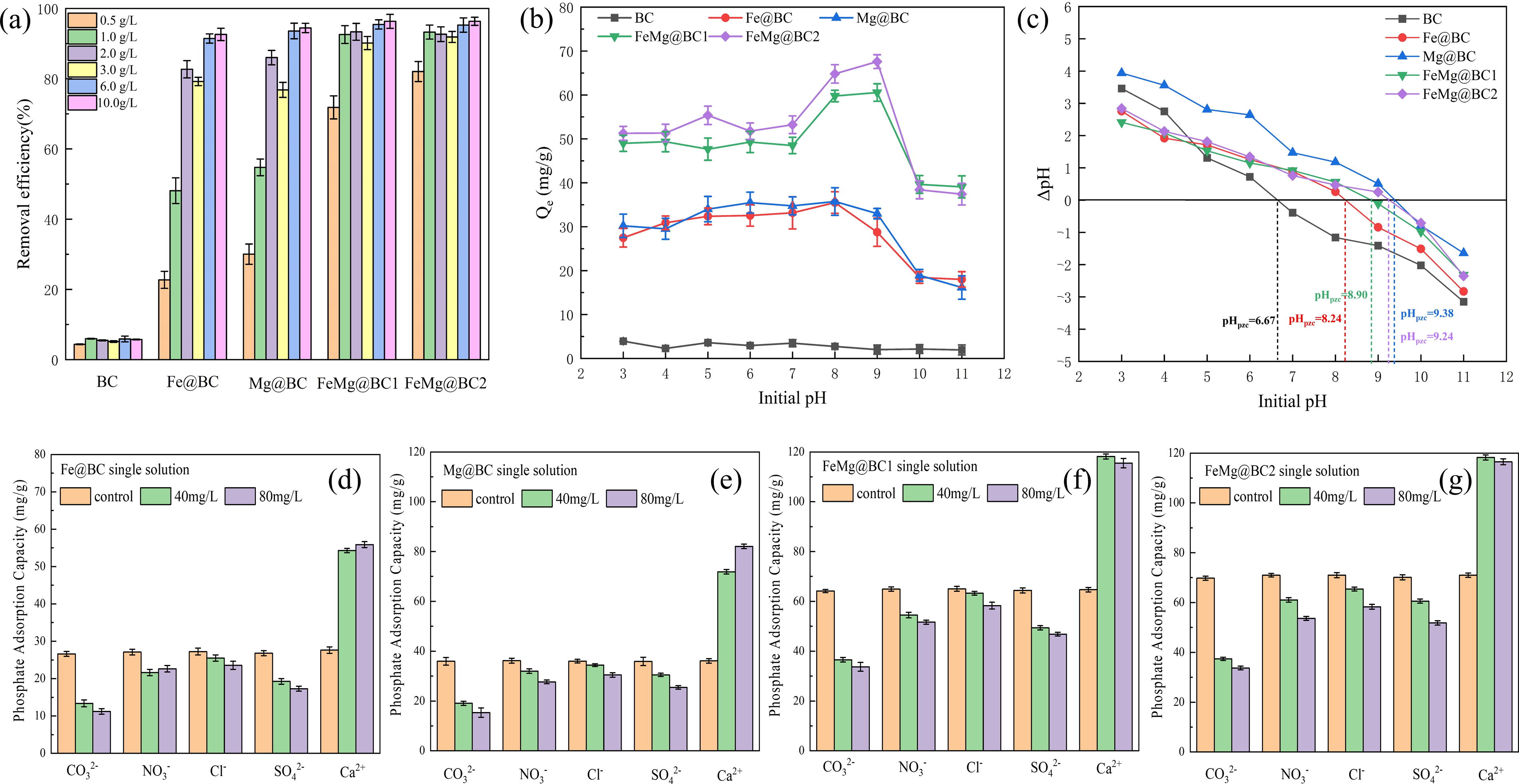
Effect of modified biochar dosage on phosphate removal efficiency
Phosphorus adsorption was a dynamic process, and despite excess modified biochar had sufficient binding sites, there remained the potential for phosphorus release from biochar loaded with phosphate precipitates (Cui et al., 2022). For instance, MgHPO4 formed during the adsorption of magnesium-modified biochar exhibited slight solubility in water, allowing for a small amount of phosphate to persist in solution (Li et al., 2024). The phosphate removal efficiencies of Fe@BC, Mg@BC, FeMg@BC1, and FeMg@BC2 increased with dosage from 6.0 g/L to 10.0 g/L, reaching 92.61%, 94.45%, 96.34%, and 96.35%, respectively. The reduction in phosphorus concentration in the solution was attributed to the abundant binding sites offered by the adsorbents, as well as the synergistic enhancement of multiple adsorption mechanisms (Liu et al., 2024). FeMg@BC2 and FeMg@BC1 exhibited higher affinity for phosphate, resulting in superior removal efficiency at the same dosage. Overall, FeMg@BC2 and FeMg@BC1 demonstrated higher phosphorus removal efficiency at a phosphate concentration of 80 mg/L, with the optimal dosage for both being 1.0 g/L.
Solution pH
Solution pH is a key factor affecting the adsorption capacity of the adsorbent, which determines the surface charge of the biochar and the ionic species of the adsorbent (Geng et al., 2021). As illustrated in Fig. 3b, the adsorption performance of biochar on phosphate was examined under various initial pH conditions. The adsorption capacity of FeMg@BC1 (49.35–147.66 mg/g) and FeMg@BC2 (51.26–55.36 mg/g) surpassed that of Fe@BC (27.49–33.17 mg/g) and Mg@BC (29.53–35.48 mg/g), whereas the pristine biochar exhibited limited adsorption capacity. At pH > 9, the increased concentrations of HPO4− and OH− in the solution led to competition for binding sites with phosphate, resulting in reduced adsorption capacity and removal efficiency of the modified biochar (Xiong et al., 2024).
The results presented in Fig. 3c indicated that the pHpzc values of Fe@BC, Mg@BC, FeMg@BC1, and FeMg@BC1 were ∼8.24, 8.90, 9.24, and 9.38, respectively. These findings aligned with previous studies (Bian et al., 2023b). At pH < 8.90, the surfaces of Fe@BC and Mg@BC were protonated, allowing them to easily bind to phosphate (Zhu et al., 2022). As the pH increased above 8.9, the negative charge on the biochar surfaces also increased, leading to a weakening of the electrostatic attraction during the adsorption process. This weakening could explain the decrease in the adsorption capacity of Fe@BC and Mg@BC, as well as the reduction in phosphate removal capacity observed at pH values above 8.22 or 8.90. However, at pH values above 9.24, the decrease in adsorption capacity for FeMg@BC1 and FeMg@BC1 only showed a decreasing trend. This suggested that FeMg@BC1 and FeMg@BC1 could effectively function over a wide pH range, exhibiting higher adsorption capacity and phosphate removal efficiency compared with Fe@BC and Mg@BC.
Solution coexistence ion
In this study, various common ions (Cl−, NO3−, CO32−, SO42−, Ca2+) present in pressed vegetable wastewater were chosen for adsorption experiments. The impact of five interfering ions on the adsorption capacity of modified biochar is demonstrated in Fig. 3d–g. The results showed that at ion concentrations of 40 mg/L and 80 mg/L, Cl− had a lower interference, possibly because of the PO43− exchange reaction being affected by hydrogen bonding and electrostatic attraction within the modified biochar. The layered structure of Cl− promoted electrostatic attraction, decreasing the chances of competitive adsorption (Loganathan et al., 2014). The adsorption of SO42− and NO3− was nonspecific and did not form external complexes that interfere with phosphate adsorption (Jia et al., 2020). CO32− had a more pronounced effect on modified biochar compared with other anions, leading to reduced phosphate adsorption. The rise in solution pH caused by CO32− triggered deprotonation of the adsorbent surface, resulting in electrostatic repulsion of anions.
It was worth noting that the phosphate adsorption capacity of solutions containing Ca2+ significantly increased, with a 2-fold rise for Fe@BC (Fig. 3d) and Mg@BC (Fig. 3e). This increase was primarily due to the reaction of calcium ions with phosphate in solution, forming various calcium/phosphorus precipitates such as octacalcium phosphate, dehydrated calcium hydrogenphosphate, and hydroxyapatite (Jellali et al., 2024). FeMg@BC1 (Fig. 3f) and FeMg@BC2 (Fig. 3g) exhibited a similar trend, with their adsorption capacities increasing by ∼1.6–1.8 times compared with the control. The rapid precipitation of calcium ions with phosphate on the modified biochar surface could lead to deposits that occupied phosphate-binding sites, hindering electrostatic attraction or complexation between magnesium, iron, and phosphate. In addition, the presence of numerous cations also induced an electrostatic repulsion effect (Jellali et al., 2023; Jin et al., 2024). This study revealed that Fe@BC, Mg@BC, FeMg@BC1, and FeMg@BC2 were influenced by ions in the following order: Ca2+ > CO32− > SO42− > NO3− > Cl−. Despite the presence of competing ions, FeMg@BC1 and FeMg@BC2 exhibited robust adsorption stability, implying a high degree of selectivity and stability that could potentially enhance phosphate recovery.
Adsorption kinetics and isotherms
Adsorption kinetics
Kinetic studies are frequently used to understand chemical pathways and adsorption mechanisms. This article provided a quantitative description of the kinetic processes using pseudo-first-order (PFO) and pseudo-second-order (PSO) models. The curves fitting the kinetics of the modified biochar are shown in Fig. 4, and the corresponding parameters are listed in Table 2. Figure 4a–d illustrates that Fe@BC, Mg@BC, FeMg@BC1, and FeMg@BC2 exhibited sustained high adsorption rates for 4 h, with adsorption capacities of 25.81, 29.33, 60.23, and 59.52 mg/g, respectively. Equilibrium was achieved after 8 h, resulting in equilibrium adsorption capacities of 29.76, 34.83, 63.51, and 70.63 mg/g, respectively. Yin et al. (2018) reported that biochar enriched with 20% Al exhibited a maximum phosphate adsorption efficiency of 57.49 mg/g. Peng et al. (2020) studied Mn/Al dioxygenated sludge biochar and found a phosphate adsorption of 28.20 mg/g primarily through aluminum–phosphate precipitation. Tao et al. (2020) developed Fe/Mg biochar nanocomposites and observed a phosphate adsorption of 6.9 mg/g through chemisorption mechanism, which was three times higher than that of pristine biochar. Li et al. (2016) synthesized Mg/Al-LDH biochar through coprecipitation and reported that the maximum phosphate adsorption was 81.8 mg/g by 4:1 Mg/Al-LDH biochar at pH 3.
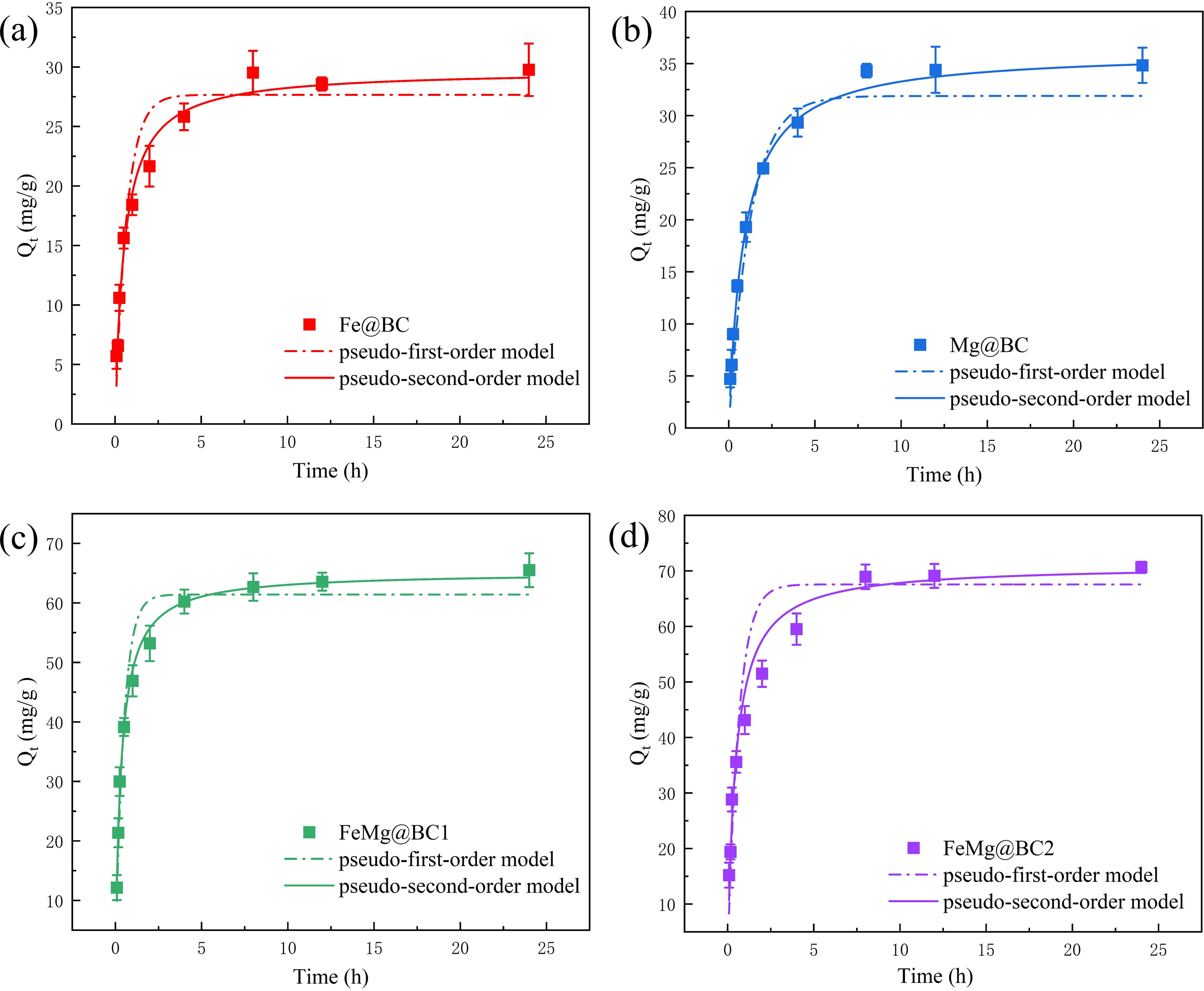
Kinetic modeling of different modified biochar
Adsorption Kinetic Parameters
In our work, FeMg@BC1 and FeMg@BC2 showed more favorable phosphate adsorption compared with Fe@BC and Mg@BC. The correlation parameters presented in Table 2 illustrate that the regression coefficients of the PSO (0.964–0.996) for the modified biochars outperformed those of the PFO (0.926–0.961), indicating a strong alignment of the PSO with the kinetic data. This implied that chemical reactions played a significant role in controlling phosphate adsorption by Fe@BC, Mg@BC, FeMg@BC1, and FeMg@BC2 at a phosphate concentration of 80 mg/L, and the surface functional groups of the modified biochar form new covalent bonds with phosphate (Liu et al., 2021).
Adsorption isotherms
The study investigated the adsorption isotherms of phosphate on modified biochar by varying the initial concentration of phosphate (Fig. 5). Isothermal modeling was used to understand the migration of phosphate in solution to the surface of biochar (Wang et al., 2018). The phosphate adsorption capacity of Fe@BC, Mg@BC, FeMg@BC1, and FeMg@BC2 increased gradually and stabilized with higher initial phosphate concentrations, as shown in Fig. 5a–d. Calculations based on the Langmuir model revealed that FeMg@BC1 and FeMg@BC2 (Fig. 5c and d) exhibited significantly higher adsorption capacities compared with Fe@BC and Mg@BC (Fig. 5a and b). As shown in Table 3, the maximum adsorption capacities of FeMg@BC1 (96.78 mg/g) and FeMg@BC2 (107.97 mg/g) were notably superior. The experimental data aligned well with the Langmuir model (R2 = 0.9734–0.9887), indicating predominantly homogeneous monolayer adsorption at the binding site (R2 > 0.97) (Kimambo et al., 2023). The adsorption indices 1/n (0.43–0.62) in the Freundlich model were all <1, indicating a weak physical interaction between the adsorbent and the phosphate, which favored chemisorption (Huang et al., 2018). Overall, FeMg@BC1 and FeMg@BC2 emerged as the most effective adsorbents for phosphate recovery from solutions, surpassing Fe@BC and Mg@BC in terms of modified biochar yield, cost, and benefits.
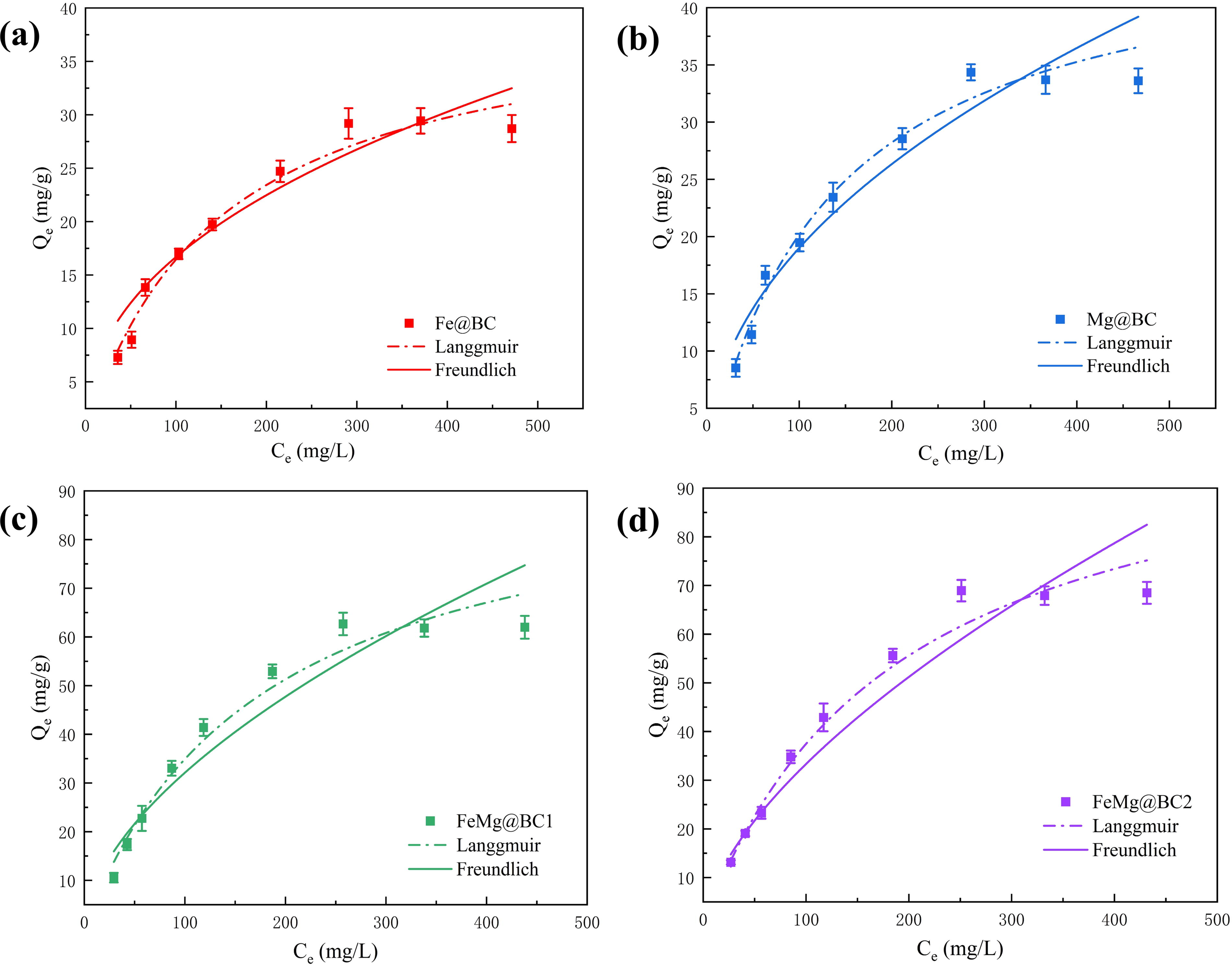
Isothermal modeling of different modified biochar
Adsorption Isotherm Parameters
Mechanism of phosphate removal by modified biochar
The possible mechanisms of phosphorus removal by modified biochar were summarized by comparing and analyzing the XRD and FTIR characterization results of Fe@BC, Mg@BC, FeMg@BC1, and FeMg@BC2 before and after phosphate adsorption (Supplementary Fig. S5). After modification, the biochar surface was bound with iron and magnesium metal ions or metal oxides such as Fe3O4 and MgO, which interacted with phosphate in water to create surface deposits (Eduah et al., 2020; Liu et al., 2019). This aligned well with the phosphorus elemental distribution observed in SEM-EDS elemental maps, the phosphorus oxides diffraction peaks in XRD, and the P-O stretching vibration peaks in FTIR. Furthermore, anions within the ferromagnesium-based biochar were displaced by phosphate ions in water, facilitating phosphate removal through adsorption. The ion-exchange process involved the exchange of anions with phosphate ions between layers (Liu et al., 2022). The modified biochar’s zero-point charges were all above 8.24, with a high number of positive charges on the adsorbent surface in lower pH solutions, enabling effective adsorption of negatively charged phosphate through electrostatic attraction. As solution pH increased, the adsorbent surface became negatively charged, repelling the phosphate ions (Antunes et al., 2018). In addition, a ligand exchange mechanism likely occurred during the adsorption process of iron–magnesium-modified biochar. Specifically, cations such as OH2+ within the bilayer structure of FeMg@BC1 and FeMg@BC2 were likely replaced by H2PO4− in the solution, forming an inner-sphere complex that facilitated phosphate removal by the adsorbent (Jin et al., 2024).
Desorption and recycling experiments in pressed vegetable wastewater
Phosphorus-loaded modified biochar was subjected to desorption tests using 0.1, 0.25, 0.5 M NaOH solutions as desorbents (Bacelo et al., 2020). The desorption rate of phosphorus-loaded modified biochar increased gradually with the rise in NaOH concentration (Fig. 6a). At a NaOH concentration of 0.1 M, the desorption rates of the four phosphorus-loaded biochars from simulated wastewater ranged from 69.4% to 70.7%, significantly higher than those from biochars recovered from pressed vegetable wastewater (53.5 − 59.2%). When the NaOH concentration was increased to 0.25 M, the desorption rates from simulated wastewater were 78.6 − 81.3%, still surpassing those from pressed vegetable wastewater (68.7 − 72.2%). Upon further increasing the NaOH concentration to 0.5 M, the desorption rate of the four phosphorus-loaded biochars from simulated wastewater was 88.4 − 92.2%, whereas the desorption rate from pressed vegetable wastewater was only 80.8 − 84.8%. Given the presence of multiple ions in actual wastewater, competition for phosphate recovery might occur, and the interference of phosphate by organic components in actual wastewater presented a potential area for future research (Jin et al., 2024). Therefore, a 0.5 M NaOH desorption solution proved effective for phosphorus recovery.

Desorption rate of different modified biochar
The stability of phosphorus adsorption by Fe@BC, Mg@BC, FeMg@BC1, and FeMg@BC2 in pressed vegetable wastewater was assessed through three cyclic adsorption and desorption tests (Fig. 6b). The results indicated that the phosphorus removal efficiency of modified biochar followed the order FeMg@BC2 > FeMg@BC1 > Mg@BC > Fe@BC, with a gradual decrease in efficiency with an increasing number of cycles. During the initial adsorption test, the removal rates for Fe@BC, Mg@BC, FeMg@BC1, and FeMg@BC2 were 44.03%, 51.61%, 72.64%, and 79.10%, respectively. After three cycles of adsorption tests, the cumulative removal percentages for the modified biochar were 102.79%, 120.32%, 174.22%, and 196.24%, respectively. Consequently, FeMg@BC2 exhibited significant advantages in phosphorus removal from real wastewater because of its higher cycle stability.
Conclusions
In this study, FeMg@BC2, a phosphorus-recovering material, was successfully synthesized from corn kernel waste using an optimized method that addressed the limitations of the original biochar. Compared with Fe@BC, Mg@BC, and FeMg@BC1 prepared through conventional coprecipitation, FeMg@BC2 exhibited a yield of 65.62%, a specific surface area of 70.69 m2/g, and improved metal-oxidizing crystallinity along with enhanced phosphate loading capacity. Through adsorption isotherm modeling, the maximum phosphate adsorption capacities of Fe@BC, Mg@BC, FeMg@BC1, and FeMg@BC2 were estimated at 40.76 mg/g, 46.97 mg/g, 96.78 mg/g, and 107.97 mg/g, respectively. FeMg@BC2 demonstrated effective adsorption across a wide pH range and maintained superior adsorption capacity even in the presence of competing ions. The phosphorus adsorption mechanism involved electrostatic adsorption, surface precipitation, and ligand exchange. This cost-effective and high-yield adsorbent removed 80% of phosphorus from pressed vegetable wastewater, with the phosphorus easily desorbed using 0.5 M NaOH. FeMg@BC2 stood out as a highly efficient adsorbent suitable for vegetable pressed wastewater treatment and agricultural fertilizer development. Future research will investigate the environmental performance of iron–magnesium-modified biochar for soil remediation, the migration patterns of phosphorus-loaded biochar in soil, and offer technical solutions for utilizing agricultural waste resources.
Footnotes
Acknowledgments
Lanzhou University of Technology provided all the experimental conditions. Thanks to Dr. Y.-H.L., College of Earth and Environmental Sciences, Lanzhou University for technical assistance.
Authors’ Contributions
Formal analysis, data curation, software, writing—original draft, and writing—reviewing and editing (equal) by T.L. Conceptualization, methodology, writing—reviewing and editing, writing—original draft, and funding acquisition (equal) by J.-P.L. Data curation and writing—original draft (supporting) by Z.-P.L. Funding acquisition by X.-W.C.
Author Disclosure Statement
No competing financial interests exist.
Funding Information
The authors gratefully acknowledge the funding support from

References
Supplementary Material
Please find the following supplemental material available below.
For Open Access articles published under a Creative Commons License, all supplemental material carries the same license as the article it is associated with.
For non-Open Access articles published, all supplemental material carries a non-exclusive license, and permission requests for re-use of supplemental material or any part of supplemental material shall be sent directly to the copyright owner as specified in the copyright notice associated with the article.
