




Abstract
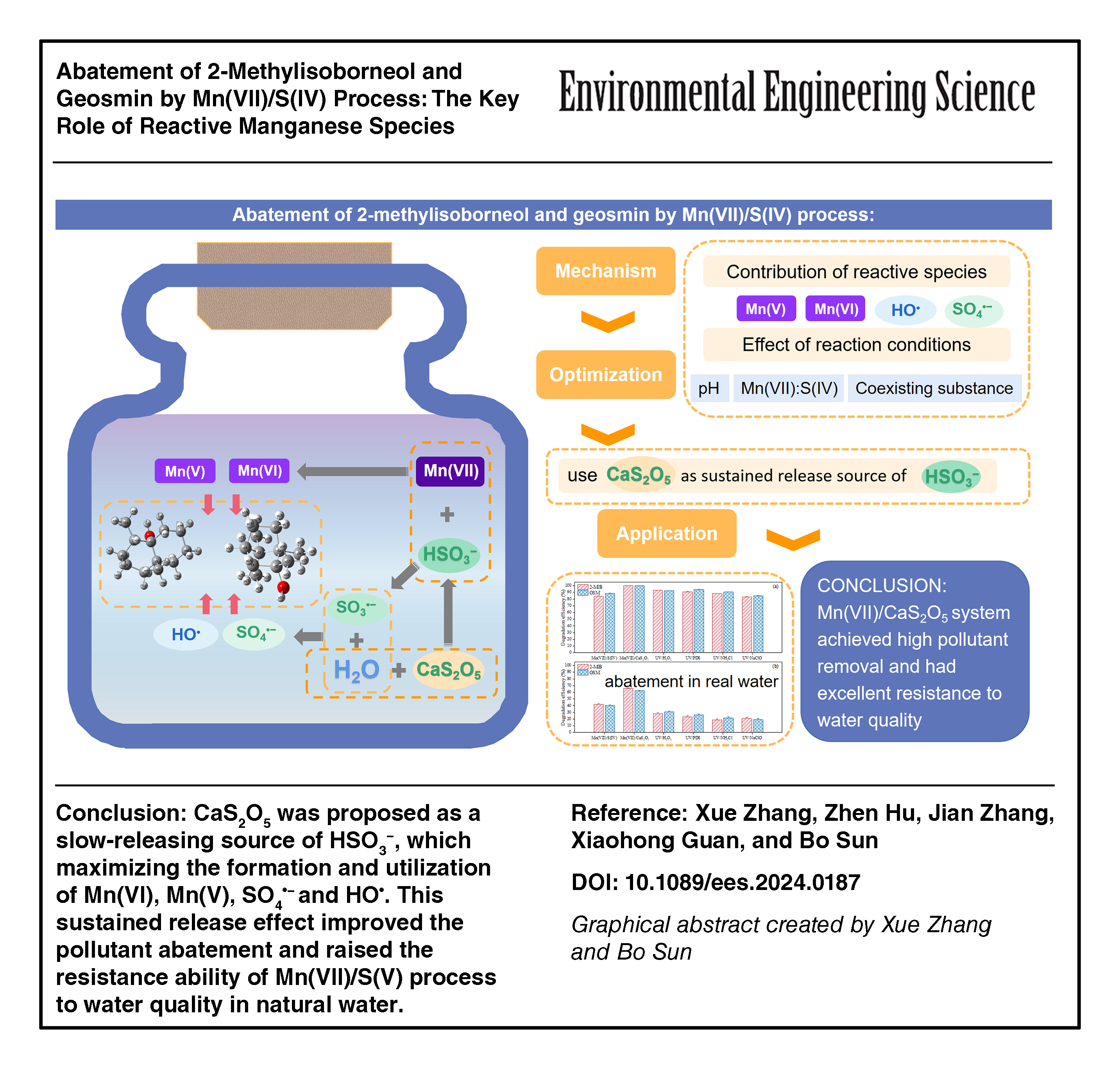
This study explores the degradation efficiency and mechanisms of 2-methylisoborneol (2-MIB) and geosmin (GSM) in permanganate/bisulfite [Mn(VII)/S(IV)] process. In ultrapure water, with a 20 μM Mn(VII) dosage and a [Mn(VII)]:[S(IV)] ratio of 1:7 at neutral pH, the degradation of 2-MIB and GSM reached ∼85% and 89%, respectively. Multiple pieces of evidence indicate that reactive manganese species (RMnS) are chiefly responsible for the abatement of 2-MIB and GSM. This high reactivity toward the pollutants is attributed to their electron-rich sites in the stereochemical structure rather than hydroxyl functional groups. The study also comprehensively investigated the effect of solution conditions like Mn(VII) dosage, pH, and common coexisting substances (dissolved organic matter, HCO3−, and Cl−) in real water on pollutant degradation and the reactive species distribution. Additionally, calcium metabisulfite (CaS2O5), a slightly soluble agent, was proposed as a sustained-release source of HSO3− to optimize the Mn(VII)/S(IV) process. Compared to the scenario of using HSO3− as an activator, the Mn(VII)/CaS2O5 system achieved complete pollutant degradation. Furthermore, the performance and cost-effectiveness of Mn(VII)/S(IV) and Mn(VII)/CaS2O5 process was compared with four other Advanced oxidation processes in natural water. This work strongly suggests the feasibility of the Mn(VII)/CaS2O5 process for removing odor compounds in water treatment applications.
Introduction
In recent years, the frequent outbreaks of blue-green algae blooms caused by water eutrophication have become a widely concerned environmental issue worldwide (Antonopoulou et al., 2014; Li et al., 2018; Zamyadi et al., 2023). The growth and metabolism of blue-green algae actinomycetes in drinking water sources such as rivers, lakes, and reservoirs can produce odor compounds, which becomes a hot topic of public concern (Clercin and Druschel, 2019; Srinivasan and Sorial, 2011). 2-Methylisoborneol (2-MIB, C11H20O) and geosmin (GSM, C12H22O) are two commonly detected and most representative algal-derived odor compounds in water supplies (Kim et al., 2016; Son et al., 2015). With odor thresholds of 6.3 ng/L (Young et al., 1996) and 4 ng/L (Zoschke et al., 2012), respectively, 2-MIB and GSM can impart unpleasant musty and earthy flavor even at extremely low concentrations (Kim et al., 2016). Although the occurrence of odor compounds in drinking water poses no direct, significant health risk to humans, it has caused complaints among water consumers, affecting public trust in drinking water safety (Li et al., 2018; Xie et al., 2015).
The frequency of drinking water accidents attributed to odor has escalated worldwide, and various countries have established concentration limits for odor compounds in drinking water. For example, the standard limits for 2-MIB and GSM in drinking water are below 20 ng/L, 10 ng/L, and 10 ng/L in South Korea, Japan, and China, respectively (Huang et al., 2022). The extremely low odor threshold concentration of 2-MIB and GSM poses significant challenges for their removal through conventional water treatment processes. Coagulation, flocculation, sedimentation, filtration, and chlorination have proven to be largely ineffective against 2-MIB and GSM (Bruce et al., 2002; Sun et al., 2014). Activated carbon adsorption (Cook et al., 2001; Newcombe et al., 2002) or biodegradation (Ho et al., 2007; Watson et al., 2008; Yuan et al., 2013) are ineffective in removing these compounds. Oxidants typically used in water treatment, such as chloramine, chlorine dioxide, ozone, and potassium permanganate, also show limited effectiveness against these compounds (Antonopoulou et al., 2014; Glaze et al., 1990). Therefore, to achieve effective degradation of GSM and 2-MIB, advanced treatment processes are desired.
Advanced oxidation processes (AOPs), which use highly reactive radicals such as hydroxyl radical (HO•) and sulfate radical (SO4•−) for oxidation, have proven effective in addressing odor issues (Peter and Von Gunten, 2007; Xie et al., 2015). The second-order rate constants for GSM and 2-MIB with HO• and SO4•− are 109 M−1 s−1 and 108 M−1 s−1, respectively (Kim et al., 2016; Xie et al., 2015). Among the various proposed AOPs, UV-based AOPs, for example, UV/H2O2, have been implemented in some drinking water treatment facilities (Huang et al., 2022; Jiang et al., 2022; Zhao et al., 2022). However, these processes face practical challenges, including high equipment (the UV lamp) (Wang et al., 2024) and operational costs (Cai et al., 2023; Chen et al., 2021). In addition, the HO• and SO4•− are considered non- or less selective oxidants and suffer significant effects of the background water constituents and their precursors (Guan et al., 2022). Thus, the strategy with less costs in equipment, small required area, easy operation, and selective oxidation to odor compounds is desired. Our group introduced a cost-effective and efficient alternative in 2015, the permanganate/bisulfite [Mn(VII)/S(IV)] process, utilizing HSO3− to activate MnO4− for organic contaminant degradation at extraordinarily high rates (Sun et al., 2015). This method, requiring minimal modifications and offering easy operation, can integrate into existing water treatment infrastructures, which highlight its potential in practical applications (Rodríguez et al., 2007; Zhang et al., 2014). Mechanistic investigations suggested that HO•, SO4•−, and reactive manganese species [RMnS, including Mn(VI), Mn(V), and Mn(III)] are the main reactive species, and their contribution to pollutant degradation depends on the structure of pollutants and reaction conditions (Chen et al., 2020; Guan et al., 2022). Compared to the HO• and SO4•−, RMnS are selective oxidants and showed high reactivity to organic contaminants with electron-rich moieties (Shi et al., 2019; Sun et al., 2018a). However, despite these virtues, limited information is available on the use of the Mn(VII)/S(IV) process specifically for 2-MIB and GSM removal. Detailed evaluation is necessary to assess the possibility of this process as an alternative strategy of the currently used UV-AOPs for odor control in drinking water treatment.
This study delves into the Mn(VII)/S(IV) system’s ability to degrade odor compounds under various conditions, shedding light on the mechanisms involved and the impact of coexisting substances on its efficacy. A novel approach, permanganate/calcium metabisulfite [Mn(VII)/CaS2O5] process, involving CaS2O5 as a sustained-release source of HSO3−, was explored to optimize the Mn(VII)/S(IV) system in terms of pollutant degradation. The performance of the optimized Mn(VII)/CaS2O5 process was compared with other AOPs in real-world conditions, offering insights into its effectiveness. Finally, the impact of the Mn(VII)/CaS2O5 process for water quality postcoagulation/sedimentation was assessed.
Materials and Methods
Chemical reagents
Detailed information of chemical reagents was provided in Supplementary Data S1.
Experimental procedures
All batch experiments were conducted in 250-mL ground glass bottles. Mn(VII) was added into the solution containing S(IV) and other organic contaminants of interest to initiate the reactions. Solution pH was adjusted to the set value in advance by dosing H2SO4 and NaOH. The bottle was sealed to avoid the volatilization of pollutants except when adding reagents. The reaction temperature was kept at 25 ± 0.5°C. After ∼5 s of reaction, excessive Na2S2O3 was added to quench the oxidants, and sample was withdrawn and filtered for further determination.
The UV-based AOPs were conducted in a cylindrical glass reactor which was placed beneath the low-pressure mercury UV-lamp for UV treatment. A piece of quartz glass was used as the cover of this reactor to prevent the volatilization of compounds in the solution, and a magnetic stirrer was used to ensure complete mixing of the solution. A low-pressure mercury UV-lamp, emitting monochromatic light at 254 nm, was used as the radiation source of the UV-based AOPs experiments. The rated power is 10W, and the light intensity is measured to be 2.1 × 10⁻⁴ W·cm−2. The distance between the solution and the lamp was about 30 cm, and the effective path length was 3.98 cm.
The coagulation sedimentation experiments were conducted in a 500-mL beaker. Al2(SO4)3 (3.0 mg·L−1, as Al3+) was used as the coagulant after the Mn(VII)/S(IV) process, and the mixture was rapidly mixed at a stirring rate of 150 rpm for 1 min, then slowly mixed at 50 rpm for 10 min, followed by sedimentation for 30 min.
Analytical methods
2-MIB and GSM were detected according to “Organic compounds in drinking water-Test methods of geosmin and 2-methylisoborneol” in China, and the minimum detectable mass concentrations of 2-MIB and GSM are 3.8 ng/L and 2.2 ng/L, respectively. Solid-phase microextraction (SPME) method and gas chromatography mass spectrometry (GC-MS, QP2010c, SHIMADZU, Japan) were used for the detection of 2-MIB and GSM. After experiments, 40 mL solutions were collected into a 60 mL SPME-analysis bottle containing 10 g NaCl and a magnetic stir bar, then the bottle was heated to 60°C and held for 40 min while a 50/30 μm syringe fiber (Supelco, Sigma-Aldrich) coated with Divinylbenzene/Carboxen/Polydimethylsiloxane was equipped in the upper space of the bottle for adsorption and enrichment of 2-MIB and GSM. Then the syringe fiber was desorbed in the injection port of GC-MS at 250°C and 56.5 kPa for 5 min, and a selective ion monitoring mode was selected for analyzation of 2-MIB and GSM. The temperature program of the GC-MS and the remaining analytical methods were provided in Supplementary Data S2.
Results and Discussion
Effect of oxidant dosage on pollutant abatement
Supplementary Fig. S1 and Figure 1a show that 2-MIB and GSM are recalcitrant to MnO4− and HSO3−, but are notably degraded through the combined application of MnO4− and HSO3−. With a constant initial molar ratio of [Mn(VII)]:[S(IV)] at 1:5 under neutral pH conditions, over 95% of 2-MIB and GSM were eliminated at initial pollutant concentrations of 50 ng/L with a Mn(VII) dosage of 50 μM. Even at increased pollutant concentration to 100 ng/L, the degradation efficiency of 2-MIB and GSM remained above 90%. Reducing the Mn(VII) dosage to 20 μM led to a decline in the degradation efficiency of 2-MIB and GSM (Fig. 1b). Nonetheless, at an initial concentration of 50 ng/L for 2-MIB and GSM, their degradation efficiency exceeded 80%, ensuring the residual pollutant levels met the water quality standard of less than 10 ng/L. It is noteworthy that reactions in Mn(VII)/S(IV) process are exceedingly rapid, often completing within hundreds of milliseconds, indicating the high efficiency of Mn(VII)/S(IV) process in controlling these odor compounds.
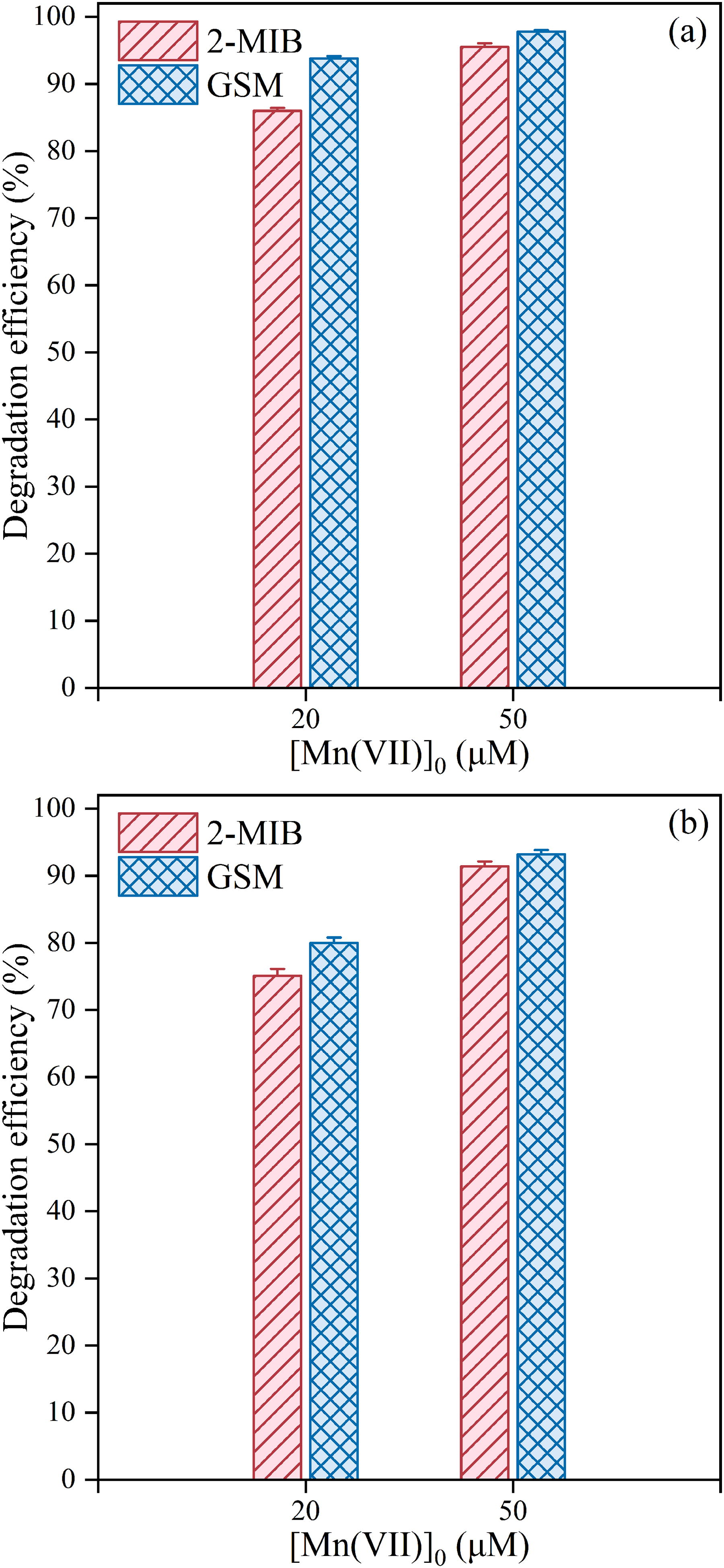
Effect of oxidant dosage on 2-MIB and GSM abatement in Mn(VII)/S(IV) system. Experimental conditions: [2-MIB]0 = [GSM]0 = 50 ng/L for
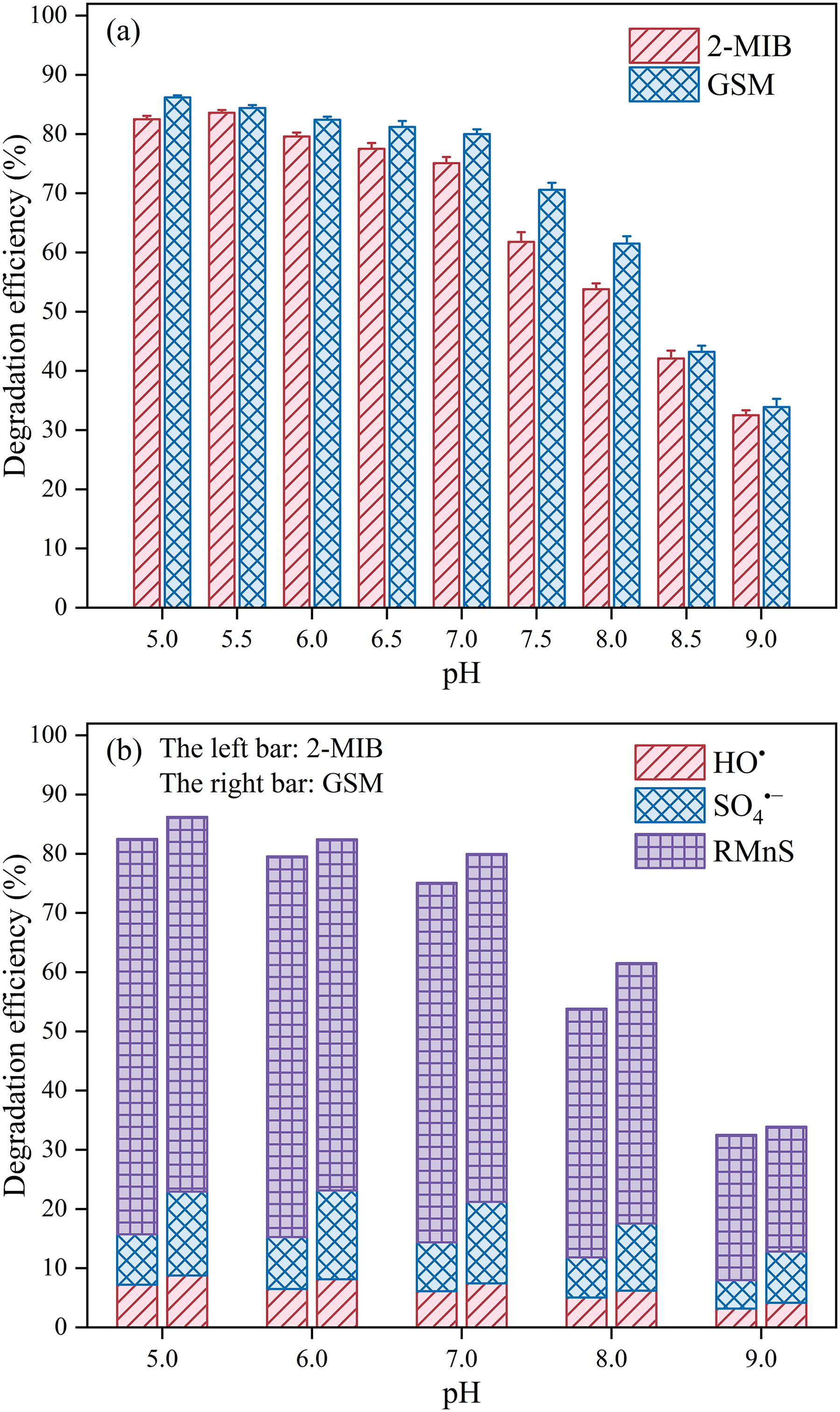
Previous studies have demonstrated that various reactive species, such as HO•, SO4•–, and RMnS, play crucial roles in the degradation of pollutants in the Mn(VII)/S(IV) process. To distinguish the contributions of HO•, SO4•–, and RMnS to degradation of 2-MIB and GSM, a competition kinetic method was developed (Supplementary Data S3). Due to rapid degradation rates of 2-MIB and GSM, which complicate direct kinetic measurement, the quantification of these reactive species was expressed using time-integrated concentration. Nitrobenzene (NB) and benzoic acid (BA) were selected as probe compounds. Previous study demonstrated that RMnS is inert to NB and BA in Mn(VII)/S(IV) system (Qi et al., 2023). Specifically, the degradation of NB is solely attributed to its reaction with HO•. Whereas the degradation of BA results from the combined effects of both HO• and SO4•−. Thus, the degradation of pollutants could be described with Equations (1)–(4). With the experimentally determined degradation of NB and BA in the Mn(VII)/S(IV) system (Supplementary Fig. S2) and the second-order rate constants of HO• and SO4•− toward NB and BA (Supplementary Table S1), the time-integrated concentrations of HO• and SO4•− were calculated to be 2.63 × 10⁻¹¹ M•s and 3.64 × 10⁻¹⁰ M•s, respectively (Supplementary Table S2). SO4•− arose from the radical chain reactions of HSO3− oxidation in the Mn(VII)/S(IV) process (Supplementary Fig. S3), and HO• was generated from the reaction of SO4•− with H2O with the rate constant smaller than 3 × 10³ s−1. Consequently, the concentration of HO• in Mn(VII)/S(IV) process was ∼1 order of magnitude lower than that of SO4•−. With literature-reported second-order rate constants of HO• and SO4•− toward the two odor compounds, respectively (Xie et al., 2015), the contributions of HO• and SO4•− to the degradation of 2-MIB and GSM were determined. Then, the contribution of RMnS to pollutant degradation was obtained by subtracting the contributions of HO• and SO4•−. As shown in Figure 2, compared to HO• and SO4•−, RMnS was mainly responsible for the degradation of 2-MIB and GSM.
Effect of pH on 2-MIB and GSM degradation
To validate the results regarding the contribution of RMnS in pollutant degradation, a series of experiments were conducted. Initially, the degradation of 2-MIB and GSM was measured in a UV/peroxydisulfate (PDS) system, both in the absence and presence of 100 mM Cl−. The results obtained are presented in Supplementary Fig. S4. In the absence of Cl− in the UV/PDS system, the degradation of 2-MIB and GSM was primarily attributed to SO4•− and HO•. High concentration of Cl− shifted the radical distribution to dichloro radical anion (Cl2•−) in the UV/PDS process because of the fast transformation in Equations (5)–(6) (Chen et al., 2022; Wu et al., 2019). Negligible 2-MIB and GSM were removed in the UV/PDS system in the presence of 100 mM of Cl−, suggesting that these two pollutants are recalcitrant to Cl2•−. Then, excessive Cl− was added into the Mn(VII)/S(IV) system to scavenge SO4•− and HO• while Cl− was recalcitrant to RMnS (Qi et al., 2023). Thus, the removed 2-MIB and GSM under the reaction condition of this study should be ascribed to RMnS oxidation. As shown in Supplementary Fig. S5, the calculated degradation of 2-MIB and GSM resulting from RMnS oxidation was consistent with the experimental results, demonstrating the critical role of RMnS for the degradation of 2-MIB and GSM in the Mn(VII)/S(IV) system.
Previous studies consider RMnS as selective oxidants which show high reactivity to organic contaminants with phenolic, olefin, and sulfoxide moieties (Jiang et al., 2012; Waldemer and Tratnyek, 2006; Zhang et al., 2014; Zhang et al., 2024). Chen et al. demonstrated the low reactivity of RMnS toward alcohol compounds (Chen et al., 2020). Thus, the high oxidation capacity of RMnS toward 2-MIB and GSM is possibly due to their stereochemical structure rather than the hydroxyl functional group. Supplementary Fig. S6 shows the electron arrangement of 2-MIB and GSM, including the highest occupied molecular orbital (HOMO) and the lowest unoccupied molecular orbital (LOMO). HOMO map displays the sites with the most active electronic energy, which may be attacked by RMnS through electrophilic reaction. The calculation results proved that the stereochemical structure of pollutants might be the reason for its high reactivity with RMnS, which supports our inference (Liu et al., 2023). Further, alcohol-substance scavenging experiments were employed to verify this deduction. As displayed in Supplementary Fig. S7, 10 mM of methanol and tertbutyl alcohol decreased the degradation of 2-MIB by ∼12% and ∼10%, respectively, and the degradation of GSM by ∼22% and ∼21%, respectively. The slight inhibition effects of alcohol scavengers on pollutants degradation indicate that the degradation of pollutants by RMnS was mainly achieved by attacking electron-rich sites other than hydroxyl groups.
Effect of pH on pollutant abatement
Since pH affects the transformation of HO• and SO4•−, as well as the stability and reactivity of RMnS (Jiang et al., 2012; Wang et al., 2014; Xu et al., 2019), the influence of pH on the degradation of 2-MIB and GSM by the Mn(VII)/S(IV) system was examined. As shown in Figure 2a, the degradation of 2-MIB and GSM by Mn(VII)/S(IV) process varied slightly under the pH range of 5.0 − 7.0 while decreasing monotonously with increasing pH from 7.0 to 9.0. This pH-dependent behavior aligns well with previous research findings, which suggest that Mn(VII)/S(IV) systems generally exhibit optimal performance under acidic conditions, while alkaline environments tend to hinder their effectiveness (Shi et al., 2019; Sun et al., 2015; Sun et al., 2016; Sun et al., 2018b). The distribution of reactive species under different pH was determined with above constructed competition kinetic method (Supplementary Fig. S2), and the results are presented in Figure 2b. Increasing pH negatively influences the concentration of SO4•−, HO• and RMnS in the Mn(VII)/S(IV) system. This might be ascribed to the shift of S(IV) species from HSO3− (pKa = 7.2) to SO32− which shows higher reactivity to these reactive species (Li et al., 2022). Besides, the reactivity and stability of RMnS dropped with increasing pH (Jiang et al., 2009; Jiang et al., 2010).
Effect of background water constituents on Mn(VII)/S(IV) process
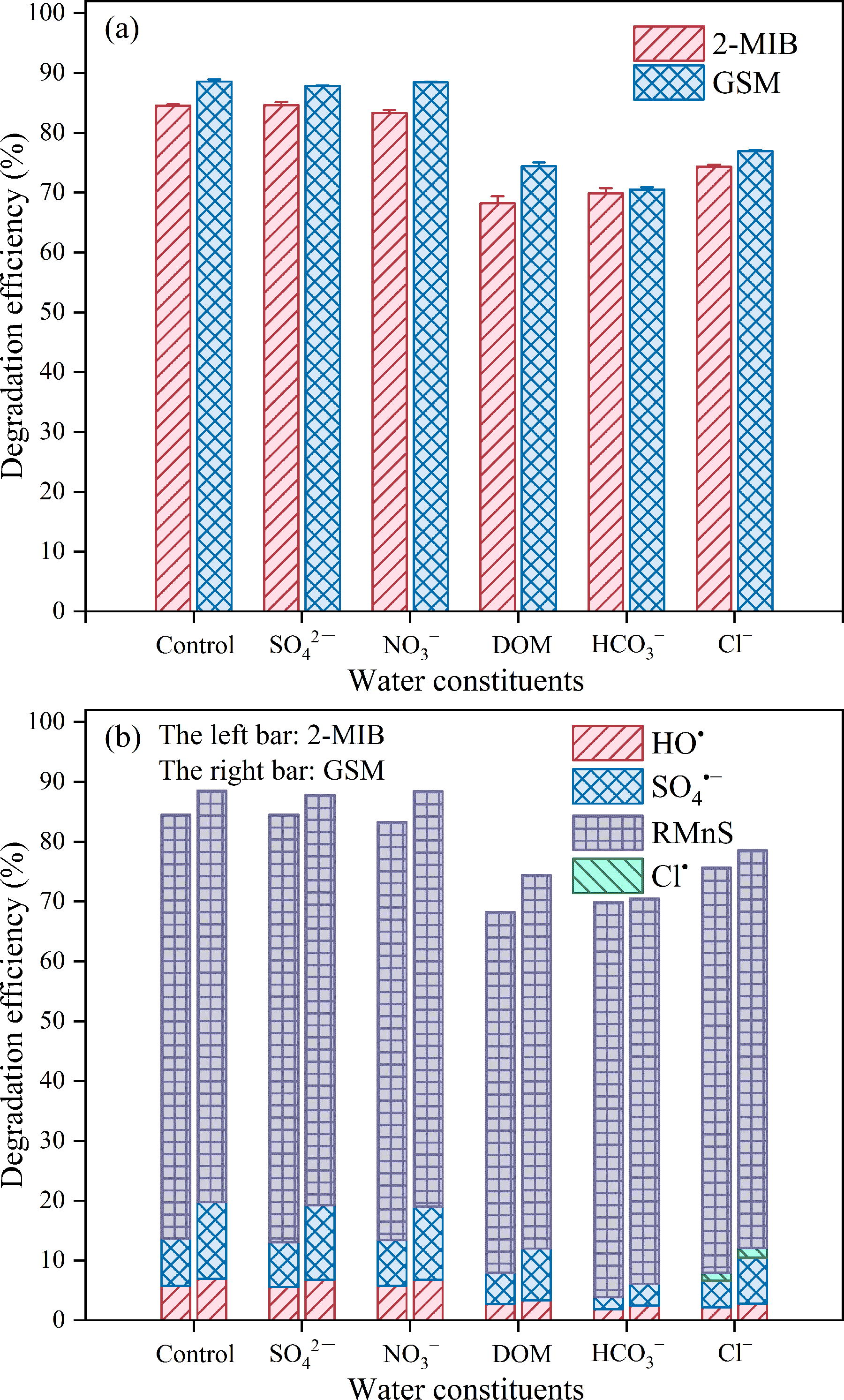
Various background water constituents exist in natural water, including SO42−, NO3−, HCO3−, Cl−, dissolved organic matter (DOM), etc. The impacts of these substances on the degradation of 2-MIB and GSM by the Mn(VII)/S(IV) process under neutral conditions were investigated. The concentrations of these background constituents were determined based on the common concentration in natural water. As illustrated in Figure 3a, SO42− and NO3− negligibly influenced the degradation of 2-MIB and GSM, while DOM, HCO3−, and Cl− inhibited the abatement of pollutants. The distribution of reactive species was also determined (Supplementary Fig. S8), which was discussed in the following sections.
Effect of background water constituents on 2-MIB and GSM degradation
DOM. As shown in Figure 3a, 1.0 mg/L of DOM decreased the degradation of 2-MIB and GSM by ∼16% and ∼14%, respectively. As shown in Supplementary Table S3 and Figure 3b, dosing DOM decreased the time-integrated concentration of SO4•− and HO• by ∼47% and ∼63%, respectively. It is a common sense that DOM acts as a competitor of SO4•− and HO• and thus accounts for the depressed AOPs performance (Guan et al., 2020; Guan et al., 2022). Comparatively, the contribution of RMnS to the degradation of 2-MIB and GSM decreased by ∼10% and ∼6%, respectively, with addition of DOM. The oxidation of HSO3− is a radical chain reaction (Supplementary Fig. S3), and the consumption of SO4•− and HO• by DOM possibly affected the decay of HSO3−, which would influence the consumption of RMnS by HSO3− in turn. As the HSO3− was exhausted rapidly in the Mn(VII)/S(IV) process with HSO3− dosage of 140 μM, it is difficult to draw the decay kinetic of HSO3−. Here, excessive HSO3− (1 mM) was added into solution and the influence of DOM on the concentration of residual HSO3− was investigated. As shown in Supplementary Fig. S9, DOM decreased the consumption of HSO3−, which might account for the suppressed contribution of RMnS to pollutant degradation. In addition, DOM contain some electron-rich functional groups, such as phenols, unsaturated carboxylic acids, etc., and consume the RMnS (Lutze et al., 2015; Shi et al., 2019). Overall, compared to SO4•− and HO•, RMnS is more selective and suffers less effects of DOM.
HCO3−. 120 mg/L HCO3− resulted in a notable decrease in the pollutant degradation by ∼15% and ∼18%. As demonstrated in the previous study, CO3•− was supposed to generate from reactions with SO4•− and HO• in the system [Equations. (7) and (8)].
While CO3•− is a weak oxidant and its contribution of CO3•− to 2-MIB and GSM degradation was neglected here (Li et al., 2019; Xie et al., 2015), the time-integrated concentration of SO4•− and HO• significantly decreased due to their reaction with HCO3− at a rate constant of up to 106 M−1 s−1, thereby reducing their contribution to pollutant degradation.
The reactivity of HCO3− toward RMnS remained unclear, hindered by the rapid disproportionation of short-lived RMnS species, making direct probing challenging. Previous study suggested that Mn(VII)/As(III) system and acidified Mn(VI) could serve as proxies for evaluating the reactivity of RMnS (Mn(V) and Mn(VI)). In addition, studies have demonstrated that the generation of methyl phenyl sulfone (PMSO2) during the oxidation of methyl phenyl sulfoxide (PMSO) was attributed to Mn(VI) and Mn(V) in these systems. Therefore, PMSO was selected as a model compound to assess the reactivity of HCO3– toward RMnS in the Mn(VII)/As(III) and acidified Mn(VI) systems. [Mn(V)] and [Mn(VI)] represent the concentration of Mn(VI) and Mn(V) which were assumed to keep constant during the reaction. As displayed in Supplementary Fig. S10, the addition of 120 mg/L HCO3– negligibly influenced the generation of PMSO2, indicating that RMnS was inert to HCO3–. Consequently, the contribution of RMnS to 2-MIB and GSM degradation marginally decreased by ∼5% and ∼4%, respectively (Fig. 3b). Supplementary Fig. S9 shows that the addition of HCO3– retarded the consumption of HSO3–, which was attributed to the effect of HCO3– on the radical chain reaction of HSO3− oxidation in the Mn(VII)/S(IV) system through consuming SO4•− and HO•, and thus decreasing the contribution of RMnS.
Cl−. In the presence of 36 mg/L Cl−, NB, BA, and 4-Chlorobenzoic acid (pCBA) were selected as probe compounds to calculate the contribution of reactive species to pollutant degradation in the Mn(VII)/S(IV) system using competitive kinetics, detailed in Supplementary Data S4. As shown in Figure 3b, the presence of Cl− reduced the contribution of SO4•− to pollutant degradation. Cl− is highly reactive to SO4•− (k = 3.1 × 10⁸ M−1 s−1) and transformed SO4•− to Cl• via one-electron transfer (Huang et al., 2022; Kim et al., 2016). The reactivity of Cl• toward 2-MIB and GSM are calculated with the relative rate method, and the details are shown in Supplementary Data S3. A majority of Cl• might further combine with Cl− to form Cl2•− (Chen et al., 2022; Wu et al., 2019), which is inert to the odor compounds. Consequently, Cl• negligibly contributed to the degradation of 2-MIB and GSM (Fig. 3b). Qi et al. (2023) have demonstrated that Cl− is recalcitrant to RMnS, while interfering the radical chain oxidation of HSO3−. As shown in Supplementary Fig. S9, Cl− retarded the consumption of HSO3−, which changed the ratio of Mn(VII) to S(IV) during the reaction and thus increased the consumption of RMnS by HSO3−.
Effect of Mn(VII)/S(IV) molar ratio on pollutant abatement
Studies have shown that the effectiveness of the Mn(VII)/S(IV) process for treating organic pollutants significantly varies with the molar ratios of Mn(VII):S(IV) (Dong et al., 2020; Gao et al., 2017). Optimal pollutant removal, typically ranging from a 1:5 to a 1:10 [Mn(VII)]:[S(IV)] ratio, is generally achieved under acidic conditions. This study investigates the degradation of 2-MIB and GSM under neutral conditions by examining various [Mn(VII)]:[S(IV)] ratios and their impact on reactive species distribution (Supplementary Fig. S11).
As shown in Figure 4a, the degradation of pollutants increased with increasing [Mn(VII)]:[S(IV)] ratios from 1:1 to 1:7, followed by a decrease at higher ratios. The distribution of reactive species was calculated with the competition kinetic method, and the results are illustrated in Figure 4b. The maximal contribution of RMnS to pollutant degradation was observed at [Mn(VII)]:[S(IV)] ratio of 1:7. Low HSO3− dosage induced less RMnS, whereas excessive HSO3− quenched the generated RMnS and enhanced the formation of SO3•−. As shown in Supplementary Fig. S3, SO4•− was generated via the reaction of HSO3− with SO5•−, which was derived from the combination of SO3•− and dissolved oxygen. Thus, the enhanced formation of SO3•− with increasing HSO3− resulted in the increased contribution of SO4•− to pollutant degradation. The concentration of HO• initially increased and then decreased with increasing [Mn(VII)]:[S(IV)] ratios from 1:1 to 1:20 (Supplementary Table S4). This is because the increased SO4•− concentration enhanced its transformation to HO•, while high concentration of HSO3− reacted with HO• along with the formation of SO3•−.

Degradation of 2-MIB and GSM
As RMnS are selective oxidants and mainly responsible for the degradation of 2-MIB and GSM in the Mn(VII)/S(IV) system, increasing the exposure of RMnS is expected to substantially enhance the degradation of these odor compounds. The above results demonstrate that high dosage of HSO3− consumes the generated RMnS in the Mn(VII)/S(IV) system, while HSO3− at low concentration may not be enough to induce sufficient RMnS to achieve the efficient oxidation of 2-MIB and GSM. On the contrary, the reaction in Mn(VII)/S(IV) system typically occurs on a millisecond scale; the degradation of pollutants might be limited to the diffusion rate of RMnS which possibly decomposes without oxidizing pollutants. To overcome these shortages of Mn(VII)/S(IV) process, CaSO3, which can release SO32− gradually, was previously employed as the source of S(IV), while SO32− possesses a higher quenching effect of RMnS (Rao et al., 2021). In this study, CaS2O5 was synthesized and used as a slow-releasing source of HSO3−. CaS2O5 is sparingly soluble and can release Ca2+ and S2O52− slowly and continuously. One molecule of S2O52− could be hydrolyzed to form two molecules of HSO3− [Equations. (9)]. The details of CaS2O5 preparation were described in Supplementary Data S1.
As shown in Figure 5, the comparative tests showed that with a fixed MnO4− concentration of 20 μM and a 1:7 [Mn(VII)]:[S(IV)] ratio, pollutant degradation efficiency was 80% to 90%. The Mn(VII)/CaS2O5 system, with 25 mg/L CaS2O5, increased the degradation efficiency to approximately 95%. A further increase to 50 mg/L CaS2O5 achieved complete pollutant removal. This superior performance is attributed to: (1) CaS2O5 in the solution slowly and continuously releases a moderate amount of HSO3−, maximizing the utilization of reactive species for oxidizing pollutants. The sustained release effect of CaS2O5 can be directly observed by the time of Mn(VII) discoloration. In the Mn(VII)/S(IV) system, HSO3− rapidly changed Mn (VII) from purple to light yellow. However, in the Mn(VII)/CaS2O5 system, after adding Mn(VII) to initiate the reaction, the purple color slowly became lighter, and after ∼30 s, the purple color completely faded away, and the solution turned to light yellow. Therefore, it can be concluded that CaS2O5 significantly prolonged the reaction time. (2) With CaS2O5 powder uniformly distributed in solution, RMnS was generated in the whole solution from the reaction of released HSO3− with MnO4−, which minimized the limitation of mass transfer.

Degradation of 2-MIB and GSM in Mn(VII)/S(IV) system and Mn(VII)/CaS2O5 system under different CaS2O5 dosage. Experimental conditions: [Mn(VII)]0 = 20 μM, [2-MIB]0 = [GSM]0 =100 ng/L, pHini = 7.0, T = 25°C.
Comparison of pollutant degradation in different AOPs
In order to further estimate the potential of Mn(VII)/S(IV) process for odor compound degradation in water treatment, the performance of Mn(VII)/S(IV) process and four other AOPs was compared in terms of 2-MIB and GSM degradation. As displayed in Figure 6a, 2-MIB and GSM were completely removed in Mn(VII)/CaS2O5 system in ultrapure water, and the degradation efficiency of the rest of the processes exceeded 80%. In real water, despite that, the removal for 2-MIB and GSM in 6 processes was all significantly inhibited, with the Mn(VII)/CaS2O5 system exhibiting the best degradation efficiency (Fig. 6b). The amount of DOM, HCO3−, and Cl− coexisting in the real water were listed in Supplementary Table S5. The high concentrations of DOM and HCO3− are possibly responsible for the inhibition of pollutant degradation. Compared to the UV-based AOPs, the high efficiency of the Mn(VII)/CaS2O5 process in degrading 2-MIB and GSM in real water suggested RMnS suffer minor effects of background water constituents.
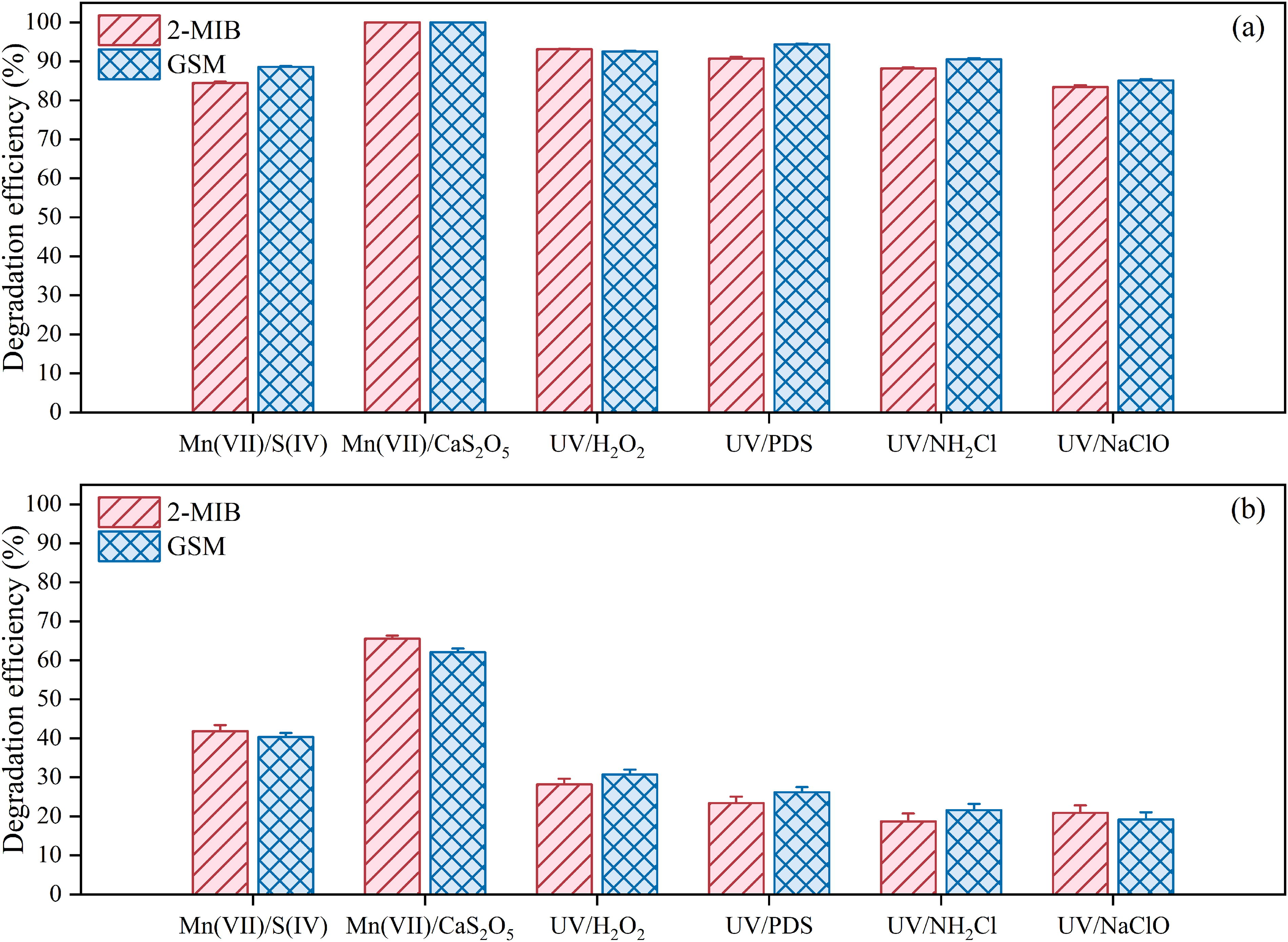
Comparison of pollutants degradation in different AOPs in ultrapure water
Besides the properties of reactive species, Mn(VII)/CaS2O5 stood out among the AOPs for odor control in terms of the required land area, infrastructure cost, and operation condition. Degradation of 2-MIB and GSM could be achieved by simply dosing Mn(VII) and CaS2O5, thus the equipment, like the ultraviolet lamps which are essential for the UV-based AOPs, is needless. With the common investment in equipment of 45 − 75 $/t water for the UV/H2O2 process, 4.5 − 7.5 million dollars are needed for a drinking water plant with the treatment capacity of 100,000 tons of water per day. In addition, the efforts in equipment maintenance, as well as the land area for placing equipment, can be saved. To achieve higher abatement of pollutants, higher dosages of reagents were needed. For the Mn(VII)/CaS2O5 process, HSO3− was gradually released, and excessive CaS2O5 will not bring the considerable quenching effect. However, for the most commonly employed UV/H2O2 process (Tan et al., 2016), the quenching effects increased significantly with higher dosage of H2O2 (k = 2.7 × 10⁷ M−1 s−1 (Imoberdorf and Mohseni, 2011; Ouyang et al., 2023). Thus, for the water containing high concentration of odor compounds, the Mn(VII)/CaS2O5 process might be more viable.
The synergistic effect of Mn(VII)/CaS2O5 treatment and coagulation/sedimentation process
High levels of dissolved manganese in drinking water can pose health risks, and the U.S. Environmental Protection Agency set the allowable upper limit for Mn content at 0.05 mg/L. Therefore, it is necessary to remove residual manganese species after the Mn(VII)/CaS2O5 process. The manganese species after Mn(VII)/CaS2O5 process consisted of colloidal MnO2 and Mn(II). Due to its negative surface charge, colloidal MnO2 absorbs Mn(II), and since MnO2 can be easily removed from water through filtration or coagulation/sedimentation (Chen et al., 2020; Chen et al., 2021), the removal of Mn(II) likely occurs simultaneously.
Source water from the southwest of Shandong province, China, which faced odor pollution, was used for conducting the Mn(VII)/CaS2O5 and coagulation/sedimentation processes. The concentrations of 2-MIB and GSM were approximately 30 ng/L. Mn(VII), CaS2O5, and coagulant were added simultaneously into the water. As shown in Supplementary Fig. S12, the concentration of residual 2-MIB and GSM were below the minimum detection value after oxidation process. The concentration of Mn2+ after Mn(VII)/CaS2O5 treatment and coagulation/sedimentation is 0.0274 mg/L, well within the drinking water quality standard of 0.05 mg/L, as listed in Supplementary Table S6, demonstrating the feasibility of the Mn(VII)/CaS2O5 process for addressing odor issues in drinking water. Additionally, Ca2+ was introduced into the water, and SO42−, produced from HSO3− oxidation, combined with Ca2+ to form sparingly soluble CaSO4. After sedimentation, Ca2+ concentration fell below the detection limit. The total organic carbon (TOC) also decreased from 4.26 mg/L to 2.45 mg/L after treatment. The in-situ formed MnO2 colloid and CaSO4 solid might assist the coagulation process and thus enhance the performance for TOC removal (Chen et al., 2021; Sun et al., 2021; Wang et al., 2023; Zhou et al., 2022; Zhu et al., 2019). These results highlight the Mn(VII)/CaS2O5 process as a viable solution for addressing the odor issue in drinking water treatment.
Conclusions
In this study, the abatement of 2-MIB and GSM and the mechanism under various conditions were comprehensively investigated in Mn(VII)/S(IV) system. Results suggested that alkaline pH influenced the transformation and reactivity of RMnS. Coexisting substances, including DOM, HCO3−, and Cl−, inhibited the contribution of reactive species; compared with HO• and SO4•−, RMnS played a key role in terms of pollutants abatement. Excessive HSO3− interfered the radical chain reaction because of the quenching effect of HSO3− toward radicals and RMnS, inhibiting the contribution of reactive species to the degradation of pollutants. Particularly, CaS2O5 was proposed as a slow-releasing source of HSO3− for the optimization of Mn(VII)/S(IV) system, further improved the pollutant removal. The experimental results indicated that Mn(VII)/CaS2O5 system had excellent resistance to water quality and effectively removed pollutants in the natural water. Compared with UV/AOPs, Mn(VII)/CaS2O5 system had the advantages of less equipment investment, lower transformation cost, and convenient operation. After Mn(VII)/CaS2O5 process and coagulation/sedimentation treatment, Mn2+and Ca2+ residues in the effluent well met the Chinese Drinking Water Standard, and TOC was also reduced, which is due to the synergistic removal of substances by MnO2 colloid generated by Mn(VII)/CaS2O5 system and coagulation/sedimentation. This research provided a cost-effective, efficient, and easily implementable solution for the removal of odor compounds from drinking water.
Footnotes
Authors’ Contributions
X.Z.: Investigation, formal analysis, data curation, and writing—original draft. Z.H.: Supervision and resources. J.Z.: Supervision, resources, and funding acquisition. X.G.: Supervision and resources. B.S.: Conceptualization, supervision, project administration, and funding acquisition.
Author Disclosure Statement
The authors declare that they have no known competing financial interests or personal relationships that could have appeared to influence the work reported in this article.
Funding Information
This study was supported by the

References
Supplementary Material
Please find the following supplemental material available below.
For Open Access articles published under a Creative Commons License, all supplemental material carries the same license as the article it is associated with.
For non-Open Access articles published, all supplemental material carries a non-exclusive license, and permission requests for re-use of supplemental material or any part of supplemental material shall be sent directly to the copyright owner as specified in the copyright notice associated with the article.
