




Abstract
The pollution problems of manure and wastewater in large-scale pig farms are becoming more and more serious with the rapid development of the pig industry. Using straw featuring a large specific surface area as filter media for filtering pig farm wastewater can effectively reduce the concentrations of pollutants, such as pig feces, pig urine, and feed residues in the wastewater, alleviating the subsequent treatment burden. However, the remaining straw filter residues with pollutants and high moisture content lack further recycling approaches. Aerobic composting could be favorable for simultaneously processing the straw filter residues and the pig manure. However, nitrogen losses and harmful gas emissions through ammonia (NH3), nitrous oxide (N2O), and methane (CH4) volatilizations remain during aerobic composting due to the high ammonia-nitrogen content of swine manure and the anaerobic reactions occurring under insufficient aeration. The coaerobic composting characteristics of straw filter residues and pig manure were investigated by adding phosphorus and magnesium salts based on the mechanisms of magnesium ammonium phosphate precipitation. Although the additives decreased the temperature and shortened the high-temperature duration to some extent, the NH3, N2O, and CH4 emissions were significantly reduced during aerobic composting, realizing the efficient retention of nitrogen and reducing the emissions of harmful gases. Calcium dihydrogen phosphate [Ca(H2PO4)2] combined with magnesium sulfate (MgSO4) were optimal additives. Under the optimal conditions, the maximal temperature, duration over 50°C, and seed germination index reached 61.24°C, 15 days, and 95.21%. Meanwhile, the total organic carbon and total nitrogen losses and the NH3, N2O, and CH4 emissions were decreased by 1.55%, 21.65%, 69.83%, 33.18%, and 31.34% compared to the blank control without additives. Straw filtration of wastewater and then co-composting of straw filter residues and manure would be a competitive approach for intensive pig farms to dispose of solid–liquid mixed organic pollutants.

Introduction
The average annual output of agricultural straws, namely the dry stalks including stems and leaves of cereal plants remained after the grain and chaff have been separated, in China reaches 865 million metric tonnes, and more and more attention is dedicated to the timely and efficient recycling of straws (Zhang et al., 2021). Simultaneously, >600 million metric tonnes of pig manure and a large amount of pig farm wastewater are produced per year with the large-scale development of the pig industry in China (Shi and Hu, 2022; Liu et al., 2022), causing severe environmental pollution and disposal burden (Sun et al., 2021). Pig farm wastewater containing pig feces, pig urine, and feed residues is challenging to treat due to superabundant volume, high moisture, and high organic matter content. Agricultural straw has a large specific surface area and favorable interception and adsorption characteristics. Using straw as filter media for filtering pig farm wastewater can not only effectively reduce the concentrations of pollutants in the wastewater, alleviating the subsequent treatment burden, but also diversify the efficient utilization approach of straw, which is an economical and effective means to deal with waste by waste (Guan et al., 2021; Hu et al., 2022). Nevertheless, exploring how to recycle the straw filter residues with pollutants and high moisture content would be novel and compelling.
Aerobic composting is a favorable approach for intensive pig farms to simultaneously process the straw filter residues after filtering pig farm wastewater and the pig manure, and the composting product is an excellent soil conditioner (Wattiaux et al., 2019). The straw filter residues can not only increase the oxygen exposure of compost feedstocks as a bulking agent but also regulate the carbon-to-nitrogen (C/N) ratio as an organic conditioner, improving the metabolism of microorganisms during aerobic composting (Wang et al., 2017). However, the volatilization losses of ammonia (NH3) and nitrous oxide (N2O) generally account for 20–60% and 9.9% of the total loss amount of nitrogen during traditional composting (Li et al., 2020). Meanwhile, anaerobic reactions often occur to produce methane (CH4) under insufficient aeration (Castanheira et al., 2010), leading to secondary environmental pollution. Therefore, reducing nitrogen loss through NH3 and N2O emissions will be practical and critical for improving the aerobic composting quality of straw filter residues and pig manure.
The related approaches for reducing the loss of nitrogen and the emissions of NH3 and N2O in the composting process fall into three categories: (1) the addition of adsorbents that can increase the porosity of feedstocks based on physical adsorption mechanisms, such as biochar and zeolite, thereby improving microbial activity and aeration potential (Mao et al., 2019). For example, the NH3 emissions were reduced by 30% and 44% during the composting of chicken manure and wheat straw with biochar additions of 5% and 10% (Janczak et al., 2017). The NH3 and N2O emissions were decreased by 28% and 55% by adding zeolite of 10% in the composting of chicken manure and straw (Wang et al., 2024a). (2) Physical barriers or encapsulation technologies for improving process control. The NH3 and methane (CH4) emissions were reduced by 7.34% and 91.23% through membrane cover technology (Wang et al., 2024b). The combined means of semipermeable membrane covering and intermittent ventilation reduced greenhouse gas emissions by 70.76% during the composting of cow manure (Fang et al., 2021). (3) Employment of chemical reagents, such as aluminum sulfate [Al2(SO4)3], ferric chloride (FeCl3), calcium sulfate (CaSO4), phosphorus salts, and magnesium salts, to convert ammonium nitrogen (NH4+-N) from the liquid phase to the solid phase and reduce the concentration of NH4+-N in the compost pile, thereby reducing NH3 emissions (Ren et al., 2010). Among them, the magnesium ammonium phosphate precipitation (MAP) is considered one of the most effective ways, which realizes the coexistence of magnesium ions (Mg2+), phosphate ions (PO43−), and ammonium ions (NH4+) under alkaline conditions (pH 7.0–9.0) by adding the same molar ratio of phosphorus salts and magnesium salts (Wang et al., 2013). The MAP crystallization (guano stone), a high-quality slow-release fertilizer, is generated when the concentrations of the Mg2+, PO43−, and NH4+ exceed the solubility of insoluble electrolytes, and the reaction is as follows:
The PO43− is usually appended as orthophosphate or phosphate, and the Mg2+ is commonly introduced by adding magnesium sulfate (MgSO4), magnesium oxide (MgO), and magnesium hydroxide [Mg(OH)2]. For example, Lin et al. (2017) added potassium dihydrogen phosphate (KH2PO4), MgSO4, and potassium sulfate (K2SO4) into the composting pile of cow dung and rice bran and found that NH3 volatilization was reduced, and MgSO4 was more effective in nitrogen retention than K2SO4. Ren et al. (2010) reduced the total nitrogen (TN) loss from 35% to 1% during the composting of swine manure by supplementing Mg(OH)2 and phosphoric acid (H3PO4). However, Luo et al. (2012) and Wu et al. (2020) found that the addition of calcium dihydrogen phosphate [Ca(H2PO4)2] reduced the rate of temperature rise during the composting. Li et al. (2011) reported that although both KH2PO4 and dibasic potassium phosphate (K2HPO4) could reduce the emissions of NH3 during the composting of kitchen waste under the addition of MgSO4, K3PO4 increased the NH3 loss. Jiang et al. (2016) reported that the NH3 emissions could be reduced by 59.08% during the composting of swine manure and corn stover by adding Ca(H2PO4)2 and MgSO4, while the N2O emissions could not be decreased. Yang et al. (2015) and Lei et al. (2021) found that phosphogypsum decreased the emissions of NH3 but increased the emissions of N2O during the composting of kitchen waste and swine manure. Therefore, the nitrogen retention effect of the MAP method on the composting process varied depending on different feedstocks, composting conditions, reagents, etc. The moisture and NH4+-N contents of the straw filter residues would be higher than those of raw dry straw because straw could absorb water and expand but also adsorb a certain amount of NH4+-N in the straw filtration of pig wastewater process. However, the co-composting characteristics of straw filter residues and pig manure and the effect of the MAP approach on their nitrogen retention remain unclear. In addition, sulfate-reducing bacteria in the presence of sulfate can inhibit the activity of methanogenic bacteria and reduce the rate of CH4 production by competing for electron donors and producing inhibitory metabolites, such as sulfides (Ren et al., 2025). Therefore, MgSO4, KH2PO4, Ca(H2PO4)2, and H3PO4 were employed as the sources of Mg2+ and PO43− in this study to investigate the effects of the MAP method on the rise of temperature, the conversions of carbon and nitrogen, and the emissions of greenhouse gas and odor during the composting of straw filter residues and pig manure. The information obtained in this study will provide the basis for the aerobic composting process of straw filter residues and pig manure and contribute to the simultaneous recycling of pig farm wastewater and pig manure at intensive pig farms.
Materials and Methods
Feedstocks
The air-dried corn straw obtained from the experimental field (45°42′N, 126°46′E) at Northeast Agricultural University in Harbin, China, in late October 2022, was ground to 1–3 cm using a cutting mill (JFSD-100-Ⅱ, Shanghai Jiading Agri-Industries Instrument Co., Ltd., Shanghai, China) and stored in a sealed plastic bag at 20–22°C. The moisture, total organic carbon (TOC), and TN contents and the C/N ratio of corn straw were 12.01 ± 0.38%, 435.12 ± 9.26 g/kg, 6.29 ± 0.02 g/kg, and 69.18, respectively. The TN and total suspended solids contents and the chemical oxygen demand (COD) of the pig wastewater from the Guangming pig farm (45°75′N, 126°81′E) in Harbin, China, were 1250.81 ± 10.13, 4950.99 ± 4.11, and 8650.01 ± 6.56 mg/L, respectively. The moisture, TOC, and TN contents and the C/N ratio of pig manure from the same pig farm were 55.05 ± 1.01%, 242.40 ± 2.88 g/kg, 16.50 ± 0.11 g/kg, and 14.69, respectively. The corn straw was loaded into a transparent Plexiglas column (inner diameter of 9.0 cm, length of 50.0 cm, and wall thickness of 0.5 cm) and compacted with a density of 0.15 g/cm3 and a height of 40 cm. The bottom mouth of the Plexiglas column was sealed using three layers of medical gauze to avoid corn straw runoff. The pig wastewater was passed through the corn straw filter layer from top to bottom, relying on gravity. The moisture, TOC, and TN contents and the C/N ratio of straw filter residues after filtration were 67.97 ± 1.13%, 435.10 ± 5.66 g/kg, 6.60 ± 0.09 g/kg, and 65.92, respectively.
Aerobic composting of straw filter residues and pig manure
The aerobic composting reactor was a sealable cylindrical barrel made of polypropylene with a total volume of 80 L, a total height of 750 mm, a thickness of 2.5 mm, and inner diameters of the upper and lower ports of 550 and 400 mm, as shown in Figure 1. The reactor and ventilation pipeline were insulated using 10 mm aluminum foil thermal insulation cotton (part 9 in Fig. 1) to reduce heat loss. The inner diameters of the air inlet and outlet ports for aeration were 20 mm. The air pumped into the reactor from the bottom using the air pump (part 1 in Fig. 1) was forcibly ventilated by flowing sequentially through the airflow meter (part 3 in Fig. 1) and composting pile and then discharged to the outside through the exhaust port (part 6 in Fig. 1) on the roof cap (part 7 in Fig. 1). An initial C/N ratio of 25–35 is generally suitable for aerobic composting (Wu, 2017), and the higher the initial C/N ratio, the lower the nitrogen loss rate during composting based on a previous study by our research team (Wang et al., 2022). Although the nitrogen content of the straw filter residues could be slightly increased after filtration compared to that of raw corn straw, their carbon content (435.10 ± 5.66 g/kg) and C/N ratio (65.92) were high enough to use as the sole carbon source for the composting process in this study. Therefore, the initial C/N ratio, moisture content, duration, and the continuously forced ventilation rate were 35, 65%, 30 days, and 0.2 m3/h, respectively. The initial total weight of straw filter residues (20.38 kg), pig manure (8.84 kg), and moisture (0.78 kg) with a mass ratio of straw filter residues to pig manure of 1.64:1 (dry basis) was 30 kg in each composting reactor. The ambient room temperature was 11.03–24.32°C during aerobic composting experiments implemented in September. Jeong and Hwang (2005) reported that the additional amount of phosphorus and magnesium salts accounting for 20% of the TN content was optimal. Considering that the straw filter residues themselves can adsorb a certain amount of NH4+-N and reduce NH3 volatilization losses, three designs [KH2PO4+ MgSO4 (B1), Ca(H2PO4)2 + MgSO4 (B2), and H3PO4 + MgSO4 (B3)] were investigated comparatively in this study and the additional amount of phosphoric acid, phosphate salts, and magnesium salts were 15% of the initial nitrogen content. The aerobic composting of straw filter residues and pig manure under the same conditions but without additives was used as a control (CK).
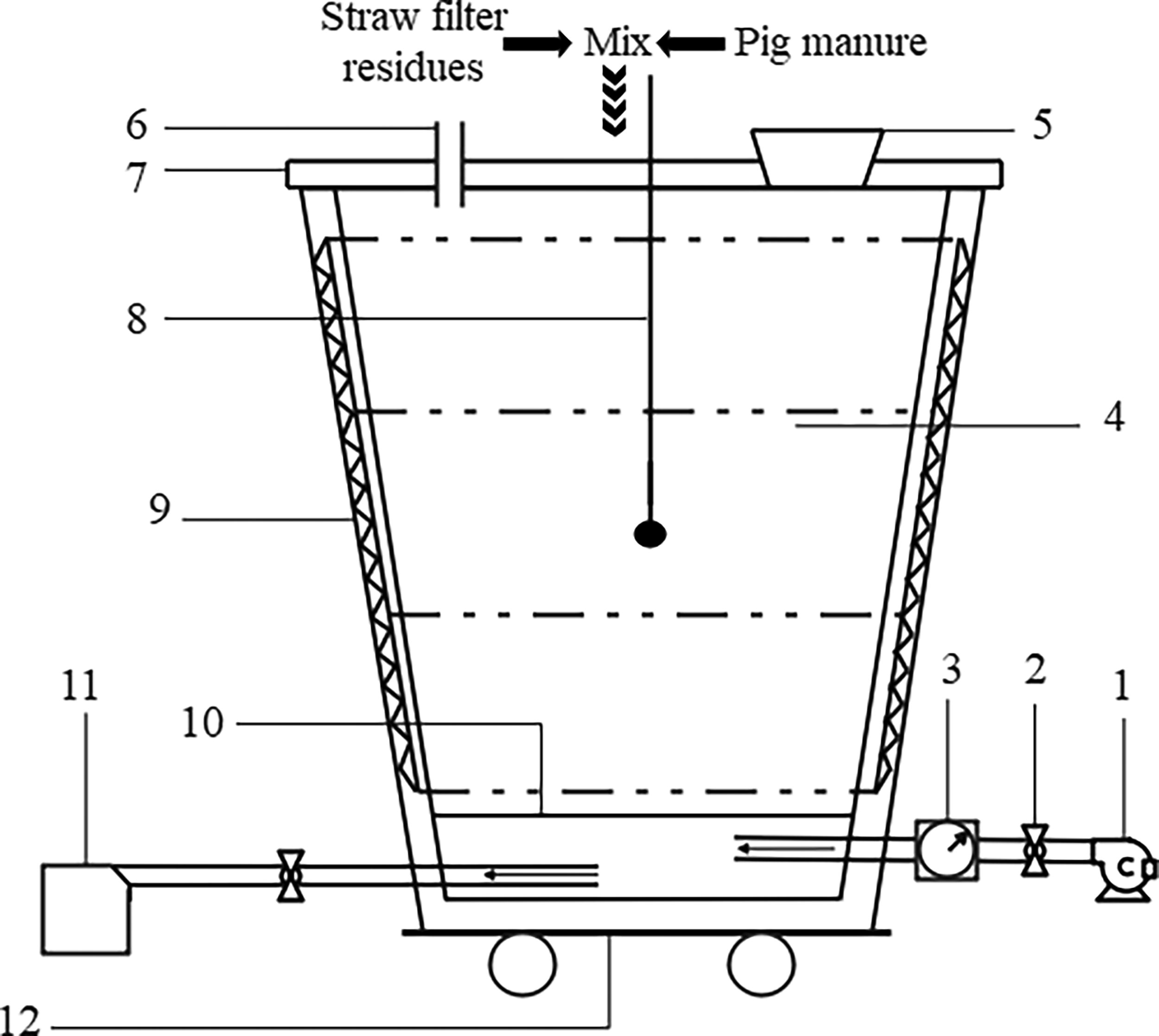
Schematic diagram of aerobic composting device. 1. Air pump. 2. Throttle valve. 3. Air flow meter. 4. Composting reactor. 5. Feedstocks entry. 6. Exhaust port. 7. Roof cap. 8. Temperature sensor. 9. Heat insulator. 10. Dividing panel. 11. Leachate collector. 12. Roller carrier.
Analytical methods
The real-time temperature of the composting pile was monitored using a temperature sensor with a test accuracy of ±0.5°C (part 8 in Fig. 1) (GJD-200LED, Zhengxu Electronic Technology Co, Ltd, Hengshui, China), and the highest daily temperature was recorded for temperature rise analysis. The laboratory temperature was determined using a high-precision electronic thermometer (XMT-00-8, People Electric Company, Zhejiang, China). The exhaust gas discharged from the composting pile was collected using a gas collection bag that was replaced once a day. The NH3, N2O, CH4, and carbon dioxide (CO2) contents in exhaust gas were determined once per day using a gas chromatograph (GC-6890 N, Agilent Inc., Santa Clara, CA, USA). 30 g of compost samples were taken every 3 days for physicochemical analysis. The pH value was measured using a thunder magnetic pH meter (PHS-25, Shanghai INESA Scientific Instrument Co, Ltd, Shanghai, China) with a 1:2.5 ratio of fresh compost sample to distilled water. The contents of NH4+-N and nitrate nitrogen (NO3−-N) were determined using a continuous flow analyzer (SAN++, SKALAR Analytical Instruments Company, The Netherlands). The seed germination index (GI) of the compost sample was determined as follows (Bernal et al., 2009; Li et al., 2012).
First, 5 mL of the compost sample extract solution was dropped onto the two layers of filter paper in a sterile petri dish after pH value determination. Second, ten cabbage seeds were evenly distributed on the filter paper and then incubated at 20°C with no light for 48 h, and then the number of germinated seeds and the average root length were determined (Gao et al., 2021). The compost sample extract solution was replaced with distilled water in the incubation process as a control, and the calculation of GI value was as follows:
TOC content was determined using an organic carbon analyzer (Vario TOC, Elementar Trading Co, Ltd, Shanghai, China). TN content was determined using a Kjeldahl nitrogen analyzer (Haineng K9860, Haineng Instruments Co, Ltd, Jinan, China). The calculation of TOC and TN loss rates was as follows:
Statistical analyses
The data reported in this study were the averages from triplicated experiments. Statistical analyses employed SPSS 25.0 (International Business Machines Corporation, Armonk, NY, USA.
Results and Discussion
Effects of additives on the aerobic composting characteristics of straw filter residues and pig manure
The temperature, pH value, and GI value variations during the aerobic composting of straw filter residues and pig manure are in Figure 2.

Effects of additives on the temperature rise, pH, and GI (seed germination index) during the aerobic composting of straw filter residues and pig manure.
The temperature of the composting pile first increased with the increase in composting duration, then steadily decreased with the gradual depletion of organic matter, as shown in Figure 2a. The perishable organic matter was consumed preferentially by microorganisms, releasing a large amount of heat, and the temperature of the composting pile rose quickly. CK, B1, B2, and B3 began to enter a high-temperature period (>50°C) on days 3, 3, 5, and 6, respectively, and maintained for 21, 16, 15, and 10 days, respectively. The highest temperatures of CK, B1, B2, and B3 reached 65.91, 64.74, 61.24, and 58.35°C, respectively, thereby the weed seeds and pathogenic microorganisms could be effectively inactivated (Li et al., 2014). In addition, the additives decreased the temperatures of the composting pile and the durations of high-temperature phases, which elucidated that the microorganisms might be inhibited. Jiang et al. (2016), Luo et al. (2012), and Wu et al. (2020) also found similar temperature reductions by adding phosphorus and magnesium salts to the composting processes. Lee et al. (2009) reported that the decomposition rate of organic matter was possibly slowed when the addition ratio of the phosphorus salts and magnesium salts exceeded 5% of TN content. Luo et al. (2012) obtained that the high-temperature period began to occur on days 6, 15, and 15 under Ca(H2PO4)2 addition ratios of 6.6%, 9.9%, and 13.2%, respectively, during the composting of corn stover and swine manure at the ambient temperatures (18–23°C) similar to those of this study, which were later than the 3–6 days required to reach the high-temperature period in this study. In comparison, physical adsorption additives generally could increase the temperature of the composting pile. Mao et al. (2019) found that the peak temperatures during the composting of pig manure and sawdust at the ambient temperature of about 20°C could be increased to 67.8, 65.0, 67.8, and 65.5°C under adding medical stone, zeolite, bamboo biochar, and wood vinegar, respectively, and the high-temperature periods above 50°C lasted for 12, 11, 8, and 11 days. Therefore, although the MAP method of simultaneously adding phosphorus and magnesium salts impacted the temperatures, the co-composting of straw filter residues and pig manure remained favorable. In addition, B3 was the least desirable, and its highest temperature did not reach 60°C but still could meet the requirements of composting harmlessness (Li et al., 2014). A possible reason for this phenomenon is that the addition of H3PO4 lowered the pH value and increased the accumulation of volatile fatty acids (VFAs) and NH4+ in the early composting process, thereby decreasing the degradation rate of organic matter and the temperature rise rate of the composting pile (Sellami et al., 2008; Wong et al., 2009).
Generally, a too-high or too-low pH value can cause protein denaturation and inhibit microbial activity, interfering with the NH3 emissions and nitrogen conversion during composting (Qiu et al., 2021). As shown in Figure 2b, the pH values of CK, B1, B2, and B3 first increased as the increase of time significantly (p < 0.01), reached the maxima (8.27, 8.39, 8.32, and 7.62), and then gradually decreased to be stable except B3 showed an increased tendency again after 12 days. The organic acids from the decomposition process of organic matter and the organic nitrogen were consumed synchronously by active microorganisms to produce NH4+ and hydroxide ions (OH−) as the temperature increased at the beginning of composting, thereby increasing the pH value (Gao et al., 2021). Subsequently, the pH value showed a gradual downward trend as the weakening of organic nitrogen ammonification and the volatilization loss of NH3 and CO2, as well as the increase of hydrogen ions (H+) during nitrification of nitrifying and nitrogen-fixing bacteria (Wu et al., 2020). It might also be because the Mg2+ in the magnesium salt reacted with PO43− and NH4+ to generate MAP crystals, which immobilized the Mg2+ and NH4+ but released the sulfite ions (SO32−) or sulfate ions (SO42−), lowering the pH value (Lin et al., 2017). The pH value of B3 during the composting was lower than those of other samples because of the addition of H3PO4 (Shi et al., 2011). The pH values at the end of composting for 36 days were 8.14, 8.24, 8.18, and 7.75 for CK, B1, B2, and B3, respectively, meeting the standard pH range (8.0–9.0) for composting except for B3. Jiang et al. (2016) added phosphorus and magnesium salts to the composting of corn straw and pig manure and also obtained that pH fluctuations were small in the late composting stage. The pH value can impact the precipitation process of MAP by affecting the ion morphology, solubility products, and chemical reaction balance, and the optimal pH value generally ranges from 7.5 to 9.0 (Shan et al., 2021). Therefore, the pH value fluctuations in this study had fewer effects on the generation of MAP.
In addition, a compost product is nontoxic on crops if its GI value exceeds 80% (Chang et al., 2017). As shown in Figure 2c, a significant increase in GI value was observed (p < 0.01) with the gradual depletion of organic acids and the inactivation of pathogenic microorganisms under high-temperature conditions. The GI values of CK, B1, B2, and B3 at the end of composting for 36 days reached 81.03%, 99.21%, 95.21%, and 72.32%, respectively. Although the peak temperatures of B1 and B2 were lower than that of CK, their GI values were considerably higher than CK’s (p < 0.05) by 18.18% and 14.18% at the end of composting, respectively. The maximal GI value (79.85%) obtained by Yin (2019) through the composting of maize stover and cow manure at room temperature (20–35°C) for 36 days was slightly lower than that of CK in this study (81.03%). Lin et al. (2017) found that the GI values decreased significantly to only 52.06 − 76.23% under adding KH2PO4 alone or in combination with K2SO4 or magnesium-containing waste residues during the composting of cow dung and rice bran and proposed that the GI value could be inhibited when the NH4+-N content was >5 g/kg. Therefore, the aerobic composting of straw filter residues and pig manure was practically favorable, and the MAP method significantly further promoted the composting effect.
Effects of additives on the composition of aerobic compost
Aerobic composting is mainly a mineralization and humification process of organic matter containing carbon and nitrogen. The carbon and nitrogen variations during the composting were in Figures 3 and 4.

Effects of additives on the TOC (total organic carbon) content during the aerobic composting of straw filter residues and pig manure.
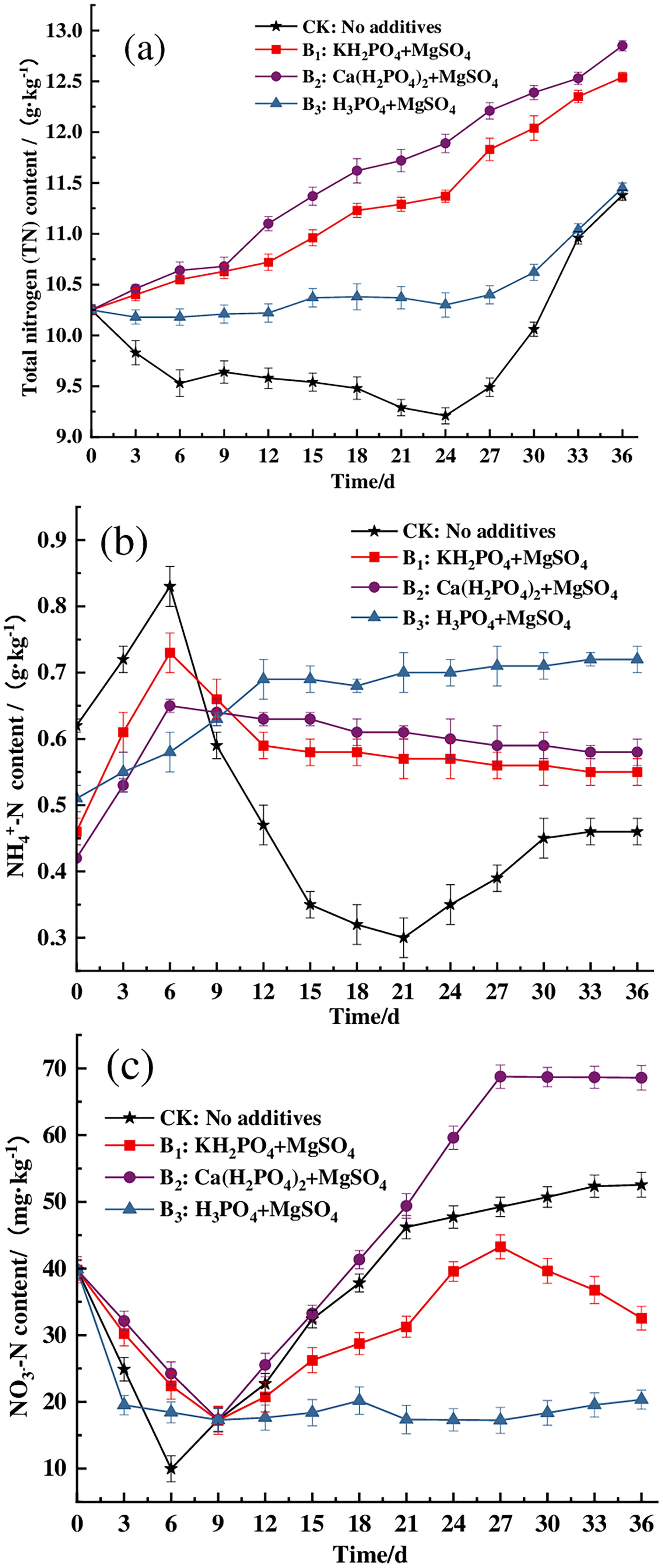
Effects of additives on the nitrogen content during the aerobic composting of straw filter residues and pig manure.
As shown in Figure 3, the TOC contents of CK, B1, B2, and B3 decreased rapidly over time from an initial 364.02 g/kg and then gradually stabilized to 188.75, 226.93, 212.75, and 251.03 g/kg, respectively, at the end of composting. After day 6, the TOC content of CK was significantly lower than those of B1, B2, and B3 (p < 0.05), and B3 showed almost no variation. Therefore, the additives reduced the mineralization rate of organic carbon, which matched the above temperature variations. Jiang et al. (2016) obtained similar TOC variations to those in this study by adding H3PO4 and MgO to the composting process of maize straw and pig manure. The total amount of TOC in the composting pile decreased along with the gradual degradation of organic matter as the composting continued. The TOC loss efficiencies of B1, B2, and B3 during the composting for 36 days reached 53.51%, 57.08%, and 44.37% and were lower than that (57.98%) of CK by 7.71%, 1.55%, 23.47%, respectively.
As shown in Figure 4a, the TN content of CK showed a decreased tendency in the first 24 days except for a slight upward fluctuation between day 6 and day 9 mainly and then increased rapidly after 24 d as the increase of time. In comparison, B3 barely fluctuated in the first 24 days, while B1 and B2 continued to rise during the composting (p < 0.01). The TN contents of CK, B1, B2, and B3 reached 11.385, 12.545, 12.855, and 11.450 g/kg at 36 d. The additives increased the TN content during the composting. Although the TN content increased at the end of composting, the total amount of TN in the composting pile reduced because the total volume and dry mass of the compost pile decreased along with the gradual dissipation of NH3, N2O, and inorganic salts produced during the degradation of organic matters. The actual TN loss efficiencies of 8.76%, 7.89%, and 9.88% were for B1, B2, and B3 and lower than that (10.07%) of CK by 13.01%, 21.65%, and 1.89%, respectively, which were comparable with the maximal reduction of TN loss (21%) obtained by Janczak et al. (2017) through adding biochar to the composting of poultry manure and wheat straw.
As shown in Figure 4b, the NH4+-N contents of CK, B1, B2, and B3 first rapidly increased because of the mineralization of organic nitrogen. The NH4+-N content of CK decreased quickly after 6 d because not only aerobic microorganisms need to consume the NH4+-N for their growth, but also the NH4+-N could be converted to gaseous NH3 under the conditions of high temperature and high pH (Zhang et al., 2018), while began to rise again after 21 d with the decrease of microbial activity and temperature. Although the maximal NH4+-N contents of B1, B2, and B3 were slightly lower than that of CK, their NH4+-N contents fluctuated little from the 12th day and were significantly higher than CK’s (p < 0.01), which indicated that the NH4+-N could be effectively retained in the composting pile because the microbial activities and the temperatures of B1, B2, and B3 with additives were decreased compared to CK except the NH4+-N could be transferred from the liquid phase to the solid phase by the actions of Mg2+ and PO43− (Lin et al., 2017). The NH4+-N content of B3 showed a relatively slowly increased trend in the first 12 days due to the lower pH value under the addition of H3PO4 but noteworthily higher than those of B1 and B2 after 12 days, which matched the lower GI value of B3 [(Figure 2c) and further demonstrated that the excessively high NH4+-N levels were detrimental to the increase of GI value during composting. The NH4+-N contents of CK, B1, B2, and B3 were 0.46, 0.55, 0.58, and 0.72 g/kg at the end of composting for 36 days and were decreased by 40.74% and increased by 19.57%, 27.59%, and 29.17%, respectively, compared to the initial NH4+-N content at the beginning of composting.
As shown in Figure 4c, the NO3−-N contents of CK, B1, B2, and B3 first decreased rapidly at the initial stage of composting because the nitrite and nitrifying bacteria could be constrained under high temperature and high NH3 concentration and then increased again except B3 hardly variated after 3 days. CK and B2 tended to be stable after 33 d and 27 d, respectively, while B1 decreased again after 27 d. The NO3−-N contents of CK, B1, B2, and B3 reached 52.55, 32.54, 68.59, and 20.34 mg/kg, respectively, at 36 d, and were increased by 31.8% and 64.8% for CK and B2, respectively, and decreased by 18.2% and 48.97% for B1 and B3, respectively, compared to the initial NO3−-N contents at the beginning of composting. The NO3−-N content of B2 was significantly higher than those of other samples (p < 0.05). Therefore, B2 was most favorable for nitrifying bacteria to regain activity and showed the best retention effect on NO3−-N. Although the lower temperature under B3 theoretically could promote the proliferation of nitrifying bacteria, enhancing the conversion of NH3 (Chen et al., 2023), the lower pH conditions under adding H3PO4 hindered the composting process. Consequently, the NO3−-N holding capacity of B3 was weakened compared to CK, B1, and B2. Meanwhile, the NH4+-N and NO3−-N contents of B3 fluctuated less after day 12 and day 3, respectively, due to the higher emissions of NH3 and N2O (Fig. 5 and Fig. 6).

Effects of additives on the emissions of greenhouse gases during the aerobic composting of straw filter residues and pig manure.

Effects of additives on the NH3 (ammonia) emission during the aerobic composting of straw filter residues and pig manure.
Effect of additives on greenhouse gas and odor emissions from aerobic composting
The effects of additives on CH4, CO2, N2O, and NH3 emissions during composting are shown in Figures 5 and 6.
The greenhouse gases produced during composting mainly contain CH4, CO2, and N2O, wherein the CH4 emission generally occurs under the conditions of anaerobic reaction. As shown in Figure 5a, the CH4 discharged mainly in the first 9 days. The daily CH4 emission amount first increased rapidly with the prolonging of time, reached the maximum on the 3rd day, and then decreased. The cumulative CH4 emissions of B1, B2, and B3 were 33.49, 31.46, and 23.81 g during the composting for 36 days and lower than that of CK (45.82 g) by 26.91%, 31.34%, and 48.04%, respectively. The CH4 emissions of CK, B1, B2, and B3 in the first 9 days accounted for 85.49%, 78.44%, 75.14%, and 67.79% of the 36-day total emissions, respectively. The maximum peaks of CH4 emission were CK, B1, B2, and B3 in descending order. Therefore, the additives significantly decreased the CH4 emission (p < 0.05) because the sulfate-reducing bacteria inhibited the methanogenic bacteria under anaerobic conditions when sulfate-reducing bacteria and methanogenic bacteria used the same carbon source (Hao et al., 2005). Therefore, the MAP method of adding phosphorus and magnesium salts could effectively reduce CH4 emissions but was still not as effective as the membrane-covering technology in reducing CH4 emissions. Wang et al. (2024b) reduced the CH4 emission by 91.23% by combining membrane-covering method with microbial agents. Fang et al. (2021) combined the semipermeable membrane covering with intermittent ventilation and reduced CH4 emission by 99.89% during composting.
As shown in Figure 5b, the daily CO2 emissions of CK, B1, B2, and B3 were not significantly different and increased similarly to the maximum on the 3rd day, and then gradually decreased and finally approached zero. The cumulative CO2 emissions during the composting for 36 days were 1112.70, 1217.48, 1171.01, and 1270.70 g for CK, B1, B2, and B3, respectively. Therefore, the CO2 emissions that mainly occurred in the temperature-rise period were significantly related to the temperature of the composting pile (p < 0.01). However, the difficultly degradable organic matter gradually became the carbon source of composting microorganisms after the easily degradable organic matter decomposed as the composting reaction progressed, and the microbial activity gradually weakened, thereby the CO2 emission rate gradually decreased and stabilized (Wang et al., 2013).
The nitrifying bacteria on the surface of composting can produce N2O under a relatively low temperature and sufficient oxygen (Chowdhury et al., 2014), and the incomplete denitrification process also generates N2O. The local anaerobic reaction occurred inside the composting pile at the early stage of composting because of low temperature and high moisture content, and the nitrifying and denitrifying bacteria produced N2O. The nitrifying bacteria could die in large numbers or go dormant when the temperature exceeds 50°C, inhibiting N2O production and significantly lowering the N2O emission (Chen et al., 2023). Therefore, the N2O emissions mainly occurred in the stages of temperature rise and high-temperature maintenance and showed a rapid increase followed by a rapid decrease and remained stable after 18 days, as shown in Figure 5c. The N2O emissions resembled the rise and fall of NO3−-N contents. The accumulative N2O emissions of B1, B2, and B3 during the composting for 36 days reached 5.52, 4.23, and 5.88 g, which were lower than that (6.33 g) of CK by 12.80%, 33.18%, and 7.11%, respectively, indicating the additives could effectively reduce the N2O emissions. The maximal daily N2O emission peak and the accumulative N2O emission amount of B2 were significantly lower than those of other samples (p < 0.05), and there was no significant difference in the N2O emissions of CK, B1, and B3. The reduction rate of N2O emission under B2 in this study exceeded the average results (21.59% and 16.27%) obtained by Shan et al. (2021) through analyzing literature on composting with microbial additives and chemical additives (acid chemicals and struvite crystallization) but lower than the average result (50.30%) using physical additives (Shan et al., 2021).
In addition, the NH3 emissions are the critical odor source in the composting process and seriously pollute the environment around the composting area. As shown in Figure 6, almost all the NH3 was produced in the first 21 days, and the daily NH3 emission showed a trend of rapid increase and then rapid decrease. The organic nitrogen was transformed into NH4+-N or NH3 under the action of a deaminase at the early stage of composting, and the NH4+-N was easy to volatilize as molecular NH3 under the conditions of high temperature and high pH value. The maximal peak of daily NH3 emissions occurred on day 6, and the accumulative NH3 emissions for 36 days (30.56, 22.44, and 46.40 g) of B1, B2, and B3 were significantly lower than that of CK (74.39 g) by 58.92%, 69.83%, and 37.63%, respectively. Shan et al. (2021) reported that the approach of acid chemicals and MAP crystallization could significantly reduce NH3 emissions during composting, and the mean reduction rate of NH3 could reach 51.33% but insignificantly affected N2O emissions. However, the average emission reduction rate of NH3 during composting with physical additives could reach only 38.55% (Shan et al., 2021). Therefore, the MAP method for reducing NH3 emissions during composting was favorable.
In conclusion, although the MAP method promoted CO2 emissions to some extent in the aerobic composting process of straw filter residue and pig manure, the CH4, N2O, and NH3 emissions were significantly decreased, realizing the efficient retention of nitrogen and the emission reductions of harmful gases through MAP crystallization production in the composting process. The greenhouse gas and odor emissions mainly occurred in the early phase of composting. Under B2, although the CH4 emission amount was slightly higher than that under CK, the NH3 and N2O emissions were the lowest compared to CK, B1, and B3. Therefore, simultaneously adding Ca(H2PO4)2 and MgSO4 under B2 was the most effective approach for nitrogen retention compared to B1 and B3.
Conclusions
Straw filtration of pig farm wastewater and co-composting of straw filter residues and pig manure was feasible. The MAP method of simultaneously adding phosphorus and magnesium salts was favorable for improving aerobic composting characteristics and nitrogen retention capacities. Although the temperatures and high-temperature durations of the composting pile with additives were slightly reduced, the NH3, N2O, and CH4 emissions mainly occurring in the early phase of composting could be significantly reduced. Mixedly adding Ca(H2PO4)2 and MgSO4 was optimum compared to other mixed additions of KH2PO4 and MgSO4 or H3PO4 and MgSO4. H3PO4 was the least desirable additive. The highest temperature under the conditions of adding H3PO4 and MgSO4 did not reach 60°C but still met the requirements of composting harmlessness. Under the optimal conditions, the maximal temperature, duration over 50°C, and GI value reached 61.24°C, 15 days, and 95.21%. Meanwhile, the TOC and TN losses and the NH3, N2O, and CH4 emissions were decreased by 1.55%, 21.65%, 69.83%, 33.18%, and 31.34%, respectively. Straw filtration of pig farm wastewater followed by aerobic composting of straw filter residues and pig manure would be a promising approach for intensive pig farms to simultaneously process pig farm wastewater and pig manure, promoting environmental improvements on pig farms.
Footnotes
Authors’ Contributions
L.W.: Conceptualization, funding acquisition, and review and editing. Z.W.: Formal analysis and writing—original draft. L.X.: Investigation and methodology. J.Z.: Data curation.
Data Availability Statement
Data will be made available on request.
Author Disclosure Statement
No potential conflict of interest was reported by the authors.
Funding Information
This work was funded by the Joint Key Program of the Natural Science Foundation of Heilongjiang Province, China (Project No: ZL2024E002), the Key R&D Program of Heilongjiang Province, China (Project No: GA21C024) and the National Natural Science Foundation of China (Project Nos: U21A20162 and 51406032).