




Abstract
Environmental engineering is a dynamic and growing field that addresses some of the most important work in science and engineering—protecting the Earth’s resources, ensuring the safety of water and air, and devising strategies for humans to thrive in the face of a changing climate. Publications in this field have shifted from concerns of polluted cities and hazardous wastes in the mid-20th century to today’s challenges of provision of water supplies across the globe, innovation in sustainable energy, urban resilience to heat and storms, and informed strategies for environmental policy. Through excellence in teaching and research, members of the Association of Environmental Engineering and Science Professors (AEESP) are addressing these grand challenges. The official journal of AEESP is Environmental Engineering Science, published by Mary Ann Liebert, Inc. It is an important venue for the publication of cutting-edge research, state-of-the-art educational approaches, workshop outcomes, and prevailing views about the environment in a societal and policy context. This year marks 28 years of the journal in its current configuration, since Dr. Domenico Grasso became the Editor-in-Chief. This year also marks a transition of the Editor-in-Chief from Dr. Catherine Peters to Dr. Ramana Gadhamshetty. Through a review of selected publications that highlight member contributions, this article contains Dr. Peters’ perspective on the journal’s trajectory, commitment to publication excellence, and service to the AEESP community.
A Retrospective View
It has been an honor to serve as the Editor-in-Chief of Environmental Engineering Science (EES) since 2019 and before that as the Deputy Editor since 2014. The EES journal serves the Association of Environmental Engineering and Science Professors (AEESP) by publishing high-impact articles in the field, spanning discovery-based scientific research to innovation-based technological advancements. The iconic cover image has been a steadfast reminder of the historical and ongoing importance of the field of environmental engineering and science (Fig. 1). My work was in partnership with several EES associate editors (Fig. 2), most recently Drs. Baolin Deng, Ramana Gadhamshetty, and Angela Harris. This year, I will step down as Editor-in-Chief, and Dr. Gadhamshetty is stepping into that role.
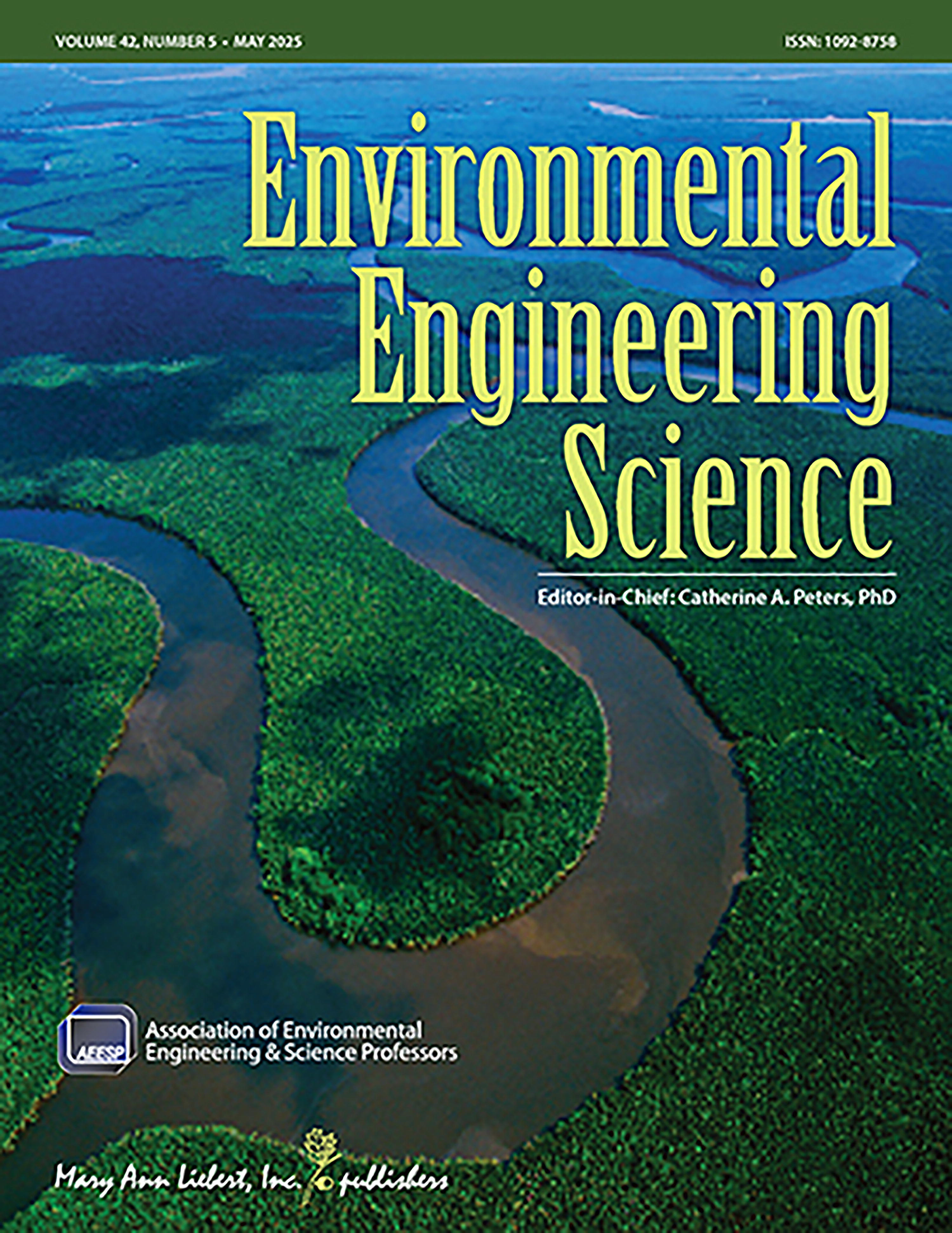
The iconic cover of the Environmental Engineering Science journal.
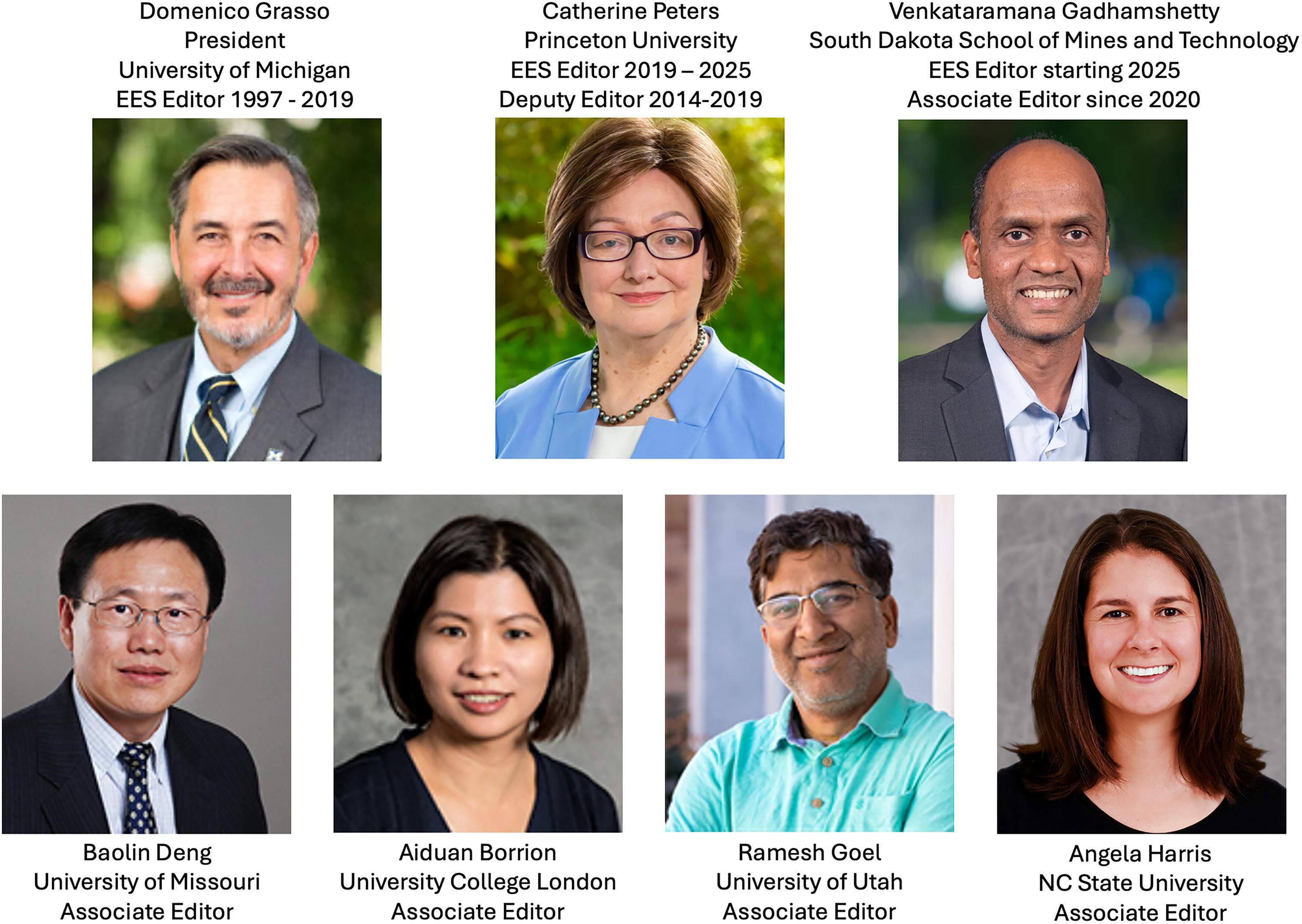
Past, current, and incoming Editors-in-Chief of the EES journal. Also shown are associate editors I have worked with in recent years.
In 2012, Mary Ann Liebert, Inc. (publisher) and the AEESP established a partnership, and the EES journal became the official journal of the association. As AEESP President in 2011–2012, Dr. Joel Burken established an ad hoc committee and conducted a survey to assess the pending partnership, culminating with a majority of the AEESP membership supporting the affiliation. The historical path to the affiliation and its implications for AEESP were outlined in a letter from AEESP presidents (Weavers and Trotz, 2019). That letter emphasized the importance of the ongoing board review of the ways that the journal is serving the entire AEESP community.
For decades, the EES journal has published cutting-edge research concerning pollution that threatens air, water, and soil, as well as remediation and treatment, which protect the Earth’s resources and human health. This journal was started in 1983 as “Hazardous Waste & Hazardous Materials,” which were important topics for the field of environmental engineering at the time. In 1997, editorial leadership transitioned to Dr. Domenico Grasso who envisioned a broader scope, and he changed the name to “Environmental Engineering Science” in 1998. Dr. Grasso went on to become President of AEESP in 2001–2002 and in that role he planted the seeds for EES to become the official journal of AEESP. As detailed in a recent tribute article (Gadhamshetty et al., 2025), Dr. Grasso has just been appointed as the President of the University of Michigan.
In partnership with the editorial team, we expanded the breadth of the EES journal to include curbing climate change and creating healthy resilient cities, following the National Academies of Sciences, Engineering and Medicine report on grand challenges in environmental engineering for the 21st century (NASEM, 2019). This report was produced by the National Academies Committee on Grand Challenges and Opportunities for Environmental Engineering for the 21st Century, which was chaired by Dr. Grasso. Prior to the NASEM report, the AEESP community had begun to shift priorities and grapple with the emerging grand challenges. Dr. Jim Mihelcic and his team identified the grand challenge of achieving sustainability in global developing regions (Mihelcic et al., 2017). Dr. Lee Blaney and other leaders in the field used comprehensive data analytics to report on gender, race, and ethnic diversity in environmental engineering and the critical significance of diversity in our ability to tackle today’s grand challenges (Blaney et al., 2018).
In 2019, we published “Reflections on Connections Needed to Meet Grand Challenges of Environmental Engineering” by Dr. Maya Trotz who was the AEESP President at the time (Trotz, 2019). In that article, Dr. Trotz called on AEESP members to put our work in context with historical, socioeconomic, and political frameworks and to strive to create sustainable communities that support equitable and just societies.
Special Issues Make Their Mark
AEESP members are invited to be guest editors in leading EES special issues. In recent years, the special issue topics have substantially broadened the journal’s scope. The special issues since my time on the editorial team are shown in Table 1. Notably, in the 2023 special issue edited by Dr. Susan Masten (Masten et al., 2023), we honored the passing of leaders: Drs. Edward (Ed) Bouwer (1955–2019), Michael (Mike) Aitken (1956–2020), James (Jim) J. Morgan (1932–2020), Deborah (Deb) Swackhamer (1954–2021), and Philip (Phil) Singer (1942–2020). All five were accomplished researchers and dedicated mentors, teachers, and colleagues in the field of environmental engineering. The special issue was a tribute to these pioneers, who established new paths of research scholarship, conducted groundbreaking scientific discovery, advanced technological innovation, wrote definitive textbooks, and influenced environmental policy and the protection of public health.
Special Issues in Environmental Engineering Science Since 2016
We sometimes publish special issues on topics at the forefront of the field, in which the number of environmental engineering researchers is not yet large. For example, the special issue on reactive transport modeling for addressing water and energy challenges was designed to highlight emerging research strategies and methods (Deng et al., 2021). Another notable example is the special issue on mitigating climate change using sustainable energy technologies (Clarens and Peters, 2016), in which the lead article was an explicit “call to action” for environmental engineers to play a leadership role in advancing climate change mitigation technologies at the carbon–water nexus.
Serving the AEESP Community
A wonderful outcome of the partnership between AEESP and Mary Ann Liebert, Inc. is the sponsorship of an award for publication excellence, conferred for the first time in 2018. The annual award recognizes authors of an outstanding EES article that addresses an important research question, is significant and original, is well written, is substantial in scope, and makes a consequential advancement in the field. Table 2 lists the winning authors and articles since the inception of the award. Not surprisingly, these articles have emerged as some of our most highly cited and downloaded articles.
Winners of the AEESP/Mary Ann Liebert Award for Publication Excellence in Environmental Engineering Science, Since the Inception of This Award
The partnership led to a solid working relationship between the EES editors and the AEESP Publications Committee. This committee now has the job of generating the “spotlight” articles three times per year. The spotlights draw attention to selected EES articles, thereby helping AEESP achieve its mission of developing and disseminating knowledge in environmental engineering and science. The chairs of the Publications Committee that I have had the pleasure of working with are Dr. Susan Masten (Michigan State University), Dr. Mark Krzmarzick (Oklahoma State University), and Dr. David Ladner (Clemson University).
Soon after the start of the partnership between AEESP and Mary Ann Liebert, Inc., the AEESP Board surveyed the membership (Weavers and Trotz, 2019). The survey findings revealed that AEESP members would like the EES journal to publish more articles on education as well as articles documenting AEESP conferences, workshops, and professional initiatives from standing committees and ad hoc groups. Recent examples of such articles are shown in Table 3. These articles draw a lot of interest as indicated by high download counts. (For this type of article, number of downloads is often in the thousands and may be a better measure of impact than metrics based on citations).
Examples of EES Articles That Showcase Innovations in Education, Novel Student Course Projects, AEESP Professional Initiatives, Documentation of AEESP Conferences, and Summaries of Workshops
AEESP Letters, Commentaries, and Opinions
In 2019, we started publishing the letters of the AEESP Presidents, three times per year. Often, the first letter contains the new president’s vision and aspirations, the second letter updates progress and challenges, and the third letter summarizes accomplishments and lessons learned. Notably, Dr. Joel Ducoste, who was president in 2021, wrote about the challenges facing professors during the COVID pandemic, which required universal virtual teaching and distance learning, and he wrote about the coordinated efforts of the AEESP community in sharing best practices for online teaching and pedagogy (Ducoste, 2021a).
We also publish many excellent analyses, commentaries, opinions, and perspectives. A frequent contributor is Dr. Dan Oerther who has written insightful pieces on teaching in the virtual classroom (Daniel B. Oerther and Peters, 2020; D.B. Oerther and Peters, 2020), as well as perspectives on the value of an education in environmental engineering to address the world’s most challenging problems in human and planetary health (Oerther et al., 2024). Dr. Oerther is the Executive Director of the American Academy of Environmental Engineers and Scientists, and his EES contributions have illustrated the connections of AEESP with AAEES and other relevant organizations.
Parting Thoughts
I cannot imagine a more important time to adhere to high standards of excellence in scholarly publication. Universities are facing extraordinary scrutiny of how we admit students, how we educate students, how we conduct campus operations, and what topics we select for scholarly research. For more than a century, higher education and research scholarship have been a part of the contract that universities have had with America to benefit national and global communities, and yet the value of scholarly output is being questioned. As professors, through scholarly publication, we play an important role in gaining public trust and in protecting academic freedom. We must strictly adhere to codes of ethics in the conduct of research, publish research findings in a timely fashion, and communicate clearly to a broad audience. In addition, researchers must engage deeply in the peer review process, which ensures publication integrity and the advancement of our entire field. When you receive invitations to review articles, keep in mind the heuristic: for every article you publish, you have an obligation to review three articles.
AEESP members must be unstoppable in their education and research scholarship, as well as professional service and engagement, to serve our multiple constituencies. At this challenging time, let us draw from the lessons we learned 5 years ago when we came together as a community to sustain excellence in the face of the global pandemic that changed not only the way we do things but it also changed us and our students in profound ways. These lessons were best summarized by Dr. Joel Ducoste at the end of his presidency: “At the end of the day, what we have learned through this pandemic is that life is precious, personal well-being and interactions with others are critically important, encouragement, mentorship, listening to others, empathy, reducing implicit (explicit or unconscious) bias footprint, and along the way, having fun must be a part of our everyday life experiences. We are all here to support each other through life’s uncertain and yet beautiful experiences.” (Ducoste, 2021b).
I offer my most sincere best wishes to Dr. Gadhamshetty as he assumes control of this important journal, which I view as the equivalent of a “Fabergé Egg” because it is so precious. I have utmost confidence as he takes on the editorship. He will move EES to new frontiers including the bridge to public policy as well as applications of AI and data science. He will also work to keep EES relevant and continue to serve the AEESP community in multiple ways.
To all the associate editors, I have had the pleasure of working with: Thank you for your dedication and commitment to excellence—your work, often done on weekends and late in the evening, is enormously important. Finally, I want to thank the Mary Ann Liebert, Inc. staff whose hard work has supported the EES journal and ensured its success over the years. Those who have my warmest regards and greatest appreciation are Vicki Cohn, Cathia Falvey, Jamie Devereaux, Jennifer Kuhn, Abby Cook Dommer, and Dawn Densmore-Parent.
Footnotes
Author Disclosure Statement
No interests to disclose.
Funding Information
No funding was received for this article.