




Abstract
Abstract
There is a rich political science literature on the relationship between election administration and voter turnout but it is largely based on studies of U.S. elections. Innovations with election administration by the United Kingdom’s New Labour government allow researchers to see whether U.S. findings travel. These short-term experiments and permanent reforms have been criticized for encouraging electoral fraud and undermining confidence in the democratic process (Wilks-Heeg, 2009); being led by motivations of party statecraft (James, 2010a); or being a false substitute for real democratic reform (Hay and Stoker, 2009: 226). There is much to these claims, and drawing lessons from the pilots is difficult because of poor experimental design. However, the innovations suggest that election administration can affect U.K. turnout. The effects of all-postal and individual registration appear to be particularly significant. Election administration is therefore an overlooked variable in non-U.S. literatures on electoral participation and is worthy of further investigation by researchers and policymakers.
Introduction
Political science is thus brimming with a rich literature which maps the relationship between administrative procedures and voter turnout. However, most of this research retains a U.S. bias, and election administration is rarely studied in other countries (James, 2010b). This is understandable. Innovations, such as those described in Michigan, are not normally possible overseas since election administration is usually determined by the central state. Researchers cannot therefore investigate the consequences of internal state variations.3 However, the U.K.'s New Labour government introduced a range of “experiments” to election administration from 2000 to 2007 that allows researchers to investigate whether changing election procedures can affect turnout in the United Kingdom too. Mirroring the rhetoric of American innovators, nearly forty years ago, British politicians sought to introduce changes that would make voting easier. These included permanent changes such as universal postal voting on demand,4 continuous rather than annual registration, and individual registration5 (in Northern Ireland). A range of pilots took place at individual elections involving procedures such as short message service (SMS) voting, Internet voting, or extended hours of polling. Such reforms were unprecedented in the United Kingdom since procedures had changed very little during the twentieth century.
It is now a suitable time to revisit what impact these changes have had on participation in British elections. This article draws from local and strategic evaluations by the U.K. Electoral Commission, reports from local authorities, and research by independent academics to provide an overall assessment of what can be learned, if anything, about the causes of non-participation in elections from the Labour government's reforms. The article argues that poor experimental design makes solid inferences difficult, but there is some evidence that election administration affects levels of participation in ways not fully appreciated in the existing British literature. The research findings broadly mirror those from the U.S. literature, suggesting some degree of external validity. This provides a reason to test the effects of variations in election administration in non-Anglo-American settings.
This article begins by recalling the broad contours of British literature on electoral turnout, before outlining the Labour government's reforms. Each of the changes is then evaluated in turn, and presented on a continuum according to their effects on turnout.
British Explanations of Voter Turnout
When New Labour took office in 1997, declining turnout at the ballot box was already a distinct trend in post-war British politics, and this decline did not abate. At the 2001 general election, only 59.4% of the electorate participated. This was the lowest turnout since the full franchise was established in 1918. In the 1950 election, for example, 83.9% of the electorate participated (Rallings and Thrasher, 2006: 89–92). Turnout in European, Scottish Parliamentary, Welsh Assembly, and local elections has been much lower. Some 58.2% of people voted in the first elections for the Scottish Parliament in 1999; 46.4% voted in the Welsh Assembly election (ibid., p. 210). However, subsequent turnouts in these devolved bodies were lower still. From 1979 to 1999, turnout in the European elections ranged from 24.0% to 36.8% (ibid., p. 179). Only 33.2% voted in the local elections the year before New Labour came to power (ibid., p. 215).6 These troubling statistics have caused much public concern about British democracy and spawned many studies into non-participation.
One broad approach to understanding turnout has been to focus on the individual characteristics of non-voters through surveys. Studies by Crewe, Alt, and Fox (1977) and Swaddle and Heath (1989) focused on the role of variables such as socio-economic background, age, educational attainment, residential mobility, and housing tenure. Miller (1988) reported that a sense of psychological involvement in politics and the strength of an individual's party identification were also positively correlated with voting. Lower turnout is often reported among minority ethnic and religious groups (Ali and Percival, 1993; Saggar, 1998), although the size and concentration of these communities may affect participation levels within them (Cutts et al., 2007; Fieldhouse and Cutts, 2007; 2008). Low electoral participation among young people has caused some studies to propose measures to increase their engagement in politics (Russell et al., 2002; Tonge, 2009).
Some scholars have stressed the importance of broader social and cultural changes in Britain. There has been much sympathy with Inglehart's (1990) thesis that a post-material culture is developing, with citizens now more interested in issues of identity and lifestyle. It is frequently suggested that there has been a decline and/or fragmentation of class politics and trade union membership (Curtice and Seyd, 2003). Citizen engagement has become increasingly issue-led rather than ideologically driven. This has encouraged a rise in non-electoral forms of participation such as petition signing or public demonstrations. In their Citizen Audit conducted in 2000 and 2001, Charles Pattie et al. noted that three-quarters of those interviewed had attempted to “influence rules, laws or policies” in some way during the previous year. The average person had attempted to do so three times. Electoral participation may have declined, but perhaps political participation more broadly defined has not (Pattie et al., 2003).
The nature of the party system, political parties, and electoral competition also affect turnout. Starting in 1994, the Labour Party shifted to the political center and achieved electoral dominance from 1997–2005. A study of the 2001 election suggested that most voters had little incentive to vote because they saw few differences between the two main parties (Clarke et al., 2004). The perceived marginality of an election is also significant. Recent declines in turnout at general elections should not therefore surprise us: 1997, 2001, and to a lesser extent 2005 were predicted to be safe Labour victories (Heath and Taylor, 1999; Pattie and Johnston, 2001).
Hay and Stoker claim that declining participation stems from a series of institutional changes made to the British state: “Elected representatives seem both committed to, and enthusiastic about, subcontracting collective decision-making to non-elected agencies and institutions” (Hay and Stoker, 2009: 228). At the domestic level, the British government was reorganized to make a greater use of QUANGOs7 to deliver many aspects of public services and to make public policy decisions. For example, under New Labour, the power to set interest rates was hived off to the Bank of England, and minimum wages to the Low Pay Commission. The expanding powers of the European Union and prioritization of the alleged imperatives of globalization have encroached upon the policy discretion of national politicians (Hay, 2007). According to Hay and Stoker (2009), such policies constitute “anti-politics.” If politicians were bolder about what they can and should do, citizen engagement could be reignited.
The importance that the electorate attaches to an election is important. Local and European elections are often seen as being less important than national elections and therefore traditionally attract lower turnouts. Holding many elections on the same day is one strategy to increase turnout in lower-order elections (Rallings and Thrasher, 1997: 50–51). At the local level, factors such as the structure of local government, frequency of elections, authority size, and ward characteristics (e.g., level of local party activity, marginality, and socio-economic character) have all been argued to be significant determinants of local election turnout (Rallings and Thrasher, 1997: 51–60). Within London, for example, turnout was found to be higher in more affluent regions. Authorities with higher levels of unemployment, social housing, and an overcrowded housing stock were more likely to generate lower turnouts (Rallings and Thrasher, 1994).
There is a limited literature on the effects of electoral institutions on turnout. One of the longstanding arguments for a more proportional electoral system at Westminster has been that it could increase turnout by offering greater voter choice (Linton and Southcott, 1998). However, little research has directly investigated whether election administration affects turnout. One exception is Taylor's (1973) study of whether the distance an elector had to travel to a polling station affected their propensity to vote. However, unlike the United States, where the various states conduct their elections differently, thus allowing researchers to compare the effects of different procedures, Britain has had one model for election administration that has largely remained constant.
Those studies that have looked at New Labour's reforms to election administration have been very critical. For Hay and Stoker (2009: 226), the reforms were a “gimmick” and a substitute for real democratic reform. James (2010a) suggests that they were motivated by political statecraft rather than a desire to improve democracy. A more common criticism is that the reforms have facilitated electoral fraud. For example, Wilks-Heeg (2008, 2009) suggested that the introduction of postal voting on demand and all-postal elections made U.K. elections more vulnerable to large-scale fraud. According to him, the U.K. system of household registration enables the head of household to add bogus names to the register. Misconduct is easier with postal voting because it does not require the elector to visit the polling station in person. Meanwhile, postal voting has been argued to violate the principle of the secret ballot because electors cast their vote in a location unregulated by the state (such as at home or in the workplace). Other individuals or organizations could therefore exert an influence on electors' votes (Birch and Watt, 2004; Wilks-Heeg, 2008). One international monitoring team concluded that the system is open to “childishly simple” fraud (Council of Europe, 2008).
The election in the city of Birmingham, U.K., in 2004 illustrated the potential for fraud and attracted significant media attention. Here, the judge ruled that possibly well over 2,000 votes were bogus in the Bordesley Green ward and another 1,000 votes in the Aston ward. These numbers were judged to have determined the outcome of the election. The judge ruled that three Labour respondents were present in the warehouse, completing blank ballot papers and/or altering or destroying those that did not contain votes for them.8 According to the judge:
I found that corrupt and illegal practices have extensively prevailed at the election of the authority for which the election was held, namely the Ward of Bordesley Green.… On the evidence before me it was reasonable to conclude that the Labour Party had engaged in a concerted campaign to use fraudulent postal votes in problematical or marginal Wards, particularly those where Muslim voters might vote against the Labour Party in protest against the Iraq war. (Mawrey, 2004: para 9–11)
Despite this oft-cited case, uncertainty remains about the actual level of fraud in the United Kingdom. Listing cases of prosecutions is only evidence of detected fraud. We know nothing of undetected fraud, especially where, prior to 2000, no significant media attention was paid to electoral procedures. As Alvarez et al. have framed the question:
[A]re fraud accusations like airplane crashes—infrequent but focusing events that we remember; or are accusations of fraud more like car accidents, events that occur frequently but where only the most dramatic make the news? (Alvarez et al., 2008: 10)
Some new methodologies have been put forward by scholars in the United States to estimate levels of fraud, but these have not been applied to the United Kingdom.9
The purpose of the present article is to assess the effects of the reforms on turnout rather than fraud. The British debate has so far been skewed toward the latter and some of the useful lessons for electoral participation have been overlooked. This article seeks to bring these lessons back into focus.
Reforming Election Administration: The United Kingdom Experience
Election administration had undergone few reforms before New Labour came to power in 1997, and the foundations of the system therefore largely dated back to the Secret Ballot Act of 1872.10 A range of social, technological, and political forces led to New Labour's reforms (James, 2010a). However, the argument that reforming election administration could lead to an increase in turnout was one of the key stated reasons by the Labour government ministers for their reform program, which began shortly after they took office. The Representation of the People Act 2000 allowed local authorities to undertake pilots to make voting easier by allowing citizens to cast their vote either by post, Internet, cell phone, telephone, electronic kiosks, or remote/mobile polling stations. Further pilots altered the times of elections, sometimes to whole weekends. In 2000, thirty-eight pilot schemes took place involving 3.5 million citizens; a further 2.5 million were part of the schemes in 2002, and 6.4 million in 2003. The 2000 Act also introduced postal voting on demand and rolling registration as permanent changes. All-postal election piloting was extended to European elections under the European, Parliamentary, and Local Elections Pilot Act 2004, involving a further 16.5 million people in the combined European and local elections that year. Pilots were again used in 2006 and 2007 (see Table 1). The government issued a consultation on weekend voting in June 2008 (Ministry of Justice, 2008) but decided against taking this forward since “the potential benefits [were] … outweighed by the lack of consensus” among participants in the consultation (Ministry of Justice, 2010: 23).
The cases of alleged fraud reported by the media, however, generated demands for anti-fraud provisions to be introduced in mainland Britain. The Electoral Commission, for one, became less supportive of the experimental procedures. In 2004, the Commission recommended that all-postal voting should not be pursued for use at U.K. statutory elections, since such voting did not have public confidence (Electoral Commission, 2004b). The government responded by stating that it was “not persuaded of the case for abandoning all-postal voting” and that it was important to keep the option available once some security safeguards had been introduced (Department of Constitutional Affairs, 2004: 4). The government later introduced the Electoral Administration Act 2006. This provided for new electoral fraud offenses, but resisted individual registration, which many suggested was an essential step toward improving confidence in elections. The government was initially highly resistant, fearing that it would discourage participation (James, 2010a). However, in 2009, the Political Parties and Election Act introduced individual registration on a voluntary basis for those wishing to register to vote after July 1, 2010. The Act also mandated the Electoral Commission to evaluate the impact of this change and required Parliament to consider whether it should be made compulsory after a review in 2014.
Different political imperatives brought about an additional legislative program for Northern Ireland. Concerns about electoral fraud initially took priority over participation. The Electoral Fraud (Northern Ireland) Act 2002 introduced individual registration, photographic identification, and a need to re-register annually. As will be shown below, these provisions led to a decline in the number of people on the electoral register. The government therefore introduced further measures to recover the lost registrants. The Electoral Registration (Northern Ireland) Act 2005 gave the government powers to reinstate some of those who failed to re-register. Meanwhile, the Northern Ireland (Miscellaneous Provisions) Act 2006 ended the annual canvass and replaced it with continuous registration—with a complete canvass needed only every ten years. Lastly, the Representation of the People (Northern Ireland) Regulations 2008 consolidated previous legislation and enacted further changes to make voting easier. The new regulations included measures allowing voters to register closer to polling day, extending the types of photographic identification that could be used at elections, and introduced provisions to facilitate the registration of young people. While the focus of reform in Britain switched from increasing participation to decreasing fraud, the trajectory in Northern Ireland was the opposite.
Changes were also made by New Labour to the governance of election administration. The Fifth Report Committee on Standards in Public Life (1998), which investigated the funding of political parties, recommended that an “independent and authoritative” Electoral Commission be established. The Political Parties, Elections, and Referendums Act 2000 mandated the creation of this commission, with functions relating to election administration as well as party finance. The Act required the Electoral Commission to provide reports on elections, gave it the freedom to produce reviews of various electoral procedures, and stipulated that it must undertake measures to promote voter participation. As a result, the Commission produced a range of reports on election administration, such as Voting for Change, which were generally seen as trying to lead policy development and propel reform.
However, the Commission was soon criticized for overexerting itself, trying to develop government policy on electoral practice. The Committee on Standards in Public Life (2007) criticized the broad-ranging remit of the Electoral Commission. It argued that the Commission should focus more narrowly on being a regulator of elections and leave policy development to the newly created Department of Constitutional Affairs,11 which had constructed its own Electoral Policy Division. The Electoral Commission subsequently became less proactive at trying to force policy change and became more proactive in trying to enforce performance standards.
Aspects Of Election Administration and Their Effect On Turnout
As summarized above, the United Kingdom has experimented with various election administration reforms since 2000. The effects of each of these reforms are discussed in turn.12
All-postal ballots
The strongest lesson from the pilots has been that having all-postal elections (i.e., removing the option for in-person voting) has a significant effect on voter turnout. All-postal ballots have been trialed in the United Kingdom in four sets of elections, and in every instance the evidence suggests that they can increase turnout significantly. In the first year of pilots (2000), all-postal voting took place in wards in seven local authorities, and turnout rose in every instance on the previous year, in most cases by at least 50% (Rallings and Thrasher, 2000: 16–24). The largest increase was in the Bensham ward of Gateshead, where turnout increased by 137.4%. In the remaining boroughs of Gateshead, where all-postal voting was not implemented, turnout rose by only 2.7% (Rallings and Thrasher, 2000: 18).
An additional thirteen all-postal elections were held in 2002 and the Electoral Commission again reported a universal increase in each case against the previous comparable election (Electoral Commission, 2002: 25). Its evaluation claimed that turnout doubled in South Tyneside and nearly doubled in Chorley, Gateshead, and the piloting wards in Crawley. The average turnout for all-postal elections was 47.5%, which was fifteen percentage points higher than the non-pilot elections (Electoral Commission, 2002: 25). A further thirty-two local authorities used all-postal voting in May 2003, with five multi-channel pilots13 also allowing postal voting as an option. Significant increases were again obtained, with the one exception of St. Edmundsbury, which was explained by the Electoral Commission as being due to a high number of uncontested wards (2003g: 24).
In some of the 2002 and 2003 pilots, postal voting was available for the second consecutive election. A notable finding was that turnout remained high in such cases. In Gateshead, for example, although turnout decreased from 57.3% to 54.7% between 2002 and 2003, this was still a significant increase from the 26.4% obtained in 1999 (Electoral Commission, 2003g: 24). After the 2003 pilots, the Electoral Commission therefore concluded:
[O]verall, our evaluation of the all-postal pilot schemes suggests that this approach is very effective in boosting participation rates at local elections—to an extent that was largely underestimated when the pilots process first began, and which appears to be sustainable. (2003g: 24)
The most widespread use of all-postal voting took place in 2004 in the combined European and local elections. There was an overall increase in turnout in all regions (except Northern Ireland), but as Table 2 shows, regions that held all-postal ballots had the most significant increase. Turnout rose by an average of twenty-one percentage points in English regions where all-postal elections were held (Electoral Commission, 2004a: 109).
Compiled from Electoral Commission, (2004a: 107).
Although all-postal ballots were not held after 2004, the U.K. pilots suggest that this practice can lead to a considerable increase in turnout. Rallings and Thrasher therefore concluded that they have an “unambiguous positive effect on turnout levels” (Rallings and Thrasher, 2007: 340).
Postal voting on demand
Perhaps the most significant permanent change was the introduction of postal voting on demand in 2000. This entitled every citizen to apply for a postal vote without having to fit predefined criteria, as had previously been the case. The deadline for applications was also extended by a week. However, in contrast to all-postal voting, citizens still had to apply for a postal ballot by ticking a box on their registration form and were not sent one automatically (Lardy, 2001: 23).
The system was first used in the 2000 local elections on a pilot basis in four local authorities. Rallings and Thrasher noted that in two of these, Amber Valley and Gloucester, turnout increased by more than a quarter compared to previous local elections (2000: 14). However, direct comparison was complicated by changes in the boundaries, considerable local media coverage, and in the case of Gloucester, the presence of a new polling station in a supermarket (ibid., pp. 9–15). In Eastleigh and Milton Keynes, comparisons were more difficult since the pilots covered the whole (or most) of the council area (ibid., pp. 10–13). Making inferences from the limited pilots is therefore difficult.
Significantly, however, the extension of postal voting was available at the 2001 and 2005 general elections, and there was a considerable increase in postal ballots, from 2.1% of the electorate in 1997 to 12.1% in 2005 (Table 3). Did postal voting lead to an increase in turnout at the general elections? Rallings and Thrasher (2005) suggested that one test would be to see whether greater increases in turnout occurred where there was a greater increase in postal-vote applications between 2001 and 2005. Table 4 reproduces their results (2005: 17), which show that, as postal voting increases, turnout slowly increases, but does level off. They concluded that no excuse postal voting “seems to have helped to add about one percentage point to overall participation” at the general election (2005: 17). Postal voting on demand therefore only appears to encourage voter turnout to a very limited extent.
Compiled from Howarth (1999: appendix n) and Rallings and Thrasher (2005: 13–14).
Source: Rallings and Thrasher (2005: 17).
Internet voting and other “multi-channel” innovations
The United Kingdom was initially seen as a world leader in the use of technology in election administration, with remote electronic voting mechanisms being the most advanced technological innovation. Internet voting, used in 2002, 2003, and 2007, allowed citizens to cast their vote from any personal computer with an Internet connection using personalized information provided on their polling card. The effects of Internet voting are difficult to identify because other electronic and non-electronic pilots were often run simultaneously. These included pilots that allowed the public to vote via cell phone (SMS), landline telephone, digital TV service, or electronic kiosks in public areas. These elections have therefore been referred to as “multi-channel elections.”
Table 5 summarizes the use of multi-channel methods in U.K. elections where postal voting was included as one of the options for the electorate using data compiled from local Electoral Commission reports.14 All of these pilots were in 2003. The proportions of the registered electorate that used each of the methods to cast their vote are given in the table. The table demonstrates that high turnouts were achieved of around 50%. These were mostly considerable increases on previous elections in these areas. The turnout of 47.4% in South Somerset compares favorably to that in 1999 (38%) and 1995 (42%) (Electoral Commission, 2003b: 18). Turnout also rose in the district of Shrewsbury and Atcham. Here it reached 54.8%, an increase on 41.2% in May 2002, and turnouts of approximately 35% between 1998 and 2001. However, the local report suggested that new electoral boundaries in 2002 increased interest in the election, and this may have caused some of the increase in participation (Electoral Commission, 2003e: 16). In South Tyneside, a decline in turnout was noted against the previous year's figure of 57.6%, when all-postal pilots had been run, but it was still a significant increase on turnout compared to the previous three elections, which had seen participation levels of below 30% (Electoral Commission, 2003f: 21). Likewise, Chorley saw a drop in turnout to 49.8% from 61.5% in 2002 when elections were also all-postal. This was still a sizable improvement on the 32% achieved in 2000, the last election in which pilots were not held (Electoral Commission, 2003d: 16).
The registered electorate and the number of votes cast by each method are compiled from the individual reports. Percentages are based on the author's calculations.
South Tyneside: Electoral Commission (2003f: 22) provides the total registered electorate and the total votes cast and by which method.
Chorley: Electoral Commission (2003d: 16) provides the total number of votes cast and by which method. It also provides a figure for the overall turnout, from which the author has calculated the total registered electorate.
Shrewsbury and Atcham: Electoral Commission (2003e: 16) provides the total votes cast and by which method. Ibid (p. 4) provides the registered electorate.
South Somerset: Electoral Commission (2003b: 18) provides the total registered electorate and the total votes cast and by which method. The report also gives a previous turnout of 38% for 1999.
However, in each case, postal votes accounted for the majority of the votes cast: Around 40% of the registered electorate used this method. In comparison, Shrewsbury and Atcham recorded the highest number of votes using one of the alternative methods. Some 6.2% of the electorate cast their vote via the Internet there. Given the limited number of pilots, conclusions must again be tentative. However, the pilots suggest that, given a choice of methods, voters generally prefer to cast their votes by mail.
Without all-postal voting as an option, how frequently were other mechanisms used? The take-up was higher. Table 6 details the use of each channel in the 2003 pilots (where the majority of multi-channel pilots were held). One trend is that, where postal ballots were not automatically provided, the utilization of the new electronic methods was higher. When postal ballots were sent out automatically, only 8.5% of votes were cast via the Internet; when postal ballots had to be requested, 15% of votes were cast via the Internet.
Adapted from Electoral Commission (2003g: 64).
Another pattern was that Internet voting was by far the most widely used method, with landline telephone voting the second most popular. In particular, Internet voting was frequently used in St. Albans, Sheffield, and Swindon. For example, in St. Albans nearly a quarter of votes were cast over the Internet in 2003 (Electoral Commission, 2003c: 20). The Electoral Commission's evaluation suggested that two important factors explained these comparatively high rates of Internet voting. Firstly, these pilots had used Internet voting before in 2002, which suggested that procedures might be more widely used once the public became used to them. Secondly, two of these pilots allowed Internet voting up to the close of polls (Electoral Commission, 2003g: 64). In the case of St. Albans, 57% of votes were cast on the traditional day of the election (Electoral Commission, 2003c: 20). Few voters were interested in casting their vote via SMS or digital TV. For example, the highest use of Internet voting was only 0.9% in Shrewsbury and Atcham (Electoral Commission, 2003e).
Generally, the schemes received positive feedback from citizens in Electoral Commission surveys. In 2003, Internet voting schemes received the highest ratings, with 94% rating it as easy to use and 98% as convenient. Telephone voting received the second highest rating, SMS third, and the kiosks the lowest. Internet voting was particularly praised for increasing convenience. Some 68% of users felt that it was safe from fraud (and 23% had no opinion), leaving only a limited proportion of users with concerns (Electoral Commission, 2003g: 66).
The surveys produced mixed evidence on whether it made a difference to turnout. One commissioned poll in 2003 found that approximately 68% of people were aware of the e-voting pilots but did not think that it would make a difference as to whether they would vote or not (MORI, 2003: 27). Some 31% suggested that it encouraged them to vote, with this figure being higher among the 18–34 age group (37%) than the 55 + age group (25%) (ibid., p. 29). Similar findings were reported by Henry (2003), who surveyed electors in Swindon using Internet voting in 2003. She found that only 17.7% of those voting with this method were first-time or infrequent voters. Her conclusion was that it was impossible to be certain that the pilot increased turnout, but that it seemed that most of those using the facility were regular voters anyway (ibid., p. 201). Thus, on balance, Internet voting and other remote electronic schemes appear to produce only a marginally positive effect on turnout. This effect may increase with more regular use and if Internet voting is always allowed until the close of the traditional poll. However, it is too early to tell on the basis of the experiments so far.
Voting times
Innovations with the hours of polling took place in 2000, 2002, 2006, and 2007. In some cases this involved extending the poll by only a couple of hours. In more extreme cases, this involved allowing citizens to cast their vote up to nine days before the election.15
Table 7 summarizes the percentage of the registered electorate who cast their vote early by year. Perhaps the most striking conclusion is that, at best, only a limited proportion of the electorate made use of early voting, on average only 1% of the electorate. The ranges suggest that as little as 0.2% voted early but that this rose to as much as 3.7% in one authority in 2000 (Watford) where an additional polling station was made available in a supermarket.
†(Rallings and Thrasher, 2000: 27).
◊Author's calculation based on Electoral Commission (2002: 56).
□Author's calculations based on data in the 2006 local evaluation reports: Broxbourne (p. 9 and p. 4), Gateshead (p. 15), Lewisham (p. 28), Newcastle (p. 15), Rushmoor (p. 16 and p. 5), Shrewsbury and Atcham (p. 16 and p. 5), South Tyneside (p. 15), and Sunderland (p. 15). Westminster and Newham are excluded from the calculations since they offered early voting only to military personnel and their families and people in care homes.
∘Author's calculations based on data in the 2007 local evaluation reports: Bedford (p. 18), Broxbourne (p. 13), Gateshead (p. 15), Sheffield (p. 24 and p. 7), and Sunderland (p. 16 and p. 6).
In many of the pilots, surveys were undertaken to ask early voters if the extended hours increased the chances that they would vote. In 2000, such surveys were undertaken in all local authorities by the local council (the Electoral Commission had not been set up at this point). In one authority (Stoke), 53% of early voters suggested that they would not have voted without the facility. However, 53% of early voters would equate to only 0.265% of the entire electorate at the time, and most other surveys in that year were not as positive (Rallings and Thrasher, 2000: 27). Later research made similar findings. A 2007 Electoral Commission survey reported that 74% of early voters thought that they would have voted anyway (Electoral Commission, 2007a). Thus, based on the limited pilots, extending the voting hours and facilities appeared to have only a marginally positive effect on turnout in local election pilots. One experiment took place with weekend voting in 2000 but turnout fell in this election. However, Rallings and Thrasher (2000: 30) suggested that that it was “reasonable to conclude that the Watford weekend voting experiment got lost in the coverage of the London Mayoral election,” which had taken place two days earlier. It is not therefore possible to make any inferences from this single pilot.
Other pilot schemes
In three pilots, all in 2000, mobile voting booths were deployed around the authority area to allow the public to vote in person. These were used by only a handful of voters (91, 652, and 414) and therefore had a negligible effect on overall turnout. However, they helped to increase participation amongst those in the residential homes that they visited (Rallings and Thrasher, 2000: 32–33). Some pilots introduced electronic voting which required the public to cast their vote at an electronic kiosk in the usual polling station instead of using traditional paper ballots. The Electoral Commission evaluations claimed that there was no evidence that these schemes had any impact on turnout (Electoral Commission, 2002; 2003g; 2006; 2007b; 2007c). Local evaluation reports generally reported positive feedback from the public. E-counting schemes were also piloted. These involved paper ballots being printed with a bar code to enable them to be electronically counted. In 2007, five local authorities ran this scheme, but three pilots' local authorities had to resort to a manual count because of technical problems. There was no noted effect on turnout (Electoral Commission, 2007d).
Rolling registration
A number of changes were also made to registration procedures. Prior to the Representation of the People Act 2000, citizens needed to apply by an annual cutoff date in order to be included on the electoral register. “Continuous” or “rolling” registration allowed citizens to register at any point in the year. Electoral Commission research in Northern Ireland suggested that rolling registration accounted for only 6,000 changes of address per year and that the annual canvass remained the main method for gathering the details of those who might move during the year. They noted similar trends in Britain. In Cardiff, for example, the local authority reported about 4,400 additions to the register but also 4,000 removals per month (Electoral Commission, 2005b: 56). Rolling registration therefore increased the accuracy of the register. It is difficult to estimate any effect on turnout. However, rolling registration may have boosted turnout since those registering after the old cutoff date would not otherwise have been able to vote.
Individual registration, the carry-forward and reinstatement
Changes made to election administration in Northern Ireland had the initial aim of increasing security, not turnout, but some valuable lessons could be learned about their impact on participation too. The Electoral Fraud (Northern Ireland) Act 2002 brought about a change from household to individual registration and required personal identifiers (such as a signature, date of birth, and national-insurance numbers) to be collected at registration. Photographic identification (passport, photographic driver's license, or a specially issued electoral identity card) would be required at the polling station. The Returning Officer was granted powers to check information with other government agencies. Thus, from 2002, registrants could be checked against the Department of Work and Pensions database by national-insurance number. Lastly, the “carry-forward” feature was also removed, meaning that individuals would have to re-register to vote each year.
Measuring the impact of the move to individual registration in Northern Ireland is difficult because of the number of simultaneous changes. However, it is clear that the new system had an impact on registration numbers. To maximize registration, the Electoral Officer for Northern Ireland (EONI) doubled the numbers of staff employed in the canvass. A significant amount of money was also invested into media campaigns, and a network of application centers were set up (Electoral Commission, 2003a: 24). Despite this, in December 2002, when the first canvass register was published using the new system, numbers on the register had declined from 1,192,136 to 1,072,346. This represented a net loss of 119,790 names, or approximately 10% of the electorate—and a registration rate of 86% (ibid., p. 29). Subsequent reports by PricewaterhouseCoopers (PwC) continued to chart further declines on the electoral register. The canvass in September 2003 included 1,097,558 names, and the register in September 2004 included 1,075,439—just 82% of the eligible population (Price-Waterhouse Coopers, 2006: 3–4). Some reports also suggested that the decline would have been greater had it not been for the simultaneous introduction of rolling registration, the effect of approaching elections in 2003, 2004, and 2005, and political parties putting considerable resources into ensuring that potential supporters were on the register, particularly in nationalist areas of Northern Ireland (Electoral Commission, 2005a: 2).
The Electoral Commission and Unionist politicians claimed that the decline represented the successful elimination of names that should not have appeared on the register because they were either fraudulent or inaccurate. An Electoral Commission report argued that:
[T]he December 2002 register in fact provides a much better indication of actual levels of non-registration than the old register. In short, the old register did not provide an accurate record of the percentage of adults on the register because it over inflated the numbers entitled to be registered. (Electoral Commission, 2003a: 41)
However, the Electoral Commission acknowledged that not all of the decline resulted from the elimination of fraud. Some political parties claimed that the increased bureaucracy was discouraging legitimate voters from registering (Electoral Commission, 2003a).
Individual registration was not the only procedure to have potentially affected turnout. The carry-forward meant that those people who did not re-register each year would remain on the register. However, this was eliminated as part of the Electoral Fraud (Northern Ireland) Act 2002. In evidence given to the Northern Ireland Affairs Select Committee, the EONI suggested that the removal of the carry-forward may have also contributed to the decline in the register. He estimated that 10% of households did not return the form each year, meaning that, under the new procedures, these were effectively excluded the following year (Electoral Commission, 2003a: 30). In response to declining registration rates, the government decided through the Electoral Registration (Northern Ireland) Act 2005 to reinstate those who had not registered themselves. The Act was used on two separate occasions. All those who failed to re-register in the 2004 annual canvass but whose names were on the September 1, 2004 register were included in the April 1, 2005 register. This boosted the register by approximately 70,000 electors. The increase in the register ranged from 9.9% of the electorate in Belfast North to 4.4% in Fermanagh and South Tyrone and was stronger in more urban constituencies (Electoral Commission, 2005a: 2–3). Reinstatement was used again later in 2005.
The number of simultaneous changes that were made in Northern Ireland makes it difficult to draw conclusions about the effect of any particular change. Nonetheless, the experience does suggest that implementing individual registration and removing the carry-forward can alter registration levels considerably. This will have a knock-on effect on the number of votes cast16 and warrants further comparative inquiry.
The Pilots In Retrospect: Assessing The Experiments
Having assessed the outcomes of the pilots undertaken in the United Kingdom, what conclusions can we make about the causes of electoral participation?
One conclusion is that the methodological research design for the “experiments” was less than ideal. Pilots were chosen on the basis of political and administrative willpower, the level of interest, and the financial position of local authorities rather than hard social-science principles of experimental design.17 Often, a number of changes were undertaken simultaneously, making it extremely difficult to locate the exact effects of different reforms. We are left struggling to find control cases to compare with the test cases. As noted above in the brief review of British electoral turnout, electoral participation is multi-causal. Many of the comparisons made in the Electoral Commission's reports are therefore mostly of turnout in the pilot authority against previous turnouts in that authority. However, changes in other variables will certainly also be determining ebbs and flows in participation, and these need to be factored in. Permanent changes, such as those made in Northern Ireland, are also difficult to evaluate because of the multitude of simultaneous changes.
In addition, as local evaluation reports note, the experiments were surrounded by considerable media publicity as authorities sought to maximize the turnout that the pilots brought. One cause for caution is that, if these procedures were put into permanent practice, would the increase in turnout be sustained? It could be argued that some of the pilots were a “placebo” because they created increased media coverage of the elections. This media coverage, not the experiments themselves, may have caused increases in turnout. Alternatively, if the new procedures became embedded, they could accrue a long-term increase in participation as citizens become more accustomed to the procedures. There is evidence that those regions that had previous experience with postal voting would be more likely to apply for a postal vote. For example, Rallings and Thrasher noted that postal-vote applications rose most in the 2005 general election in regions that had previously piloted all-postal elections. In the North East, postal voting accounted for 25.1% of valid votes in the 2005 general election (Rallings and Thrasher, 2005: 16).
Designing future U.K. (and overseas) pilots using social-science principles will allow better comparisons and conclusions to be made. Using the political science literature on the determinants of turnout surveyed earlier in this article, control cases (without a pilot) and test cases (with a pilot) could be identified. To control for other sources of change in turnout, it would be wise to choose two cases with the same political party in power at the local level, the same degrees of electoral marginality, the same demographic characteristics, the same levels of unemployment, the same average ward size, and the same local government structure.18 It would also be logical to focus experimentation in areas that previously had low turnout, as these are likely to be the main source of political concern. Using this improved quasi-experimental research design, the inferences made by policy makers and political scientists would substantially improve.
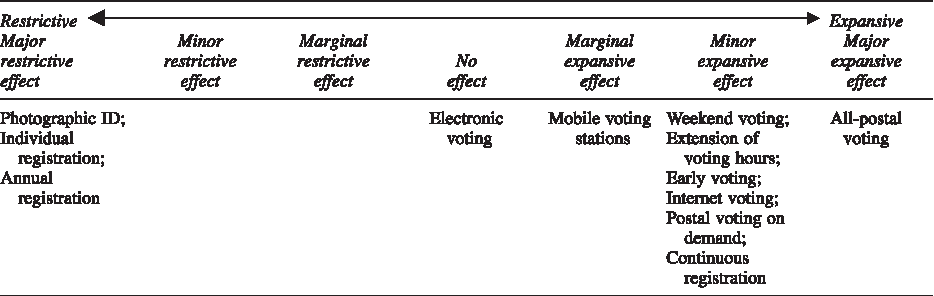
Despite these methodological reservations, the pilots and the permanent reforms do allow for some inferences to be made. While reforms to election administration certainly cannot reverse democratic malaise single-handedly, there is some evidence that they can affect turnout and, therefore, election administration is an important—and previously ignored, at least in the United Kingdom—factor in participation. This is most obvious with postal voting. It seems reasonably clear that all-postal voting has had a considerable positive impact on voter turnout, leading to a roughly fifteen percentage point increase in turnout in local elections. This supports the directionality of its effect, detailed in the U.S. literature (Magleby, 1987; Southwell, 2004; Southwell and Burchett, 2000). There appears to be some evidence from the pilots that early voting, extended hours, postal voting on demand, and Internet voting can have more meager but still positive effects on turnout, which also supports international research findings.19
In contrast, some changes to the registration system appear to have made a considerable negative impact on participation in Northern Ireland. Photographic identification, individual registration, and annual registration may have dampened participation by introducing new administrative barriers to registration.20 Interestingly, the impact of changing the registration system from household to individual registration has not been discussed by the international literature, as far as the author is aware, and this opens fresh lines of comparative inquiry and deserves further research. Finally, some procedures such as electronic counting, mobile voting stations, and continuous registration appear to have had no effect on turnout.
Table 8 summarizes the changes in turnout attributable to particular procedures based on the pilots conducted so far. Various forms of election administration are placed into one of seven categories. These range from those on the far left, which have a major restrictive effect that is likely to bring about a contraction in participation, to those on the far right, which have a large expansive effect likely to bring about an increase in participation.21 Given some of the methodological reservations noted, their positioning should be seen as tentative, and it is subject to amendment with further piloting and research. However, many of these findings have a broad congruence with the U.S. literature, which brings some external validity to the continuum.
Does the position of these election administration practices reflect the costs of voting arising from each? The premise of much of the existing literature on election administration and voter turnout has been the rational choice logic that procedures will affect participation because the costs of voting are raised or lowered. Clearly, some of those tentatively classified as restrictive procedures do appear to involve extra work for the citizen. Needing to provide photographic identification, being unable to rely on other members of the household to register on one's behalf, and having to re-register each year involve additional tasks that incur extra time. The marginal citizen might not therefore get around to voting. Likewise, it is plausible that some expansive provisions may involve lower costs. By allowing citizens to vote on the weekend and cast their ballot via the mail or through the Internet, they may find it easier to fit voting into their everyday lives.
However, it is unclear whether the effect of election administration on turnout is entirely due to cost. For example, in the case of the multi-channel elections, citizens seemed to prefer postal voting to Internet voting, SMS voting, or TV voting. Depending on how costs are measured and quantified, it does not seem obvious that postal voting involves fewer costs than the other methods. The voters would have to leave their homes to cast their vote, which they would not have to do with an electronic vote. It would seem reasonable that other factors such as trust in procedures and habits are also important.22 This needs to be considered when designing electoral procedures.
Conclusion: Election Administration Matters
There is a well-developed body of U.S. literature on the effects of election administration on voter turnout but it remains parochial. The innovations in the United Kingdom from 2000 to 2007 provide an opportunity to investigate the effects of reforming election administration in a different geographical context. The research design of the reforms makes it difficult to draw definitive conclusions on the relationships between procedures and turnout. It is by no means the case that election administration is the only factor affecting turnout—there have been dramatic changes in U.K. electoral participation during the twentieth century, but election administration has remained constant. However, a tentative observation is that all-postal voting can have a significant effect on voter turnout. Likewise, individual registration and photographic identification appear to reduce participation at the ballot box. The effects of using individual rather than household registration are largely unknown, and this warrants further investigation. The effect of other changes appears to be less significant or unclear. These administrative practices have been placed onto a continuum.23 This continuum reinforces the importance of institutional explanations of voter participation and suggests that such reforms should not be discarded as a “gimmick.” Rather, election administration should be treated as an important determinant of voter turnout in the United Kingdom, and scholars of electoral participation outside of the United States and United Kingdom should consider its importance there too.
What is the future of election administration in the United Kingdom? The new Conservative–Liberal Democrat coalition government looks likely to introduce more restrictive forms of election administration. The Conservative Party has long been critical of the government's experiments, blaming them for a loss of integrity in the voting process. Instead, they have supported individual registration, along with personal identifiers, suggesting that these could reduce fraud. The implementation of these changes across the United Kingdom would be a historic change in the way in which elections are organized. Based on the experience in Northern Ireland, they could bring about a considerable retraction of the electoral register unless offset by other measures. Such changes should therefore be closely studied not only by practitioners, but also by political scientists. Future election reforms in the United Kingdom could bring further lessons to the international literature on election administration and voter turnout.
Footnotes
1
“Election administration” is more commonly known as “electoral administration” in the UK, but the former term is used in this article.
2
For example, see: Harris (1934) or Kelley Junior et al. (1967).
3
Although, in Switzerland, cantons have also implemented postal voting at various times, which has facilitated analysis there. See: Luechinger et al. (2007).
4
Or “no-excuse” absentee voting, as it is known in the U.S.
5
Individual registration requires each citizen to complete their own form to be registered to vote. In contrast, household registration allows the “head of household” to complete a registration form for all those living at a given address.
6
That year (1996), local elections took place in England only.
7
QUANGOs are quasi-autonomous non-governmental organizations. See Greve et al. (2002) for a discussion about their definition and comparative form.
8
For a discussion of the case, see Stewart (2006).
9
For example, Alvarez and Katz (2008) suggest that, by comparing the predicted outcome against the actual outcome of a given election, officials could routinely scrutinize anomalies to locate cases worth investigating further. Meanwhile, Kiewiet et al. (2008) suggest using incident reports completed by local officials to locate patterns of problems at local precincts, which may then warrant closer investigation.
10
The nineteenth century legislation was consolidated in the Representation of the People Acts of 1949 and 1983. Changes made during the twentieth century before New Labour was elected included the Representation of People Act 1918, which extended the franchise and led to registers being compiled by local government rather than by those overseeing the poor law; the Representation of the People Act 1948, which allowed postal voting for the armed forces and certain categories of civilians such as those physically incapacitated; the Representation of the People Act 1969, which extended polling hours from 9 pm to 10 pm; and the Representation of the People Act 1985, which extended those categories of civilians able to apply for a postal vote to vacationers. See: Rallings and Thrasher (2006: 104–105).
11
The responsibilities of the Department of Constitutional Affairs were taken over by the Ministry of Justice on May 9, 2007.
12
The government mandated the Electoral Commission to produce evaluations of all pilots that took place from 2002 onward. Pilots first took place in 2000, but since the Electoral Commission had not yet been set up, local authorities undertook their own evaluations. In combination with reports and papers by academics, a rich source of information for evaluating the effects of each reform/pilot is available and used in this article.
13
Multi-channel pilots are elections in which citizens can vote through a variety of mechanisms. The effects of multi-channel elections on turnout are discussed separately below.
14
As well as generating strategic meta-evaluations of the pilots in each year, the Electoral Commission had a statutory requirement to undertake individual surveys of each pilot. These reports contain more detailed information, which includes the total registered electorate and the number of votes cast via each method.
15
It should be remembered that postal voting is also a form of early voting.
16
It is important to note that official turnout statistics in the United Kingdom are calculated by the number of votes cast divided by the registered electorate. Reducing the registered electorate may therefore ironically increase official turnout.
17
For a pilot to take place, the local authority would have to apply to the Home Secretary, who would then approve the pilot. The integration of social scientists into this process could allow stronger conclusions to be made.
18
This list is not exhaustive but could be used to guide both U.K. and non-U.K. experiments.
19
For example, on voting hours see: Garcia et al. (1993), Richardson and Neely (1996), and Stein and Garcia-Monet (1997).
20
Some might dispute this since these procedures could paradoxically increase turnout if it is calculated as the number of votes cast as a percentage of those on the electoral register. By removing inaccuracies on the register, the overall percentage will increase even if the number of votes cast remains constant. However, in real terms, the number of votes cast is likely to have decreased.
21
Of course, compulsory voting would be the most expansive provision. There has been occasional debate in the United Kingdom about this proposal, but it has not been seriously pursued.
22
Similar arguments are made by Barreto and Pump (2007).
23
See James (2010c) for an international version of this continuum.