




Abstract
Background:
Skin-to-stone distance (SSD) has been shown to influence the outcome of shockwave lithotripsy. SSD is composed of different tissues, including the subcutaneous fat, abdominal muscles, and renal tissue. The aim of this in vitro study was to investigate the effectiveness of extracorporeal shockwaves to fragment standard stones after passing through these tissue media.
Methods:
Standard stones (Dornier's artificial model stones) were exposed to similar-intensity shockwaves that had to pass through different media before fragmenting the stones. The media that were placed in a special container between the stones and the lithotripter head included saline (n = 5), pure liquid animal fat (n = 6) and animal fatty tissue (n = 6), muscle (n = 6), and kidney tissue (n = 6). The number of shockwaves and energy required to completely fragment the stones were measured.
Results:
There was no significant difference in the number of shockwaves required to completely fragment the stones when using pure liquid animal fat, animal fatty tissue, muscle tissue, or kidney tissue (19,908 ± 3447; 21,255 ± 4051; 22,845 ± 3964; and 19,648 ± 3691, respectively). However, when saline was used, the number of shockwaves was lower than in the other four media (5866 ± 1018, p < 0.001 for all the media). The total energy required in each medium followed the same trend.
Conclusions:
The findings of this study indicated that the shockwaves had the same effectiveness in fragmenting stones whether they pass through the fatty or nonfatty tissues (muscle and kidney) that compose the SSD.
Introduction
The SSD is composed of different tissues, including, mainly, the subcutaneous fat, abdominal muscles, and renal tissue. Logically, each one of these tissues should contribute to the final effect the SSD has on the attenuation of shockwaves as they pass through these tissues. Therefore, the aim of this in vitro study was to attempt to investigate the effectiveness of the shockwaves to fragment standard artificial stones after passing through these tissue media.
Methods
The effectiveness of shockwaves to fragment standard stones after passing through different tissue media was investigated in vitro using the electromagnetic Dornier Lithotripter S II (DLS II). As shown in Figure 1, the setup was composed of the lithotripter and a modification of its calibration set. In this setup, similar-intensity shockwaves were applied to uniform standard stones (Dornier artificial model stones) that were placed in the net of the calibration set in the focal zone area. The net had uniform holes of the same size. 10 Once formed, fragments smaller than the net holes would fall down out of the holder. To enable the small fragments to fall down freely through the net holes, the stones were completely immersed in saline that was placed in an inner container. The base of the inner container is composed of a strong rubber material. The outer container was filled with the different medium under investigation.
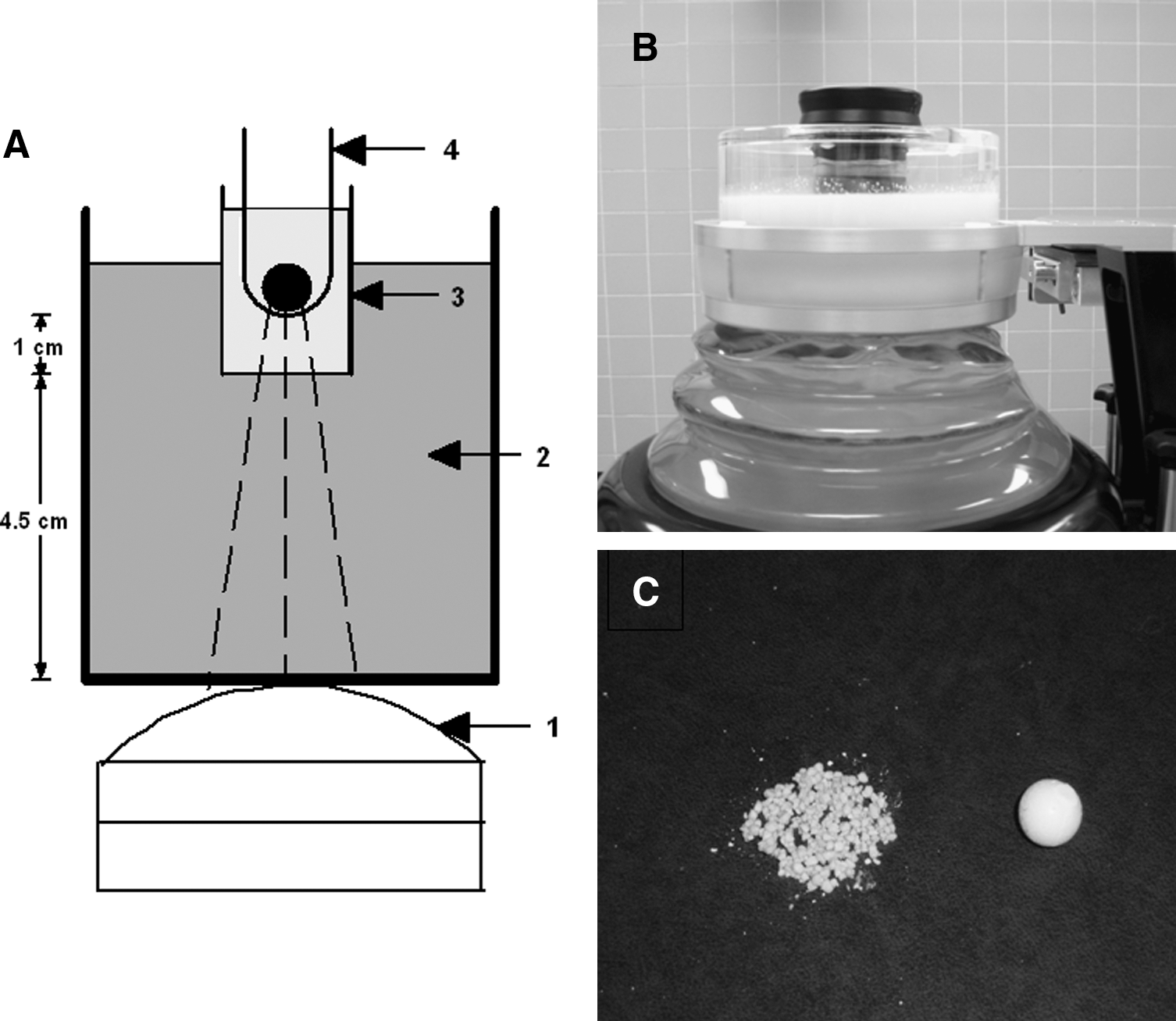
The experimental setup. (
The media that were investigated in this study included physiologic saline (n = 5), pure liquid animal fat (n = 6), and freshly obtained bovine tissues [fatty tissue (n = 6), muscle (n = 6), and kidney tissues (n = 6)]. All the tested media had a temperature between 37°C and 37.5°C at the start of the experiment. This temperature range was maintained throughout the experiment by adjusting the room temperature according to the reading of a thermometer, which was placed in the media. The fatty tissue, muscle tissue, and kidney tissue were cut into uniform slices of approximately 10 × 4 × 1.5 cm and placed in the outer container in a compact fashion to leave minimal spaces in between. To ensure that these spaces were not filled with air, physiologic saline was added to fill these tiny spaces in case of muscle tissue and kidney tissue, and pure liquid animal fat was used in case of fatty tissue. The muscle fibers were positioned so that their fibers were directing horizontally, that is, perpendicular to the waves similar to the situation in the clinical setup. The experiments were performed in a random fashion.
The saline that was used in the experiment as a control was degassed by boiling it for 15 minutes as previously described. 11 The volume of the saline was calculated before and after boiling and adjustments were made for the water that was lost during evaporation by adding similar amount of degassed water on the boiled saline. Saline was used within 2 hours of boiling.
The ability of various media to attenuate the effect of shockwaves was tested by subjecting the standard stones to similar-intensity (0.85%) continuous shockwaves at a rate of 70 shocks per minute, which is generally similar to what is used clinically in our institute. The total number of shock waves and energy required to completely fragment the stones were calculated. Complete fragmentation was defined as the disappearance of the fragments from the net.
Statistical analysis was performed using SPSS V15.0 (SPSS, Chicago, IL). One-way analysis of variance (ANOVA) was used to perform statistical comparisons of the number of shockwaves and total energy in the groups overall. Post-hoc pair-wise Student-Newman-Keuls (S-N-K) test was then used to compare the various media. A p-value of <0.05 was considered statistically significant. The results were expressed as mean ± standard deviation.
Results
In this experiment, the number of shockwaves and energy required to completely fragment the standard stones when normal saline was used was less than 30% of those required when using other media as shown in Table 1 (p < 0.001 for the overall comparison between the groups in both the number of shockwaves and energy required). Pair-wise comparisons between the various groups revealed a significant difference between the normal saline and other media (p < 0.001 for all comparisons with the four media: pure liquid animal fat, fatty tissue, muscle tissue, and kidney tissue). Among these four media, the maximum number of shockwaves and energy were required in case of muscle tissues, and the least when pure liquid fat was used. Nevertheless, there were no statistical differences in the number of shockwaves or energy required among these four media.
There was no significant difference in the number of shockwaves or energy required among pure liquid animal fat, fatty tissue, muscle tissue, and kidney tissue.
p < 0.001 when compared with the number of shockwaves required in the saline medium.
p < 0.001 when compared with the total energy required in the saline medium.
SD = standard deviation; J = joule.
Discussion
The results of this study appear to indicate that the shockwaves' effectiveness in fragmenting stones is similar after passing through fatty tissue, muscle tissue, or kidney tissue, as suggested by the similarities in the number of shockwaves and energy required to completely fragment the standard stones after passing through these tissues. In other words, these media appear to result in similar attenuation of the shockwaves as they pass through them. These findings might have potential clinical implications particularly on the effect of the total SSD on the success of SWL. In this regard, some studies have recently shown SSD to be a significant predictor of SWL outcome. 6 –9 The total SSD is composed of several tissues, mainly subcutaneous fatty tissues, muscle tissue, and renal tissue. The degree of contribution of each component to the final outcome is not known. This may be clinically relevant because the proportion of fat to nonfat components is variable among different individuals. For example in athletes, due to the bulky muscles, the proportion of nonfat component is higher than the one in obese patients who have a higher proportion of fat although both may have the same SSD. Similar disproportionate relationships between the fat and nonfat components may also be found in children and in patients with hepatic and renal failure or even among different races such as Asians when compared with Caucasians. 12 Therefore, it is of clinical relevance to investigate the contribution of SSD various component to the final outcome of SWL.
Despite its limitations, the results of this experiment appear to indicate that the total SSD has the same attenuation effect on the shockwaves whether it is composed mainly of fatty tissue as in obese people or muscle tissues as in athletes; however, further clinical studies to correlate the outcome of SWL to the fatty and non-fatty tissues in patients with various SSDs is required to confirm the findings of this study. Collectively, these results were in agreement with the attenuation studies that addressed the effect of various tissues on the ultrasonic waves when passing through different media. 13 As the sound waves pass through a medium, some of its energy gets absorbed and hence attenuated. The degree of attenuation of a sound wave with certain frequency depends predominantly on the macromolecular composition and relaxation and not significantly dependent on the tissue structure of the media. 14
The design of the in vitro model in this experiment enabled us to study the effect of various tissues on extracorporeal shockwaves. Similar model was used by Bohris. 15 The saline that was placed in the inner container allowed the small fragments, once formed, to fall out of the net holes easily and hence allowed an accurate measurement of the energy and number of shockwaves required for complete fragmentation. Without using this saline-containing inner container it would have been very difficult to obtain these measurements, as the liquid fat or other tissue media would not have allowed the fragments to fall down freely. Moreover, this appears to replicate the in vivo situation where stones are sitting in a fluid medium within the kidney or ureter. In addition, the use of uniform artificial model stones that had the same composition (Plaster of Paris) rendered them appropriate for this type of experiments. The physical and acoustic properties of these stones have been previously investigated in detail. 16
The current study has its limitations, among which was the use of nonliving animal tissues that might have a different effect compared with the living human tissues. However, the use of animal models and tissues is widely used in research to investigate the effect of various factors on humans. This is not only due to their wide availability but also due to the large similarities between these tissues and human tissues. For example, the histological features of the human kidney including the structure of the glomeruli and tubules show a lot of similarities to farm animals' kidneys including the bovine kidney which was used in this study. 17 However, one possible limitation in this study was the use of subcutaneous and not perirenal bovine fatty tissue in this experiment as there may be some evidence from animal research to suggest that the perirenal fatty tissue may have a slightly lower percentage of water content compared to the subcutaneous fat. 18 Whether this could have affected the overall results would be difficult to ascertain from this study. However, the fact that similar results were obtained in both pure animal liquid fat and in the animal fatty tissue may indicate that the results were unlikely to be affected significantly by the type of fat used although further research is required in this field. Other potential limitations included the applicability of the results of this study to different shockwave intensities and frequencies and on calculi with different sizes and compositions. Therefore, further clinical studies are necessary to confirm the applicability of these findings to clinical practice.
In conclusion, the findings of his study indicated that the shockwaves had the same effectiveness in fragmenting stones whether they pass through the fatty or nonfatty tissues (muscle and kidney), which compose the SSD.
Footnotes
Acknowledgment
The authors would like to thank Gulf & World Traders LCC, Dubai and Dornier for their kind donation of the artificial model stones which were used in this study.
Disclosure Statement
No competing financial interests exist.