




Abstract
Technologic advances in endourologic surgical material have led to improved image quality, power sources, and auxiliary material (probes, nitinol baskets, etc.). Nevertheless, this material is more expensive, especially the flexible endoscopic material—ureterorenoscopes and nephroscopes. We present a method to expand (average) mean life of flexible nephroscopes: An efficient and cheap protective cover.
Problem
We experienced mechanical damage to the flexible nephroscope at the contact point between the Amplatz sheath and the nephroscope. The rim of the Amplatz sheath is fairly blunt, but it has a small cutting edge. The Amplatz sheath and the nephroscope axes have to be in line during percutaneous nephrolithotomy (Fig. 1). In complex procedures, we may lose the accurate alignment when the pathway is explored—ie, the pyelocaliceal system (Fig. 2). In that setting, the repetitive turning movement of the nephroscope over the Amplatz sheath may lead to failure earlier than usual. We decided to design a system to strengthen and protect the external sheath of the flexible nephroscope and to prolong its service life.
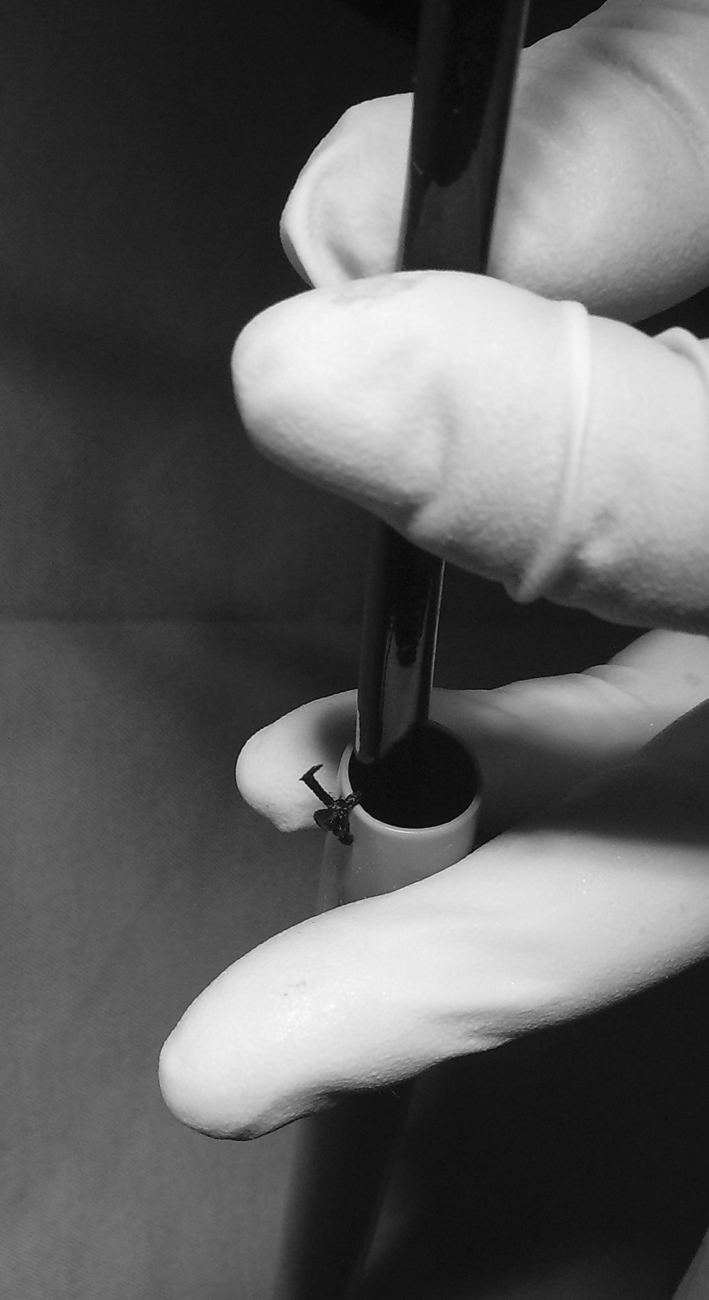
Friction point between the Amplatz sheath and the nephroscope.
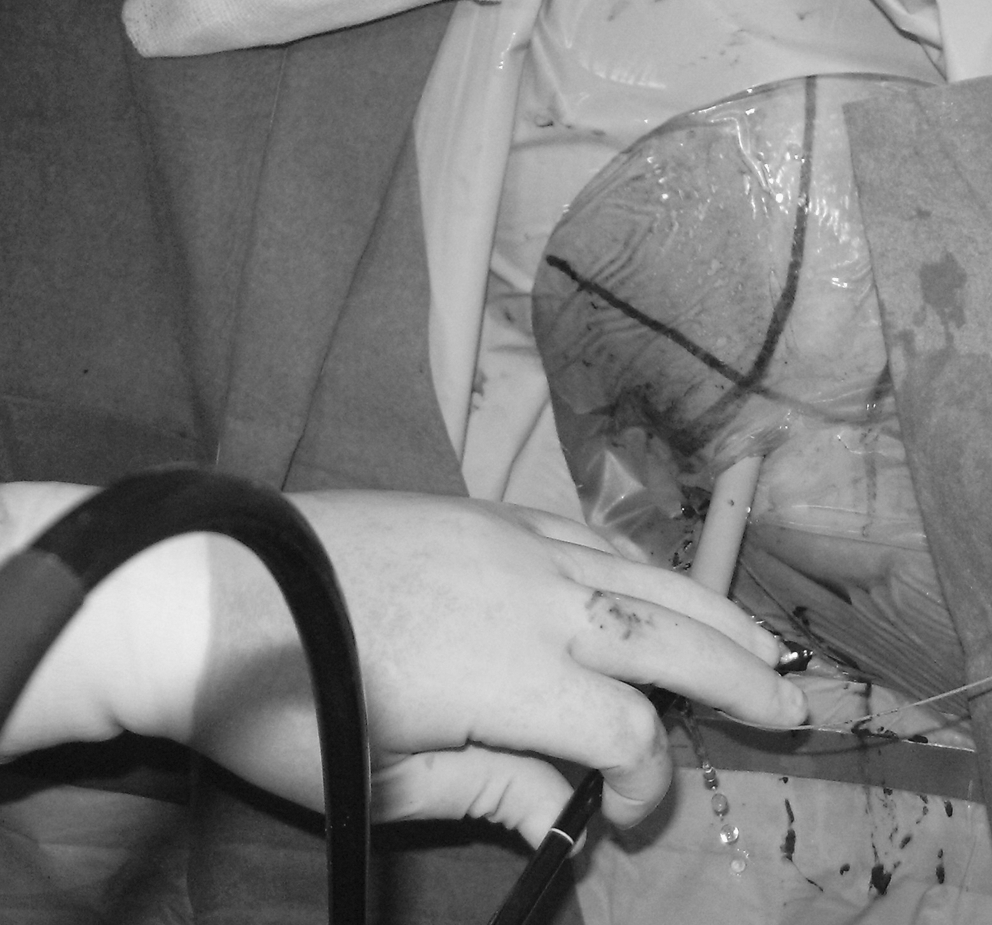
Complex percutaneous nephrolithotomy with losing of the correct axes between the nephroscope and the Amplatz sheath.
Technique
The nephroscope is covered with a flexible polyvinyl chloride (PVC) tube at the contact point between the nephroscope and the sheath (Fig. 3). With the flexibility of the PVC tube and its diameter slightly less than that of the nephroscope, it is fixed and remains attached to the outside of the nephroscope without movement, as shown in Figures 4 and 5.
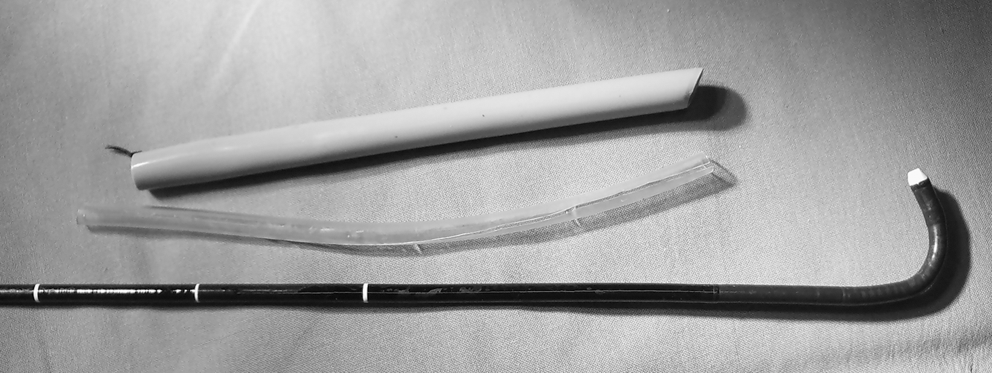
From top: Amplatz sheath, plastic guard, and flexible nephroscope.
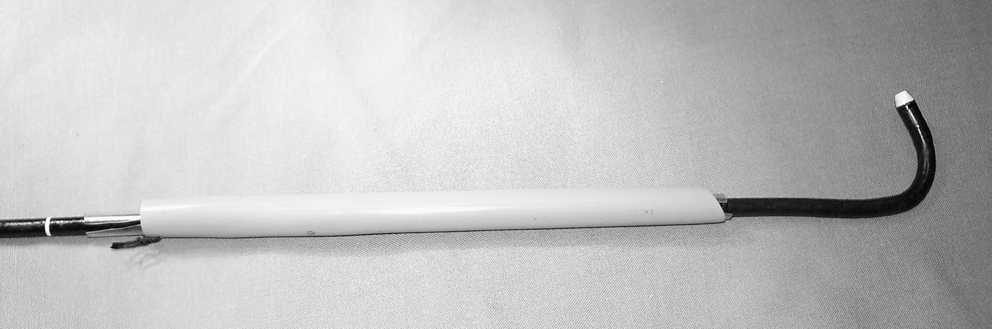
Nephroscope inside the plastic guard and both inside the Amplatz sheath.
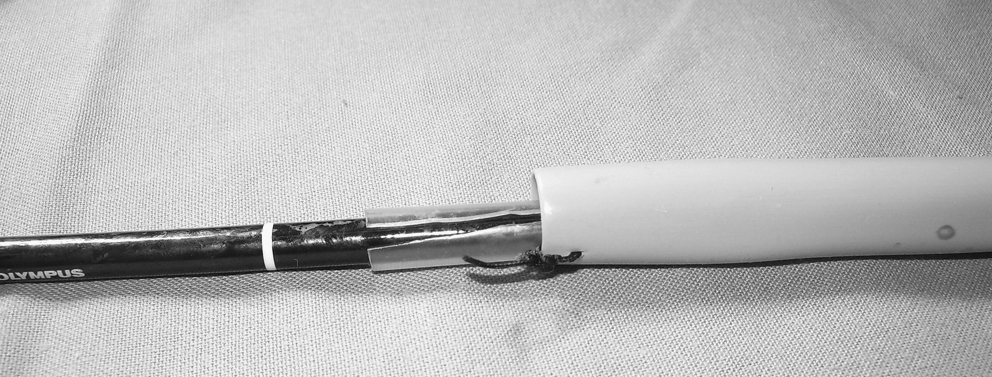
We have used this device in more than 50 procedures without movement of the sheath. In our experience, the thickness and length of this coating does not restrict the movements of the nephroscope into the Amplatz sheath nor its original deflection capability inside of the pyelocaliceal system (Figs. 4–5). Furthermore, we make a longitudinal cut in the tube to fit to the nephroscope without damage.
The use of a sheath does not decrease visibility, because it fits closely to the nephroscope. Because it is external, it does not hinder the use of baskets, probes, or sources of energy. Likewise, it does not restrict deflection of the nephroscope, because when inserted, this part is left free. Moreover, the use of a sheath does not affect the results of the technique in terms of residual stones, bleeding, or urinoma. Its only purpose is to prolong the useful life of our flexible nephroscope.
The cost of each tube is negligible (less than €1 or $1.40). Although the same tube could be used several times, given its low cost and availability, we do not consider it necessary or advisable to reuse it, especially because the PVC could become less flexible after repeated resterilizations.
To perform flexible ureterorenoscopy, we use a flexible ureteral access sheath whose end opens out into a fan precisely to prevent the flexible instrument from rubbing against the edge of the sheath. This mechanism does not currently exist in the case of Amplatz sheaths. Currently, we have designed a mechanism to avoid the point of friction between the Amplatz sheath and the flexible nephroscope.
Footnotes
Disclosure Statement
No competing financial interests exist.