




Abstract
Background:
Renal biopsies are usually performed by a nephrologist and require ultrasound guidance from an expert. This procedure can be time-consuming and expensive.
Patients and Methods:
We propose using a robotic arm, controlled from a remote location, to perform ultrasound guidance during renal biopsies in postrenal transplant patients. The procedure would be performed under ultrasound guidance from a radiologist, controlling a robotic arm from one institution, while the nephrologist would perform the biopsy at another. This would allow biopsies to be performed under the guidance of an expert in ultrasonography, without requiring him to leave his institution.
Results:
Four patients underwent teleoperated renal biopsy. None of the patients had any postbiopsy complication. Total time used to perform the renal biopsies was significantly increased when compared with conventional biopsy technique. Compared with conventional ultrasound guidance, the nephrologists performing the biopsies reported discomfort with the robotic arm carrying out the ultrasonography.
Conclusions:
We demonstrated the feasibility of teleoperated ultrasound-guided renal biopsies. This technique can be used to compensate for the absence of an ultrasonography expert and save time. Additional invasive urologic procedures using the ESTELE robot arm, including renal punctures before percutaneous nephrolithotomy and prostate biopsies, are planned.
Introduction
Patients and Methods
Four consecutive patients who underwent kidney transplantation and elected to have a post-transplant biopsy were enrolled in the study. All patients gave informed consent according to the ethical committee that gave the approval to perform the study. A nephrologist who held the robotic arm on the patient's body and an ultrasonography expert located at another center performed biopsies. All the patients were transplanted in the right iliac fossa and the biopsy was performed in the supine position.
Patient characteristics are summarized in Table 1. Before starting the procedure, the robot operator fixed the echographic probe on the robotic arm (Fig. 1) and inserted the probe and cable inside a sterile sheath. The robotic arm (ESTELE) holding the ultrasonographic probe was remotely operated by an ultrasonography expert who controlled the arm using a fake probe (Fig. 2). The robotic arm reproduced all movements of the expert's hand. When the expert observed the area where the biopsy has to be performed, the nephrologist was asked to put one finger below the probe. The black shadow induced by the simple maneuver showed the expert where the biopsy needle has to be placed (Fig. 3). Next, the expert, using color Doppler, informed the nephrologist whether the path between the finger shadow and the internal portion of the kidney was free of vessels. The biopsy was then performed by inserting the needle near the finger and advancing it in the plane of the echographic probe, while keeping the angle of advancement constant. The expert kept the robotic arm motionless, to keep the kidney image in view, and informed the nephrologist of the trajectory and depth of the needle until it reached the area of tissue to be collected.

Robot maintained by an automated arm.
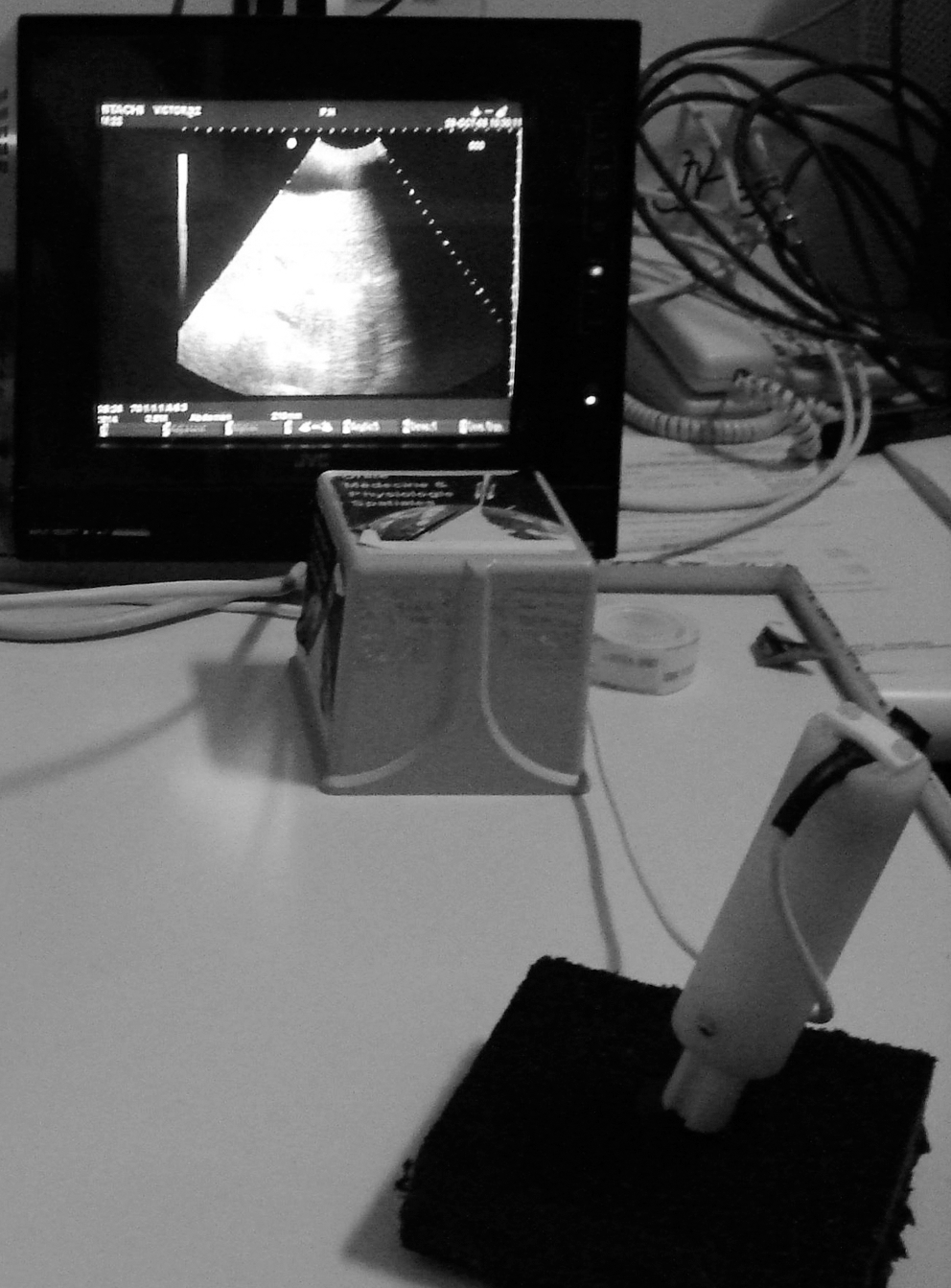
The “dummy-expert” probe.

The patient with the robotic arm maintained on his body; the nephrologist performs the biopsy. The nephrologist punctures the kidney under guidance from the ultrasonography expert.
The procedure was determined to be feasible when the nephrologist and pathologist established (using visual and microscopic criteria) that the telerobotic biopsy, with the sonographer at the patient's side, was as accurate as a conventional one. All difficulties encountered by both the nephrologists and patients were recorded to make the next biopsy more accurate. Time required to perform renal biopsy was noted and compared with the typical time required to perform a renal biopsy using conventional ultrasound-guided technique (around 20 minutes).
Results
After installation of the patient, the ESTELE robot Integrated Services Digital Network (ISDN) connection with the expert's center was tested. The ultrasonography expert and nephrologist followed the scenario described above. The ultrasonography expert located all areas of interest in the kidney and informed the nephrologist where the biopsy has to be performed.
Listening to the expert's advice, the nephrologist inserted the biopsy gun under ultrasound guidance. Both providers were able to observe the procedure in real time via an audio/video screen. This ensured that the ultrasonography expert was able to tell the nephrologist the location of the needle at any point during the procedure. When the needle was confirmed as being above the renal capsule, the ultrasonography expert informed the nephrologist that the biopsy could be performed. After performing the biopsy, the expert checked for evidence of hematoma using the robot-assisted echographic probe. A pathologist who was blinded about the type of procedure analyzed renal specimens. Pathological findings confirmed that all renal biopsies met criteria for a well-performed procedure; pathologists were not able to distinguish if the biopsy had been performed with the robot or conventionally. No postbiopsy complications were experienced. The total time required to perform a telerobotic renal biopsy was significantly increased when compared with a conventional biopsy (mean time was 55% higher than conventional biopsy for the last two patients) (Table 1). Patients felt inconvenience because of the increased duration of the procedure and the need to remain motionless in an uncomfortable position during the procedure. Compared with conventional ultrasound guidance, nephrologists reported discomfort with the robotic arm carrying the probe because the possible area for inserting the needle seemed too small and the probe movements interacted with the biopsy gun.
Discussion
Renal biopsy is routinely performed and employed as a diagnostic tool. Different techniques have been developed since its original description by Iversen and Brun 2 in 1951. The use of real-time ultrasound-guided technique and automated biopsy needles have improved the rate of diagnosis to over 95% for renal biopsies. 3 The procedure is now well established and has a standardized protocol. 3 Complications related to renal biopsy occur in 13% of patients, with most due to bleeding. 4 Renal insufficiency has been shown to be a predisposing risk factor for bleeding. 4,5 The use of ultrasound guidance has led to decreased morbidity and increased success rates, making it compulsory, especially in patients with a solitary kidney. 6
Increasing numbers of robotic tools are being used in surgery and percutaneous biopsies. 7 –9 A robot that uses resonance magnetic imaging has been developed for targeting the prostate. 7 Open resonance magnetic imaging is useful for robot-assisted needle placement, 8 but is not routinely available. Additionally, a system that utilizes computed tomography guidance for robot-assisted percutaneous procedures has been developed. 9 This tool was previously used under ultrasound guidance, but required the presence of a radiologist. 10
Our study is the first to report on the use of a robotic arm for teleoperated ultrasound guidance during renal biopsies performed on postrenal transplant patients. ESTELE has been previously used for abdominal and fetal tele-echography, 1,11,12 but never for invasive percutaneous procedures. Echography is operator dependent and not all sonographers are similarly skilled. Using a robotic arm, it is possible to provide nearly any patient with access to an ultrasonography expert with a high level of competence and dexterity. The robotic arm accurately reproduces the movements of the user's hand, allowing for the desired view of the kidney. Moreover, the system is sufficiently sensitive to hand movements, allowing for fine tuning of probe orientation, which is needed when tracking the biopsy needle trajectory.
One study showed that when the system was used for diagnostics, the most important abdominal organs were correctly observed in 85% of cases, whereas in the remaining 15% cases, one of the desired organs could not be observed correctly. 1 This confirms that use of tele-echography or remote guidance of an echographic probe is possible for diagnostics and our study showed that it was possible for interventional echography.
Difficulties described in our study show how the system can be improved. Time required to complete a biopsy decreased as more procedures were performed. As users gain experience, we estimate that this procedure will take similar operative time to the conventional technique. Many urologic procedures, including renal puncture for percutaneous nephrolithotomy and prostate biopsy, will make use of a robotic arm for ultrasound guidance. This procedure is also an option to perform kidney biopsy with the use of telemedicine, to help low-experienced professionals or to teach them. We provided our robot into distant medical centers around our teaching hospital to develop interconnections between centers and to allow experts to teach young ultrasonographers. More studies are needed to confirm the accuracy and reproducibility of this technique; we plan to confirm our results with more cases and in different practices.
Conclusions
We demonstrated the feasibility of teleoperated ultrasound guidance for renal biopsy. This technique can be used to compensate for the absence of an ultrasonography expert and, ultimately, could save time and money in the future. Within our study, few difficulties were observed and the arm is being modified for more routine use. Other invasive urologic procedures using the ESTELE robotic arm, including renal puncture for percutaneous nephrolithotomy and prostate biopsy, are planned in the near future.