




Abstract
Background and Purpose:
Enucleation-transurethral resection of the prostate (e-TURP) is our evolution of the conventional TURP. The aim of this study was to report our experience with e-TURP for the endoscopic management of benign prostatic hyperplasia (BPH).
Patients and Methods:
The e-TURP combines the basic steps of classic TURP with the technique of holmium laser enucleation of the prostate (HoLEP) but using only the bipolar resector. The charts of 64 patients who underwent e-TURP for BPH in our department between October 2005 and October 2009 were retrospectively studied.
Results:
The mean resected tissue weight was 27.21 g, and the mean operative time was 75.7 min. The mean decreases in hemoglobin and serum sodium levels were 1.63 g/dL and 0.55 mEq/L, respectively. Mean catheter duration was 2.53 days, and the mean total hospitalization time was 3.75 days. There was a significant improvement in urinary peak flow rate (Qmax) 2 months postoperatively (P = 0.009718), as well as a significant decrease in the International Prostate Symptom Score during the same period (P < 0.0001). No major complications were observed, and the rates for early and late complications were 10% and 5%, respectively, at 14.75-month mean follow-up.
Conclusion:
The e-TURP seems to be a safe and effective method for the endoscopic management of BPH. Further investigation with randomized trials is needed on this matter.
Introduction
We evolved the conventional TURP into enucleation-TURP (e-TURP), combining the basic steps of classic TURP with the technique of the holmium laser enucleation of the prostate (HoLEP) but using only the bipolar resector. In the present study, we report our experience with the e-TURP.
Patients and Methods
We retrospectively studied the charts of 66 patients who underwent e-TURP for BPH in our department between October 2005 and October 2009. Transperineal, transrectal ultrasonography-guided, prostate needle biopsy had been preoperatively performed in 20 of them either because of a positive digital rectal examination or an elevated serum prostate-specific antigen (PSA) level, with negative results. However, in two patients who had not undergone a biopsy procedure, the pathologic analysis of the specimen revealed prostate cancer, and they were excluded from the study, reducing the number of patients to 64. The only criterion, at least for the first 20 to 30 cases, for proceeding with this procedure vs conventional TURP or HoLEP, was the small size of the adenoma.
PSA level, International Prostate Symptom Score (IPSS), and urinary peak flow rate (Qmax) were recorded preoperatively. IPSS and Qmax were also recorded 2 months after the operation. In addition, we measured the hemoglobin (Hb) and serum sodium (Na) levels before surgery and on the first postoperative day. Resected tissue weight, total operative time, duration of catheter use, and hospitalization time were documented in detail.
All patients were operated on by the same surgeon (GB) with the Gyrus bipolar system, under general or spinal anesthesia. Normal saline was the fluid of irrigation. After the insertion of a continuous 26F resectoscope through the urethra into the urinary bladder, the ureteral orifices, the verumontanum, and the prostatic adenoma were visualized. Afterward, the initial step of resection depended, usually, on the presence of a middle lobe. If a middle lobe was encountered, it was first resected. In that case, the resection continued with a deep and long incision at 6 o'clock, ending just proximal to the verumontanum, creating a midline groove. If the middle lobe was absent, the previous step could be omitted, and a lateral right groove was developed at the 11 o'clock position, as in the Nesbit technique.
The periapical mucosa was then incised in a transverse fashion extending from the end of the Nesbit groove to the lateral right of the verumontanum. The incision was deepened down to the level of the surgical capsule to lift up the apex of the right lobe and start the enucleation in an antegrade approach. Once on the surgical capsule, the adenoma was enucleated with a good cleavage plane, combining mostly the mechanical action of the beak of the resectoscope with the bipolar energy (Fig. 1). Finally, the adenoma was left attached to a rather wide base of the capsule so it could subsequently be resected very rapidly and bloodlessly: A real “in situ” morcellation. The same procedure was then repeated for the left lobe.
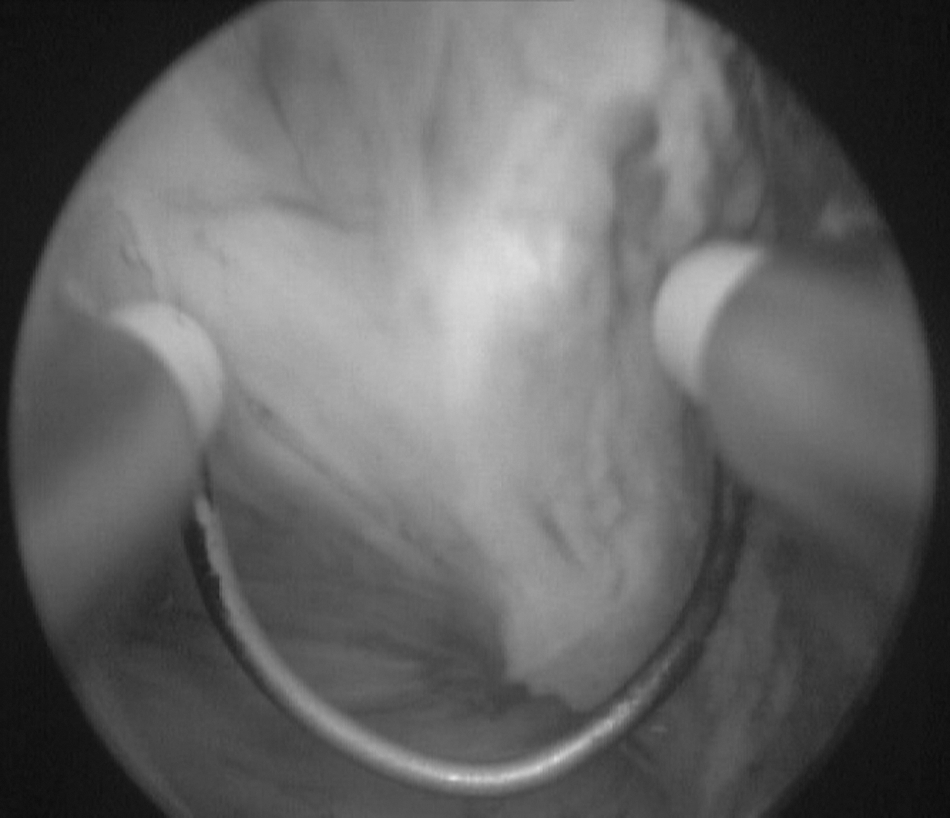
Once on the surgical capsule, the adenoma is enucleated with a good cleavage plane, in an antegrade fashion, combining mostly the mechanical action of the beak of the resectoscope with the bipolar energy.
Results
Table 1 shows the characteristics of the 64 patients, and Table 2 shows the perioperative data of these cases. The mean resected tissue weight was 27.21 g (range 5–70 g), and the mean operative time was 75.7 minutes (range 30–150 min). On the first postoperative day, the mean decreases in Hb and serum Na levels were 1.63 g/dL and 0.55 mEq/L, respectively. Mean catheter duration was 2.53 days, and the total hospitalization time was 3.75 days.
SD = standard deviation; PSA = prostate-specific antigen; IPSS = International Prostate Symptom Score; Qmax = peak flow rate.
SD = standard deviation; Hb = hemoglobin; Na = serum sodium.
IPSS significantly decreased 2 months after surgery from a mean of 20.29 (preoperatively) to a mean of 5.96. Accordingly, the mean Qmax improved from 11.15 mL/s to 20.8 mL/s. The significance difference is demonstrated in Table 3.
Data presented as mean ± standard deviation (range); results assessed statistically using the Student t test.
IPSS = International Prostate Symptom Score; Qmax = peak flow rate.
Patients were followed for a mean time of 14.75 months (range 2–36 mos) to identify early and late complications, which are shown on Table 4. No TURP syndrome was detected, but two patients had moderate nausea postoperatively. Two patients needed blood transfusion because of a severe fall of Hb, and urinary tract infection developed in three patients. Another short-term complication was transient inability to void, necessitating recatheterization, in three patients.
In terms of late complications, a bulbar urethral stricture developed in two patients; it was managed successfully with internal urethrotomy. Transient urge incontinence was observed in three patients.
Discussion
Despite new advances in MIT for BPH, TURP still remains the gold standard. For many years, there had not been any significant evolvements in TURP until the advent of the bipolar resectoscope, which seems to offer better results than the monopolar one. 4 –6 Even with this advanced system, however, the resection near the verumontanum still remains the difficult and challenging part of the whole procedure. All the classic techniques of TURP (Nesbit, Barnes, Flocks, and Culp) 7 –9 suppose the retrograde movement (craniocaudal to the patient) of the loop, keeping under control the verumontanum, which is “on guard” of the external urinary sphincter. It is mainly at this level that the resection may fail, either because of an incomplete resection or because of a resection too extensive, resulting in damage of the sphincter.
HoLEP offers, probably, a solution to this problem by enucleating the adenoma in an antegrade fashion, although violating that way one of the main axioms of endoscopic training: “Down from above and never up from down.” Because the enucleation technique of HoLEP has already been described with excellent results, 10,11 one could use a similar strategy to perform a real enucleation-resection of the adenoma by using only the resectoscope loop, as described earlier.
The idea to accomplish an enucleation-resection with the resectoscope is not entirely new. Hiraoka and Akimoto 12 published a study in 1989 that introduced the procedure of transurethral enucleation of the prostate using a “prostate-detaching blade” in conjunction with the tip of the resectoscope. Further evolutions and ameliorations of this technique have also been reported. 13 –15 In addition, in 2002 Rolf Muschter patented an instrument, the “transurethral dissection electrode,” by which “the prostatic adenoma without laser resection might be simply and effectively released from the inner wall of the urethra, close to the prostatic capsule.” Neither a clinical study nor a case report has ever described the technique, however. Finally, in 2006, Neill and associates 16 used an “axipolar cystoscope electrode” suitable for enucleation to compare plasmakinetic enucleation of the prostate with HoLEP, although they did not describe in detail either the procedure or the instrument. As for the in situ morcellation of the adenoma, a similar technique, called the mushroom technique, was presented by Hochreiter and colleagues, 17 although referring to HoLEP.
We believe that our technique gathers several advantages in comparison not only with conventional TURP, but also with other minimally invasive treatments, such as HoLEP. Our success rates are comparable with classic TURP, as was demonstrated by the significant improvement in the mean Qmax and the mean IPSS. All the other perioperative and postoperative parameters of our study are also comparable with the ones of other previous studies for TURP. We achieved no postoperative urinary stress incontinence, however, and this, in fact, is a major advantage of e-TURP, because the resection limit of the prostatic apex near the verumontanum (and the external sphincter, of course) is very well defined, eliminating the Achilles' heel of all retrograde techniques. Compared with HoLEP, the e-TURP apposes lower cost, greater flexibility (there is only one instrument that resects, enucleates, and coagulates), no need for a morcellator, and, mostly, it is related to equipment that is quite familiar to all urologists.
Conclusion
Although not supported by a randomized study and therefore with a low level of evidence, the e-TURP seems to be a safe and effective method for the endoscopic management of BPH. The hope is that this primary study will stimulate further investigation on this matter.
Footnotes
Disclosure Statement
No competing financial interests exist.