




Abstract
Background and Purpose:
Thomas Alva Edison was an icon of American achievement who literally invented the 20th century. Although best known as the inventor of the electric light bulb, the phonograph, and motion pictures, he also left a lasting legacy via peripheral developmental applications, such as endoscopes.
Methods:
A review of published urologic writings about incandescent cystoscopes was cross-referenced to writings about or from Edison. Important events that allowed transference of technology from the Edison laboratory to clinical practice were emphasized.
Results:
Edison was born in 1847 while Lincoln was serving in Congress; he died in 1931 when Hoover struggled with the Great Depression. Edison's life spanned the formative period of America that Henry Adams called the “coming of age.” Edison received a Sprengel vacuum device in late 1879, and as usual, he was able to tweak the machine to better performance. For 5 days in October, 16 to 21, he improved the vacuum from 1/100,000 to 1/1,000,000 atm, and his first incandescent bulb burned softly. On December 21, 1879, he leaked the story to N.Y. Herald journalist Marshall Fox, and the world was notified of the light bulb. Special Christmas light visits started in Menlo Park just 4 days later. Edison patented the screw cap for easy changes, and the first bulbs sold for 40 cents (cost $1.40). 100,000 bulbs sold in 1882, 4 million by 1892, and 45 million in 1903. Immediately, competitors and specialty manufacturers entered the market. Dr. Henry Koch and Charles Preston in Rochester, N.Y., developed a smaller, low amperage bulb that could be fitted to medical devices.
Conclusions:
No discussion of electricity and modern applications would be complete without some discussion of Thomas Alva Edison and his sentinel contributions. The first church, post office, and ship were illuminated in 1892. The first hotel, theater, and electric sign were in 1893. The rapidity of dispersal and secondary applications of Edison's inventions is typified by the rise of cystoscopes. Nitze used a modified Edison bulb in his second and third generation scopes by 1887–1888 within 8 years of discovery.
Introduction
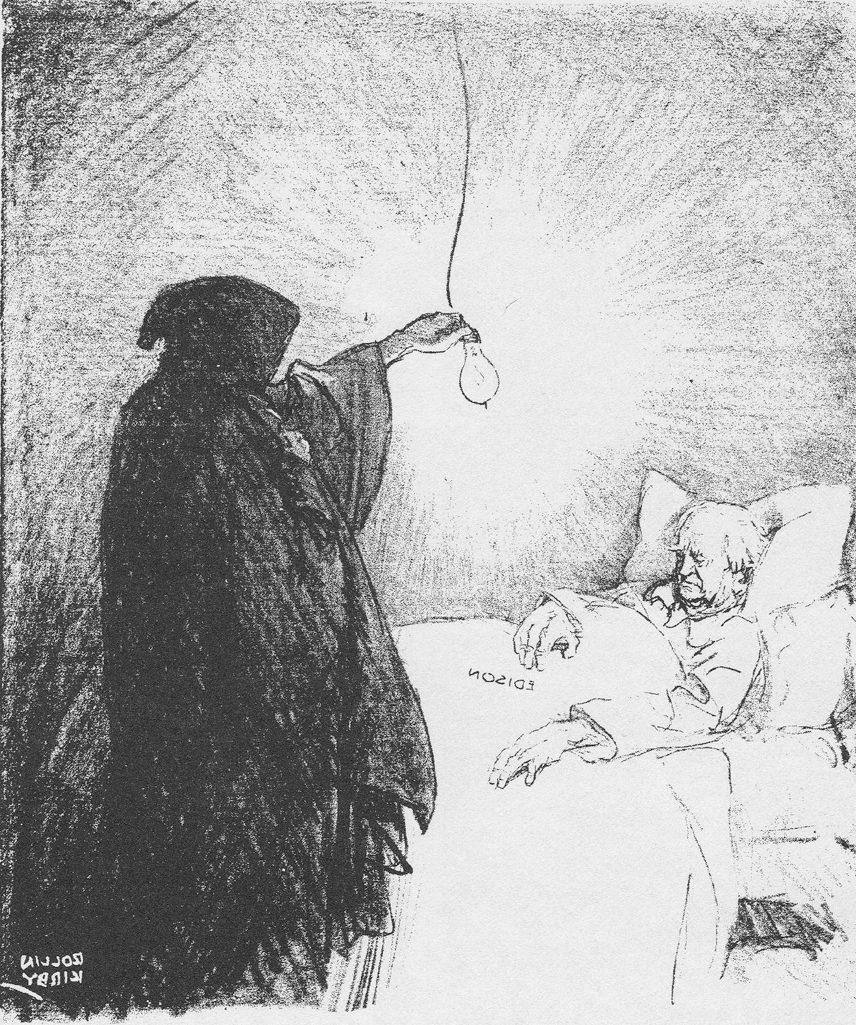
Edison in Death. From Rollin Kirby; New York World-Telegram, called “Lights Out.” Reprinted with permission, Penguin Group (USA) Inc., New York.
Much has been written about the invention of the incandescent bulb. There was a long legacy of persons who tried with some degree of success before Edison's fateful December 21, 1879, debut (Fig. 2). 3 In addition, after the successful demonstration and installation, a host of others rushed to market their own types of incandescent bulbs. 4 This scenario is typified by the rise of cystoscopy and the switch from hot incandescent wire sources to the vacuum filament bulbs. This is an historic sojourn into Edison's introduction of the electric light bulb and the rise of the modern era of urology.
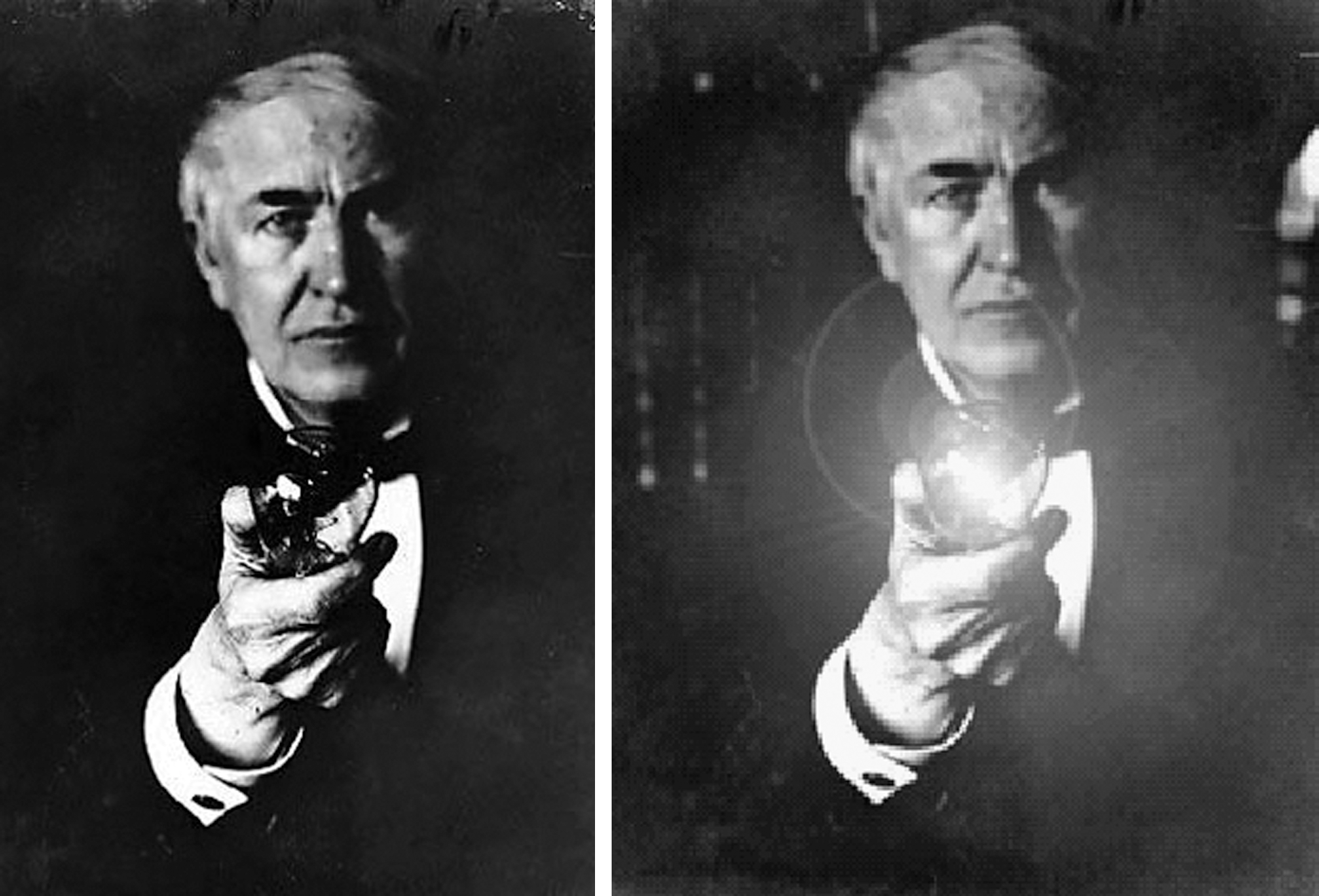
Edison holding his newest invention, the incandescent filament electric light bulb.
Methods
A growing industry of Edison biography is available to the student of early modern electricity. There at least five monumental biographies regarding Edison. 1 –5 In addition, the era that spawned Thomas Edison's vast technical accomplishments was further enhanced by a wealth of other inventors, including his nemesis, Nikola Tesla. Edison's accomplishments must be viewed in light of these others who, by and large, existed in his shadow. 6
In addition, since this historic review emphasizes the newly invented light bulb and the subsequent development of the cystoscope, careful attention to the early events in the manufacture of the cystoscopes is necessary to develop the overall implications of Edison's work on urology. 7
Results
Thomas Alva Edison was born on February 11, 1847, as the seventh child of Nancy and Samuel Edison. Edison died on October 18, 1931, from a mixture of medical problems that included Bright disease, uremia, and diabetes. 8 During his long life, he grew up in the Lincoln era and survived to see the Great Depression. Edison's life spanned the formative period of America that Henry Adams called the “coming of age.” 9
Edison was constantly impressed with the ability of electricity to do work. His mind and his experimental capacity were singularly focused on applications. The history of the electric light is overwhelmed by Edison's presence, although clearly others were actively involved in the development of this life-changing device. He had cautiously approached this technology at least in 1878. In 1877, Jablochkoff candles were used with great fanfare to illuminate the Avenue de l'Opera in Paris with arc lighting. Others that were also antecedent to Edison in this field included Jobart (1838), J.W. Starr (1845), Dr. J.W. Draper (1850), W.E. Stairs (1850), E.C. Shepher (1850), Moses Farmer (1858), Lodyguine, and most importantly for Edison, Joseph Swan, who had worked on electric incandescent bulbs for years in England. 10
Edison's main contribution to the incandescent light bulb was the actual names, tungsten filament (here Edison's mythology is again legend—“genius is one percent inspiration and 99 percent perspiration”), the screw cap bulb insertion apparatus, the subsystems for electrical generation and delivery, insulation of cables, and the publicity he was able to generate for the electric bulb. 2
Within months following the December 21st debut of Edison's incandescent lightbulb, competitors and specialty manufacturers entered the market. Dr. Henry Koch and Charles Preston in Rochester, N.Y., developed a smaller, low amperage bulb that could be fitted to medical devices. 11 In 1883, David Newman from Glasgow placed one of the miniaturized Edison-type vacuum filament bulbs at the distal end of his large cystoscope. 7 By 1886, Nitze finally struck on the notion of using the Edison bulb, as did his now estranged former collaborator, Josef Leiter, in Vienna. Both produced prototypes that had an incandescent bulb at the tip, and both were presented at the 1887 Surgery Congress in Berlin. 12 It is known that Nitze paid the Friedländer Company to create small mignon bulbs for his use in 1886. His article was not submitted, however, until January 25, 1887.
Nitze's mentor, Justus Schramm-Vogelsand, illuminated his own version of an endoscope in 1888 using the Edison rival Swan bulb. 13 In 1890, New York electrician Stammers created an incandescent bulb to illuminate a scope designed by Dr. Henry G. Piffard. Also, another electrician working for the Electro-Surgical Instrument Co. of Rochester, created incandescent urethroscopes for Dr. Henry Koch in Rochester and for Ferdinand C. Valentine in New York City. 14,15
Despite the rather significant advantages of directly illuminated urethroscopes and cystourethroscopes, the voices of the antitechnologists (Luddites) were apparent as well, such as articles by Willliam C. Otis. 14 By the end of the 19th century, incandescent cystoscopy was finding regular use by physicians who specialized in urologic problems. 16
Conclusions
No discussion of electricity and modern applications would be complete without some discussion of Thomas Alva Edison and his sentinel contributions. Of his 1093 patents, the electric incandescent filament bulb was just part of a system that Edison had to develop to make electric lighting feasible. The rapidity of dispersal and secondary applications of Edison's inventions is typified by the rise of incandescent cystoscopes by 1883. Nitze used a modified Edison bulb in his second and third generation scopes by 1887–1888 within 8 years of discovery.
“Nothing in education is so astonishing as the amount of ignorance it accumulates in the form of inert facts.” Henry Adams 9