




Abstract
Minimal bleeding during endoscopic surgery of the urinary tract may prevent optimum vision. We used neurosurgical patties for dissection during our laparoscopic procedures in the pediatric population and aimed to describe this technique as an alternative to standard ways of dissection during laparoscopic procedures. We have performed 21 procedures, including pyeloplasties, nephrectomies, and management of duplication anomalies, by using 0.5 inch Codman neurosurgical patties.™ Use of neurosurgical patties during laparoscopic urologic procedures yields a clear vision that enables the surgeon to perform the procedure more comfortably and effectively.
Introduction
Neurosurgical patties are used in almost every intradural procedure. Generally, they are used for protection of neural tissue, as a dissecting device, and for absorbing cerebrospinal fluid or other fluids. 3 Patties are made of a porous absorptive material that is flexible, soft, and absorbs irrigation fluids and blood. 1 We used neurosurgical patties for dissection during our laparoscopic procedures in children. We aimed to describe this technique as an alternative to standard ways of dissection during laparoscopic procedures.
Technique
We have performed 21 procedures, including pyeloplasties, nephrectomies, and management of duplication anomalies, by using 0.5 inch Codman Neurosurgical Patties™ without any undo difficulty. These patties are easily introduced into a 5-mm port site, contain a radiopaque marker, and, if necessary, can be soaked in epinephrine (Fig. 1).
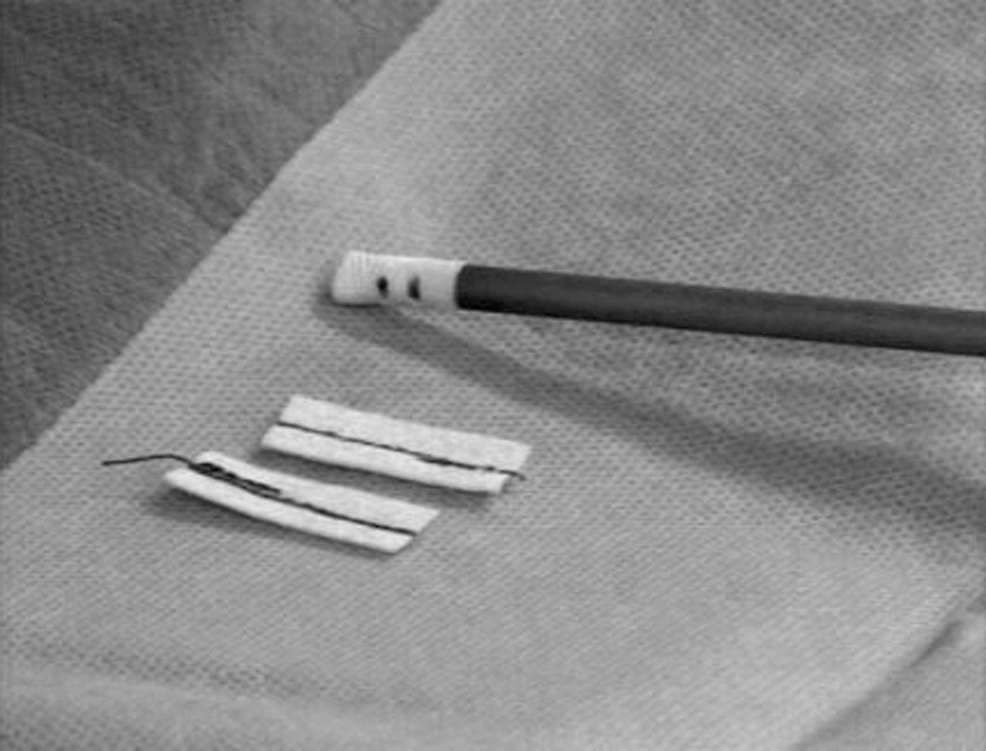
0.5 inch Codman neurosurgical patties.
These are high absorption capacity materials that show no adhesion to the underlying surface. 1 Because of the nature of the material, patties can absorb more than five times their weight very quickly, thus preventing any accumulation on the surgical field. We have used the patties grasped with dissectors and continued the dissection using this technique (Figs. 2 and 3).
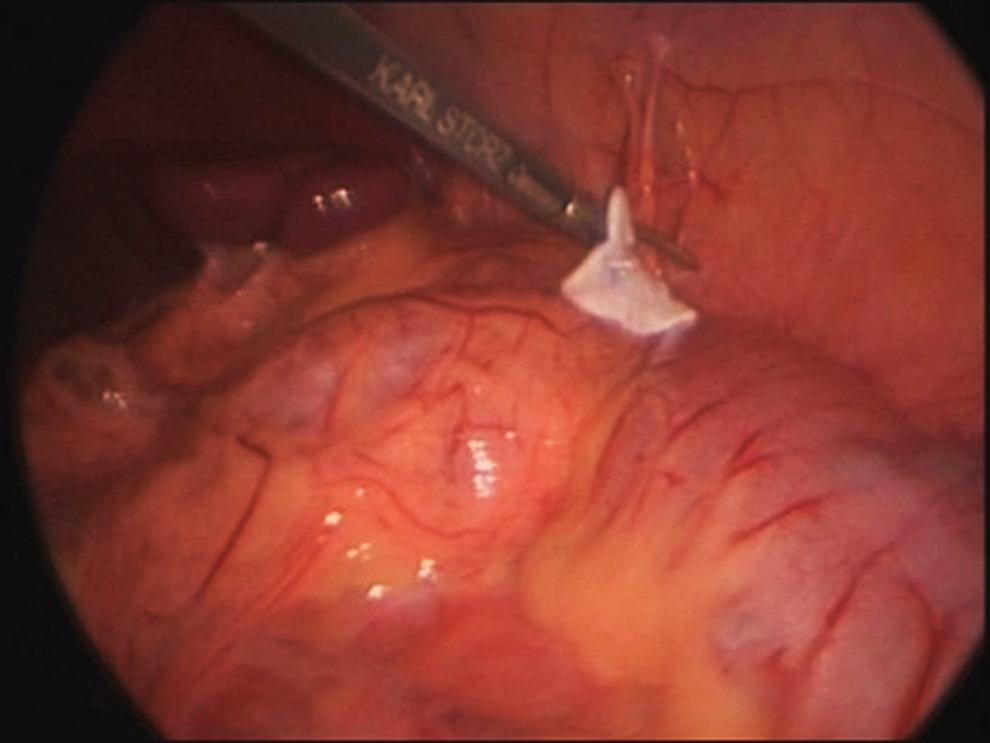
Neurosurgical patties for dissection during laparoscopic procedures in children.
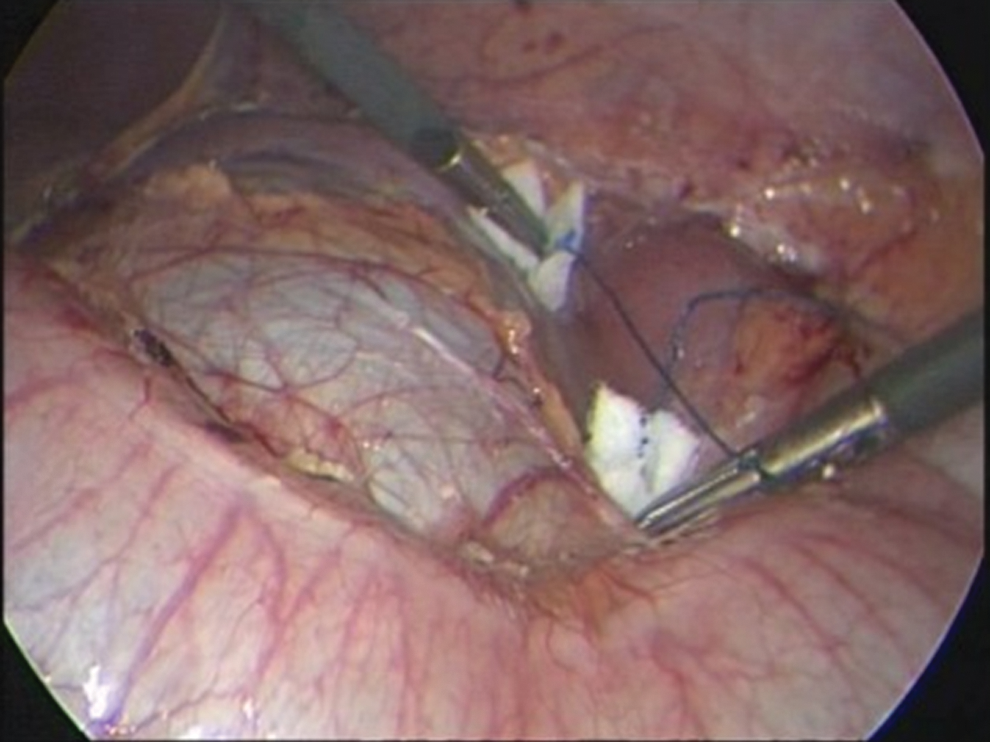
Patties are grasped with dissectors, and the dissection is continued using this technique.
Discussion
There are many factors that affect success rates of laparoscopic procedures. Besides the technique, experience and proficiency of the surgeon and other factors such as an optimal vision during the operation are crucial. In our series, grasping the patties with dissectors and continuing the dissection using the patties provided an excellent method of blunt dissection, which was gentle on the surrounding tissue and was absorbent of blood, so maintaining a good field of vision. 1 –3
We commonly use two to three pads during the procedure that lasts 1 to 2 hours. Although not measured objectively, we have the impression that use of patties also decreases the operative time, because patties can absorb more than five times their weight very quickly, thus preventing any accumulation in the surgical field. A better surgical vision becomes possible with less lens cleaning. Use of the patties decreases the need for cautery when compared with standard use of dissectors during the procedures.
Soaking pads into epinephrine is not a routine approach; however, this was successfully used in some cases. Actually, when the patties are soaked in epinephrine solution, they become less absorbent, which is less preferable. We used epinephrine where the continuous minimal bleeding of undefined origin caused a visual problem. Although theoretically one should be careful, especially in children, about the amount of epinephrine, when patties were used as soaked, we did not see any complications because this was used only on limited areas.
The major advantage of the patty when compared with existing products such as “laparoscopic peanut” or “chopstick,” is the cheaper cost and greater surface area; thus, the increased absorption capability. When absorption capacity decreases, it is easier to change the patty to refresh the tool than reusing a peanut or a chopstick after manually cleaning it. After defining the technique, further comparative and well-structured studies that quantify the exact advantage of this technique compared with conventional means are needed.
Conclusion
Use of neurosurgical patties during laparoscopic urologic procedures in children can potentially reduce and absorb minimal bleeding. During blunt dissection, this yields a clear vision that enables the surgeon to perform the procedure more comfortably and effectively.
Footnotes
Disclosure Statement
No competing financial interests exist.