




Abstract
Purpose:
We describe our multi-institutional experience using a laparoscopic clamp to induce selective regional ischemia during robot-assisted laparoscopic partial nephrectomy (RALPN) without hilar occlusion.
Patients and Methods:
A retrospective review of Institutional Revew Board-approved databases of patients who underwent selective regional clamping during RALPN at four institutions was performed.
Results:
In 20 patients who were treated for elective indications, RALPN with parenchymal clamping was successful in 17 (85%). Mean age was 63 years (24–78 y). Median tumor diameter was 2.2 cm (1.1–7.2 cm). Mass location was polar in 13 (76%) and interpolar in 4 (24%). Median R.E.N.A.L. nephrometry score was 6 (4–10). Median overall operative time was 190 minutes (129–309 min), while selective clamp time was 26 minutes (19–52 min). Collecting system repair occurred in 8 (47%) patients. No patients needed a blood transfusion. There was no significant difference in preoperative (median 86 mL/min/1.73 m2) and immediate postoperative glomerular filtration rate (GFR) (median 78 mL/min/1.73 m2, P=0.33) or with the most recent GFR (median 78 mL/min/1.73 m2, P=0.54) at a mean follow-up of 6.1 months (1.2–11.9 mos). Final pathology determination revealed renal-cell carcinoma in 71% with no positive margins on frozen or final evaluation. In three additional patients who were undergoing RALPN, bleeding because of incomplete distal clamp compression necessitated subsequent central hilar clamping for the completion of the procedure.
Conclusions:
In our preliminary multi-institutional experience, regional ischemia using a laparoscopic parenchymal clamp is feasible during RALPN for hemostasis. Careful preoperative selection of patients is needed to determine ideal patient and tumor characteristics. Further comparison studies are necessary to determine the true utility of this technique.
Introduction
Parenchymal regional ischemia has been used to avoid complete vascular occlusion during partial nephrectomy. 6 –9 Simon and associates 10 first reported the use of a novel laparoscopic parenchymal clamp (Fig. 1) that allows for regional vascular control without complete renal warm ischemia. We recently described the technique using the laparoscopic Simon clamp (Aesculap AG, Tuttlingen, Germany) during robot-assisted laparoscopic partial nephrectomy (RALPN). 11 We now report our early multi-institutional experience using the laparoscopic Simon clamp for the performance of parenchymal regional ischemia during RALPN without need for central renal hilar clamping.
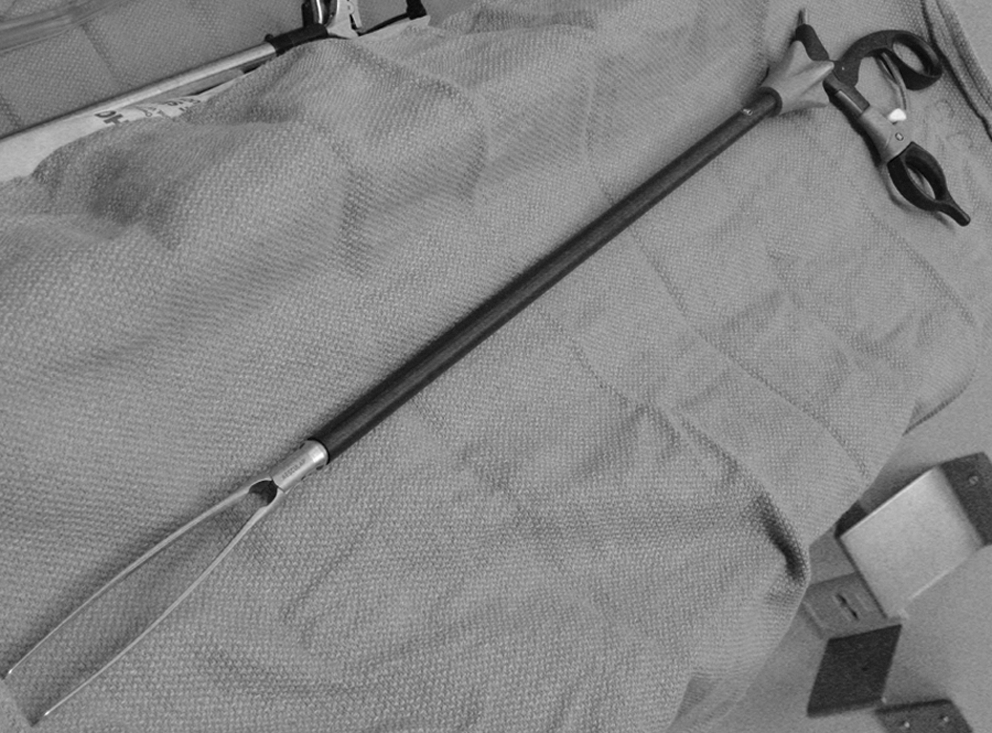
Laparoscopic Simon clamp for selective renal parenchymal ischemia.
Patients and Methods
After Institutional Review Board approval, a retrospective review of all RALPN using selective parenchymal clamping performed by four experienced minimally invasive renal surgeons at four high-volume institutions was undertaken. We described previously the technique and trocar arrangement for RALPN with selective clamping. All procedures in this study were performed using similar techniques, although there was some slight variation in the means of initial access and individual trocar placement. Use of the laparoscopic parenchymal clamp was based on individual surgeon discretion at each institution. During preoperative assessment, preference was given to patients with favorably located tumors, primarily polar lesions or small exophytic masses on the lateral convexity of the kidney.
Perioperative data, including clinical and pathologic outcomes, were retrospectively reviewed. Renal tumor complexity was assessed using the R.E.N.A.L nephrometry score as well as the need for collecting system repair. 12 Estimated glomerular filtration rate (eGFR) was calculated using the Modification of Diet in Renal Disease (MDRD) equation. 13
Results
Between August 2009 and August 2010, 20 of 88 patients who were undergoing RALPN were treated with regional ischemia for elective indications. RALPN with clamp use was successful in 17 (85%). In the three remaining patients, incomplete clamp compression at the distal aspect resulted in bleeding and decreased visualization necessitating parenchymal clamp removal and placement of a central hilar clamp for the completion of the procedure. All cases were completed robotically without need for open conversion.
As listed in Table 1, in 17 patients (8 men and 9 women) who successfully underwent parenchymal clamping, the mean patient age was 62.5 years with a median tumor size of 2.2 cm (3 cm polar, 1.4 cm interpolar). Median nephrometry score was 6 with 47% needing collecting system repair. Final pathology determination revealed renal-cell carcinoma in 71% with all surgical margins on frozen and permanent sections negative for malignancy (Table 2). Median total operative time was 190 minutes with a median parenchymal clamp time of 26 minutes. Mean estimated blood loss was 125 mL with an average stay of 3.1 days. No patient needed a blood transfusion, had a symptomatic urine leak, or needed hemodialysis postoperatively.
BMI=body mass index; ASA=American Society of Anesthesiologists.
JP=Jackson-Pratt; GFR=glomerular filtration rate.
There were two grade 2 Clavien-Dindo complications at 90-days follow-up, including one patient with a history of deep vein thrombosis in whom a pulmonary embolus developed and who needed anticoagulation therapy. 14 In 14 patients with 3-month postoperative or last follow-up triphasic CT, all affected kidneys showed good excretion of contrast per the official radiology report. At a mean follow-up of 6.1 months, no recurrences were noted in the 10 cancer patients with imaging.
Preoperatively, 6 (35%), 10 (59%) and 1 patient (6%) had National Kidney Foundation Stage I, II, and III chronic kidney disease, respectively. There was no significant difference in preoperative (median 86 mL/min/1.73 m2) and immediate postoperative eGFR (median 78 mL/min/1.73 m2, P=0.33) or with the most recent eGFR (median 78 mL/min/1.73 m2, P=0.54). Overall, 14 (82%) patients immediately and at last follow-up maintained a postoperative eGFR greater than 60 mL/min/1.73 m2. A 78-year-old man with a 7 cm (7x) polar mass and a clamp time of 40 minutes had a change in eGFR from 39 to 40 mL/min/1.73 m2 postoperatively that has decreased to 36 mL/min/1.73 m2 at 4-month follow-up. A 77-year-old woman with a 4.5 cm (7x) polar mass and clamp time of 24 minutes had a change in eGFR from 65 to 74 mL/min/1.73 m2 postoperatively that has decreased to 53 mL/min/1.73 m2 at 10-month follow-up. Finally, a 70-year-old man with a 3 cm (5a) polar mass and clamp time of 40 minutes had a change in eGFR from 86 to 40 mL/min/1.73 m2 postoperatively that has increased to 55 mL/min/1.73 m2 at 9-month follow-up.
In the three patients (all men) who needed subsequent central hilar clamping secondary to incomplete hemostasis with parenchymal clamping, the patient age was 74, 55, and 58 years. Tumor characteristics included 5 cm (7a) and 2 cm (6x) polar lesions and a 6.8 cm (6p) interpolar lesion. Combined parenchymal and hilar clamp times were 57, 18, and 42 minutes. At a mean follow-up of 2 months, the two patients (Patients 1 and 3) with preoperative stage 3 chronic kidney disease (eGFR 42 and 58 mL/min/1.73 m2) has slight worsening of renal function (eGFR 33 and 43 mL/min/1.73 m2) while the remaining patient's values (Patient 2) remain stable (eGFR 93 vs 93 mL/min/1.73 m2).
Discussion
With the prevalence of baseline chronic renal disease likely higher than previously expected, the current treatment of patients with small, clinically localized renal-cell carcinoma is focused on minimally invasive approaches that limit damage to normal renal tissue. 1,3 Although minimally invasive based renal hypothermia is possible, complete renal hilar clamping with warm ischemia remains the conventional method for the creation of a bloodless operative field during minimally invasive partial nephrectomy. 15,16 The duration of vessel clamping has been shown to be an independent predictor for the development of renal insufficiency, and limiting warm ischemia times to less than 30 minutes continues to be the primary modifiable technical factor during surgery. 4,5
In patients with ideal tumor locations—in particular, polar lesions or small exophytic masses on the lateral convexity of the kidney—selective parenchymal clamping has been used to create hemostasis while avoiding systemic warm ischemia. 6 –10 Animal studies suggest that renal function and intraoperative oxygenation profiles are improved during selective parenchymal clamping compared with complete hilar clamping, although diminished oxygenation levels are noted in the unclamped areas of the parenchyma as well. 17
We previously described our technique using a novel laparoscopic parenchymal clamp in combination with RALPN. 11 In this study, we present our initial multi-institutional experience using the laparoscopic Simon clamp to create a bloodless operative field during RALPN without hilar clamping. Overall, performance of RALPN using the Simon clamp was accomplished without hilar clamping in 85% of patients. Tumor complexity was notable for a median nephrometry score of 6 and collecting system repair needed in 47%. There were two grade 2 complications at 90 days with no patient needing a blood transfusion or noted with a symptomatic urine leak. All tumor margins were negative on frozen and final pathology determination with no evidence of recurrence in patients with follow-up imaging.
Previously reported methods of laparoscopic regional ischemia have ranged from loop tourniquets or bands to commonly used vascular clamps. 6 –9 With an open jaw diameter of 70 mm, the Simon clamp is novel in that it has a standard ratchet handle that can be locked into place, thereby preventing clamp sliding while curved jaws evenly distribute a constant and uniform pressure. 10 An additional benefit of the laparoscopic clamp is that it allows for immediate pathologic review of tumor/margin status without concern for warm ischemia as well as better visualization of all bleeding vessels through transient reduction in clamp compression. The laparoscopic clamp can be placed through any standard 10 mm trocar. Special consideration should be made, however, regarding the ideal trocar location for clamp placement to minimize contact with the robot arms during manipulation, and the console surgeon is reliant on the bedside assistant for careful positioning of the instrument.
The true benefits of regional ischemia in patients with preoperative renal insufficiency remain unclear. In this study, 82% of patients maintained a postoperative eGFR greater than 60 mL/min/1.73 m2. Use of the laparoscopic clamp, however, was based solely on individual surgeon discretion with no absolute criteria for size or location restriction, and patients were not specifically selected based on baseline renal function. At most recent follow-up, stage 3 chronic kidney disease has developed postoperatively in two patients undergoing parenchymal clamping. In three additional patients, central hilar clamping was needed for the completion of laparoscopic tumor excision because of incomplete hemostasis during parenchymal clamping. We minimally skeletalize the renal hilum at initial mobilization in all cases to allow for central clamp application relatively quickly, if necessary. In the two patients with baseline renal insufficiency, worsening eGFR at follow-up likely reflects the prolonged combined clamp duration, although no patient in this study has needed any additional renal support.
Formal statistical evaluation of both sets of patients is limited by the small total number of patients. The tumor size (6.8 cm) of the patient with the interpolar lesion necessitating subsequent hilar clamping, however, was much greater than the sizes (1.1–1.9 cm) for successfully completed interpolar masses. While the range of tumor sizes between successful and unsuccessful polar lesions was similar, our findings underscore that careful consideration during preoperative planning and counseling regarding adequate closure of the distal clamp jaws is needed to truly define which lesions are amenable to this treatment.
As noted in previous studies, parenchymal clamping may best be used in polar, exophytic lesions in which the parenchymal clamp may be positioned without hilar interaction. 6 –10 While very select lateral lesions may currently be amenable to regional ischemia, continued improvements in clamp design may permit additional use. Improved anatomic evaluation of the lesion and its associated extrarenal vasculature may also help define optimal patient selection. Previous cadaveric studies have described the variations in blood supply to different segments of the kidney. Continued improvements in three-dimensional volume renderings both preoperatively and intraoperatively as well as real-time duplex ultrasonography during resection may be beneficial to assess parenchymal clamp feasibility. 18,19 Further comparative studies with matched patients undergoing standard hilar clamping are needed to determine the ideal patient population, tumor characteristics, and true benefits in outcome that would occur from regional ischemia.
Conclusions
Our preliminary multi-institutional experience demonstrates that regional ischemia using a laparoscopic renal parenchymal clamp is feasible during RALPN to create a bloodless operative field. Careful preoperative selection of patients with optimally located renal tumors, in particular polar lesions, with respect to complete clamp jaw closure is needed for successful use of regional clamping. This technique may be useful in patients at high risk for renal damage after prolonged complete warm ischemia. Comparison studies are necessary, however.
Footnotes
Disclosure Statement
S. Duke Herrell is a consultant for Aesculap Inc. For the remaining authors, no competing financial interests exist.