




Abstract
Purpose:
The objective of this study was to investigate the patterns of renal function recovery with different renal vessel clamping modalities during a prolonged warm ischemia (WI) condition in an experimental two-kidney rabbit model.
Materials and Methods:
Twenty-eight rabbits were randomly clustered into four groups and underwent laparotomy with different types of renal pedicle clamping. Group 1 (n=4) was sham-operated. Group 2 (n=8) underwent 80 minutes of WI with artery only clamping. Group 3 (n=8) underwent arteriovenous clamping for 80 minutes, and group 4 (n=8) received an arteriovenous clamping for 80 minutes with 10-second declamping periods every 20 minutes. Serum levels of creatinine (SCr) were recorded preoperatively and on postoperative days (PODs) 1, 3, and 7. Renal function was evaluated by 99mtechnetium-mercaptoacetyltriglycine scintigraphy. Afterward, the animals were euthanized, and the kidneys were harvested and evaluated microscopically.
Results:
Renal function completely recuperated on POD 7 in the groups that underwent artery only and ateriovenous intermittent clamping, and both of these methods were superior to ateriovenous clamping (P<0.001). SCr showed a similar variation in all the clamping groups and did not demonstrate statistical differences among the groups. Histopathologic changes were similar among the ischemic groups.
Conclusion:
The less deleterious clamping modalities in this experimental model were the artery only and intermittent en bloc clamping methods.
Introduction
Thirty minutes of renal WIT is the generally accepted limit for ensuring complete recovery of renal function. 4 Another factor that influences this recovery is the method used to control the renal pedicle. Renal vessel control modalities necessitate experiments to determine the least deleterious method. Classical studies have shown that only clamping the artery is superior to arteriovenous clamping. 5 Some studies have been conducted on intermittent clamping, but these have shown controversial results. 6,7
We present an experimental model to investigate the effects of prolonged normothermic ischemia performed with three types of pedicle renal control. The objective of this study was to compare clamping modalities in a rabbit model by assessing renal function with 99mtechnetium-mercaptoacetyltriglycine (Tc-MAG3) scintigraphy and serum creatinine (SCr) levels and to investigate the histologic ramifications of each clamping method.
Materials and Methods
Experimental protocol
A total of 28 male New Zealand rabbits weighing 2 to 3 kg and aged approximately 3 months were used in this protocol. This study was approved by the Research Ethics Committee at the University of São Paulo Medical School (FMUSP), São Paulo, Brazil. The experiments were conducted between January 2008 and January 2009.
The renal functions of all animals were evaluated preoperatively by analyzing SCr levels and performing renal 99mTc -MAG3 scintigraphy. Animals with SCr >2.0 mg/dL or with abnormal scintigraphy findings were excluded from the protocol. The animals were housed in individual steel cages with dark-light cycles, and they had free access to water and industrial food.
Anesthesia was induced with an intravenous injection of 50 mg/kg ketamine, 10 mg/kg xylazine, and 2 mg/kg acepromazine and maintained by spontaneous ventilation with catheter oxygen at 3 L/min. Vital signs and oxygen saturation were monitored throughout the surgical procedure.
Animals were randomly assigned into one of four groups (1, 2, 3, and 4). The four groups underwent a midline laparotomy and soft dissection of the left renal pedicle under sterile conditions and anesthesiologic protocol. Prophylactic antibiotic treatment with 50,000 IU/kg benzylpenicillin was administered to all animals.
Each group of animals underwent different occlusion methods of the left renal pedicle using a miniature bulldog clamp (KLS-Martin™). Group 1 (n=4) was sham-operated. Group 2 (n=8) underwent 80 minutes of WIT with artery only clamping. Group 3 (n=8) underwent arteriovenous clamping for 80 minutes, and group 4 (n=8) underwent arteriovenous clamping for 80 minutes with 10-second declamping periods every 20 minutes. Intraoperative hydration was provided by intravenous administration of saline (10 mL/h). No heparin, mannitol, or furosemide was given to any animal. The right renal pedicle was not manipulated. The experimental protocol is illustrated in Figure 1.
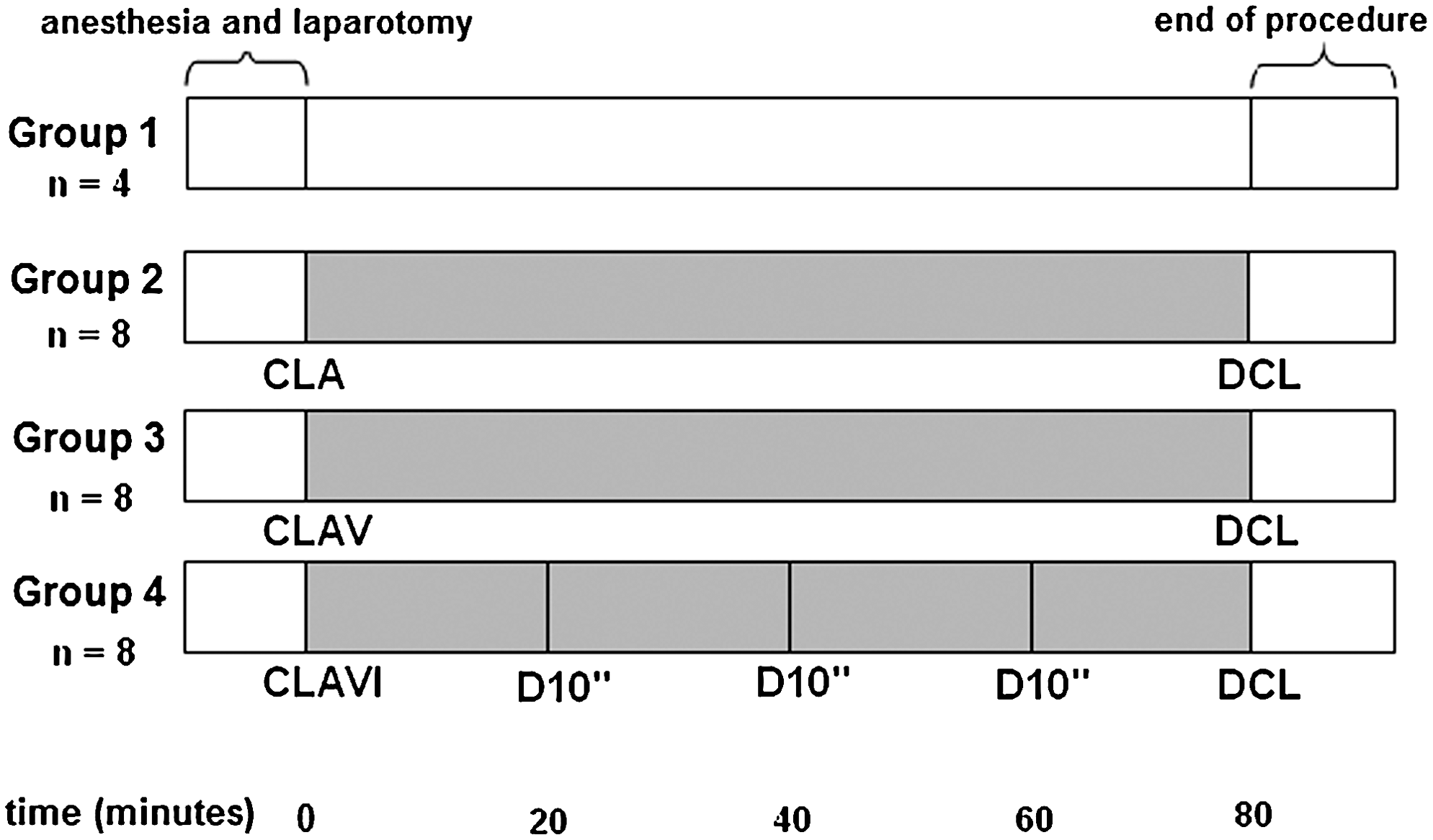
Experimental protocol. CLA=arterial only clamping; DCL=declamping; CLAV=arteriovenous clamping; CLAVI=arteriovenous intermittent clamping.
SCr levels were analyzed preoperatively and on postoperative days (PODs) 1, 3, and 7. Renal function was evaluated by 99mTc -MAG3 scintigraphy. Afterward, the animals were euthanized, and the kidneys were harvested and evaluated microscopically.
99mTc -MAG3 scintigraphy was performed for all animals at basal conditions (preoperative) and on PODs 1, 3, and 7. In addition, SCr was determined on the preoperative day and PODs 1, 3, and 7. On POD 15, the animals were anesthetized and then euthanized with a bolus intravenous injection of 5 mL pentobarbital to harvest both kidneys. An inventory of the abdominal cavity was performed to check for hematomas, urine collections, and organ damage. The kidneys were removed, cut transversally, and sent for histopathologic analysis. The organs were paraffin-embedded, and the largest diameter was cut, mounted onto slides, and stained with hematoxylin and eosin (H&E).
The H&E-stained slides were assessed by a uropathologist in a blinded fashion, and the findings were stratified by a semiquantitative score for ATN grading described by Klausner and associates. 8 Scores ranged from 0 to 4. Ischemic changes, such as tubular dilatation, cellular vacuolization, intratubular casts, and cellular necrosis, received a score of 0 for no lesions, 1 point for less than 5%, 2 points for 5% to 25%, 3 points for 25% to 75%, and 4 points for more than 75% of cortical extension.
Statistical analysis
Changes in renal function between the ischemia and control groups as determined by 99mTc -MAG3 scintigraphy were analyzed using the analysis of variance test. For different periods in the same animal, the scintigraphic results were analyzed by the Tukey test. The Kruskal-Wallis test was used to compare histopathologic scores. SCr was treated as a continuous variable and is presented as the mean±standard deviation.
The experiment was completely randomized. All statistical analyses were conducted using the SPPS 14 software. A 5% significance level was adopted (P<0.05).
Results
Renal scintigraphy showed equal damage for the three groups in the first 24 hours, with no statistical difference in left kidney function loss (P=0.165) in this period. On POD 3, there was a statistical difference (P=0.006) between groups 3 and 4, demonstrating the superiority of the declamping factor for renal function protection (Figure 2). On POD 7, group 2 showed better renal function (P<0.001) than group 3, and group 4 was also superior to group 3 (P<0.001). On POD 7, there were no significant differences between groups 2 and 4. Functionally, the selective and intermittent warm ischemia (WI) techniques were better than a nonselective one. These results are shown in Table 1 and Figure 2.
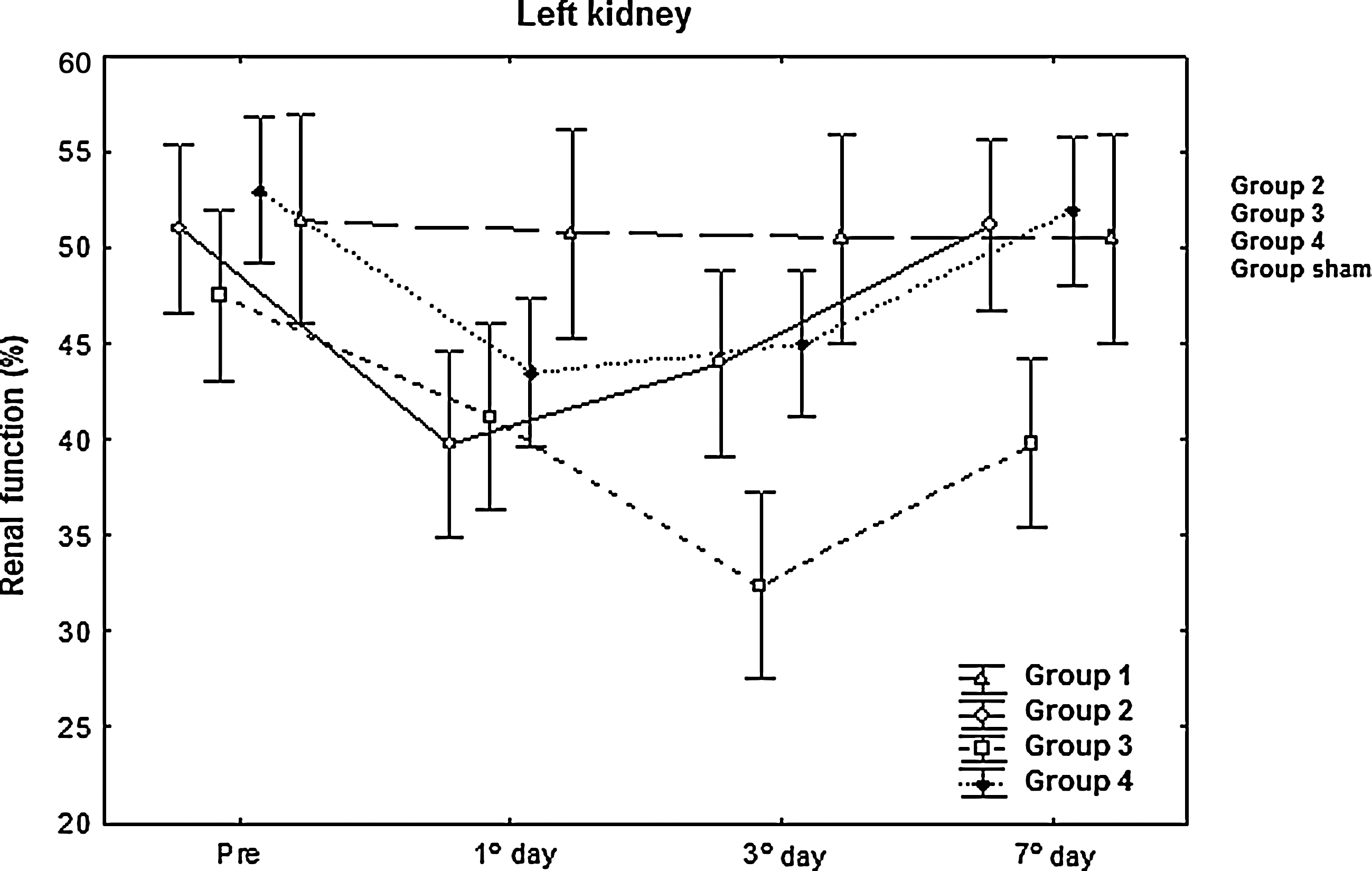
Descriptive graphic of renal function by 99mtechnetium-mercaptoacetyltriglycine scintigraphy among the groups at the different time points.
P value – analysis of variance.
Mean±standard deviation.
Values with at least one symbol (a b c) differ with statistical significance by Tukey test at a level of 5%.
Groups: 1=sham; 2=selective; 3=arteriovenous; 4=intermittent arteriovenous.
Histopathology for the three clamping modalities showed similar changes for cellular necrosis, tubular dilatation, cellular dilatation, and intratubular casts without statistical differences among the ischemic groups (P<0.05). No damage was observed in the right kidneys or in the sham group. Figure 3 shows some microscopic findings of ATN. Figure 4 demonstrates ATN grading distribution among ischemic groups.

Microscopic findings:

Acute tubular necrosis grading distribution among ischemic groups.
SCr showed a significant variation among the ischemic groups, with increased levels on POD 1 and 3 (P=0.002 and P<0.001, respectively). Mean SCr levels for the ischemic groups on POD 1, 3, and 7 were 1.26 mg/dL (±0.24), 1.51 mg/dL (±0.27), and 0.87 mg/dL (±0.2), respectively; these values were similar among the different clamping groups. On POD 7, SCr in the clamping groups returned to basal levels, with no significant difference compared with controls (P=0.06). The mean SCr levels are demonstrated in the Table 2.
P value – analysis of variance.
Mean±standard deviation.
Values with at least one symbol (a b c) differ with statistical significance by Tukey test at a level of 5%.
Groups: 1=sham; 2=selective; 3=arteriovenous; 4=intermittent arteriovenous.
No complications or side effects of the procedure were observed in this study.
Discussion
Partial nephrectomy has become the gold-standard treatment for localized renal neoplasms. 9 The literature shows oncologic results equivalent to those of radical nephrectomy and better functional long-term results because of the preservation of maximal renal parenchyma in patients with T1a and T1b renal masses, even those with a normal contralateral kidney. 10 There is much interest in techniques that minimize damage from WI injury during nephron-sparing surgery, 11,12 but it has not yet been determined which model of pedicle clamping or control is the least deleterious. 13
The present study compared selective occlusion of the left renal artery with en bloc occlusion and intermittent occlusion of the renal pedicle. The scintigraphy results show a similar functional impact among the ischemic groups on POD 1. The early ischemic damage was probably similar among the groups, and this was likely because of the WIT rather than the clamping method.
On POD 3, the scintigraphy data show a statistically significant difference between groups 3 and 4 (P=0.006), demonstrating the advantage of the intermittence method. On POD 7, groups 2 and 4 showed no significant difference in terms of the scintigraphy results, but both groups demonstrated better renal function than group 3.
Intermittent clamping is a common maneuver in hepatic surgery. 14 Even in short periods, it has the advantage of washing out catabolites produced by anaerobic metabolism and reoxygenating renal tissue. The blood flow facilitated by intermittence leads to a substantial gain in oxygen saturation (PaO2) because the oxygen gradient between the renal artery and vein is small. In laparoscopy, studies have shown that the benefit of selective arterial clamping is reduced or removed when vein compression by CO2 pressure is applied. 15
Our data indicate that clamping the pedicle en bloc with intermittent declamping can result in reduced deleterious renal effects compared with arterial only clamping. This method should allow for dissection in a near bloodless field, an important factor for ensuring the optimal oncologic outcome that must remain the focus of partial nephrectomy regardless of the approach.
We tested animals with 40 and 60 minutes of ischemia in the preproject phase, and we did not observe any important functional impact. Therefore, we chose 80 minutes of ischemia as a prolonged ischemic time to induce renal damage.
En bloc clamping may also be safer than other methods, because there is less chance of iatrogenic injury hilum vessel dissection. We have demonstrated that functional recovery is similar regardless of whether the artery alone is clamped or en bloc intermittent clamping is used. In addition, some surgeons prefer to not leave the vein patent to avoid continuous bleeding. 16
Histologic examination showed that the three ischemic groups had ATN findings, and there was no significant difference among them. The most important factor that best represents ischemic damage is the degree of cellular necrosis, which was similar among the ischemic groups. The histologic results did not correlate completely with the functional outcomes.
Resilience to renal ischemia in rabbits has been studied in several articles. Tyritzis and colleagues 12 showed a functional recovery after 60 minutes of WI. Dahlager 17 (1978) and Lyrdal and coworkers 3 demonstrated good tolerance of up to 90 minutes of WI in a one-kidney rabbit model. These results are similar to those of our study. Other studies have shown conflicting results about intermittent clamping in ischemia. Wilson et al. 18 (1971) observed a harmful effect of intermittence in dogs. Truss (1971) observed an advantageous effect of intermittent clamping. 6 Stueber and associates 7 in a classic study about intermittent clamping of the renal pedicle showed no benefit of that maneuver.
The present study has some limitations. Experiments with small animals (mice, rabbits, etc.) are criticized because the kidneys of these animals present anatomic differences from the human kidney. Small animals have unipapillaries and unilobular kidneys, which are different from human kidneys, and their renal masses are proportionally greater than those of humans. Another limitation of this study is that we did not use laparoscopic intervention, and we therefore could not test the impact of pneumoperitoneum. SCr is not a completely trustworthy parameter because this model had two kidneys; however, we decided to keep the right kidney as a control for the left kidney and to use the 99mTc -MAG3 scintigraphy evaluation. In addition, we chose to keep the two kidneys because the current indications for nephron-sparing surgery are more comprehensive, and most patients have two renal units.
In this study, we evaluated the clamping modalities without the use of nephroprotectors, such as mannitol or furosemide, because we wanted to determine the effect of clamping type without any confounding factors. We use selective arterial clamping in our daily practice, because it is still the most accepted technique. More studies are necessary to confirm these data and to change the clinical practice. Further studies of intermittent clamping are needed to justify its use in the surgical routine.
Conclusion
In this model, the most protective renal pedicle clamping modalities were the selective arterial and the intermittent arteriovenous techniques. In this study, the animals showed renal function recovery from 80 minutes of normothermic ischemia with either a selective clamping or an intermittent clamping procedure.
Footnotes
Acknowledgments
This study was supported by São Paulo State Research Foundation (FAPESP), grant number 08/58420-7. We also want to express our thanks to the Nuclear Medicine Division, Department of Radiology, University of São Paulo School of Medicine, São Paulo, Brazil.
Disclosure Statement
No competing financial interests exist.