




Abstract
Background and Purpose:
Impaired irrigation causes reduced visibility in flexible ureteroscopy. The aim of this ex-vivo study was to investigate the impact of working tools on light transmission in a medium as an objective measurement of visibility in flexible ureteroscopes.
Materials and Methods:
Five ureteroscopes (Viper, Cobra, FlexX2, URF-P5, DUR-8 Elite) were evaluated. The endoscopes were placed into a dark chamber with a photo diode, measuring light transmission. Light transmission was measured in a clear liquid and a 2% ink solution to simulate impaired vision. The time needed to restore light transmission by clear irrigation inflow was measured. Measurements were carried out five times, with empty and loaded ureteroscopes (1.7F, 2.2F basket, 273 μm laser fiber).
Results:
The time needed to restore light transmission as a measurement of visibility depends on tool size and the length of the working channel. The presented setup provides more sensitive results than the measurement of the irrigation flow rate. With empty working channels, the fastest restoration of light transmission (increase by 1000 units) was achieved with the Cobra dual channel device (25 s), followed by single channel DUR-8 (28 s), Viper (38.5), and Flex X2 (40 s). The ureteroscope with the longest working channel (URF-P5) needed the longest irrigation time to restore light transmission (66.5 s). These results become even more obvious with the use of different working tools.
Conclusion:
Measurement of light transmission is a sensitive tool to evaluate irrigation performance. Double irrigation is superior to single irrigation in terms of light transmission.
Introduction
Recently, two different approaches have been introduced on the market to overcome impaired visibility. One is the introduction of digital fURS (DUR-D™ [ACMI], URF-D™ [Olympus], and FlexX-C™ [K. Storz]), undoubtedly leading to high-quality, large, digitally enhanced scale pictures. 3 On the other hand, digital systems still have to prove their superiority in terms of clinical outcome. A second way was approached by R. Wolf (Knittlingen, Germany) by the introduction of a dual channel fURS for RIRS (Cobra™), promising to provide increased irrigation flow and, by that, increased vision.
Previous studies have investigated the influence of working tools on irrigation flow in single channel fURS. 4 Although it is accepted that irrigation is crucial to visibility, the measurement of irrigation flow volume remains an indirect measurement of vision. Consequently, it remains unclear as to what extent a certain decrease in irrigation flow in mL/min influences loss of visibility.
The purpose of this ex-vivo study was to objectively investigate the impact of working tools on light transmission as a direct measure of visibility in the latest generation of flexible fiber ureterorenoscopes and to compare those results to the performance of the newly introduced dual-channel fURS.
Materials and Methods
The light transmission of five flexible ureteroscopes (four single-channel fURS: Viper™ [R. Wolf], FlexX 2 ™ [K. Storz], URF-P5,™ DUR-8 Elite™ [Olympus/ACMI], and one dual-channel fURS, Cobra) was evaluated. All fURS were provided by the manufacturer after being sent through the manufacturer's quality control (Table 1). To measure light transmission, the following experimental setup was created. A chamber with adjustable chamber volume was constructed (Fig. 1). At the bottom of this chamber, a light diode was installed, measuring light transmission in total units (Fig. 2). The endoscopes were mounted into the dark chamber filled with clear irrigation fluid and at a predetermined distance to a light diode, measuring the maximum light transmission. At this point, light transmission was measured in clear liquid to determine a baseline value. Afterward, the irrigation in the chamber was displaced by a 2% ink solution (to simulate bleeding or turbid surrounding), without changing the position of the scope or the volume in the chamber (Fig. 3). Ink irrigation inflow was continued until the lowest level of light transmission was reached. Now, the time needed to elevate light transmission by 1000 units, by switching back to clear irrigation inflow was measured (LT1). LT1 thereby represents the time needed to increase the light transmission from the tip of the scope to the photo diode by 1000 units. To rule out light scatter from outside the chamber, a black rubber tube was placed over the chamber during all measurements.
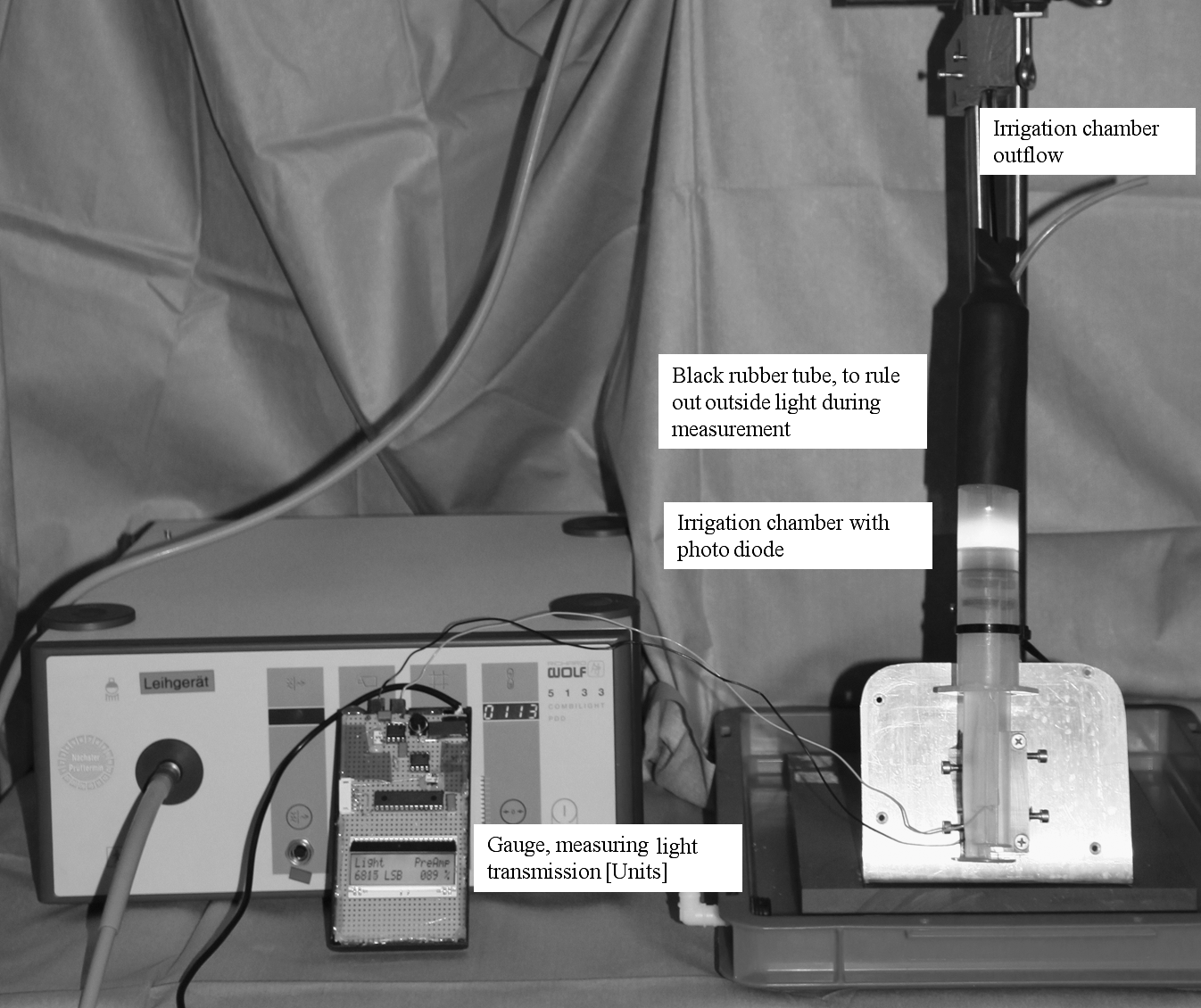
Experimental setup. The flexible ureterorenoscope (fURS) is mounted into a dark chamber with defined volume and defined distance to a photo diode measuring light transmission.
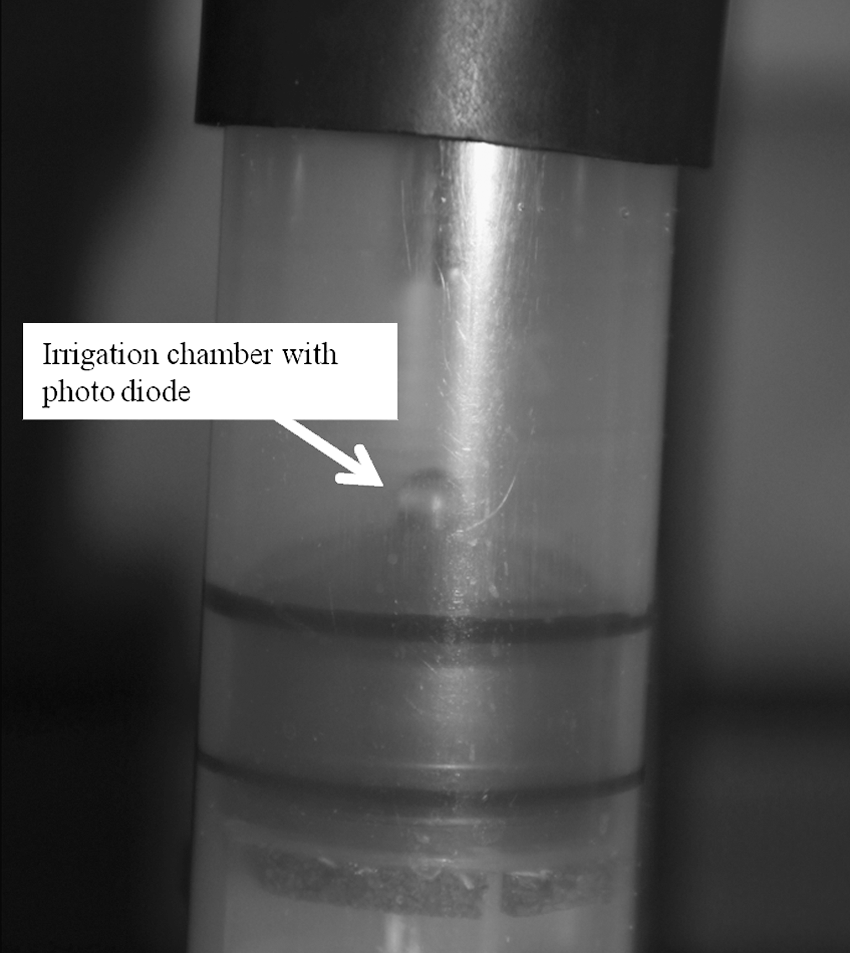
Photo diode at the bottom of the chamber measuring light transmission.

Chamber filled with ink solution, before the inflow of clear irrigation fluid.
The container with irrigation fluid was placed at a standardized height of 100 cm above each fURS irrigation channel. Measurements were performed with empty and loaded scopes, using a 1.7F and a 2.2F basket (NCircle, Cook, Bloomingtom, IN) and a 273 μm optical core (420 μm outer diameter) laser probe (LISA laser, Katlenburg, Germany). To minimize measurement errors, all measurements were performed five times, and mean values were calculated. All measurements were performed using the same light source and light delivery cable (R. Wolf, Knittlingen, Germany). An appropriate connective adapter was used where applicable.
Statistical analysis was performed with SPSS statistical software using the paired samples t test as appropriate. A P value < 0.05 was considered statistically significant.
Results
As expected, all tested ureteroscopes showed the highest level of light transmission in a clear surrounding. This level of light transmission dropped when the clear irrigation fluid was replaced by the 2% ink solution.
The time needed to increase light transmission by 1000 units was determineds to be dependent on two variables: The diameter of the working channel and the length of the working channel.
Comparing the four single-channel fiber fURS, one can see that the length of the working channel does have a relevant influence on the irrigation flow and by that also on light transmission. In the ureterorenoscope with the longest working length (URF-P5), the time needed to improve light transmission by 1000 units was, on average, two times as long, as in the fURS with the shortest working length (DUR-8 Elite).
The dual-channel fURS proved to have considerable shorter times needed to restore light transmission than all four tested single-channel fURS. The gain, thereby, becomes more relevant the larger the used working tool gets. Comparing the Cobra with the DUR-8 Elite, the difference with empty working channels is minor (10.7%). The gain in favor of the Cobra, however, increases up to 61.7 %, when testing the 2.2F basket. The results are summarized in Table 2.
P values compare single-channel with double-channel irrigation.
Discussion
RIRS has become a standard procedure for urinary stone disease in the whole collecting system. In particular, the ongoing development of flexible ureteroscopes has put RIRS into a position to treat virtually every point within the collecting system. The latest generation of fURS demonstrates improved durability and maneuverability. 1,5 Visibility is crucial in RIRS, however, and remains impaired in these devices, because of small caliber irrigation and working channels and subsequently a low volume of irrigation flow. Once working tools are introduced into the irrigation channel, irrigation flow decreases to a minimum or vanishes completely, depending on working tool size. 6
Digital fURS (as provided by Olympus/ACMI and Karl Storz) has been introduced to overcome the problem of low picture quality. Improved vision subsequently is supposed to improve clinical outcome. Already there is early evidence supporting the theory that digital fURS will lead to improved clinical outcome in terms of improved clinical applicability. 7,8 On the other hand, these early studies do have limitations because of the study design or the limited number of patients treated. Furthermore, digital systems may cause problems because of the larger caliber size of the ureteroscope, which is determined by the size of the optical chip at the tip of the instrument. Another way to improve visibility was approached by R.Wolf (Knittlingen, Germany) with the introduction of a dual-channel fURS for RIRS (Cobra™), supported by the idea that increased irrigation flow will consequently provide increased vision.
Previous studies investigated the influence of working tools on irrigation flow in single-channel furs. 4,6,9,10 The measurement of irrigation flow volume, however, remains an indirect measurement of vision, Especially since the differences in flow (mL/min) become minor with increasing size of the working tool. Consequently, it remains unclear how much a decrease in irrigation flow in mL/min objectively influences loss of visibility.
The hypothesis that irrigation flow in mL/min may not be the perfect tool to measure the influence of working tools on flow rate is supported when analyzing previously published data. Comparing the above presented data with data from the authors' own group published in 2008, Bach and colleagues 6 showed that of course with increasing size of the used working tool, the irrigation flow rate decreases. Differences in flow rate, however, as a result of different working size length were not detected in this previous study. Abdelshehid and associates 10 compared flow rates in flexible ureteroscopes with a standardized irrigation pressure of 100 mm Hg. Although only the ACMI DUR-8 Elite was also tested in the above presented series, the authors found similar results that showed decreased irrigation flow with increased working tool size. In contrast to the above presented results, the differences in flow rates with loaded scopes were minor, again suggesting that flow rate in mL/min may not be the optimal evaluation parameter. 9 Another work, presented by Pasqui and coworkers 11 in 2004, measured flow rates with different working tools in an older generation of flexible ureteroscopes.
Comparing the presented data in this study, again working flow decreases according to tool size. When comparing the working flow with the length of the irrigation channel, however, the data are diverse, showing higher flow rates in ureteroscopes with longer irrigation channels. Summing up the results of previously published studies dealing with the topic of working flow in fURS, the authors believe that measuring light transmission is a more sensitive and accurate approach to evaluate flow rate.
Consequently, the above presented results serve two different purposes: First, to evaluate an objective parameter of visibility, namely light transmission, through a dyed irrigate surrounding, simulating bleeding or impaired vision. Measuring the increase of light transmission during clear irrigation inflow by a defined range (1000 units) serves as an objective and very sensitive parameter of flow performance. Differences between the tested ureteroscopes are more precise than compared with studies measuring simply flow volume in mL/min. 6,10,11 Comparing the data from our previous study, 6 measuring flow rates in mL/min, the difference between the FlexX 2 and the URF-P5 is only 0.4% when measuring flow rates with a 2.2F basket in the working channel. On the other hand, the reduction of the flow rate with the 2.2F basket is in both ureterorenoscopes more than 80% (82.9% vs 83.3%). Comparing this data with the results of the above presented experimental setup, the difference in light transmission increase becomes even more evident (Table 2), showing almost a 1.5 fold increase in time needed to restore light transmission with a 2.2F basket in the working channel.
The second aim of this study was to compare those results with the performance of the newly introduced dual-channel fURS. According to the manufacturer, this dual-channel design is supposed to deliver significantly higher amounts of irrigation flow into the kidney and thereby provide clear vision much faster. The presented results show that the Cobra device de facto achieves shorter times to restore light transmission in our setup. This advantage pays off the larger the size of the used stone retrieval basket becomes. Although irrigation performance is superior with a double-channel ureteroscope, one has to keep in mind that two irrigation channels may possible lead to compromised handling by needing, for example, two irrigation tubes. Therefore, clinical evaluation of this newly introduced Cobra device seems mandatory.
The presented results suggest that irrigation flow (mL/min) may not be the optimal tool to compare the in-vitro performance of ureterorenoscopes, because this measurement seems to be to imprecise. The clinical impact of the presented results, however, needs to be determined. Knowing the data about flow capacity and light transmission may help to choose the proper ureteroscope for the correlating clinical situation.
A possible limitation of the introduced model is that digital ureteroscopes cannot be measured with this experimental setup. Most of the digital URS use a feedback connection with the light source to regulate the light intensity once the scope comes close to the ureteral surface. This mechanism is used by the manufacturers to avoid crossfading of the image. The problem in our model is that up and down regulation of the light intensity varies, of course, with the measurement of light intensity. Therefore, digital ureteroscopes cannot be easily compared with fiberoptic ones. For conventional instruments, however, the proposed model presents a precise approach to measure the influence of different working tools on irrigation flow.
Conclusion
Measuring light transmission is a sensitive and precise instrument to assess flow rates in fURS. The caliber of the used working tool and the length of the working channel influence the irrigation flow and, by this, the time needed to restore light transmission. Double irrigation during fURS is superior to single irrigation in terms of flow rates as measured by light transmission. The larger the diameter of the used working tool becomes, the higher the gain using dual-channel irrigation becomes.
Footnotes
Acknowledgments
The authors wish to thank Dr. H.O. Teichmann and his team from LISA laser for the support in building the measuring unit and the patience during the information transfer in the basics of light transmission. Furthermore, we would like to thank the manufacturers (R. Wolf, K. Storz, Olympus/ACMI) for the unrestricted participation in this evaluation.
Disclosure Statement
AJ Gross and T Bach are consultants for Cook Urology. No competing financial interests exist for the other authors.