




Abstract

Croes Council
Jean de la Rosette, M.D.
Amsterdam (The Netherlands)
Adrian Joyce, M.S.
Leeds (UK)
Stavros Gravas, M.D.
Larissa (Greece)
Margaret Pearle, M.D.
Dallas, TX (USA)
Dean Assimos, M.D.
Wake Forest, NC (USA)
Ying-Hao Sun, M.D.
Shanghai (China)
Tadashi Matsuda, M.D.
Osaka (Japan)
Treasurer
John Denstedt, M.D.
London (Canada)
Office Manager
Sonja van Rees Vellinga
Amsterdam (The Netherlands)
Mission
Through worldwide collaboration, CROES seeks to assess, using evidence based scientific methodology, the various aspects of clinical endourology.
Vision
By applying rigorous scientific evaluation to the field of clinical endourology, CROES will enable all urologic surgeons to bring to their patients the most effective and efficient care possible.
Projects
Global PCNL study
Global URS study
Global Greenlight Laser study
Global Renal Mass study
Global NBI study
Contact
For more information please contact Sonja van Rees Vellinga (
News From Croes: Wce 2010 and Beyond
Jean de la Rosette and Stavros Gravas
The 28th World Congress of Endourology and SWL was held in Chicago last September with great success. The presence of CROES was loud and strong, while in addition some new interesting features came into light.
Annual Progress Report
The Endourological Society allocated a timeslot to CROES to give the Council the opportunity to present the progress that has been made since the founding of the office during the WCE meeting 2008 in Shanghai. Jean de la Rosette, in his function as chairman of CROES, gave a lecture on “CROES update,” in the Plenary Session. At that occasion he highlighted the changing attitude towards clinical research.
The challenge in endourological research is to transform the global perception of ‘value of research findings' into one of ‘value in participation.’ On one hand, clinical trialing is increasingly bureaucratic and expensive, placing a greater burden on investigators in terms of compliance, documentation, and training. In order to increase participation one needs to lower barriers and the burden of participation. Given the overwhelming response by the many participating centers to the first study by CROES on percutaneous nephrolithotomy (PCNL), obviously CROES is succeeding in meeting this goal. Moreover, there is a trend towards globalization of research and as such CROES is the ideal partner to become a member of a global network in endourological research.
Professor de la Rosette made a plea to improve the trial quality in the era of evidence-based endourology. One cannot ignore that at present we have plenty of room to further improve the quality of our research. When applying the Cochrane Collaboration checklist to many of our research papers, we often fail to mention the method of randomization, whether the assessor or the patients were blinded for the study, if Internal Review Board (IRB) approval was given and a signed consent was obtained or even a sample size calculation. It was underlined that the quality of our scientific work may be regarded as an audit of our clinical work and consequently reflects our scientific integrity. The initiative of the Endourological Society to establish CROES is a good step in the right direction. In line with this, CROES has become the premier platform for global endourological research. 1 As such, CROES promotes and supports international research in endourology, provides the infrastructure to support and conduct studies, and can serve as a platform for technological developments in partnership with industry. CROES aims also to ensure the ethical and scientific integrity of our clinical research globally, promote harmonization of international research, and provide information about benefits and risks of new devices among populations and environments worldwide. 1
Presentations and publications
At the occasion of the WCE meeting in Chicago, Professor de la Rosette announced that the first paper derived from the Global PCNL study has been accepted for publication in Journal of Endourology. 2 He quoted the comments from several reviewers including the following: “The paper details the basics of a large study of patients undergoing PCNL. It is a proof of principle that worldwide studies are possible. The next step, however, is to refine the data collection, inclusion criteria and standardize pre- and post operative management so that the study population will be more homogeneous” and “The paper is probably the closest we get to a true description of daily clinical practice throughout the world. Very valuable information.” In the meantime, a second paper was submitted to Journal of Endourology and three more manuscripts are in preparation. Based on the data available in the Database, the Publication Office of CROES estimates to publish over ten milestone papers within the oncoming year.
Five posters related to the PCNL Global study were presented in Chicago including P1: “The Clinical Research Office of the Endourological Society (CROES) percutaneous nephrolithotomy (PCNL) global study: indications, complications and outcomes in 5,803 patients;” P2: “Prognosticators of bleeding and operating time for percutaneous nephrolithotomy comparing different dilatation methods;” P3: “Tract dilatation in percutaneous nephrolithotomy: a global overview;’ P4: “Staghorn stones in the Global PCNL study: a comparison of outcomes between staghorn and non staghorn stones;” and P5: “Postoperative complications and Clavien score assessment in percutaneous nephrolithotomy” (Fig. 1). These posters triggered interesting discussions and exchange of opinions with the audience and underlined the importance of the PCNL Global study. To view these posters you are invited to visit the CROES website (
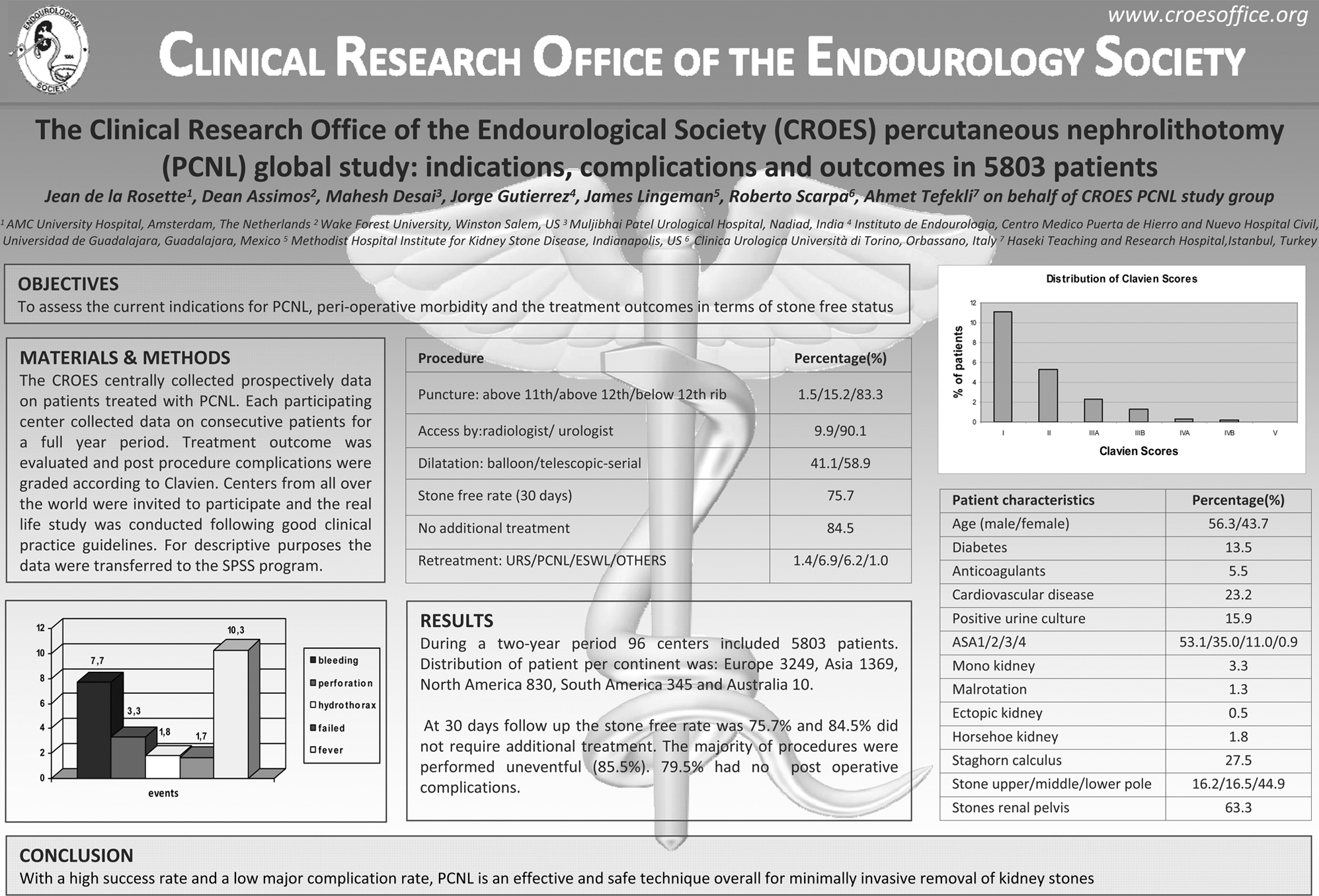
Example of poster presented at the WCE meeting in Chicago, Illinois, September 2010.
Ongoing CROES studies
Separate meetings of the steering committees of each project with the CROES Council and representatives from industry that support each study, also took place in Chicago. Participating centers are updated on a regular base by newsletter (Fig. 2). The current progress of each project was reported on, including: URS study: Over 5,000 patients have been included by 113 sites since the study was initiated in the beginning of 2010. We foresee that in this milestone study, close to 10,000 patients will be included and important new findings can be derived from this work. Renal Mass study: This study was also initiated in the beginning of 2010 and by now almost 1500 patients have been included in 80 sites. To our knowledge, this is one of the largest prospective international studies on the treatment of renal mass and the steering committee is confident to derive new insights from this work. Greenlight Laser study: This project was launched more recently, and thus far 30 sites have included nearly 300 cases. NBI study: This is the first randomized study coordinated by CROES. Forty sites have confirmed participation and we aim to include 1,000 patients worldwide. The study will help the endourological community establish the position of NBI in the treatment of nonmuscle-invasive bladder cancer.
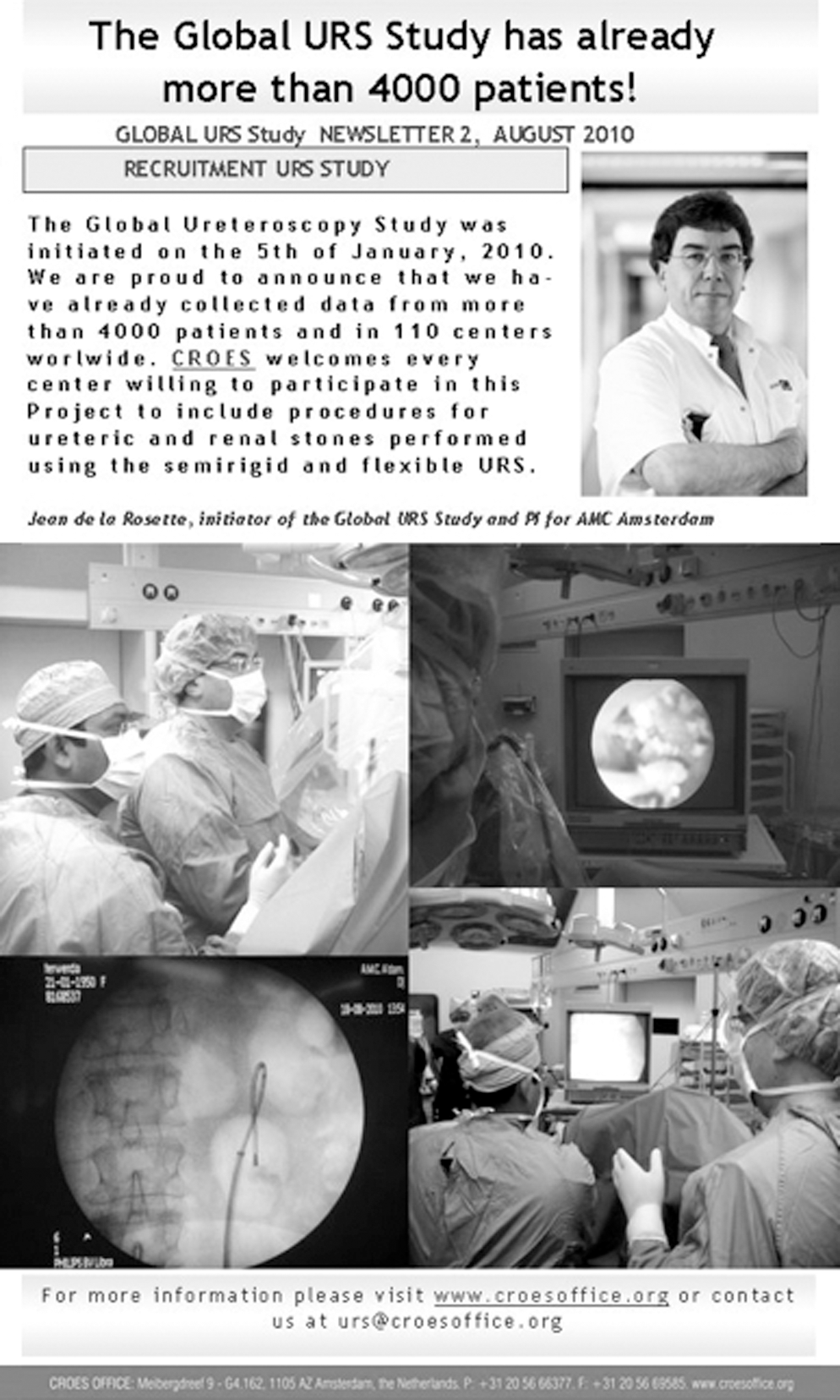
Example of newsletter sent to participants in each CROES study.
Quality assurance through audit
CROES is aware that we need to ensure the highest level of quality that can be achieved in the collection of the data. This can be achieved at different levels, including: Electronically: The unique web-based database management system includes some special features that enable the data to be audited electronically. This will put a minimal burden on the investigators and will not jeopardize the comfort to collect and document data. It will, however, help us to guarantee on an actual base the collection of reliable and viable data. Site visits: These may be included based on the information received from participating centers. Moreover, some centers may be selected at random to have an audit of their data provided.
In the transfer agreement signed by all participating centers the responsibilities are clearly stated. 3 Whilst all participants will contribute to further improved care for our patients in an altruistic way, we also need to safeguard that the conclusions made are impeccable and accurate. Thus an Audit Office will be installed and in future communications we will provide more information about this very important issue.
Last but not least, the Fund Run has become a tradition for the WCE. This year the 5K Fund Run was related to CROES. Dr. Ariel Shalhav and the organizing committee kindly decided to donate all funds raised by the participants who run along one of the most scenic routes by Lake Michigan and Chicago waterways. Competition was really high, but after all participation counts (Fig. 3). Thank you all for your offer that acknowledges and supports the efforts of CROES.
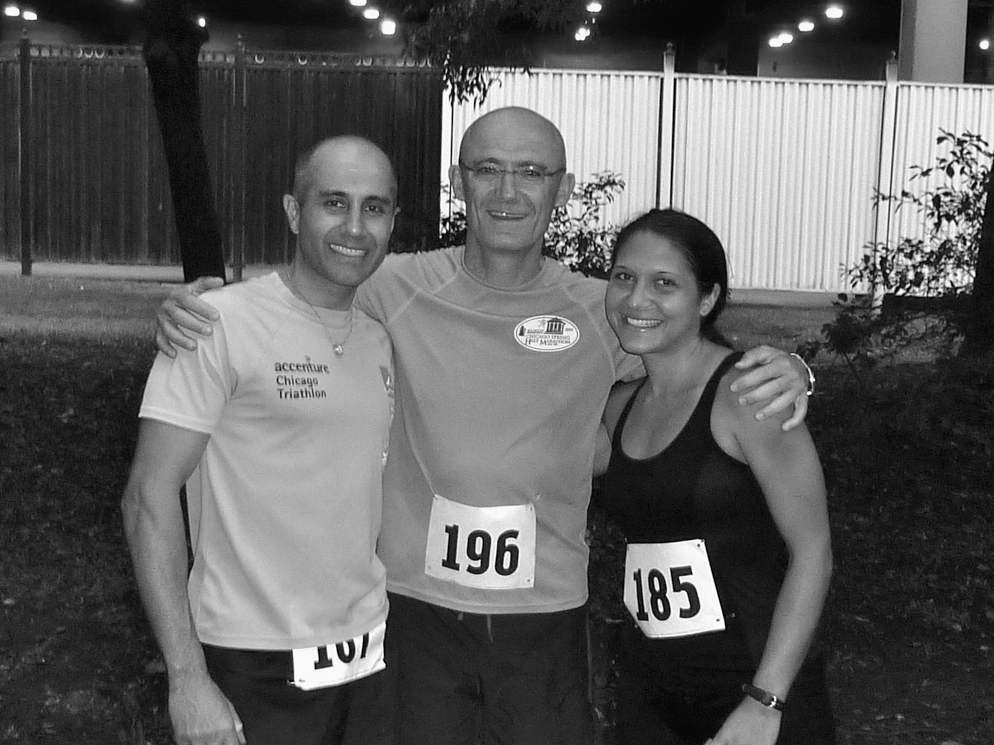
Impression from fund run event during the WCE meeting in Chicago, Illinois, September 2010.
Many participants visited the CROES booth in front of the exhibition area and received information from the Executive Office Manager Mrs. Sonja van Rees Vellinga. As a result, new centers have expressed their interest and willingness to participate in one or more of the ongoing or future CROES studies.