




Abstract

Croes Council
Jean de la Rosette, M.D.
Amsterdam (The Netherlands)
Adrian Joyce, M.S.
Leeds (UK)
Stavros Gravas, M.D.
Larissa (Greece)
Margaret Pearle, M.D.
Dallas, TX (USA)
Dean Assimos, M.D.
Wake Forest, NC (USA)
Ying-Hao Sun, M.D.
Shanghai (China)
Tadashi Matsuda, M.D.
Osaka (Japan)
Treasurer
John Denstedt, M.D.
London (Canada)
Office Manager
Sonja van Rees Vellinga
Amsterdam (The Netherlands)
Mission
Through worldwide collaboration, CROES seeks to assess, using evidence based scientific methodology, the various aspects of clinical endourology.
Vision
By applying rigorous scientific evaluation to the field of clinical endourology, CROES will enable all urologic surgeons to bring to their patients the most effective and efficient care possible.
Projects
Global PCNL study
Global URS study
Global Greenlight Laser study
Global Renal Mass study
Global NBI study
Contact
For more information please contact Sonja van Rees Vellinga (
Sonja van Rees Vellinga and Jean de la Rosette
The Clinical Research Office of the Endourological Society (CROES) aims to promote and support high quality international patient-centered research in a transparent way and to facilitate the implementation of research projects by creating a global network and providing the infrastructure to conduct such multicenter studies, including evaluation of the quality of the project, data collection, statistical analysis and preparation of manuscripts. 1,2
The PCNL study (concluded December 31, 2009), was the first study to assess if a global study would be feasible. In total, 5,803 patients were treated in 96 centers and were enrolled in the PCNL database. 3 It was shown that, indeed, a global network and large global studies within endourology are feasible. At this moment, four other projects with a large amount of data are being conducted within CROES. The Global URS study database already consists of 7,000 cases and the Renal Mass study database includes 2,000 patients. The Greenlight Laser study and the NBI study for bladder cancer are also expected to provide us with data in 1,000 cases. CROES recognizes the importance of the reliability and safety of such a large database and the validity of data collection. CROES constantly aims to improve and professionalize the procedures and processes. The Data Management System (DMS) was established to guarantee the quality of data collection.
Data Management System
The data from CROES studies are collected through a web-based data collecting and management system. It is a reliable and user-friendly program by which the users can collect data with a single username and password for all CROES studies. The system can be accessed through the CROES website:
The DMS consists of several parts, among these the main program, the “heart” of the system, which enables users to connect and to enter data. Secondly, all data entered by the users, login activity and history files are defined in multiple databases. The DMS contains a program that generates inclusion overview reports and a program that automatically runs queries to check for inconsistencies in the data collected. These programs enable the CROES team to constantly monitor the progress of the study and the individual centers. For a schematic overview of the system see Figure 1.
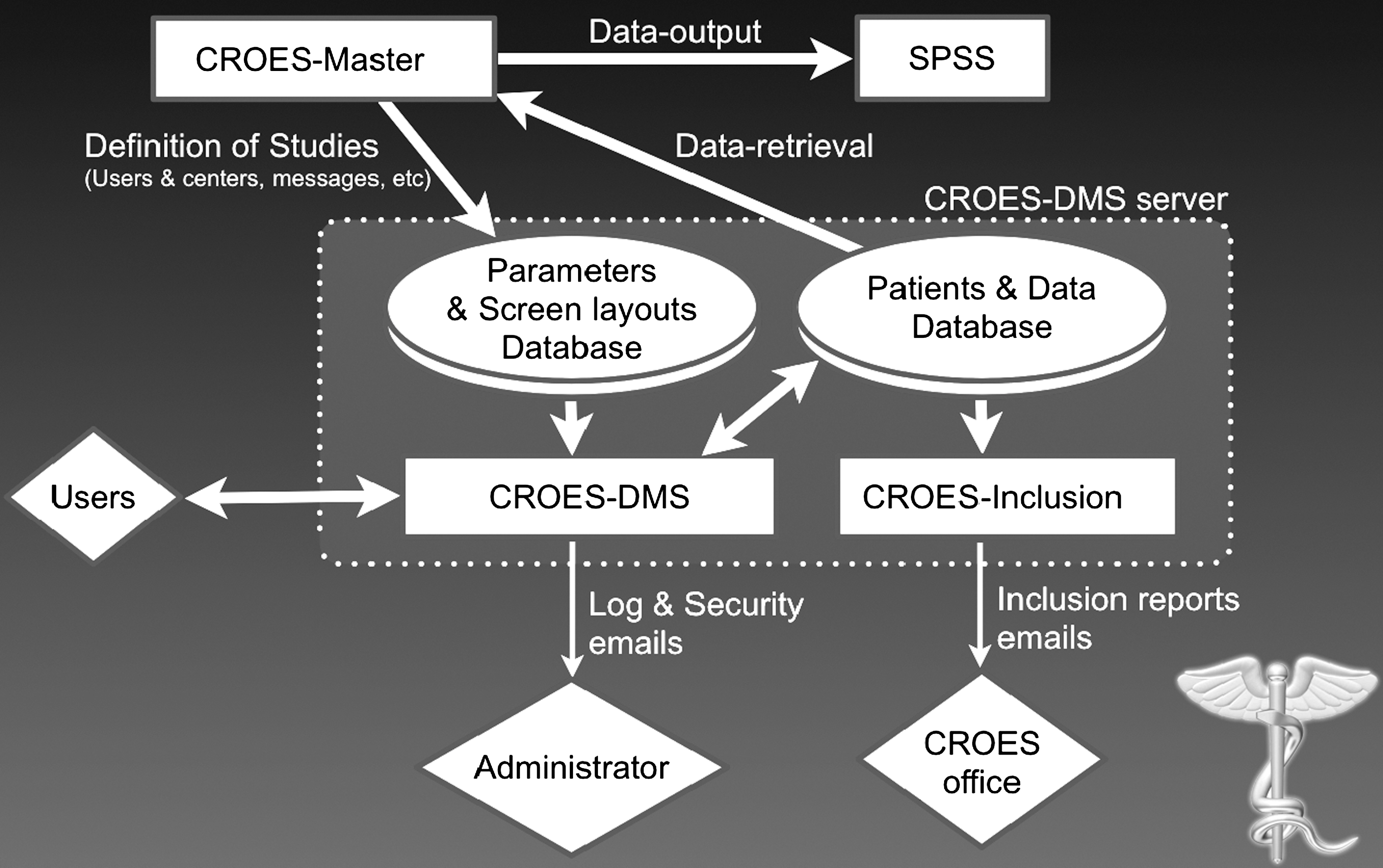
CROES Data Management System. CROES = Clinical Research Office of the Endourological Society; DMS = data management system.
Last, but not least, for the design and definition of new studies a specialized program, running at the CROES office, generates the data-entry layouts and parameter definitions. After approval by the involved steering committee, the results are uploaded to the study definition databases on the server, and the study can be opened for data entry. In this way, new studies can be defined without changing any software at all, which decreases the likelihood of errors.
Security
It is of great importance for CROES to ensure a high level of security for data collection. To guarantee safety, the system is located on a secure server in a secure environment with multiple high-speed connections to the Internet. The system, hosted by a professional company, is located in a building that has a high level of security (physical access only by a limited number of people), has its own redundant power supply (including a master backup power generator in case of a general power failure), and has a data backup system (including backup in a separate secure building). The up-time is guaranteed to be higher than 99%. The connection to the system, via htpps, is encrypted for a reliable and secure data transfer.
Monitoring activity and progress of data collection
All data are controlled daily by CROES data managers to ensure a reliable dataset. The data managers communicate with the researchers in case of questions, inconsistencies or missing data. The reports regarding the inclusion of patients in the studies are generated automatically at a predefined time by the system and are sent to the CROES team. In this way a continuous monitoring of the progress of data collection is achieved. For an example of the inclusion reports that are generated weekly see Figure 2.

Example of inclusion per week in the Global Ureteroscopy (URS) study.
CROES recommends entering data in the system as soon as possible after the data become available, preferably at the operating theatre or on the day of operation. Not doing so may result in large amounts of data that still have to be entered and can furthermore easily result in missing data that takes a lot of effort to resolve.
The inclusion rate of each individual center is monitored by the automated generated graphs as shown in Figure 3. These graphs are used to control and monitor the rate of inclusion per center. If such an inclusion rate decreases or stops, the data managers can take the appropriate actions to encourage centers to keep including new patients. For all studies it is essential that all consecutive cases are recorded in the database.
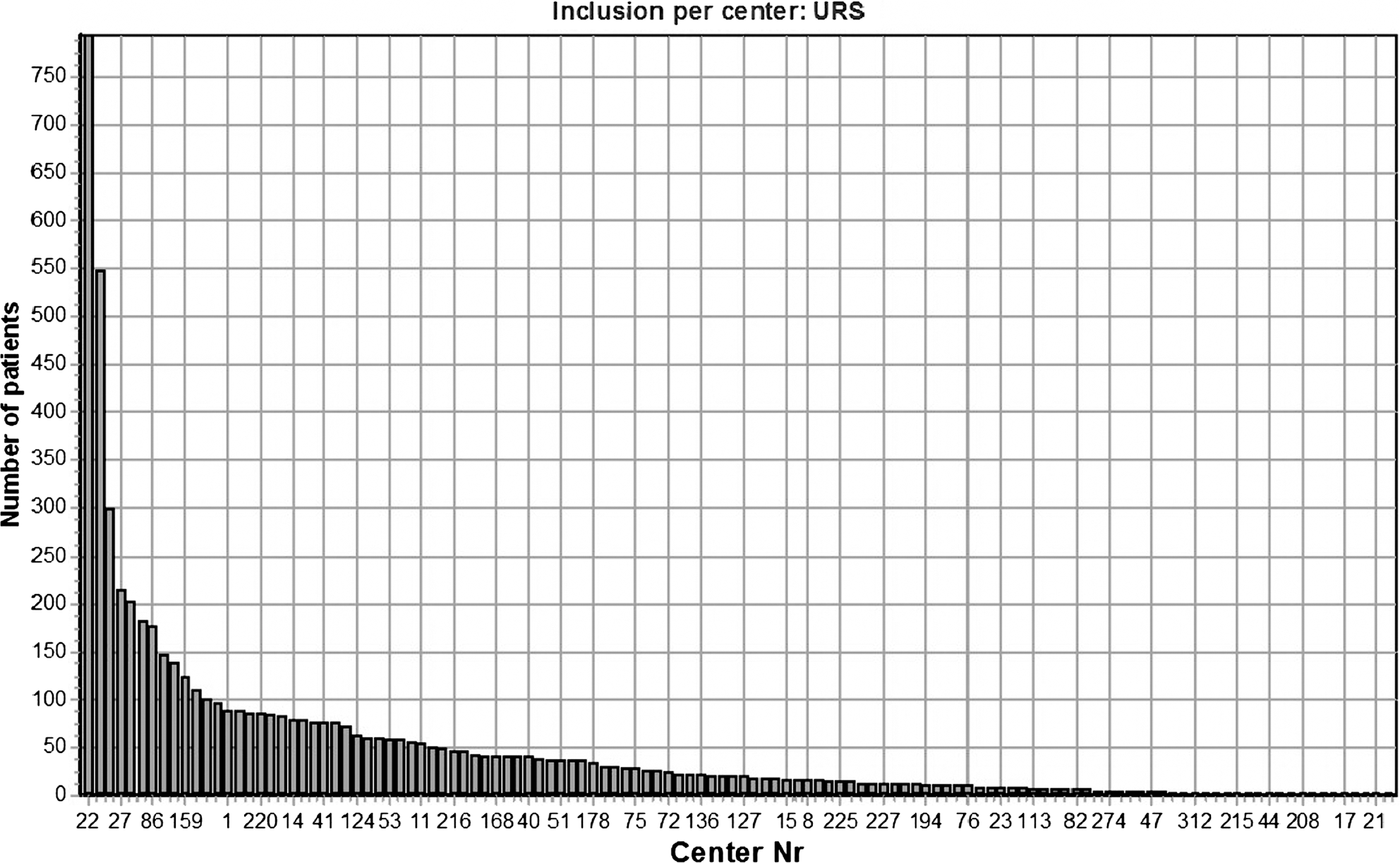
Example of inclusion per center in the Global Ureteroscopy (URS) study.
The activity of all users from all centers is monitored. Each login attempt will automatically generate a notification that is sent to the CROES office. All activity, such as entering a study, adding a patient, entering data and changing data is also stored in a log database, including date and time. This enables the CROES office not only to monitor all activity, but also to use this information for further optimization of the system.
To further improve the reliability of the data, the CROES audit committee can decide to initiate audits randomly or based on the data entered. The audit committee is responsible for preparing guidelines, supervising the audits and reporting on the audit outcome to the CROES council, the steering committees of each study and to all participants. The data management system includes some special features that enable the data to be audited electronically. This will put a minimal burden on the investigators and will not jeopardize the ease of collecting and documenting data. It will, however, help us to guarantee on an actual base the collection of reliable and viable data.
To ensure good quality data collection, CROES is constantly improving and evaluating the Data Management System. CROES is you; therefore, send us your feedback or suggestions to further improve this common effort. The time is now—with CROES, the ability is yours. 4
Frequently Asked Questions
1) Q: How do I…?
A: There is a help file present in the system. It can be downloaded by clicking the appropriate links in the system. We do advise that you read this help file because it contains all the information needed to be able to use the system in the most optimal way.
2) Q: Help, I lost my password.
A: People tend to forget their user name and/or password. On the login page of the data management system, you will find two links by which you can request sending your user name and/or password. The requested data will be sent to your entered email address as known by the CROES data management system. Please note that always after login with a new password you will have to change the password. This new password is stored encrypted in the user database. Therefore, nobody has access to your personal password.
3) Q: Do I have to sign a contract?
A: Depending on the study, you will have to sign a contract and/or the first time you enter a study you will need to agree with some statements. By signing and/or agreeing, you state, for example, that you will do your utmost best to collect data and to enter it correctly.
4) Q: I want to enter inches instead of centimeters, or I would like to change the date format.
A: After login, in the welcome page, you can change your preferences regarding units (metric or imperial), the date format and the use of a period or comma as decimal separator. You only have to do this once. The system will remember your choices.
5) Q: Is there help available while entering data?
A: While entering data, for every field there is a hint available. If the mouse pointer is kept still for a few moments above a field, the hint will become visible. Furthermore, there is a status line at the top of the data entry pages that also shows the hint, and in some cases will show some additional information (see next).
6) Q: After entering data my field displays a color. What does that mean?
A: All fields can have several data checking algorithms. If you enter a wrong value, for example, text where numeric input is requested, the field will be colored red, and the status line will show an error message. Errors should be corrected, because with errors you cannot save the data. If a value is out of some warning range, you will get a warning, and the status line will show, for example, “Are you sure you entered a correct value?” For more information please read the available help file.