




Abstract
Background:
Various techniques are available for intracorporeal disintegration of renal and ureteral stones, among them ballistic lithotripsy, ultrasonic lithotripsy and laser lithotripsy. The therapeutic effectiveness of these devices has been sufficiently studied and compared. This does not apply, however, to the risk of destroying the stone basket.
Materials and Methods:
The time until destruction of the wires of various baskets with use of four different lithotripsy devices (LithoClast, EMS; LithoRapid, Olympus; Calcuson 27610029, Storz; Vera Pulse, Coherent) was measured in a model closely aligned with the clinic.
Results:
As expected, the direct application of laser pulses (wavelength 2.1 μm) irrespective of thickness and shape led to a melting of all wires of the stone extraction basket in less than 50 seconds (pulse energy: 800 mJ, pulse repetition rate: 8 hertz; fiber diameter: 365 μm). The purely kinetic functioning lithotripters (electrokinetic-ballistic and pneumatic-ballistic) were not able to destroy any wire within the set time limit of one minute. The sonotrode of the ultrasonic device, which is considered to be very tissue-conserving, separated all wires of baskets with a diameter of 1.8F (4 wires), 75% of baskets with a diameter of 2.5F (9 of 12), but only 8.3% of baskets with a diameter of 3.5F (1 of 12). Plaited wires demonstrated a good resistance (0 of 4) in comparison with the sonotrode.
Conclusion:
Our study consequently shows that in addition to the laser, the ultrasonic probe can also easily destroy nitinol (nickel titanium) baskets.
Introduction
The further development of instrumental technique toward extremely thin and even flexible ureteroscopes as well as modern lithotripsy procedures with various energy sources has once again placed special emphasis on endoscopic and percutaneous minimally invasive techniques. 2
One procedure frequently performed in Germany is endourologic lithotripsy. Superelastic baskets are often used to stabilize the stone during the intervention. These baskets are made of nitinol, a shape memory alloy of nickel and titanium (melting point ∼1300°C). 3 Stone extraction baskets have been described to be frequently accidentally destroyed. 4 This severing of wires can lead to ureteral trauma because of hook formation. 5
This study was designed to investigate to what extent and how quickly which lithotripsy instrument causes the destruction of stone baskets.
The described fragmentation is well known for the holmium laser: Noldus 6 urges caution during simultaneous stabilization with the stone extraction basket during stone treatment. An overview of accidental fragmentation of dormia baskets and guidewire showed that this problem should be further investigated. 7
How quickly fragmentation with the laser occurs has been examined in vitro by Honeck and associates. 8 Baskets with a diameter of 3F were destroyed in 15 to 34 seconds, and tipless nitinol baskets (1.8F diameter) were destroyed in 1 to 4 seconds with pulse energy of 0.8 and 2 J and a pulse frequency of 5 Hz. The guidance of the optical fiber occurred by means of a cystoscope in a basin filled with water.
To the best of our knowledge, comparable studies were not performed for the other lithotripsy instruments (sonotrode, electrokinetic, and pneumatic).
Material and Methods
Among the stone baskets examined were (Fig 1): - Dormia® (Mentor Porgès), four helical wires (diameter 0.18 mm), 2.5F, nitinol - Dormia® (Mentor Porgès), four helical wires (diameter 0.25 mm), 3.5F, nitinol - Equadus (OptiMed), tipless basket, four wires (diameter 0.07 mm), 1.8F, nitinol - EPflex, tipless, plaited basket (wire diameter 0.127 mm), 2.5F, nitinol

All four different basket types from left to right: - Dormia® (Mentor Porgès), 4 helical wires (diameter 0.25mm), 3.5 Ch., nitinol
Stone baskets were bombarded with four different lithotripsy instruments.
The lithotripters were a holmium:yttrium-aluminim-garnet (YAG) laser (Vera Pulse™, Coherent), an electrokinetic device (LithoRapid® EL-28, Olympus), a pneumatic-ballistic device (Swiss LithoClast,® EMS) and an ultrasonic lithotripter (Calcuson™ 27610029, Storz).
The experimental setup (Fig. 2) was closely aligned with the clinical situation: A metal container was filled with 0.9% sodium chloride (NaCl) solution, and a catheter with a diameter of 26F (8.7 mm) was attached as a simulated ureter to the rim of the container. The catheter was wrapped with tape to prevent any scattered light penetrating from outside. This resulted in an endoscopic image as in the ureter.
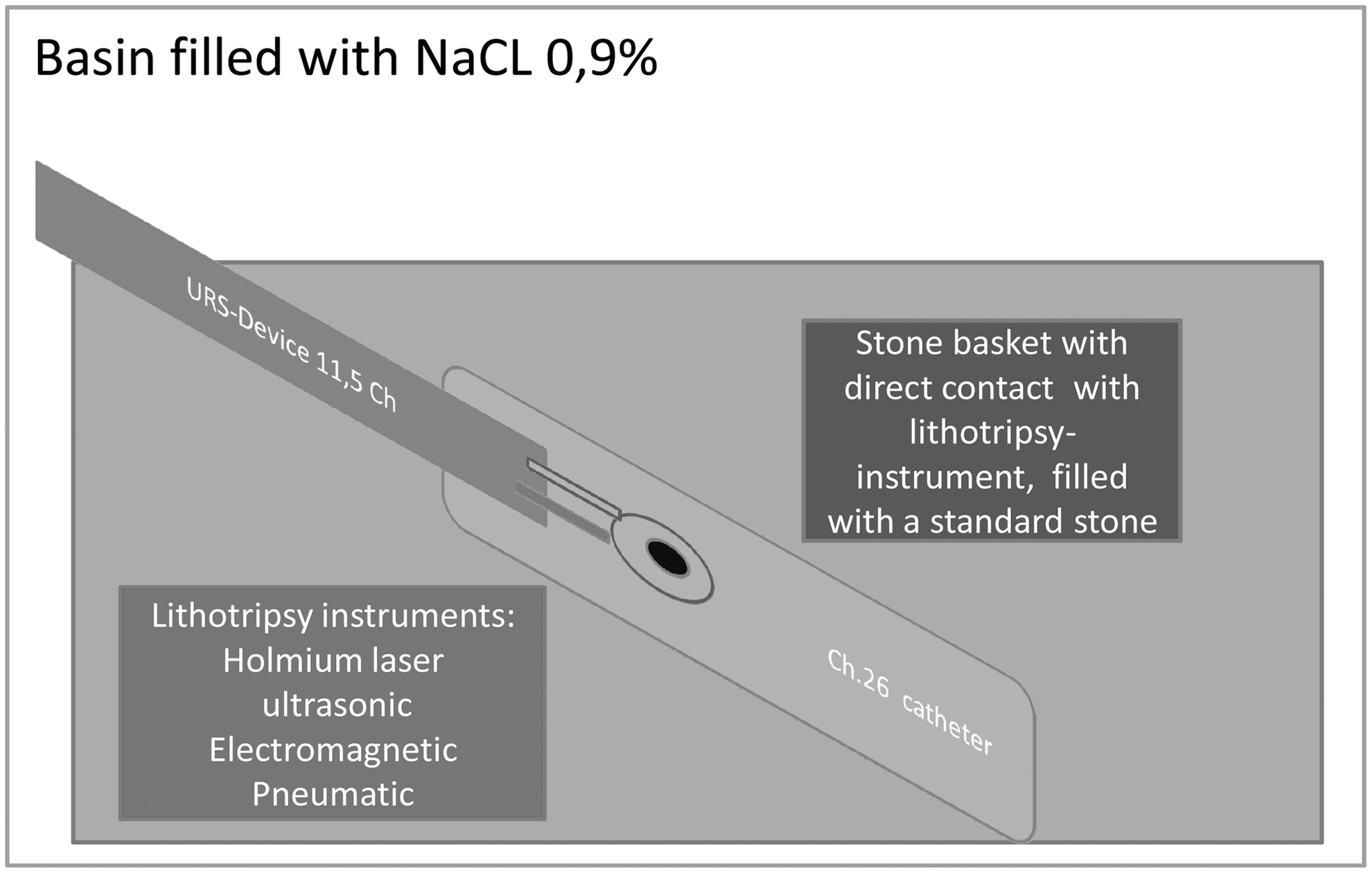
The schematic drawing of the experimental setup shows the URS-device with the stone basket with a stone and the different lithothripter in an 26F catheter under water.
The respective stone extraction basket was guided by means of a rigid URS video device (11.5F, Wolf) and a natural no uniform pebble was captured. This entire package was now inserted into the artificial ureter until the stone extraction basket—together with the stone and URS device—was under water. An experienced operator then attempted to destroy the four wires one after another with a lithotripsy instrument. The two Dormia baskets (3.5F and 2.5F) as well as the Equadus (1.8F) basket and the EPflex (2.5F) basket (total: 32 pieces) were bombarded with each device.
The baskets were used once. These were used exclusively during a stone extraction and subjected to a visual inspection after cleaning.
The time was measured with a timer. The procedure could be watched via video during the intervention, and additional information was provided by the operator with regard to the intervention.
The adjustment of the lithotripter corresponded to the adjustments customary for endoscopic lithotripsy and recommended by the manufacturer. For the holmium:YAG laser, this resulted in a pulse energy of 0.9 J at a pulse frequency of 8 Hz. The diameter of the optical fiber was 365 μm.
Level C, which corresponds to the highest level with approx. 0.65 J and 15 Hz, was selected with the electrokinetic device. The electrode had a diameter of 3F.
The pneumatic-ballistic lithotripter had an adjustment of 1.5 bar, which corresponds to an output of approximately 0.63 J with 50 Hz. The probe had a diameter of 1 mm. The ultrasonic device was operated at the middle level 2 (levels 1–3) with a probe thickness of 1.5 mm.
The result shows the seconds of intervention until destruction of a wire. The timing was also interrupted during interruption of energy input so that any adjustments with the endoscope were not incorporated in the timing.
The set time limit for the destruction of a wire amounted to 1 minute. A direct bombardment of the wire in a clinical setting of 1 minute seems to be very rare so that this time limit seems to be sufficient.
Results
The holmium:YAG laser (Vera Pulse, Coherent), destroyed all wires within 1 minute (Fig. 3). Fifty percent of the Dormia baskets with a diameter of 2.5F were severed after 5 seconds. The baskets of the same type with a diameter of 3.5F were disengaged after 8.5 seconds. The four wires of the OptiMed tipless nitinol stone extraction basket were all destroyed within 5 seconds.

Holmium:yttrium-aluminum-garnet laser lithotripsy: Plotted is the cumulative number of destructed wires against time.
The stone extraction basket with plaited wires (EPflex, 2.5F) partially withstood somewhat longer, but all wires were severed after a maximum of 15 seconds here.
The microscope image (Fig. 4a) shows recognizable melt drops that support the expectation that the holmium:YAG laser heats the nitinol beyond the melting point.

Depending on the type of basket and wire diameter, a differentiated image appeared with the ultrasonic (Calcuson 27610029, Storz) sonotrode (Fig. 5). All samples with a diameter of 1.8F were severed in 1 to 27 seconds (Equadus, OptiMed, four wires). The 3.5F-thick Dormia basket withstood the sonotrode in 92% of the experiments (11 of 12 wires); only one wire was destroyed after 6 seconds. The wires of the same-brand basket but a diameter of 2.5F were not severed in 25% of the experiments; 8 wires were destroyed within 15 seconds, another after 57 seconds.
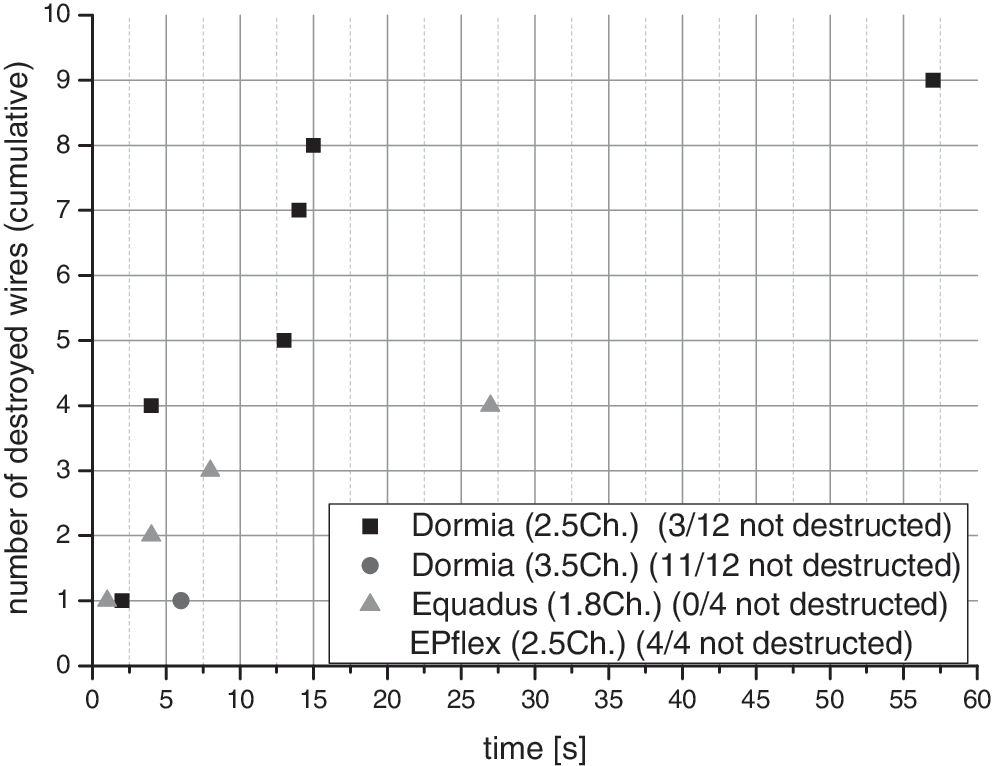
Ultrasonic lithotripsy: Plotted is the cumulative number of destructed wires against time.
The four wires of the plaited, tipless basket (EPflex, 2.5F) could not be severed by the sonotrode.
The fractures during the use of the ultrasonic device are grainy areas (Fig. 4b). All wires remained intact during the electrokinetic and pneumatic-ballistic lithotripsy. Only the pebble was destroyed.
Discussion
Although most of the laser radiation is reflected by metal, the absorbed energy of several laser pulses is enough to heat the nitinol wire beyond the melting point: The melting temperature of nitinol lies around 1300°C, the specific heat capacity at 322 J/kg K; 24.2 J/kg must be used up in the phase transition. With a thickness of 6,500 kg/m3 and an assumed volume V∼π (0,254*10−3/2) 2 m2*365 μm=2*10−11 m3 (largest nitinol wire: 0.254 mm; fiber diameter: 365 μm), the heat mass is m=1.2*10−4 g. Therefore, the energy quantity of E∼50 mJ is enough to melt the largest tested basket wire.
The radiation of the holmium laser (λ=2.1 μm) is strongly absorbed by water. The penetration depth lies at a few hundred micrometers. The so-called Moses Effect occurs, however, with sufficiently long pulses (several hundred microseconds): A bubble that is traversed by the laser beam is created through the vaporization of water directly in front of the fiber. So the effective penetration depth is enlarged. In an in vitro experiment with a holmium:YAG laser, Santa-Cruz and colleagues 9 perforated a pig ureter with an energy of 0.5 J/pulse and a pulse frequency of 10 Hz with an average of 20 pulses at a distance of 0.5 mm between fiber and sample. No direct damage to the tissue occurred at a distance of 2 mm.
Honeck and coworkers 8 destroyed the wires of the stone extraction baskets in 1 to 4 seconds. The laser fiber was brought into direct contact with the wire here. The times measured in this study vary more strongly because of the different bombardment angle.
The ultrasonic action from the sonotrode severed several of the wires through mechanical vibrations: The fractured surfaces are smooth and exhibit a grainy structure (Fig. 4b).
During use of ballistic lithotripters (LithoRapid EL-28, Olympus; Swiss LithoClast, EMS), the flexibility of the baskets is enough for them to remain intact (typical linear expansion, 15.5% until fracture). The ballistic lithotripters also have a rounded or pointed tip that cannot impinge on the wire against the stone as the ultrasonic lithotripter does. As intended in the clinical situation, only the embedded concretion is destroyed.
In a study by Piergiovanni and associates 10 in which the four lithotripters were comparatively examined (EMS Swiss LithoClast, Olympus LUS ultrasonic device, Walz Lithotron EL 23, and Coherent Vera Pulse holmium:YAG laser), a different potency of bladder and ureteral lesions were shown to apply in the pig model. The ultrasonic device and the LithoClast were categorized in the group of minimally dangerous lithotripters. The holmium:YAG laser and the electrohydraulically functioning device were categorized in the group of potentially dangerous lithotripters that can bring about a perforation. For the destruction of Dormia baskets, the ballistic devices (LithoClast, EMS and LithoRapid, Olympus) had to be categorized in the group of basket-sparing lithotripters, and the ultrasonic device and the holmium:YAG laser had to be categorized in the group of basket-destroying lithotripters.
Care should be taken when using a laser or ultrasonic device on an engaged stone with a stone basket. On the other hand, if it is intentionally wished to cut through a wire to disengage a “stuck” basket, holmium or ultrasound can successfully be used.
The good performance of the plaited basket is noteworthy. Whereas no difference with relatively fast destruction (1–15 sec.) is shown with the laser (Fig. 4c), the plaited, tipless basket withstands all other lithotripters. Even the thickest of all baskets (3.5F) could be destroyed by the sonotrode at least once out of 12 wires.
Plaiting the wires seems to improve the stability because two wires are at a different angle to the device and thus the maximum energy input can never occur in both.
Limitation of this study is using an in vitro model, which is an artificial model with direct bombardment.
Conclusion
Material and technical improvement may lead to further reduction of the described damage risk. In particular, possibilities of making the baskets more resistant to these burdens are to be sought. This already seems to be the case to a certain degree with plaited wires.
Another option possibly arises through development of a metal detection in conjunction with an automatic deactivation (eg, the holmium:YAG laser) to prevent the melting of a wire.
Footnotes
Acknowledgment
We would like to thank L. Lasarzeswki and F. Schierp for the practical support during sampling.
Disclosure Statement
No competing financial interests exist.