




Abstract
Background and Purpose:
Various hemostatic agents have been used quite effectively for hemostasis, as well as for providing effective adhesion during laparoscopic partial nephrectomies. In this study, we investigated the adhesiveness to the renal tissue of some sheet-type hemostatic agents used in combination with a liquid fibrin sealant.
Materials and Methods:
In Experiment A, component solutions of the fibrin glue (liquid fibrin sealant) were dripped onto a kite string placed annularly on a porcine kidney slice. Then, one of the sheet-type hemostats—namely, the collagen, gelatin, or cellulose hemostat—was placed on the slices, and a string scale was used to measure the force needed to pull the string apart vertically from the kidney slice. Twelve slices were used for each group, and the weight data were analyzed statistically. The tissue adhering to each sheet-type hemostatic agent was fixed in formalin and sliced and then examined by light microscopy after hematoxylin and eosin staining. In Experiment B, the solutions were dripped onto the sheet-type hemostatic agent placed first on the slice, and the force needed for pulling apart the hemostat sheet from the slice was similarly examined.
Results:
The combination of fibrin glue plus a collagen hemostat was clearly superior in Experiment A, but the hemostat and renal tissue could be pulled apart more easily in Experiment B. These results showed that fibrin glue could not exert its expected adhesive effect unless it is used in combination with another hemostatic agent or is directly applied to renal tissue.
Conclusion:
It is important to obtain further comparative data among agents and select the appropriate agents, taking into consideration the type of surgery.
Introduction
During this surgery, biologic sheet-type hemostatic agents are often used as bolsters to fill the void after removal of the tumor. In addition, a liquid fibrin sealant can be applied to the surface to simplify the suturing process, reduce the likelihood of complications, and shorten the renal-hilus ischemic time. 8 Fibrin sealant is also a kind of hemostatic agent.
Although various types of hemostatic agents are available at present, few studies have been conducted to investigate the differences in their reactions with the kidney tissue. We used various sheet-type hemostatic agents in combination with liquid fibrin sealant and examined which combination might adhere best to the renal tissue, using experimental animal kidneys. Fibrin glue was used in this study, because it is the only type of liquid fibrin sealant available in our country at present.
Materials and Methods
Experiments A and B were conducted using four male pigs weighing 40 kg each. The animals were anesthetized and intubated, and given an intramuscular injection of 2.5 mg/kg of azaperone, with the anesthesia maintained with 2% isoflurane. In the abdomen, the renal artery and vein were clipped and cut. The ureter was sectioned up to the midureter, and the kidney was quickly removed.
The removed kidney was immediately processed into 5-mm-thick, 3.0×3.0 cm slices, and a kite string was placed annularly on the cut surface. In Experiment A, 300 ìL each of the component solutions A and B of fibrin glue was dripped onto the string. Bolheal® (Chemo-Sero-Therapeutic Research Institute) was used as the fibrin glue, solution A was fibrinogen, and solution B was thrombin. A sheet-type 2.0×2.0 cm collagen, gelatin, or oxidized cellulose hemostat, or adipose tissue, as shown in Table 1, was placed on the fibrin glue, and a 100 g weight was placed over it. Twelve kidney slices each were used for each group. After 5 minutes, the weight was removed, and the string was slowly pulled away vertically (Fig. 1).
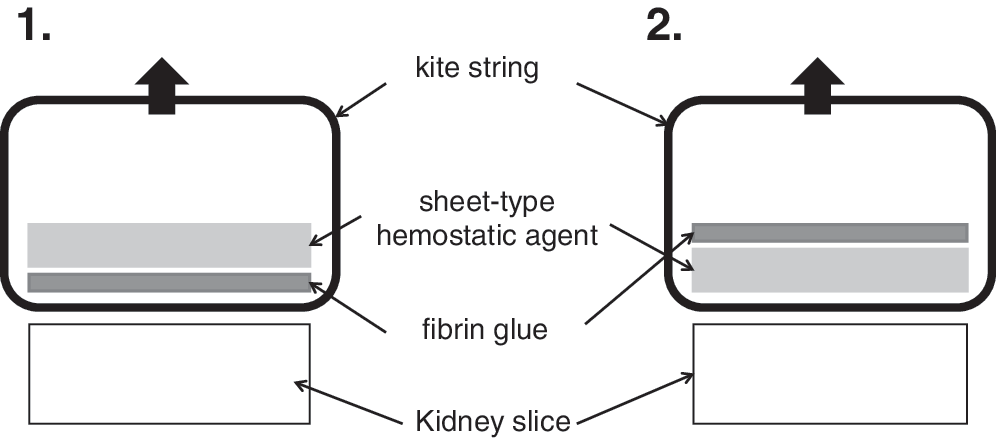
Explanatory drawings for the experiments. An annular kite string was placed on the kidney slice surface.
Mann–Whitney's U–test compared with Group 1.
Mann–Whitney's U–test compared with Group 2.
Mann–Whitney's U–test compared with Group 3.
Mann–Whitney's U–test compared with Group 4.
SD=standard deviation.
A string scale was used to accurately measure the weight needed to pull apart the agent from the renal tissue, and a statistical comparison was made using the Mann-Whitney U test. The kidney slices were divided into five groups as follows: Group 1, fibrin glue alone; group 2, fibrin glue+a collagen hemostat; group 3, fibrin glue+a gelatin hemostat; group 4, fibrin glue+an oxidized cellulose hemostat; group 5, fibrin glue+adipose tissue as control. Because fibrin glue cannot be sprayed during laparoscopy, it was applied by dripping using the double-layer method. Gelfoam® (Pfizer, 20×60×7 mm) was used as the gelatin hemostat, Surgicel® (J&J, 2.54×8.89 cm,) as the cellulose hemostat, and Integran® (Koken, 7.6×10.2 cm) as the collagen hemostat.
Furthermore, the renal tissue adhering to the hemostatic agent in groups 2 to 4 was fixed in formalin and sliced, and after hematoxylin and eosin staining, the tissue was examined by light microscopy. The degree of tissue permeation of the fibrin glue and the degree of adhesion of the hemostat to the renal tissue were compared.
In Experiment B, a string was placed on six kidney slices each from groups 2 to 4 just as in Experiment A, and the hemostatic agents were placed directly on them. The component solutions A and B of the fibrin glue were dripped onto the hemostatic sheets, and as in Experiment A, a 100-g weight was placed on each for 5 minutes. The string was pulled, and the weight needed to pull apart the glue from the kidney slices was measured and compared as in the earlier experiment. To avoid the fibrin glue from adhering to the weight, the same hemostat was also placed on top of the glue. All animals received humane care in accordance with Japan's Animal Protection and Management Law.
Results
In Experiment A, the weight needed to pull the string between the fibrin glue and the renal tissue was significantly lower in group 1 compared with that in the other groups; there was also a significant difference between group 5 and groups 2 to 4 (Table 1). Furthermore, it was significantly higher in group 2 compared with that in the other groups, although no significant difference was observed between groups 3 and 4. Microscopic survey of the tissue showed that the fibrin glue stained pink, and permeation of the fibrin glue among the hemostat fibers could clearly be observed (Fig. 2). In the collagen hemostat, the glue was equally distributed among the fibers over a large area, including in the region of its contact with the renal tissue as the fibrin gel. In the gelatin hemostat, much of the glue remained between the agent and the renal tissue as the fibrin gel, and the liquid glue components had not dispersed among the fibers of the hemostat. As for the oxidized cellulose hemostat, the fibrin glue was dispersed among the fibers, but it did not clearly remain between the agent and the renal tissue. Furthermore, each fiber seemed to be relatively large and coarse.

Microscopic examination of the tissue sections obtained from groups 2 to 4 showed that the fibrin glue stained pink.
In Experiment B, as shown in Table 2, the hemostat and renal tissue could be pulled apart more easily compared with that in Experiment A, and there were no significant differences among the groups.
Mann–Whitney's U–test compared with Group 2.
SD=standard deviation.
Discussion
When partial nephrectomy is performed without ischemia, the surgery must be completed with hemostasis established only by thermal coagulation, and it is difficult to use this method in cases that involve larger tumors. 9 This also holds true for laparoscopic surgery. Therefore, at many institutions, ischemia is used, and a biologic hemostatic agent and fibrin sealant are inserted into the tumor defect within the suture site of the renal parenchyma. 10,11
The first clinical use of fibrinogen and fibrin was reported in 1909, when fibrin powder was used for closure of a vascular wall. 12 Marked advances have been made in the use of sealants, with use of higher concentrations of fibrin and addition of coagulation factor XIII.
In the field of urologic surgery as well, fibrin sealants are not only effective in supplementing the suture procedure, but also are increasingly being used in place of sutures. 13 Currently used sealants are generally divided into fibrin glue, which is a combination of human fibrinogen and thrombin, and gelatin matrix hemostatic sealants, consisting of bovine thrombin and a gelatin substrate. 14 In this study, we used only fibrin glue, not gelatin matrix hemostatic sealants. Regarding the mechanism underlying the efficacy of fibrin glue, the fibrinogen coming in contact with thrombin changes into fibrin, which exhibits marked adhesive effects. 12 One mL of solution A contains 80 mg of fibrinogen and factor XIII at a concentration equivalent to 60 times that in normal human plasma, and one mL of solution B contains 250 units of thrombin. Fibrinogen reacts with thrombin to result in the formation of fibrin gel, and the monomer changes into an insoluble complex. In an actual wound, the actions of fibrin formed in the last stage of blood coagulation are thought to be used in the adhesion and hemostasis of tissues.
On the other hand, the sheet-type hemostatic agent is not only important as a foothold at the site of application of the fibrin sealant, but also because a substrate is formed at the site of hemostasis by the combination of the sheet-type sealant and liquid sealant. 14 In actual partial nephrectomies, the hemostatic agent can be used both to compensate for the volume of the kidney defect and to directly apply pressure to close the incision suture site.
Several kinds of hemostatic agents are available. The cellulose hemostat is made of an absorbent material, in which the acidic polysaccharide fibers generated from oxidized cellulose are prepared into cotton sheets. In this experiment, only the sheet type, namely the original Surgicel,® was applied as the cellulose hemostat, and not Surgicel Fibrillar™ or Surgicel Snow.™ The gelatin hemostat is nonstretchable but can absorb much moisture. With collagen hemostats, collagen fibers extracted from the bovine dermis are prepared into sheets. As with collagen and hydroxyapatite in the bone tissue, combining the two is known to yield significantly greater effects than when the two are used separately. 10 There have been few reports comparing the effects of using a combination of hemostatic agents and fibrin glue, however. 15 In Experiments A and B, we investigated the difference in the degree of adhesion of the sealants used—namely, a combination of fibrin glue plus sheet-type collagen, gelatin, or oxidized cellulose hemostat—to the kidney tissue.
A removed porcine kidney was sliced, and only fibrin glue, or a combination of fibrin glue plus a hemostatic agent or adipose tissue was applied to the dry slice surfaces. After applying pressure to facilitate adherence of the agents to the renal tissue, the extent of their adhesion to the slices in vitro was studied by determining the force needed to pull them off. In Experiment A, little adhesion was obtained with the use of fibrin glue alone, and there was a difference even between the groups in which fibrin glue alone and adipose tissue were used, which suggested that a material that would serve as a base was essential to obtain adequate adherence.
There were significant differences between the groups in which adipose tissue and each of the hemostats were used. Among the hemostats, the combination of fibrin glue plus the collagen hemostat appeared to be significantly superior to the others. The adhesive power of the oxidized cellulose hemostat plus fibrin glue was relatively weak. When the tissues were examined after staining, even though the fibrin glue liquid components appeared to disperse evenly among the hemostat fibers, they did not clearly remain between the cellulose hemostat and the tissue. One reason could be that since the oxidized cellulose hemostat is well known as an acidic agent, it may have an acidic effect on the tissue, reducing the activity of the thrombin in the fibrin glue. In regard to the gelatin hemostat, the glue adhered to the surface of the fibers but its adhesive effects were not as satisfactory. The reason would be that the fibrin solution did not permeate sufficiently deeply into the fibers. The gelatin hemostat was constructed as a dried gelatin matrix and was very absorbent, but the fibers themselves became harder.
In Experiment A, solutions A and B of the fibrin glue were dripped onto the kidney slices, but when the hemostatic agent was placed directly onto the renal tissue and the fibrin glue was dripped on top of it as in Experiment B, all of the hemostatic agents could be pulled off very easily. This confirmed that the fibrin glue could not exert its expected effect unless it was directly applied to the renal tissue, so that during surgery, it must be ensured that as much as possible, the fibrin glue comes in contact with the biologic surface.
Although this is an in vitro model experiment using sliced porcine kidneys with the limitations that we have not tested the gelatin matrix hemostatic sealant, Surgicel Fibrillar, nor Surgicel Snow, the results obtained clearly indicate that the combination of fibrin glue plus the sheet-type collagen hemostat was the most appropriate for obtaining a reinforced hemostatic effect. Second, it was shown that the fibrin glue could not exert its expected adhesive effect unless it was combined with a hemostatic agent or was directly applied to the renal tissue. In some countries, the combination of an oxidized cellulose hemostat plus the fibrin sealant seems to be the most frequently used in laparoscopic partial nephrectomy. 10
Conclusion
It is important to obtain further comparative data among hemostatic agents and select the appropriate materials to be used, depending on the surgical procedure. Following this study, we have performed an in vivo experiment with live rabbits as a partial nephrectomy model testing the fibrin glue and several hemostatic agents, and demonstrated that the adhesive capability of the fibrin glue is superior when combined with a collagen or gelatin hemostat. 15
Footnotes
Disclosure Statement
No competing financial interests exist.