




Abstract
Background and Purpose:
Several studies that compare open and laparoscopic procedures have demonstrated that the minimally invasive surgeon has greater musculoskeletal pain when compared with open surgeons. The purpose of our study was to demonstrate whether the use of the gel mat in the endoscopic setting offered any ergonomic benefit to the surgeon.
Materials and Methods:
One hundred endoscopic procedures, by 11 different surgeons, were randomized intostudy (use of a gel mat) and control groups. Procedures included both percutaneous nephrolithotomies and ureteroscopies and were randomized without regard to the type or expected length of the procedure. All subjects completed a preoperative, intraoperative, immediate postoperative, and 24-hour postoperative questionnaire. During the procedures, an independent observer recorded the number of intraoperative stretches and positional changes because of discomfort.
Results:
The mean preoperative metrics for the gel mat and no gel mat groups were similar with the exception of the ≤60-minute group, whose members found the gel mat group starting with greater overall discomfort (1.7 vs 1.3, P=0.0273). In the ≤60 minute group, gel mat use significantly decreased postoperative discomfort (P=0.0435) and improved postoperative energy (P=0.0411). In those procedures >60 minutes, the gel mat improved postoperative discomfort and energy as well as the number of stretches and postural changes during the procedure.
Conclusion:
Application of gel mats in the endoscopic setting improves surgeon overall postoperative discomfort and energy in all cases. For cases >60 minutes duration, gel mats also decrease the number of stretches and postural changes from discomfort. Some of these salutary effects may translate into more efficient surgery and better patient outcomes.
Introduction
Some of the challenges of minimally invasive surgery include the design and length of instruments used, 1,3,4 table height limitations, 1 static body postures, 1 the use and location of video displays, 1,4,5 and foot pedal design. 1 Minimally invasive procedures have been associated with a number of ill effects for the surgeon and operating room staff including temporary digital neuropraxia, 1,2 tremors, 2 muscle and joint pain, 2,4 and eye fatigue. 1,2 Moreover, surgeon fatigue associated with the surgical environment has been linked to surgical outcomes. 6
In a recent study to evaluate the use of gel mats in the setting of laparoscopic renal surgery, Haramis and colleagues 7 demonstrated that intraoperative use of a foot gel mat significantly improved several metrics related to a surgeon's comfort and fatigue levels. While there are similarities in endoscopic and laparoscopic procedures, the demands on the endoscopic surgeon who is operating in a cystoscopic suite are uniquely different. Multiple display monitors, surgeon's body position in relation to the patient, and the frequent use of heavy lead aprons all contribute to overall discomfort and fatigue.
The purpose of our study was to demonstrate whether the use of the gel mat in the endoscopic setting offered any ergonomic benefit to the surgeon.
Materials and Methods
Institutional Review Board approval for data collection was obtained. Between April 2010 and August 2010, we prospectively conducted a pilot registry study that was limited to 100 endoscopic procedures. One hundred endoscopic procedures, by 11 different surgeons, were randomized into study (use of a gel mat) and control groups. Procedures included both percutaneous nephrolithotomies and ureteroscopies and were randomized without regard to the type or expected length of the procedure. The study group used the gel mat foot pad (GelPro,® Austin, TX) for the entirety of the case, while the control group performed the surgery without the use of a gel mat. All subjects completed a preoperative, intraoperative, immediate postoperative, and 24-hour postoperative questionnaire at the respective times. During the procedures, an independent observer recorded the number of intraoperative stretches and positional changes because of discomfort.
The Gel mats used were either the 20×60 in or the 20×72 in models, both of which are commercially available for approximately $200. Between cases, all mats were sanitized using standard floor cleaning solutions and allowed to air dry.
The questionnaire consisted of four parts: The preoperative, intraoperative, postoperative and 24-hour postoperative sections, all of which were completed by the participating surgeon. The preoperative questionnaire included baseline statistics including the subject's age, assessment of personal health, last day of vigorous exercise, and the number of times exercise was performed per week. In addition, a discomfort/pain scale (no discomfort/pain – 1 to severe discomfort/pain – 10) was completed as a component in each of the four questionnaire sections. The participating surgeon applied the scale to assess feet, ankle, knee, hip, back, shoulder, and neck discomfort at each interval. An independent observer recorded the number of stretches, postural changes, and breaks from discomfort. The surgeon also reported any surgical errors that he/she subjectively believed occurred as a result of fatigue or discomfort.
The study and control groups were compared to determine the utility of gel mat use in the endoscopic setting. Each group was further subdivided by surgical time (procedures taking less than and more than 60 minutes) in an effort to determine if comfort with and without the gel mat was a functionality of total operative time. The distribution of variables with regard to type of procedure and gel mat use was compared using the chi-square test. Mean operative times were analyzed with two-tailed Student t test. All statistical analyses were performed with Stata v 11.0 (StataCorp, College Station, TX) with a P value of <0.05 considered significant. As a pilot registry trial, the study was not formally powered.
Results
Of the 50 procedures performed with a gel mat, 32 (64%) were endoscopic and 18 (36%) were performed percutaneously. This was significantly different than the control group, which had 44 (88%) procedures performed endoscopically and 6 (12%) performed percutaneously (P=0.009). When subdivided by operative time ≥60 minutes, there were 17 (50%) percutaneous and 17 (50%) endoscopic procedures in the gel mat group and 5 (21.7%) percutaneous and 18 (78.2%) endoscopic procedures in the control group (P=0.032). For those procedures <60 minutes, there was 1 (6.3%) percutaneous and 15 (93.8%) endoscopic procedures in the study group and 1 (3.7%) percutaneous and 26 (96.3%) endoscopic in the control group (P=0.702)
Mean operative time for the gel mat group was significantly longer than that of the control group (77.4 vs 60.4 minutes, respectively, P=0.037). When further subdivided by operative times, however, there was no difference between subsets of gel mat and no gel mat procedures lasting longer than 60 minutes (95.8 vs 87.5 minutes, respectively, P=0.402) and less than 60 minutes (30.1 vs 35.8 minutes, respectively, P=0.093). There was no difference between the study and control groups with respect to total time spent standing (74 vs 60.1 minutes, respectively, P=0.104) and total time spent sitting (2.2 vs 4.2 minutes, respectively, P=0.237).
All surgeons in the study were self-reportedly in good health, and there were no differences in time since last exercise or number of exercises per week in the two groups.
The mean preoperative metrics for the gel mat and no gel mat groups were similar with the exception of the ≤60 minute group, whose members found the gel mat group starting with greater overall discomfort (1.7 vs 1.3, respectively, P=0.027). In the ≤60 minute group, gel mat use significantly decreased postoperative discomfort (P=0.043) and improved postoperative energy (P=0.041). In those procedures >60 minutes, the gel mat not only demonstrated improvements in postoperative discomfort and energy, but also in the number of stretches and postural changes during the procedure (Table 1).
Discussion
Ergonomics is the science of designing the work space and its instruments around the worker in an effort to minimize discomfort, improve efficiency, and reduce potential injury. 8 As a science, ergonomics is relatively new, 2,5 and as such has not always been widely applied to the surgical theater despite numerous objective analyses. 9 For example, in 1983, Brearley and Watson 10 applied ergonomics to develop an efficient retractor handle and found that a vertical T-shaped handle was superior to the currently used horizontal handle. The impact of this study and many like it, however, have had no effect on instrument design. 5
On the contrary, with regard to minimally invasive surgery (MIS), the development of dedicated MIS suites has been greatly influenced by ergonomics. In 1999, the widespread introduction of video monitors into the surgical suite was viewed as “the greatest challenge yet to the surgeon's natural view of the operating field.” 5 Just 9 years later, a review of the ergonomic literature on monitor position concluded that the ceiling suspended high-definition monitors currently used in most MIS suites were the best solution to the problem, 8 suggesting that appropriate ergonomic solutions were applied in the design of the modern MIS suites.
In 2010, Haramis and colleagues 7 evaluated the use of gel mats in the setting of laparoscopic renal surgery to determine whether improved standing surfaces had an effect on surgeon discomfort, muscle and joint pain, and level of fatigue. One hundred laparoscopic renal procedures were randomized into either a foot gel mat group or a control group. The study results were astounding in that the control group needed more breaks (P=0.001), had more stretching events (P=0.001), and had from greater foot pain (P=0.003), knee pain (P=0.001), back discomfort (P=0.001), overall discomfort (P=0.001) and diminished level of energy (P=0.49). The study also demonstrated the lingering effects of poor ergonomics in that the gel pad group fared better 24 hours postoperatively as well. 7
While there are similarities in endoscopic and laparoscopic procedures, the demands on the endoscopic surgeon operating in a cystoscopic suite are uniquely different. Multiple display monitors that display the endoscopic view as well as fluoroscopic images, surgeon's body position in relation to the patient, the frequent use of heavy lead aprons, and large variations in procedure length are obstacles that are not normally encountered in the laparoscopic setting, and yet contribute to overall surgeon discomfort and fatigue. Gel mat foot pad use reduces the burden encountered by the surgeon, which may ultimately result not only in better postoperative comfort, but also improved surgical efficiency and safety.
The Gel mat foot pads used in the current study were the residential model and were donated by GelPro for the purposes of this trial. The model used in the study, however, while still available, has been redesigned specifically for the hospital setting. The surfaces of the medical grade mats are not textured, making them easier to clean (Fig. 1). The medical mats are also compatible with the quaternary cleaners used in most facilities. Moreover, the surface material has also been imbedded with a formulated coating that includes proprietary silver ions, which help to eliminate bacteria and fungus. A quarter-inch of closed cell foam has been added to the half-inch gel core to counteract the effect of using the gel mat with hospital shoes. The medical mats are commercially available in three dimensions and retail for approximately $116 to $225. In the authors' experience, the mats are quite durable. The four residential mats have been used in morethan 200 procedures, including the 50 performed as part of the current trial, and have no evidence of damage despite the heavy use. As such, the mats are cost-effective.
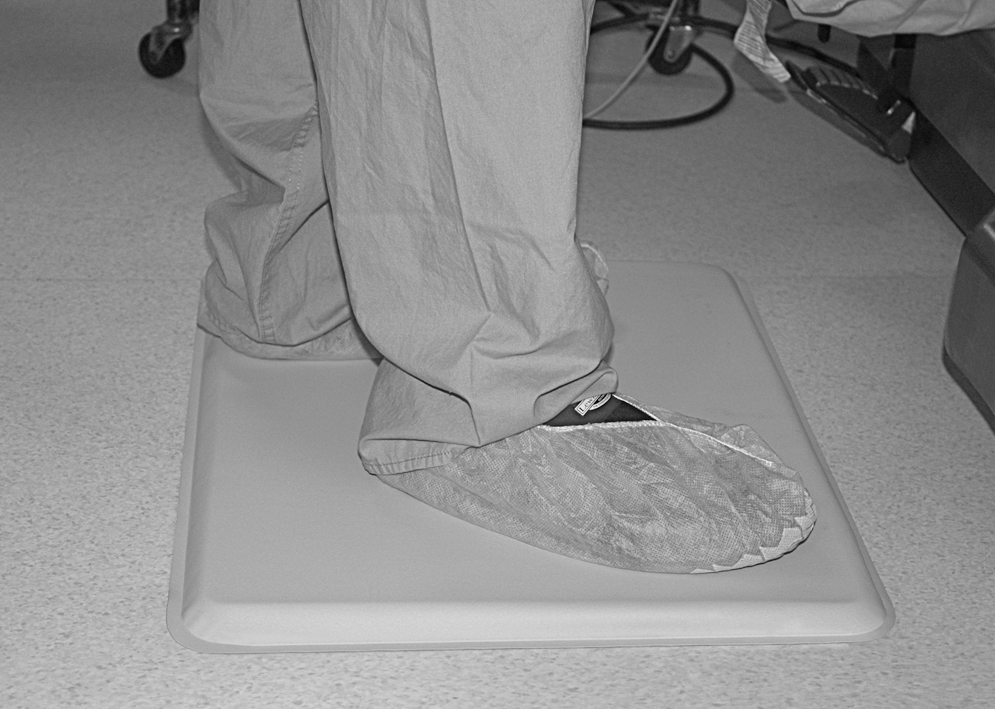
GelPro Medical Mat. Photograph courtesy of Lets Gel, Inc.
There are several limitations to the study. The first is the lack of an objective metric. The current study design focused on subjective self-evaluations by the surgeon. The core of the questionnaire, however, relied on the validated visual pain scale. Moreover, multiple surgeons participated over a span of several months, which may also diminish any biases associated with subjective testing. Second, while the study was randomized, neither the surgeons nor the independent observers were blinded. In reality, it is not possible to blind the surgeon. Once the participating urologist stands on the gel mat foot pad, it is immediately evident to which arm of the study the procedure was randomized. To counteract this known bias, the preoperative portion of the questionnaire was completed before the revealing in which study arm the surgeon was participating. In this way, the difference between preoperative and postoperative metrics would not be affected by a biased response to the preoperative metrics alone. In addition, the use of an independent observer during the surgery also reduced the degree of bias that could be present. While the observer was also not blinded, his/her role was to simply record the number of stretching events and postural changes, most of which are an unconscious act by the operating surgeon.
Conclusion
Application of gel mats in the endoscopic setting improves surgeon overall postoperative discomfort and energy in all cases. For cases >60 minutes duration, gel mats also decrease the number of stretches and postural changes because of discomfort. Although it is primarily the surgeon who benefits from the intraoperative use of gel mats, there is a possibility that some of these salutary effects may translate into more efficient surgery and better patient outcomes, particularly for longer and more challenging endoscopic surgical procedures.
Footnotes
Disclosure Statement
No competing financial interests exist.