




Abstract
Purpose:
To investigate the number of nephrons, using unbiased stereological method, after warm ischemia for laparoscopic partial nephrectomy in a pig model.
Methods:
Fourteen pigs underwent left laparoscopic partial nephrectomy, and four animals were used as controls (not operated). Renal vessels were clamped, and 25% of kidney length was resected. The animals were euthanized after 2 weeks, and the kidneys were collected. Thus, we analyzed 14 left kidneys submitted to warm ischemia, 14 right kidneys from the same animals but not submitted to ischemia and eight kidneys from control animals. Renal fragments were processed using routine histological methods. The total operative time and the time of warm ischemia were recorded. Glomerular mean volume and glomerular density were quantified by stereological methods. Creatinine serum levels were assessed preoperatively and before euthanasia.
Results:
Surgical time was 71±17 minutes, and ischemia time was 16±5 minutes. The mean glomerular volume in the left kidneys was higher when compared with controls and to right kidneys (p<0.05). In addition, the glomerular density was reduced in the left kidneys (p<0.05) when compared with controls and right kidneys. Nevertheless, creatinine serum levels after 2 weeks of surgery were not different from the preoperative levels. No difference was found for stereological measurements between controls and right kidneys.
Conclusion:
Stereological determination of glomerular density can be used as an accurate and objective method for studies regarding renal damage from ischemia. Warm ischemia during laparoscopic partial nephrectomy in pigs determined a significant reduction of glomerular density in the ipsilateral remaining parenchyma.
Introduction
Functional tests, such as serum creatinine level and glomerular filtration rate, have been used to evaluate the effects of warm ischemia during partial nephrectomy in clinical and experimental settings. 4 –7 Although the pig has been frequently used as the best model for laparoscopic partial nephrectomy, there is a lack of quantitative morphological studies on the effects of renal warm ischemia in this animal model. Thus, the aim of this study was to investigate the number of nephrons, by using unbiased stereological method, after warm ischemia for laparoscopic partial nephrectomy in a pig model.
Methods
We studied 18 adult male domestic pigs weighing 30 kg (mean). Fourteen animals underwent left laparoscopic partial nephrectomy, and four animals were kept under standard conditions, not operated, and were used as controls. Therefore, there were three groups of kidneys: left kidneys submitted to partial nephrectomy under warm ischemia (14 kidneys), right kidneys from the same animals, submitted to pneumoperitoneum but not operated (14 kidneys), and eight kidneys (four left and four right) from the control group.
All experiments were performed according to the Brazilian law for scientific use of animals, and this project was formally approved by the local Ethics Committee for animal experimentation.
After anesthesia, the left kidney was approached via a transperitoneal laparoscopic access with four trocars. Both the renal vein and artery were then clamped en bloc, and 25% of the renal length was ressected at the caudal (seven pigs) or cranial pole (seven pigs). 8 No method for achieving cold ischemia was used. Surgical and warm ischemia time in minutes was recorded.
The animals received analgesia for 24 hours after surgery, and food and water were given ad libitum after 6 hours of surgery. The recovery of normal ambulation usually occurred up to 12 hours after the procedure.
After 2 weeks, all animals were sacrificed by anesthetic overdose, and kidneys were harvested and fixed by immersion in 10% buffered formaldehyde. Fragments from these 36 kidneys were processed by routine histological methods for stereological analysis. The specimens were routinely processed for paraffin embedding, sectioned at 5-μm thickness, and stained by hematoxylin & eosin. For the operated kidneys, care was taken in order to collect fragments from the nonoperated pole, at the most distant portion from the healed pole.
From each kidney, 26 histological fields obtained from different sections of the renal cortex were acquired with a digital camera coupled to a microscope. Glomerular volume density (Vv[glom]), which indicates the volume occupied by the glomeruli in the cortex, was estimated by the point-counting technique with a M42 test-system (Fig. 1). A test grid with 21 lines and 42 point was superimposed to the histological field. The number of points hitting glomerulus is dived by 42 (the total number of points) to obtain the Vv[glom], expressed in percentage. 9,10
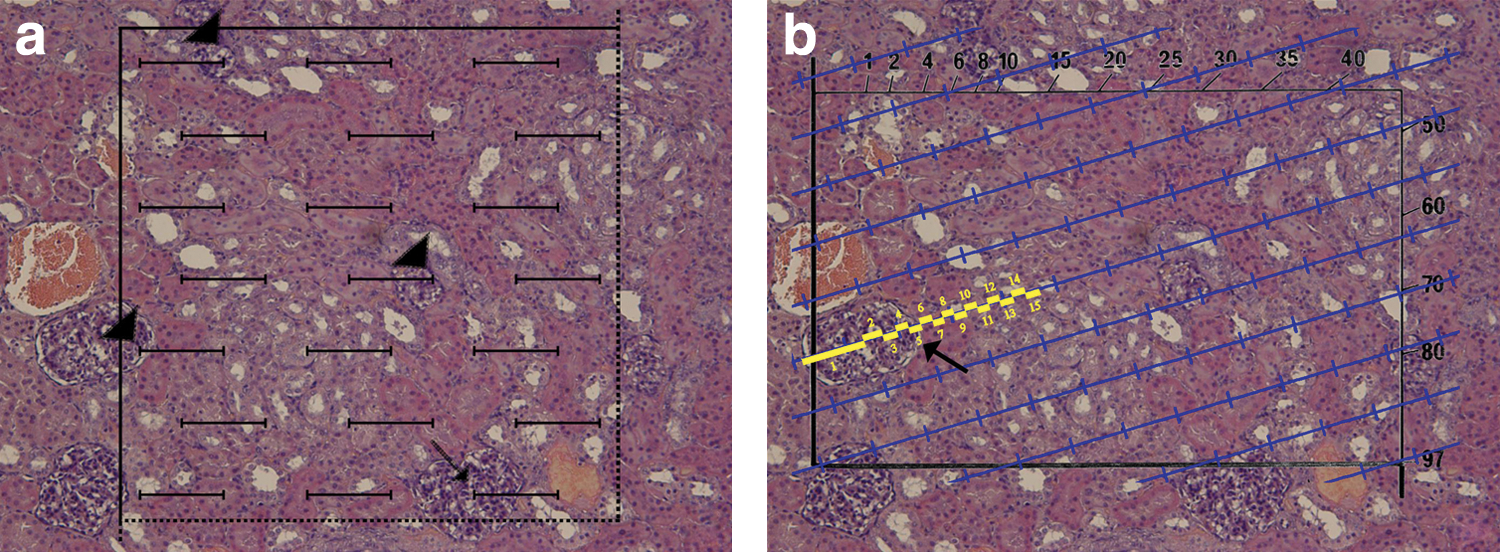
The mean glomerular volume (MGV) was estimated with the point-sampled intercepts method analyzing at least 50 glomeruli per animal. Randomly crossed glomerulus were measured with a 32-mm long logarithmic ruler composed of a series of 15 classes (Fig. 1). Each individual intercept was cubed, and the mean of all values was multiplied by π/3 in every case to obtain the MGV. 9,11
The glomerular density, expressed as the number of glomeruli per cubic millimeter of renal cortex, was calculated by dividing the Vv[glom] for the MGV. 12
Serum creatinine and urea were obtained before surgery and on postoperative day 14 to assess the renal function.
Analysis of variance with Newman–Keuls post-test was used for stereological data mean comparisons. Mean creatinine serum levels were compared by Student's t-test. For all comparisons, p<0.05 was considered significant. Data were expressed as mean±standard error. Analyses were performed using GraphPad Prism software.
Results
Serum creatinine and urea on the preoperative day were 0.72 and 25.57 mg/dL, respectively. On the postoperative day 14, the serum creatinine was 0.77 mg/dL and urea was 28.08 mg/dL. There was no significant difference between serum creatinine and urea on preoperative day and postoperative day-14.
The mean recorded surgical time was 71±4.6 minutes, and the warm ischemia time was 16±1.5 minutes.
The Vv[glom] was diminished in left kidneys by 22.6% in comparison to control kidneys and by 25,1% when compared with right kidneys (p=0.0003) (Fig. 2).
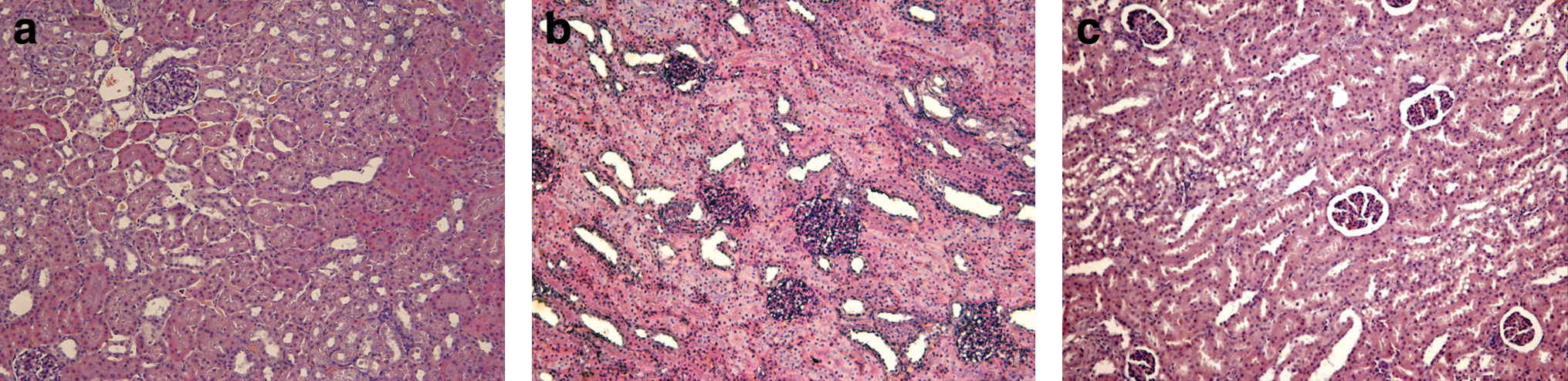
Photomicrographs of renal cortex of left kidneys (underwent laparoscopic partial nephrectomy) (
The MGV of left kidneys was higher when compared with controls and with right kidneys (30% and 18%, respectively, p<0.05). In addition, the glomerular density was reduced in the left kidneys by 41% and 36% when compared with controls and right kidneys, respectively, (p<0.05) (Fig. 3).
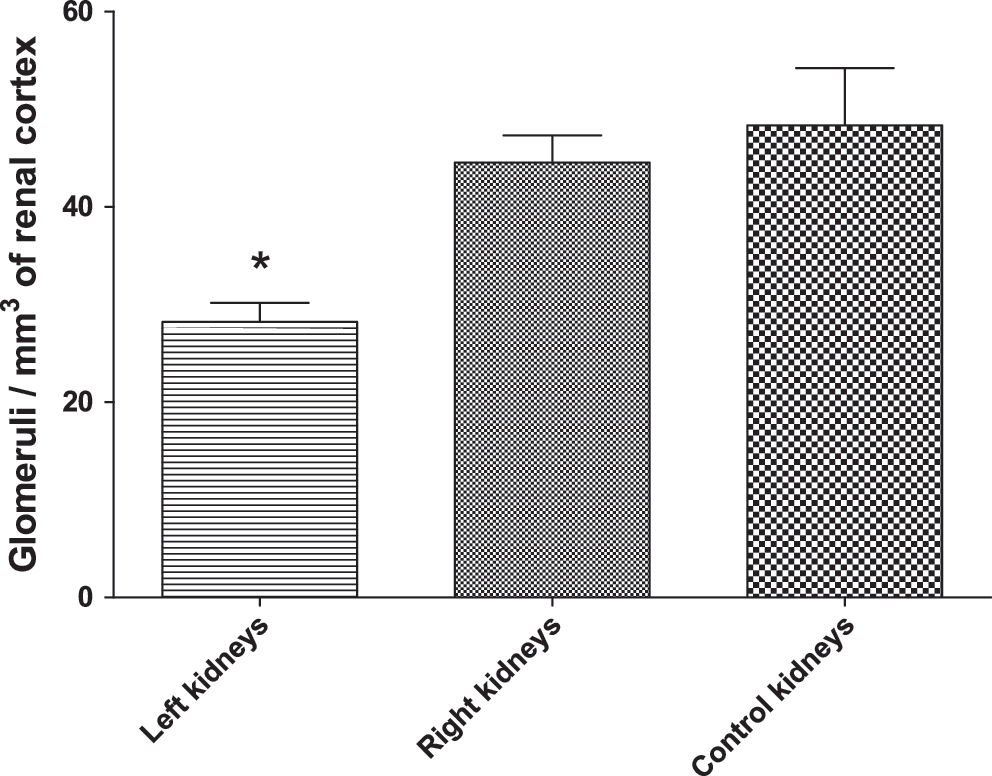
Number of glomeruli per mm3 of renal cortex in left kidneys (underwent laparoscopic partial nephrectomy), right kidneys (underwent only anesthesia and pneumoperitoneum), and control kidneys. The results are expressed as mean and standard error. *p=0.0002 compared with controls and right kidneys.
No statistically significant difference was found for MGV and for glomerular density between controls and right kidneys.
All numerical data are listed in Table 1.
Data expressed as mean±standard error.
Vv[glom]=glomerular volume density; MGV=mean glomerular volume.
Comments
Since the number of incidentally diagnosed small renal tumors has been increasing in the past decades, nephron sparing surgery is becoming the standard of care in many urological centers. 13,14 Different methods are now available for dealing with parenchyma hemostasis, collecting system closure, and optimal preservation of blood supply to the remaining kidney. 15 –17 However, warm ischemia should be considered a key point to evaluate partial nephrectomy outcomes, as it could affect renal function. 3
Studies for evaluating renal warm ischemia injury have been performed in pigs, most commonly assessing renal function, oxidative stress, and renal pathology. 18 In these experiments, tissue damage has been evaluated by subjective scores, usually appraising brush border loss, tubular cell necrosis, cellular vacuolation, tubular epithelial loss, etc. 19 –21 Since the major objective of laparoscopic partial nephrectomy is to remove the tumor while preserving the highest number of normal nephrons, the objective assessment of the glomerular density in the remaining parenchyma could be of great value. It is important to remember that in humans and animals the glomeruli cannot be formed or divided after uterine life, and so, the number of glomeruli and nephrons only falls during life. 9 The unbiased stereological methods used in this study could estimate accurately the MGV and density. 12 In the present study, we found that stereological determination of glomerular density could be used as an accurate and objective method for studies regarding renal damage from ischemia.
For the first time, a morphological study demonstrates that warm ischemia during laparoscopic partial nephrectomy in a pig model induces an important loss of nephrons in the remaining operated kidney. One should note that the reduction in glomerular density was by 41% and 36%, when compared with controls and right kidneys, respectively.
Clearly, it is better to lose 41% of the nephrons in the remaining parenchyma instead of losing the entire kidney in a radical surgery, and so, laparoscopic partial nephrectomy is still of great value as a nephron sparing technique. Besides that, our results were found in an animal model and need not necessarily be directly applied to humans.
No method for warm ischemia amelioration was attempted in this study. Future studies comparing glomerular density in animals using different protective agents for renal ischemia should aid in finding a better method.
Recently, it was demonstrated that even in patients who had a period of warm ischemia longer than 30 minutes, renal functional outcomes were superior to those who suffered radical nephrectomy. 6 However, the period of warm ischemia should be preferably kept under 20 or 25 minutes in order to avoid postoperative acute renal failure. 2,18 The present study shows that even with a relatively short warm ischemic time (16 minutes), a significant amount of nephrons could be lost. Robotic surgery appears to have a promising future in reducing warm ischemia times, 22,23 and recently, a mean period of 16 minutes of ischemia was achieved with the robot-assisted technique. 24
Besides the reduction of glomerular density, the MGV in the operated kidneys was higher when compared with controls and right kidneys (30% and 18%, respectively). It is important to note that glomerular hypertrophy has been established as a predictor of glomerulosclerosis in a variety of human and animal glomerular disorders. 25 Thus, it is possible that the glomerular function would be even lower in the operated kidneys.
Since we did not find significant difference between the right kidneys and controls, it could be assumed that the damage on left kidneys was mainly due to the warm ischemia.
Although our findings indicate that warm ischemia during laparoscopic partial nephrectomy causes glomerular hypertrophy and loss of nephrons in the remaining tissue of the operated kidney, the serum creatinine levels remained unaltered in these animals. This could be explained because of the normal function of the right (nonoperated) kidney. For evaluating the renal function of the operated kidney only, solitary kidney patients and animal models have been used, demonstrating adverse renal consequences of warm ischemia. 26,27
In conclusion, we found that warm ischemia during laparoscopic partial nephrectomy in a pig model determined significant reduction of glomerular density in the ipsilateral remaining parenchyma. In addition, the MGV was higher in the operated kidneys.
Footnotes
Acknowledgments
This research was supported by grants from the National Council of Scientific and Technological Development (CNPq) and Foundation for Research Support of Rio de Janeiro (FAPERJ), Brazil.
Disclosure Statement
No competing financial interests exist.