




Abstract
Background and Purpose:
Transurethral laser enucleation of the prostate is a common therapeutic option for the treatment of benign prostate enlargement. Evacuation of the enucleated tissue from the bladder is usually performed by electric morcellators. Until now, a standardized evaluation of the different morcellator settings does not exist. Therefore, we developed an ex-vivo model to find the best settings for four different morcellators.
Materials and Methods:
We morcellated pieces of a prostate adenoma after an open adenomectomy. The same speed settings were used to morcellate commercially available minced meat, fine pork sausage meat, and bovine heart, all of which had been cooked for 10 minutes using a Piranha Morcellator. We also morcellated raw pig perirenal fat tissue, raw pig liver, and raw bovine heart. The pieces were morcellated at different speed settings in an open water tank filled with saline. Because raw bovine heart showed to be the most equivalent tissue, we morcellated five pieces with four different settings of four different morcellators: The Piranha, the VersaCut, and two morcellator prototypes.
Results:
The median retrieval rate for the prostate adenoma was 14.02 (3.7–19.8) g/min. The retrieval rate for raw bovine heart was 13.75 (5.66–20) g/min. The maximum morcellation rates of the morcellators were: Piranha 20 (19.3–21.4) g/min, VersaCut 10.8 (8.2–13.1) g/min, Karl Storz prototype 9.8 (7.9–10.76) g/min, and Richard Wolf prototype 38.6 (35.3–42.9) g/min.
Conclusion:
Raw bovine heart tissue is suitable for ex-vivo testing of prostate morcellators and can replace human prostate tissue in this standardized setting. In our ex-vivo study, the morcellation rates of the different morcellators increased with optimized oscillation speed and suction power settings. This needs to be confirmed in clinical studies.
Introduction
The manufacturers of these morcellators provide the user with personal advice on the best configuration of their morcellation system. Although already used in clinical practice, the morcellator settings are incompletely evaluated, and systematic investigations do not exist to our knowledge.
Therefore, the aim of our study was to investigate—under standardized ex-vivo conditions—four different morcellator systems to find their optimal configurations for maximum tissue morcellation speed.
Materials and Methods
Development of the ex-vivo tissue model
First, the commercially available Piranha® Morcellator (No. 8970.011, Richard Wolf,® Knittlingen, Germany) was used to morcellate five pieces of a prostate adenoma after open prostatectomy at four different speed settings (500, 1500, 2000, and 3000 revolutions per minute)—with the patient's informed consent. All pieces were morcellated in a water tank filled with 0.9% saline that is used for the clinical procedure. We used a 26F continuous irrigation sheath with a 5-mm working channel and a pump with a permanent suction mode (No. 2208001, Richard Wolf,® Knittlingen, Germany). The pump and the morcellator were controlled by a foot pedal (No. 2030108, Richard Wolf,® Knittlingen, Germany).
The morcellator was used in an oscillating mode. Time was measured manually, starting at the time the tissue had been sucked to the tip of the morcellator and finishing after complete morcellation and evacuation of the tissue. A cup-shaped mesh was used to catch the fragments of tissue. For each speed setting (500–3000 rpm), the suction pump container used to collect the solution was emptied to provide maximal suction. The results of these experiments were considered as the reference standard.
Because of limited access to human prostate adenomas (no open adenomectomy in our department since establishment of the laser enucleation technique), we looked for organic tissues with similar properties to human prostate tissue. For this purpose, we chose commercially available minced meat, fine pork sausage meat, and bovine heart that had each been cooked for 10 minutes. We also assessed raw pig perirenal fat tissue, raw pig liver, and raw bovine heart. The tissue was cut into pieces of identical weight, and one piece was morcellated with each speed setting to find a suitable alternative to the human prostate tissue. Because raw bovine heart showed the most similar properties (see Results), five pieces were morcellated at speed setting used for the human prostate tissue.
Standardized testing of four different morcellators
The Piranha, the VersaCut™ (No. 00171991, Lumenis,® Santa Clara, CA), and two morcellator prototypes (Richard Wolf, Knittlingen, Germany and Karl Storz,® Tuttlingen, Germany) were tested using raw bovine heart as the reference tissue. Both prototypes use rotating blades combined with a permanent suction device. The Richard Wolf pump creates a vacuum before sucking the tissue. Pressing the other side of the foot pedal starts the morcellation process. The Karl Storz and the Lumenis pump start to suck the tissue immediately when pressing the foot pedal. With further pressure the morcellation process is started.
All devices were tested with four different speed settings. The two Richard Wolf morcellators and the Karl Storz morcellator were tested with 500, 1500, 2000, and 3000 revolutions per minute (rpm) and a maximum suction, respectively. The Lumenis morcellator does not provide a quantitative speed setting and was therefore tested with half and with maximum oscillation speed and suction power, respectively.
Statistical analysis
Statistical analyses were performed using SPSS® software (version 16.0, Chicago, IL). Median values of five independent measurements at maximum morcellation rates were used to compare the four groups. Global differences in tissue retrieval rates were compared using the Kruskal-Wallis test. Differences between two morcellators were assessed using the Mann-Whitney U Test. All reported P values are two-sided, and statistical significance was assumed for P<0.05.
Results
Ex-vivo tissue model
The mean weight of the prostate pieces was 6.5 (±1.6) g. The weight of the morcellated pieces of organic tissue was 4.9 (±2.7) g. The retrieval rates of the different tissues for different speed settings of the Piranha morcellator are shown in Figure 1. These results show that raw bovine heart is best suitable for the comparison with human prostate tissue morcellation. For soft tissue, the retrieval rate increases with higher speed settings. The retrieval rates of tight tissue decrease with higher speed settings.
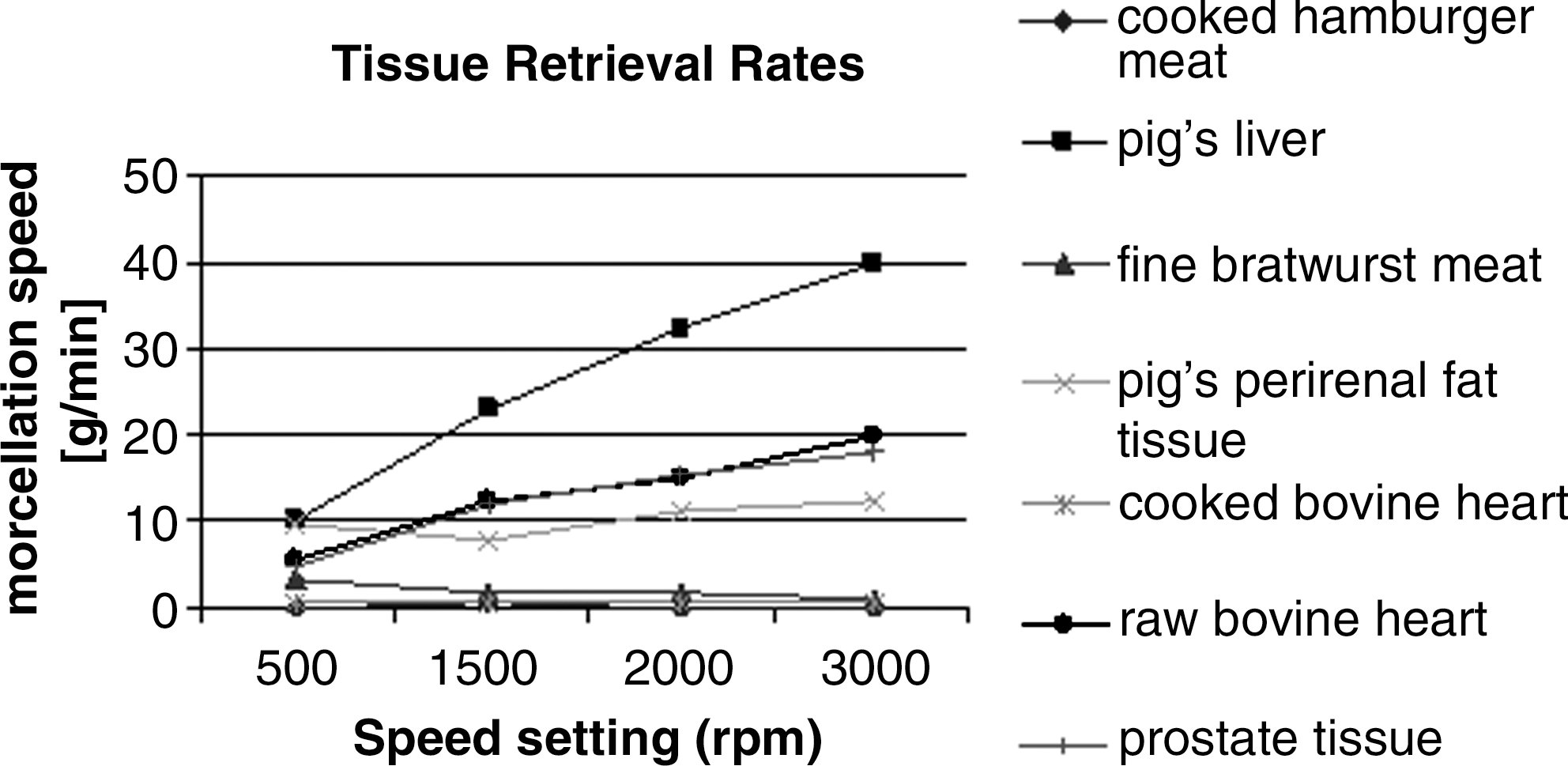
Retrieval rates of the different tissue samples depending on the speed setting of the morcellator.
Figure 2 illustrates the tissue retrieval rate of raw bovine heart and prostate tissue for different speed settings. The retrieval rate for prostate tissue also increased with higher speed settings. For the speed settings 500 rpm, 1500 rpm, and 2000 rpm, there was no statistical significance between the tissue retrieval rates for raw bovine heart and prostate tissue (exception: for 3000 rpm, the P value was <0.05). The difference of the retrieval rates with 500 rpm and 3000 rpm are significant (P=0.008) (Fig. 2).

Comparison of prostate tissue and raw bovine heart for different speed settings of the morcellator. *Indicates the statistical analysis with the Mann-Whitney-U Test.
Morcellator test
The morcellation rates of the tested devices, depending on the different speed settings, are shown in Table 1. The maximum morcellation rates achieved by the four different devices are shown in Figure 3. The Richard Wolf morcellators both achieve the highest morcellation rates with the greatest oscillation speed. The highest morcellation rate was achieved by the Richard Wolf prototype (P<0.001). The Piranha obtained the second best morcellation rate (P<0.001). The retrieval rates with the Lumenis VersaCut and the Karl Storz prototype were lower and similar (P=0.095).

Maximum morcellation rates of the tested devices.
Speed settings Lumenis VersaCut: 1=maximum oscillation speed/maximum suction power; 2=maximum oscillation speed/half suction power; 3=half oscillation speed/maximum suction power; 4=half oscillation speed/ half suction power.
Comparison of the four devices: P<0.001 (Kruskal-Wallis test).
rpm=revolutions per minute.
Discussion
Today, transurethral procedures represent competing treatment options for LUTS that are the result of large prostate adenomas. Independent of prostate size, HoLEP proved superior to TURP in randomized controlled studies with long-term follow-up data. 5 HoLEP takes longer to perform than open transvesical enucleation of the prostate, but important parameters, such as catheter time, hospital stay, and transfusion rate, favor the Holmium procedure. 6 Promising midterm follow-up data concerning thulium:yttrium-aluminium-garnet laser vapoenucleation of the prostate were reported by Bach and associates 7 recently. Both techniques need a transurethral device to evacuate large tissue pieces after the enucleation. The use of electric morcellators helped to reduce the overall operative time by reducing tissue evacuation time and therefore increased the mean tissue retrieval rates (grams per minute) for the complete procedure. 8,9
Two different morcellators are featured mainly in earlier publications: the VersaCut and the Piranha. Only Abrolat and colleagues 10 give the speed setting used for morcellation with the Piranha. They used the morcellator in oscillating mode at 550 to 575 rpm, having found this setting to be the most efficient in preliminary experiments (not described in detail). Gilling and coworkers 1 reported a significant difference in mean tissue retrieval rates when they used two different sizes of rotating knife with a modified arthroscopic shaver. Other authors give no detailed information about the setting used for the morcellator. 11 –13 The reported mean morcellation times range from 1 g/min 14 to 5 g/min. 10 Tan and Gilling 15 report that the morcellator can remove tissue at a rate of up to 10 g/min, although 3 to 5g /min is more usual, in their opinion.
Our newly developed ex-vivo model shows the technical possibility of removing up to 38.6 (35.3–42.9) g/min of prostate tissue. Of course, we had no need to watch out for the bladder wall, unlike during the clinical procedure. As complications, however, bladder wall lesions are actually very rare and do not usually interfere with the procedure. 15 Another risk during morcellation is what Vavassori BS and colleagues 16 have dubbed the “crazy ball” or “beach ball” effect. Fibrotic prostates especially have a risk to be formed into a tissue ball that is lost by the cutting window and hampers to be sucked again. There were no instances of this with our model: None of the pieces of chopped-up organic tissue or prostate formed themselves into a ball that could not be sucked in again. Low blade performance and potential tissue resistance from the presence of small fibrotic spheres can impair optimal tissue retrieval rates and result in the surgeon running the risk of cutting a crazy ball. 16
We observed that compact tissue, such as the cooked minced meat, bovine heart, and pork sausage meat, is difficult to morcellate because the tissue gets lost very easily when morcellation starts and has to be sucked up to the tip of the morcellator again. Suction is better at the lower speed settings, so tissue retrieval rates decrease at higher speeds. The softer tissues were easy to morcellate, and tissue retrieval rates increased at the higher settings. This knowledge may well help to reduce morcellation times in clinical practice and actually avoid the crazy ball effect in prostates with fibrotic tissue.
The morcellation properties of the raw bovine heart were the most similar to those of the prostate, and the results were reproducible. The tissue retrieval rate for both the raw bovine heart and the prostate increased at the higher speed settings. This suggests shorter morcellation times at higher speeds than those previously recommended. 10 The Karl Storz prototype achieves the highest morcellation rates not with the highest oscillation speed but with 2000 rpm. This might be because of a different suction procedure. The initial vacuum setup by the Richard Wolf pump facilitates the chopping up of the tissue while the permanent suction power by the Karl Storz pump seems to decrease with a higher oscillation speed than 2000 rpm. This might be because of the rotating blades that cover the cutting window more often and therefore interrupt the suction. The VersaCut achieved the maximum morcellation rate with half suction power. This enables more small movements of the tissue without being lost to the cutting window. These movements allow the blade for cutting another part of the tissue in the next oscillation cycle instead of being stucked with fibrotic tissue which we observed with maximum suction power (Table 1).
The limitations of this ex-vivo model have to do with the physical surroundings. The water tank does not have the same properties as the human bladder in terms of bladder load and bladder wall characteristics. We therefore cannot predict whether higher speed settings lead to higher bladder injury rates. The suction power of the pump, however, was only modified for the VersaCut and was used at the same setting as in clinical practice. Because the pump's suction power does not increase along with the speed of the rotating blades, there is no reason to expect more bladder injuries at higher speed settings. The suction power of the pump might even decrease with a higher oscillation speed, which should be evaluated in further studies.
Another limitation is the perfect view that this model provides for the surgeon, with no bleeding during the morcellation. This leads to easier conditions for morcellation than in clinical practice because the tissue can be followed by the device very easily and therefore sucked again immediately. Furthermore, prostate tissue offers a great variability from soft to fibrotic tissue. The reference prostate we used cannot reflect all possible tissue properties. We did, however, develop a tissue model with a standardized setting to test different morcellators and to evaluate their optimal configurations.
Conclusion
Raw bovine heart tissue is suitable for ex-vivo testing of prostate morcellators and can replace human prostate tissue to investigate the configurations of different morcellators under standardized conditions. The morcellation rates of the different morcellators can be increased with optimized oscillation speed and suction power settings. This needs to be confirmed in clinical studies.
Footnotes
Disclosure Statement
No competing financial interests exist.