




Abstract

Croes Council
Jean de la Rosette, M.D.
Amsterdam (The Netherlands)
Adrian Joyce, M.S.
Leeds (UK)
Stavros Gravas, M.D.
Larissa (Greece)
Margaret Pearle, M.D.
Dallas, TX (USA)
Dean Assimos, M.D.
Wake Forest, NC (USA)
Ying-Hao Sun, M.D.
Shanghai (China)
Tadashi Matsuda, M.D.
Osaka (Japan)
Treasurer
John Denstedt, M.D.
London (Canada)
Office Manager
Sonja van Rees Vellinga
Amsterdam (The Netherlands)
Mission
Through worldwide collaboration, CROES seeks to assess, using evidence based scientific methodology, the various aspects of clinical endourology.
Vision
By applying rigorous scientific evaluation to the field of clinical endourology, CROES will enable all urologic surgeons to bring to their patients the most effective and efficient care possible.
Projects
• Global PCNL study
• Global URS study
• Global Greenlight Laser study
• Global Renal Mass study
• Global NBI study
Contact
For more information please contact Sonja van Rees Vellinga (
An Update on Croes at the American Urological Association Annual Meeting
Sonja van Rees Vellinga and Jean de la Rosette
The Clinical Research Office of the Endourological Society (CROES) aims to promote and support high-quality international patient-centered research in a transparent way.
The CROES recognizes the importance of the active involvement and recognition of the participating centers. At the American Urological Association (AUA) Annual Meeting in Washington, D.C., all investigators who are participating in CROES studies were invited to join the investigators meeting at the Grand Hyatt Hotel. We invited all participants to discuss the state of the current projects and to exchange ideas on new studies in a friendly and relaxed setting. Almost 100 persons joined the reception regarding the update on all CROES projects. We would like to thank all participants for joining the meeting and present a short summary for those who were not able to attend.
Study Overview—Percutaneous Nephrolithotomy (PCNL)
The Global PCNL Study was the first study launched and, at present, data from 5803 patients who were treated in 96 centers have been analyzed. The value of the PCNL study is that it is a real-life study and demonstrates contemporary global practice in urinary stone management. The dataset provides significant insight on academic and community practice and covers all spectra from high to more restricted volume centers. These data allow us to assess the current indications, perioperative morbidity, and stone-free outcomes for PCNL worldwide. At the AUA Annual Meeting, a State-of-the-Art Lecture was given by Prof. Jean de la Rosette on the results of the CROES Global Study on PCNL.
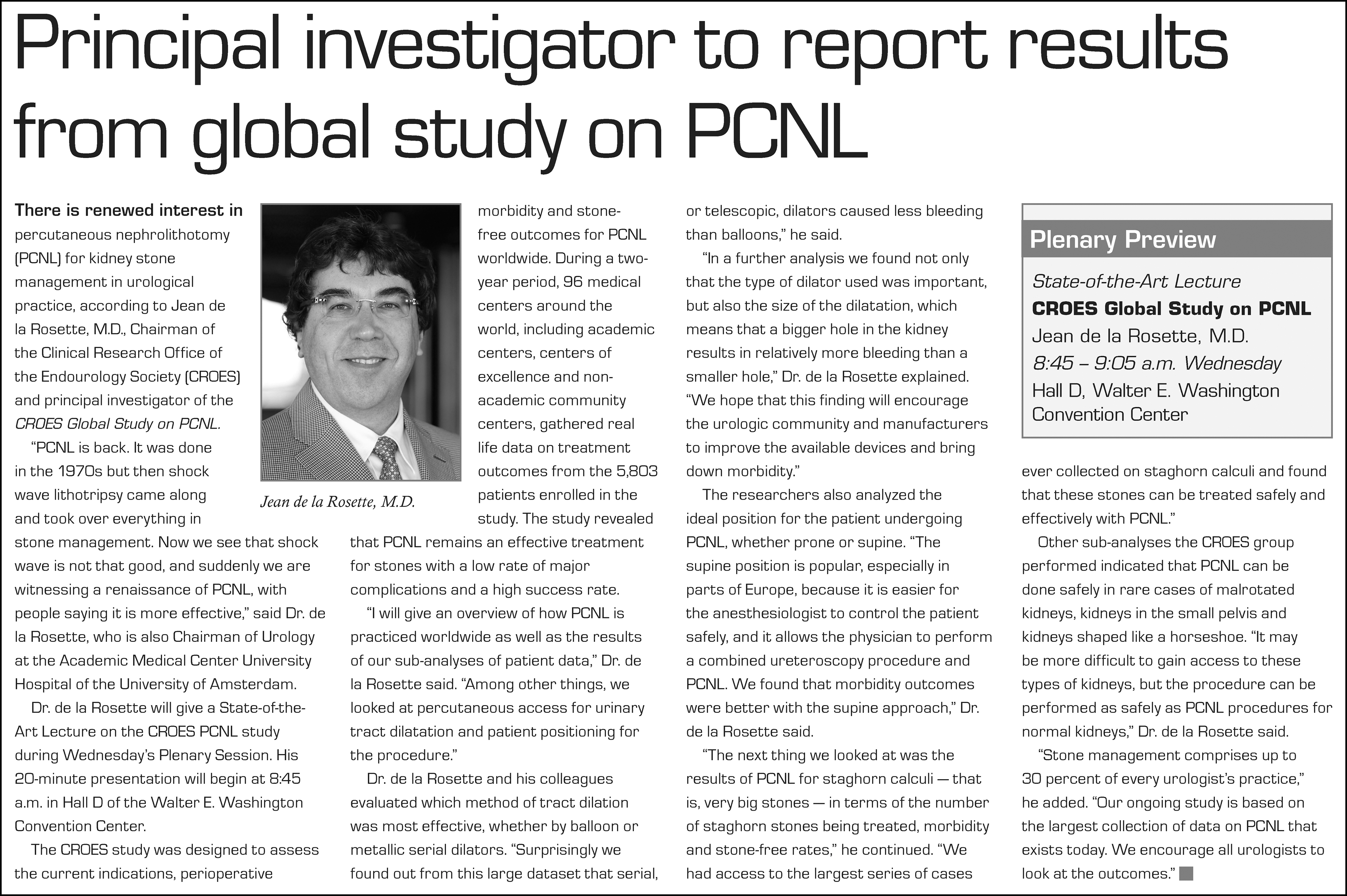
Currently, three articles have been published in the Journal of Endourology, 1,2 and five more articles have been accepted for publication. The conclusions of these articles and the new developments in PCNL were discussed at the investigators meeting. Overall, it was concluded that PCNL is safe and effective, has a high success rate, and has low complication rates. 1 The second article just published on the PCNL Study reports that balloon dilation is associated with a relatively longer operative time compared with telescopic dilators. 2 Furthermore, postoperative bleeding is associated with operative time, stone burden, and the size of the sheath used during PCNL, as described in a third article. 3
With regard to complications in PCNL, the majority are minor. Fever and postoperative bleeding are the most common. It appears that operative time and Anerican Society of Anesthesiologists score are predictors of the Clavien score in this study. Another article describes positioning and PCNL; PCNL performed in the prone position has a higher stone-free rate and shorter operative time compared with PCNL in the supine position. In a large series of staghorn stones, it appeared that operative time and complications are significantly higher in those patients. Also, renal malformations lead to longer operative times but have similar stone-free rates compared with normal kidneys. Patients with solitary kidneys have higher cardiovascular disease risk and need more postoperative transfusions. They have lower stone-free rates.
On the subject of renal malformations and solitary kidneys, two posters were presented at the AUA meeting. To view these in detail, please visit the CROES website:
Approximately 10 more articles will follow on the CROES PCNL Study. 4 The aim is to include each author in at least one of the articles. A complete overview of the different topics for analysis is presented on the CROES website. As announced at the CROES reception, we invite all participants in the PCNL Study to contact the CROES office with proposals for analysis. Each proposal will be carefully considered by the CROES office and the PCNL steering committee. If the proposal is feasible, the author can include up to four coauthors from his/her institution in the article.

Study Overview—Ureteroscopy (URS)
Three other projects were launched last year. These studies have been very well received, and in the Global URS Study, 5 approximately 150 sites have included more than 10,000 cases. The sites are located in 38 countries, of which India, Romania, Turkey, Italy, and the United States are contributing with large numbers. Also, new centers have signed up from countries such as Serbia, Singapore, and Iran, which broadens the network of CROES. In the URS Study, we will investigate possible (institutional) differences concerning indication for surgery, equipment used, and maybe outcomes. Moreover, specific factors may influence treatment-related morbidity. At the moment, the database consists of patients with a mean age of approximately 50 years. Most stones are ureteral stones, and about one quarter of the patients treated have renal stones. The type of URS most frequently performed is semirigid (around 75%). This study has been closed with regard to the recruitment of new centers, but the data collection for participating centers is ongoing. At the beginning of next year, we will start with the first analyses of the data.
Study Overview—Renal Mass
The Renal Mass Study 6 was launched in January 2010, and 120 centers have included more than 3000 cases. In this prospective study, we aim to assess on a global basis the indications, treatment modality, and outcomes of instrumental treatment for patients with renal masses, including radical or partial nephrectomy and ablative treatments. At the moment, the biggest contributions in number of cases come from countries such as Turkey, France, Czech Republic, and the United States. The mean age of the patients now included in the database is approximately 60 years, but a significant portion of younger patients is also included. The technique most frequently performed is still radical nephrectomy, but partial nephrectomy is often performed. In around 15% of the cases, an ablative therapy was used. Also, this study has been closed with regard to the recruitment of new centers, but the data collection for participating centers is ongoing. The first results are expected at the beginning of 2012.
Study Overview—Greenlight Laser
In the Global HPS Study, 7 we will study on a global basis the indications and outcomes of HPS Greenlight laser treatment for benign prostatic hyperplasia. This study closed for new centers in April 2011, and at the moment, 30 centers have included almost 800 patients. The countries that have included most patients are Japan, the Netherlands, Norway, and Greece. Also, for this study, data analysis will start when the study has closed in April 2012.

Study Overview—Narrow Band Imaging (NBI) Versus White Light
The first randomized study that compares the use of NBI in addition to white light cystoscopy in the management of nonmuscle-invasive bladder cancer is still open for new centers. 8 Close to 40 centers worldwide have accepted the challenge and randomize their cases according to a strict inclusion protocol during a 1-year period. At the AUA Annual Meeting, we discussed the progress of the study at the NBI investigators meeting. There is an active involvement from centers from Asia and Europe. We therefore especially invite centers from the United States to join in this prestigious project. This milestone project will open new avenues in endourologic research.
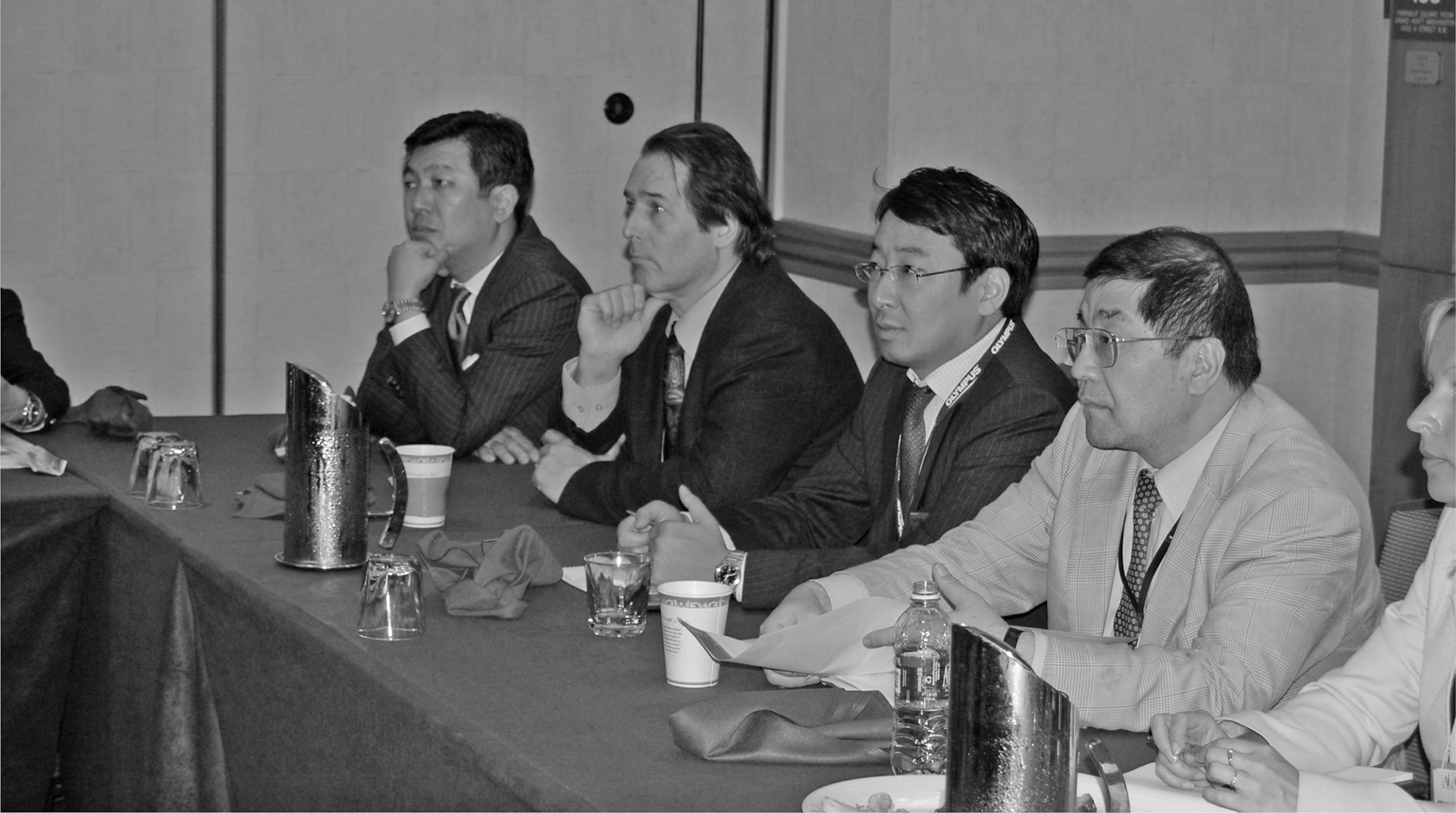
Last but not least, at the CROES investigators meeting. a new project was announced on Focal Therapy for Prostate Cancer.
We are proud to confirm that the response from many of you participating in the projects is full of enthusiasm. We would like to emphasize that all contributions, small or large, are highly appreciated. All feedback is welcome. and we invite you to contact the CROES office with new ideas and suggestions regarding ongoing studies and future projects. At the upcoming World Congress of Endourology in Japan, CROES is looking forward to presenting an update on the CROES projects.
All institutions are encouraged to become a member of the global endourology platform entitled CROES. CROES clearly states its philosophy. “The time is now—with CROES, the ability is yours.” 9